SAINIK SCHOOL REWARI
CLASS:XI
SUBJECT:ENGLISH
CHAPTER 7 (HORNBILL) : THE ADVENTURE
(JAYANT NARLIKAR)
PRESENTED BY:
ANUPRIYA PRIYADARSHI
PGT ENGLISH
About the author:
 Jayant Vishnu Narlikar (born 19 July 1938) is an
Indian astrophysicist and emeritus professor at the
Inter-University Centre for Astronomy and
Astrophysics.
 He developed with Sir Fred Hoyle the conformal
gravity theory, known as Hoyle–Narlikar theory. It
synthesises Albert Einstein's theory of relativity and
Mach's principle. It proposes that the inertial mass of
a particle is a function of the masses of all other
particles, multiplied by a coupling constant, which is
a function of cosmic epoch.
INTRODUCTION
• The chapter ‘The Adventure’ is a story about Professor
Gangadharpant Gaitonde who is strangely in a different
world. He knows it is Pune but the facts are different
from what he believes. He decided to go to Bombay via
train ‘Jijamata Express’. When he reached Bombay, things
were different. When he decides to investigate the
history, he finds some surprising facts. The East India
Company was still ruling and the Battle of Panipat had
been won by Marathas. It was different from what he
knew and had studied. The East India Company was
taken aback after events of 1857 and the Battle of
Panipat had been won by Mughals.
Summary:
• Professor Gaitonde was travelling from Pune to
Bombay via the Jijamata Express, a train which was
faster than the Deccan Queen. As he was crossing
towns and villages, he met a man named ‘Khan
Sahib’ who talked about his business and chatted
about several things. They got off at Victoria
Terminus station which was neat and clean. It had
British officers, Parsees and Anglo-Indian staff all
around. He was confused as to how the East India
Company was ruling the country as according to his
facts, they had fled away after the events of 1857.
• He went to the Hornby road and noticed that the
shops were different. He entered the Forbes
building and inquired about Mr. Vinay Gaitonde
but as checked by the receptionist, no such man
had ever worked there. He went to the Town Hall
and sat in the reading room. He took five books
related to the history and decided to go through
them one by one and check how the facts had
changed. He started investigating from the period
of Asoka to the third battle of Panipat.
• According to the fifth volume ‘Bhausahebanchi
Bakhar’, he found out that Marathas had won the
Battle of Panipat and spread their influence all over
India after that. He was confused as it was different
from what he knew so far. After the victory, India
was moved to the path of democracy. There were
no longer any kings ruling and democratic parties
had been set up. The professor started liking India
as he kept reading further about it. It was different
from the one he believed he saw. This country
knew how to stand on its feet and it was no longer
slave under the white man.
• As he was going through the book, the librarian
told him to finish since they were closing the
library. It was eight o clock. He asked about
carrying the books with him as he would return the
next morning and slipped the Bakhar book into his
left pocket. He checked into a guest house and had
his dinner. He decided to walk towards Azad
Maidan. He noticed a large crowd of people going
towards a pandal. A lecture was going on but he
noticed something unusual. The presidential chair
was empty. The speaker was talking and the crowd
was continuously moving inside and outside.
• He could not control himself and moved towards
the stage and sat on the chair. The crowd was
taken aback and started asking him to get up and
move away. He tried to talk to them but they
started throwing several objects at him such as
tomatoes, eggs, etc. Soon the crowd moved
towards him to push him away and he was
nowhere to be seen.
• Next, he woke up in a hospital bed and saw
Rajendra in front of him. He narrated the whole
sequence of events that took place and Rajendra
listened to him amazed. The professor was
confused as to where he was and if he had been
in a coma for the past two days. What was the
experience he just had, was it real or not.
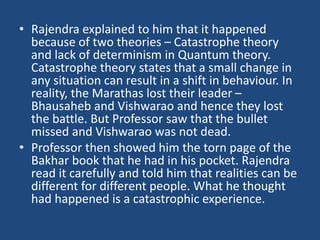
• Rajendra explained to him that it happened
because of two theories – Catastrophe theory
and lack of determinism in Quantum theory.
Catastrophe theory states that a small change in
any situation can result in a shift in behaviour. In
reality, the Marathas lost their leader –
Bhausaheb and Vishwarao and hence they lost
the battle. But Professor saw that the bullet
missed and Vishwarao was not dead.
• Professor then showed him the torn page of the
Bakhar book that he had in his pocket. Rajendra
read it carefully and told him that realities can be
different for different people. What he thought
had happened is a catastrophic experience.
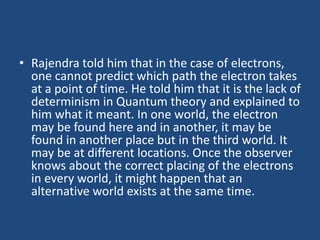
• Rajendra told him that in the case of electrons,
one cannot predict which path the electron takes
at a point of time. He told him that it is the lack of
determinism in Quantum theory and explained to
him what it meant. In one world, the electron
may be found here and in another, it may be
found in another place but in the third world. It
may be at different locations. Once the observer
knows about the correct placing of the electrons
in every world, it might happen that an
alternative world exists at the same time.
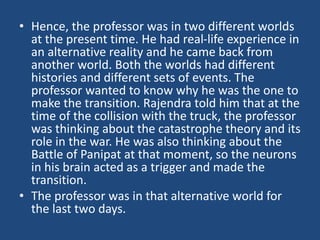
• Hence, the professor was in two different worlds
at the present time. He had real-life experience in
an alternative reality and he came back from
another world. Both the worlds had different
histories and different sets of events. The
professor wanted to know why he was the one to
make the transition. Rajendra told him that at the
time of the collision with the truck, the professor
was thinking about the catastrophe theory and its
role in the war. He was also thinking about the
Battle of Panipat at that moment, so the neurons
in his brain acted as a trigger and made the
transition.
• The professor was in that alternative world for
the last two days.
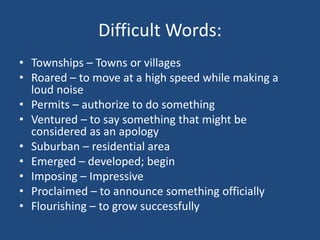
Difficult Words:
• Townships – Towns or villages
• Roared – to move at a high speed while making a
loud noise
• Permits – authorize to do something
• Ventured – to say something that might be
considered as an apology
• Suburban – residential area
• Emerged – developed; begin
• Imposing – Impressive
• Proclaimed – to announce something officially
• Flourishing – to grow successfully
• Converged – met
• Precise – exact; accurate
• Triumphant – Successful
• Blow – by – blow account – a detailed account
• Avidly – with great interest
• Morale booster – anything which boosts self-
confidence
• Supremacy – the condition of being superior to
others
• Expansionist – a follower of the policy of territorial
or economic expansion
11 THE ADVENTURE'.pptx

11 THE ADVENTURE'.pptx

  • 1.
    SAINIK SCHOOL REWARI CLASS:XI SUBJECT:ENGLISH CHAPTER7 (HORNBILL) : THE ADVENTURE (JAYANT NARLIKAR) PRESENTED BY: ANUPRIYA PRIYADARSHI PGT ENGLISH
  • 2.
    About the author: Jayant Vishnu Narlikar (born 19 July 1938) is an Indian astrophysicist and emeritus professor at the Inter-University Centre for Astronomy and Astrophysics.  He developed with Sir Fred Hoyle the conformal gravity theory, known as Hoyle–Narlikar theory. It synthesises Albert Einstein's theory of relativity and Mach's principle. It proposes that the inertial mass of a particle is a function of the masses of all other particles, multiplied by a coupling constant, which is a function of cosmic epoch.
  • 3.
    INTRODUCTION • The chapter‘The Adventure’ is a story about Professor Gangadharpant Gaitonde who is strangely in a different world. He knows it is Pune but the facts are different from what he believes. He decided to go to Bombay via train ‘Jijamata Express’. When he reached Bombay, things were different. When he decides to investigate the history, he finds some surprising facts. The East India Company was still ruling and the Battle of Panipat had been won by Marathas. It was different from what he knew and had studied. The East India Company was taken aback after events of 1857 and the Battle of Panipat had been won by Mughals.
  • 4.
    Summary: • Professor Gaitondewas travelling from Pune to Bombay via the Jijamata Express, a train which was faster than the Deccan Queen. As he was crossing towns and villages, he met a man named ‘Khan Sahib’ who talked about his business and chatted about several things. They got off at Victoria Terminus station which was neat and clean. It had British officers, Parsees and Anglo-Indian staff all around. He was confused as to how the East India Company was ruling the country as according to his facts, they had fled away after the events of 1857.
  • 5.
    • He wentto the Hornby road and noticed that the shops were different. He entered the Forbes building and inquired about Mr. Vinay Gaitonde but as checked by the receptionist, no such man had ever worked there. He went to the Town Hall and sat in the reading room. He took five books related to the history and decided to go through them one by one and check how the facts had changed. He started investigating from the period of Asoka to the third battle of Panipat.
  • 6.
    • According tothe fifth volume ‘Bhausahebanchi Bakhar’, he found out that Marathas had won the Battle of Panipat and spread their influence all over India after that. He was confused as it was different from what he knew so far. After the victory, India was moved to the path of democracy. There were no longer any kings ruling and democratic parties had been set up. The professor started liking India as he kept reading further about it. It was different from the one he believed he saw. This country knew how to stand on its feet and it was no longer slave under the white man.
  • 7.
    • As hewas going through the book, the librarian told him to finish since they were closing the library. It was eight o clock. He asked about carrying the books with him as he would return the next morning and slipped the Bakhar book into his left pocket. He checked into a guest house and had his dinner. He decided to walk towards Azad Maidan. He noticed a large crowd of people going towards a pandal. A lecture was going on but he noticed something unusual. The presidential chair was empty. The speaker was talking and the crowd was continuously moving inside and outside.
  • 8.
    • He couldnot control himself and moved towards the stage and sat on the chair. The crowd was taken aback and started asking him to get up and move away. He tried to talk to them but they started throwing several objects at him such as tomatoes, eggs, etc. Soon the crowd moved towards him to push him away and he was nowhere to be seen. • Next, he woke up in a hospital bed and saw Rajendra in front of him. He narrated the whole sequence of events that took place and Rajendra listened to him amazed. The professor was confused as to where he was and if he had been in a coma for the past two days. What was the experience he just had, was it real or not.
  • 9.
    • Rajendra explainedto him that it happened because of two theories – Catastrophe theory and lack of determinism in Quantum theory. Catastrophe theory states that a small change in any situation can result in a shift in behaviour. In reality, the Marathas lost their leader – Bhausaheb and Vishwarao and hence they lost the battle. But Professor saw that the bullet missed and Vishwarao was not dead. • Professor then showed him the torn page of the Bakhar book that he had in his pocket. Rajendra read it carefully and told him that realities can be different for different people. What he thought had happened is a catastrophic experience.
  • 10.
    • Rajendra toldhim that in the case of electrons, one cannot predict which path the electron takes at a point of time. He told him that it is the lack of determinism in Quantum theory and explained to him what it meant. In one world, the electron may be found here and in another, it may be found in another place but in the third world. It may be at different locations. Once the observer knows about the correct placing of the electrons in every world, it might happen that an alternative world exists at the same time.
  • 11.
    • Hence, theprofessor was in two different worlds at the present time. He had real-life experience in an alternative reality and he came back from another world. Both the worlds had different histories and different sets of events. The professor wanted to know why he was the one to make the transition. Rajendra told him that at the time of the collision with the truck, the professor was thinking about the catastrophe theory and its role in the war. He was also thinking about the Battle of Panipat at that moment, so the neurons in his brain acted as a trigger and made the transition. • The professor was in that alternative world for the last two days.
  • 12.
    Difficult Words: • Townships– Towns or villages • Roared – to move at a high speed while making a loud noise • Permits – authorize to do something • Ventured – to say something that might be considered as an apology • Suburban – residential area • Emerged – developed; begin • Imposing – Impressive • Proclaimed – to announce something officially • Flourishing – to grow successfully
  • 13.
    • Converged –met • Precise – exact; accurate • Triumphant – Successful • Blow – by – blow account – a detailed account • Avidly – with great interest • Morale booster – anything which boosts self- confidence • Supremacy – the condition of being superior to others • Expansionist – a follower of the policy of territorial or economic expansion