UTTARAKHAND PUBLIC SCHOOL
C.B.S.E
SESSION: - 2022-23
English (301)
Project File
Name: AYUSH KUMAR
Class: XI - B
Roll No: 10
CERTIFICATE
This is to certify that the project report titled “Ancient Egypt”
is a bona fide work carried out and successfully completed by
AYUSH KUMAR of Class: XI-B of “Uttarakhand Public School”,
Sector 56, Noida for the fulfillment of the ASL project work.
Principal’s Signature
Subject Teacher’s Signature
ACKNOWLEDGMENT
A project is a golden opportunity for learning and self-
development. I consider myself fortunate and privileged to
have such a wonderful mentor’s guide through the journey to
the completion of the project.
My heartful gratitude to my teacher and guide, Ms.
Suchismita for her patience and belief in me. Her exemplary
investment in the complete process, constant encouragement,
and insightful feedback helped me to achieve my objective.
I would also like to thank my parents for encouraging me
during the course of this project. Finally, I would like to thank
CBSE for giving me this opportunity to undertake this project.
Bibliography
Ancient Egyptian Agriculture
https://www.fao.org › country-showcase › item-detail
Education in the earliest civilizations - Encyclopedia
Britannica
https://www.britannica.com › topic › Education-in-the-ear...
Trade in Ancient Egypt - World History Encyclopedia
https://www.worldhistory.org › article › trade-in-ancien..
Ancient Egyptian Science & Technology
https://www.worldhistory.org › article › ancient-egyptia...
Ancient Egyptian History for Kids: Hieroglyphics -
Ducksters
https://www.ducksters.com › history › ancient_egyptian..
I)Everyday life in Ancient Egypt
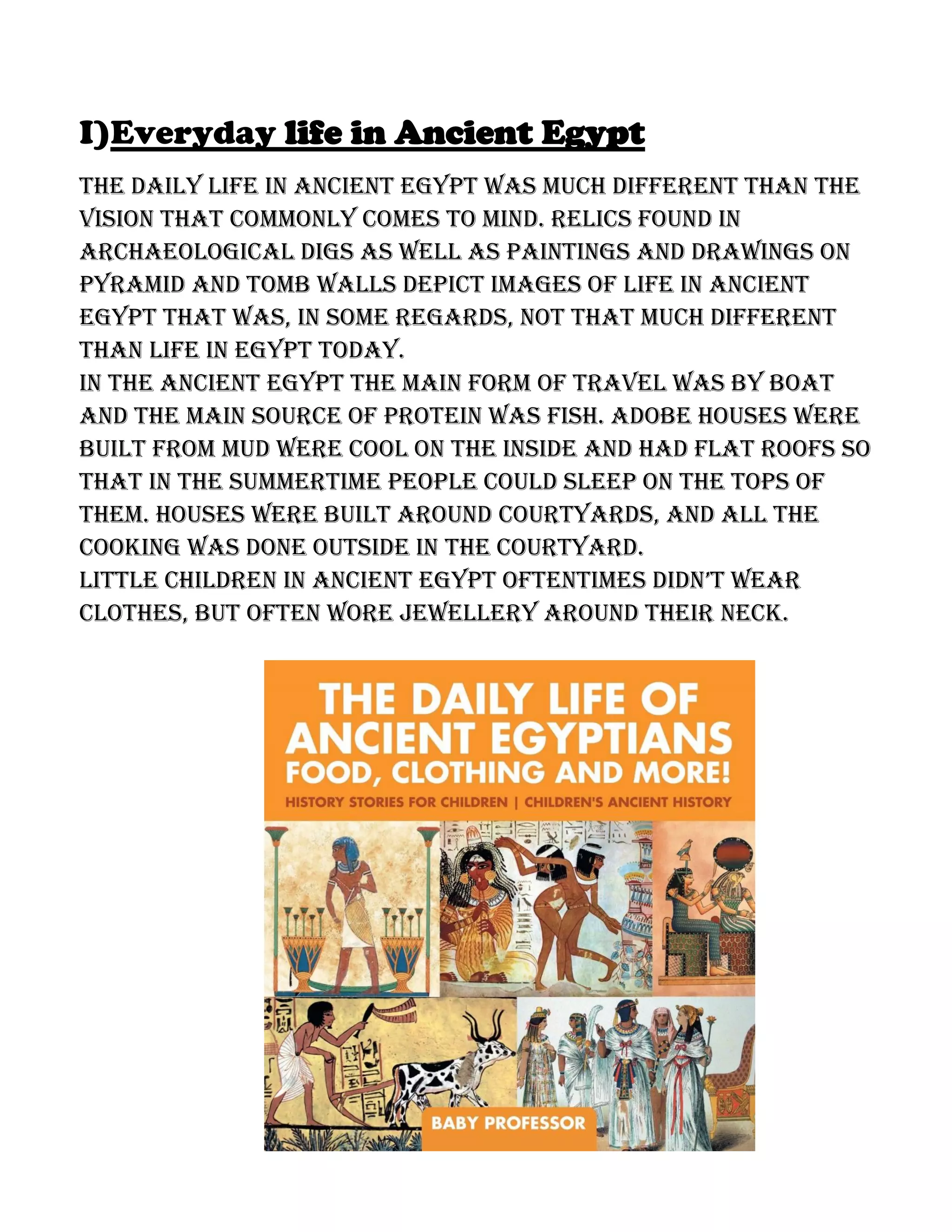
The daily life in ancient Egypt was much different than the
vision that commonly comes to mind. Relics found in
archaeological digs as well as paintings and drawings on
pyramid and tomb walls depict images of life in ancient
Egypt that was, in some regards, not that much different
than life in Egypt today.
In the ancient Egypt the main form of travel was by boat
and the main source of protein was fish. Adobe houses were
built from mud were cool on the inside and had flat roofs so
that in the summertime people could sleep on the tops of
them. Houses were built around courtyards, and all the
cooking was done outside in the courtyard.
LittLe chiLdren in ancient egypt oftentimes didn’t wear
clothes, but often wore jewellery around their neck.
II)Agriculture in ancient Egypt
Egyptians are credited as being one of the first groups of
people to practice agriculture on a large scale. This was
possible because of the ingenuity of the Egyptians as they
developed basin irrigation. Their farming practices
allowed them to grow staple food crops, especially grains
such as wheat and barley, and industrial crops, such as
flax and papyrus. They excelled in horticulture.
The Egyptian grew a variety of crops for consumption,
including grains, vegetables, and fruits. However, their
diets revolved around several staple crops, especially
cereals and barley. Other major crops grains grown
included einkorn wheat and emmer wheat, grown to make
bread. Other staples for majority of the population
includes beans, lentils, and later chickpeas and fava
beans. Root crops, such as onions, garlic and radishes were
also grown, along with salad crops, such as lettuce and
parsley.
Fruits were a common motif of Egyptian artwork,
suggesting that their growth was also a major focus of
agricuLturaL efforts as the civiLization’s agricuLturaL
technology developed.
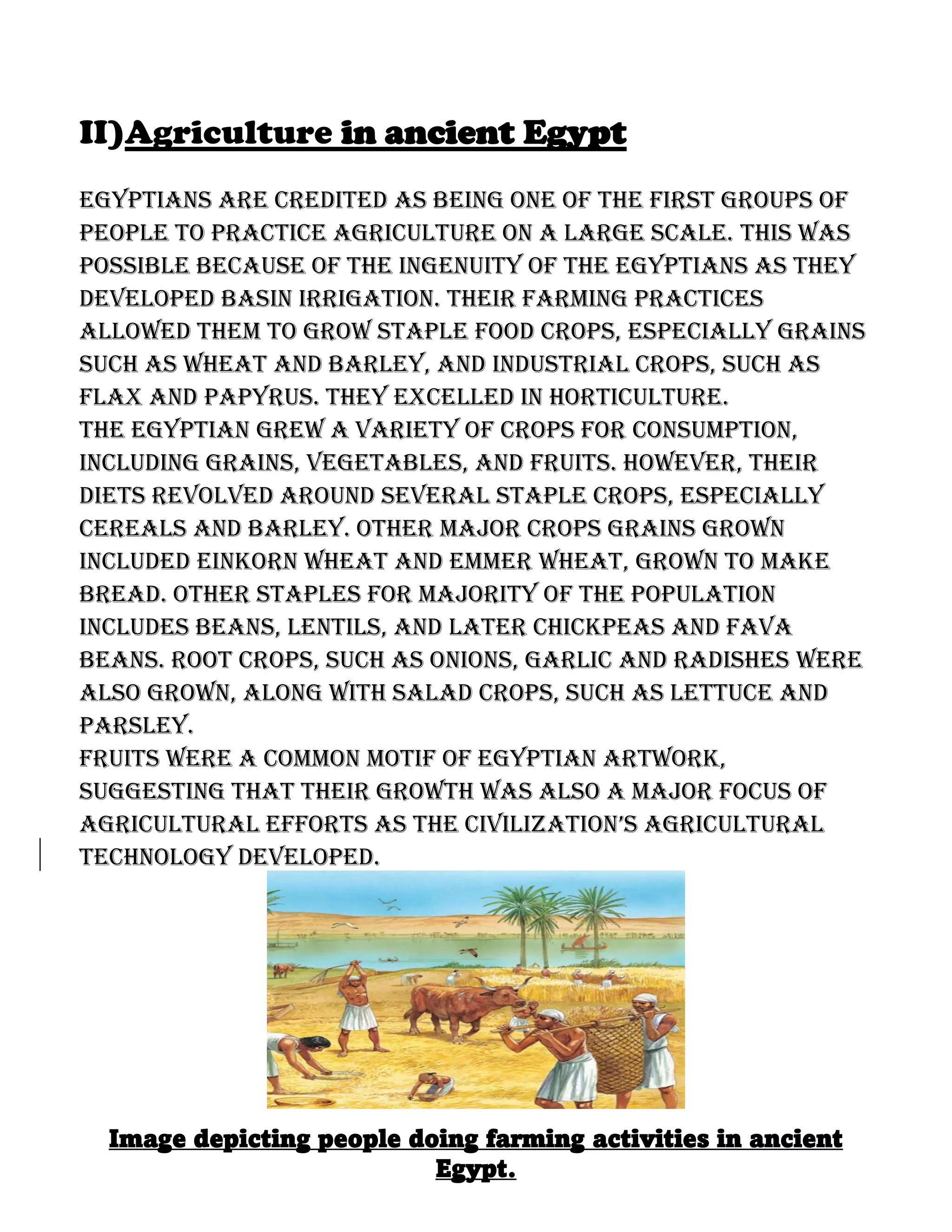
Image depicting people doing farming activities in ancient
Egypt.
III)Trade Activities in Ancient Egypt
Ancient Egyptian trade included contact with Syria in the
5th century BCE, and importation of pottery and
construction ideas from Canaan in the 4th century BCE. By
this time, shipping was common, and the donkey, camel, and
horse were domesticated and used for transportation.
Lebanese cedar has been found in the tombs of Nekhen,
dated to the Naqada I and II periods. Egyptians during this
period also imported obsidian from Ethiopia, gold, and
incense from Nubia in the south, oil jugs from Palestine, and
other goods from the oases of the western desert and the
cultures of the eastern Mediterranean. Egyptian
artifacts from this era have been found in Canaan and
parts of the former Mesopotamia. In the latter half of the
4th century BCE, the gemstone lapis lazuli was being
imported from Badakhshan (modern-day Afghanistan).
Just before the First Dynasty, Egypt had a colony in
southern Canaan that produced Egyptian pottery for
export to Egypt. In the Second Dynasty, Byblos provided
quality timber that could not be found in Egypt. By the
Fifth Dynasty, trade with Punt gave Egyptians gold,
aromatic resins, ebony, ivory, and wild animals. Egypt also
traded with Anatolia for tin and copper to make bronze.
Mediterranean trading partners provided olive oil and
other fine goods.
Egypt commonly exported grain, gold, linen, papyrus, and
finished goods, such as glass and stone objects.
A well-travelled land route from the Nile to the Red Sea
crossed through the Wadi Hammamat and was known from
predynastic times. This route allowed travellers to move
from Thebes to the Red Sea port of Elim and led to the rise
of ancient cities.
Another route, the Darb el-Arbain, was used from the time
of the Old Kingdom of Egypt to trade gold, ivory, spices,
wheat, animals, and plants. This route passed through
Kharga in the south and Asyut in the north and was a major
route between Nubia and Egypt.
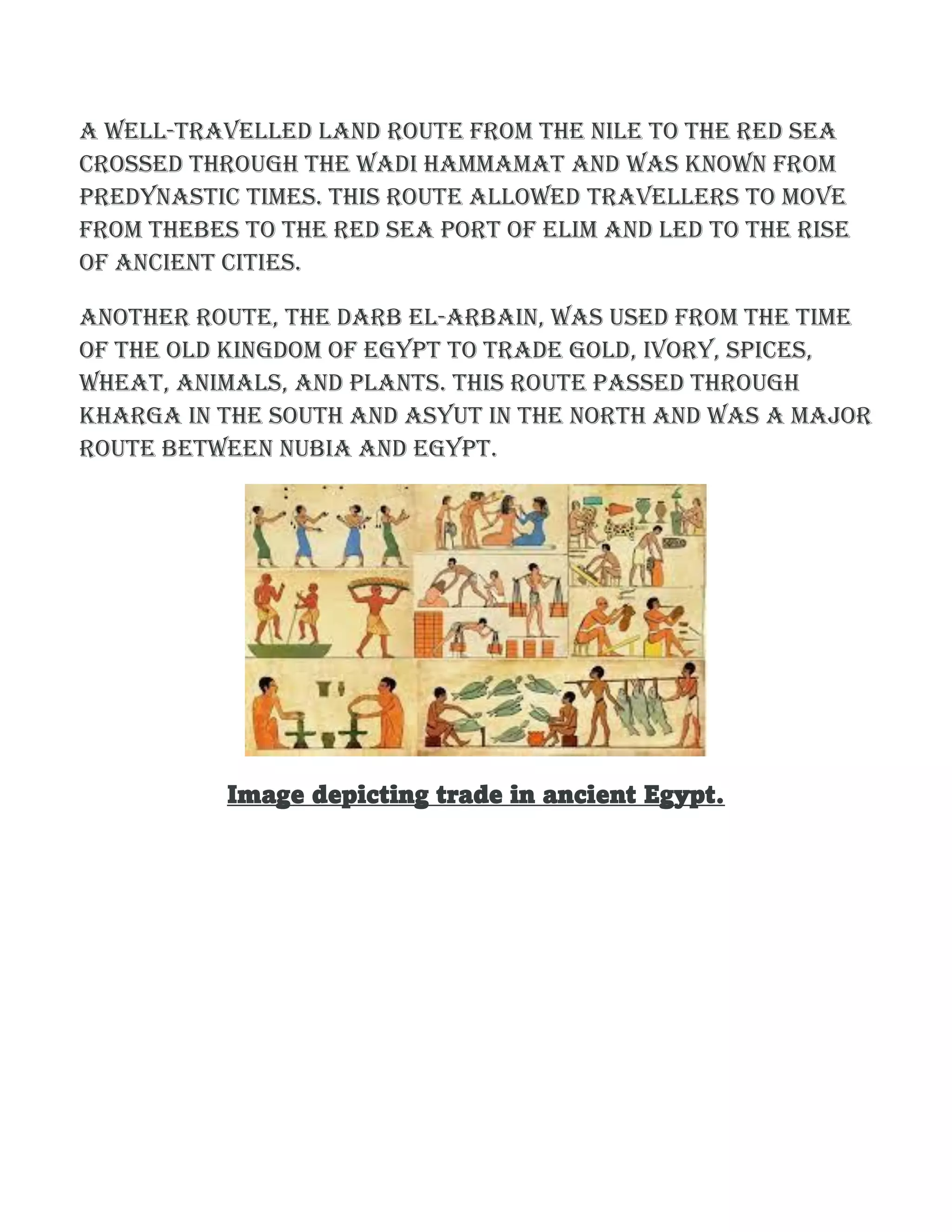
Image depicting trade in ancient Egypt.
IV)About Education in Ancient Egypt
Egyptian culture and education were preserved and controlled
chiefly by the priests, a powerful intellectual elite in the Egyptian
theocracy who also served as the political bulwarks by preventing
cultural diversity. The humanities as well as such practical
subjects as science, medicine, mathematics, and geometry were in
the hands of the priests, who taught in formal schools. Vocational
skills relating to such fields as architecture, engineering.
Egyptians developed two types of formal schools for privileged
youth under the supervision of governmental officials and priests:
one for scribes and the other for priest trainees. At the age of 5,
pupils entered the writing school and continued their studies in
reading and writing until the age of 16 or 17. At the age of 13 or 14
the schoolboys were also given practical training in offices for
which they were being prepared. Priesthood training began at the
temple college, which boys entered at the age of 17; the length of
training depending upon the requirements for various priestly
offices. Rigid method and severe discipline were applied to achieve
uniformity in cultural transmission, since deviation from the
traditional pattern of thought was strictly prohibited. Egyptians
also used a work-study method in the final phase of the training for
scribes.
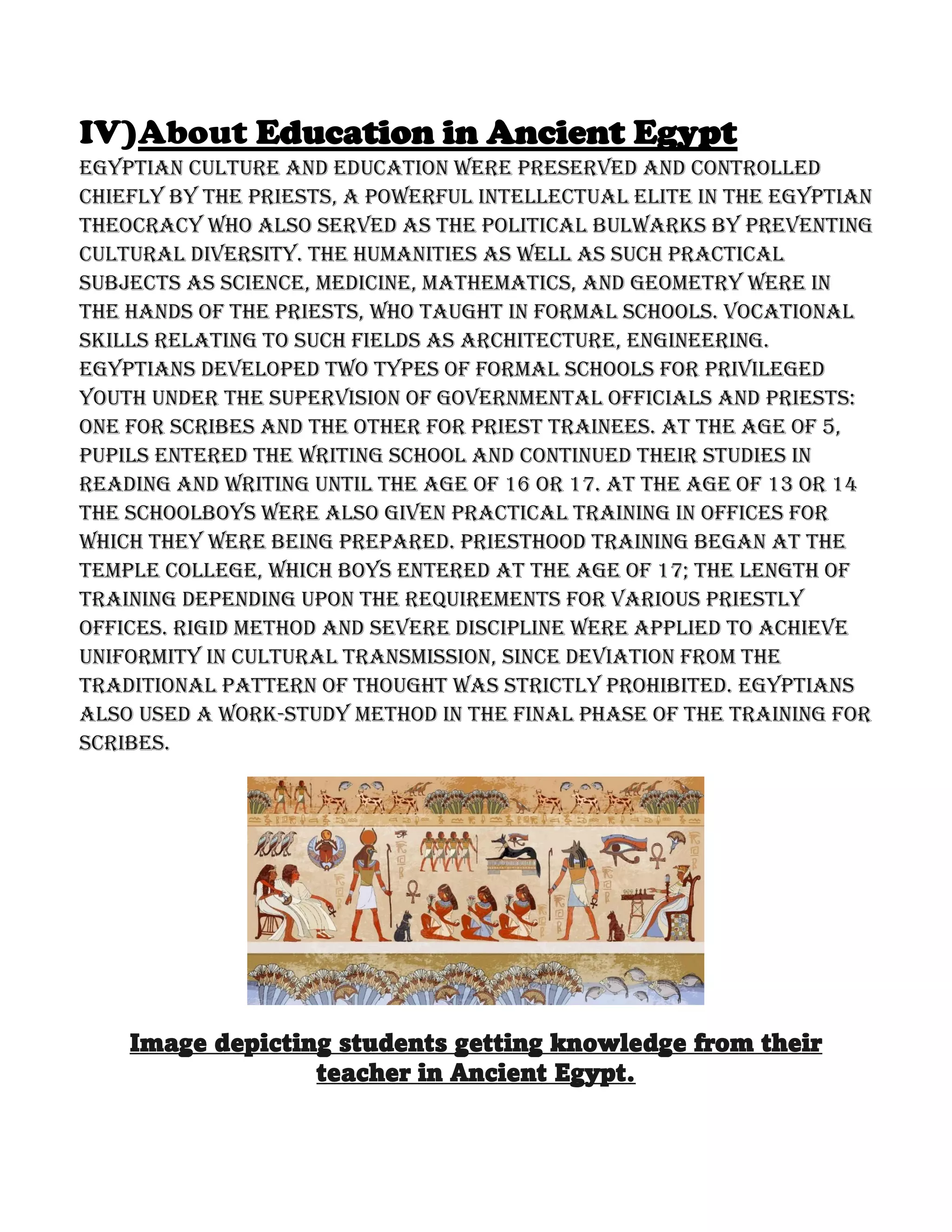
Image depicting students getting knowledge from their
teacher in Ancient Egypt.
V)Writings in ancient Egypt
Ancient Egyptian writing is known as hieroglyphics ('sacred
carvings') and developed at some point prior to the Early
Dynastic Period (c. 3150 -2613 BCE). According to some
scholars, the concept of the written word was first
developed in Mesopotamia and came
to Egypt through trade. While there certainly was cross-
cultural exchange between the two
regions, Egyptian hieroglyphics are completely Egyptian in
origin; there is no evidence of early writings which describe
non-Egyptian concepts, places, or objects, and early
Egyptian pictographs have no correlation to early
Mesopotamian signs. The designation 'hieroglyphics' is
a Greek word; the Egyptians referred to
their writing as medu-netjer, 'the god's words,' as they
believed writing had been given to them by the great
god Thoth.
Sometime in the latter part of the Predynastic Period in
Egypt (c. 6000 - c. 3150 BCE), the people began to use
symbols to represent simple concepts. People used symbols,
pictures to represent concepts such as a person or event.
The problem with a pictogram, however, is that the
information it contains is quite limited. Hieroglyphics was
developed out of the early pictographs
Hieroglyphics continued to be used throughout Egypt's
history in all forms of writing but came primarily to be the
script of monuments and temples. Hieroglyphics, grouped in
their beautifully formed rectangles, leant themselves to
the grandeur of monumental inscriptions. Hieratic came to
be used first in religious texts but then in other areas such
as business administration, magical texts, personal and
business letters, and legal documents such as wills and
court records. Hieratic was written on papyrus or ostraca
and practiced on stone and wood. It developed into a
cursive script around 800 BCE (known as 'abnormal
hieratic') and then was replaced c. 700 BCE by demotic
script.
Demotic script ('popular writing') was used in every kind of
writing while hieroglyphics continued to be the script of
monumental inscriptions in stone. The Egyptians called
demotic sekh-shat, 'writing for documents,' and it became
the most popular for the next 1,000 years in all kinds of
written works. Demotic script seems to have originated in
the Delta region of Lower Egypt and spread south during
the 26th Dynasty of the Third Intermediate period (c. 1069-
525 BCE).
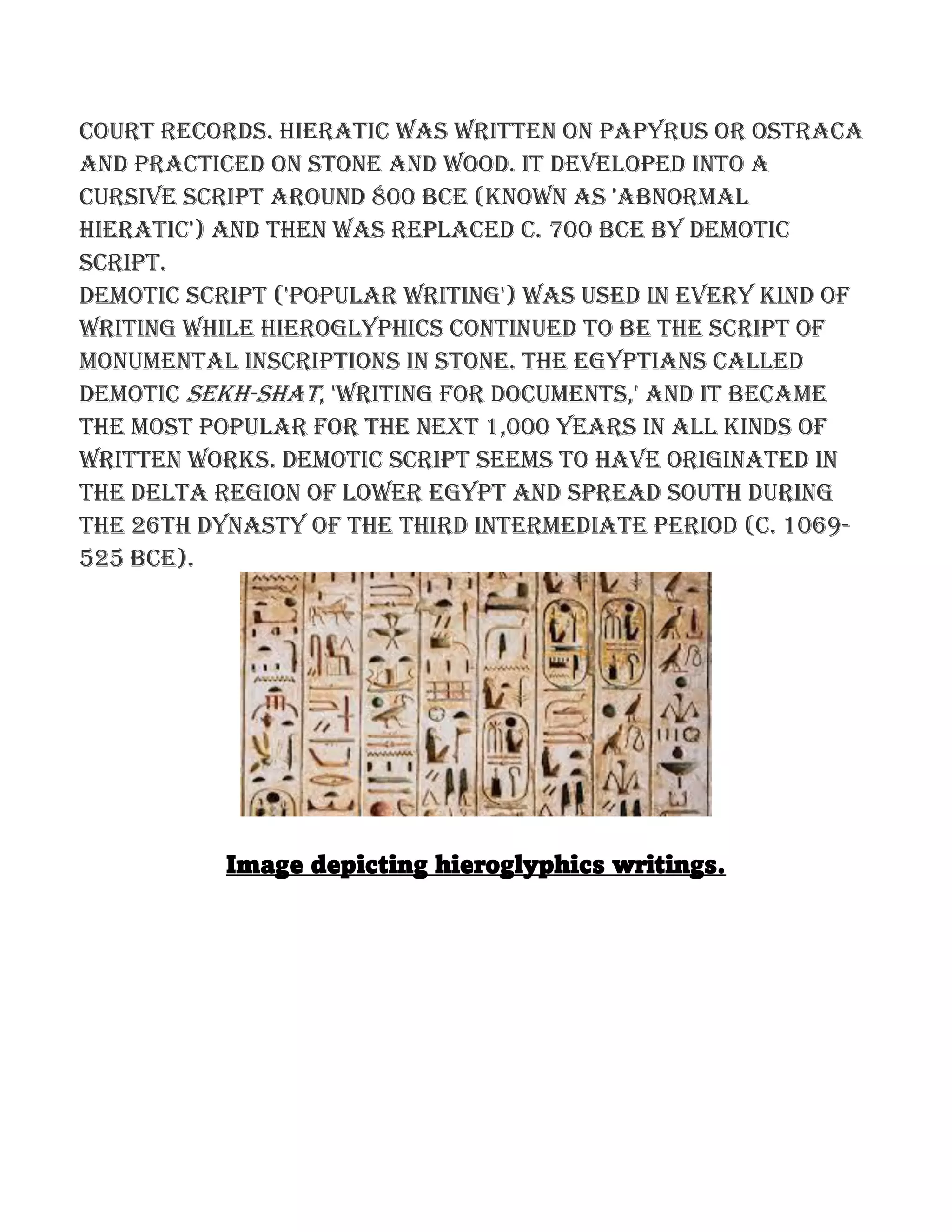
Image depicting hieroglyphics writings.
VI)About Technology in Ancient Egypt
A) Old Kingdom (c. 2613 BCE - 2181 BCE) and the First
Intermediate Period (2181-2040 BCE)
The Old Kingdom is sometimes referred to as the ''Age of the
Pyramids''. Some of Egypt's most famous landmarks were
built in this period, including the Pyramids of Giza. Scholars
disagree about how exactly these enormously
sophisticated monuments were created given the evidence
that we have about the
technology that existed at the time.
What we do know is that the Pyramids of Giza are a set of
three pyramids built as funerary temples for three kings.
The tallest of these pyramids, known as the Great Pyramid
of Giza was built for a king name Khufu and originally
stood approximately 480 feet tall. Archaeologists
estimate that it took 20,000 workers 20 years to build this
pyramid alone. Experts believe that they used wooden
machines and ramps to haul and stack over 2 million stones
to build the structure of the pyramid. The finishing touch
was an outer layer of gleaming white limestone. It was
almost perfectly level and was the tallest structure in
the world until the Eiffel Tower was built in France in 1887.
B) Middle Kingdom (c.2040 - c.1782 BCE) and the Second
Intermediate Period (c. 1782 - c. 1570 BCE)
The Middle Kingdom is also referred to as the ''classical
era'' of Egypt because it was when the civilization's wealth
and culture reached dazzling new heights. It was during
this era that the Temple of Karnak was constructed. This
temple, built to honor the god Amun, is arguably the
largest religious structure in the world. Technology also
had secular purposes. Egyptians continued to work to
control the flow of water to aid in farming and used water
pumps and canals in this period. The wheel, which was
introduced to Egypt when the Hyksos people arrived, also
represented a technological leap forward and made
possible the potter's wheel and the chariot.
C)New Kingdom (c. 1570 - c. 1069 BCE)
During the New Kingdom, a powerful central government
ruled over Egypt, led by a king known as a pharaoh. Some
of these powerful pharaohs were buried in the Valley of
the Kings in elaborate tombs. Egyptians also made great
advancements in this era in medicine, including fields such
as dentistry. Ancient Egyptians would have been familiar
with toothbrushes and an early version of toothpaste. In
addition, while knowledge of how to make transparent
glass had existed in previous eras, Egypt during the New
Kingdom made glass on a mass scale and perfected
techniques to add colour to it. It was especially sought
after for making a coloured glaze on beads. New metals
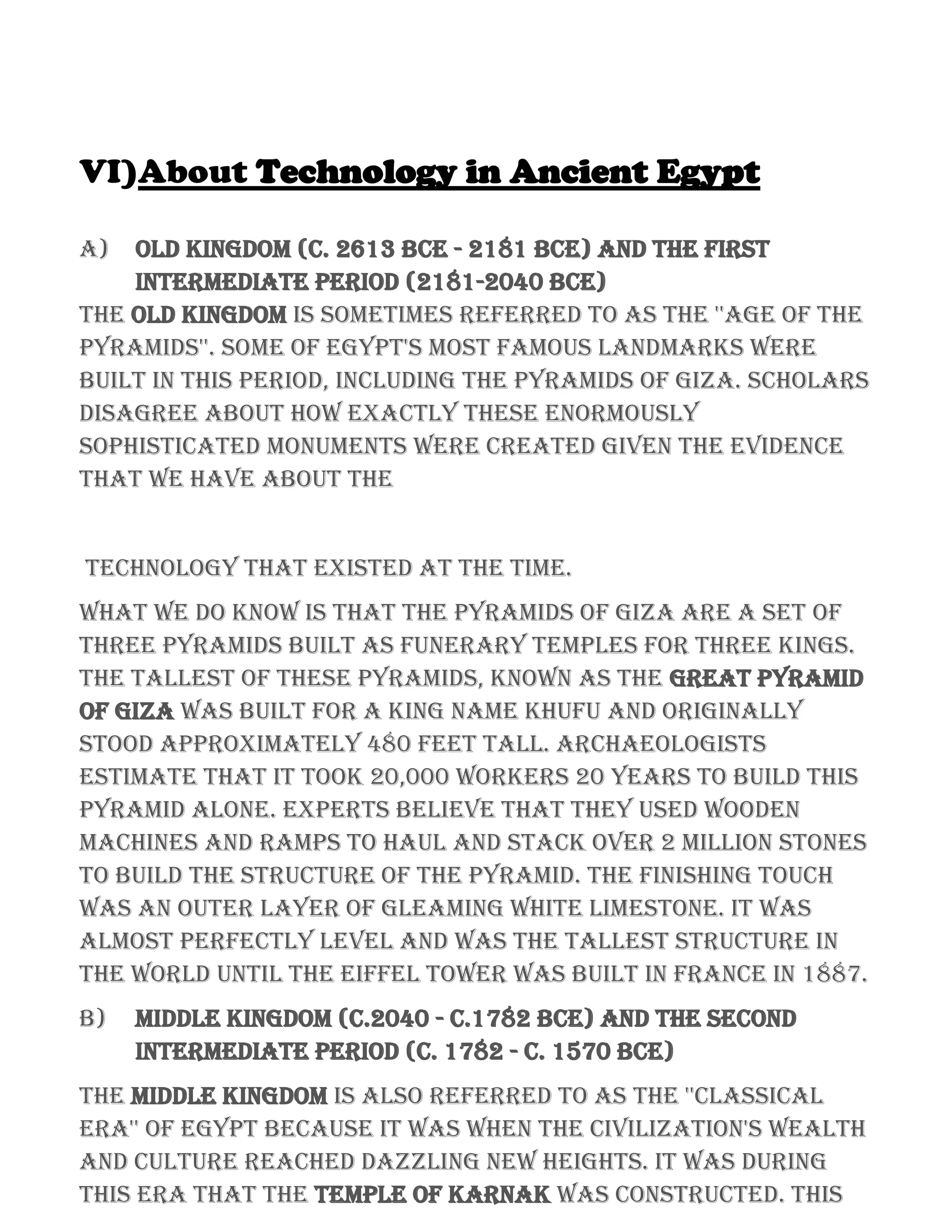
such as bronze were also available in Egypt in that era.
Image depicting makeup tools developed in Ancient Egypt.
VII)About Arts in Ancient Egypt
Ancient Egyptian art refers to art produced in ancient
Egypt between the 6th millennium BC and the
4th century AD, spanning from Prehistoric Egypt until the
Christianization of Roman Egypt. It includes paintings,
sculptures, drawings on papyrus, faience, jewelry, ivories,
architecture, and other art media. It is also very
conservative: the art style changed very little over time.
Much of the surviving art comes from tombs and monuments,
giving more insight into the ancient Egyptian afterlife
beliefs.
The ancient Egyptian language had no word for "art".
Artworks served an essentially functional purpose that
was bound with religion and ideology. To render a subject in
art was to give it permanence. Therefore, ancient Egyptian
art portrayed an idealized, unrealistic view of the world.
There was no significant tradition of individual artistic
expression since art served a wider and cosmic purpose of
maintaining order (Ma'at).
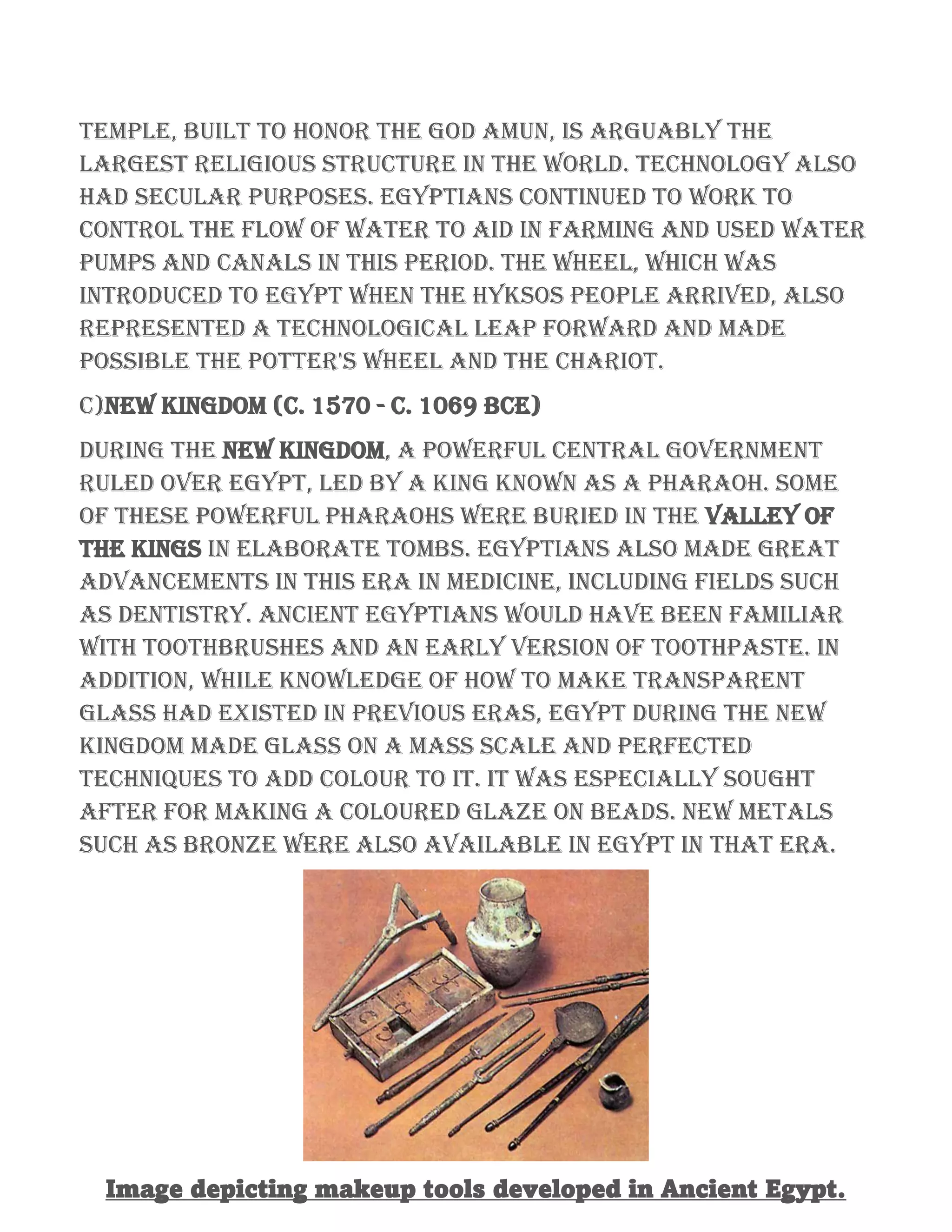
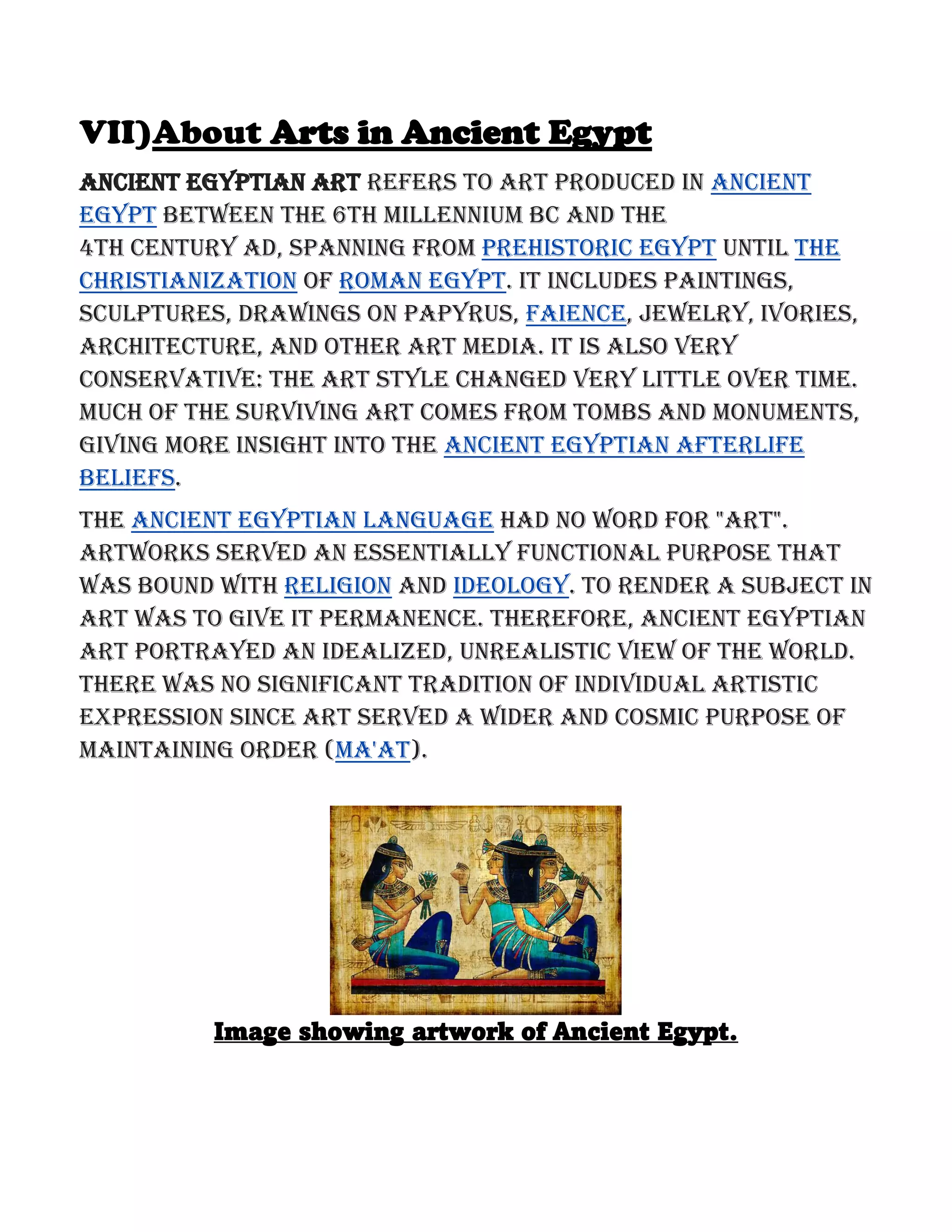
Image showing artwork of Ancient Egypt.
VIII)About Famous Pharaohs in Ancient
Egypt
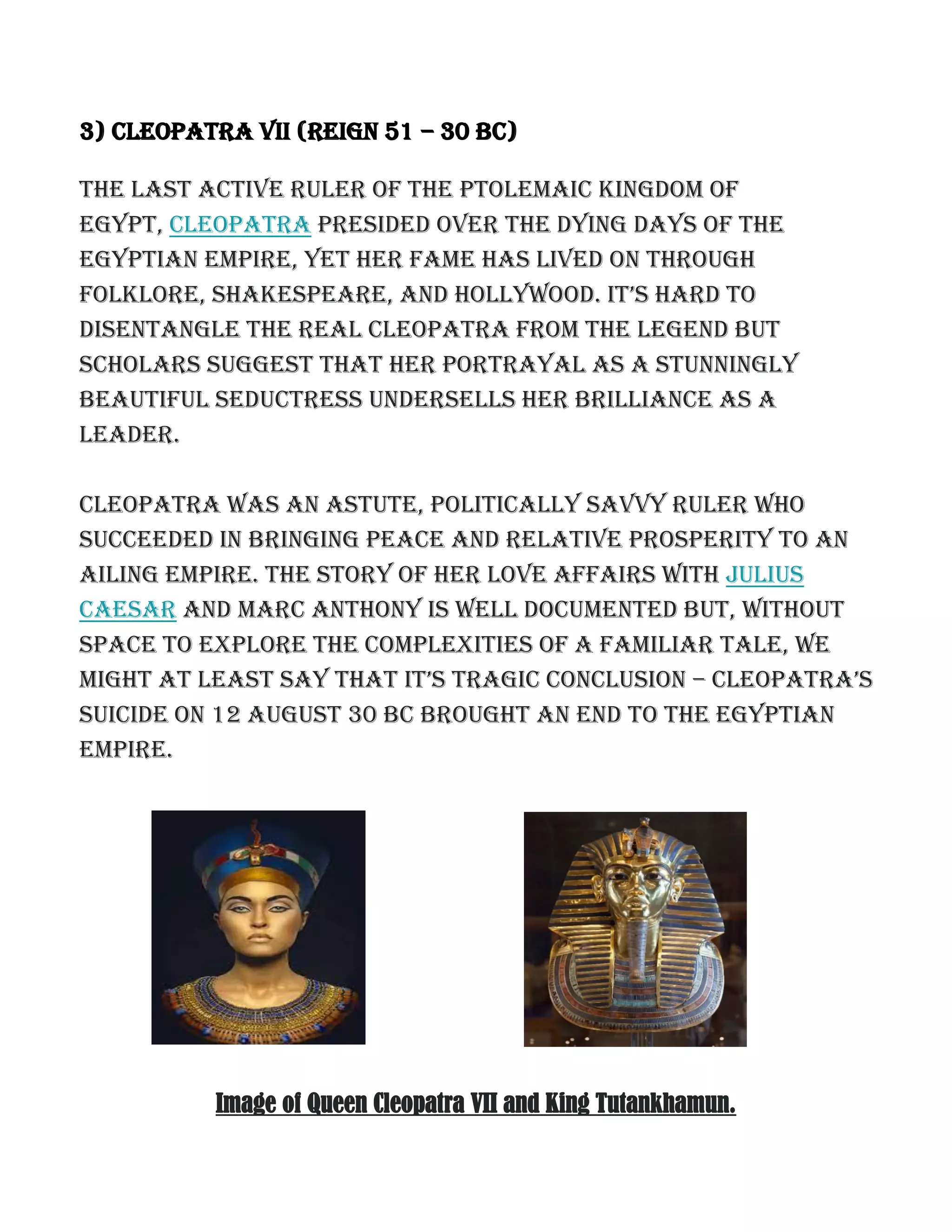
1) Tutankhamun (reign 1332–1323 BC)
The youngest pharaoh in Egyptian history when he ascended
to the throne at just 9 or 10 years
old, Tutankhamun became the most famous Egyptian
pharaoh of aLL. But the young pharaoh’s fame isn’t the
result of extraordinary achievements but instead derives
almost entirely from the discovery of his tomb in 1922 – one
of the great archaeological finds of the 20th century.
“King tut”, as the pharaoh Became Known after the
discovery of his spectacular burial site, only reigned for
10 years, and died aged just 20. The cause of his death
remains a mystery to Egyptologists.
2)Ramses II (reign 1279–1213 BC)
Ramses II’s reign was undouBtedLy the greatest of the
19th Dynasty and, even by pharaoh standards,
unabashedly ostentatious. The son of Seti I, with whom he
had a period of co-regency, Ramses II went on to declare
himself a god, while earning a reputation as
a great warrior, fathering 96 children, and ruling for 67
years. Make no mistake, Ramses the Great was not a modest
pharaoh. The extensive architectural legacy of his reign
is testament to this – as is the fact that his excesses are
thought to have left the throne close to bankruptcy at
the time of his death.
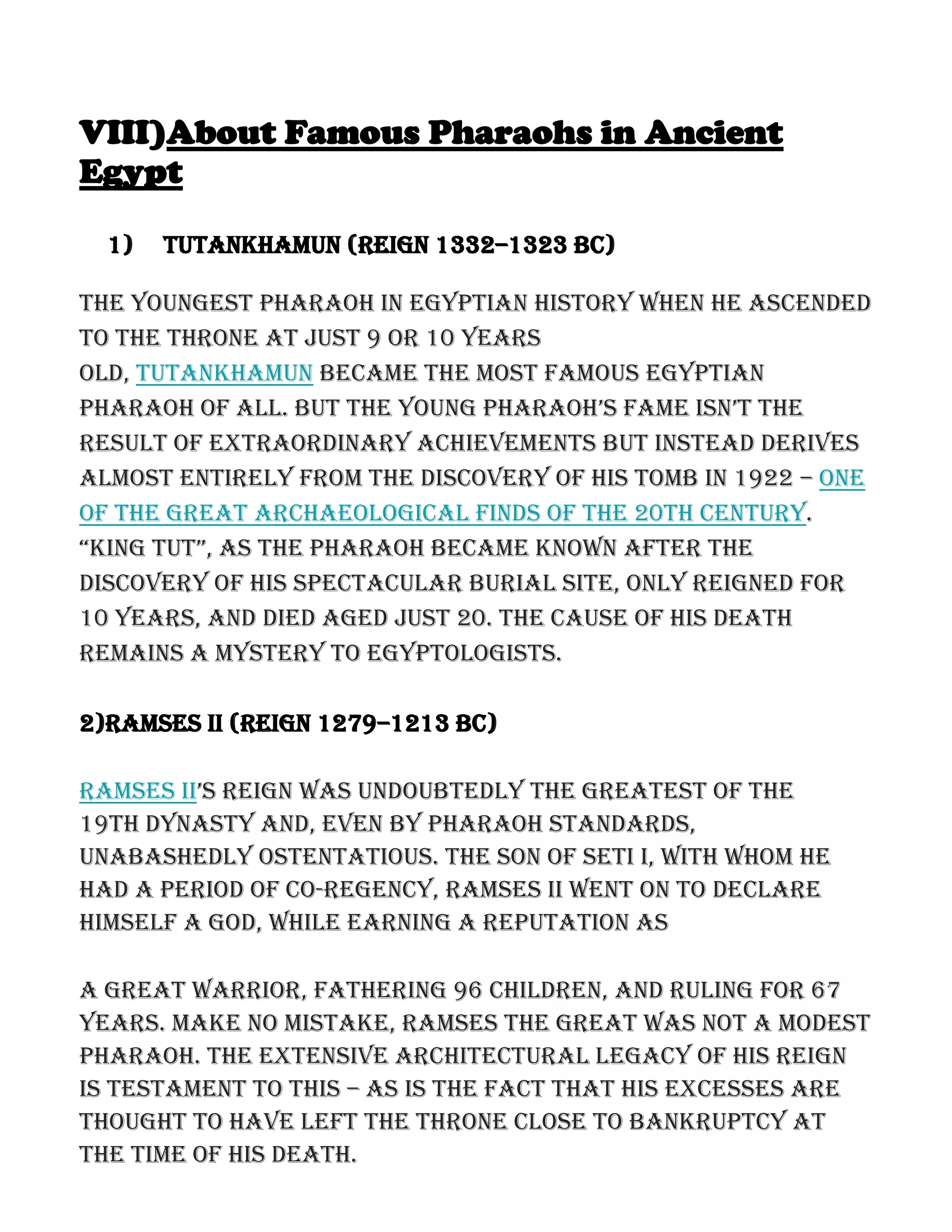
3) Cleopatra VII (reign 51 – 30 BC)
The last active ruler of the Ptolemaic Kingdom of
Egypt, Cleopatra presided over the dying days of the
Egyptian empire, yet her fame has lived on through
foLKLore, shaKespeare, and hoLLywood. it’s hard to
disentangle the real Cleopatra from the legend but
scholars suggest that her portrayal as a stunningly
beautiful seductress undersells her brilliance as a
leader.
Cleopatra was an astute, politically savvy ruler who
succeeded in bringing peace and relative prosperity to an
ailing empire. The story of her love affairs with Julius
Caesar and Marc Anthony is well documented but, without
space to explore the complexities of a familiar tale, we
might at Least say that it’s tragic concLusion – cLeopatra’s
suicide on 12 August 30 BC brought an end to the Egyptian
empire.
Image of Queen Cleopatra VII and King Tutankhamun.
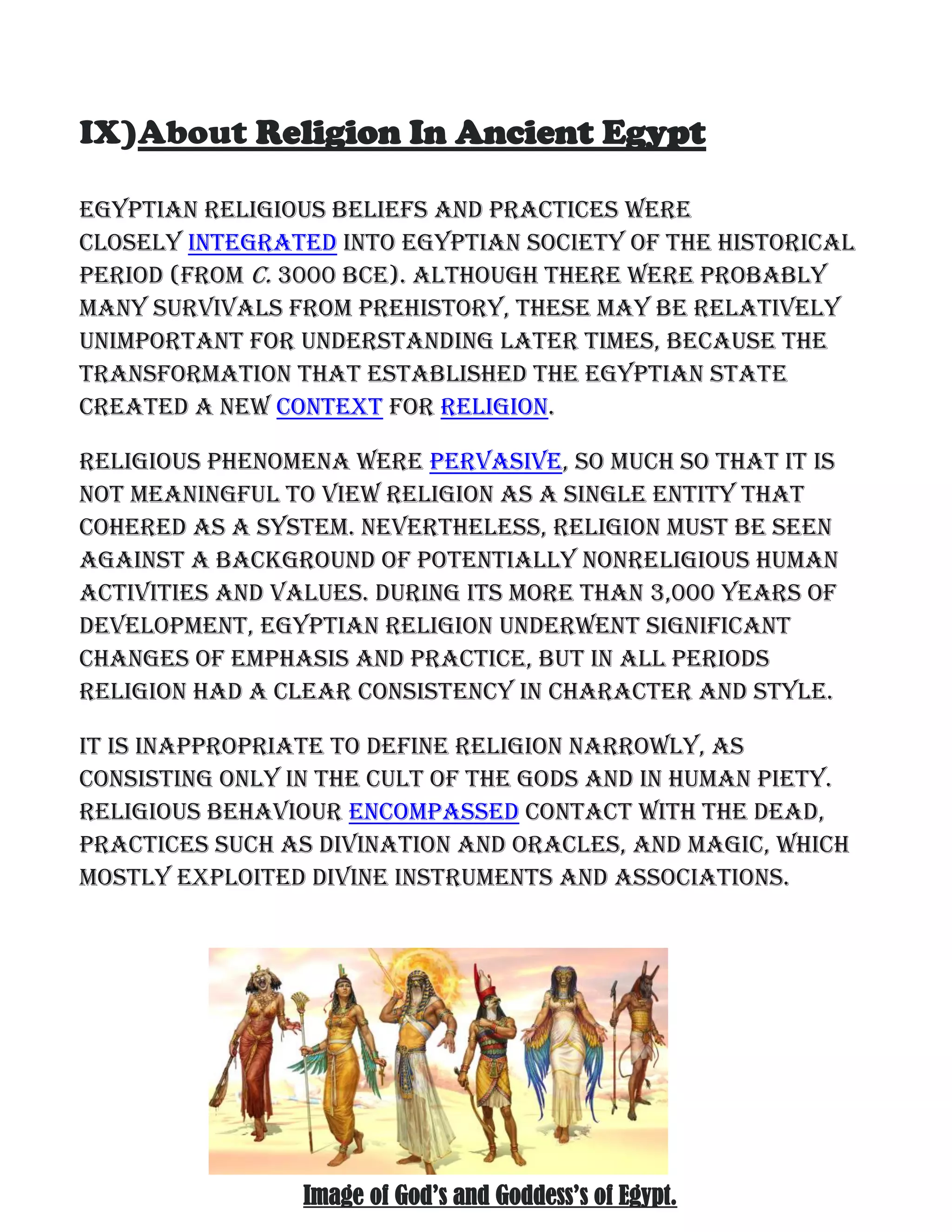
IX)About Religion In Ancient Egypt
Egyptian religious beliefs and practices were
closely integrated into Egyptian society of the historical
period (from c. 3000 BCE). Although there were probably
many survivals from prehistory, these may be relatively
unimportant for understanding later times, because the
transformation that established the Egyptian state
created a new context for religion.
Religious phenomena were pervasive, so much so that it is
not meaningful to view religion as a single entity that
cohered as a system. Nevertheless, religion must be seen
against a background of potentially nonreligious human
activities and values. During its more than 3,000 years of
development, Egyptian religion underwent significant
changes of emphasis and practice, but in all periods
religion had a clear consistency in character and style.
It is inappropriate to define religion narrowly, as
consisting only in the cult of the gods and in human piety.
Religious behaviour encompassed contact with the dead,
practices such as divination and oracles, and magic, which
mostly exploited divine instruments and associations.
Image of God’s and Goddess’s of Egypt.
x)About Dynasty rule in Egypt
The history of ancient Egypt is divided into three main
periods: the Old Kingdom (about 2,700-2,200 B.C.E.), the Middle
Kingdom (2,050-1,800 B.C.E.), and the New Kingdom (about
1,550-1,100 B.C.E.). The New Kingdom was followed by a period
called the Late New Kingdom, which lasted to about 343
B.C.E. (Intermediate kingdoms — those without strong ruling
families — filled the gaps of time in between the Old, Middle,
and New Kingdoms.) During these periods, power passed from
one dynasty to another. A dynasty ruled until it was
overthrown or there were no heirs left to rule. Each
kingdom ended in turmoil either after a period of infighting
or after being invaded. There were more than 30 dynasties
in Egyptian history. Dynasties helped keep Egypt united,
which was no easy task. Leaders faced periods of chaos,
ambitious rivals, and also the foreigners who wanted to
conquer the region.
The Earliest Dynasties
Beginning in about 4,000 B.C.E., all Egyptian society existed
in two kingdoms, Upper Egypt and Lower Egypt. Around 3,100
B.C.E., Menes, the king of Upper Egypt, started the long
string of dynasties by conquering Lower Egypt. He unified
the regions and built his capital city at Memphis, near the
border of these two kingdoms. Because Memphis was
located on an island in the Nile, it was easy to defend. So
began the first dynasty, an age appropriately called the
Early Dynastic Period. Little is known of the pharaohs
(rulers) of the early dynasties.
The Old Kingdom
About 300 years after Menes united Egypt, its rulers
formed a central government in which they held supreme
power. This was the beginning of the Old Kingdom. (Kings
tend to rule from a central place, which is why the early
dynastic period is not considered a kingdom.)
During the Old Kingdom, pyramid building flourished. Cheops
had the six-million-ton Great Pyramid of Giza constructed
as his tomb. Under Chephren, a Fourth Dynasty ruler, the
Great Sphinx was built. The end of the Old Kingdom was
marked by civil wars between pharaohs and nobles.
The Middle Kingdom
Montuhotep II (2,007-1,956 B.C.E.), an Eleventh dynasty
pharaoh, was the last ruler of the Old Kingdom and the
first ruler of the Middle Kingdom. He and his successors
restored political order. The Middle Kingdom is remembered
as a time of flourishing arts, particularly in jewellery
making. Egypt became a great trading power during this
period and continued massive construction projects.
Eventually, the long reign of prosperity gave way to old
problems: crop failures, economic woes, dynastic power
struggles, and foreign invaders. Amenemhet III (1817-1772
B.C.E.), of the Twelfth Dynasty, was responsible for the
construction of two great projects.
Trouble struck when a group of foreigners, the Hyksos, a
Semitic-Asiatic group, invaded the Nile Delta region. These
advanced warriors used new tools for war: bronze
weapons and horse-drawn chariots. They defeated the
Egyptians, who fought on foot with copper-and-stone
weapons.
The New Kingdom
Early pharaohs of the New Kingdom evicted the Hyksos. The
New Kingdom is remembered as a time of renaissance in
artistic creation, but also as the end of dynastic rule. This
period was also marred by corrupt priests and tomb-
robbing by government officials. A famed pharaoh of the
new period was Amenhotep IV, who triggered a religious
revolution. Before Amenhotep's rule, Egypt was a
polytheistic society that believed in many gods, the most
important named Amon. But Amenhotep believed only in
Aton, the sun god. Belief in only one God (monotheism) was a
radical notion. To show his devotion to Aton, the pharaoh
changed his name to Akenhaton ("he who is loyal to Aton").
Akenhaton moved his capital from Thebes, where Amon was
worshipped, to Tell el Amarna. Naturally, the priests who
represented the other gods did not like this change one bit.
Many Egyptians also did not like the pharaoh discrediting
their gods. After the death of Akenhaton, the powerful
priests forced the new capital to be moved back to Thebes.
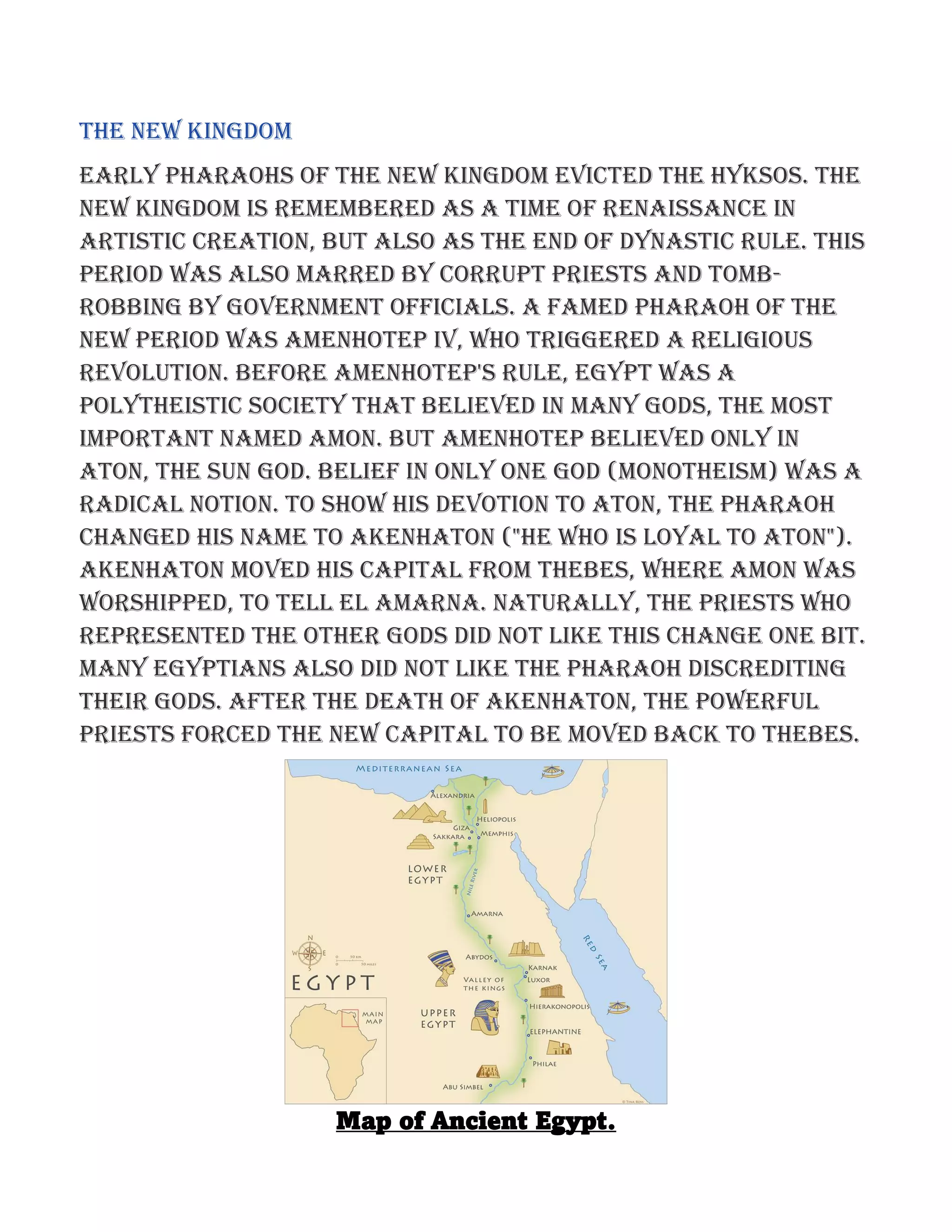
Map of Ancient Egypt.
english class 11 project

english class 11 project

  • 1.
    UTTARAKHAND PUBLIC SCHOOL C.B.S.E SESSION:- 2022-23 English (301) Project File Name: AYUSH KUMAR Class: XI - B Roll No: 10
  • 2.
    CERTIFICATE This is tocertify that the project report titled “Ancient Egypt” is a bona fide work carried out and successfully completed by AYUSH KUMAR of Class: XI-B of “Uttarakhand Public School”, Sector 56, Noida for the fulfillment of the ASL project work. Principal’s Signature Subject Teacher’s Signature
  • 3.
    ACKNOWLEDGMENT A project isa golden opportunity for learning and self- development. I consider myself fortunate and privileged to have such a wonderful mentor’s guide through the journey to the completion of the project. My heartful gratitude to my teacher and guide, Ms. Suchismita for her patience and belief in me. Her exemplary investment in the complete process, constant encouragement, and insightful feedback helped me to achieve my objective. I would also like to thank my parents for encouraging me during the course of this project. Finally, I would like to thank CBSE for giving me this opportunity to undertake this project.
  • 4.
    Bibliography Ancient Egyptian Agriculture https://www.fao.org› country-showcase › item-detail Education in the earliest civilizations - Encyclopedia Britannica https://www.britannica.com › topic › Education-in-the-ear... Trade in Ancient Egypt - World History Encyclopedia https://www.worldhistory.org › article › trade-in-ancien.. Ancient Egyptian Science & Technology https://www.worldhistory.org › article › ancient-egyptia... Ancient Egyptian History for Kids: Hieroglyphics - Ducksters https://www.ducksters.com › history › ancient_egyptian..
  • 5.
    I)Everyday life inAncient Egypt The daily life in ancient Egypt was much different than the vision that commonly comes to mind. Relics found in archaeological digs as well as paintings and drawings on pyramid and tomb walls depict images of life in ancient Egypt that was, in some regards, not that much different than life in Egypt today. In the ancient Egypt the main form of travel was by boat and the main source of protein was fish. Adobe houses were built from mud were cool on the inside and had flat roofs so that in the summertime people could sleep on the tops of them. Houses were built around courtyards, and all the cooking was done outside in the courtyard. LittLe chiLdren in ancient egypt oftentimes didn’t wear clothes, but often wore jewellery around their neck.
  • 6.
    II)Agriculture in ancientEgypt Egyptians are credited as being one of the first groups of people to practice agriculture on a large scale. This was possible because of the ingenuity of the Egyptians as they developed basin irrigation. Their farming practices allowed them to grow staple food crops, especially grains such as wheat and barley, and industrial crops, such as flax and papyrus. They excelled in horticulture. The Egyptian grew a variety of crops for consumption, including grains, vegetables, and fruits. However, their diets revolved around several staple crops, especially cereals and barley. Other major crops grains grown included einkorn wheat and emmer wheat, grown to make bread. Other staples for majority of the population includes beans, lentils, and later chickpeas and fava beans. Root crops, such as onions, garlic and radishes were also grown, along with salad crops, such as lettuce and parsley. Fruits were a common motif of Egyptian artwork, suggesting that their growth was also a major focus of agricuLturaL efforts as the civiLization’s agricuLturaL technology developed. Image depicting people doing farming activities in ancient Egypt.
  • 7.
    III)Trade Activities inAncient Egypt Ancient Egyptian trade included contact with Syria in the 5th century BCE, and importation of pottery and construction ideas from Canaan in the 4th century BCE. By this time, shipping was common, and the donkey, camel, and horse were domesticated and used for transportation. Lebanese cedar has been found in the tombs of Nekhen, dated to the Naqada I and II periods. Egyptians during this period also imported obsidian from Ethiopia, gold, and incense from Nubia in the south, oil jugs from Palestine, and other goods from the oases of the western desert and the cultures of the eastern Mediterranean. Egyptian artifacts from this era have been found in Canaan and parts of the former Mesopotamia. In the latter half of the 4th century BCE, the gemstone lapis lazuli was being imported from Badakhshan (modern-day Afghanistan). Just before the First Dynasty, Egypt had a colony in southern Canaan that produced Egyptian pottery for export to Egypt. In the Second Dynasty, Byblos provided quality timber that could not be found in Egypt. By the Fifth Dynasty, trade with Punt gave Egyptians gold, aromatic resins, ebony, ivory, and wild animals. Egypt also traded with Anatolia for tin and copper to make bronze. Mediterranean trading partners provided olive oil and other fine goods. Egypt commonly exported grain, gold, linen, papyrus, and finished goods, such as glass and stone objects.
  • 8.
    A well-travelled landroute from the Nile to the Red Sea crossed through the Wadi Hammamat and was known from predynastic times. This route allowed travellers to move from Thebes to the Red Sea port of Elim and led to the rise of ancient cities. Another route, the Darb el-Arbain, was used from the time of the Old Kingdom of Egypt to trade gold, ivory, spices, wheat, animals, and plants. This route passed through Kharga in the south and Asyut in the north and was a major route between Nubia and Egypt. Image depicting trade in ancient Egypt.
  • 9.
    IV)About Education inAncient Egypt Egyptian culture and education were preserved and controlled chiefly by the priests, a powerful intellectual elite in the Egyptian theocracy who also served as the political bulwarks by preventing cultural diversity. The humanities as well as such practical subjects as science, medicine, mathematics, and geometry were in the hands of the priests, who taught in formal schools. Vocational skills relating to such fields as architecture, engineering. Egyptians developed two types of formal schools for privileged youth under the supervision of governmental officials and priests: one for scribes and the other for priest trainees. At the age of 5, pupils entered the writing school and continued their studies in reading and writing until the age of 16 or 17. At the age of 13 or 14 the schoolboys were also given practical training in offices for which they were being prepared. Priesthood training began at the temple college, which boys entered at the age of 17; the length of training depending upon the requirements for various priestly offices. Rigid method and severe discipline were applied to achieve uniformity in cultural transmission, since deviation from the traditional pattern of thought was strictly prohibited. Egyptians also used a work-study method in the final phase of the training for scribes. Image depicting students getting knowledge from their teacher in Ancient Egypt.
  • 10.
    V)Writings in ancientEgypt Ancient Egyptian writing is known as hieroglyphics ('sacred carvings') and developed at some point prior to the Early Dynastic Period (c. 3150 -2613 BCE). According to some scholars, the concept of the written word was first developed in Mesopotamia and came to Egypt through trade. While there certainly was cross- cultural exchange between the two regions, Egyptian hieroglyphics are completely Egyptian in origin; there is no evidence of early writings which describe non-Egyptian concepts, places, or objects, and early Egyptian pictographs have no correlation to early Mesopotamian signs. The designation 'hieroglyphics' is a Greek word; the Egyptians referred to their writing as medu-netjer, 'the god's words,' as they believed writing had been given to them by the great god Thoth. Sometime in the latter part of the Predynastic Period in Egypt (c. 6000 - c. 3150 BCE), the people began to use symbols to represent simple concepts. People used symbols, pictures to represent concepts such as a person or event. The problem with a pictogram, however, is that the information it contains is quite limited. Hieroglyphics was developed out of the early pictographs Hieroglyphics continued to be used throughout Egypt's history in all forms of writing but came primarily to be the script of monuments and temples. Hieroglyphics, grouped in their beautifully formed rectangles, leant themselves to the grandeur of monumental inscriptions. Hieratic came to be used first in religious texts but then in other areas such as business administration, magical texts, personal and business letters, and legal documents such as wills and
  • 11.
    court records. Hieraticwas written on papyrus or ostraca and practiced on stone and wood. It developed into a cursive script around 800 BCE (known as 'abnormal hieratic') and then was replaced c. 700 BCE by demotic script. Demotic script ('popular writing') was used in every kind of writing while hieroglyphics continued to be the script of monumental inscriptions in stone. The Egyptians called demotic sekh-shat, 'writing for documents,' and it became the most popular for the next 1,000 years in all kinds of written works. Demotic script seems to have originated in the Delta region of Lower Egypt and spread south during the 26th Dynasty of the Third Intermediate period (c. 1069- 525 BCE). Image depicting hieroglyphics writings.
  • 12.
    VI)About Technology inAncient Egypt A) Old Kingdom (c. 2613 BCE - 2181 BCE) and the First Intermediate Period (2181-2040 BCE) The Old Kingdom is sometimes referred to as the ''Age of the Pyramids''. Some of Egypt's most famous landmarks were built in this period, including the Pyramids of Giza. Scholars disagree about how exactly these enormously sophisticated monuments were created given the evidence that we have about the technology that existed at the time. What we do know is that the Pyramids of Giza are a set of three pyramids built as funerary temples for three kings. The tallest of these pyramids, known as the Great Pyramid of Giza was built for a king name Khufu and originally stood approximately 480 feet tall. Archaeologists estimate that it took 20,000 workers 20 years to build this pyramid alone. Experts believe that they used wooden machines and ramps to haul and stack over 2 million stones to build the structure of the pyramid. The finishing touch was an outer layer of gleaming white limestone. It was almost perfectly level and was the tallest structure in the world until the Eiffel Tower was built in France in 1887. B) Middle Kingdom (c.2040 - c.1782 BCE) and the Second Intermediate Period (c. 1782 - c. 1570 BCE) The Middle Kingdom is also referred to as the ''classical era'' of Egypt because it was when the civilization's wealth and culture reached dazzling new heights. It was during this era that the Temple of Karnak was constructed. This
  • 13.
    temple, built tohonor the god Amun, is arguably the largest religious structure in the world. Technology also had secular purposes. Egyptians continued to work to control the flow of water to aid in farming and used water pumps and canals in this period. The wheel, which was introduced to Egypt when the Hyksos people arrived, also represented a technological leap forward and made possible the potter's wheel and the chariot. C)New Kingdom (c. 1570 - c. 1069 BCE) During the New Kingdom, a powerful central government ruled over Egypt, led by a king known as a pharaoh. Some of these powerful pharaohs were buried in the Valley of the Kings in elaborate tombs. Egyptians also made great advancements in this era in medicine, including fields such as dentistry. Ancient Egyptians would have been familiar with toothbrushes and an early version of toothpaste. In addition, while knowledge of how to make transparent glass had existed in previous eras, Egypt during the New Kingdom made glass on a mass scale and perfected techniques to add colour to it. It was especially sought after for making a coloured glaze on beads. New metals such as bronze were also available in Egypt in that era. Image depicting makeup tools developed in Ancient Egypt.
  • 14.
    VII)About Arts inAncient Egypt Ancient Egyptian art refers to art produced in ancient Egypt between the 6th millennium BC and the 4th century AD, spanning from Prehistoric Egypt until the Christianization of Roman Egypt. It includes paintings, sculptures, drawings on papyrus, faience, jewelry, ivories, architecture, and other art media. It is also very conservative: the art style changed very little over time. Much of the surviving art comes from tombs and monuments, giving more insight into the ancient Egyptian afterlife beliefs. The ancient Egyptian language had no word for "art". Artworks served an essentially functional purpose that was bound with religion and ideology. To render a subject in art was to give it permanence. Therefore, ancient Egyptian art portrayed an idealized, unrealistic view of the world. There was no significant tradition of individual artistic expression since art served a wider and cosmic purpose of maintaining order (Ma'at). Image showing artwork of Ancient Egypt.
  • 15.
    VIII)About Famous Pharaohsin Ancient Egypt 1) Tutankhamun (reign 1332–1323 BC) The youngest pharaoh in Egyptian history when he ascended to the throne at just 9 or 10 years old, Tutankhamun became the most famous Egyptian pharaoh of aLL. But the young pharaoh’s fame isn’t the result of extraordinary achievements but instead derives almost entirely from the discovery of his tomb in 1922 – one of the great archaeological finds of the 20th century. “King tut”, as the pharaoh Became Known after the discovery of his spectacular burial site, only reigned for 10 years, and died aged just 20. The cause of his death remains a mystery to Egyptologists. 2)Ramses II (reign 1279–1213 BC) Ramses II’s reign was undouBtedLy the greatest of the 19th Dynasty and, even by pharaoh standards, unabashedly ostentatious. The son of Seti I, with whom he had a period of co-regency, Ramses II went on to declare himself a god, while earning a reputation as a great warrior, fathering 96 children, and ruling for 67 years. Make no mistake, Ramses the Great was not a modest pharaoh. The extensive architectural legacy of his reign is testament to this – as is the fact that his excesses are thought to have left the throne close to bankruptcy at the time of his death.
  • 16.
    3) Cleopatra VII(reign 51 – 30 BC) The last active ruler of the Ptolemaic Kingdom of Egypt, Cleopatra presided over the dying days of the Egyptian empire, yet her fame has lived on through foLKLore, shaKespeare, and hoLLywood. it’s hard to disentangle the real Cleopatra from the legend but scholars suggest that her portrayal as a stunningly beautiful seductress undersells her brilliance as a leader. Cleopatra was an astute, politically savvy ruler who succeeded in bringing peace and relative prosperity to an ailing empire. The story of her love affairs with Julius Caesar and Marc Anthony is well documented but, without space to explore the complexities of a familiar tale, we might at Least say that it’s tragic concLusion – cLeopatra’s suicide on 12 August 30 BC brought an end to the Egyptian empire. Image of Queen Cleopatra VII and King Tutankhamun.
  • 17.
    IX)About Religion InAncient Egypt Egyptian religious beliefs and practices were closely integrated into Egyptian society of the historical period (from c. 3000 BCE). Although there were probably many survivals from prehistory, these may be relatively unimportant for understanding later times, because the transformation that established the Egyptian state created a new context for religion. Religious phenomena were pervasive, so much so that it is not meaningful to view religion as a single entity that cohered as a system. Nevertheless, religion must be seen against a background of potentially nonreligious human activities and values. During its more than 3,000 years of development, Egyptian religion underwent significant changes of emphasis and practice, but in all periods religion had a clear consistency in character and style. It is inappropriate to define religion narrowly, as consisting only in the cult of the gods and in human piety. Religious behaviour encompassed contact with the dead, practices such as divination and oracles, and magic, which mostly exploited divine instruments and associations. Image of God’s and Goddess’s of Egypt.
  • 18.
    x)About Dynasty rulein Egypt The history of ancient Egypt is divided into three main periods: the Old Kingdom (about 2,700-2,200 B.C.E.), the Middle Kingdom (2,050-1,800 B.C.E.), and the New Kingdom (about 1,550-1,100 B.C.E.). The New Kingdom was followed by a period called the Late New Kingdom, which lasted to about 343 B.C.E. (Intermediate kingdoms — those without strong ruling families — filled the gaps of time in between the Old, Middle, and New Kingdoms.) During these periods, power passed from one dynasty to another. A dynasty ruled until it was overthrown or there were no heirs left to rule. Each kingdom ended in turmoil either after a period of infighting or after being invaded. There were more than 30 dynasties in Egyptian history. Dynasties helped keep Egypt united, which was no easy task. Leaders faced periods of chaos, ambitious rivals, and also the foreigners who wanted to conquer the region. The Earliest Dynasties Beginning in about 4,000 B.C.E., all Egyptian society existed in two kingdoms, Upper Egypt and Lower Egypt. Around 3,100 B.C.E., Menes, the king of Upper Egypt, started the long string of dynasties by conquering Lower Egypt. He unified the regions and built his capital city at Memphis, near the border of these two kingdoms. Because Memphis was located on an island in the Nile, it was easy to defend. So began the first dynasty, an age appropriately called the Early Dynastic Period. Little is known of the pharaohs (rulers) of the early dynasties.
  • 19.
    The Old Kingdom About300 years after Menes united Egypt, its rulers formed a central government in which they held supreme power. This was the beginning of the Old Kingdom. (Kings tend to rule from a central place, which is why the early dynastic period is not considered a kingdom.) During the Old Kingdom, pyramid building flourished. Cheops had the six-million-ton Great Pyramid of Giza constructed as his tomb. Under Chephren, a Fourth Dynasty ruler, the Great Sphinx was built. The end of the Old Kingdom was marked by civil wars between pharaohs and nobles. The Middle Kingdom Montuhotep II (2,007-1,956 B.C.E.), an Eleventh dynasty pharaoh, was the last ruler of the Old Kingdom and the first ruler of the Middle Kingdom. He and his successors restored political order. The Middle Kingdom is remembered as a time of flourishing arts, particularly in jewellery making. Egypt became a great trading power during this period and continued massive construction projects. Eventually, the long reign of prosperity gave way to old problems: crop failures, economic woes, dynastic power struggles, and foreign invaders. Amenemhet III (1817-1772 B.C.E.), of the Twelfth Dynasty, was responsible for the construction of two great projects. Trouble struck when a group of foreigners, the Hyksos, a Semitic-Asiatic group, invaded the Nile Delta region. These advanced warriors used new tools for war: bronze weapons and horse-drawn chariots. They defeated the Egyptians, who fought on foot with copper-and-stone weapons.
  • 20.
    The New Kingdom Earlypharaohs of the New Kingdom evicted the Hyksos. The New Kingdom is remembered as a time of renaissance in artistic creation, but also as the end of dynastic rule. This period was also marred by corrupt priests and tomb- robbing by government officials. A famed pharaoh of the new period was Amenhotep IV, who triggered a religious revolution. Before Amenhotep's rule, Egypt was a polytheistic society that believed in many gods, the most important named Amon. But Amenhotep believed only in Aton, the sun god. Belief in only one God (monotheism) was a radical notion. To show his devotion to Aton, the pharaoh changed his name to Akenhaton ("he who is loyal to Aton"). Akenhaton moved his capital from Thebes, where Amon was worshipped, to Tell el Amarna. Naturally, the priests who represented the other gods did not like this change one bit. Many Egyptians also did not like the pharaoh discrediting their gods. After the death of Akenhaton, the powerful priests forced the new capital to be moved back to Thebes. Map of Ancient Egypt.