ENGLISH 8
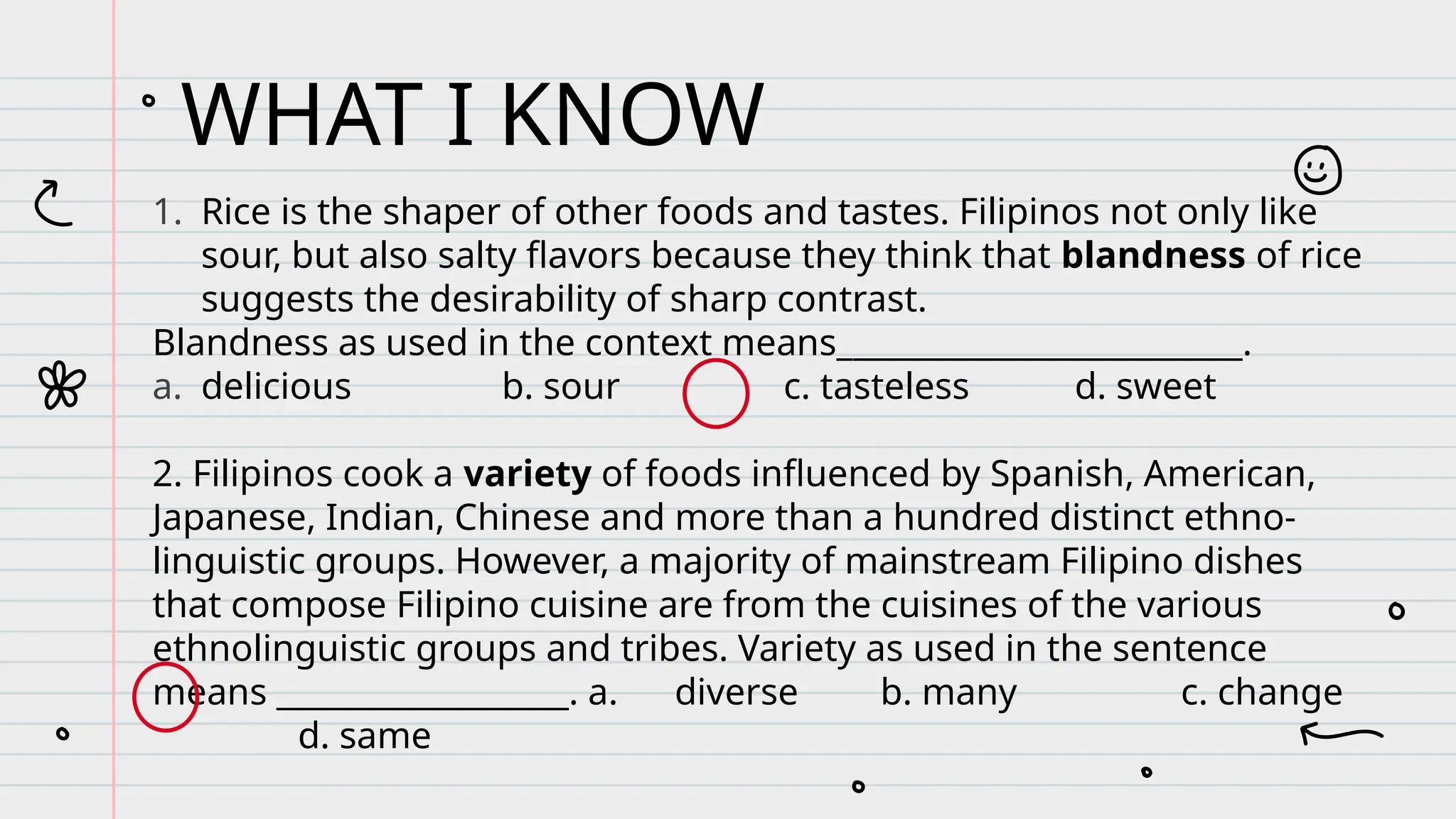
1. Rice is the shaper of other foods and tastes. Filipinos not only like
sour, but also salty flavors because they think that blandness of rice
suggests the desirability of sharp contrast.
Blandness as used in the context means_________________________.
a. delicious b. sour c. tasteless d. sweet
2. Filipinos cook a variety of foods influenced by Spanish, American,
Japanese, Indian, Chinese and more than a hundred distinct ethno-
linguistic groups. However, a majority of mainstream Filipino dishes
that compose Filipino cuisine are from the cuisines of the various
ethnolinguistic groups and tribes. Variety as used in the sentence
means __________________. a. diverse b. many c. change
d. same
WHAT I KNOW
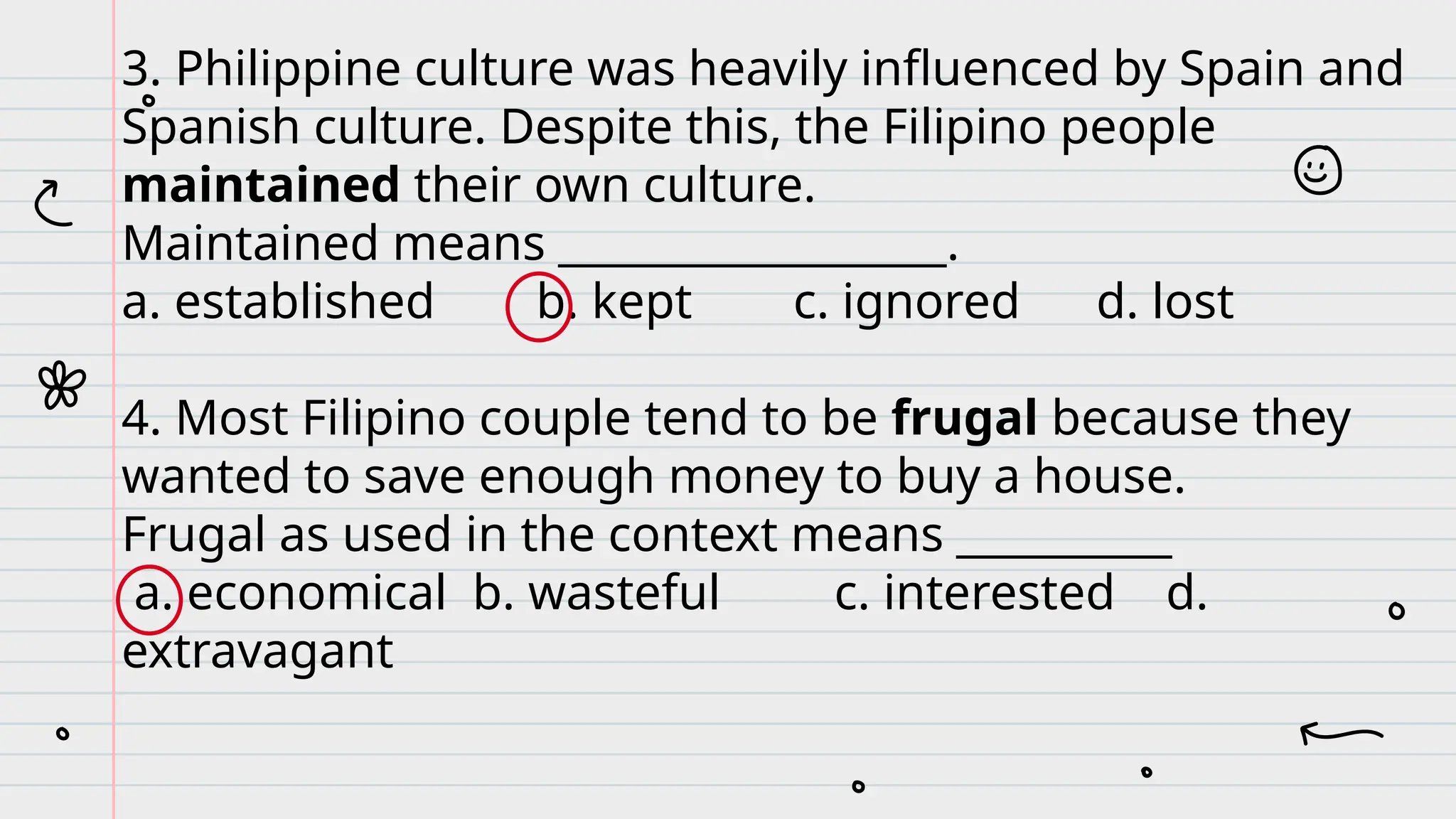
3. Philippine culture was heavily influenced by Spain and
Spanish culture. Despite this, the Filipino people
maintained their own culture.
Maintained means __________________.
a. established b. kept c. ignored d. lost
4. Most Filipino couple tend to be frugal because they
wanted to save enough money to buy a house.
Frugal as used in the context means __________
a. economical b. wasteful c. interested d.
extravagant
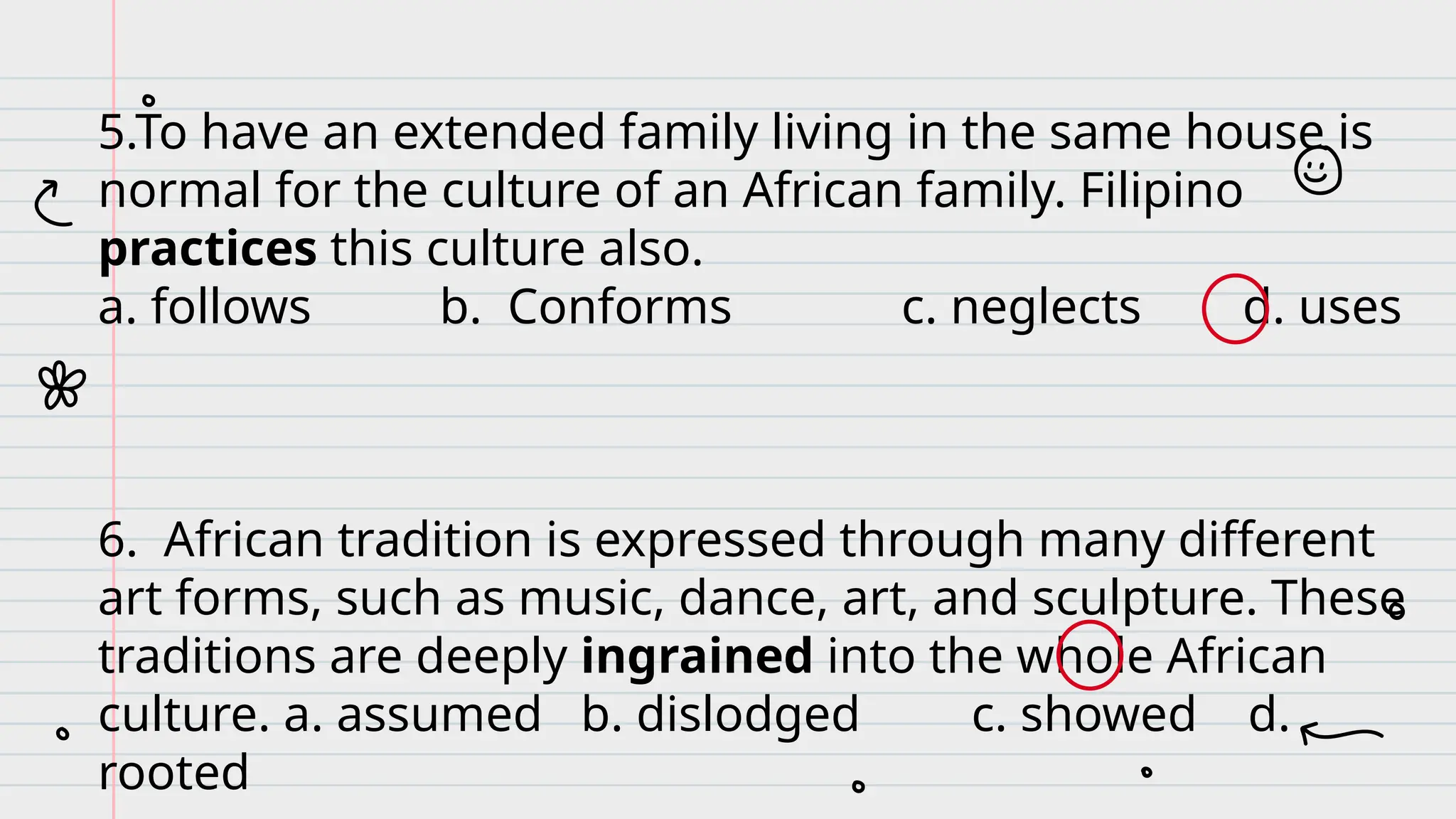
5.To have an extended family living in the same house is
normal for the culture of an African family. Filipino
practices this culture also.
a. follows b. Conforms c. neglects d. uses
6. African tradition is expressed through many different
art forms, such as music, dance, art, and sculpture. These
traditions are deeply ingrained into the whole African
culture. a. assumed b. dislodged c. showed d.
rooted
Learning Objectives
After going through this lesson, the
students are expected to:
 Determine the meaning of words and
expressions that reflect local culture
by noting context clues;
 Read intensively to determine author’s
purpose;
Determining
Meaning of Words
and Local
Expressions
through Context
Clues
Context Clues
- - provide information about a
word or phrase that helps
readers understand the
meaning. These clues offer
insight - either directly or
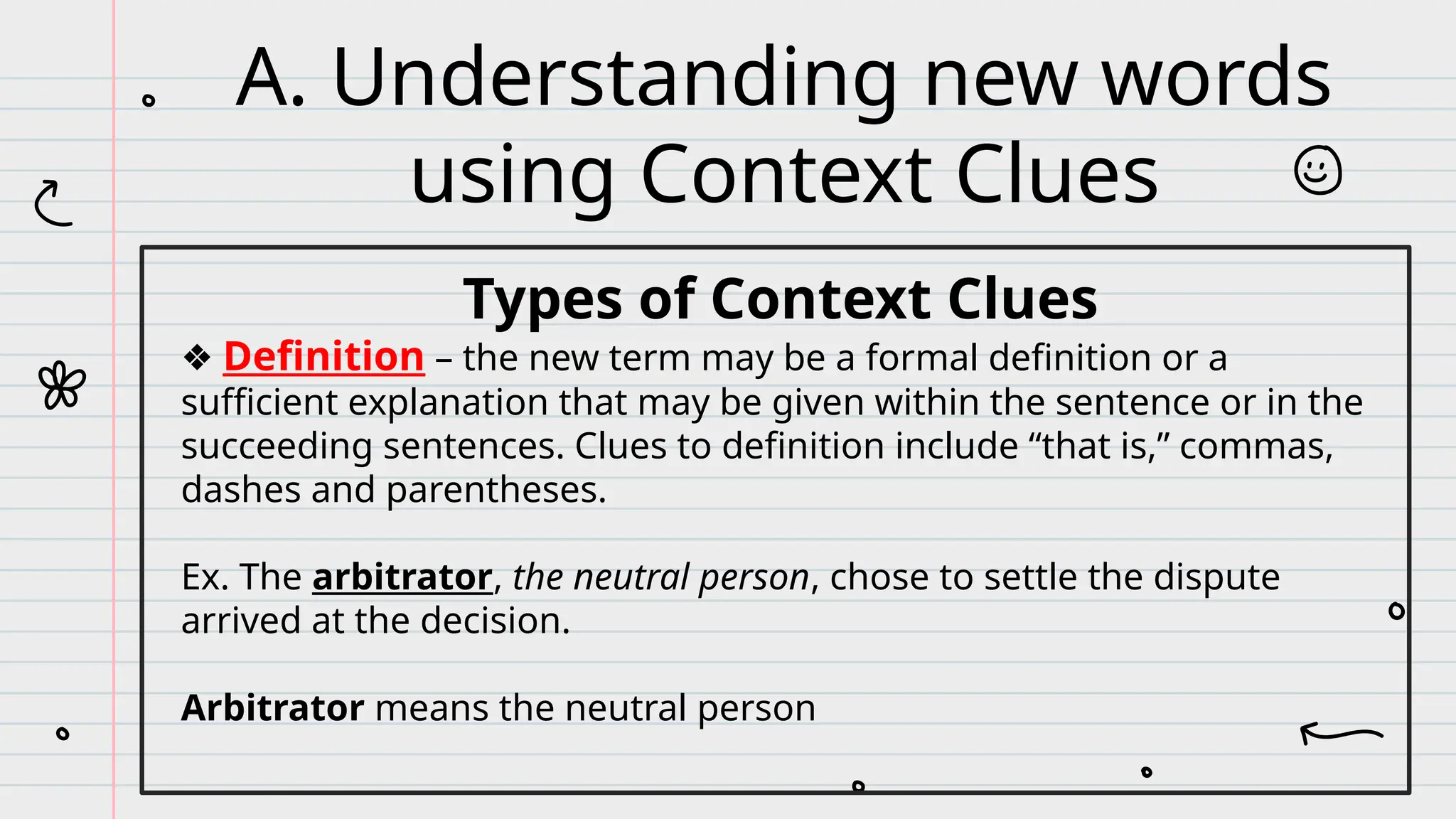
Types of Context Clues
❖ Definition – the new term may be a formal definition or a
sufficient explanation that may be given within the sentence or in the
succeeding sentences. Clues to definition include “that is,” commas,
dashes and parentheses.
Ex. The arbitrator, the neutral person, chose to settle the dispute
arrived at the decision.
Arbitrator means the neutral person
A. Understanding new words
using Context Clues
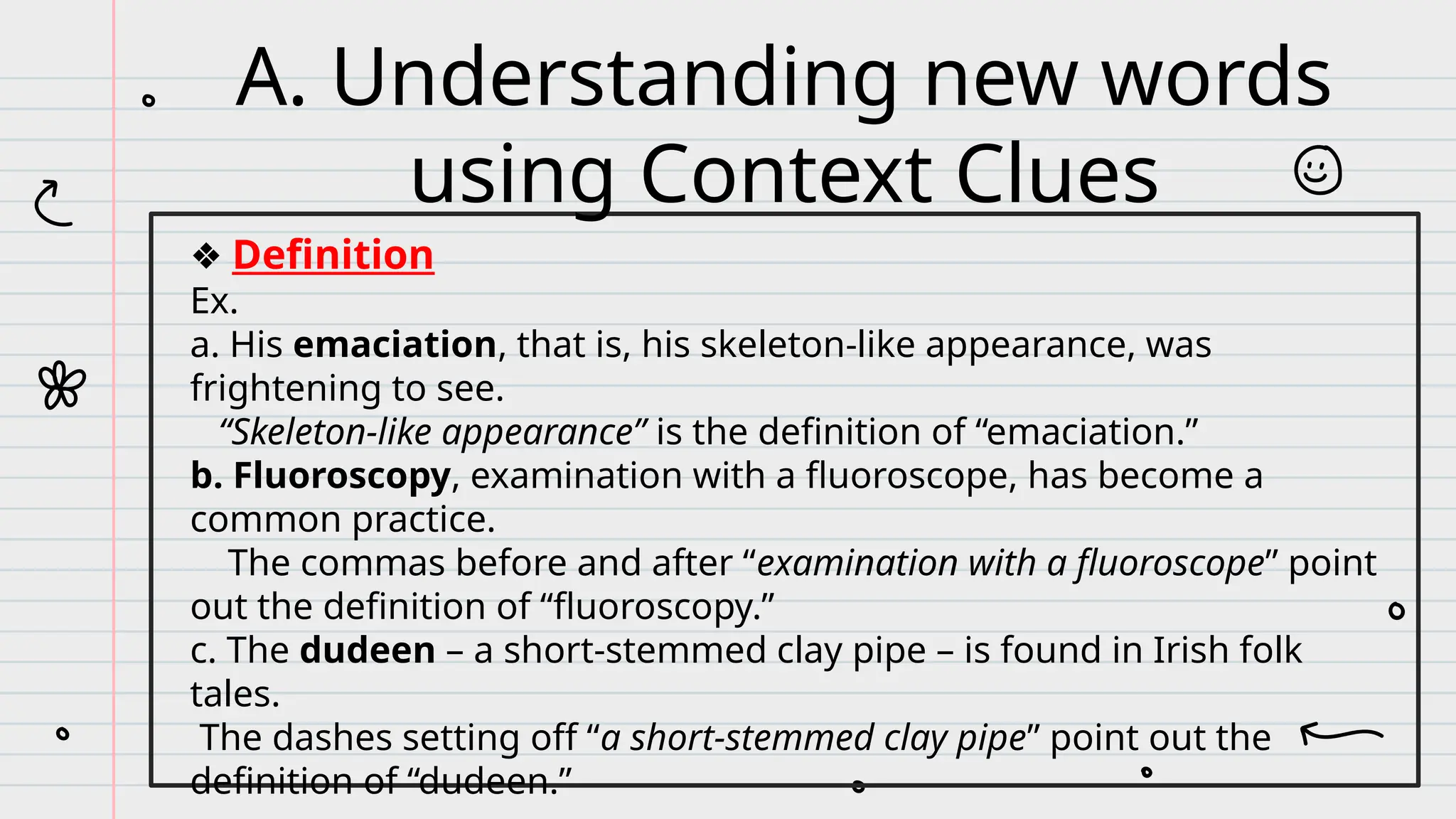
❖ Definition
Ex.
a. His emaciation, that is, his skeleton-like appearance, was
frightening to see.
“Skeleton-like appearance” is the definition of “emaciation.”
b. Fluoroscopy, examination with a fluoroscope, has become a
common practice.
The commas before and after “examination with a fluoroscope” point
out the definition of “fluoroscopy.”
c. The dudeen – a short-stemmed clay pipe – is found in Irish folk
tales.
The dashes setting off “a short-stemmed clay pipe” point out the
definition of “dudeen.”
A. Understanding new words
using Context Clues
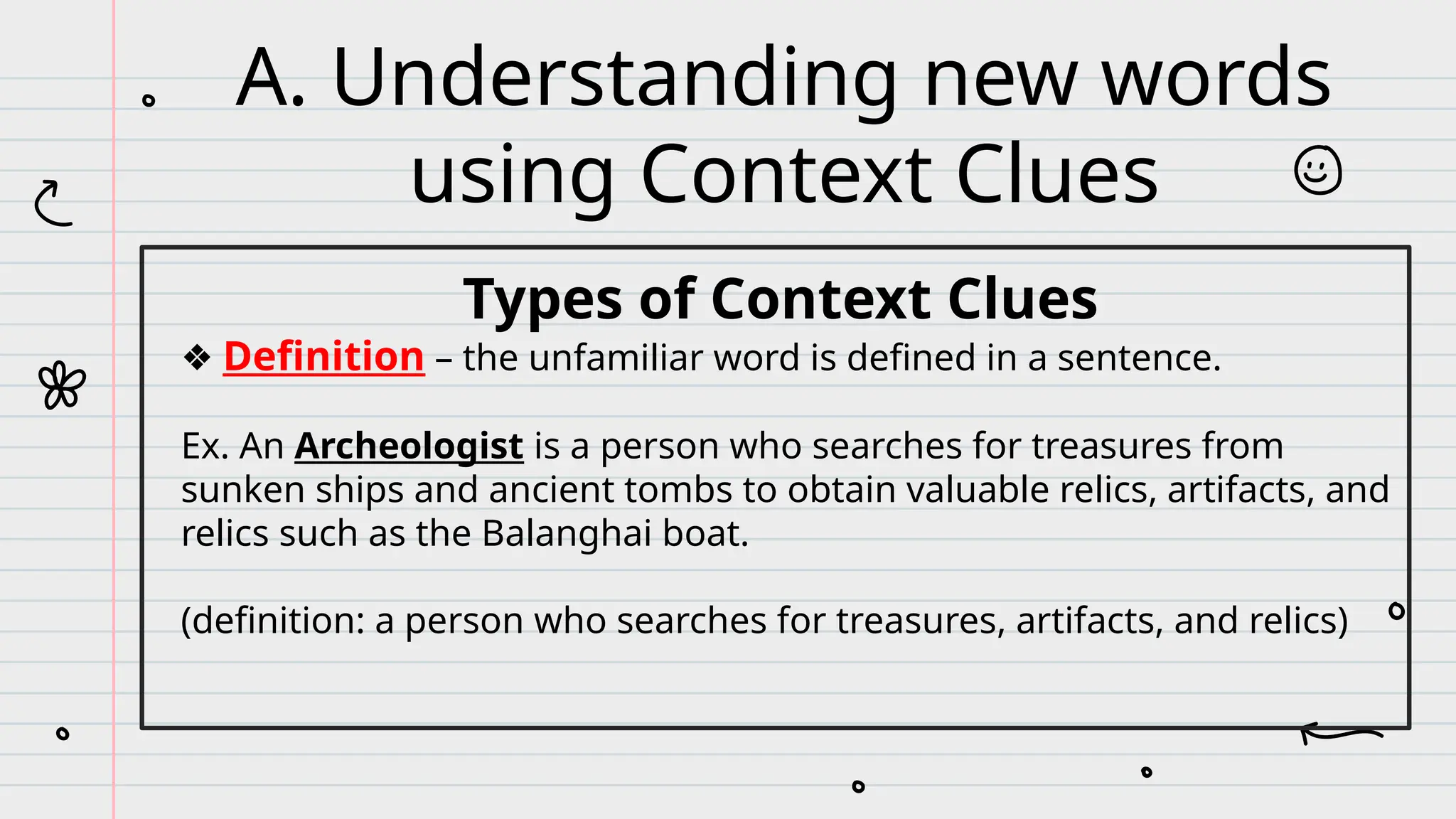
Types of Context Clues
❖ Definition – the unfamiliar word is defined in a sentence.
Ex. An Archeologist is a person who searches for treasures from
sunken ships and ancient tombs to obtain valuable relics, artifacts, and
relics such as the Balanghai boat.
(definition: a person who searches for treasures, artifacts, and relics)
A. Understanding new words
using Context Clues
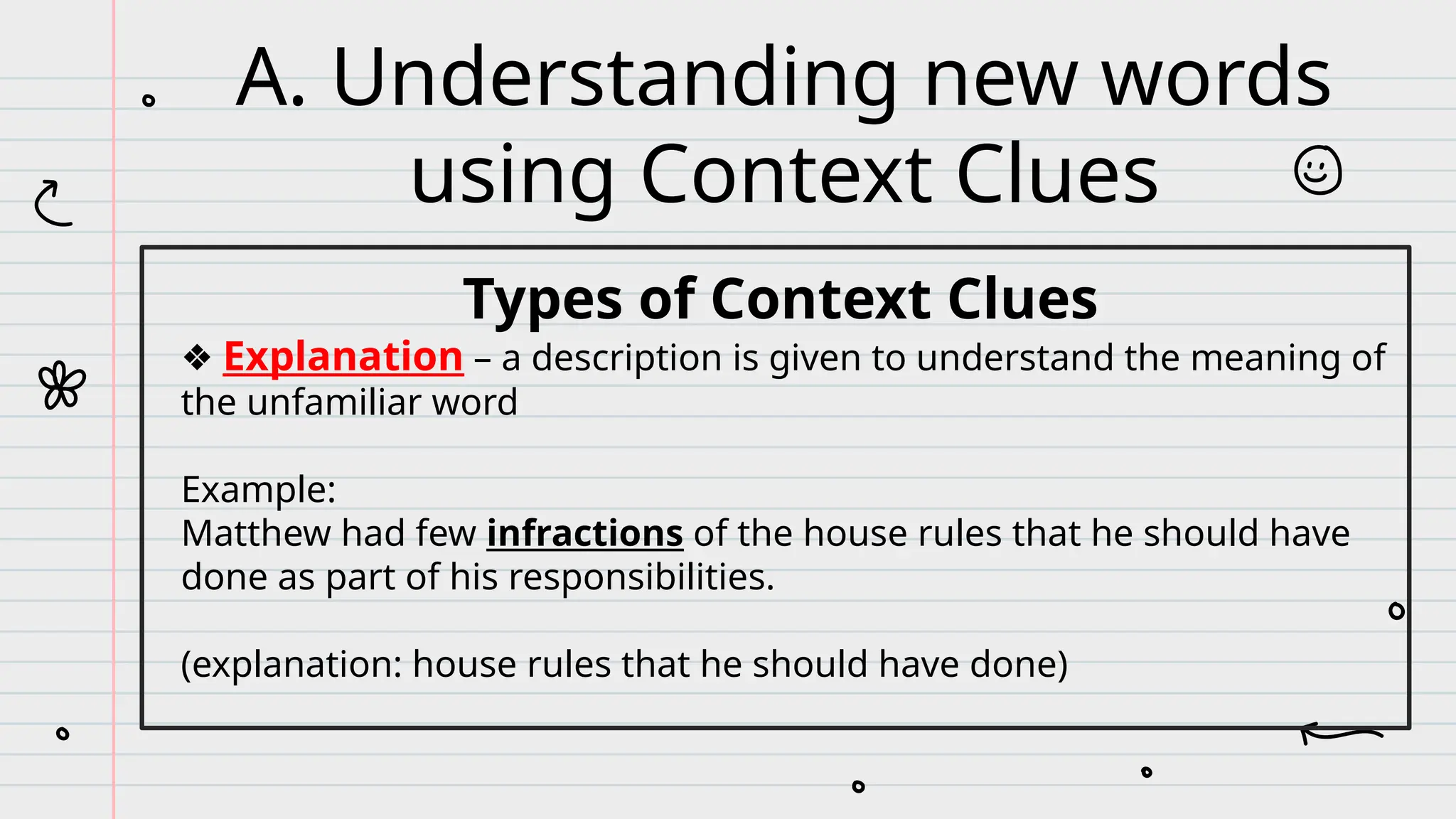
Types of Context Clues
❖ Explanation – a description is given to understand the meaning of
the unfamiliar word
Example:
Matthew had few infractions of the house rules that he should have
done as part of his responsibilities.
(explanation: house rules that he should have done)
A. Understanding new words
using Context Clues
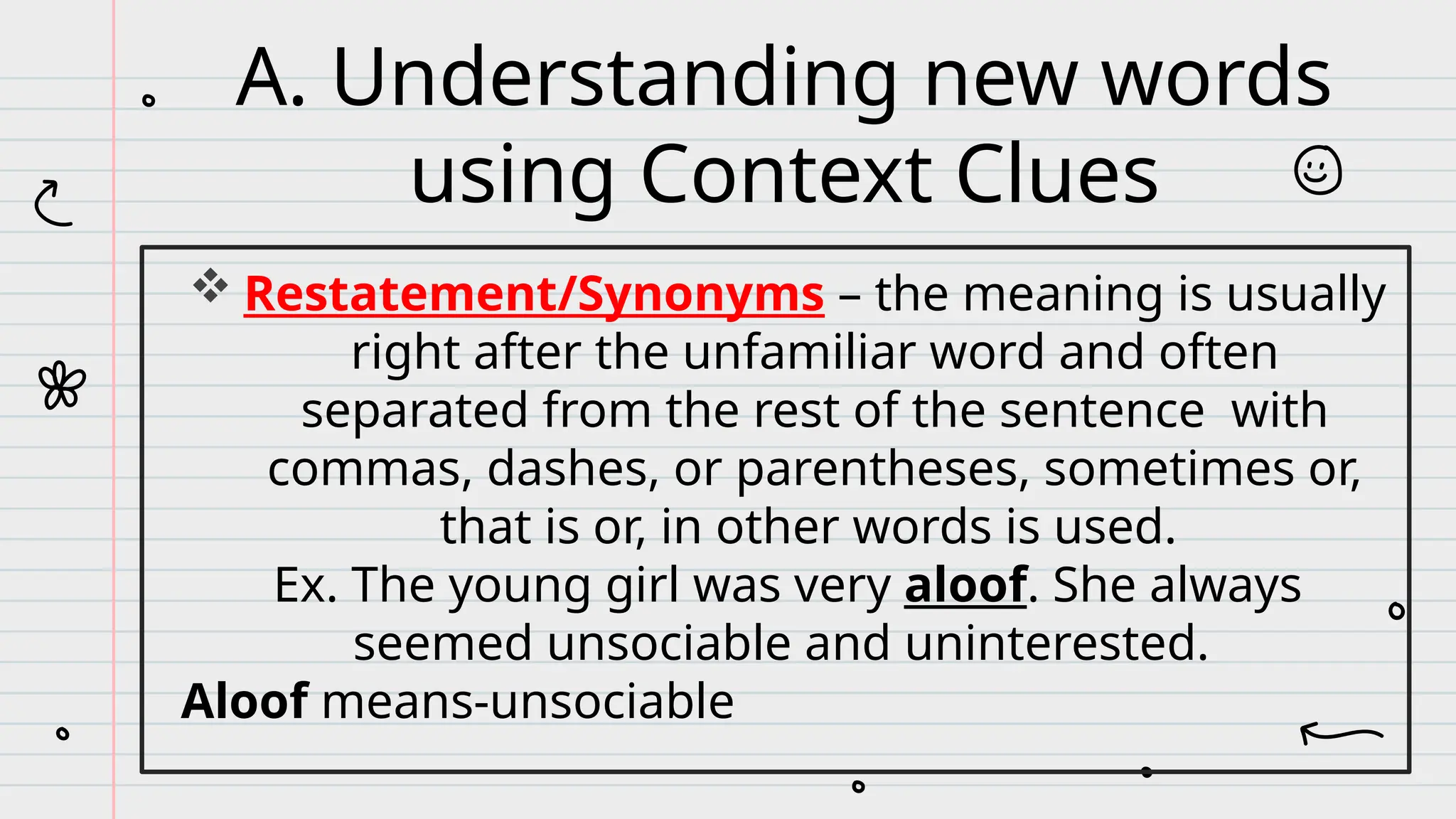
 Restatement/Synonyms – the meaning is usually
right after the unfamiliar word and often
separated from the rest of the sentence with
commas, dashes, or parentheses, sometimes or,
that is or, in other words is used.
Ex. The young girl was very aloof. She always
seemed unsociable and uninterested.
Aloof means-unsociable
A. Understanding new words
using Context Clues
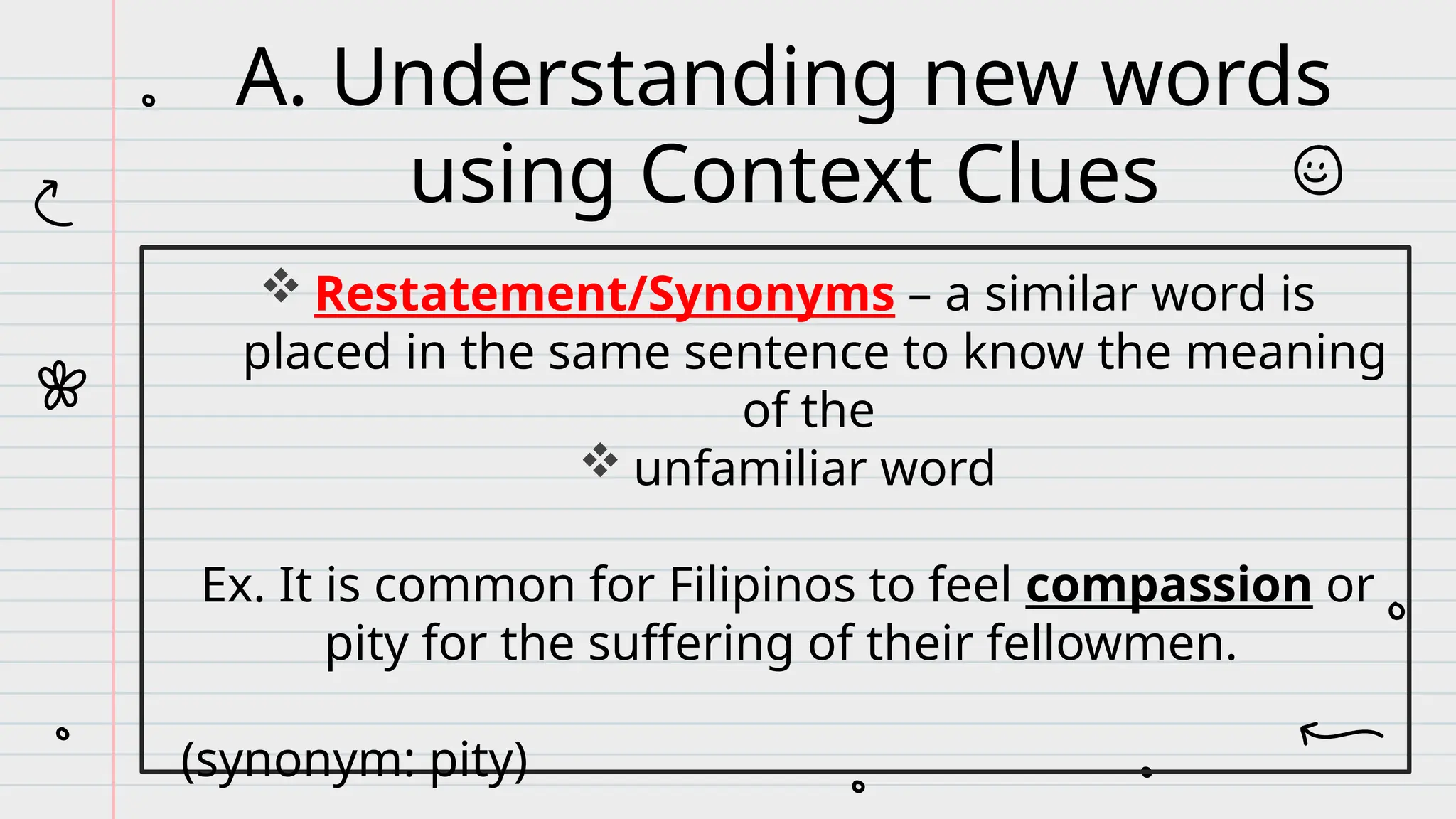
 Restatement/Synonyms – a similar word is
placed in the same sentence to know the meaning
of the
 unfamiliar word
Ex. It is common for Filipinos to feel compassion or
pity for the suffering of their fellowmen.
(synonym: pity)
A. Understanding new words
using Context Clues
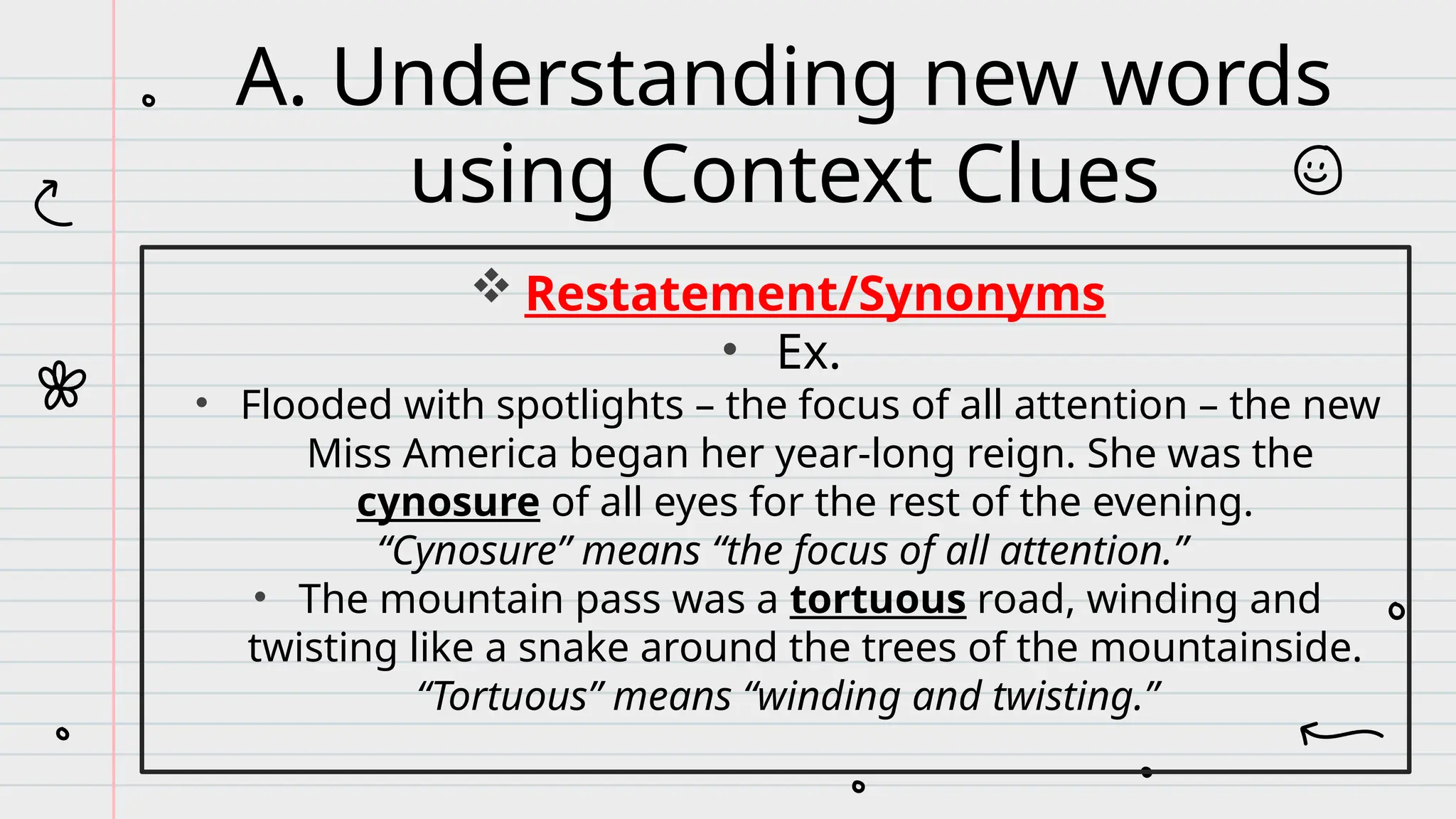
 Restatement/Synonyms
• Ex.
• Flooded with spotlights – the focus of all attention – the new
Miss America began her year-long reign. She was the
cynosure of all eyes for the rest of the evening.
“Cynosure” means “the focus of all attention.”
• The mountain pass was a tortuous road, winding and
twisting like a snake around the trees of the mountainside.
“Tortuous” means “winding and twisting.”
A. Understanding new words
using Context Clues
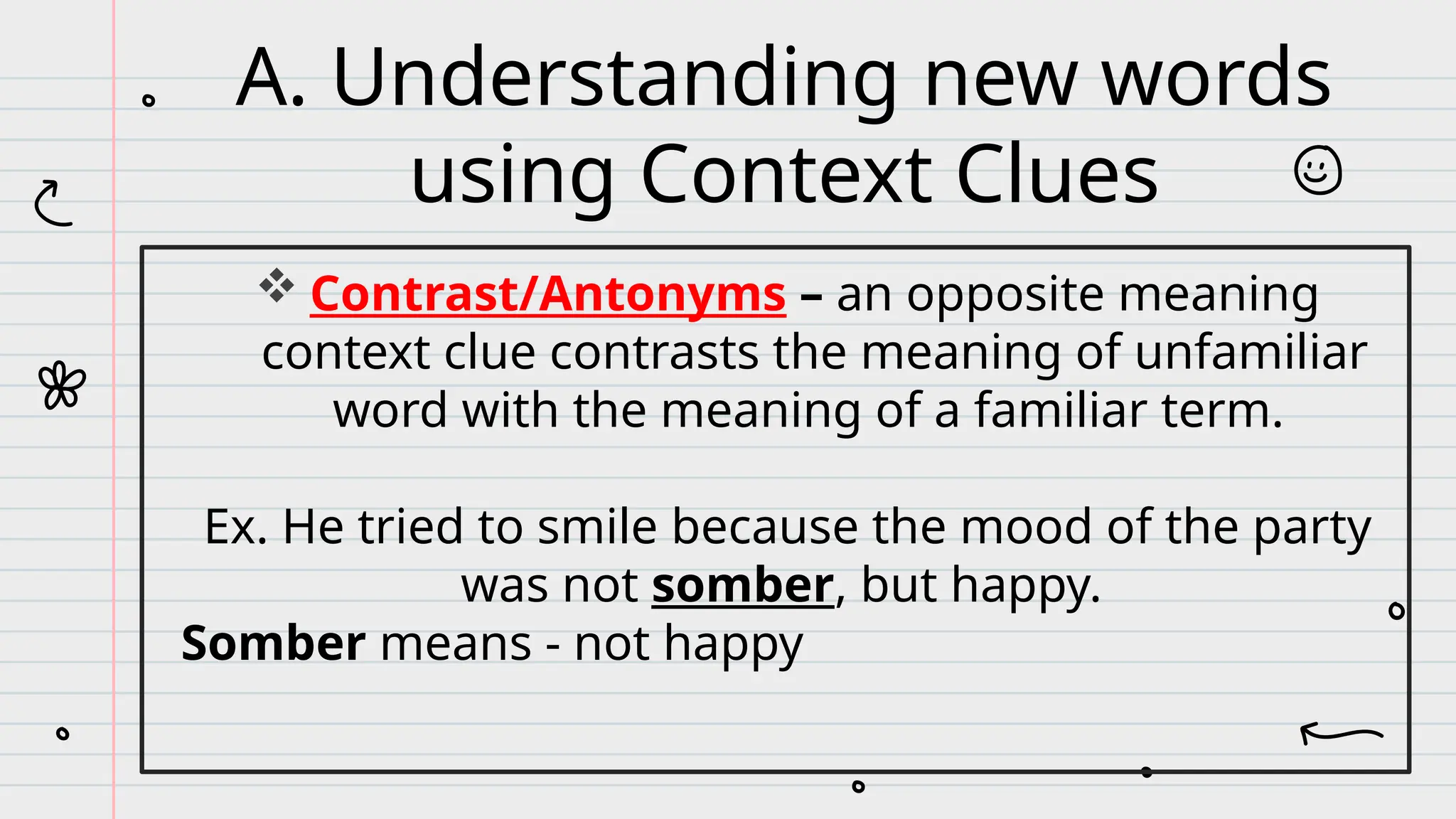
 Contrast/Antonyms – an opposite meaning
context clue contrasts the meaning of unfamiliar
word with the meaning of a familiar term.
Ex. He tried to smile because the mood of the party
was not somber, but happy.
Somber means - not happy
A. Understanding new words
using Context Clues
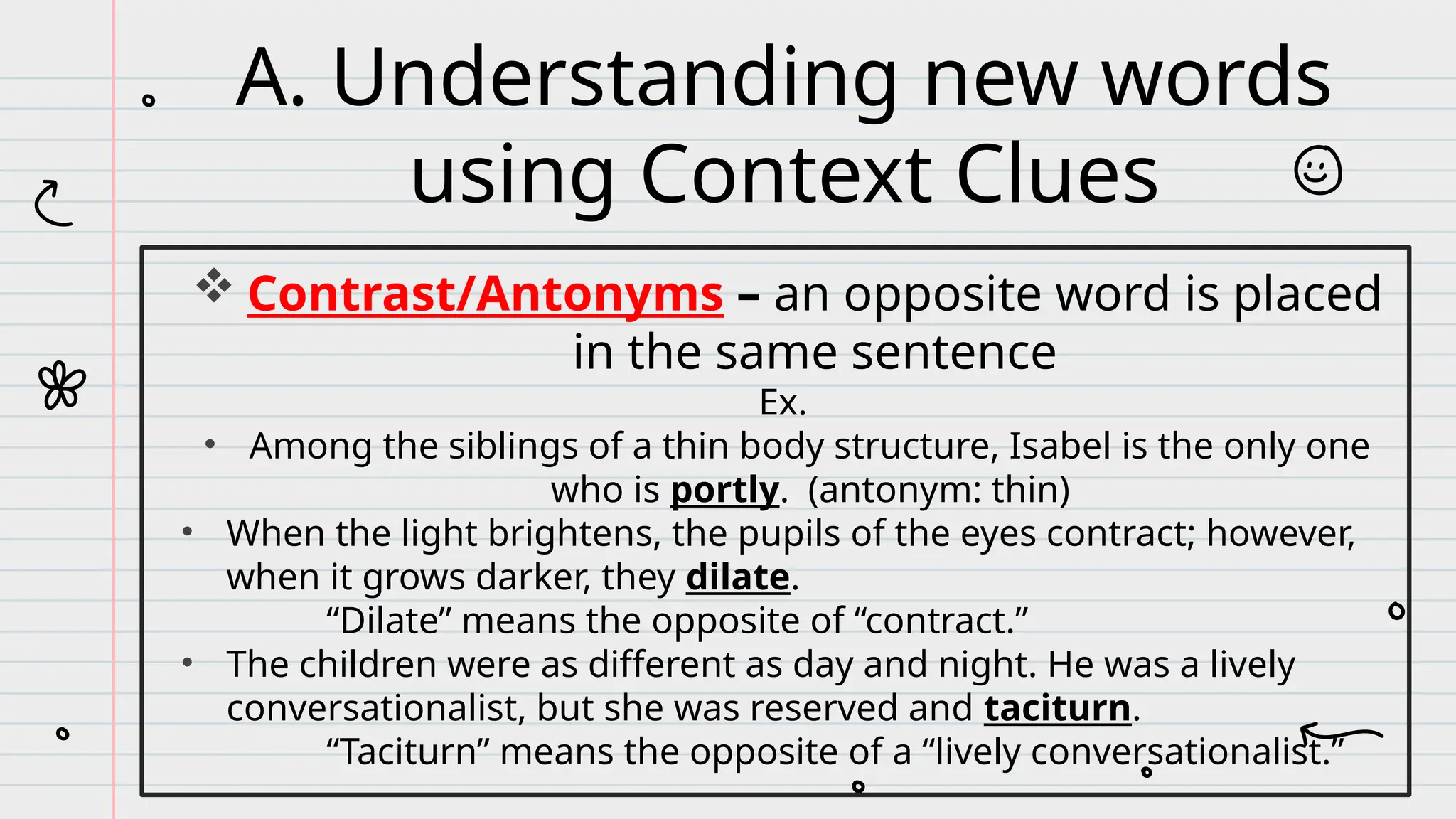
 Contrast/Antonyms – an opposite word is placed
in the same sentence
Ex.
• Among the siblings of a thin body structure, Isabel is the only one
who is portly. (antonym: thin)
• When the light brightens, the pupils of the eyes contract; however,
when it grows darker, they dilate.
“Dilate” means the opposite of “contract.”
• The children were as different as day and night. He was a lively
conversationalist, but she was reserved and taciturn.
“Taciturn” means the opposite of a “lively conversationalist.”
A. Understanding new words
using Context Clues
 Inference/General –the meaning of the unfamiliar
word can be inferred or understood from the
description or a situation.
Ex. The school nurse states that she would require free
reign in overseeing the children. “These two need
discipline, and I intend to provide it.”
The nurse wants the freedom to discipline the two
children her way because she noticed how undisciplined
they already are, and she is determined to provide it all by
herself.
A. Understanding new words
using Context Clues
 Inference/General – to understand the meaning of
the unknown word, one has to make a guess
based on the description given in the sentence
Example: When one shows hospitality, kind words
and welcoming actions can be observed among
Filipinos.
(description: kind words, welcoming actions)
A. Understanding new words
using Context Clues
 by Comparison • a similar word with the same
meaning of the unfamiliar word is placed with an
object to be compared
Example: The stench of the garbage was like the
smell of a rotten fish.
(comparison: rotten fish, means bad odor)
A. Understanding new words
using Context Clues
 by Example - samples are provided in the sentence
to understand the meaning of the unfamiliar word.
Words like including, such as, and for example, point
out example clues.
Example: In ancient times, some of our forefathers
believed in amulets, such as pearl of the crocodile,
pearl of the ax, bullet necklace, and bag of herbs to
protect them from harm.
(example: pearl of the crocodile, pearl of the ax, bullet necklace,
bag of herbs)
A. Understanding new words
using Context Clues
Examples:
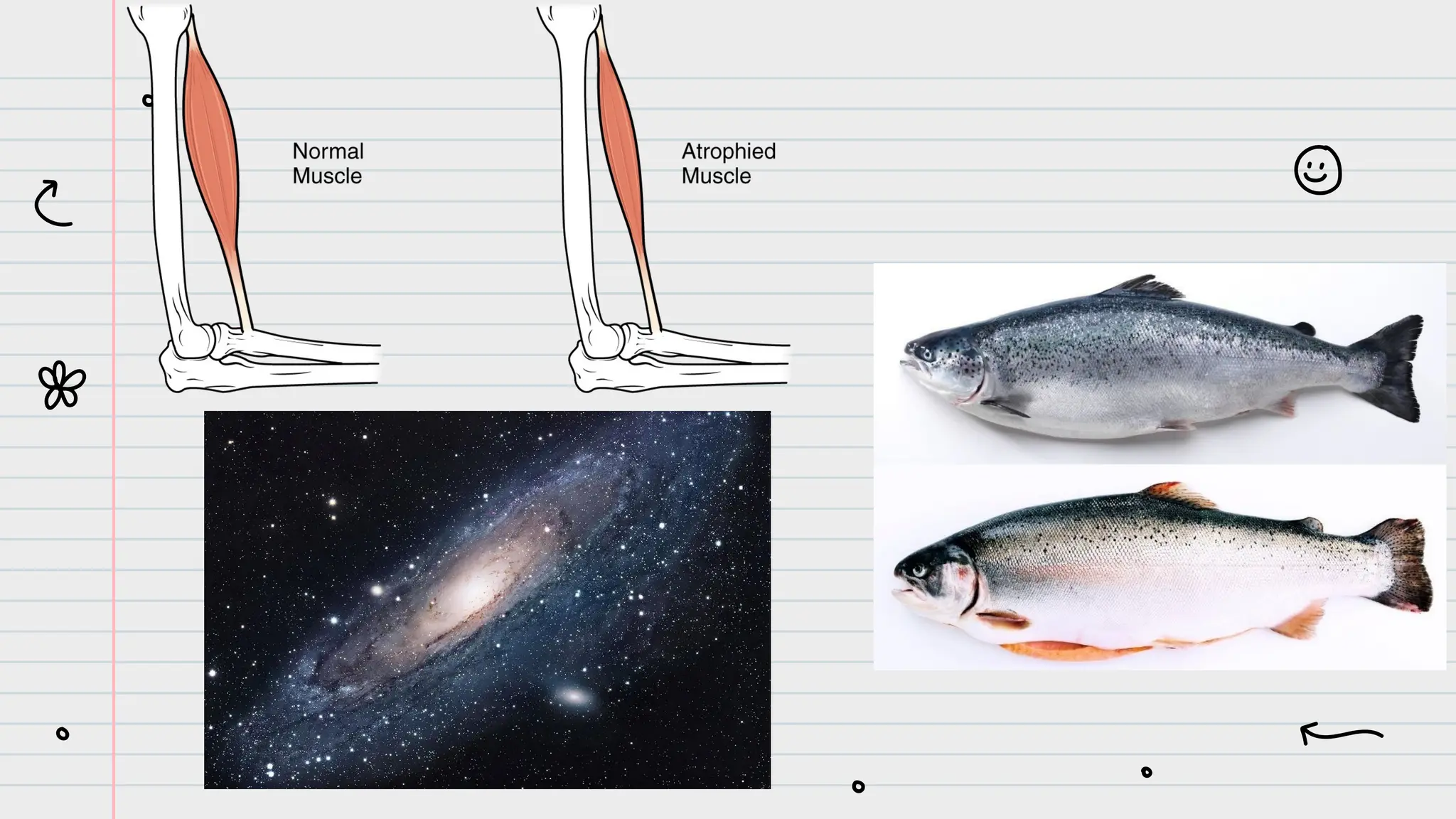
a. Piscatorial creatures, such as flounder, salmon, and trout, live in
the coldest parts of the ocean.
“Piscatorial” obviously refers to fish.
b. Celestial bodies, including the sun, moon, and stars, have
fascinated man through the centuries.
“Celestial” objects are those in the sky or heavens.
c. In the course of man’s evolution, certain organs have atrophied.
The appendix, for example, has wasted away from disuse.
“Atrophied” means “wasted away.”
A. Understanding new words
using Context Clues
 by Cause and Effect- the meaning of the difficult
word depends on the cause-effect relationship of
other words as expressed in the sentence
Example: Since only a few followed the wearing of
face mask, it was made mandatory by the
government.
(cause: only a few followed the wearing of face mask)
A. Understanding new words
using Context Clues
 by Cause and Effect- Words like “because,” “since,”
“therefore,” “thus,” “so,” etc. may signal context
clues.
Example:
She wanted to impress all her dinner guests with the
food she served, so she carefully studied the
necessary culinary arts.
“Culinary” means “food preparation.”
A. Understanding new words
using Context Clues
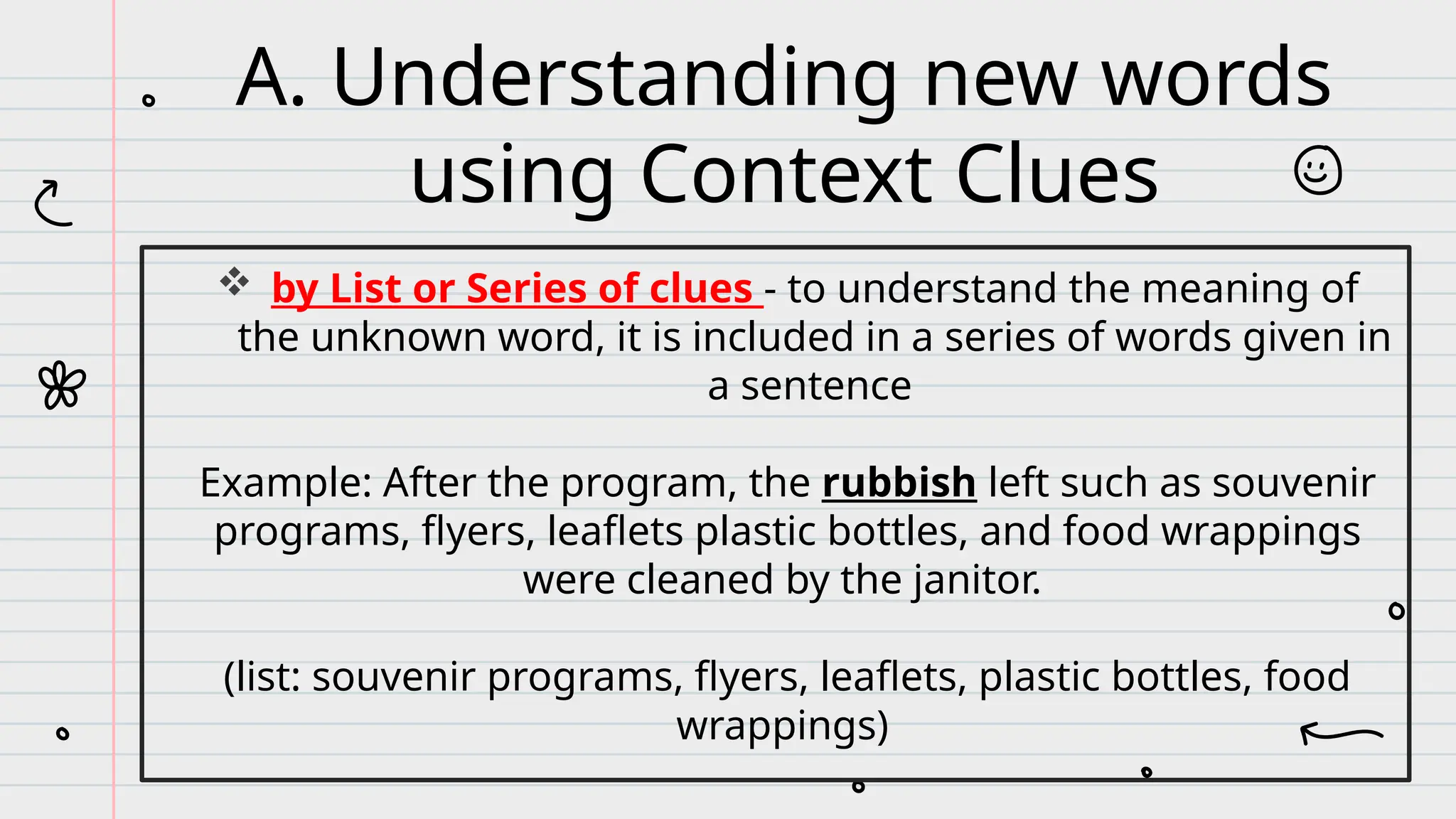
 by List or Series of clues - to understand the meaning of
the unknown word, it is included in a series of words given in
a sentence
Example: After the program, the rubbish left such as souvenir
programs, flyers, leaflets plastic bottles, and food wrappings
were cleaned by the janitor.
(list: souvenir programs, flyers, leaflets, plastic bottles, food
wrappings)
A. Understanding new words
using Context Clues
Directions: Choose the meaning of the underlined words
through context clues. Write your answers on a separate sheet
of paper.
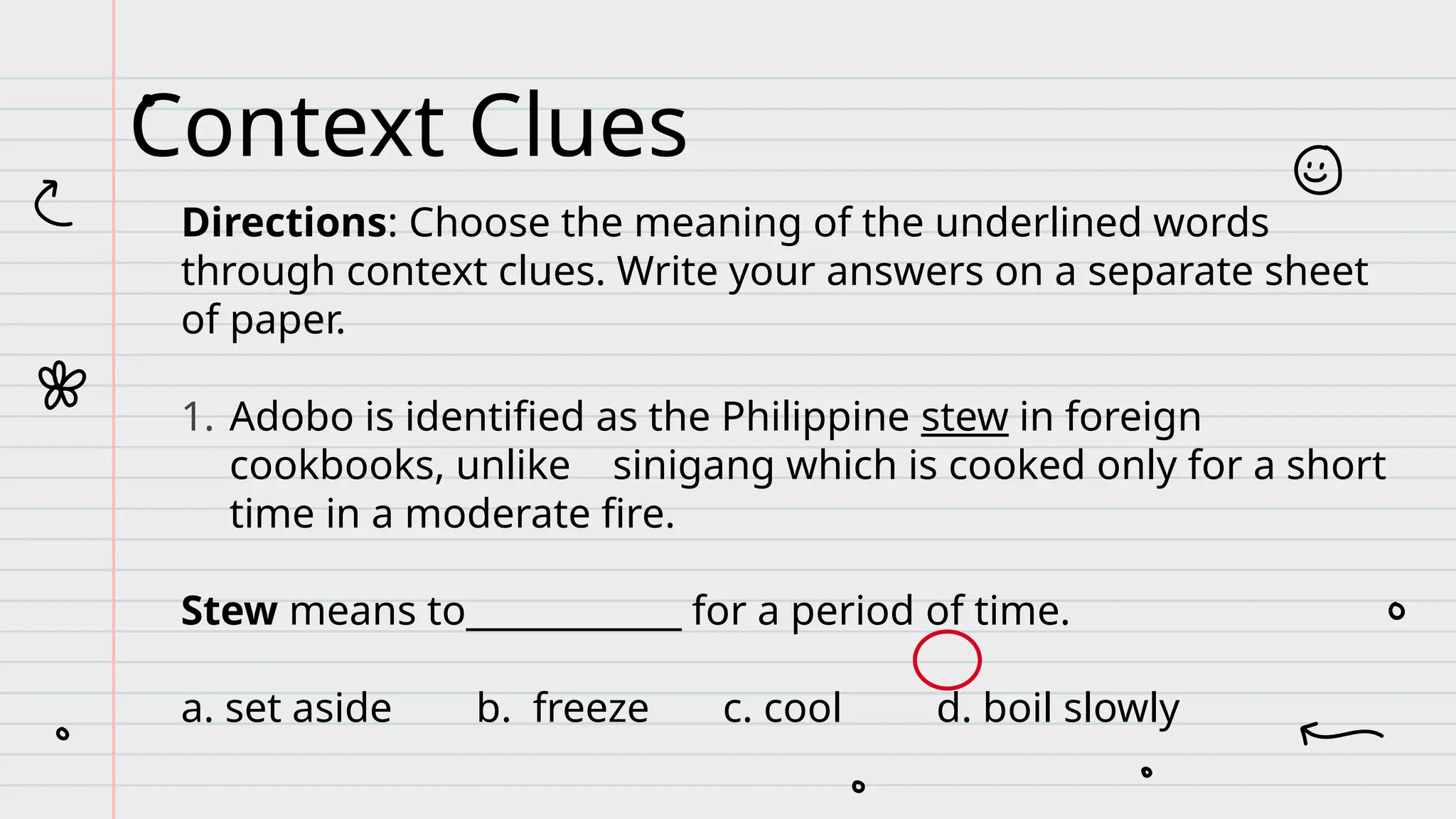
1. Adobo is identified as the Philippine stew in foreign
cookbooks, unlike sinigang which is cooked only for a short
time in a moderate fire.
Stew means to____________ for a period of time.
a. set aside b. freeze c. cool d. boil slowly
Context Clues
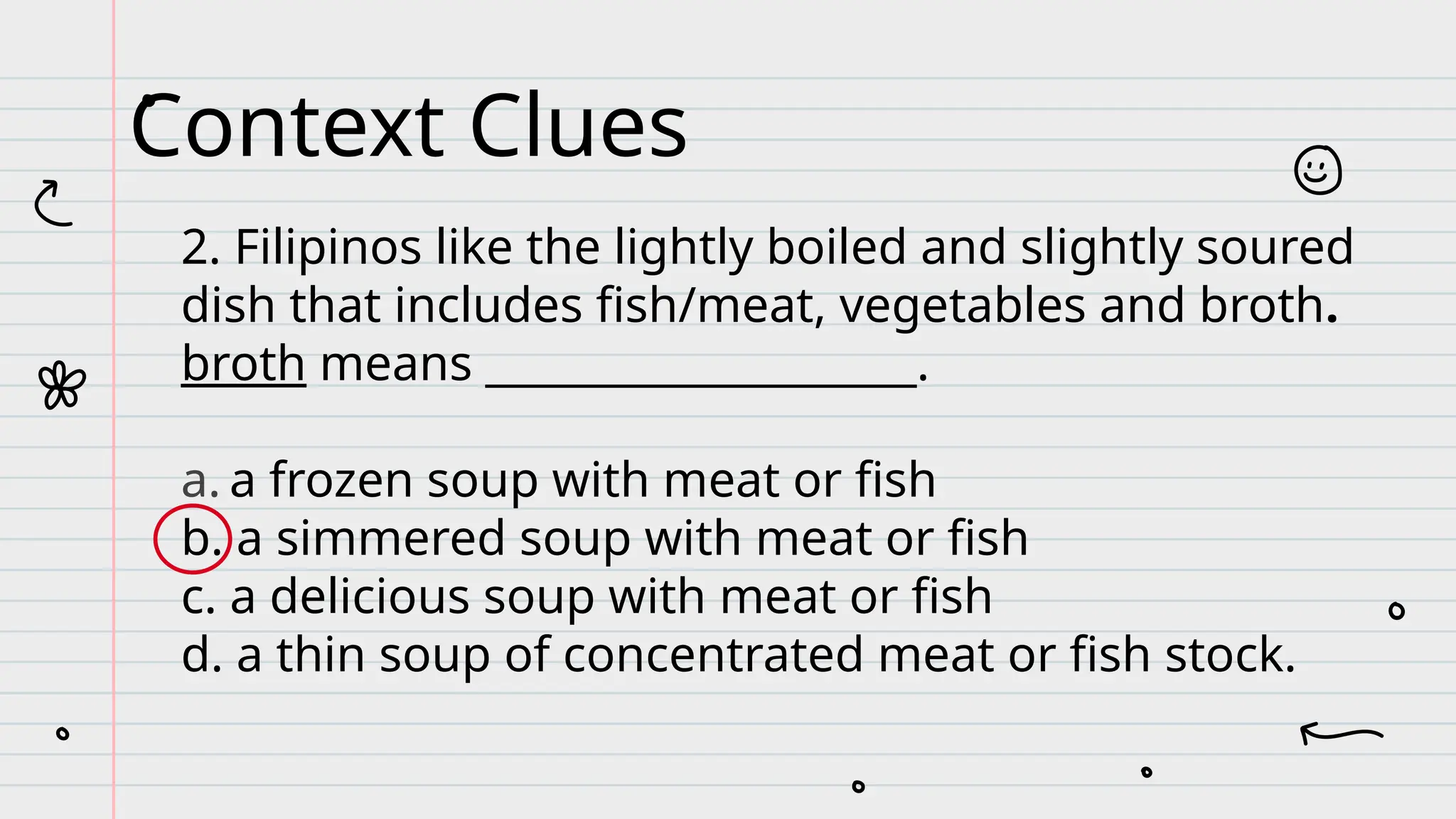
2. Filipinos like the lightly boiled and slightly soured
dish that includes fish/meat, vegetables and broth.
broth means ____________________.
a. a frozen soup with meat or fish
b. a simmered soup with meat or fish
c. a delicious soup with meat or fish
d. a thin soup of concentrated meat or fish stock.
Context Clues
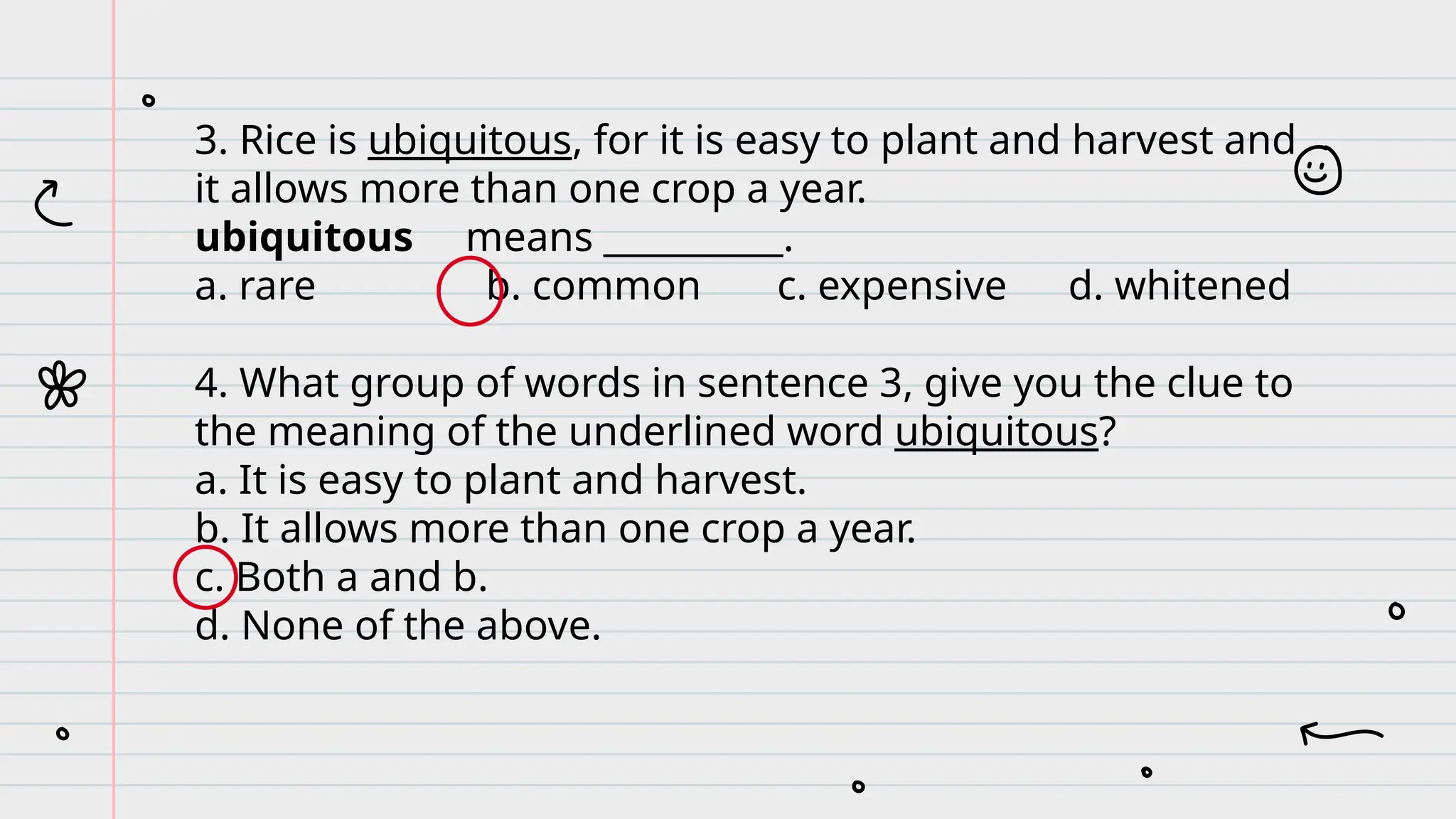
3. Rice is ubiquitous, for it is easy to plant and harvest and
it allows more than one crop a year.
ubiquitous means __________.
a. rare b. common c. expensive d. whitened
4. What group of words in sentence 3, give you the clue to
the meaning of the underlined word ubiquitous?
a. It is easy to plant and harvest.
b. It allows more than one crop a year.
c. Both a and b.
d. None of the above.
5. Sinigang is commonly served in the most
expensive restaurants and to gleaming ilustrado
table.
The Spanish word ilustrado means ____________.
a. rich b. famous
c. educated d. uneducated
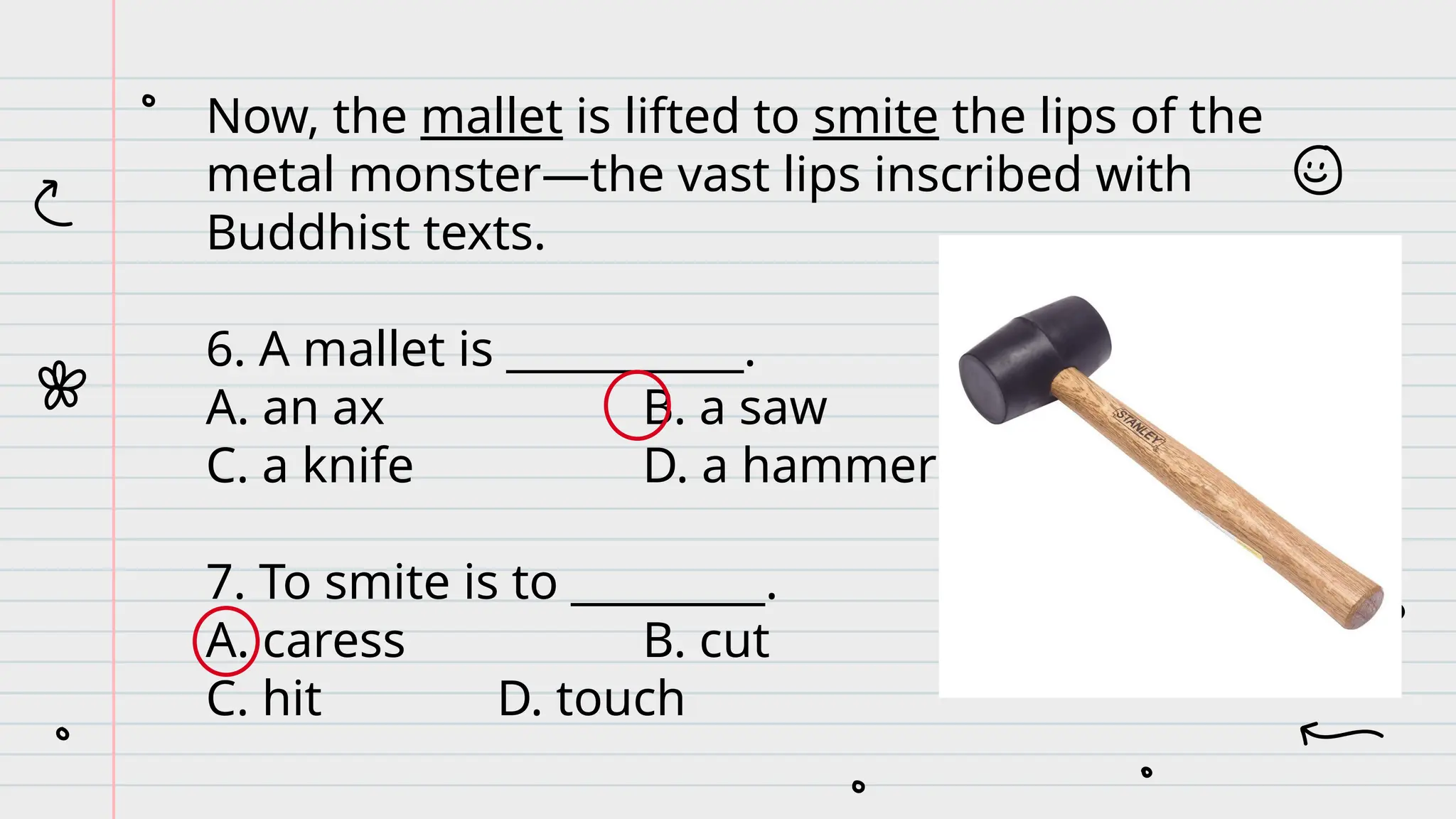
Now, the mallet is lifted to smite the lips of the
metal monster—the vast lips inscribed with
Buddhist texts.
6. A mallet is ___________.
A. an ax B. a saw
C. a knife D. a hammer
7. To smite is to _________.
A. caress B. cut
C. hit D. touch
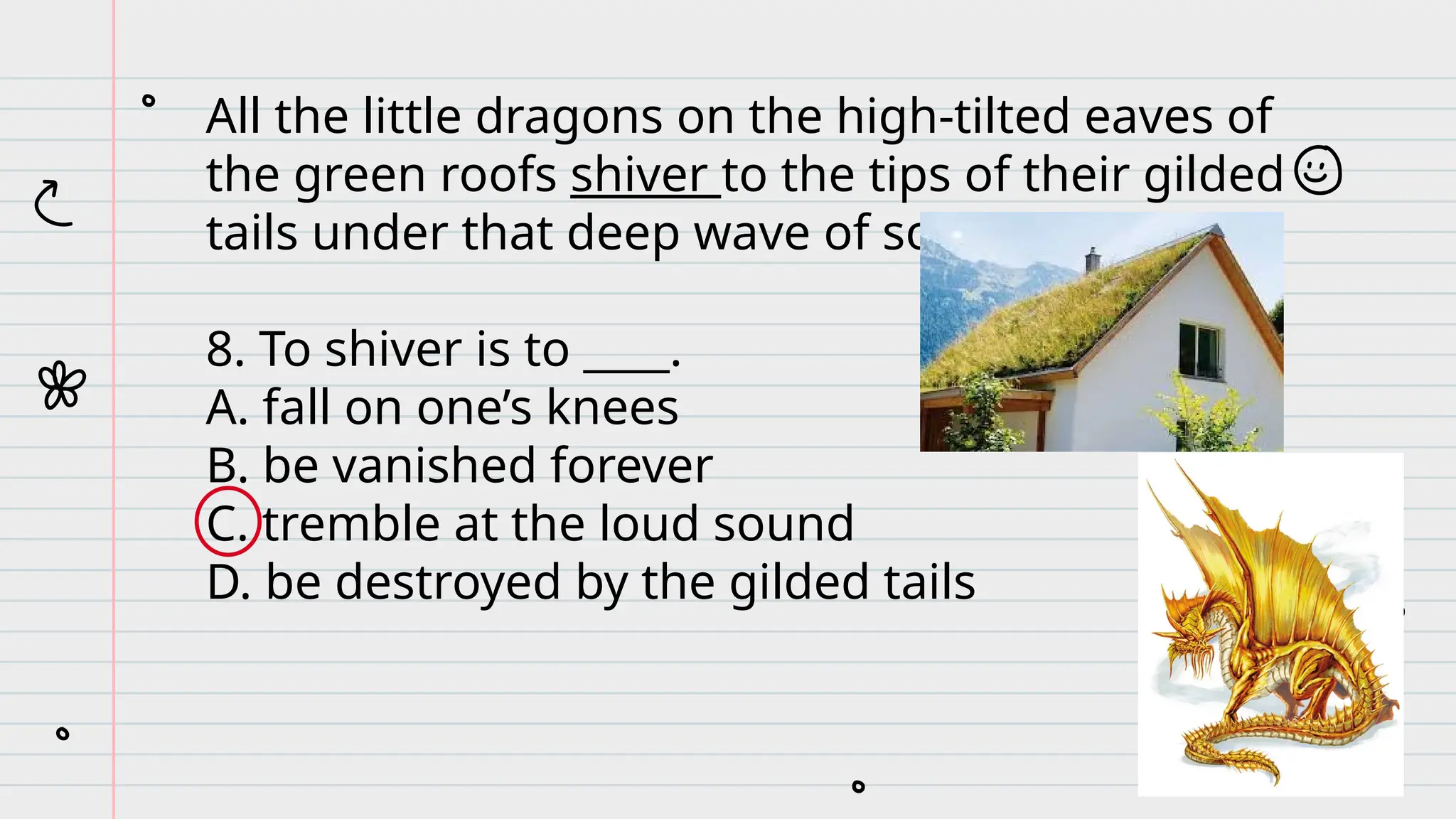
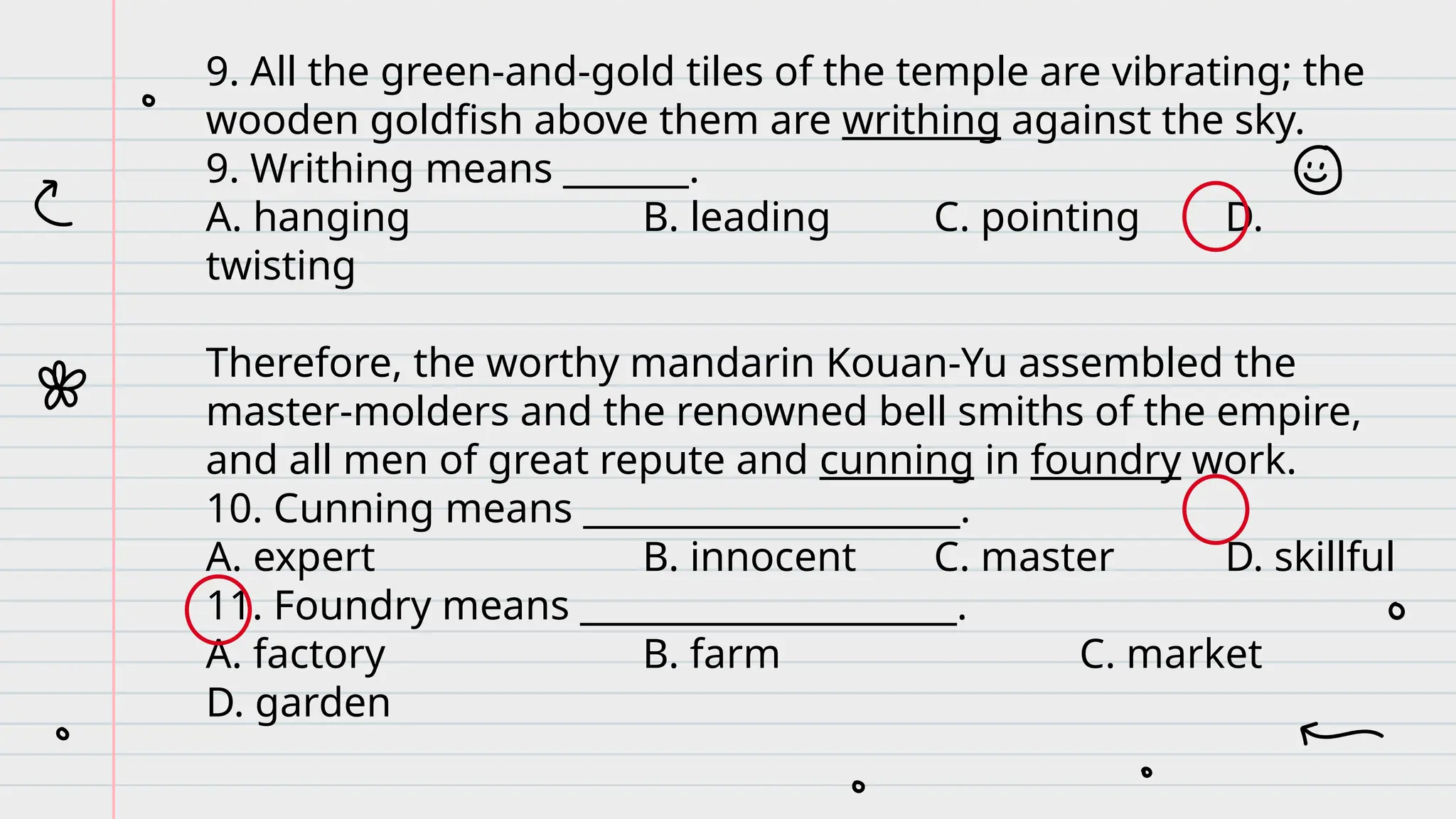
All the little dragons on the high-tilted eaves of
the green roofs shiver to the tips of their gilded
tails under that deep wave of sound.
8. To shiver is to ____.
A. fall on one’s knees
B. be vanished forever
C. tremble at the loud sound
D. be destroyed by the gilded tails
9. All the green-and-gold tiles of the temple are vibrating; the
wooden goldfish above them are writhing against the sky.
9. Writhing means _______.
A. hanging B. leading C. pointing D.
twisting
Therefore, the worthy mandarin Kouan-Yu assembled the
master-molders and the renowned bell smiths of the empire,
and all men of great repute and cunning in foundry work.
10. Cunning means _____________________.
A. expert B. innocent C. master D. skillful
11. Foundry means _____________________.
A. factory B. farm C. market
D. garden
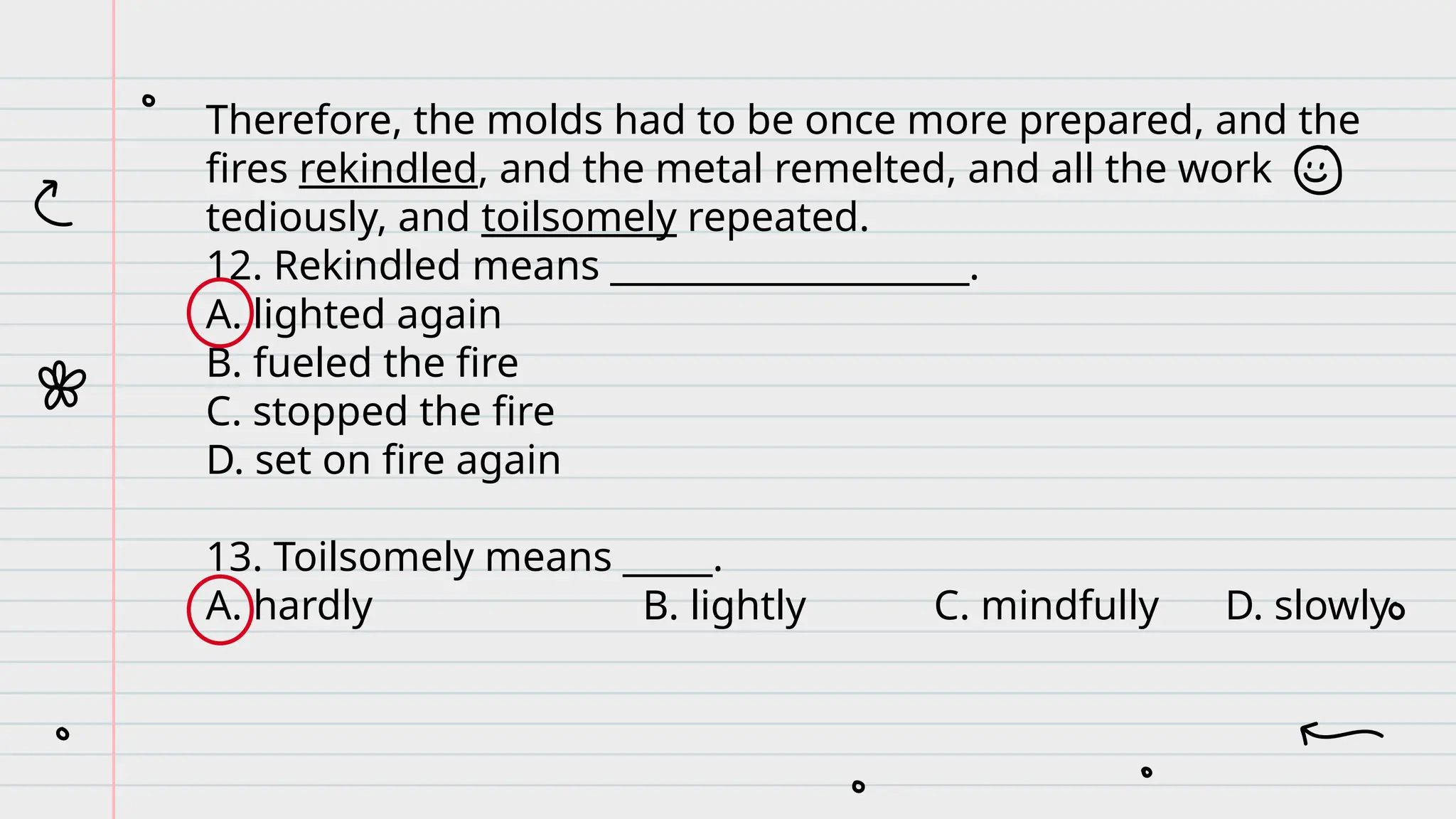
Therefore, the molds had to be once more prepared, and the
fires rekindled, and the metal remelted, and all the work
tediously, and toilsomely repeated.
12. Rekindled means ____________________.
A. lighted again
B. fueled the fire
C. stopped the fire
D. set on fire again
13. Toilsomely means _____.
A. hardly B. lightly C. mindfully D. slowly
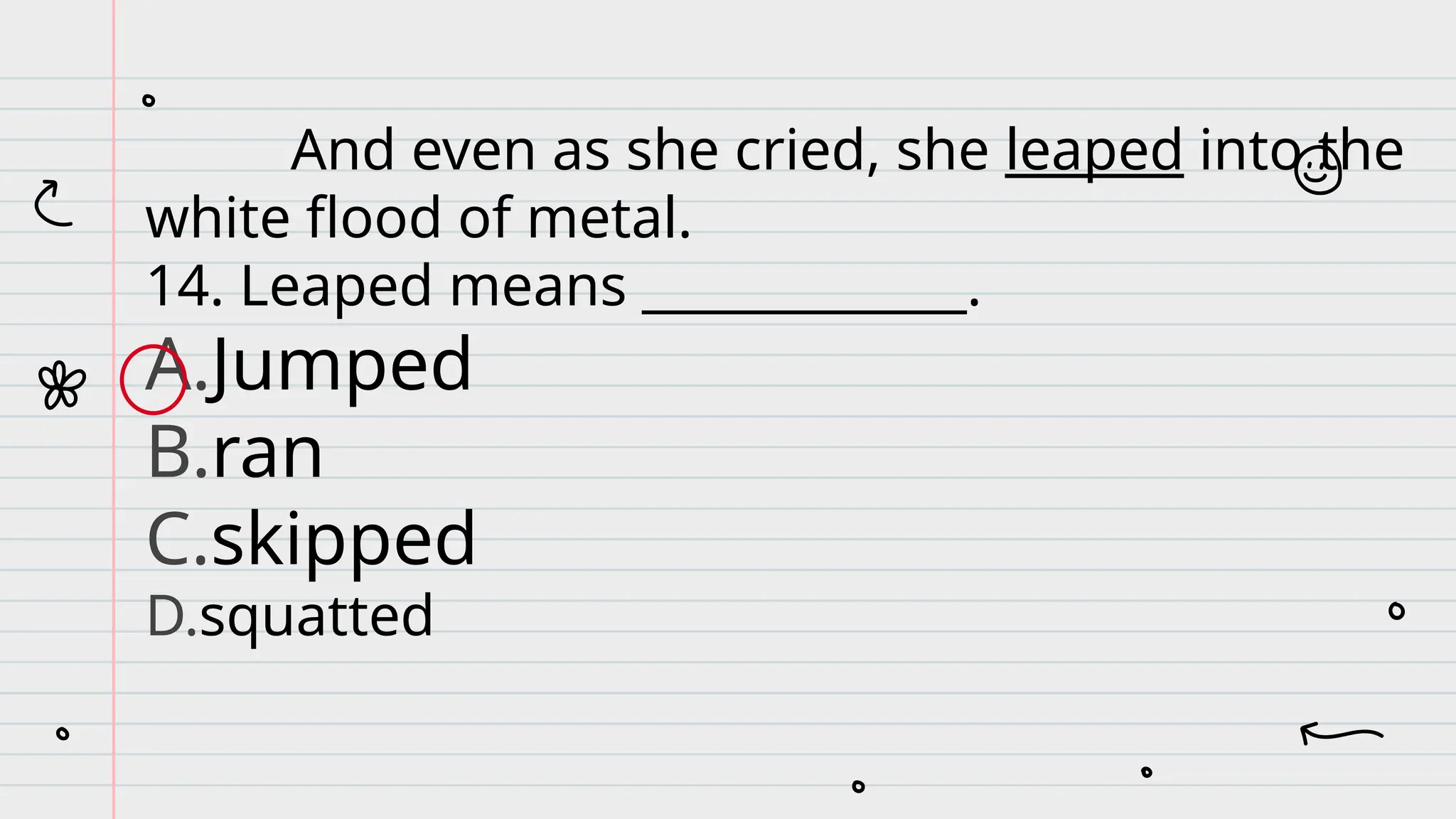
And even as she cried, she leaped into the
white flood of metal.
14. Leaped means _____________.
A.Jumped
B.ran
C.skipped
D.squatted
ASSESSMENT:
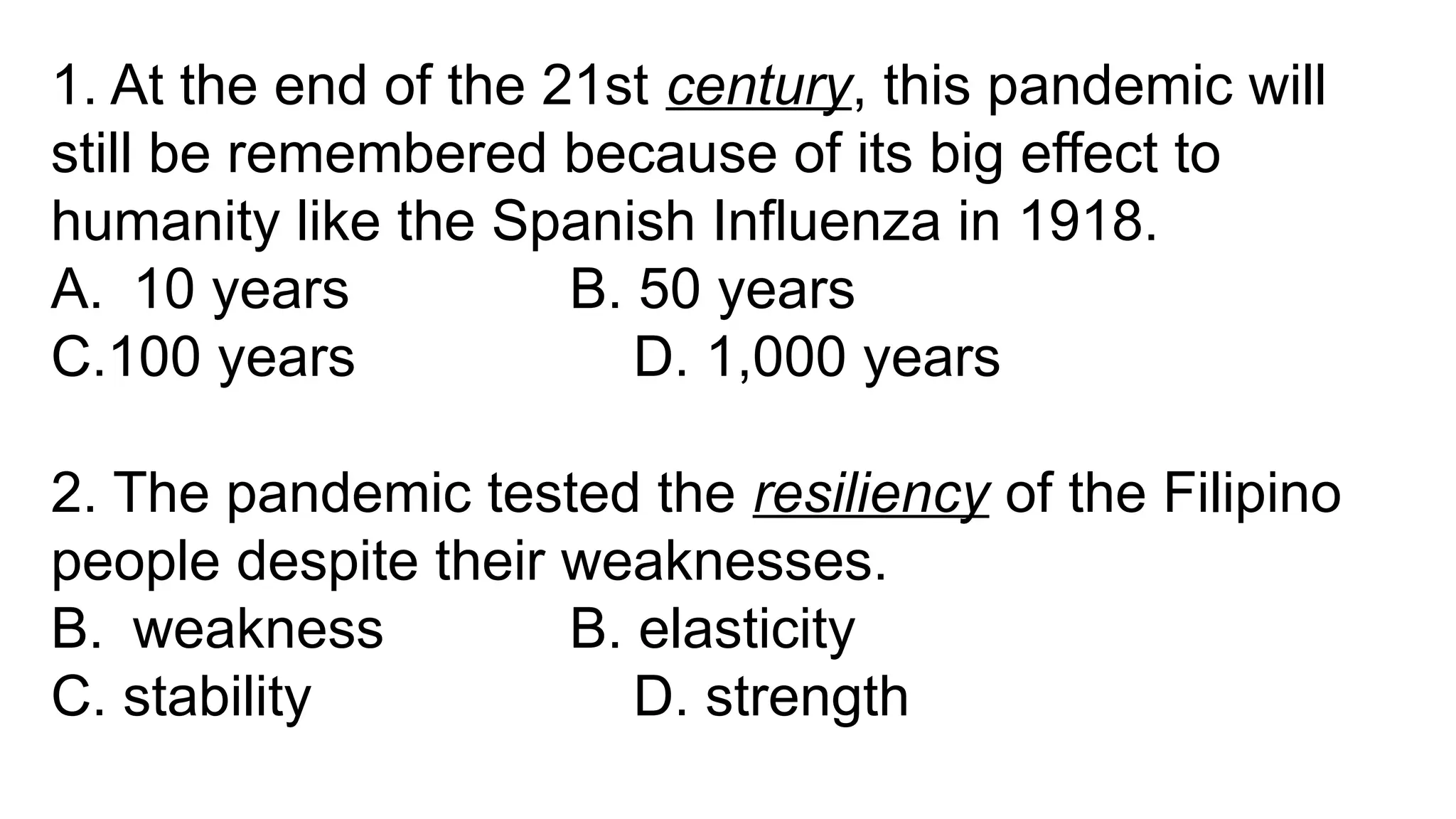
1. At the end of the 21st century, this pandemic will
still be remembered because of its big effect to
humanity like the Spanish Influenza in 1918.
A. 10 years B. 50 years
C.100 years D. 1,000 years
2. The pandemic tested the resiliency of the Filipino
people despite their weaknesses.
B. weakness B. elasticity
C. stability D. strength
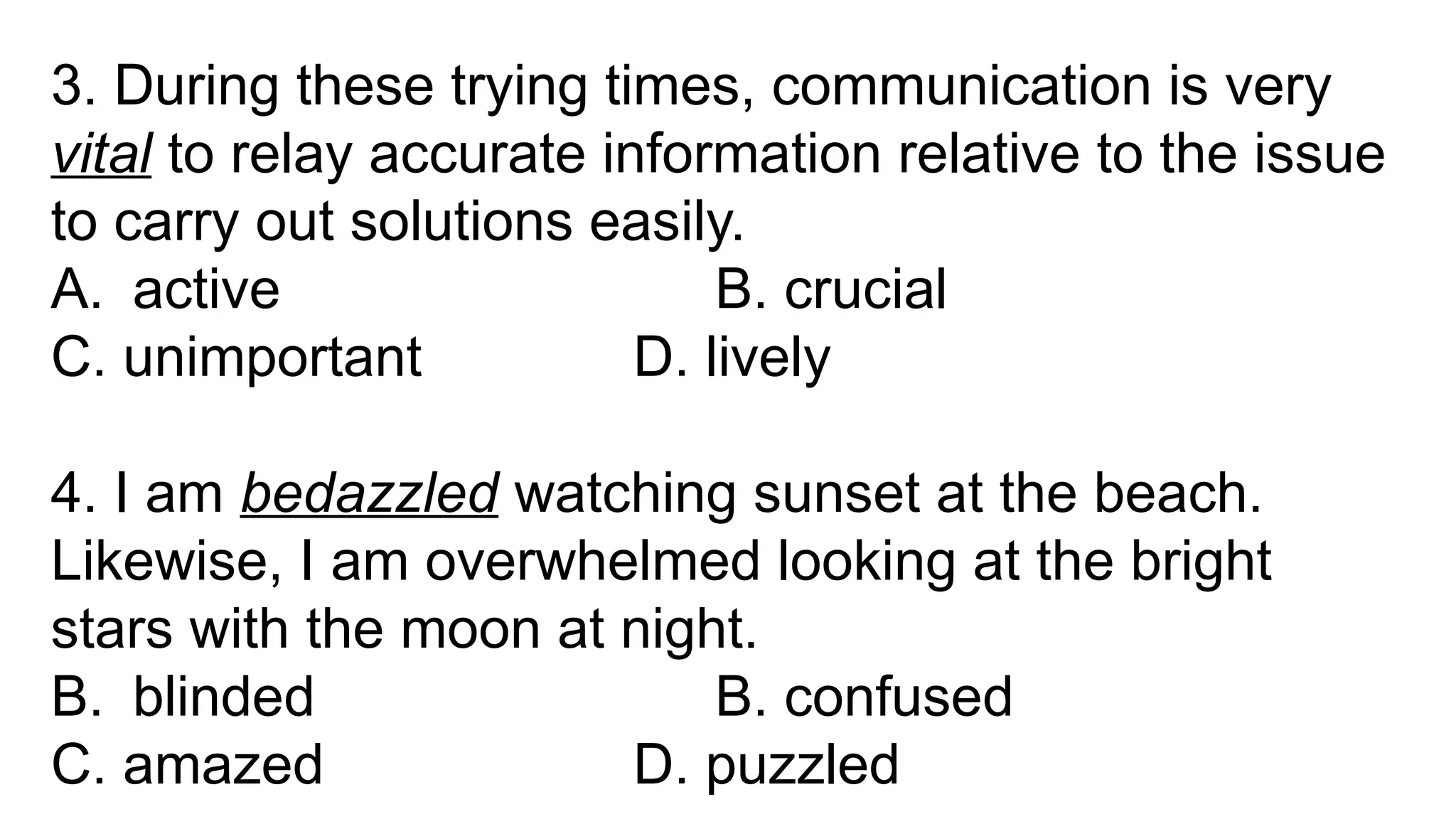
3. During these trying times, communication is very
vital to relay accurate information relative to the issue
to carry out solutions easily.
A. active B. crucial
C. unimportant D. lively
4. I am bedazzled watching sunset at the beach.
Likewise, I am overwhelmed looking at the bright
stars with the moon at night.
B. blinded B. confused
C. amazed D. puzzled
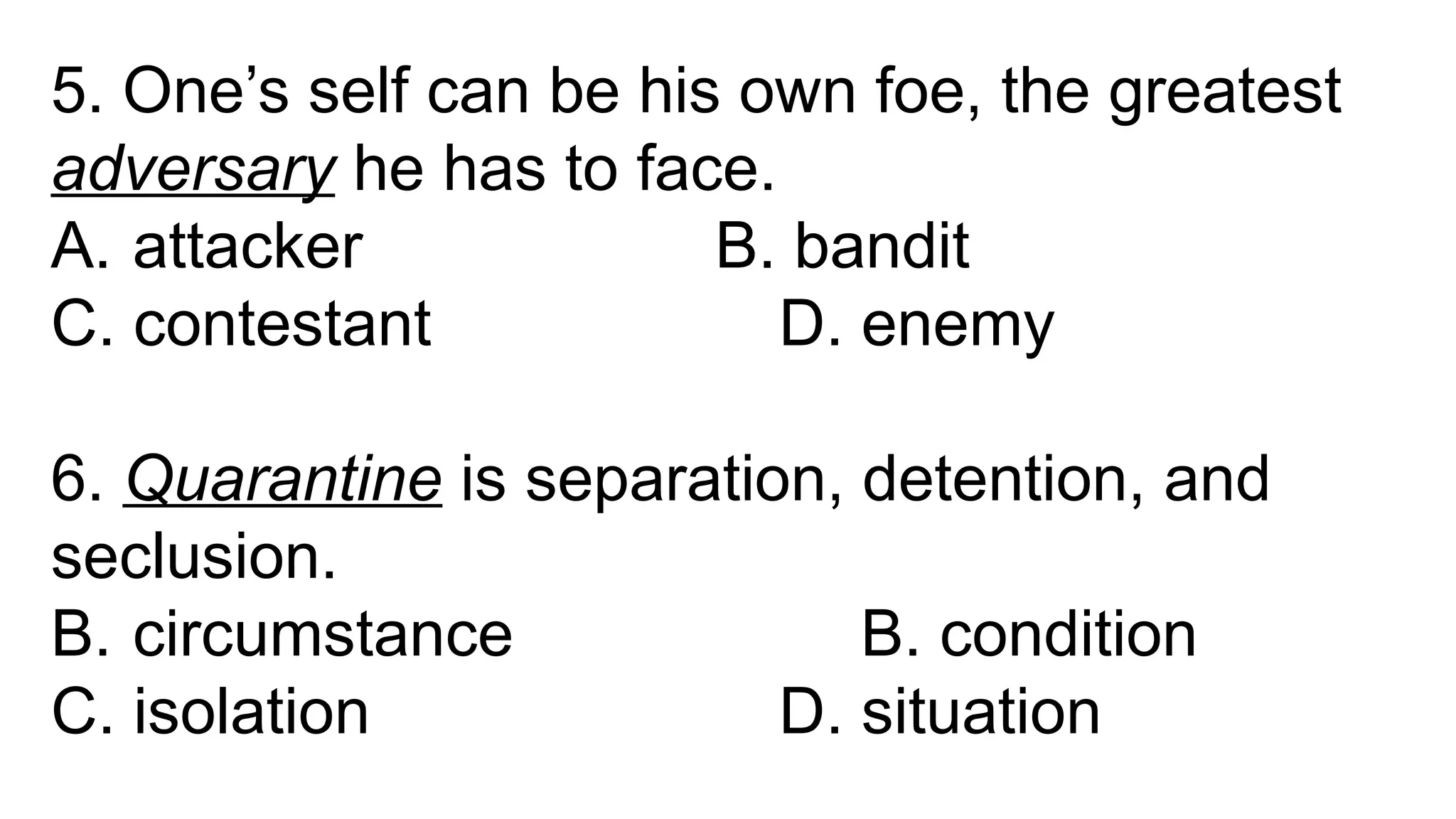
5. One’s self can be his own foe, the greatest
adversary he has to face.
A. attacker B. bandit
C. contestant D. enemy
6. Quarantine is separation, detention, and
seclusion.
B. circumstance B. condition
C. isolation D. situation
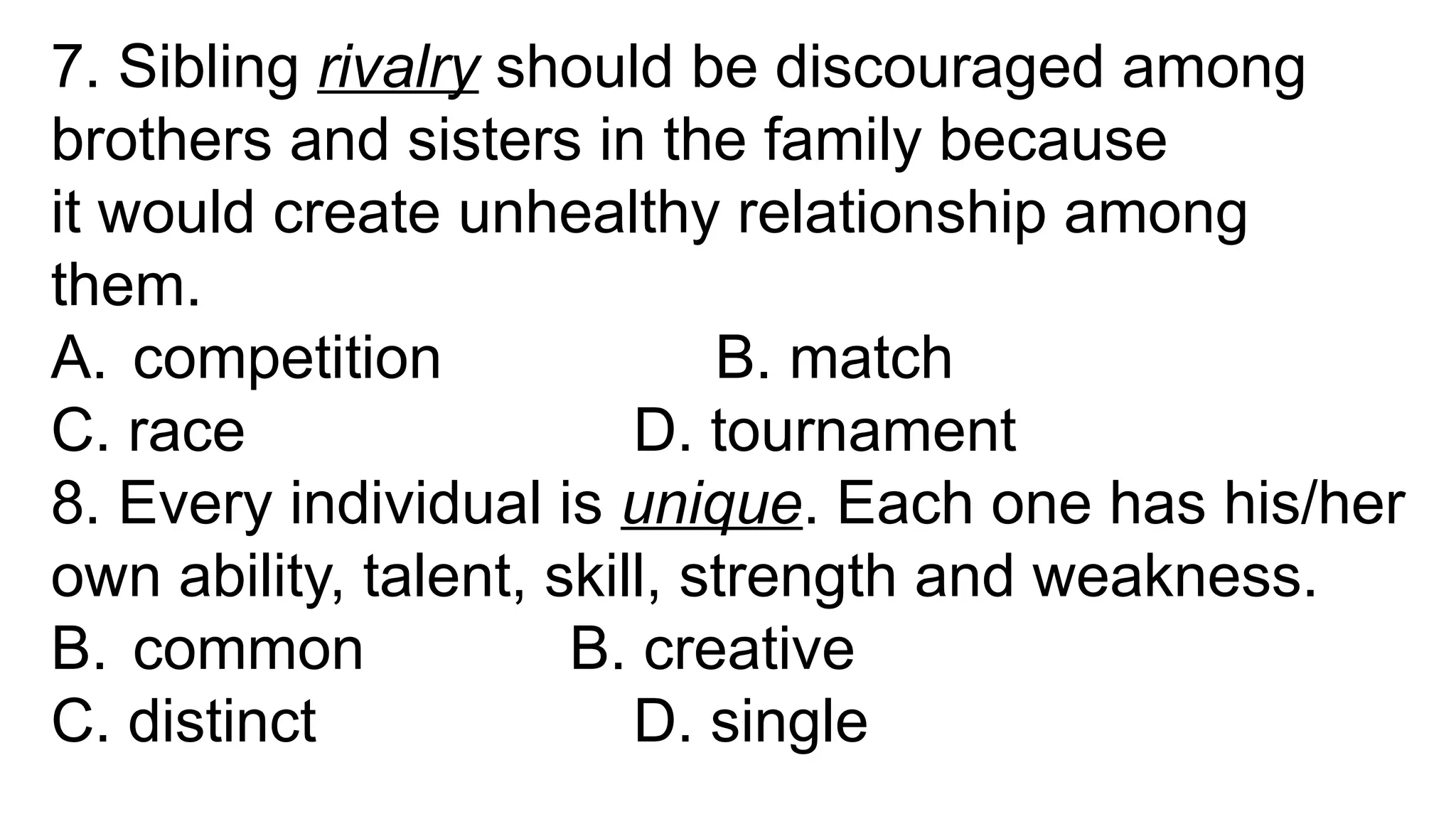
7. Sibling rivalry should be discouraged among
brothers and sisters in the family because
it would create unhealthy relationship among
them.
A. competition B. match
C. race D. tournament
8. Every individual is unique. Each one has his/her
own ability, talent, skill, strength and weakness.
B. common B. creative
C. distinct D. single
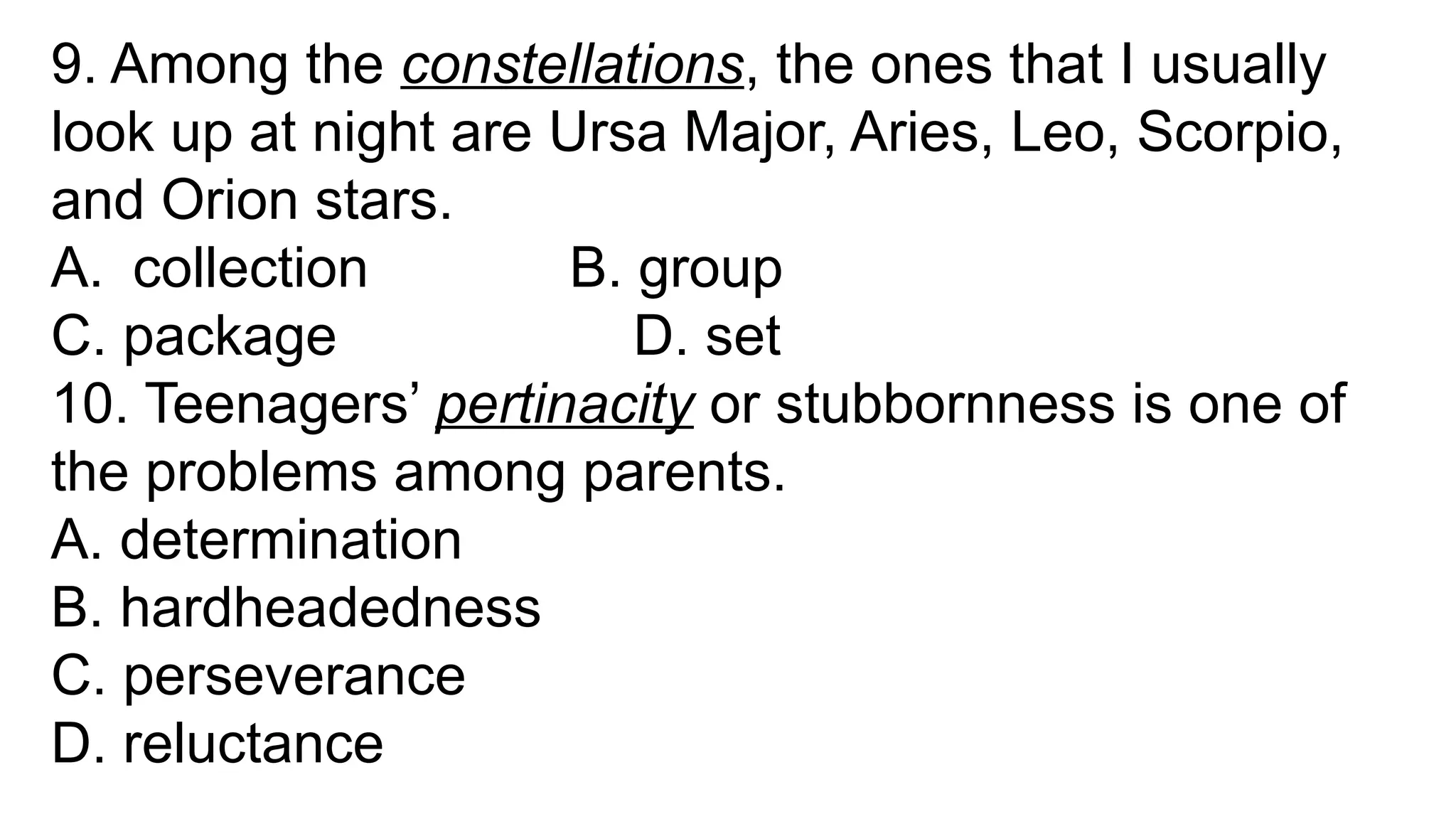
9. Among the constellations, the ones that I usually
look up at night are Ursa Major, Aries, Leo, Scorpio,
and Orion stars.
A. collection B. group
C. package D. set
10. Teenagers’ pertinacity or stubbornness is one of
the problems among parents.
A. determination
B. hardheadedness
C. perseverance
D. reluctance
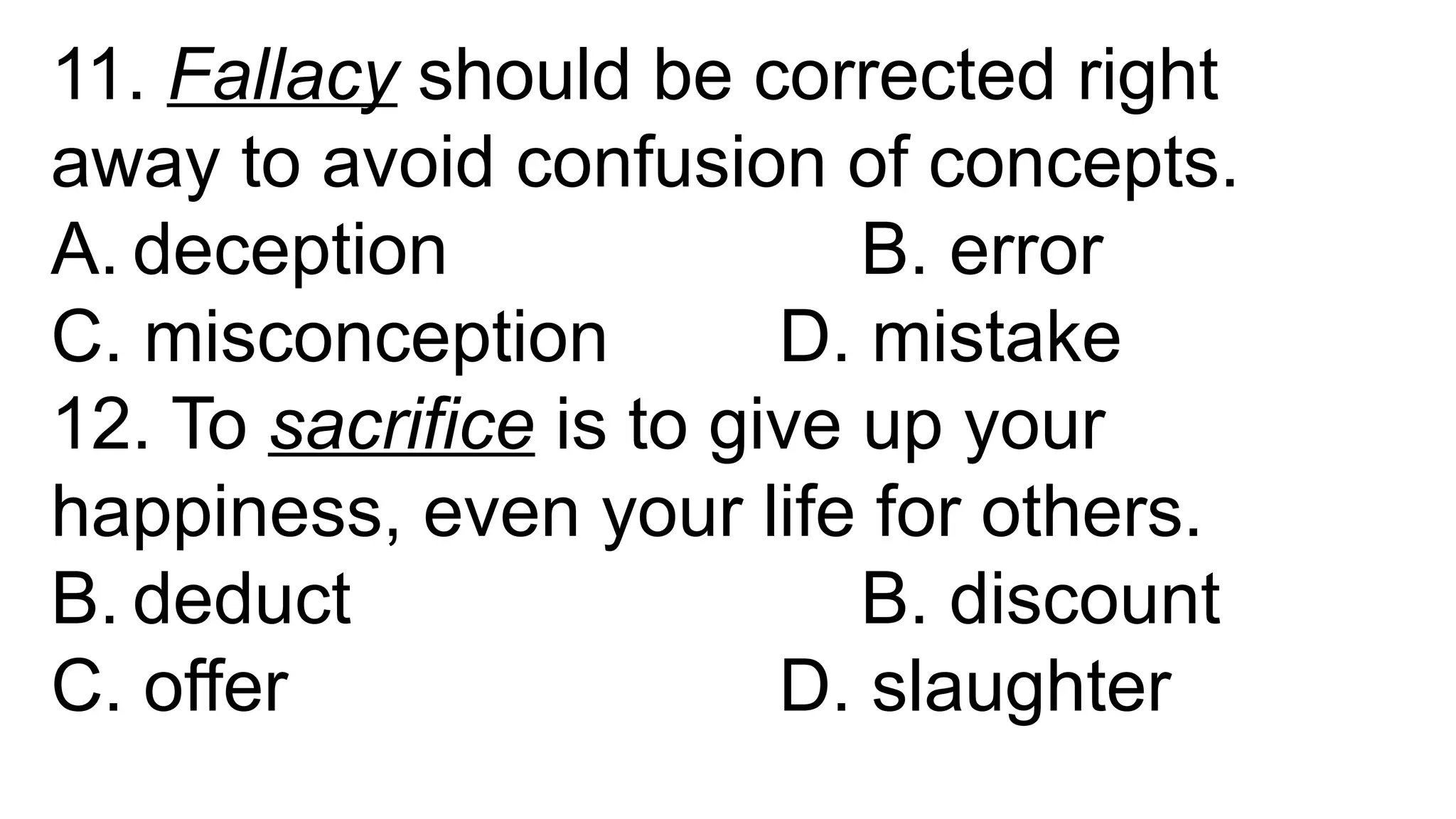
11. Fallacy should be corrected right
away to avoid confusion of concepts.
A. deception B. error
C. misconception D. mistake
12. To sacrifice is to give up your
happiness, even your life for others.
B. deduct B. discount
C. offer D. slaughter
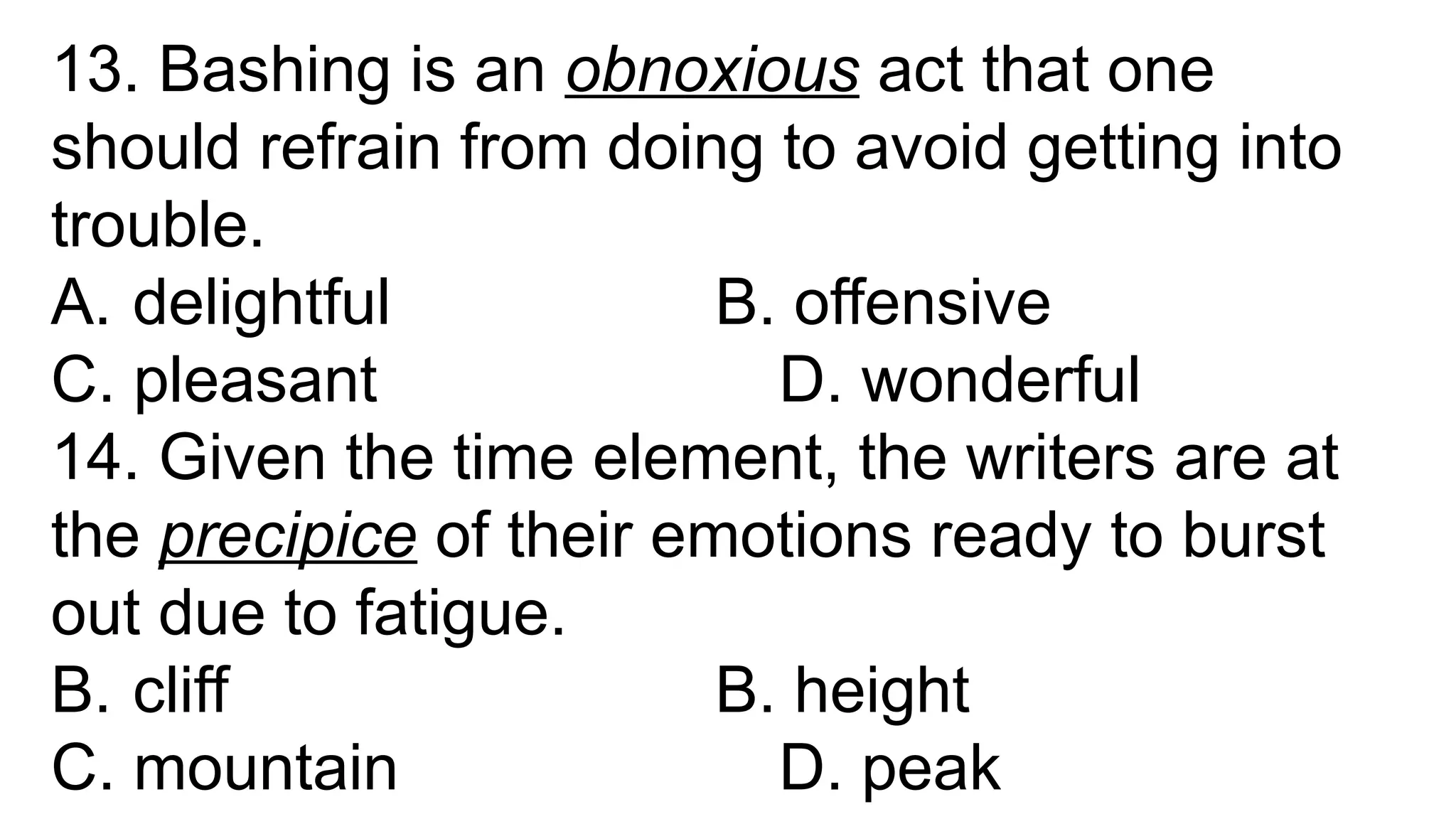
13. Bashing is an obnoxious act that one
should refrain from doing to avoid getting into
trouble.
A. delightful B. offensive
C. pleasant D. wonderful
14. Given the time element, the writers are at
the precipice of their emotions ready to burst
out due to fatigue.
B. cliff B. height
C. mountain D. peak
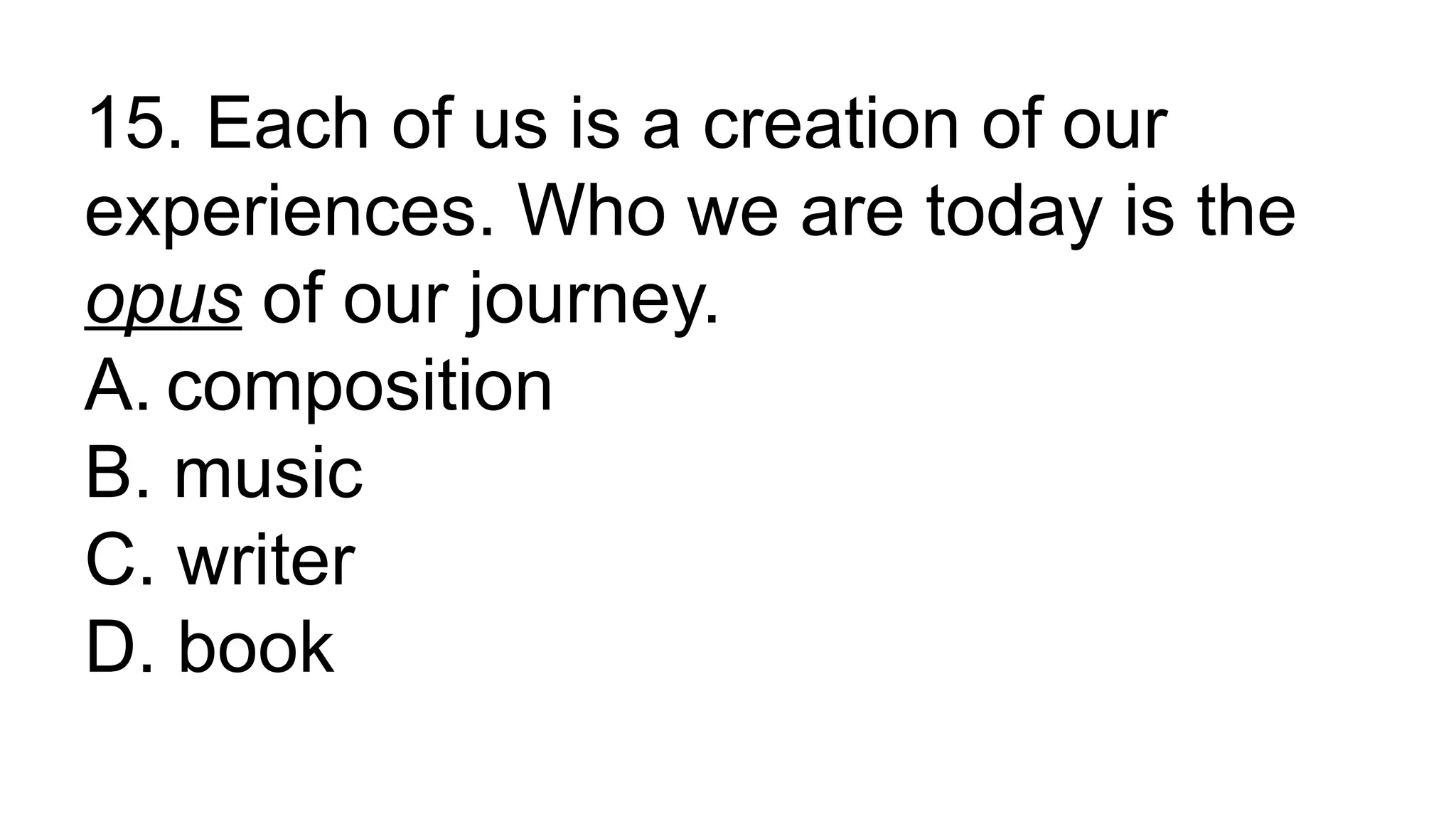
15. Each of us is a creation of our
experiences. Who we are today is the
opus of our journey.
A. composition
B. music
C. writer
D. book
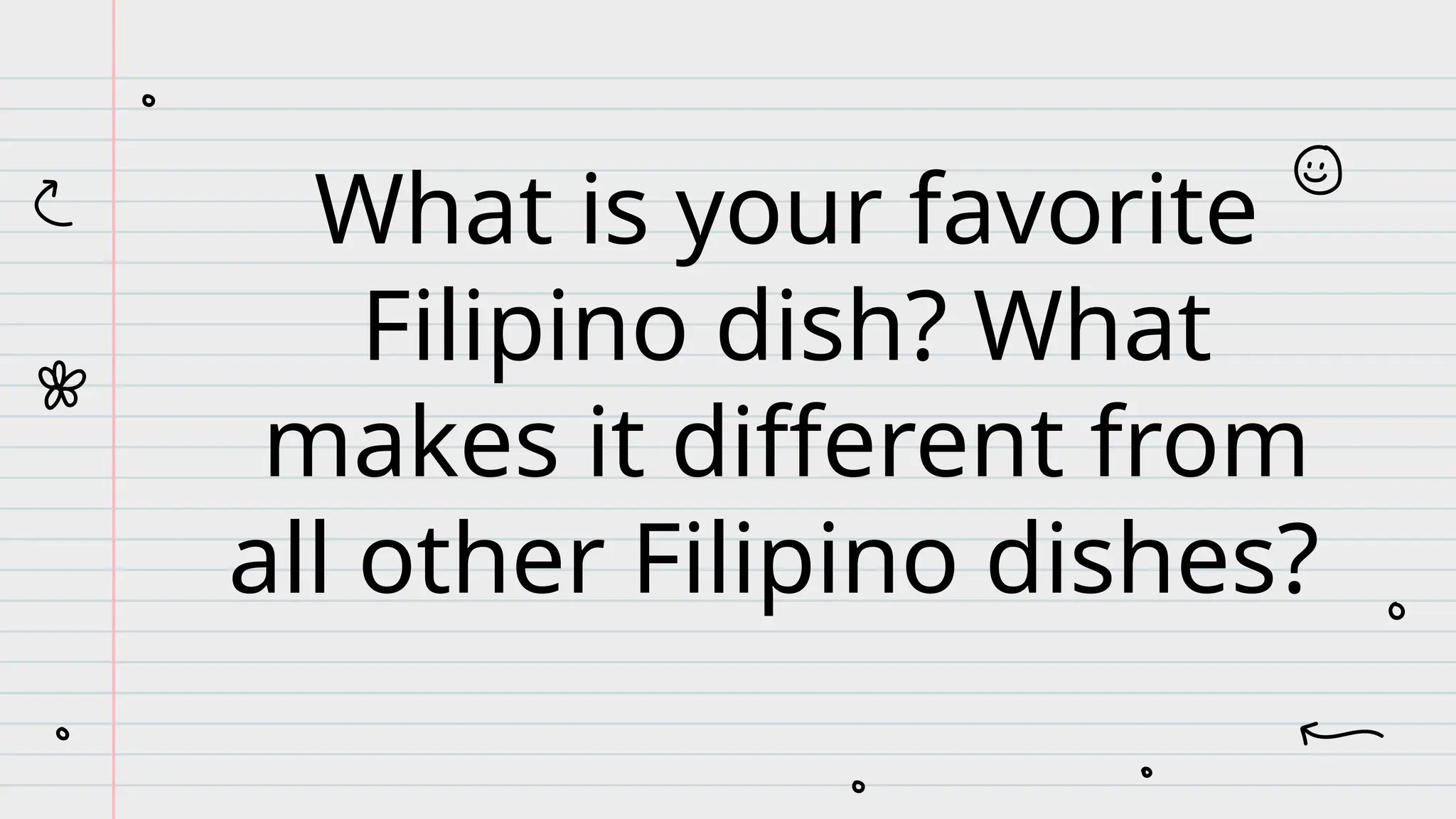
What is your favorite
Filipino dish? What
makes it different from
all other Filipino dishes?
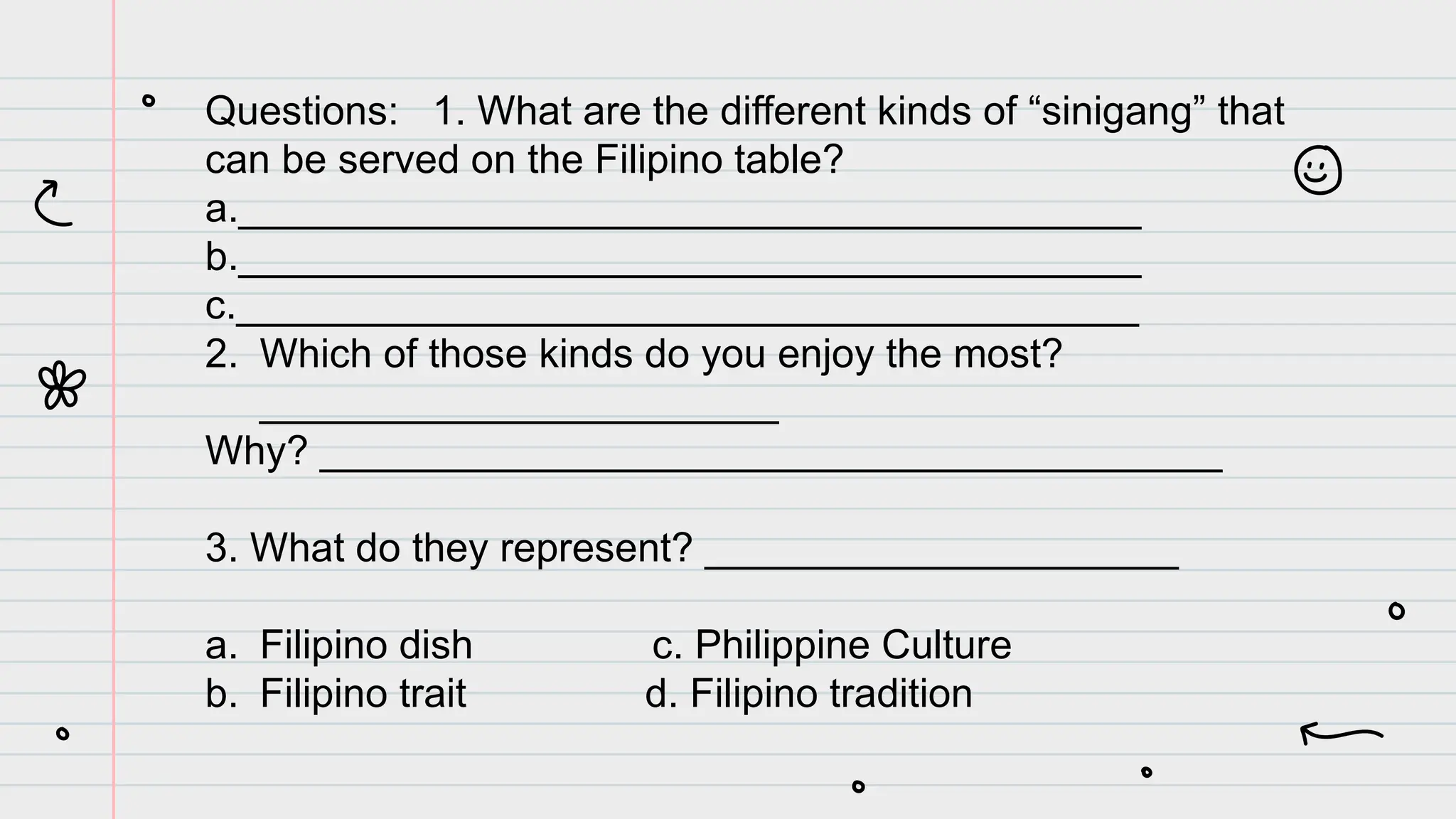
Questions: 1. What are the different kinds of “sinigang” that
can be served on the Filipino table?
a.________________________________________
b.________________________________________
c.________________________________________
2. Which of those kinds do you enjoy the most?
_______________________
Why? ________________________________________
3. What do they represent? _____________________
a. Filipino dish c. Philippine Culture
b. Filipino trait d. Filipino tradition
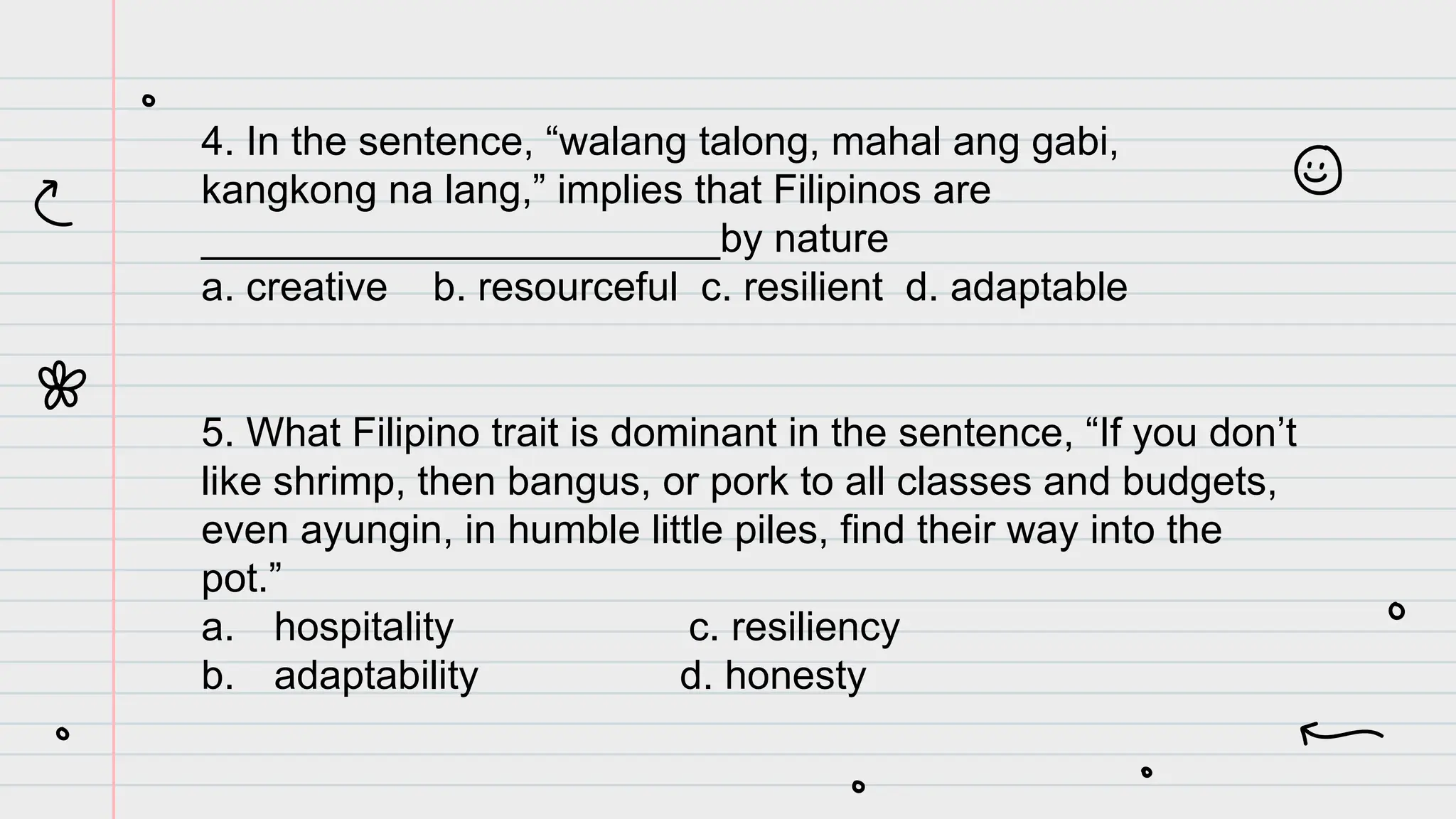
4. In the sentence, “walang talong, mahal ang gabi,
kangkong na lang,” implies that Filipinos are
_______________________by nature
a. creative b. resourceful c. resilient d. adaptable
5. What Filipino trait is dominant in the sentence, “If you don’t
like shrimp, then bangus, or pork to all classes and budgets,
even ayungin, in humble little piles, find their way into the
pot.”
a. hospitality c. resiliency
b. adaptability d. honesty
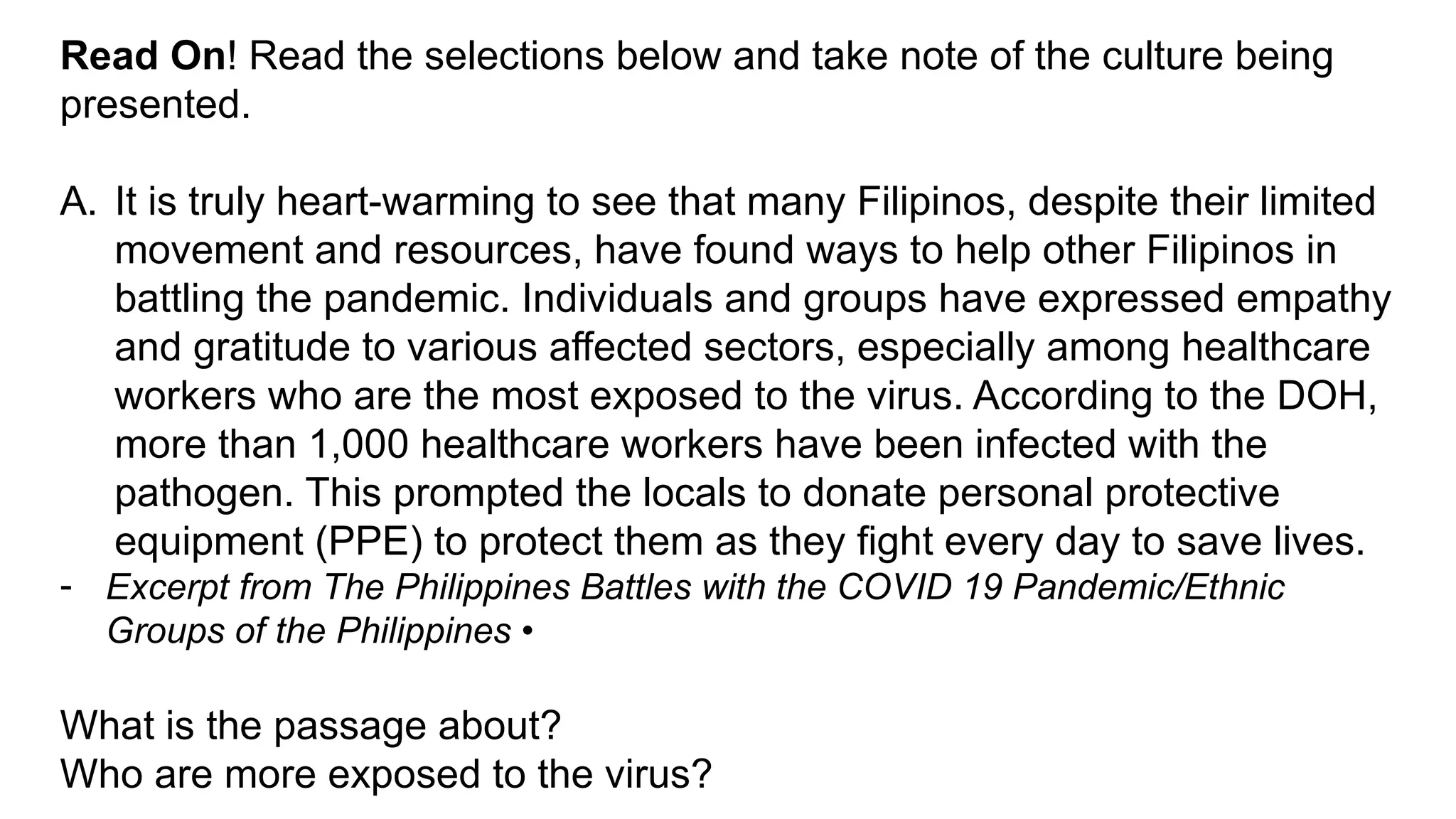
Read On! Read the selections below and take note of the culture being
presented.
A. It is truly heart-warming to see that many Filipinos, despite their limited
movement and resources, have found ways to help other Filipinos in
battling the pandemic. Individuals and groups have expressed empathy
and gratitude to various affected sectors, especially among healthcare
workers who are the most exposed to the virus. According to the DOH,
more than 1,000 healthcare workers have been infected with the
pathogen. This prompted the locals to donate personal protective
equipment (PPE) to protect them as they fight every day to save lives.
- Excerpt from The Philippines Battles with the COVID 19 Pandemic/Ethnic
Groups of the Philippines •
What is the passage about?
Who are more exposed to the virus?
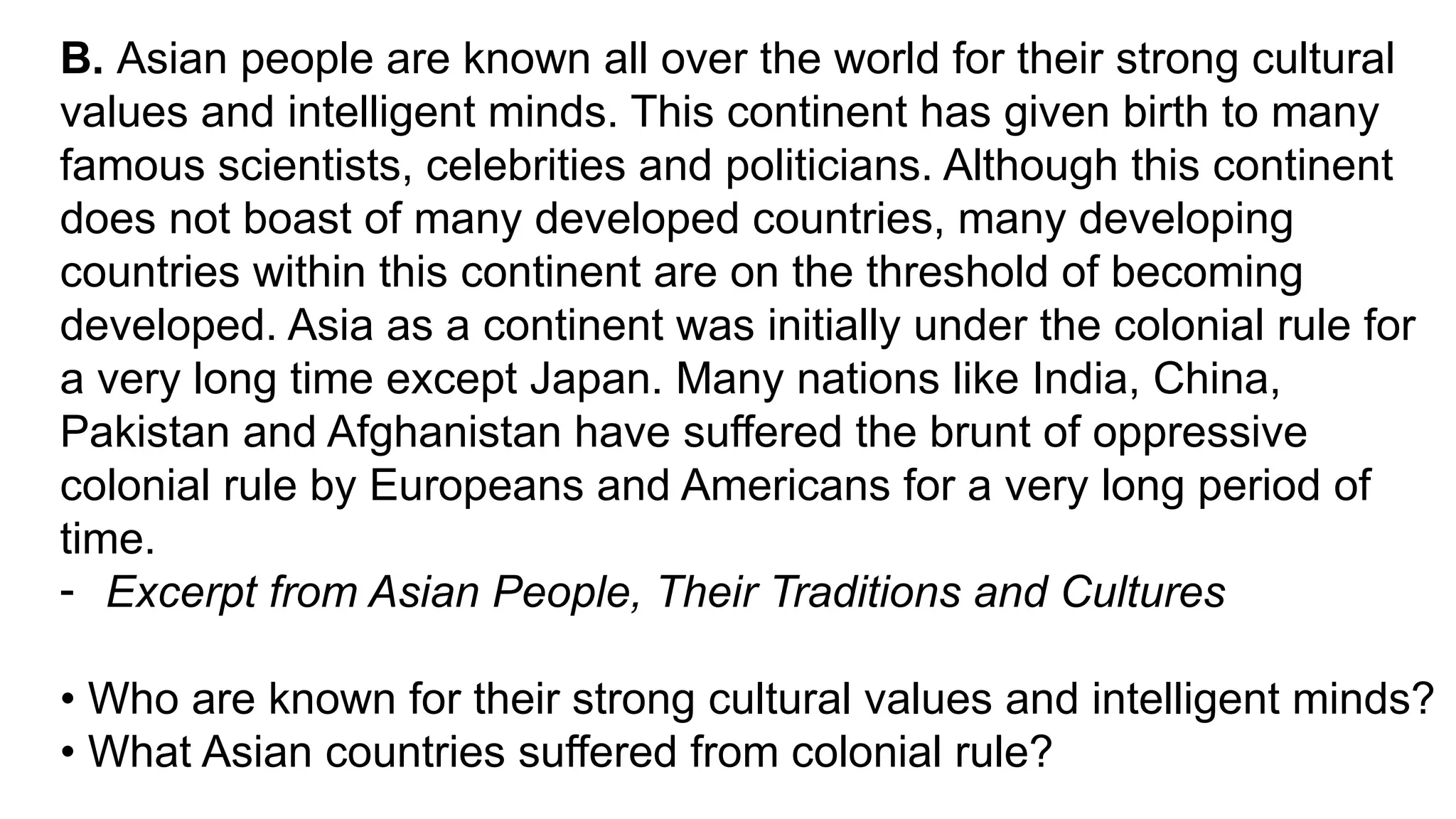
B. Asian people are known all over the world for their strong cultural
values and intelligent minds. This continent has given birth to many
famous scientists, celebrities and politicians. Although this continent
does not boast of many developed countries, many developing
countries within this continent are on the threshold of becoming
developed. Asia as a continent was initially under the colonial rule for
a very long time except Japan. Many nations like India, China,
Pakistan and Afghanistan have suffered the brunt of oppressive
colonial rule by Europeans and Americans for a very long period of
time.
- Excerpt from Asian People, Their Traditions and Cultures
• Who are known for their strong cultural values and intelligent minds?
• What Asian countries suffered from colonial rule?

ENGLISH 8.pptx Determining Meaning of Words and Local Expressions through Context Clues

  • 1.
  • 2.
    1. Rice isthe shaper of other foods and tastes. Filipinos not only like sour, but also salty flavors because they think that blandness of rice suggests the desirability of sharp contrast. Blandness as used in the context means_________________________. a. delicious b. sour c. tasteless d. sweet 2. Filipinos cook a variety of foods influenced by Spanish, American, Japanese, Indian, Chinese and more than a hundred distinct ethno- linguistic groups. However, a majority of mainstream Filipino dishes that compose Filipino cuisine are from the cuisines of the various ethnolinguistic groups and tribes. Variety as used in the sentence means __________________. a. diverse b. many c. change d. same WHAT I KNOW
  • 3.
    3. Philippine culturewas heavily influenced by Spain and Spanish culture. Despite this, the Filipino people maintained their own culture. Maintained means __________________. a. established b. kept c. ignored d. lost 4. Most Filipino couple tend to be frugal because they wanted to save enough money to buy a house. Frugal as used in the context means __________ a. economical b. wasteful c. interested d. extravagant
  • 4.
    5.To have anextended family living in the same house is normal for the culture of an African family. Filipino practices this culture also. a. follows b. Conforms c. neglects d. uses 6. African tradition is expressed through many different art forms, such as music, dance, art, and sculpture. These traditions are deeply ingrained into the whole African culture. a. assumed b. dislodged c. showed d. rooted
  • 5.
    Learning Objectives After goingthrough this lesson, the students are expected to:  Determine the meaning of words and expressions that reflect local culture by noting context clues;  Read intensively to determine author’s purpose;
  • 6.
    Determining Meaning of Words andLocal Expressions through Context Clues
  • 7.
    Context Clues - -provide information about a word or phrase that helps readers understand the meaning. These clues offer insight - either directly or
  • 8.
    Types of ContextClues ❖ Definition – the new term may be a formal definition or a sufficient explanation that may be given within the sentence or in the succeeding sentences. Clues to definition include “that is,” commas, dashes and parentheses. Ex. The arbitrator, the neutral person, chose to settle the dispute arrived at the decision. Arbitrator means the neutral person A. Understanding new words using Context Clues
  • 9.
    ❖ Definition Ex. a. Hisemaciation, that is, his skeleton-like appearance, was frightening to see. “Skeleton-like appearance” is the definition of “emaciation.” b. Fluoroscopy, examination with a fluoroscope, has become a common practice. The commas before and after “examination with a fluoroscope” point out the definition of “fluoroscopy.” c. The dudeen – a short-stemmed clay pipe – is found in Irish folk tales. The dashes setting off “a short-stemmed clay pipe” point out the definition of “dudeen.” A. Understanding new words using Context Clues
  • 10.
    Types of ContextClues ❖ Definition – the unfamiliar word is defined in a sentence. Ex. An Archeologist is a person who searches for treasures from sunken ships and ancient tombs to obtain valuable relics, artifacts, and relics such as the Balanghai boat. (definition: a person who searches for treasures, artifacts, and relics) A. Understanding new words using Context Clues
  • 11.
    Types of ContextClues ❖ Explanation – a description is given to understand the meaning of the unfamiliar word Example: Matthew had few infractions of the house rules that he should have done as part of his responsibilities. (explanation: house rules that he should have done) A. Understanding new words using Context Clues
  • 12.
     Restatement/Synonyms –the meaning is usually right after the unfamiliar word and often separated from the rest of the sentence with commas, dashes, or parentheses, sometimes or, that is or, in other words is used. Ex. The young girl was very aloof. She always seemed unsociable and uninterested. Aloof means-unsociable A. Understanding new words using Context Clues
  • 13.
     Restatement/Synonyms –a similar word is placed in the same sentence to know the meaning of the  unfamiliar word Ex. It is common for Filipinos to feel compassion or pity for the suffering of their fellowmen. (synonym: pity) A. Understanding new words using Context Clues
  • 14.
     Restatement/Synonyms • Ex. •Flooded with spotlights – the focus of all attention – the new Miss America began her year-long reign. She was the cynosure of all eyes for the rest of the evening. “Cynosure” means “the focus of all attention.” • The mountain pass was a tortuous road, winding and twisting like a snake around the trees of the mountainside. “Tortuous” means “winding and twisting.” A. Understanding new words using Context Clues
  • 15.
     Contrast/Antonyms –an opposite meaning context clue contrasts the meaning of unfamiliar word with the meaning of a familiar term. Ex. He tried to smile because the mood of the party was not somber, but happy. Somber means - not happy A. Understanding new words using Context Clues
  • 16.
     Contrast/Antonyms –an opposite word is placed in the same sentence Ex. • Among the siblings of a thin body structure, Isabel is the only one who is portly. (antonym: thin) • When the light brightens, the pupils of the eyes contract; however, when it grows darker, they dilate. “Dilate” means the opposite of “contract.” • The children were as different as day and night. He was a lively conversationalist, but she was reserved and taciturn. “Taciturn” means the opposite of a “lively conversationalist.” A. Understanding new words using Context Clues
  • 17.
     Inference/General –themeaning of the unfamiliar word can be inferred or understood from the description or a situation. Ex. The school nurse states that she would require free reign in overseeing the children. “These two need discipline, and I intend to provide it.” The nurse wants the freedom to discipline the two children her way because she noticed how undisciplined they already are, and she is determined to provide it all by herself. A. Understanding new words using Context Clues
  • 18.
     Inference/General –to understand the meaning of the unknown word, one has to make a guess based on the description given in the sentence Example: When one shows hospitality, kind words and welcoming actions can be observed among Filipinos. (description: kind words, welcoming actions) A. Understanding new words using Context Clues
  • 19.
     by Comparison• a similar word with the same meaning of the unfamiliar word is placed with an object to be compared Example: The stench of the garbage was like the smell of a rotten fish. (comparison: rotten fish, means bad odor) A. Understanding new words using Context Clues
  • 20.
     by Example- samples are provided in the sentence to understand the meaning of the unfamiliar word. Words like including, such as, and for example, point out example clues. Example: In ancient times, some of our forefathers believed in amulets, such as pearl of the crocodile, pearl of the ax, bullet necklace, and bag of herbs to protect them from harm. (example: pearl of the crocodile, pearl of the ax, bullet necklace, bag of herbs) A. Understanding new words using Context Clues
  • 21.
    Examples: a. Piscatorial creatures,such as flounder, salmon, and trout, live in the coldest parts of the ocean. “Piscatorial” obviously refers to fish. b. Celestial bodies, including the sun, moon, and stars, have fascinated man through the centuries. “Celestial” objects are those in the sky or heavens. c. In the course of man’s evolution, certain organs have atrophied. The appendix, for example, has wasted away from disuse. “Atrophied” means “wasted away.” A. Understanding new words using Context Clues
  • 23.
     by Causeand Effect- the meaning of the difficult word depends on the cause-effect relationship of other words as expressed in the sentence Example: Since only a few followed the wearing of face mask, it was made mandatory by the government. (cause: only a few followed the wearing of face mask) A. Understanding new words using Context Clues
  • 24.
     by Causeand Effect- Words like “because,” “since,” “therefore,” “thus,” “so,” etc. may signal context clues. Example: She wanted to impress all her dinner guests with the food she served, so she carefully studied the necessary culinary arts. “Culinary” means “food preparation.” A. Understanding new words using Context Clues
  • 25.
     by Listor Series of clues - to understand the meaning of the unknown word, it is included in a series of words given in a sentence Example: After the program, the rubbish left such as souvenir programs, flyers, leaflets plastic bottles, and food wrappings were cleaned by the janitor. (list: souvenir programs, flyers, leaflets, plastic bottles, food wrappings) A. Understanding new words using Context Clues
  • 26.
    Directions: Choose themeaning of the underlined words through context clues. Write your answers on a separate sheet of paper. 1. Adobo is identified as the Philippine stew in foreign cookbooks, unlike sinigang which is cooked only for a short time in a moderate fire. Stew means to____________ for a period of time. a. set aside b. freeze c. cool d. boil slowly Context Clues
  • 27.
    2. Filipinos likethe lightly boiled and slightly soured dish that includes fish/meat, vegetables and broth. broth means ____________________. a. a frozen soup with meat or fish b. a simmered soup with meat or fish c. a delicious soup with meat or fish d. a thin soup of concentrated meat or fish stock. Context Clues
  • 28.
    3. Rice isubiquitous, for it is easy to plant and harvest and it allows more than one crop a year. ubiquitous means __________. a. rare b. common c. expensive d. whitened 4. What group of words in sentence 3, give you the clue to the meaning of the underlined word ubiquitous? a. It is easy to plant and harvest. b. It allows more than one crop a year. c. Both a and b. d. None of the above.
  • 29.
    5. Sinigang iscommonly served in the most expensive restaurants and to gleaming ilustrado table. The Spanish word ilustrado means ____________. a. rich b. famous c. educated d. uneducated
  • 30.
    Now, the malletis lifted to smite the lips of the metal monster—the vast lips inscribed with Buddhist texts. 6. A mallet is ___________. A. an ax B. a saw C. a knife D. a hammer 7. To smite is to _________. A. caress B. cut C. hit D. touch
  • 31.
    All the littledragons on the high-tilted eaves of the green roofs shiver to the tips of their gilded tails under that deep wave of sound. 8. To shiver is to ____. A. fall on one’s knees B. be vanished forever C. tremble at the loud sound D. be destroyed by the gilded tails
  • 32.
    9. All thegreen-and-gold tiles of the temple are vibrating; the wooden goldfish above them are writhing against the sky. 9. Writhing means _______. A. hanging B. leading C. pointing D. twisting Therefore, the worthy mandarin Kouan-Yu assembled the master-molders and the renowned bell smiths of the empire, and all men of great repute and cunning in foundry work. 10. Cunning means _____________________. A. expert B. innocent C. master D. skillful 11. Foundry means _____________________. A. factory B. farm C. market D. garden
  • 33.
    Therefore, the moldshad to be once more prepared, and the fires rekindled, and the metal remelted, and all the work tediously, and toilsomely repeated. 12. Rekindled means ____________________. A. lighted again B. fueled the fire C. stopped the fire D. set on fire again 13. Toilsomely means _____. A. hardly B. lightly C. mindfully D. slowly
  • 34.
    And even asshe cried, she leaped into the white flood of metal. 14. Leaped means _____________. A.Jumped B.ran C.skipped D.squatted
  • 35.
  • 36.
    1. At theend of the 21st century, this pandemic will still be remembered because of its big effect to humanity like the Spanish Influenza in 1918. A. 10 years B. 50 years C.100 years D. 1,000 years 2. The pandemic tested the resiliency of the Filipino people despite their weaknesses. B. weakness B. elasticity C. stability D. strength
  • 37.
    3. During thesetrying times, communication is very vital to relay accurate information relative to the issue to carry out solutions easily. A. active B. crucial C. unimportant D. lively 4. I am bedazzled watching sunset at the beach. Likewise, I am overwhelmed looking at the bright stars with the moon at night. B. blinded B. confused C. amazed D. puzzled
  • 38.
    5. One’s selfcan be his own foe, the greatest adversary he has to face. A. attacker B. bandit C. contestant D. enemy 6. Quarantine is separation, detention, and seclusion. B. circumstance B. condition C. isolation D. situation
  • 39.
    7. Sibling rivalryshould be discouraged among brothers and sisters in the family because it would create unhealthy relationship among them. A. competition B. match C. race D. tournament 8. Every individual is unique. Each one has his/her own ability, talent, skill, strength and weakness. B. common B. creative C. distinct D. single
  • 40.
    9. Among theconstellations, the ones that I usually look up at night are Ursa Major, Aries, Leo, Scorpio, and Orion stars. A. collection B. group C. package D. set 10. Teenagers’ pertinacity or stubbornness is one of the problems among parents. A. determination B. hardheadedness C. perseverance D. reluctance
  • 41.
    11. Fallacy shouldbe corrected right away to avoid confusion of concepts. A. deception B. error C. misconception D. mistake 12. To sacrifice is to give up your happiness, even your life for others. B. deduct B. discount C. offer D. slaughter
  • 42.
    13. Bashing isan obnoxious act that one should refrain from doing to avoid getting into trouble. A. delightful B. offensive C. pleasant D. wonderful 14. Given the time element, the writers are at the precipice of their emotions ready to burst out due to fatigue. B. cliff B. height C. mountain D. peak
  • 43.
    15. Each ofus is a creation of our experiences. Who we are today is the opus of our journey. A. composition B. music C. writer D. book
  • 44.
    What is yourfavorite Filipino dish? What makes it different from all other Filipino dishes?
  • 45.
    Questions: 1. Whatare the different kinds of “sinigang” that can be served on the Filipino table? a.________________________________________ b.________________________________________ c.________________________________________ 2. Which of those kinds do you enjoy the most? _______________________ Why? ________________________________________ 3. What do they represent? _____________________ a. Filipino dish c. Philippine Culture b. Filipino trait d. Filipino tradition
  • 46.
    4. In thesentence, “walang talong, mahal ang gabi, kangkong na lang,” implies that Filipinos are _______________________by nature a. creative b. resourceful c. resilient d. adaptable 5. What Filipino trait is dominant in the sentence, “If you don’t like shrimp, then bangus, or pork to all classes and budgets, even ayungin, in humble little piles, find their way into the pot.” a. hospitality c. resiliency b. adaptability d. honesty
  • 47.
    Read On! Readthe selections below and take note of the culture being presented. A. It is truly heart-warming to see that many Filipinos, despite their limited movement and resources, have found ways to help other Filipinos in battling the pandemic. Individuals and groups have expressed empathy and gratitude to various affected sectors, especially among healthcare workers who are the most exposed to the virus. According to the DOH, more than 1,000 healthcare workers have been infected with the pathogen. This prompted the locals to donate personal protective equipment (PPE) to protect them as they fight every day to save lives. - Excerpt from The Philippines Battles with the COVID 19 Pandemic/Ethnic Groups of the Philippines • What is the passage about? Who are more exposed to the virus?
  • 48.
    B. Asian peopleare known all over the world for their strong cultural values and intelligent minds. This continent has given birth to many famous scientists, celebrities and politicians. Although this continent does not boast of many developed countries, many developing countries within this continent are on the threshold of becoming developed. Asia as a continent was initially under the colonial rule for a very long time except Japan. Many nations like India, China, Pakistan and Afghanistan have suffered the brunt of oppressive colonial rule by Europeans and Americans for a very long period of time. - Excerpt from Asian People, Their Traditions and Cultures • Who are known for their strong cultural values and intelligent minds? • What Asian countries suffered from colonial rule?

Editor's Notes

  • #2 C A B A D D
  • #3 C A B A D D
  • #4 C A B A D D
  • #7 Context clues are hints found within a sentence, paragraph, or passage that a reader can use to understand the meanings of new or unfamiliar words. Learning the meaning of a word through its use in a sentence or paragraph is the most practical way to build vocabulary, since a dictionary is not always available when a reader encounters an unknown word
  • #8 Dispute-a disagreement, argument, or debate.
  • #16 Portly-fat Taciturn- uncommunicative in speech; saying little., silent
  • #26 D B B C C D C C D D A A A A
  • #27 D B B C C D C C D D A A A A
  • #28 D B B C C D C C D D A A A A
  • #29 D B B C C D C C D D A A A A
  • #30 D B B C C D C C D D A A A A
  • #31 D B B C C D C C D D A A A A
  • #32 Repute - the state of being highly thought of; fame. reputation
  • #33 Tediously-boringly/not interesting
  • #34 D B B C C D C C D D A A A A
  • #35 C D B C D C A C B B D C B A A
  • #36 C D B C D C A C B B D C B A A
  • #37 C D B C D C A C B B D C B A A
  • #38 C D B C D C A C B B D C B A A
  • #39 C D B C D C A C B B D C B A A
  • #40 C D B C D C A C B B D C B A A
  • #41 C D B C D C A C B B D C B A A
  • #42 C D B C D C A C B B D C B A A
  • #43 C D B C D C A C B B D C B A A
  • #45 Sinigang na Baboy Sinigang na Hipon Sinigang na Bangus 3. a
  • #46 4. B 5. B
  • #47 Helping each other despite the pandemic. Filipinos have ways to lend some help. Healthcare workers
  • #48 Asian People India, China, Pakistan and Afghanistan