ENGLISH
I. OBJECTIVES
A. ContentStandards The learner demonstrates an understanding of African literature as a means of exploring
forces that human beings are content with; various reading styles vis-à-vis purposes of
reading; prosodic features that serve as carriers of meaning; ways by which information
may be organized; related; and delivered orally; and parallel structures and cohesive
devices in presenting the information.
B. Performance
Standards
The learner transfers learning by composing and delivering an informative speech based on
a specific topic of interest keeping in mind the proper and effective use of parallel structures
and cohesive devices and appropriate prosodic features, stances, and behavior.
C. Learning
Competencies/Objectives
Write the LC code for each
Determine the meaning of words and expressions that reflect
the local culture by noting context clues
EN8V-If-6
II. CONTENT Noting Context Clues
III. LEARNING
RESOURCES
A. References
1. Teacher’s Guide
pages
English 8 –SLM Noting Context Clues, First Edition, 2020
2. Learner’s Material
pages
3. Textbook pages
4. Additional
Materials from
Learning Resource
(LR) portal
B. Other Learning
Resources
SLMs, Internet
IV. PROCEDURES Prayer
Greetings
Checking of attendance
A. Reviewing previous lesson
or presenting the new
lesson
Ask the students.
1. Do you love reading?
2. What do you usually do if you encounter words that are new or not familiar to
you?
B. Establishing a purpose for
the lesson
Directions: Jumbled letters are posted on the board in Column A and B. Ask the
students to form a meaningful word out of it.
A. B.
TOONXETIC SEULC
Note: By this activity, the topic will be introduced to the students.
a. Presenting
examples/instances of the
new lesson
Pre-Test
Directions: Read each item carefully and use your notebook to write your
answer.
A. Choose the letter that corresponds to the correct answer.
1. Use context clues from the sentence to choose the correct meaning of
underlined word.
Unlike my frugal parents, I do not clip coupons.
a. careful b. thrifty c. fruity d. wasteful
2. Which type of context clue hints at the word’s meaning?
Jane was frugal with her money, but when it came to her family, she was
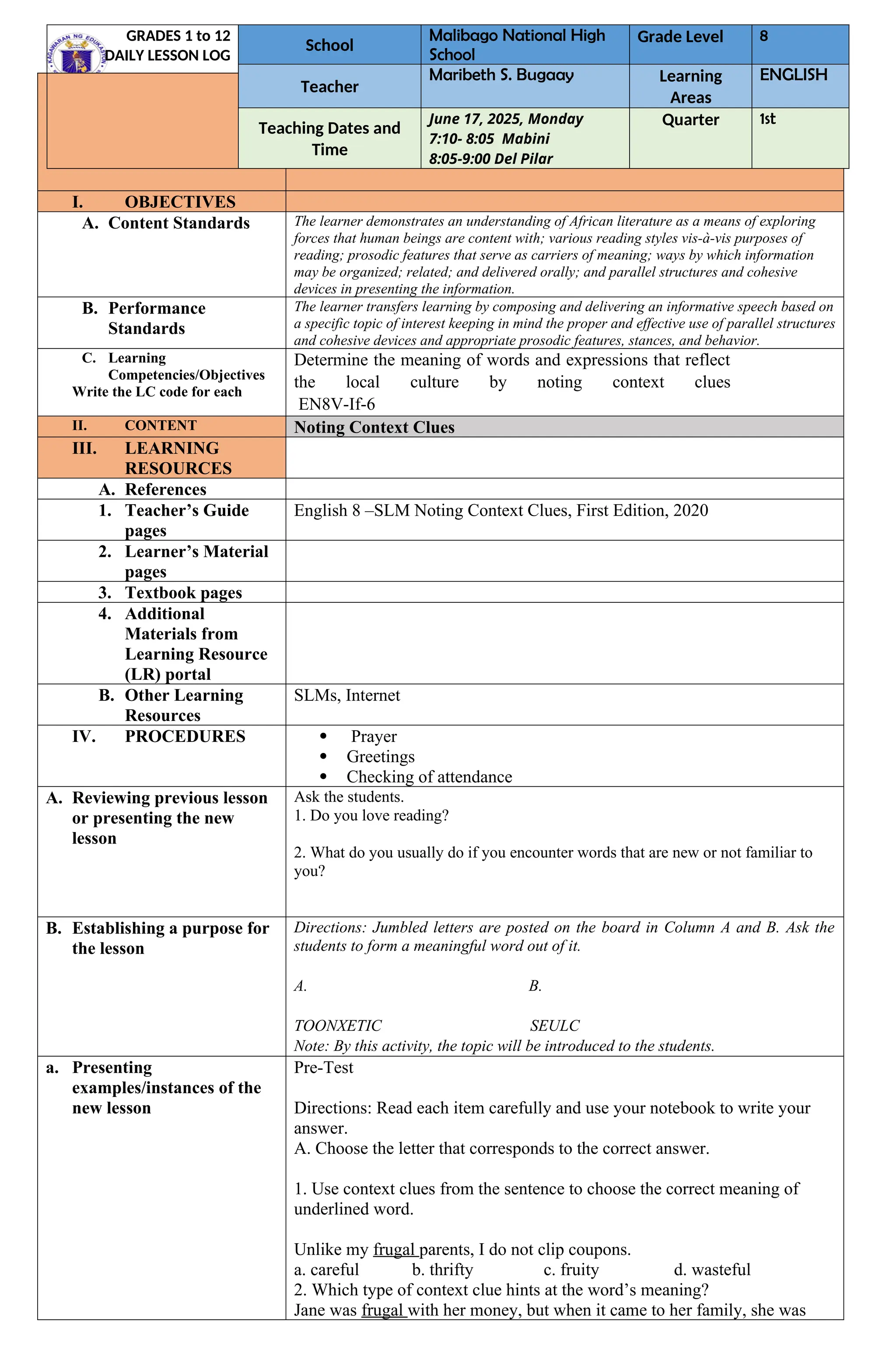
GRADES 1 to 12
DAILY LESSON LOG
School
Malibago National High
School
Grade Level 8
Teacher
Maribeth S. Bugaay Learning
Areas
ENGLISH
Teaching Dates and
Time
June 17, 2025, Monday
7:10- 8:05 Mabini
8:05-9:00 Del Pilar
Quarter 1st
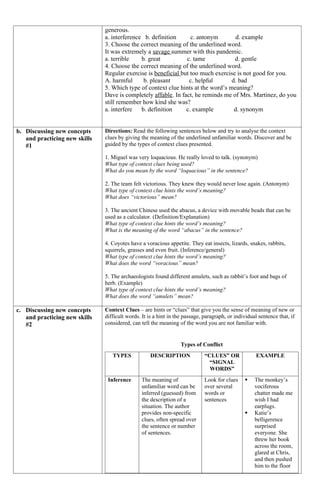
2.
generous.
a. interference b.definition c. antonym d. example
3. Choose the correct meaning of the underlined word.
It was extremely a savage summer with this pandemic.
a. terrible b. great c. tame d. gentle
4. Choose the correct meaning of the underlined word.
Regular exercise is beneficial but too much exercise is not good for you.
A. harmful b. pleasant c. helpful d. bad
5. Which type of context clue hints at the word’s meaning?
Dave is completely affable. In fact, he reminds me of Mrs. Martinez, do you
still remember how kind she was?
a. interfere b. definition c. example d. synonym
b. Discussing new concepts
and practicing new skills
#1
Directions: Read the following sentences below and try to analyse the context
clues by giving the meaning of the underlined unfamiliar words. Discover and be
guided by the types of context clues presented.
1. Miguel was very loquacious. He really loved to talk. (synonym)
What type of context clues being used?
What do you mean by the word “loquacious” in the sentence?
2. The team felt victorious. They knew they would never lose again. (Antonym)
What type of context clue hints the word’s meaning?
What does “victorious” mean?
3. The ancient Chinese used the abacus, a device with movable beads that can be
used as a calculator. (Definition/Explanation)
What type of context clue hints the word’s meaning?
What is the meaning of the word “abacus” in the sentence?
4. Coyotes have a voracious appetite. They eat insects, lizards, snakes, rabbits,
squirrels, grasses and even fruit. (Inference/general)
What type of context clue hints the word’s meaning?
What does the word “voracious” mean?
5. The archaeologists found different amulets, such as rabbit’s foot and bags of
herb. (Example)
What type of context clue hints the word’s meaning?
What does the word “amulets” mean?
c. Discussing new concepts
and practicing new skills
#2
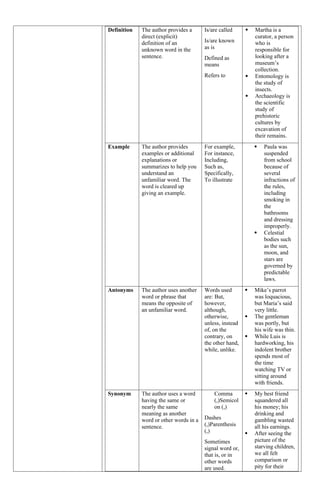
Context Clues – are hints or “clues” that give you the sense of meaning of new or
difficult words. It is a hint in the passage, paragraph, or individual sentence that, if
considered, can tell the meaning of the word you are not familiar with.
Types of Conflict
TYPES DESCRIPTION “CLUES” OR
“SIGNAL
WORDS”
EXAMPLE
Inference The meaning of
unfamiliar word can be
inferred (guessed) from
the description of a
situation. The author
provides non-specific
clues, often spread over
the sentence or number
of sentences.
Look for clues
over several
words or
sentences
The monkey’s
vociferous
chatter made me
wish I had
earplugs.
Katie’s
belligerence
surprised
everyone. She
threw her book
across the room,
glared at Chris,
and then pushed
him to the floor
3.
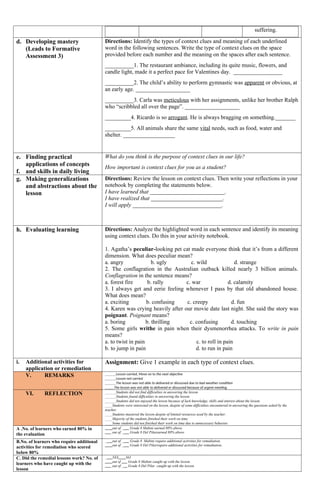
Definition The authorprovides a
direct (explicit)
definition of an
unknown word in the
sentence.
Is/are called
Is/are known
as is
Defined as
means
Refers to
Martha is a
curator, a person
who is
responsible for
looking after a
museum’s
collection.
Entomology is
the study of
insects.
Archaeology is
the scientific
study of
prehistoric
cultures by
excavation of
their remains.
Example The author provides
examples or additional
explanations or
summarizes to help you
understand an
unfamiliar word. The
word is cleared up
giving an example.
For example,
For instance,
Including,
Such as,
Specifically,
To illustrate
Paula was
suspended
from school
because of
several
infractions of
the rules,
including
smoking in
the
bathrooms
and dressing
improperly.
Celestial
bodies such
as the sun,
moon, and
stars are
governed by
predictable
laws.
Antonyms The author uses another
word or phrase that
means the opposite of
an unfamiliar word.
Words used
are: But,
however,
although,
otherwise,
unless, instead
of, on the
contrary, on
the other hand,
while, unlike.
Mike’s parrot
was loquacious,
but Maria’s said
very little.
The gentleman
was portly, but
his wife was thin.
While Luis is
hardworking, his
indolent brother
spends most of
the time
watching TV or
sitting around
with friends.
Synonym The author uses a word
having the same or
nearly the same
meaning as another
word or other words in a
sentence.
Comma
(,)Semicol
on (,)
Dashes
(,)Parenthesis
(,)
Sometimes
signal word or,
that is, or in
other words
are used.
My best friend
squandered all
his money; his
drinking and
gambling wasted
all his earnings.
After seeing the
picture of the
starving children,
we all felt
comparison or
pity for their
4.
suffering.
d. Developing mastery
(Leadsto Formative
Assessment 3)
Directions: Identify the types of context clues and meaning of each underlined
word in the following sentences. Write the type of context clues on the space
provided before each number and the meaning on the spaces after each sentence.
__________1. The restaurant ambiance, including its quite music, flowers, and
candle light, made it a perfect pace for Valentines day. _________________
__________2. The child’s ability to perform gymnastic was apparent or obvious, at
an early age. ___________________
__________3. Carla was meticulous with her assignments, unlike her brother Ralph
who “scribbled all over the page”. ___________________
_________4. Ricardo is so arrogant. He is always bragging on something._______
_________5. All animals share the same vital needs, such as food, water and
shelter. __________________
e. Finding practical
applications of concepts
f. and skills in daily living
What do you think is the purpose of context clues in our life?
How important is context clues for you as a student?
g. Making generalizations
and abstractions about the
lesson
Directions: Review the lesson on context clues. Then write your reflections in your
notebook by completing the statements below.
I have learned that __________________________.
I have realized that _________________________.
I will apply _______________________________.
h. Evaluating learning Directions: Analyze the highlighted word in each sentence and identify its meaning
using context clues. Do this in your activity notebook.
1. Agatha’s peculiar-looking pet cat made everyone think that it’s from a different
dimension. What does peculiar mean?
a. angry b. ugly c. wild d. strange
2. The conflagration in the Australian outback killed nearly 3 billion animals.
Conflagration in the sentence means?
a. forest fire b. rally c. war d. calamity
3. I always get and eerie feeling whenever I pass by that old abandoned house.
What does mean?
a. exciting b. confusing c. creepy d. fun
4. Karen was crying heavily after our movie date last night. She said the story was
poignant. Poignant means?
a. boring b. thrilling c. confusing d. touching
5. Some girls writhe in pain when their dysmenorrhea attacks. To write in pain
means?
a. to twist in pain c. to roll in pain
b. to jump in pain d. to run in pain
i. Additional activities for
application or remediation
Assignment: Give 1 example in each type of context clues.
V. REMARKS ______Lesson carried, Move on to the next objective
______Lesson not carried
______The lesson was not able to delivered or discussed due to bad weather condition
_____The lesson was not able to delivered or discussed because of urgent meeting.
VI. REFLECTION ______Students did not find difficulties in answering the lesson
______Students found difficulties in answering the lesson.
______Students did not enjoyed the lesson because of lack knowledge, skills and interest about the lesson.
____Students were interested on the lesson, despite of some difficulties encountered in answering the questions asked by the
teacher.
____Students mastered the lesson despite of limited resources used by the teacher.
____Majority of the students finished their work on time.
____Some students did not finished their work on time due to unnecessary behavior.
A .No. of learners who earned 80% in
the evaluation
____out of ____ Grade 8 Mabini earned 80% above.
____out of ____ Grade 8 Del Pilarearned 80% above.
B.No. of learners who require additional
activities for remediation who scored
below 80%
____out of ____ Grade 8 Mabini require additional activities for remediation.
____out of ____ Grade 8 Del Pilarrequire additional activities for remediation..
C. Did the remedial lessons work? No. of
learners who have caught up with the
lesson
____YES____NO
____out of ___ Grade 8 Mabini caught up with the lesson.
____out of ___ Grade 8 Del Pilar caught up with the lesson.
5.
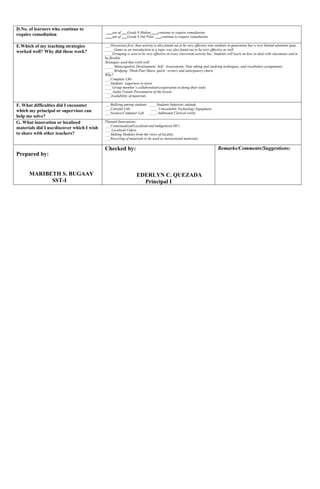
D.No. of learnerswho continue to
require remediation ____out of ___Grade 8 Mabini____continue to require remediation.
____out of ___Grade 8 Del Pilar____continue to require remediation.
E.Which of my teaching strategies
worked well? Why did these work?
___Discussion first, then activity is also found out to be very effective sine students in generation has a very limited attention span.
_____Game as an introduction to a topic was also found out to be very effective as well.
____Grouping is seen to be very effective in every classroom activity bec. Students will learn on how to deal with classmates and to
be flexible.
Strategies used that work well:
_____Metacognitive Development: Self –Assessments, Note taking and studying techniques, and vocabulary assignments.
_____Bridging: Think-Pair-Share, quick –writers and anticipatory charts
Why?
___Complete LMs
___Students’ eagerness to learn
____Group member’s collaboration/cooperation in doing their tasks
____Audio Visuals Presentation of the lesson
___Availability of materials
F. What difficulties did I encounter
which my principal or supervisor can
help me solve?
___Bullying among students ____Students behavior/ attitude
___Colorful LMs ____ Unavailable Technology Equipment
___Science/Computer Lab ____ Additional Clerical works
G. What innovation or localized
materials did I use/discover which I wish
to share with other teachers?
Planned Innovations:
___Contextualized/Localized and Indigenized IM’s
___ Localized Videos
___Making Modules from the views of locality.
___Recycling of materials to be used as instructional materials.
Prepared by:
MARIBETH S. BUGAAY
SST-I
Checked by:
EDERLYN C. QUEZADA
Principal I
Remarks/Comments/Suggestions: