July 17, 2024
Distinguishing a
Holistic Perspective
from a Partial Point
of View
Agenda
•Introduction to Perspectives
•What is a Holistic Perspective?
•What is a Partial Point of View?
•Key Differences
•Benefits of a Holistic Perspective
•Drawbacks of a Partial Point of View
•Examples in Different Fields
•Case Study: Holistic vs. Partial in Healthcare
•Case Study: Holistic vs. Partial in
Education
•Approaches to Adopting a Holistic
Perspective
•Challenges in Maintaining a Holistic
View
•Interactive Activity
•Conclusion
•Key Takeaways
•Q&A
A perspective is a particular attitude or way
of viewing something. It shapes how we
interpret and understand the world around
us. Perspectives are crucial because they
influence our thoughts, decisions, and
actions. By recognizing different
perspectives, we can gain a more
comprehensive understanding of complex
issues and foster empathy towards others'
viewpoints.
Introduction to
Perspectives
Introduction
Plus tip:
You can adapt this slide by adding
specific examples or cultural
references to make the concept of
perspectives more relatable to your
audience.
What is a Holistic Perspective?
A holistic perspective refers to an approach that considers the entire system or whole rather
than just individual components. It emphasizes the interconnectedness and interdependence
of all parts, suggesting that understanding the whole system provides more insight than
analyzing its separate elements. This perspective is crucial in fields such as ecology, healthcare,
and organizational management, where the interplay between different parts significantly
influences outcomes.
Concepts
Plus tip:
Consider tailoring the examples to the
specific context or field that is most
relevant to your audience for better
engagement.
A partial point of view focuses on individual components of
a larger system without considering the entire context.
This perspective isolates specific parts for detailed
analysis, often ignoring how these parts interact with each
other. While this method can provide in-depth
understanding of particular aspects, it may lead to a
fragmented and incomplete understanding of the overall
picture. For example, in business, focusing solely on sales
data without considering customer feedback or market
trends can result in misguided strategies.
What is a Partial
Point of View?
Definition
Plus tip:
Customize this slide by providing an
example from your own field or experience
where a partial point of view led to an
incomplete or inaccurate understanding.
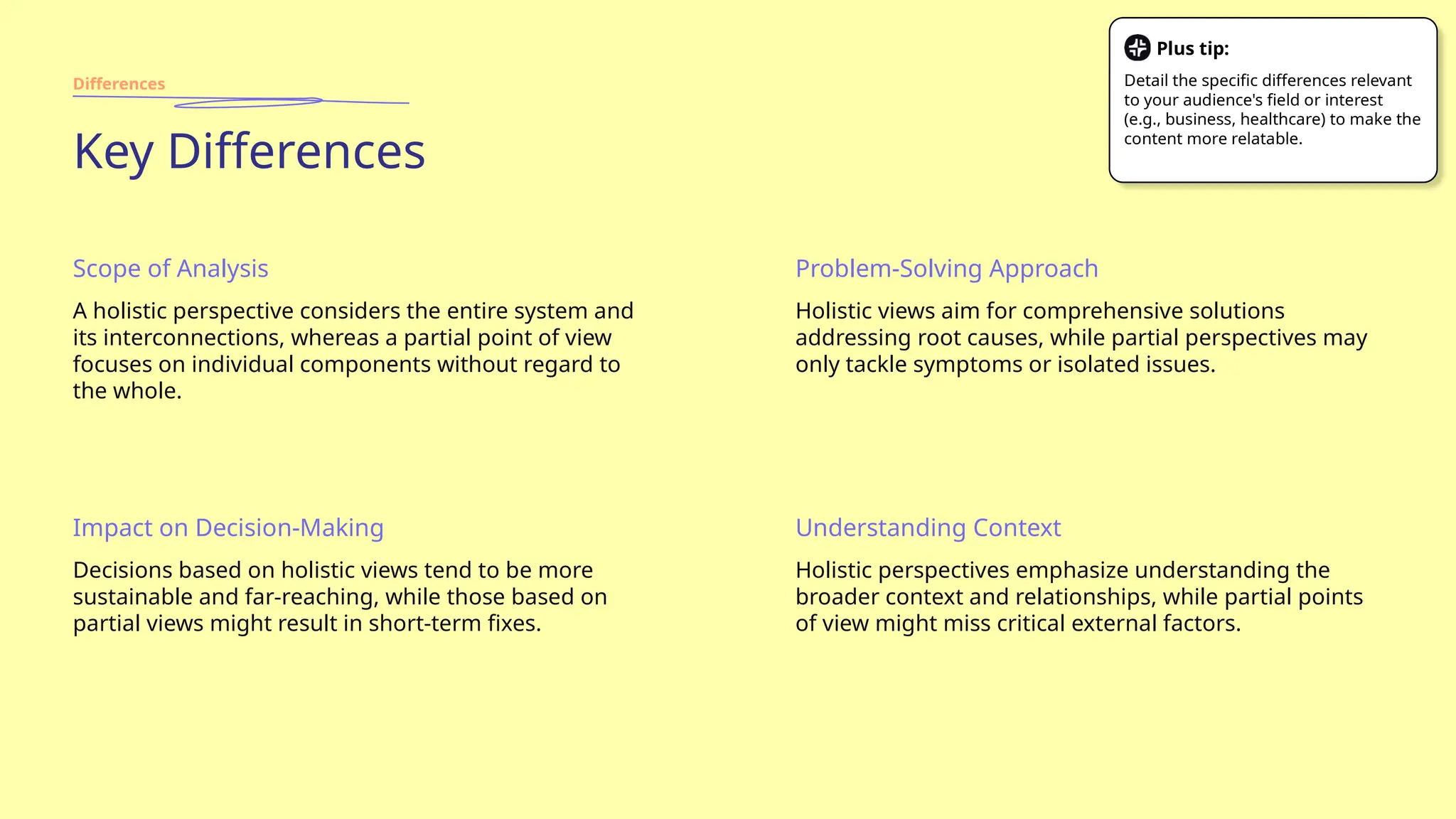
Differences
A holistic perspective considers the entire system and
its interconnections, whereas a partial point of view
focuses on individual components without regard to
the whole.
Scope of Analysis
Holistic views aim for comprehensive solutions
addressing root causes, while partial perspectives may
only tackle symptoms or isolated issues.
Problem-Solving Approach
Decisions based on holistic views tend to be more
sustainable and far-reaching, while those based on
partial views might result in short-term fixes.
Impact on Decision-Making
Holistic perspectives emphasize understanding the
broader context and relationships, while partial points
of view might miss critical external factors.
Understanding Context
Key Differences
Plus tip:
Detail the specific differences relevant
to your audience's field or interest
(e.g., business, healthcare) to make the
content more relatable.
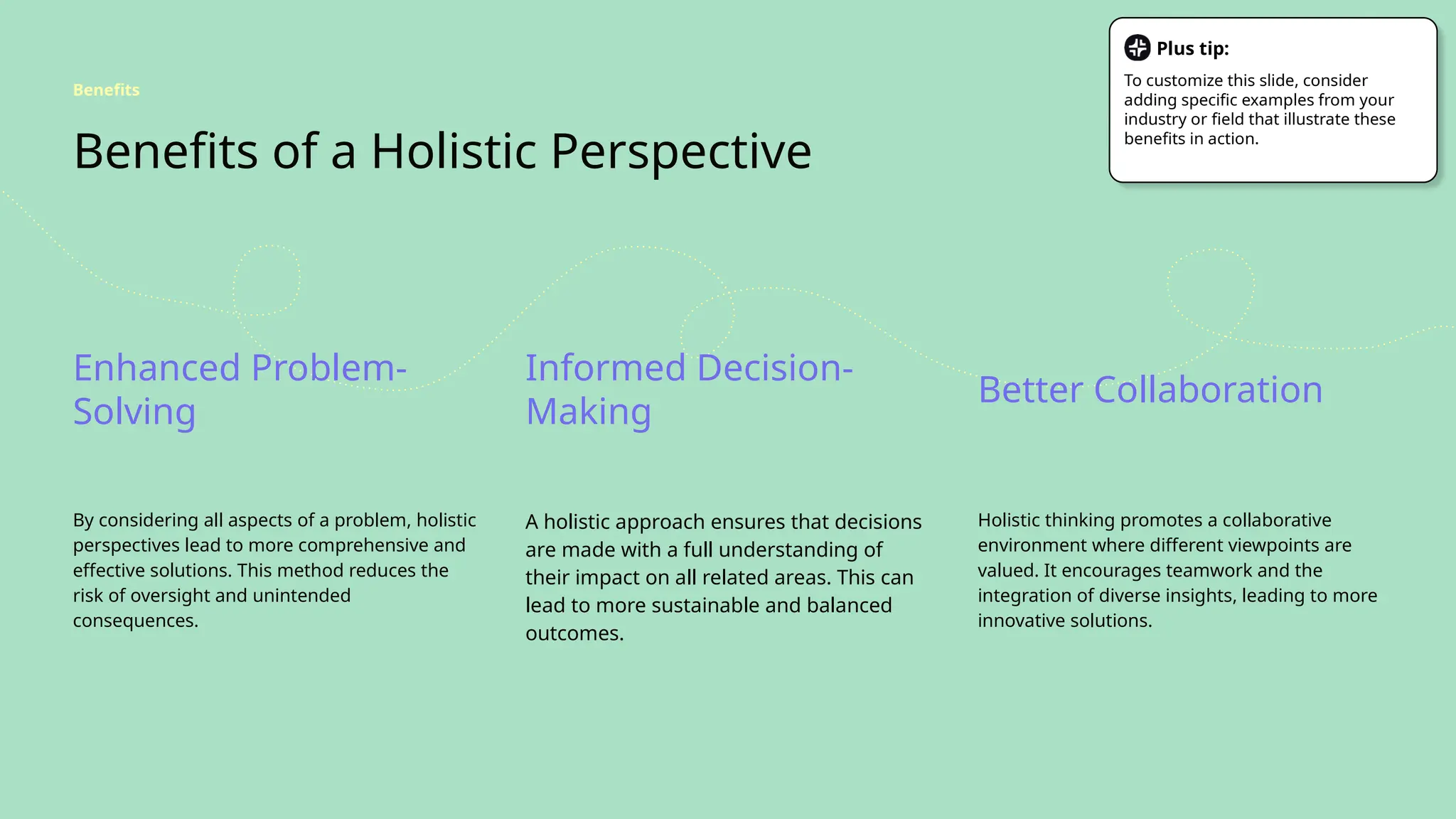
Benefits of a Holistic Perspective
Enhanced Problem-
Solving
Informed Decision-
Making
Better Collaboration
By considering all aspects of a problem, holistic
perspectives lead to more comprehensive and
effective solutions. This method reduces the
risk of oversight and unintended
consequences.
A holistic approach ensures that decisions
are made with a full understanding of
their impact on all related areas. This can
lead to more sustainable and balanced
outcomes.
Holistic thinking promotes a collaborative
environment where different viewpoints are
valued. It encourages teamwork and the
integration of diverse insights, leading to more
innovative solutions.
Benefits
Plus tip:
To customize this slide, consider
adding specific examples from your
industry or field that illustrate these
benefits in action.
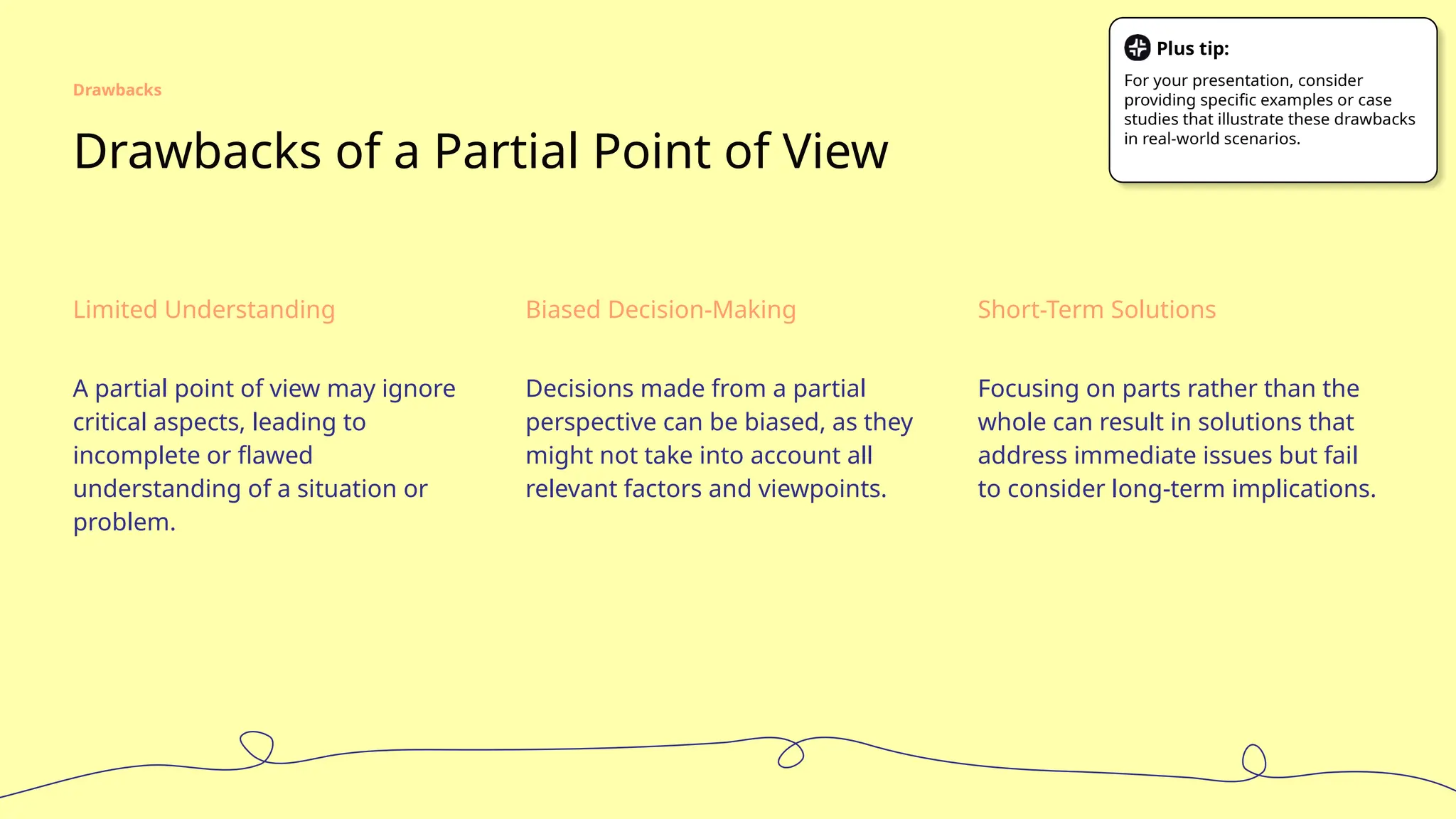
Drawbacks of a Partial Point of View
Limited Understanding Biased Decision-Making Short-Term Solutions
A partial point of view may ignore
critical aspects, leading to
incomplete or flawed
understanding of a situation or
problem.
Decisions made from a partial
perspective can be biased, as they
might not take into account all
relevant factors and viewpoints.
Focusing on parts rather than the
whole can result in solutions that
address immediate issues but fail
to consider long-term implications.
Drawbacks
Plus tip:
For your presentation, consider
providing specific examples or case
studies that illustrate these drawbacks
in real-world scenarios.
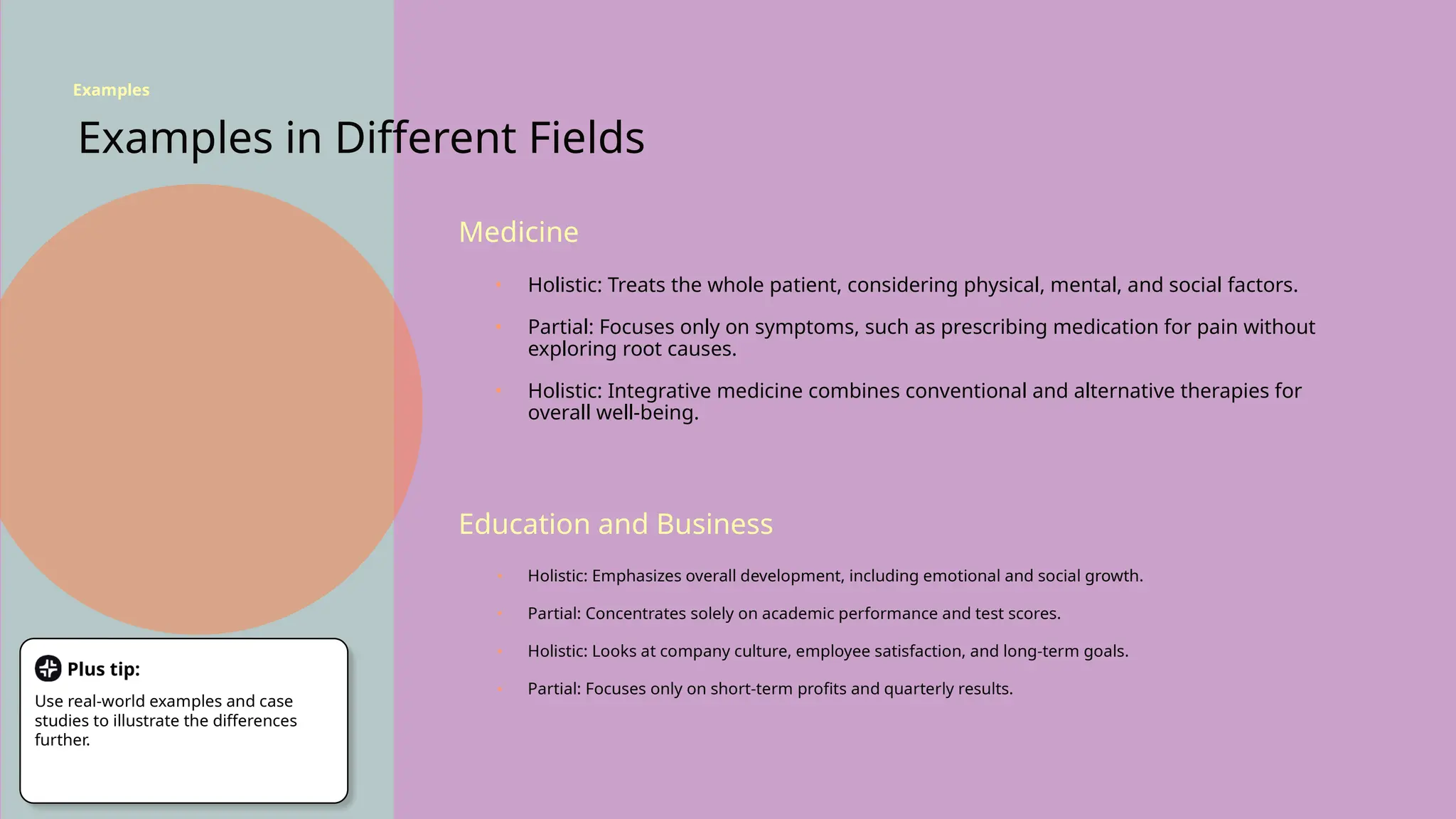
Examples in Different Fields
Medicine
Education and Business
• Holistic: Treats the whole patient, considering physical, mental, and social factors.
• Partial: Focuses only on symptoms, such as prescribing medication for pain without
exploring root causes.
• Holistic: Integrative medicine combines conventional and alternative therapies for
overall well-being.
• Holistic: Emphasizes overall development, including emotional and social growth.
• Partial: Concentrates solely on academic performance and test scores.
• Holistic: Looks at company culture, employee satisfaction, and long-term goals.
• Partial: Focuses only on short-term profits and quarterly results.
Examples
Plus tip:
Use real-world examples and case
studies to illustrate the differences
further.
Case Study: Holistic vs. Partial in Healthcare
A 45-year-old patient with chronic headaches visited two different doctors. The first doctor focused solely on the
symptoms, prescribing painkillers without further investigation. This partial view provided temporary relief but did
not address the underlying cause. The second doctor took a holistic approach, considering the patient's lifestyle, diet,
stress levels, and medical history. This thorough examination revealed that the headaches were stress-related. The
holistic treatment plan included stress management techniques, dietary adjustments, and regular exercise. As a
result, the patient experienced long-term relief and improved overall well-being. This case highlights the importance
of holistic perspectives in achieving comprehensive and sustainable healthcare outcomes.
Case Study
Plus tip:
Customize the case study with real-life
examples from your own experiences or
relevant studies in your field. Emphasize the
outcomes to make a compelling argument
for holistic approaches.
Case Study: Holistic vs. Partial
in Education
In a high school setting, two different teaching approaches were analyzed. The holistic approach integrated subjects such as
history, literature, and science into a single, cohesive curriculum. Students engaged in project-based learning, exploring topics
from multiple angles and developing critical thinking skills. Conversely, the partial approach focused on teaching each subject in
isolation. While students excelled in specific areas, they struggled to connect concepts across disciplines. Outcomes showed that
holistic learners demonstrated better problem-solving abilities and retained information longer, while partial learners had
higher test scores in individual subjects but lacked interdisciplinary understanding.
Education
Plus tip:
Customize this slide by adding specific
data points or quotes from educators
involved in the study to provide more
credibility.
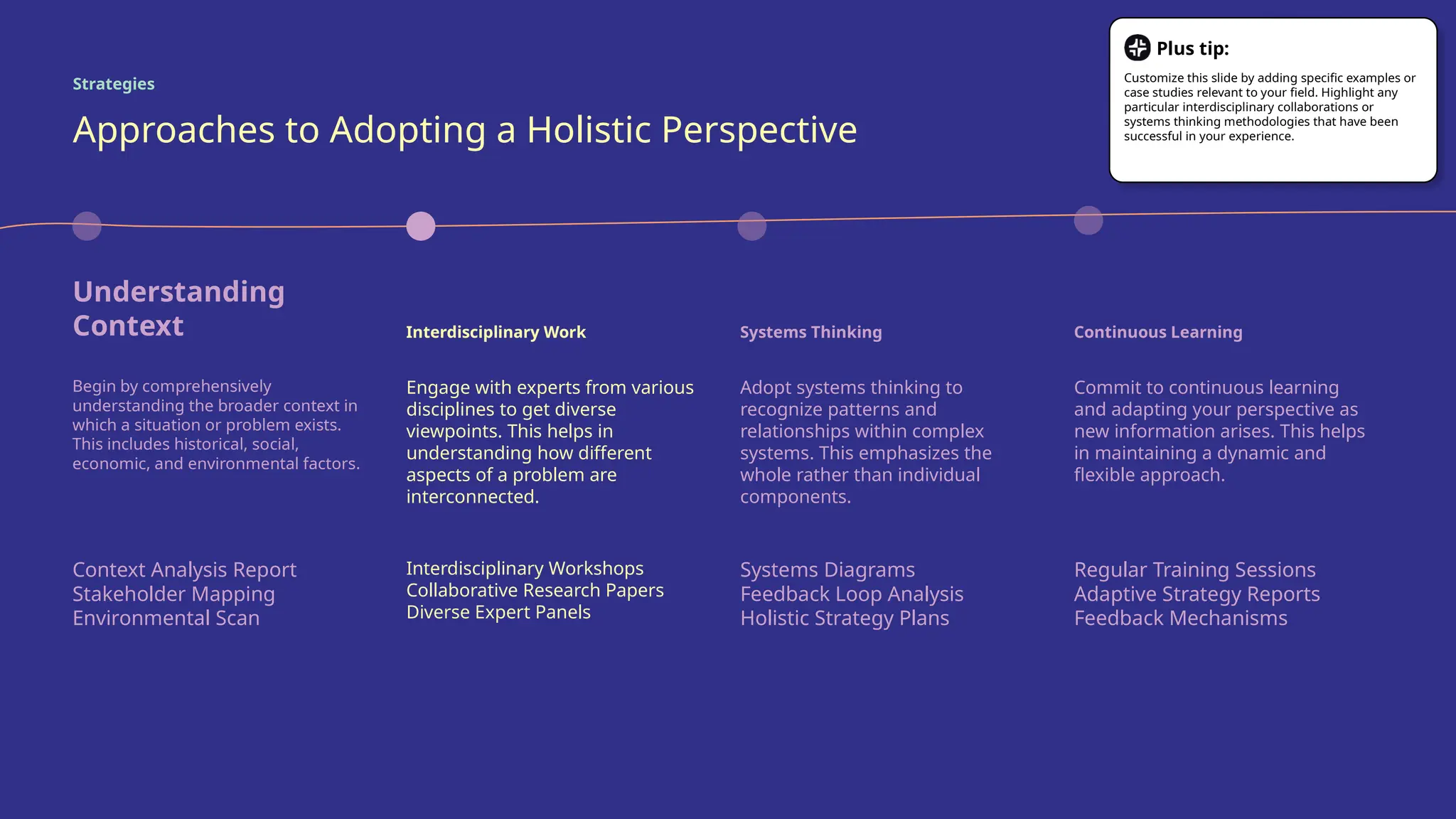
Approaches to Adopting a Holistic Perspective
Begin by comprehensively
understanding the broader context in
which a situation or problem exists.
This includes historical, social,
economic, and environmental factors.
Engage with experts from various
disciplines to get diverse
viewpoints. This helps in
understanding how different
aspects of a problem are
interconnected.
Adopt systems thinking to
recognize patterns and
relationships within complex
systems. This emphasizes the
whole rather than individual
components.
Understanding
Context Interdisciplinary Work Systems Thinking
Commit to continuous learning
and adapting your perspective as
new information arises. This helps
in maintaining a dynamic and
flexible approach.
Continuous Learning
Context Analysis Report
Stakeholder Mapping
Environmental Scan
Interdisciplinary Workshops
Collaborative Research Papers
Diverse Expert Panels
Systems Diagrams
Feedback Loop Analysis
Holistic Strategy Plans
Regular Training Sessions
Adaptive Strategy Reports
Feedback Mechanisms
Strategies
Plus tip:
Customize this slide by adding specific examples or
case studies relevant to your field. Highlight any
particular interdisciplinary collaborations or
systems thinking methodologies that have been
successful in your experience.
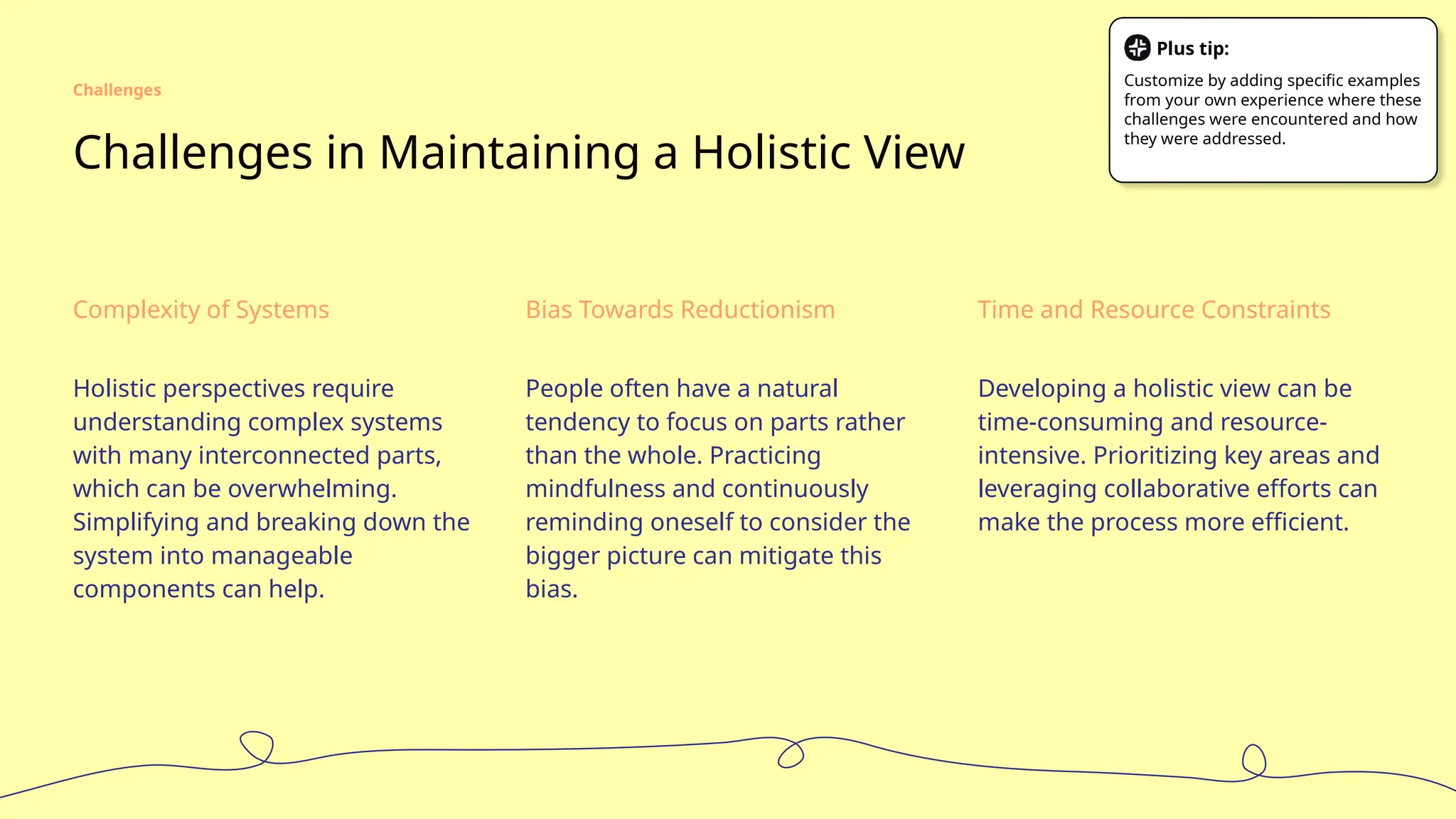
Challenges in Maintaining a Holistic View
Complexity of Systems Bias Towards Reductionism Time and Resource Constraints
Holistic perspectives require
understanding complex systems
with many interconnected parts,
which can be overwhelming.
Simplifying and breaking down the
system into manageable
components can help.
People often have a natural
tendency to focus on parts rather
than the whole. Practicing
mindfulness and continuously
reminding oneself to consider the
bigger picture can mitigate this
bias.
Developing a holistic view can be
time-consuming and resource-
intensive. Prioritizing key areas and
leveraging collaborative efforts can
make the process more efficient.
Challenges
Plus tip:
Customize by adding specific examples
from your own experience where these
challenges were encountered and how
they were addressed.
Interactive Activity
Engage the audience in a group activity where they are divided into small
teams. Each team is presented with a complex scenario (e.g., planning a
community event, addressing an environmental issue). One half of the teams
will approach the scenario from a holistic perspective, considering all
interconnected factors and stakeholders. The other half will take a partial
point of view, focusing on a specific aspect of the scenario. After 15 minutes,
each team will present their findings and strategies. This activity will highlight
the differences in outcomes and thought processes between holistic and
partial perspectives.
Activity
Plus tip:
Customize the scenarios based on
your audience’s interests or
professional background to make the
activity more relevant and engaging.
Conclusion
Throughout this presentation, we have explored the fundamental differences between holistic perspectives and
partial points of view. A holistic perspective considers the interconnectedness and integration of all parts to form a
comprehensive understanding, while a partial point of view focuses on individual components in isolation.
Understanding these differences is crucial as it enables more effective problem-solving, decision-making, and
critical thinking. By distinguishing between these perspectives, we can apply the most appropriate approach for
various situations, leading to more balanced and informed outcomes.
Conclusion
Plus tip:
Customize this slide by relating the
conclusion to specific examples or case
studies relevant to your audience’s
field or interests.
Key Takeaways
● A holistic perspective considers all parts and their interconnections to form a complete
understanding.
● A partial point of view focuses on specific elements, potentially missing the bigger picture.
● Holistic perspectives are beneficial for comprehensive problem-solving and informed
decision-making.
● Relying solely on partial points of view can lead to incomplete analyses and suboptimal
outcomes.
● Adopting a holistic perspective involves recognizing the complexity and interconnectedness
of various components.
Conclusion
Q&A
● How can adopting a holistic perspective benefit decision-making in
your field?
● Can you provide an example of a situation where a partial point of
view led to an incomplete understanding?
● What are some strategies you use to ensure you are considering all
relevant factors in a situation?
● How do you balance the need for detailed analysis with the need
for a broader perspective?
● What are some challenges you have faced in maintaining a holistic
perspective, and how did you overcome them?
Conclusion
Plus tip:
Encourage audience members to
share their personal experiences and
examples to foster an engaging
discussion.
Thank
you

HOLISTIC AND PARTIAL.pptx Distinguishing a Holistic Perspective from a Partial Point of View

  • 1.
    July 17, 2024 Distinguishinga Holistic Perspective from a Partial Point of View
  • 2.
    Agenda •Introduction to Perspectives •Whatis a Holistic Perspective? •What is a Partial Point of View? •Key Differences •Benefits of a Holistic Perspective •Drawbacks of a Partial Point of View •Examples in Different Fields •Case Study: Holistic vs. Partial in Healthcare •Case Study: Holistic vs. Partial in Education •Approaches to Adopting a Holistic Perspective •Challenges in Maintaining a Holistic View •Interactive Activity •Conclusion •Key Takeaways •Q&A
  • 3.
    A perspective isa particular attitude or way of viewing something. It shapes how we interpret and understand the world around us. Perspectives are crucial because they influence our thoughts, decisions, and actions. By recognizing different perspectives, we can gain a more comprehensive understanding of complex issues and foster empathy towards others' viewpoints. Introduction to Perspectives Introduction Plus tip: You can adapt this slide by adding specific examples or cultural references to make the concept of perspectives more relatable to your audience.
  • 4.
    What is aHolistic Perspective? A holistic perspective refers to an approach that considers the entire system or whole rather than just individual components. It emphasizes the interconnectedness and interdependence of all parts, suggesting that understanding the whole system provides more insight than analyzing its separate elements. This perspective is crucial in fields such as ecology, healthcare, and organizational management, where the interplay between different parts significantly influences outcomes. Concepts Plus tip: Consider tailoring the examples to the specific context or field that is most relevant to your audience for better engagement.
  • 5.
    A partial pointof view focuses on individual components of a larger system without considering the entire context. This perspective isolates specific parts for detailed analysis, often ignoring how these parts interact with each other. While this method can provide in-depth understanding of particular aspects, it may lead to a fragmented and incomplete understanding of the overall picture. For example, in business, focusing solely on sales data without considering customer feedback or market trends can result in misguided strategies. What is a Partial Point of View? Definition Plus tip: Customize this slide by providing an example from your own field or experience where a partial point of view led to an incomplete or inaccurate understanding.
  • 6.
    Differences A holistic perspectiveconsiders the entire system and its interconnections, whereas a partial point of view focuses on individual components without regard to the whole. Scope of Analysis Holistic views aim for comprehensive solutions addressing root causes, while partial perspectives may only tackle symptoms or isolated issues. Problem-Solving Approach Decisions based on holistic views tend to be more sustainable and far-reaching, while those based on partial views might result in short-term fixes. Impact on Decision-Making Holistic perspectives emphasize understanding the broader context and relationships, while partial points of view might miss critical external factors. Understanding Context Key Differences Plus tip: Detail the specific differences relevant to your audience's field or interest (e.g., business, healthcare) to make the content more relatable.
  • 7.
    Benefits of aHolistic Perspective Enhanced Problem- Solving Informed Decision- Making Better Collaboration By considering all aspects of a problem, holistic perspectives lead to more comprehensive and effective solutions. This method reduces the risk of oversight and unintended consequences. A holistic approach ensures that decisions are made with a full understanding of their impact on all related areas. This can lead to more sustainable and balanced outcomes. Holistic thinking promotes a collaborative environment where different viewpoints are valued. It encourages teamwork and the integration of diverse insights, leading to more innovative solutions. Benefits Plus tip: To customize this slide, consider adding specific examples from your industry or field that illustrate these benefits in action.
  • 8.
    Drawbacks of aPartial Point of View Limited Understanding Biased Decision-Making Short-Term Solutions A partial point of view may ignore critical aspects, leading to incomplete or flawed understanding of a situation or problem. Decisions made from a partial perspective can be biased, as they might not take into account all relevant factors and viewpoints. Focusing on parts rather than the whole can result in solutions that address immediate issues but fail to consider long-term implications. Drawbacks Plus tip: For your presentation, consider providing specific examples or case studies that illustrate these drawbacks in real-world scenarios.
  • 9.
    Examples in DifferentFields Medicine Education and Business • Holistic: Treats the whole patient, considering physical, mental, and social factors. • Partial: Focuses only on symptoms, such as prescribing medication for pain without exploring root causes. • Holistic: Integrative medicine combines conventional and alternative therapies for overall well-being. • Holistic: Emphasizes overall development, including emotional and social growth. • Partial: Concentrates solely on academic performance and test scores. • Holistic: Looks at company culture, employee satisfaction, and long-term goals. • Partial: Focuses only on short-term profits and quarterly results. Examples Plus tip: Use real-world examples and case studies to illustrate the differences further.
  • 10.
    Case Study: Holisticvs. Partial in Healthcare A 45-year-old patient with chronic headaches visited two different doctors. The first doctor focused solely on the symptoms, prescribing painkillers without further investigation. This partial view provided temporary relief but did not address the underlying cause. The second doctor took a holistic approach, considering the patient's lifestyle, diet, stress levels, and medical history. This thorough examination revealed that the headaches were stress-related. The holistic treatment plan included stress management techniques, dietary adjustments, and regular exercise. As a result, the patient experienced long-term relief and improved overall well-being. This case highlights the importance of holistic perspectives in achieving comprehensive and sustainable healthcare outcomes. Case Study Plus tip: Customize the case study with real-life examples from your own experiences or relevant studies in your field. Emphasize the outcomes to make a compelling argument for holistic approaches.
  • 11.
    Case Study: Holisticvs. Partial in Education In a high school setting, two different teaching approaches were analyzed. The holistic approach integrated subjects such as history, literature, and science into a single, cohesive curriculum. Students engaged in project-based learning, exploring topics from multiple angles and developing critical thinking skills. Conversely, the partial approach focused on teaching each subject in isolation. While students excelled in specific areas, they struggled to connect concepts across disciplines. Outcomes showed that holistic learners demonstrated better problem-solving abilities and retained information longer, while partial learners had higher test scores in individual subjects but lacked interdisciplinary understanding. Education Plus tip: Customize this slide by adding specific data points or quotes from educators involved in the study to provide more credibility.
  • 12.
    Approaches to Adoptinga Holistic Perspective Begin by comprehensively understanding the broader context in which a situation or problem exists. This includes historical, social, economic, and environmental factors. Engage with experts from various disciplines to get diverse viewpoints. This helps in understanding how different aspects of a problem are interconnected. Adopt systems thinking to recognize patterns and relationships within complex systems. This emphasizes the whole rather than individual components. Understanding Context Interdisciplinary Work Systems Thinking Commit to continuous learning and adapting your perspective as new information arises. This helps in maintaining a dynamic and flexible approach. Continuous Learning Context Analysis Report Stakeholder Mapping Environmental Scan Interdisciplinary Workshops Collaborative Research Papers Diverse Expert Panels Systems Diagrams Feedback Loop Analysis Holistic Strategy Plans Regular Training Sessions Adaptive Strategy Reports Feedback Mechanisms Strategies Plus tip: Customize this slide by adding specific examples or case studies relevant to your field. Highlight any particular interdisciplinary collaborations or systems thinking methodologies that have been successful in your experience.
  • 13.
    Challenges in Maintaininga Holistic View Complexity of Systems Bias Towards Reductionism Time and Resource Constraints Holistic perspectives require understanding complex systems with many interconnected parts, which can be overwhelming. Simplifying and breaking down the system into manageable components can help. People often have a natural tendency to focus on parts rather than the whole. Practicing mindfulness and continuously reminding oneself to consider the bigger picture can mitigate this bias. Developing a holistic view can be time-consuming and resource- intensive. Prioritizing key areas and leveraging collaborative efforts can make the process more efficient. Challenges Plus tip: Customize by adding specific examples from your own experience where these challenges were encountered and how they were addressed.
  • 14.
    Interactive Activity Engage theaudience in a group activity where they are divided into small teams. Each team is presented with a complex scenario (e.g., planning a community event, addressing an environmental issue). One half of the teams will approach the scenario from a holistic perspective, considering all interconnected factors and stakeholders. The other half will take a partial point of view, focusing on a specific aspect of the scenario. After 15 minutes, each team will present their findings and strategies. This activity will highlight the differences in outcomes and thought processes between holistic and partial perspectives. Activity Plus tip: Customize the scenarios based on your audience’s interests or professional background to make the activity more relevant and engaging.
  • 15.
    Conclusion Throughout this presentation,we have explored the fundamental differences between holistic perspectives and partial points of view. A holistic perspective considers the interconnectedness and integration of all parts to form a comprehensive understanding, while a partial point of view focuses on individual components in isolation. Understanding these differences is crucial as it enables more effective problem-solving, decision-making, and critical thinking. By distinguishing between these perspectives, we can apply the most appropriate approach for various situations, leading to more balanced and informed outcomes. Conclusion Plus tip: Customize this slide by relating the conclusion to specific examples or case studies relevant to your audience’s field or interests.
  • 16.
    Key Takeaways ● Aholistic perspective considers all parts and their interconnections to form a complete understanding. ● A partial point of view focuses on specific elements, potentially missing the bigger picture. ● Holistic perspectives are beneficial for comprehensive problem-solving and informed decision-making. ● Relying solely on partial points of view can lead to incomplete analyses and suboptimal outcomes. ● Adopting a holistic perspective involves recognizing the complexity and interconnectedness of various components. Conclusion
  • 17.
    Q&A ● How canadopting a holistic perspective benefit decision-making in your field? ● Can you provide an example of a situation where a partial point of view led to an incomplete understanding? ● What are some strategies you use to ensure you are considering all relevant factors in a situation? ● How do you balance the need for detailed analysis with the need for a broader perspective? ● What are some challenges you have faced in maintaining a holistic perspective, and how did you overcome them? Conclusion Plus tip: Encourage audience members to share their personal experiences and examples to foster an engaging discussion.
  • 18.