


DramathinkDramathink
Actful Teaching,Actful Teaching,
UruguayUruguay
June 6June 6thth
, 2015, 2015
Susan Hillyard B.Ed (Hons)Susan Hillyard B.Ed (Hons)
http://susanhillyard.blogspot.com.arhttp://susanhillyard.blogspot.com.ar//
Questions for todayQuestions for today
 What is Drama?
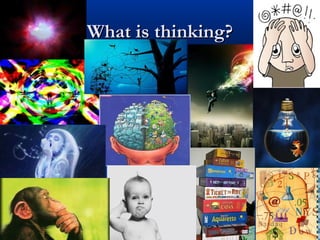
 What is thinking?
 How are they related?
 How do we use Drama to bring
thinking skills to our students to
help them acquire the language?
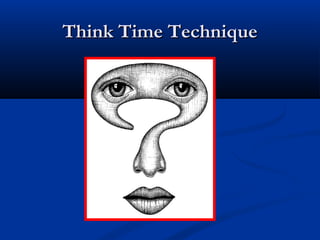
Think Time TechniqueThink Time Technique
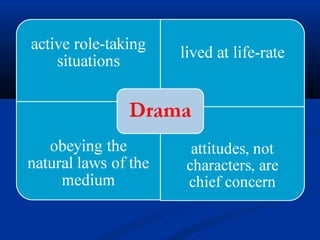
· a willing suspension of disbelief· a willing suspension of disbelief
· an agreement to pretence· an agreement to pretence
· employing all past experiences· employing all past experiences
· employing any conjecture of imagination· employing any conjecture of imagination
to create a living, moving picture of life whichto create a living, moving picture of life which
aims at surprise and discovery for theaims at surprise and discovery for the
participants rather than for any onlookers.participants rather than for any onlookers.
What is thinking?What is thinking?
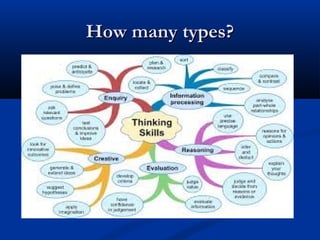
How many types?How many types?
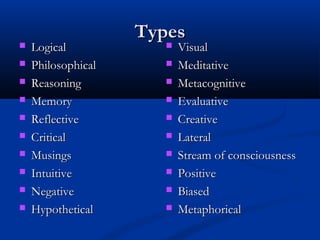
TypesTypes
 LogicalLogical
 PhilosophicalPhilosophical
 ReasoningReasoning
 MemoryMemory
 ReflectiveReflective
 CriticalCritical
 MusingsMusings
 IntuitiveIntuitive
 NegativeNegative
 HypotheticalHypothetical
 VisualVisual
 MeditativeMeditative
 MetacognitiveMetacognitive
 EvaluativeEvaluative
 CreativeCreative
 LateralLateral
 Stream of consciousnessStream of consciousness
 PositivePositive
 BiasedBiased
 MetaphoricalMetaphorical
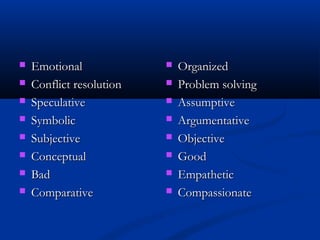
 EmotionalEmotional
 Conflict resolutionConflict resolution
 SpeculativeSpeculative
 SymbolicSymbolic
 SubjectiveSubjective
 ConceptualConceptual
 BadBad
 ComparativeComparative
 OrganizedOrganized
 Problem solvingProblem solving
 AssumptiveAssumptive
 ArgumentativeArgumentative
 ObjectiveObjective
 GoodGood
 EmpatheticEmpathetic
 CompassionateCompassionate
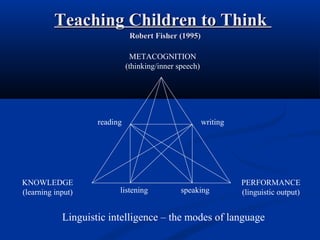
METACOGNITION
(thinking/inner speech)
KNOWLEDGE
(learning input)
PERFORMANCE
(linguistic output)
reading writing
listening speaking
Linguistic intelligence – the modes of language
Teaching Children to ThinkTeaching Children to Think
Robert Fisher (1995)Robert Fisher (1995)
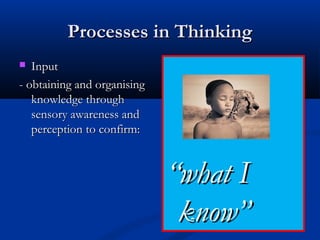
Processes in ThinkingProcesses in Thinking
 InputInput
- obtaining and organising- obtaining and organising
knowledge throughknowledge through
sensory awareness andsensory awareness and
perception to confirm:perception to confirm:
““what Iwhat I
know” know” 
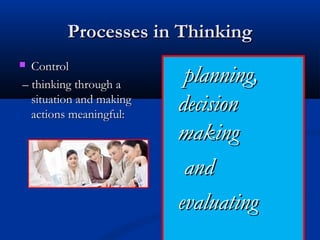
Processes in ThinkingProcesses in Thinking
 ControlControl
–– thinking through athinking through a
situation and makingsituation and making
actions meaningful:actions meaningful:
planning,planning,
decisiondecision
makingmaking
andand
evaluatingevaluating  
Processes in ThinkingProcesses in Thinking
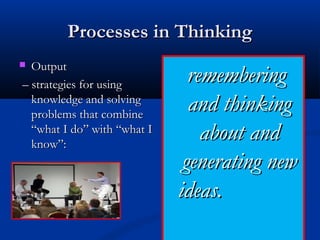
 OutputOutput
–– strategies for usingstrategies for using
knowledge and solvingknowledge and solving
problems that combineproblems that combine
“what I do” with “what I“what I do” with “what I
know”:know”:
rememberingremembering
and thinkingand thinking
about andabout and
generating newgenerating new
ideas.ideas.
The Language and ThoughtThe Language and Thought
ConnectionConnection
 objects, events and experiences are linkedobjects, events and experiences are linked
internally as the students develop theirinternally as the students develop their
understanding of symbolism and symbolic formunderstanding of symbolism and symbolic form
 the “dialogic” talk enables “intermental”the “dialogic” talk enables “intermental”
experiences to influence “intramental” thoughtexperiences to influence “intramental” thought
 unique collective opps for exploratory talk inunique collective opps for exploratory talk in
role/”as if ”/ as self in imagined worldsrole/”as if ”/ as self in imagined worlds
 speculation, consideration, evaluation,reasoningspeculation, consideration, evaluation,reasoning
Drama provides an exciting and safeDrama provides an exciting and safe
forum for thinking and acting behindforum for thinking and acting behind
the shield of a role but once the shieldthe shield of a role but once the shield
is removed the experience and thoughtsis removed the experience and thoughts
from the drama remain with the childfrom the drama remain with the child
cognitively and maybe emotionally.cognitively and maybe emotionally.
Drama is a forum forDrama is a forum for
encouraging, stimulating andencouraging, stimulating and
liberating individual andliberating individual and
collective thoughts ……..So?collective thoughts ……..So?
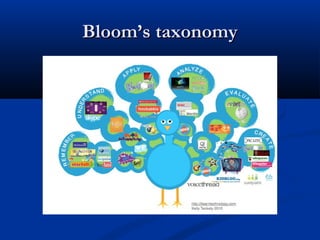
Bloom’s taxonomyBloom’s taxonomy
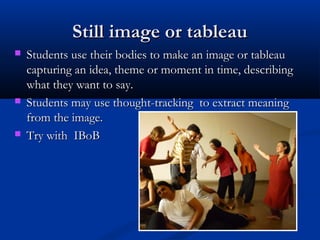
Still image or tableauStill image or tableau
 Students use their bodies to make an image or tableauStudents use their bodies to make an image or tableau
capturing an idea, theme or moment in time, describingcapturing an idea, theme or moment in time, describing
what they want to say.what they want to say.
 Students may use thought-tracking to extract meaningStudents may use thought-tracking to extract meaning
from the image.from the image.
 Try with IBoBTry with IBoB
Inclusive BrainstormingInclusive Brainstorming
on Bullyingon Bullying
 In groups up to 8In groups up to 8
 Number down in 4 columns 1-8 (or 1-5 etc)Number down in 4 columns 1-8 (or 1-5 etc)
 Sit in a circle and label each with a N°Sit in a circle and label each with a N°
 Start with N° 1 who says a word or a phraseStart with N° 1 who says a word or a phrase
 Everybody lists each person’s contributionEverybody lists each person’s contribution
 Keep listing until you are all saying PASSKeep listing until you are all saying PASS
 Using your words create a tableau toUsing your words create a tableau to
represent Bullyingrepresent Bullying
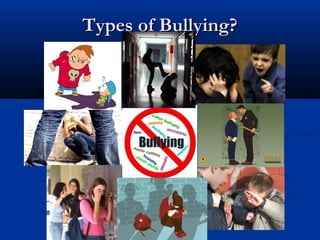
Types of Bullying-VisualisationTypes of Bullying-Visualisation
Use your Mind’s Eye…..Use your Mind’s Eye…..
Can you identify 5 types?Can you identify 5 types?
Talk TimeTalk Time
Types of Bullying?Types of Bullying?
Ping pongPing pong
BullyBully
What doesWhat does
the bullythe bully
SaySay andand
DoDo??
VictimVictim
What doesWhat does
the Victimthe Victim
Feel?Feel?
Bully does…..Victim feels…..Bully does…..Victim feels…..
 TeasingTeasing
 Name callingName calling
 PushingPushing
 HittingHitting
 ViolenceViolence
 PokingPoking
 Ordering aboutOrdering about
 StealingStealing
 Swearing at….Swearing at….
 SadSad
 AloneAlone
 RejectedRejected
 In painIn pain
 AnxiousAnxious
 AfraidAfraid
 FrustratedFrustrated
 SmallSmall
 AshamedAshamed
 HelplessHelpless
Call and ResponseCall and Response
 How does sadness smell?How does sadness smell?
 ……..rejection sound?..rejection sound?
 …………self esteem feel?self esteem feel?
 …………anxiety taste?anxiety taste?
 What does loneliness look like?What does loneliness look like?
 ………………helplessness feel like?helplessness feel like?
A Lump of ClayA Lump of Clay
1.1. ImagineImagine
2.2. Pick it upPick it up
3.3. Put it downPut it down
4.4. Make a sausage shapeMake a sausage shape
5.5. Now make the same shape a different wayNow make the same shape a different way
6.6. Now put it down and think…..how can youNow put it down and think…..how can you
make it into a person…..start now…make it into a person…..start now…
7.7. In pairs tell what you did ….you can ask QsIn pairs tell what you did ….you can ask Qs
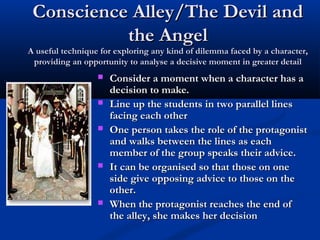
Conscience Alley/The Devil andConscience Alley/The Devil and
the Angelthe Angel
A useful technique for exploring any kind of dilemma faced by a character,A useful technique for exploring any kind of dilemma faced by a character,
providing an opportunity to analyse a decisive moment in greater detailproviding an opportunity to analyse a decisive moment in greater detail
 Consider a moment when a character has aConsider a moment when a character has a
decision to make.decision to make.
 Line up the students in two parallel linesLine up the students in two parallel lines
facing each otherfacing each other
 One person takes the role of the protagonistOne person takes the role of the protagonist
and walks between the lines as eachand walks between the lines as each
member of the group speaks their advice.member of the group speaks their advice.
 It can be organised so that those on oneIt can be organised so that those on one
side give opposing advice to those on theside give opposing advice to those on the
other.other.
 When the protagonist reaches the end ofWhen the protagonist reaches the end of
the alley, she makes her decisionthe alley, she makes her decision
Improvisation and Freeze FrameImprovisation and Freeze Frame
 Get into groups of 4 - Plan an improvisation:Get into groups of 4 - Plan an improvisation:
 Choose one of the types of bullying:Choose one of the types of bullying:
1.1. VerbalVerbal
2.2. PhysicalPhysical
3.3. ExtortionExtortion
4.4. ExclusionExclusion
5.5. On-lineOn-line
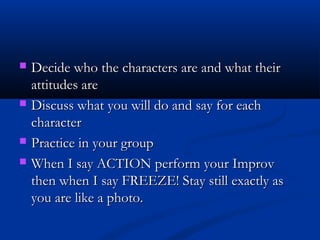
 Decide who the characters are and what theirDecide who the characters are and what their
attitudes areattitudes are
 Discuss what you will do and say for eachDiscuss what you will do and say for each
charactercharacter
 Practice in your groupPractice in your group
 When I say ACTION perform your ImprovWhen I say ACTION perform your Improv
then when I say FREEZE! Stay still exactly asthen when I say FREEZE! Stay still exactly as
you are like a photo.you are like a photo.
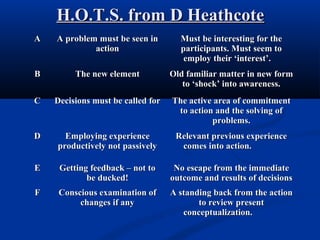
H.O.T.S. from D HeathcoteH.O.T.S. from D Heathcote
AA A problem must be seen inA problem must be seen in
actionaction
Must be interesting for theMust be interesting for the
participants. Must seem toparticipants. Must seem to
employ their ‘interest’.employ their ‘interest’.
BB The new elementThe new element Old familiar matter in new formOld familiar matter in new form
to ‘shock’ into awareness.to ‘shock’ into awareness.
CC Decisions must be called forDecisions must be called for The active area of commitmentThe active area of commitment
to action and the solving ofto action and the solving of
problems.problems.
DD Employing experienceEmploying experience
productively not passivelyproductively not passively
Relevant previous experienceRelevant previous experience
comes into action.comes into action.
EE Getting feedback – not toGetting feedback – not to
be ducked!be ducked!
No escape from the immediateNo escape from the immediate
outcome and results of decisionsoutcome and results of decisions
FF Conscious examination ofConscious examination of
changes if anychanges if any
A standing back from the actionA standing back from the action
to review presentto review present
conceptualization.conceptualization.
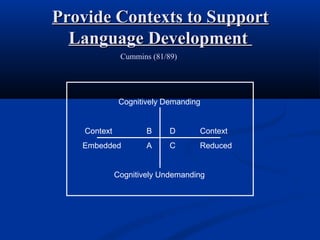
Provide Contexts to SupportProvide Contexts to Support
Language DevelopmentLanguage Development
Cummins (81/89)
Cognitively Demanding
Context B D Context
Embedded A C Reduced
Cognitively Undemanding
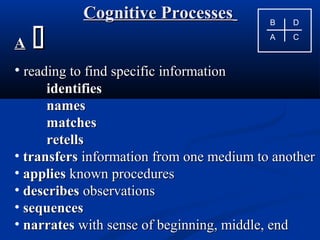
Cognitive ProcessesCognitive Processes
AA 
• reading to find specific informationreading to find specific information
identifiesidentifies
namesnames
matchesmatches
retellsretells
• transferstransfers information from one medium to anotherinformation from one medium to another
• appliesapplies known proceduresknown procedures
• describesdescribes observationsobservations
• sequencessequences
• narratesnarrates with sense of beginning, middle, endwith sense of beginning, middle, end
B D
A C
B D
A C
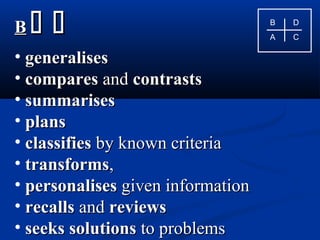
BB  
• generalisesgeneralises
• comparescompares andand contrastscontrasts
• summarisessummarises
• plansplans
• classifiesclassifies by known criteriaby known criteria
• transformstransforms,,
• personalisespersonalises given informationgiven information
• recallsrecalls andand reviewsreviews
• seeksseeks solutionssolutions to problemsto problems
B D
A C
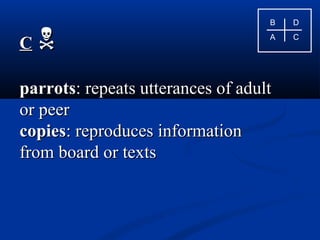
CC 
parrotsparrots: repeats utterances of adult: repeats utterances of adult
or peeror peer
copiescopies: reproduces information: reproduces information
from board or textsfrom board or texts
B D
A C
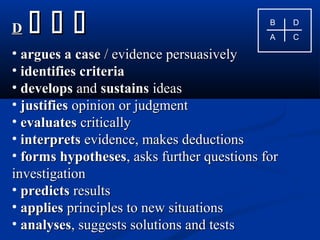
DD   
• argues a caseargues a case / evidence persuasively/ evidence persuasively
• identifies criteriaidentifies criteria
• developsdevelops andand sustainssustains ideasideas
• justifiesjustifies opinion or judgmentopinion or judgment
• evaluatesevaluates criticallycritically
• interpretsinterprets evidence, makes deductionsevidence, makes deductions
• forms hypothesesforms hypotheses, asks further questions for, asks further questions for
investigationinvestigation
• predictspredicts resultsresults
• appliesapplies principles to new situationsprinciples to new situations
• analysesanalyses, suggests solutions and tests, suggests solutions and tests
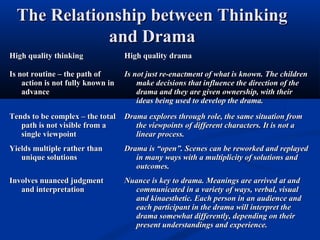
The Relationship between ThinkingThe Relationship between Thinking
and Dramaand Drama
High quality thinkingHigh quality thinking High quality dramaHigh quality drama
Is not routine – the path ofIs not routine – the path of
action is not fully known inaction is not fully known in
advanceadvance
Is not just re-enactment of what is known. The childrenIs not just re-enactment of what is known. The children
make decisions that influence the direction of themake decisions that influence the direction of the
drama and they are given ownership, with theirdrama and they are given ownership, with their
ideas being used to develop the drama.ideas being used to develop the drama.
Tends to be complex – the totalTends to be complex – the total
path is not visible from apath is not visible from a
single viewpointsingle viewpoint
Drama explores through role, the same situation fromDrama explores through role, the same situation from
the viewpoints of different characters. It is not athe viewpoints of different characters. It is not a
linear process.linear process.
Yields multiple rather thanYields multiple rather than
unique solutionsunique solutions
Drama is “open”. Scenes can be reworked and replayedDrama is “open”. Scenes can be reworked and replayed
in many ways with a multiplicity of solutions andin many ways with a multiplicity of solutions and
outcomes.outcomes.
Involves nuanced judgmentInvolves nuanced judgment
and interpretationand interpretation
Nuance is key to drama. Meanings are arrived at andNuance is key to drama. Meanings are arrived at and
communicated in a variety of ways, verbal, visualcommunicated in a variety of ways, verbal, visual
and kinaesthetic. Each person in an audience andand kinaesthetic. Each person in an audience and
each participant in the drama will interpret theeach participant in the drama will interpret the
drama somewhat differently, depending on theirdrama somewhat differently, depending on their
present understandings and experience.present understandings and experience.
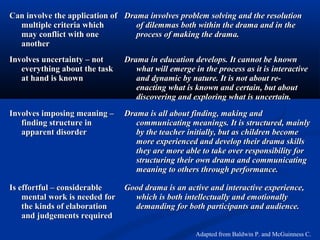
Can involve the application ofCan involve the application of
multiple criteria whichmultiple criteria which
may conflict with onemay conflict with one
anotheranother
Drama involves problem solving and the resolutionDrama involves problem solving and the resolution
of dilemmas both within the drama and in theof dilemmas both within the drama and in the
process of making the drama.process of making the drama.
Involves uncertainty – notInvolves uncertainty – not
everything about the taskeverything about the task
at hand is knownat hand is known
Drama in education develops. It cannot be knownDrama in education develops. It cannot be known
what will emerge in the process as it is interactivewhat will emerge in the process as it is interactive
and dynamic by nature. It is not about re-and dynamic by nature. It is not about re-
enacting what is known and certain, but aboutenacting what is known and certain, but about
discovering and exploring what is uncertain.discovering and exploring what is uncertain.
Involves imposing meaning –Involves imposing meaning –
finding structure infinding structure in
apparent disorderapparent disorder
Drama is all about finding, making andDrama is all about finding, making and
communicating meanings. It is structured, mainlycommunicating meanings. It is structured, mainly
by the teacher initially, but as children becomeby the teacher initially, but as children become
more experienced and develop their drama skillsmore experienced and develop their drama skills
they are more able to take over responsibility forthey are more able to take over responsibility for
structuring their own drama and communicatingstructuring their own drama and communicating
meaning to others through performance.meaning to others through performance.
Is effortful – considerableIs effortful – considerable
mental work is needed formental work is needed for
the kinds of elaborationthe kinds of elaboration
and judgements requiredand judgements required
Good drama is an active and interactive experience,Good drama is an active and interactive experience,
which is both intellectually and emotionallywhich is both intellectually and emotionally
demanding for both participants and audience.demanding for both participants and audience.
Adapted from Baldwin P. and McGuinness C.
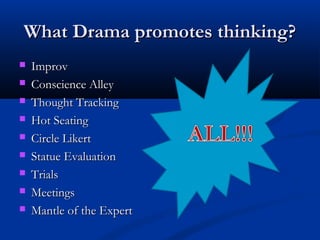
What Drama promotes thinking?What Drama promotes thinking?
 ImprovImprov
 Conscience AlleyConscience Alley
 Thought TrackingThought Tracking
 Hot SeatingHot Seating
 Circle LikertCircle Likert
 Statue EvaluationStatue Evaluation
 TrialsTrials
 MeetingsMeetings
 Mantle of the ExpertMantle of the Expert
Evaluatio
n

Dramathink 2015

  • 1.
    DramathinkDramathink Actful Teaching,Actful Teaching, UruguayUruguay June6June 6thth , 2015, 2015 Susan Hillyard B.Ed (Hons)Susan Hillyard B.Ed (Hons) http://susanhillyard.blogspot.com.arhttp://susanhillyard.blogspot.com.ar//
  • 2.
    Questions for todayQuestionsfor today  What is Drama?  What is thinking?  How are they related?  How do we use Drama to bring thinking skills to our students to help them acquire the language?
  • 4.
  • 6.
    · a willingsuspension of disbelief· a willing suspension of disbelief · an agreement to pretence· an agreement to pretence · employing all past experiences· employing all past experiences · employing any conjecture of imagination· employing any conjecture of imagination to create a living, moving picture of life whichto create a living, moving picture of life which aims at surprise and discovery for theaims at surprise and discovery for the participants rather than for any onlookers.participants rather than for any onlookers.
  • 7.
  • 8.
    How many types?Howmany types?
  • 9.
    TypesTypes  LogicalLogical  PhilosophicalPhilosophical ReasoningReasoning  MemoryMemory  ReflectiveReflective  CriticalCritical  MusingsMusings  IntuitiveIntuitive  NegativeNegative  HypotheticalHypothetical  VisualVisual  MeditativeMeditative  MetacognitiveMetacognitive  EvaluativeEvaluative  CreativeCreative  LateralLateral  Stream of consciousnessStream of consciousness  PositivePositive  BiasedBiased  MetaphoricalMetaphorical
  • 10.
     EmotionalEmotional  ConflictresolutionConflict resolution  SpeculativeSpeculative  SymbolicSymbolic  SubjectiveSubjective  ConceptualConceptual  BadBad  ComparativeComparative  OrganizedOrganized  Problem solvingProblem solving  AssumptiveAssumptive  ArgumentativeArgumentative  ObjectiveObjective  GoodGood  EmpatheticEmpathetic  CompassionateCompassionate
  • 11.
    METACOGNITION (thinking/inner speech) KNOWLEDGE (learning input) PERFORMANCE (linguisticoutput) reading writing listening speaking Linguistic intelligence – the modes of language Teaching Children to ThinkTeaching Children to Think Robert Fisher (1995)Robert Fisher (1995)
  • 12.
    Processes in ThinkingProcessesin Thinking  InputInput - obtaining and organising- obtaining and organising knowledge throughknowledge through sensory awareness andsensory awareness and perception to confirm:perception to confirm: ““what Iwhat I know” know” 
  • 13.
    Processes in ThinkingProcessesin Thinking  ControlControl –– thinking through athinking through a situation and makingsituation and making actions meaningful:actions meaningful: planning,planning, decisiondecision makingmaking andand evaluatingevaluating  
  • 14.
    Processes in ThinkingProcessesin Thinking  OutputOutput –– strategies for usingstrategies for using knowledge and solvingknowledge and solving problems that combineproblems that combine “what I do” with “what I“what I do” with “what I know”:know”: rememberingremembering and thinkingand thinking about andabout and generating newgenerating new ideas.ideas.
  • 15.
    The Language andThoughtThe Language and Thought ConnectionConnection  objects, events and experiences are linkedobjects, events and experiences are linked internally as the students develop theirinternally as the students develop their understanding of symbolism and symbolic formunderstanding of symbolism and symbolic form  the “dialogic” talk enables “intermental”the “dialogic” talk enables “intermental” experiences to influence “intramental” thoughtexperiences to influence “intramental” thought  unique collective opps for exploratory talk inunique collective opps for exploratory talk in role/”as if ”/ as self in imagined worldsrole/”as if ”/ as self in imagined worlds  speculation, consideration, evaluation,reasoningspeculation, consideration, evaluation,reasoning
  • 16.
    Drama provides anexciting and safeDrama provides an exciting and safe forum for thinking and acting behindforum for thinking and acting behind the shield of a role but once the shieldthe shield of a role but once the shield is removed the experience and thoughtsis removed the experience and thoughts from the drama remain with the childfrom the drama remain with the child cognitively and maybe emotionally.cognitively and maybe emotionally.
  • 17.
    Drama is aforum forDrama is a forum for encouraging, stimulating andencouraging, stimulating and liberating individual andliberating individual and collective thoughts ……..So?collective thoughts ……..So?
  • 18.
  • 21.
    Still image ortableauStill image or tableau  Students use their bodies to make an image or tableauStudents use their bodies to make an image or tableau capturing an idea, theme or moment in time, describingcapturing an idea, theme or moment in time, describing what they want to say.what they want to say.  Students may use thought-tracking to extract meaningStudents may use thought-tracking to extract meaning from the image.from the image.  Try with IBoBTry with IBoB
  • 22.
    Inclusive BrainstormingInclusive Brainstorming onBullyingon Bullying  In groups up to 8In groups up to 8  Number down in 4 columns 1-8 (or 1-5 etc)Number down in 4 columns 1-8 (or 1-5 etc)  Sit in a circle and label each with a N°Sit in a circle and label each with a N°  Start with N° 1 who says a word or a phraseStart with N° 1 who says a word or a phrase  Everybody lists each person’s contributionEverybody lists each person’s contribution  Keep listing until you are all saying PASSKeep listing until you are all saying PASS  Using your words create a tableau toUsing your words create a tableau to represent Bullyingrepresent Bullying
  • 23.
    Types of Bullying-VisualisationTypesof Bullying-Visualisation Use your Mind’s Eye…..Use your Mind’s Eye….. Can you identify 5 types?Can you identify 5 types?
  • 24.
  • 25.
  • 26.
    Ping pongPing pong BullyBully WhatdoesWhat does the bullythe bully SaySay andand DoDo?? VictimVictim What doesWhat does the Victimthe Victim Feel?Feel?
  • 27.
    Bully does…..Victim feels…..Bullydoes…..Victim feels…..  TeasingTeasing  Name callingName calling  PushingPushing  HittingHitting  ViolenceViolence  PokingPoking  Ordering aboutOrdering about  StealingStealing  Swearing at….Swearing at….  SadSad  AloneAlone  RejectedRejected  In painIn pain  AnxiousAnxious  AfraidAfraid  FrustratedFrustrated  SmallSmall  AshamedAshamed  HelplessHelpless
  • 28.
    Call and ResponseCalland Response  How does sadness smell?How does sadness smell?  ……..rejection sound?..rejection sound?  …………self esteem feel?self esteem feel?  …………anxiety taste?anxiety taste?  What does loneliness look like?What does loneliness look like?  ………………helplessness feel like?helplessness feel like?
  • 29.
    A Lump ofClayA Lump of Clay 1.1. ImagineImagine 2.2. Pick it upPick it up 3.3. Put it downPut it down 4.4. Make a sausage shapeMake a sausage shape 5.5. Now make the same shape a different wayNow make the same shape a different way 6.6. Now put it down and think…..how can youNow put it down and think…..how can you make it into a person…..start now…make it into a person…..start now… 7.7. In pairs tell what you did ….you can ask QsIn pairs tell what you did ….you can ask Qs
  • 30.
    Conscience Alley/The DevilandConscience Alley/The Devil and the Angelthe Angel A useful technique for exploring any kind of dilemma faced by a character,A useful technique for exploring any kind of dilemma faced by a character, providing an opportunity to analyse a decisive moment in greater detailproviding an opportunity to analyse a decisive moment in greater detail  Consider a moment when a character has aConsider a moment when a character has a decision to make.decision to make.  Line up the students in two parallel linesLine up the students in two parallel lines facing each otherfacing each other  One person takes the role of the protagonistOne person takes the role of the protagonist and walks between the lines as eachand walks between the lines as each member of the group speaks their advice.member of the group speaks their advice.  It can be organised so that those on oneIt can be organised so that those on one side give opposing advice to those on theside give opposing advice to those on the other.other.  When the protagonist reaches the end ofWhen the protagonist reaches the end of the alley, she makes her decisionthe alley, she makes her decision
  • 31.
    Improvisation and FreezeFrameImprovisation and Freeze Frame  Get into groups of 4 - Plan an improvisation:Get into groups of 4 - Plan an improvisation:  Choose one of the types of bullying:Choose one of the types of bullying: 1.1. VerbalVerbal 2.2. PhysicalPhysical 3.3. ExtortionExtortion 4.4. ExclusionExclusion 5.5. On-lineOn-line
  • 32.
     Decide whothe characters are and what theirDecide who the characters are and what their attitudes areattitudes are  Discuss what you will do and say for eachDiscuss what you will do and say for each charactercharacter  Practice in your groupPractice in your group  When I say ACTION perform your ImprovWhen I say ACTION perform your Improv then when I say FREEZE! Stay still exactly asthen when I say FREEZE! Stay still exactly as you are like a photo.you are like a photo.
  • 33.
    H.O.T.S. from DHeathcoteH.O.T.S. from D Heathcote AA A problem must be seen inA problem must be seen in actionaction Must be interesting for theMust be interesting for the participants. Must seem toparticipants. Must seem to employ their ‘interest’.employ their ‘interest’. BB The new elementThe new element Old familiar matter in new formOld familiar matter in new form to ‘shock’ into awareness.to ‘shock’ into awareness. CC Decisions must be called forDecisions must be called for The active area of commitmentThe active area of commitment to action and the solving ofto action and the solving of problems.problems. DD Employing experienceEmploying experience productively not passivelyproductively not passively Relevant previous experienceRelevant previous experience comes into action.comes into action. EE Getting feedback – not toGetting feedback – not to be ducked!be ducked! No escape from the immediateNo escape from the immediate outcome and results of decisionsoutcome and results of decisions FF Conscious examination ofConscious examination of changes if anychanges if any A standing back from the actionA standing back from the action to review presentto review present conceptualization.conceptualization.
  • 34.
    Provide Contexts toSupportProvide Contexts to Support Language DevelopmentLanguage Development Cummins (81/89) Cognitively Demanding Context B D Context Embedded A C Reduced Cognitively Undemanding
  • 35.
    Cognitive ProcessesCognitive Processes AA • reading to find specific informationreading to find specific information identifiesidentifies namesnames matchesmatches retellsretells • transferstransfers information from one medium to anotherinformation from one medium to another • appliesapplies known proceduresknown procedures • describesdescribes observationsobservations • sequencessequences • narratesnarrates with sense of beginning, middle, endwith sense of beginning, middle, end B D A C
  • 36.
    B D A C BB  • generalisesgeneralises • comparescompares andand contrastscontrasts • summarisessummarises • plansplans • classifiesclassifies by known criteriaby known criteria • transformstransforms,, • personalisespersonalises given informationgiven information • recallsrecalls andand reviewsreviews • seeksseeks solutionssolutions to problemsto problems
  • 37.
    B D A C CC parrotsparrots: repeats utterances of adult: repeats utterances of adult or peeror peer copiescopies: reproduces information: reproduces information from board or textsfrom board or texts
  • 38.
    B D A C DD   • argues a caseargues a case / evidence persuasively/ evidence persuasively • identifies criteriaidentifies criteria • developsdevelops andand sustainssustains ideasideas • justifiesjustifies opinion or judgmentopinion or judgment • evaluatesevaluates criticallycritically • interpretsinterprets evidence, makes deductionsevidence, makes deductions • forms hypothesesforms hypotheses, asks further questions for, asks further questions for investigationinvestigation • predictspredicts resultsresults • appliesapplies principles to new situationsprinciples to new situations • analysesanalyses, suggests solutions and tests, suggests solutions and tests
  • 39.
    The Relationship betweenThinkingThe Relationship between Thinking and Dramaand Drama High quality thinkingHigh quality thinking High quality dramaHigh quality drama Is not routine – the path ofIs not routine – the path of action is not fully known inaction is not fully known in advanceadvance Is not just re-enactment of what is known. The childrenIs not just re-enactment of what is known. The children make decisions that influence the direction of themake decisions that influence the direction of the drama and they are given ownership, with theirdrama and they are given ownership, with their ideas being used to develop the drama.ideas being used to develop the drama. Tends to be complex – the totalTends to be complex – the total path is not visible from apath is not visible from a single viewpointsingle viewpoint Drama explores through role, the same situation fromDrama explores through role, the same situation from the viewpoints of different characters. It is not athe viewpoints of different characters. It is not a linear process.linear process. Yields multiple rather thanYields multiple rather than unique solutionsunique solutions Drama is “open”. Scenes can be reworked and replayedDrama is “open”. Scenes can be reworked and replayed in many ways with a multiplicity of solutions andin many ways with a multiplicity of solutions and outcomes.outcomes. Involves nuanced judgmentInvolves nuanced judgment and interpretationand interpretation Nuance is key to drama. Meanings are arrived at andNuance is key to drama. Meanings are arrived at and communicated in a variety of ways, verbal, visualcommunicated in a variety of ways, verbal, visual and kinaesthetic. Each person in an audience andand kinaesthetic. Each person in an audience and each participant in the drama will interpret theeach participant in the drama will interpret the drama somewhat differently, depending on theirdrama somewhat differently, depending on their present understandings and experience.present understandings and experience.
  • 40.
    Can involve theapplication ofCan involve the application of multiple criteria whichmultiple criteria which may conflict with onemay conflict with one anotheranother Drama involves problem solving and the resolutionDrama involves problem solving and the resolution of dilemmas both within the drama and in theof dilemmas both within the drama and in the process of making the drama.process of making the drama. Involves uncertainty – notInvolves uncertainty – not everything about the taskeverything about the task at hand is knownat hand is known Drama in education develops. It cannot be knownDrama in education develops. It cannot be known what will emerge in the process as it is interactivewhat will emerge in the process as it is interactive and dynamic by nature. It is not about re-and dynamic by nature. It is not about re- enacting what is known and certain, but aboutenacting what is known and certain, but about discovering and exploring what is uncertain.discovering and exploring what is uncertain. Involves imposing meaning –Involves imposing meaning – finding structure infinding structure in apparent disorderapparent disorder Drama is all about finding, making andDrama is all about finding, making and communicating meanings. It is structured, mainlycommunicating meanings. It is structured, mainly by the teacher initially, but as children becomeby the teacher initially, but as children become more experienced and develop their drama skillsmore experienced and develop their drama skills they are more able to take over responsibility forthey are more able to take over responsibility for structuring their own drama and communicatingstructuring their own drama and communicating meaning to others through performance.meaning to others through performance. Is effortful – considerableIs effortful – considerable mental work is needed formental work is needed for the kinds of elaborationthe kinds of elaboration and judgements requiredand judgements required Good drama is an active and interactive experience,Good drama is an active and interactive experience, which is both intellectually and emotionallywhich is both intellectually and emotionally demanding for both participants and audience.demanding for both participants and audience. Adapted from Baldwin P. and McGuinness C.
  • 41.
    What Drama promotesthinking?What Drama promotes thinking?  ImprovImprov  Conscience AlleyConscience Alley  Thought TrackingThought Tracking  Hot SeatingHot Seating  Circle LikertCircle Likert  Statue EvaluationStatue Evaluation  TrialsTrials  MeetingsMeetings  Mantle of the ExpertMantle of the Expert
  • 42.