EWRT 211 Class
AGENDA
Vocab: Spells through Vocab 21
GPU: Appositives, sentence fragments
Review
◦ Introduction
◦ Thesis
Body Paragraphs
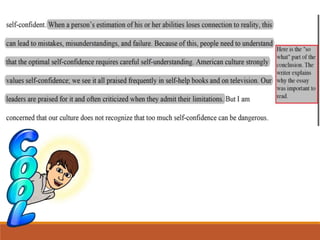
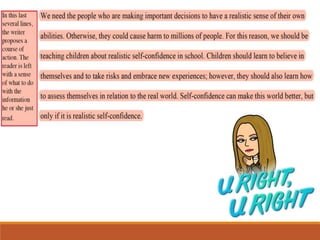
Conclusions:
◦ So What?
◦ Connect your essay to the world: Propose a course of
Action
◦ Frame the essay by relating the ending to the beginning
Vocabulary
10. Jaunty: “morning, mum,” said George, in what he clearly thought was
a jaunty, winning voice.
11. Prod: “YOU COULD DO WITH TAKING A LEAF OUT OF PERCY’S
BOOK!” Yelled Mrs. Weasley, prodding a finger in Fred’s chest. “You could
have died, you could have been seen, you could have lost your father his
job —”
12. Haphazardly: Mrs. Weasley was clattering around, cooking breakfast
a little haphazardly, throwing dirty looks at her sons as she threw
sausages into the frying pan.
13. Cheeky: as always in the wizarding world, the photograph was
moving; the wizard, who Harry supposed was Gilderoy Lockhart, kept
winking cheekily up at them all.
14. Slouch: the Weasleys slouched outside with Harry behind them.
15. Gnarled: the Dursleys wouldn’t have liked it — there were plenty of
weeds, and the grass needed cutting — but there were gnarled trees
all around the walls, plants Harry had never seen spilling from every
flower bed, and a big green pond full of frogs.
16. Straggling: soon, the crowd of gnomes in the field started walking
away in a straggling line, their little shoulders hunched.
17. Emblazon: “The Chudley Cannons,” said Ron, pointing at the
orange bedspread, which was emblazoned with two giant black c’s and
a speeding cannonball.
18. Amble: you two’ve got them, too,” he added, as Fred and George ambled in,
still in their pajamas
19. molt: He sat down in the only remaining chair but leapt up again almost
immediately, pulling from underneath him a molting, gray feather duster — at
least, that was what Harry thought it was, until he saw that it was breathing.
20. outstrip: They took turns riding Harry’s Nimbus Two Thousand, which was
easily the best broom; Ron’s old Shooting Star was often outstripped by
passing butterflies.
21. gloat: “He’s not himself. His exam results
came the day before you did; twelve O.W.L.s
and he hardly gloated at all.”
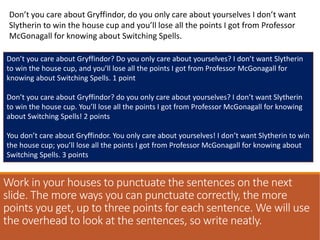
Work in your houses to punctuate the sentences on the next
slide. The more ways you can punctuate correctly, the more
points you get, up to three points for each sentence. We will use
the overhead to look at the sentences, so write neatly.
Don’t you care about Gryffindor, do you only care about yourselves I don’t want
Slytherin to win the house cup and you’ll lose all the points I got from Professor
McGonagall for knowing about Switching Spells.
Don’t you care about Gryffindor? Do you only care about yourselves? I don’t want Slytherin
to win the house cup, and you’ll lose all the points I got from Professor McGonagall for
knowing about Switching Spells. 1 point
Don’t you care about Gryffindor? do you only care about yourselves? I don’t want Slytherin
to win the house cup. You’ll lose all the points I got from Professor McGonagall for knowing
about Switching Spells! 2 points
You don’t care about Gryffindor. You only care about yourselves! I don’t want Slytherin to win
the house cup; you’ll lose all the points I got from Professor McGonagall for knowing about
Switching Spells. 3 points
1. One of the most loved series by many the stories are about fantasy
and some discoveries about the main character's life. Harry Potter and
the Sorcerer’s Stone.
2. He had not only enrolled into Hogwarts school of Witchcraft and
Wizardry but also learned how to use magic with the help of friends he
successfully obtained a magic stone and defeated Lord Voldemort.
3. The acting was fantastic especially how Harry played his role, in 2001
he was only 11 when he started acting back in 18 years ago.
4. The film throws you into this boy named
Harry’s life he lost his parents when he
was still an infant now he is an orphan
being taken care of by his aunt and uncle
however Harry is mistreated and neglected
as they treated him as filth.
5. Negative energy hindering his
surroundings almost making it impossible
to be at peace.
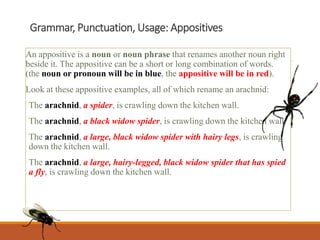
Grammar, Punctuation, Usage: Appositives
An appositive is a noun or noun phrase that renames another noun right
beside it. The appositive can be a short or long combination of words.
(the noun or pronoun will be in blue, the appositive will be in red).
Look at these appositive examples, all of which rename an arachnid:
The arachnid, a spider, is crawling down the kitchen wall.
The arachnid, a black widow spider, is crawling down the kitchen wall.
The arachnid, a large, black widow spider with hairy legs, is crawling
down the kitchen wall.
The arachnid, a large, hairy-legged, black widow spider that has spied
a fly, is crawling down the kitchen wall.
1. My brother's car, a sporty red convertible with bucket seats, is the envy
of my friends.
2. The chief surgeon, an expert in organ-transplant procedures, took her
nephew on a hospital tour.
An appositive phrase usually follows the word it explains or identifies, but it
may also precede it.
3. A bold innovator, Wassily Kandinsky is known for his colorful abstract
paintings.
4. The first state to ratify the U. S. Constitution, Delaware is rich in history.
5. A beautiful collie, Skip was my favorite dog.
From Purdue Owl. For more help go to:
https://owl.english.purdue.edu/owl/resource/596/01/
More examples of appositives: note that when you remove the appositive phrase,
the sentence is still complete.
When the appositive begins the sentence, it looks like this:
1. Characterized as feelings of despondency and dejection,
depression hurts the victim and disrupts families.
When the appositive interrupts the sentence, it looks like this:
2. Anger, a strong feeling of annoyance, displeasure, or hostility,
causes the adrenal glands flood the body with stress hormones.
And when the appositive ends the sentence, it looks like this:
3. Mary suffers from extreme nervousness, a trait that causes her to
be easily agitated or alarmed
Working in your houses, and using the examples below as models, write at
least three appositive phrases—one at the beginning of a sentence, one in the
middle, and one at the end. Write sentences that use or define a trait you have
chosen.
REVIEW
GET OUT YOUR DRAFT
Look at your introduction
1. Do you have three paragraphs? Count them.
2. Do you have a definition from a reliable source?
Underline it
3. Have you defined the trait in your own words?
Underline it.
4. Have you included an explanation from an outside
article? Underline it.
5. Does your introduction distinguish between types or
positive and negative traits? Underline that part too.
6. Have you explained the trait by giving examples you
have come up with yourself? Identify and underline
these examples.
7. Find and underline the thesis statement.
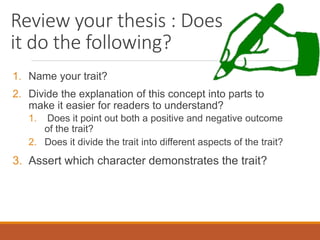
Review your thesis : Does
it do the following?
1. Name your trait?
2. Divide the explanation of this concept into parts to
make it easier for readers to understand?
1. Does it point out both a positive and negative outcome
of the trait?
2. Does it divide the trait into different aspects of the trait?
3. Assert which character demonstrates the trait?
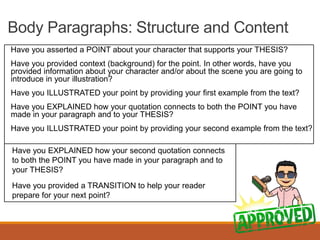
Body Paragraphs: Structure and Content
Have you asserted a POINT about your character that supports your THESIS?
Have you provided context (background) for the point. In other words, have you
provided information about your character and/or about the scene you are going to
introduce in your illustration?
Have you ILLUSTRATED your point by providing your first example from the text?
Have you EXPLAINED how your quotation connects to both the POINT you have
made in your paragraph and to your THESIS?
Have you ILLUSTRATED your point by providing your second example from the text?
Have you EXPLAINED how your second quotation connects
to both the POINT you have made in your paragraph and to
your THESIS?
Have you provided a TRANSITION to help your reader
prepare for your next point?
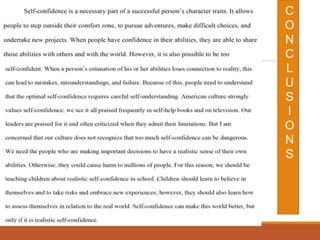
C
O
N
C
L
U
S
I
O
N
S
In-Class Writing:
Conclusions
Conclusions:
Frame the essay by relating the ending to the
beginning
So What?
Connect your essay to the world: Propose a
course of Action
HOMEWORK
Finish HP Chapter 18 327-end.
HW Discussion 10
Bring: two copies of your entire draft to our
next meeting. Minimum requirements: Intro
(should be multiple paragraphs, describing and
defining the trait, with citations), thesis, three
body paragraphs, focused on multiple aspects
of ONE character trait via ONE character from
Harry Potter, and a conclusion, using one or
more of the strategies we discussed in class.
This should be at least three complete pages
plus a works cited page.

Ewrt 211 class 12

  • 1.
  • 2.
    AGENDA Vocab: Spells throughVocab 21 GPU: Appositives, sentence fragments Review ◦ Introduction ◦ Thesis Body Paragraphs Conclusions: ◦ So What? ◦ Connect your essay to the world: Propose a course of Action ◦ Frame the essay by relating the ending to the beginning
  • 3.
    Vocabulary 10. Jaunty: “morning,mum,” said George, in what he clearly thought was a jaunty, winning voice. 11. Prod: “YOU COULD DO WITH TAKING A LEAF OUT OF PERCY’S BOOK!” Yelled Mrs. Weasley, prodding a finger in Fred’s chest. “You could have died, you could have been seen, you could have lost your father his job —” 12. Haphazardly: Mrs. Weasley was clattering around, cooking breakfast a little haphazardly, throwing dirty looks at her sons as she threw sausages into the frying pan. 13. Cheeky: as always in the wizarding world, the photograph was moving; the wizard, who Harry supposed was Gilderoy Lockhart, kept winking cheekily up at them all.
  • 4.
    14. Slouch: theWeasleys slouched outside with Harry behind them. 15. Gnarled: the Dursleys wouldn’t have liked it — there were plenty of weeds, and the grass needed cutting — but there were gnarled trees all around the walls, plants Harry had never seen spilling from every flower bed, and a big green pond full of frogs. 16. Straggling: soon, the crowd of gnomes in the field started walking away in a straggling line, their little shoulders hunched. 17. Emblazon: “The Chudley Cannons,” said Ron, pointing at the orange bedspread, which was emblazoned with two giant black c’s and a speeding cannonball.
  • 5.
    18. Amble: youtwo’ve got them, too,” he added, as Fred and George ambled in, still in their pajamas 19. molt: He sat down in the only remaining chair but leapt up again almost immediately, pulling from underneath him a molting, gray feather duster — at least, that was what Harry thought it was, until he saw that it was breathing. 20. outstrip: They took turns riding Harry’s Nimbus Two Thousand, which was easily the best broom; Ron’s old Shooting Star was often outstripped by passing butterflies. 21. gloat: “He’s not himself. His exam results came the day before you did; twelve O.W.L.s and he hardly gloated at all.”
  • 6.
    Work in yourhouses to punctuate the sentences on the next slide. The more ways you can punctuate correctly, the more points you get, up to three points for each sentence. We will use the overhead to look at the sentences, so write neatly. Don’t you care about Gryffindor, do you only care about yourselves I don’t want Slytherin to win the house cup and you’ll lose all the points I got from Professor McGonagall for knowing about Switching Spells. Don’t you care about Gryffindor? Do you only care about yourselves? I don’t want Slytherin to win the house cup, and you’ll lose all the points I got from Professor McGonagall for knowing about Switching Spells. 1 point Don’t you care about Gryffindor? do you only care about yourselves? I don’t want Slytherin to win the house cup. You’ll lose all the points I got from Professor McGonagall for knowing about Switching Spells! 2 points You don’t care about Gryffindor. You only care about yourselves! I don’t want Slytherin to win the house cup; you’ll lose all the points I got from Professor McGonagall for knowing about Switching Spells. 3 points
  • 7.
    1. One ofthe most loved series by many the stories are about fantasy and some discoveries about the main character's life. Harry Potter and the Sorcerer’s Stone. 2. He had not only enrolled into Hogwarts school of Witchcraft and Wizardry but also learned how to use magic with the help of friends he successfully obtained a magic stone and defeated Lord Voldemort. 3. The acting was fantastic especially how Harry played his role, in 2001 he was only 11 when he started acting back in 18 years ago. 4. The film throws you into this boy named Harry’s life he lost his parents when he was still an infant now he is an orphan being taken care of by his aunt and uncle however Harry is mistreated and neglected as they treated him as filth. 5. Negative energy hindering his surroundings almost making it impossible to be at peace.
  • 8.
    Grammar, Punctuation, Usage:Appositives An appositive is a noun or noun phrase that renames another noun right beside it. The appositive can be a short or long combination of words. (the noun or pronoun will be in blue, the appositive will be in red). Look at these appositive examples, all of which rename an arachnid: The arachnid, a spider, is crawling down the kitchen wall. The arachnid, a black widow spider, is crawling down the kitchen wall. The arachnid, a large, black widow spider with hairy legs, is crawling down the kitchen wall. The arachnid, a large, hairy-legged, black widow spider that has spied a fly, is crawling down the kitchen wall.
  • 9.
    1. My brother'scar, a sporty red convertible with bucket seats, is the envy of my friends. 2. The chief surgeon, an expert in organ-transplant procedures, took her nephew on a hospital tour. An appositive phrase usually follows the word it explains or identifies, but it may also precede it. 3. A bold innovator, Wassily Kandinsky is known for his colorful abstract paintings. 4. The first state to ratify the U. S. Constitution, Delaware is rich in history. 5. A beautiful collie, Skip was my favorite dog. From Purdue Owl. For more help go to: https://owl.english.purdue.edu/owl/resource/596/01/ More examples of appositives: note that when you remove the appositive phrase, the sentence is still complete.
  • 10.
    When the appositivebegins the sentence, it looks like this: 1. Characterized as feelings of despondency and dejection, depression hurts the victim and disrupts families. When the appositive interrupts the sentence, it looks like this: 2. Anger, a strong feeling of annoyance, displeasure, or hostility, causes the adrenal glands flood the body with stress hormones. And when the appositive ends the sentence, it looks like this: 3. Mary suffers from extreme nervousness, a trait that causes her to be easily agitated or alarmed Working in your houses, and using the examples below as models, write at least three appositive phrases—one at the beginning of a sentence, one in the middle, and one at the end. Write sentences that use or define a trait you have chosen.
  • 11.
  • 12.
    Look at yourintroduction 1. Do you have three paragraphs? Count them. 2. Do you have a definition from a reliable source? Underline it 3. Have you defined the trait in your own words? Underline it. 4. Have you included an explanation from an outside article? Underline it. 5. Does your introduction distinguish between types or positive and negative traits? Underline that part too. 6. Have you explained the trait by giving examples you have come up with yourself? Identify and underline these examples. 7. Find and underline the thesis statement.
  • 13.
    Review your thesis: Does it do the following? 1. Name your trait? 2. Divide the explanation of this concept into parts to make it easier for readers to understand? 1. Does it point out both a positive and negative outcome of the trait? 2. Does it divide the trait into different aspects of the trait? 3. Assert which character demonstrates the trait?
  • 14.
    Body Paragraphs: Structureand Content Have you asserted a POINT about your character that supports your THESIS? Have you provided context (background) for the point. In other words, have you provided information about your character and/or about the scene you are going to introduce in your illustration? Have you ILLUSTRATED your point by providing your first example from the text? Have you EXPLAINED how your quotation connects to both the POINT you have made in your paragraph and to your THESIS? Have you ILLUSTRATED your point by providing your second example from the text? Have you EXPLAINED how your second quotation connects to both the POINT you have made in your paragraph and to your THESIS? Have you provided a TRANSITION to help your reader prepare for your next point?
  • 15.
  • 19.
    In-Class Writing: Conclusions Conclusions: Frame theessay by relating the ending to the beginning So What? Connect your essay to the world: Propose a course of Action
  • 20.
    HOMEWORK Finish HP Chapter18 327-end. HW Discussion 10 Bring: two copies of your entire draft to our next meeting. Minimum requirements: Intro (should be multiple paragraphs, describing and defining the trait, with citations), thesis, three body paragraphs, focused on multiple aspects of ONE character trait via ONE character from Harry Potter, and a conclusion, using one or more of the strategies we discussed in class. This should be at least three complete pages plus a works cited page.