Few Rules
 No copying of assignment
 Be punctual in submitting assignment
 No absenteeism in OHTs
 Questions are welcome
“He who asks is a fool for five minutes, but he who
does not ask remains a fool forever”
INTRODUCTION TO
ENGINEERING ECONOMY
Chapter # 1
Objectives
 Objectives of Chapter 1 are :

Introduce the subject of engineering economy

Discuss its critical role in engineering design and analysis

Discuss basic principles of the subject

Provide an overview of book
 Following topics are discussed

Importance of the subject in engineering practice

Origins of engineering economy

Principles of engineering economy

Engineering economy and design process

Accounting and engineering economy studies
3
4
Introduction
 Purpose of this book

principles and methodology

for basic economic question of engineering
 Engineering

apply mathematics, natural sciences and judgment
gained by study, experience and practice

utilize the materials and forces of nature for the benefit
of mankind

has physical aspect & economical aspect
5
Economics
 The study of how individuals and societies choose to
use scarce resources that nature and previous
generations have provided
 Resources

Land

Labor

Capital
6
Engineering Economy
 Discipline that is concerned with the economic aspects
of engineering, and involves the systematic evaluation of
the costs and benefits of proposed technical and
business projects and ventures
 Structured procedure and mathematical modeling
techniques
 Dollars-and-costs side of the decisions
 Trade-offs among different types of costs and the
performance of the proposed design
 Balance these trade-offs in the most economical manner
Examples
 Selecting among alternative preliminary designs, or
alternative detailed designs, as part of engineering design
process
 Estimating and analysing economic consequences of
alternatives automation improvements in a factory operation
 Selecting among proposed projects within the annual capital
budget limits established in a corporation
 Analysing whether the transportation equipment in the
service fleet should be replaced, and at what rate
 Choosing between asset lease and purchase options to
support a new product line within a company
7
8
Origins of Engineering Economy
 Arthur M. Wellington ( a pioneer in the field)

a civil engineer, addressed a role of economic analysis in
engineering projects

followed by other contributions which emphasized techniques
depending on financial and actuarial mathematics
 Eugene Grant

In 1930, published the first edition of his textbook, which was a
milestone in the development of engineering economy as we
know it today
 Woods & DeGarmo

In 1942, wrote first edition of this book, later tilted Engineering
Economy
9
Principles of Engineering Economy
 Principle 1 – Develop Alternatives
 Principle 2 – Focus on the Differences
 Principle 3 – Use a Consistent Viewpoint
 Principle 4 – Use a Common Unit of Measure
 Principle 5 – Consider All Relevant Criteria
 Principle 6 – Make Uncertainty Explicit
 Principle 7 – Revisit Your Decisions
10
Principle 1: Develop Alternatives
The choice is among alternatives. The alternatives
need to be identified and then defined for
subsequent analysis

“Do Nothing” is also an alternative

Creativity and innovation essential for the process
11
Principle 2: Focus on the Differences
Only the differences in expected future outcomes
among the alternatives are relevant to their
comparison and should be considered in the
decision

Outcomes, common to all alternatives, can be disregarded
in the comparison
Apartment Rent - same rental price

EE Analysis: to recommend a future course of action
based on the differences
Apartment Rent - location, operating & maintenance cost
12
Principle 3: Use a Consistent Viewpoint
The prospective outcomes of the alternatives,
economic and others, should be consistently
developed from a defined viewpoint (perspective)

Viewpoint should be first defined, and then used
consistently in the description, analysis, and comparison
• plan to upgrade & increase power generators

view1 : owners of the firm, cost if same

view2 : employees, benefits package
13
Principle 4: Use a Common Unit of Measure
Using a common unit of measurement to enumerate as
many of the prospective outcomes as possible will simplify
the analysis and comparison of alternatives

common unit simplifies the analysis and comparison

monetary unit, dollars, is the common measure

for outcomes that are not economic:
• quantify the results using an appropriate unit,
• or describe the consequences explicitly for decision
14
Principle 5: Consider All Relevant Criteria
Selection of a preferred alternative (decision making) requires the use of
a criterion (or several criteria). The decision process should consider
both the outcomes enumerated in the monetary unit and those
expressed in some other unit of measurement or made explicit in a
descriptive manner

Decision requires a criterion/several criteria

Decision process should consider both
• outcomes enumerated in the monetary unit
• outcomes in some other unit of measurement or made explicit in a
descriptive manner

Decision maker long-term interests
• long-term financial interest
• Other organizational objectives (weighted)
15
Principle 6: Make Uncertainty Explicit
Uncertainty inherent in projecting (or estimating)
the future outcomes of the alternatives should be
recognized in their analysis and comparison

Uncertainty is inherent and should be recognized

Alternative involves no change from current operations
• probability is high
16
Principle 7: Revisit Your Decisions
Improved decision making results from an adaptive
process; to the extent practicable, the initial projected
outcomes of the selected alternative should be
subsequently compared with actual results achieved

initial projected outcomes should be compared with actual results

implemented decisions are routinely post-evaluated

results are used to improve future analyses of alternatives and quality
of decision making
17
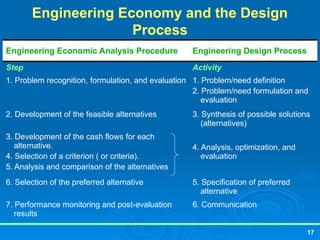
Engineering Economy and the Design
Process
Engineering Economic Analysis Procedure Engineering Design Process
Step Activity
1. Problem recognition, formulation, and evaluation 1. Problem/need definition
2. Problem/need formulation and
evaluation
2. Development of the feasible alternatives 3. Synthesis of possible solutions
(alternatives)
3. Development of the cash flows for each
alternative.
4. Selection of a criterion ( or criteria).
5. Analysis and comparison of the alternatives
4. Analysis, optimization, and
evaluation
6. Selection of the preferred alternative 5. Specification of preferred
alternative
7. Performance monitoring and post-evaluation
results
6. Communication
18
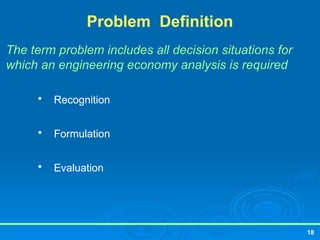
Problem Definition
The term problem includes all decision situations for
which an engineering economy analysis is required

Recognition

Formulation

Evaluation
19
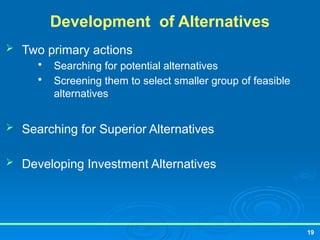
Development of Alternatives
 Two primary actions

Searching for potential alternatives

Screening them to select smaller group of feasible
alternatives
 Searching for Superior Alternatives
 Developing Investment Alternatives
20
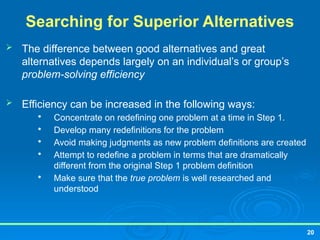
Searching for Superior Alternatives
 The difference between good alternatives and great
alternatives depends largely on an individual’s or group’s
problem-solving efficiency
 Efficiency can be increased in the following ways:

Concentrate on redefining one problem at a time in Step 1.

Develop many redefinitions for the problem

Avoid making judgments as new problem definitions are created

Attempt to redefine a problem in terms that are dramatically
different from the original Step 1 problem definition

Make sure that the true problem is well researched and
understood
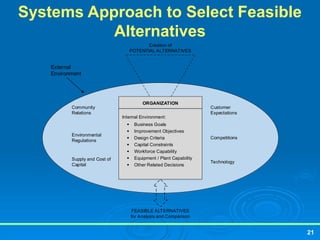
Systems Approach to Select Feasible
Alternatives
21
Creation of
POTENTIAL ALTERNATIVES
Customer
Expectations
Competitions
Technology
Community
Relations
Environmental
Regulations
Supply and Cost of
Capital
ORGANIZATION
Internal Environment:
 Business Goals
 Improvement Objectives
 Design Criteria
 Capital Constraints
 Workforce Capability
 Equipment / Plant Capability
 Other Related Decisions
External
Environment
FEASIBLE ALTERNATIVES
for Analysis and Comparison
22
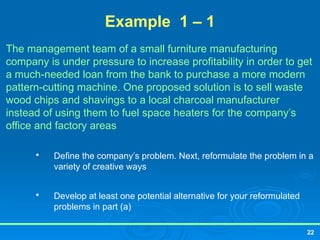
Example 1 – 1
The management team of a small furniture manufacturing
company is under pressure to increase profitability in order to get
a much-needed loan from the bank to purchase a more modern
pattern-cutting machine. One proposed solution is to sell waste
wood chips and shavings to a local charcoal manufacturer
instead of using them to fuel space heaters for the company’s
office and factory areas

Define the company’s problem. Next, reformulate the problem in a
variety of creative ways

Develop at least one potential alternative for your reformulated
problems in part (a)
23
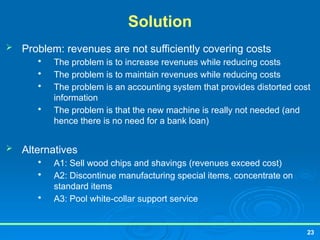
Solution
 Problem: revenues are not sufficiently covering costs

The problem is to increase revenues while reducing costs

The problem is to maintain revenues while reducing costs

The problem is an accounting system that provides distorted cost
information

The problem is that the new machine is really not needed (and
hence there is no need for a bank loan)
 Alternatives

A1: Sell wood chips and shavings (revenues exceed cost)

A2: Discontinue manufacturing special items, concentrate on
standard items

A3: Pool white-collar support service
24
Developing Investment Alternatives
It takes money to make money
 Classical Brainstorming
 Nominal Group Technique
25
Development of Prospective Outcomes
 Principle 2, 3, 4
 Use basic cash-flow approach
 Non monetary factors

Meeting or exceeding customer expectations

Safety

Improving employee satisfaction

Maintaining production flexibility to meet changing
demands

Meeting or exceeding all environmental requirements
26
Selection of a Decision Criterion
 Principle 5
 Selection

Long-term interests of the owners of the organization

Should reflect or a consistent & proper view point
(Principle 3)
27
Analysis and Comparison of Alternatives
 Analysis of the economic aspects of an engineering
problem is largely based on cash-flow estimates for
the feasible alternatives selected for detailed study
 Substantial effort

Obtain reasonable accurate forecasts of cash flows -
inflationary (deflationary), exchange rate, movements,
and regulatory

Principle 6 (uncertainty)

Principle 2 (compared based on their difference)
28
Selection of the Preferred Alternatives
 When the first five steps of the engineering
economic analysis procedure have been done
properly, the preferred alternative is simply a result
of the total effort
 The soundness of the technical-economic modeling
and analysis techniques dictates the quality of the
results
29
Performance Monitoring and Post evaluation
of Results
 Monitoring project performance during its operational phase
improves the achievement of related goals and objectives and
reduces the variability in desired results
 Follow-up step

Comparing actual results with the preciously estimated outcomes
 The aim is to learn how to do better analyses, and the
feedback from post implementation evaluation

is important to the continuing improvement of operations in any
organization
30
Example 1 – 2
 An engineering project team has been organized in your
corporation to reanalyze the size of a new office and service
support building being designed and to review the use of other
space.
 The problem under review concerns the projected increase in
requirements for laboratory space (26%) and personnel space
(11%).
 Due to the status of the detailed design effort, it is important that
the team present a recommendation to management within 7
weeks on the best way to meet these additional space
requirements.
 Discuss representative activities of the team in terms of the
previous discussion of engineering economy and the design
process.
Solution : Example 1 – 2
 Following information as obtained from design process & other sources as
part of problem definition:

Foundation and structural design will permit addition of two floors to six
presently planned for building. Each floor has 22,000 gross sq ft of space

HVAC system is planned for six floors. Detailed design of system has not
started, but cost of a larger HVAC system would have to be included if
additional floors were added

Additional laboratory space (26%) and personnel space (11%) will require
31,500 gross sq ft

There is a time constraint. Need for new building space is urgent

Additional money for new building, beyond that already allocated is limited
 Feasible alternatives

Add two floors to the design of new buildings

Rehabilitate some existing storage space for laboratory space and rent
additional space needed for personnel and storage

Rent additional space required for laboratories and personnel
31
32
Accounting & Engineering Economy
Studies
 Engineering Economy

Provide information on which current decisions pertaining to
future decision
 Accounting procedure for

Financial events can be recorded, summarized & financial
performance determined.

Controls can be established & utilized for operation
 Accounting procedures are

General accounting & cost accounting
 Accounting data

Past & current financial events

Introduction to Engineering Economics 01

  • 1.
    Few Rules  Nocopying of assignment  Be punctual in submitting assignment  No absenteeism in OHTs  Questions are welcome “He who asks is a fool for five minutes, but he who does not ask remains a fool forever”
  • 2.
  • 3.
    Objectives  Objectives ofChapter 1 are :  Introduce the subject of engineering economy  Discuss its critical role in engineering design and analysis  Discuss basic principles of the subject  Provide an overview of book  Following topics are discussed  Importance of the subject in engineering practice  Origins of engineering economy  Principles of engineering economy  Engineering economy and design process  Accounting and engineering economy studies 3
  • 4.
    4 Introduction  Purpose ofthis book  principles and methodology  for basic economic question of engineering  Engineering  apply mathematics, natural sciences and judgment gained by study, experience and practice  utilize the materials and forces of nature for the benefit of mankind  has physical aspect & economical aspect
  • 5.
    5 Economics  The studyof how individuals and societies choose to use scarce resources that nature and previous generations have provided  Resources  Land  Labor  Capital
  • 6.
    6 Engineering Economy  Disciplinethat is concerned with the economic aspects of engineering, and involves the systematic evaluation of the costs and benefits of proposed technical and business projects and ventures  Structured procedure and mathematical modeling techniques  Dollars-and-costs side of the decisions  Trade-offs among different types of costs and the performance of the proposed design  Balance these trade-offs in the most economical manner
  • 7.
    Examples  Selecting amongalternative preliminary designs, or alternative detailed designs, as part of engineering design process  Estimating and analysing economic consequences of alternatives automation improvements in a factory operation  Selecting among proposed projects within the annual capital budget limits established in a corporation  Analysing whether the transportation equipment in the service fleet should be replaced, and at what rate  Choosing between asset lease and purchase options to support a new product line within a company 7
  • 8.
    8 Origins of EngineeringEconomy  Arthur M. Wellington ( a pioneer in the field)  a civil engineer, addressed a role of economic analysis in engineering projects  followed by other contributions which emphasized techniques depending on financial and actuarial mathematics  Eugene Grant  In 1930, published the first edition of his textbook, which was a milestone in the development of engineering economy as we know it today  Woods & DeGarmo  In 1942, wrote first edition of this book, later tilted Engineering Economy
  • 9.
    9 Principles of EngineeringEconomy  Principle 1 – Develop Alternatives  Principle 2 – Focus on the Differences  Principle 3 – Use a Consistent Viewpoint  Principle 4 – Use a Common Unit of Measure  Principle 5 – Consider All Relevant Criteria  Principle 6 – Make Uncertainty Explicit  Principle 7 – Revisit Your Decisions
  • 10.
    10 Principle 1: DevelopAlternatives The choice is among alternatives. The alternatives need to be identified and then defined for subsequent analysis  “Do Nothing” is also an alternative  Creativity and innovation essential for the process
  • 11.
    11 Principle 2: Focuson the Differences Only the differences in expected future outcomes among the alternatives are relevant to their comparison and should be considered in the decision  Outcomes, common to all alternatives, can be disregarded in the comparison Apartment Rent - same rental price  EE Analysis: to recommend a future course of action based on the differences Apartment Rent - location, operating & maintenance cost
  • 12.
    12 Principle 3: Usea Consistent Viewpoint The prospective outcomes of the alternatives, economic and others, should be consistently developed from a defined viewpoint (perspective)  Viewpoint should be first defined, and then used consistently in the description, analysis, and comparison • plan to upgrade & increase power generators  view1 : owners of the firm, cost if same  view2 : employees, benefits package
  • 13.
    13 Principle 4: Usea Common Unit of Measure Using a common unit of measurement to enumerate as many of the prospective outcomes as possible will simplify the analysis and comparison of alternatives  common unit simplifies the analysis and comparison  monetary unit, dollars, is the common measure  for outcomes that are not economic: • quantify the results using an appropriate unit, • or describe the consequences explicitly for decision
  • 14.
    14 Principle 5: ConsiderAll Relevant Criteria Selection of a preferred alternative (decision making) requires the use of a criterion (or several criteria). The decision process should consider both the outcomes enumerated in the monetary unit and those expressed in some other unit of measurement or made explicit in a descriptive manner  Decision requires a criterion/several criteria  Decision process should consider both • outcomes enumerated in the monetary unit • outcomes in some other unit of measurement or made explicit in a descriptive manner  Decision maker long-term interests • long-term financial interest • Other organizational objectives (weighted)
  • 15.
    15 Principle 6: MakeUncertainty Explicit Uncertainty inherent in projecting (or estimating) the future outcomes of the alternatives should be recognized in their analysis and comparison  Uncertainty is inherent and should be recognized  Alternative involves no change from current operations • probability is high
  • 16.
    16 Principle 7: RevisitYour Decisions Improved decision making results from an adaptive process; to the extent practicable, the initial projected outcomes of the selected alternative should be subsequently compared with actual results achieved  initial projected outcomes should be compared with actual results  implemented decisions are routinely post-evaluated  results are used to improve future analyses of alternatives and quality of decision making
  • 17.
    17 Engineering Economy andthe Design Process Engineering Economic Analysis Procedure Engineering Design Process Step Activity 1. Problem recognition, formulation, and evaluation 1. Problem/need definition 2. Problem/need formulation and evaluation 2. Development of the feasible alternatives 3. Synthesis of possible solutions (alternatives) 3. Development of the cash flows for each alternative. 4. Selection of a criterion ( or criteria). 5. Analysis and comparison of the alternatives 4. Analysis, optimization, and evaluation 6. Selection of the preferred alternative 5. Specification of preferred alternative 7. Performance monitoring and post-evaluation results 6. Communication
  • 18.
    18 Problem Definition The termproblem includes all decision situations for which an engineering economy analysis is required  Recognition  Formulation  Evaluation
  • 19.
    19 Development of Alternatives Two primary actions  Searching for potential alternatives  Screening them to select smaller group of feasible alternatives  Searching for Superior Alternatives  Developing Investment Alternatives
  • 20.
    20 Searching for SuperiorAlternatives  The difference between good alternatives and great alternatives depends largely on an individual’s or group’s problem-solving efficiency  Efficiency can be increased in the following ways:  Concentrate on redefining one problem at a time in Step 1.  Develop many redefinitions for the problem  Avoid making judgments as new problem definitions are created  Attempt to redefine a problem in terms that are dramatically different from the original Step 1 problem definition  Make sure that the true problem is well researched and understood
  • 21.
    Systems Approach toSelect Feasible Alternatives 21 Creation of POTENTIAL ALTERNATIVES Customer Expectations Competitions Technology Community Relations Environmental Regulations Supply and Cost of Capital ORGANIZATION Internal Environment:  Business Goals  Improvement Objectives  Design Criteria  Capital Constraints  Workforce Capability  Equipment / Plant Capability  Other Related Decisions External Environment FEASIBLE ALTERNATIVES for Analysis and Comparison
  • 22.
    22 Example 1 –1 The management team of a small furniture manufacturing company is under pressure to increase profitability in order to get a much-needed loan from the bank to purchase a more modern pattern-cutting machine. One proposed solution is to sell waste wood chips and shavings to a local charcoal manufacturer instead of using them to fuel space heaters for the company’s office and factory areas  Define the company’s problem. Next, reformulate the problem in a variety of creative ways  Develop at least one potential alternative for your reformulated problems in part (a)
  • 23.
    23 Solution  Problem: revenuesare not sufficiently covering costs  The problem is to increase revenues while reducing costs  The problem is to maintain revenues while reducing costs  The problem is an accounting system that provides distorted cost information  The problem is that the new machine is really not needed (and hence there is no need for a bank loan)  Alternatives  A1: Sell wood chips and shavings (revenues exceed cost)  A2: Discontinue manufacturing special items, concentrate on standard items  A3: Pool white-collar support service
  • 24.
    24 Developing Investment Alternatives Ittakes money to make money  Classical Brainstorming  Nominal Group Technique
  • 25.
    25 Development of ProspectiveOutcomes  Principle 2, 3, 4  Use basic cash-flow approach  Non monetary factors  Meeting or exceeding customer expectations  Safety  Improving employee satisfaction  Maintaining production flexibility to meet changing demands  Meeting or exceeding all environmental requirements
  • 26.
    26 Selection of aDecision Criterion  Principle 5  Selection  Long-term interests of the owners of the organization  Should reflect or a consistent & proper view point (Principle 3)
  • 27.
    27 Analysis and Comparisonof Alternatives  Analysis of the economic aspects of an engineering problem is largely based on cash-flow estimates for the feasible alternatives selected for detailed study  Substantial effort  Obtain reasonable accurate forecasts of cash flows - inflationary (deflationary), exchange rate, movements, and regulatory  Principle 6 (uncertainty)  Principle 2 (compared based on their difference)
  • 28.
    28 Selection of thePreferred Alternatives  When the first five steps of the engineering economic analysis procedure have been done properly, the preferred alternative is simply a result of the total effort  The soundness of the technical-economic modeling and analysis techniques dictates the quality of the results
  • 29.
    29 Performance Monitoring andPost evaluation of Results  Monitoring project performance during its operational phase improves the achievement of related goals and objectives and reduces the variability in desired results  Follow-up step  Comparing actual results with the preciously estimated outcomes  The aim is to learn how to do better analyses, and the feedback from post implementation evaluation  is important to the continuing improvement of operations in any organization
  • 30.
    30 Example 1 –2  An engineering project team has been organized in your corporation to reanalyze the size of a new office and service support building being designed and to review the use of other space.  The problem under review concerns the projected increase in requirements for laboratory space (26%) and personnel space (11%).  Due to the status of the detailed design effort, it is important that the team present a recommendation to management within 7 weeks on the best way to meet these additional space requirements.  Discuss representative activities of the team in terms of the previous discussion of engineering economy and the design process.
  • 31.
    Solution : Example1 – 2  Following information as obtained from design process & other sources as part of problem definition:  Foundation and structural design will permit addition of two floors to six presently planned for building. Each floor has 22,000 gross sq ft of space  HVAC system is planned for six floors. Detailed design of system has not started, but cost of a larger HVAC system would have to be included if additional floors were added  Additional laboratory space (26%) and personnel space (11%) will require 31,500 gross sq ft  There is a time constraint. Need for new building space is urgent  Additional money for new building, beyond that already allocated is limited  Feasible alternatives  Add two floors to the design of new buildings  Rehabilitate some existing storage space for laboratory space and rent additional space needed for personnel and storage  Rent additional space required for laboratories and personnel 31
  • 32.
    32 Accounting & EngineeringEconomy Studies  Engineering Economy  Provide information on which current decisions pertaining to future decision  Accounting procedure for  Financial events can be recorded, summarized & financial performance determined.  Controls can be established & utilized for operation  Accounting procedures are  General accounting & cost accounting  Accounting data  Past & current financial events