Engaging young minds in CS
    through game dev
            Giuseppe Maggiore
      Università Ca’ Foscari di Venezia
         NHTV University of Breda
Agenda

The problem with young students and CS

3rd year university students

1st year university students

High school students
Problem statement
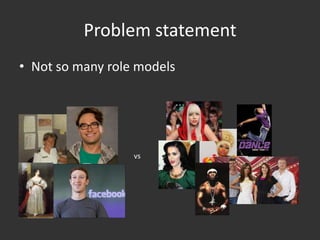
• Not so many role models


                  vs
Problem statement
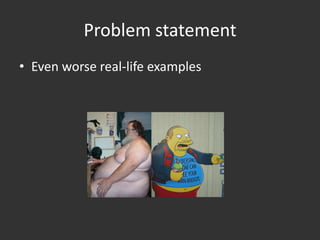
• Even worse real-life examples
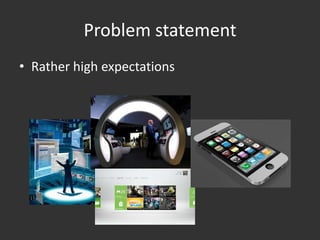
Problem statement
• Rather high expectations
3rd year university students
• Easier to work with
  – More knowledge
  – Less preconceptions
• Can work with modern libraries and tools
• Can work in teams
• Significant investment in CS
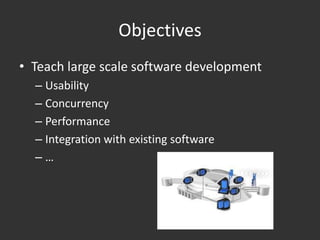
Objectives
• Teach large scale software development
  – Usability
  – Concurrency
  – Performance
  – Integration with existing software
  –…
Course structure
• Create a game
• Around an existing logical library
  – AI, moves, etc.
• Keep the program responsive
  – Library is rather slow
  – Concurrency
Results
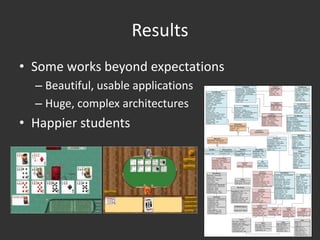
• Some works beyond expectations
  – Beautiful, usable applications
  – Huge, complex architectures
• Happier students
1st year university students
•   Harder task
•   Less knowledge
•   Bad working habits (no teams)
•   More expectations
Objectives
• Basic programming
• Reasoning about programs
  – May not even start
  – May run and crash
  – May run, not crash, and still not work
Course Structure
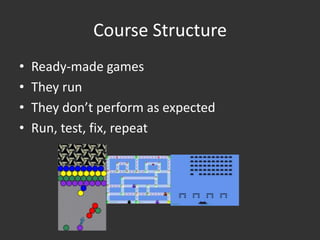
•   Ready-made games
•   They run
•   They don’t perform as expected
•   Run, test, fix, repeat
Results
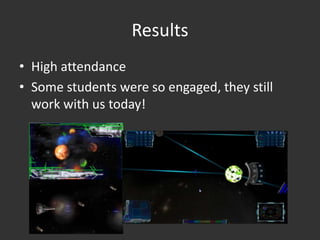
• High attendance
• Some students were so engaged, they still
  work with us today!
High school students
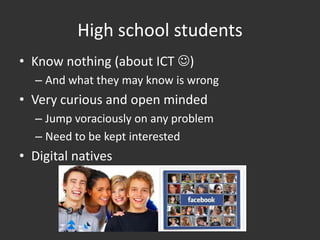
• Know nothing (about ICT )
  – And what they may know is wrong
• Very curious and open minded
  – Jump voraciously on any problem
  – Need to be kept interested
• Digital natives
Objectives
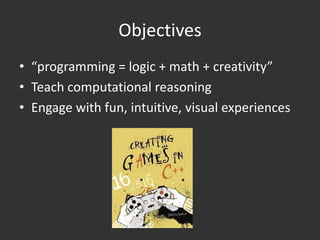
• “programming = logic + math + creativity”
• Teach computational reasoning
• Engage with fun, intuitive, visual experiences
Course(s) structure
1. Take a problem which can be visualized
2. Devise a series of mathematical/logical
   solutions of increasing quality
3. Provide a starting, almost broken sample
4. Let the students discover its flaws and apply
   the solutions in (2)
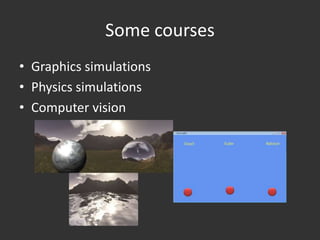
Some courses
• Graphics simulations
• Physics simulations
• Computer vision
Results
• Great students/teachers feedback
• Increase in first year CS enrollment
Conclusions
• Role models
  – Out of our hands…
  – …but not completely; let’s create some!
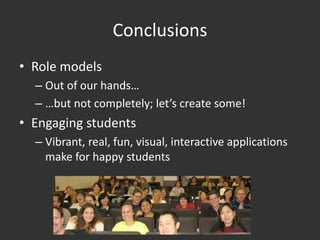
• Engaging students
  – Vibrant, real, fun, visual, interactive applications
    make for happy students
Friendly F# - Fun With Game Programming – Maggiore, Costantini
Game Programming as a non-threatening introduction to functional languages –
Maggiore, Costantini, Cortesi
Learning by Fixing and Extending Games – Costantini, Maggiore, Cortesi
Engaging High School Students in Computer Science via
Challenging Applications – Maggiore, Torsello, Sartoretto, Cortesi


REFERENCES

Engaging young minds in cs

  • 1.
    Engaging young mindsin CS through game dev Giuseppe Maggiore Università Ca’ Foscari di Venezia NHTV University of Breda
  • 2.
    Agenda The problem withyoung students and CS 3rd year university students 1st year university students High school students
  • 3.
    Problem statement • Notso many role models vs
  • 4.
    Problem statement • Evenworse real-life examples
  • 5.
  • 6.
    3rd year universitystudents • Easier to work with – More knowledge – Less preconceptions • Can work with modern libraries and tools • Can work in teams • Significant investment in CS
  • 7.
    Objectives • Teach largescale software development – Usability – Concurrency – Performance – Integration with existing software –…
  • 8.
    Course structure • Createa game • Around an existing logical library – AI, moves, etc. • Keep the program responsive – Library is rather slow – Concurrency
  • 9.
    Results • Some worksbeyond expectations – Beautiful, usable applications – Huge, complex architectures • Happier students
  • 10.
    1st year universitystudents • Harder task • Less knowledge • Bad working habits (no teams) • More expectations
  • 11.
    Objectives • Basic programming •Reasoning about programs – May not even start – May run and crash – May run, not crash, and still not work
  • 12.
    Course Structure • Ready-made games • They run • They don’t perform as expected • Run, test, fix, repeat
  • 13.
    Results • High attendance •Some students were so engaged, they still work with us today!
  • 14.
    High school students •Know nothing (about ICT ) – And what they may know is wrong • Very curious and open minded – Jump voraciously on any problem – Need to be kept interested • Digital natives
  • 15.
    Objectives • “programming =logic + math + creativity” • Teach computational reasoning • Engage with fun, intuitive, visual experiences
  • 16.
    Course(s) structure 1. Takea problem which can be visualized 2. Devise a series of mathematical/logical solutions of increasing quality 3. Provide a starting, almost broken sample 4. Let the students discover its flaws and apply the solutions in (2)
  • 17.
    Some courses • Graphicssimulations • Physics simulations • Computer vision
  • 18.
    Results • Great students/teachersfeedback • Increase in first year CS enrollment
  • 19.
    Conclusions • Role models – Out of our hands… – …but not completely; let’s create some! • Engaging students – Vibrant, real, fun, visual, interactive applications make for happy students
  • 20.
    Friendly F# -Fun With Game Programming – Maggiore, Costantini Game Programming as a non-threatening introduction to functional languages – Maggiore, Costantini, Cortesi Learning by Fixing and Extending Games – Costantini, Maggiore, Cortesi Engaging High School Students in Computer Science via Challenging Applications – Maggiore, Torsello, Sartoretto, Cortesi REFERENCES