Stanford University


                        ENGR 245
                   The Lean Launch Pad
    (officially: Technology Entrepreneurship and the Lean Startup)


                       Mentor Handbook


               http://e245.stanford.edu/

Professors:
Steve Blank                sblank@kandsranch.com
Ann Miura-Ko               ann@floodgate.com
Jon Feiber                 jdf@mdv.com


Teaching assistants:
Thomas Haymore             thaymore@stanford.edu
Felix Huber                fhuber@stanford.edu


Engr 245 Mentor Handbook          Revision 5                page 1 of 6
Welcome as a team mentor in the E 245 Lean Launchpad course at the Stanford
School of Engineering.

This handbook is designed to help mentors understand their roles in the course, and
on course policies and process.

Course Goal: Lean Startups
Provide an experiential learning opportunity for engineers to see how entrepreneurs
really build companies. In ten weeks, teach a four-person team how to transform a
technology idea into a venture-scale business opportunity. Do it by having them get
outside the classroom and test each element of their business model.

Students
The class is limited to 40 graduate students selected out of a pool of applicants. The
students are typically working on their Masters or PhD’s in engineering or science;
however the class is also open to MBA students.

E 245 Course Organization
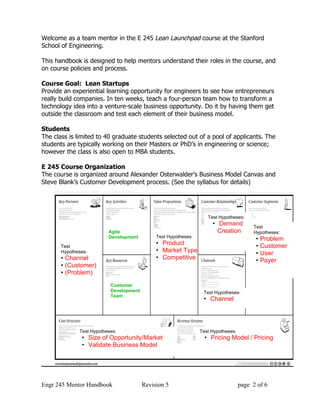
The course is organized around Alexander Osterwalder’s Business Model Canvas and
Steve Blank’s Customer Development process. (See the syllabus for details)


                                                                    Test Hypotheses:
                                                                      • Demand           Test
                          Agile                                         Creation         Hypotheses:
                          Development         Test Hypotheses:
                                                                                          •   Problem
       Test
                                              • Product                                   •   Customer
       Hypotheses:                            • Market Type                               •   User
       • Channel                              • Competitive                               •   Payer
       • (Customer)
       • (Problem)
                           Customer
                           Development                            Test Hypotheses:
                           Team
                                                                  • Channel


              Test Hypotheses:                                   Test Hypotheses:
               • Size of Opportunity/Market                        • Pricing Model / Pricing
               • Validate Business Model


Engr 245 Mentor Handbook                 Revision 5                                 page 2 of 6
Each week’s class is organized around:
   • a lecture on one of the 9 building blocks of a business model.
   • Students teams present their “lessons learned” from getting out of the
      building and iterating or pivoting their business model.

   •   The Eight (3 hour) Class Sessions:
       Session 1: Jan 4th - Course Introduction, Business Models, Customer
       Development
       Session 2: Jan 11th – Value Proposition
       Session 3: Jan 18th – Customer Segment
       Session 4: Jan 25th - Channels
       Session 5: Feb 1st – Demand Creation
       Session 6: Feb 8th – Revenue Model
       Session 7: Feb 15th - Partners
       Session 8: Feb 22nd – Resources and Costs
       Session 9 & 10: Mar 1st / 8th – Lessons Learned Presentations

All mentors are welcome to attend any of the classes.

Schedule
Classes meet at Psych (Jordan Hall) 041
Tuesday, 4:15 -7:05pm. January 4th through March 8th

Office hours are held Tuesdays from 3-4 pm in TBD.
Class details can be found on the class website. http://www.stanford.edu/class/xxxx

Textbooks
• Alexander Osterwalder & Yves Pigneur, Business Model Generation
  http://www.businessmodelgeneration.com/order.php
• Steven Blank, Four Steps to the Epiphany
  http://www.stevenblank.com/books.html
• Jessica Livingston, Founders at Work
  http://www.amazon.com/gp/product/1590597141

Grading
• Weekly Lessons Learned                        65% of their grade
• Final Lessons Learned Presentation            35% of their grade

Website
     http://e245.stanford.edu/

Mentors
Each team will have at least two mentors assigned.


Engr 245 Mentor Handbook           Revision 5                        page 3 of 6
The Role of Mentors
As a mentor, you are the advisor for one team (each team has four students.) In ten
very short weeks your team has to 1) come up with a business idea, 2) get outside
the classroom and test all their business model hypotheses and 3) if a web-based
business get it up and running.

Mentors and Opportunity Selection
Our experience has shown the first issue for most teams is finding, selecting and
sizing the right opportunity. As in the real world, if they don’t get this part right, the
rest of their business model is at risk.

We’ve found that the best plans came from students who (from best to worst):

      Already were working on a technology driven research project
      Was a domain expert and was solving a problem for the “next bench”
      Had a passion for a specific idea
      Had an interest in an idea
      Worked on someone else’s idea
      Picked the latest fad getting funded in the valley

Therefore one of your greatest contributions can be to help extract ideas from
reluctant engineers. We’ve found that challenging a team with “you mean that with
a team of four engineering PhD candidates the best idea your team can come with is
another social networking shopping site?” can be extremely helpful.

Make your team think hard about how to commercialize technologies they’ve been
working on or are familiar with, before they default to a pedestrian idea that every
other startup in the valley is doing. Remind them that their technical work at
Stanford, while familiar to them, will be unique to an investor audience. Having said
that, we believe that struggling to find a viable business opportunity is an integral
part of the learning process. Although many of our mentors are eager to share some
of their business ideas with their teams, we ask that you hold off to give them a
chance to come up with something on their own.

Remember: The class is not trying to be Y Combinator. We are trying to teach give
students models, heuristics and experience they can apply when they leave Stanford.
The class is about what they learned on the journey.

Mentors and Getting Out of the Building
The class is about teaching the students that the 9 building blocks of a business
model are simply hypothesis until they actually validate them with customers and
partners; and since there are “no facts inside the building, they need to get outside.”
This means as part of this class they need to talk to customers, channel partners,
and domain experts and gather real-world data – for each part of their plan.

Engr 245 Mentor Handbook              Revision 5                           page 4 of 6
For engineers this can be a daunting and formidable task. To the best of your
ability, help them network, teach them how to send email and make phone calls and
run customer surveys. Open your rolodex to whatever level you feel comfortable
with.

Mentors and Web-based Startups
If your team is building a web-based business they need to get the site up and
running during the semester. The goal is not a finished or polished site but a vehicle
so they can test their assumptions about minimum feature set, demand creation,
virality, stickyness, etc.

Mentor Time Commitment
The wisdom and advice you give these students are invaluable. We’ve found that
successful mentor/team interactions look like this:
- Physically meeting with your assigned team a least every two weeks
- Additional communication as needed by phone or email.
- You are welcome to attend any of the classes as well as your teams’ final
   presentation to the Venture Capital panel at the end of the quarter.

Mentor/Team Selection
The teams form after the first class meeting. By the second class they have
submitted their initial description of their business concept to the teaching team.

At the start of the class we will assign you to specific teams, so you can participate in
the teams opportunity selection process. If after seeing a team’s initial idea you
think your expertise is a not a match, feel free to let us know your preference for a
specific team.

Mentor Communications
We’ve found that keeping the mentors, teaching team and teaching assistants in
sync is the best way to ensure both a great outcome for the students and a
satisfying experience for you.

   1. We will hold a one hour Mentor orientation session on Tuesday January 4th at
      3pm, right before the class. Even if you’ve done this before we ask you to
      attend. We update the process yearly as you give us additional feedback.
   2. We ask you to send the entire teaching team an email summarizing the teams
      progress and dynamics each time you meet with them letting us know if we
      need to specifically help and intervene.
   3. In addition, we will share all these emails with the entire mentor team and see
      if there are any common problems that need to be addressed class-wide.

Thanks once again for your support and participation,
Steve, Ann & Jon

Engr 245 Mentor Handbook             Revision 5                          page 5 of 6
Mentor List (as of Dec 4th 2010)

• Gina Bianchini, Ning                  gina@bianchini.com
• Ethan Bloch, Flowtown                 ethan@flowtown.com
• David Camplejohn, Fliptop             doug@fliptop.com
• Shawn Carolan, Menlo Ventures         shawn@menloventures.com
• Eric Carr, Loopt                      ecarr@mac.com
• Rowan Chapman, MDV                    rchapman@mdv.com
• Jason Davies, SOS Technologies        jmdavies.md.phd@gmail.com
• Jonathan Ebinger, BlueRun Ventures cheryltamcheng@gmail.com
• David Feinleib, MDV
• Jim Greer, Kongregate                 jim@kongregate.com
• Konstantin Guericke, LinkedIn         konstantin@stanfordalumni.org
• Will Harvey, IMVU                     willharvey@gmail.com
• Thomas Hessler, Zanox
• Heiko Hubertz, BigPoint               h.hubertz@bigpoint.net
• Charles Hudson                        charles@charleshudson.net
• Maheesh Jain, Cafepress               maheesh.jain@gmail.com
• George John, Rocket Fuel              gjohn@rocketfuelinc.com
• Dan Martell, Flowtown                 dan@flowtown.com
• Josh Reeves, unwrap                   joshua.reeves@gmail.com
• Karen Richardson, Silverlake Partners karenrich@mac.com
• Josh Schwarzapel                      joschwa9@gmail.com
• Justin Shaffer, Facebook              j@fb.com
• Jim Smith, MDV
• Bryan Stolle, MDV
• Steve Weinstein, Movielabs            SWeinstein@movielabs.com
• George Zachary, Charles River Ventures      gzachary@crv.com


Engr 245 Mentor Handbook           Revision 5             page 6 of 6

Eng245 mentor handbook rev 5

  • 1.
    Stanford University ENGR 245 The Lean Launch Pad (officially: Technology Entrepreneurship and the Lean Startup) Mentor Handbook http://e245.stanford.edu/ Professors: Steve Blank sblank@kandsranch.com Ann Miura-Ko ann@floodgate.com Jon Feiber jdf@mdv.com Teaching assistants: Thomas Haymore thaymore@stanford.edu Felix Huber fhuber@stanford.edu Engr 245 Mentor Handbook Revision 5 page 1 of 6
  • 2.
    Welcome as ateam mentor in the E 245 Lean Launchpad course at the Stanford School of Engineering. This handbook is designed to help mentors understand their roles in the course, and on course policies and process. Course Goal: Lean Startups Provide an experiential learning opportunity for engineers to see how entrepreneurs really build companies. In ten weeks, teach a four-person team how to transform a technology idea into a venture-scale business opportunity. Do it by having them get outside the classroom and test each element of their business model. Students The class is limited to 40 graduate students selected out of a pool of applicants. The students are typically working on their Masters or PhD’s in engineering or science; however the class is also open to MBA students. E 245 Course Organization The course is organized around Alexander Osterwalder’s Business Model Canvas and Steve Blank’s Customer Development process. (See the syllabus for details) Test Hypotheses: • Demand Test Agile Creation Hypotheses: Development Test Hypotheses: • Problem Test • Product • Customer Hypotheses: • Market Type • User • Channel • Competitive • Payer • (Customer) • (Problem) Customer Development Test Hypotheses: Team • Channel Test Hypotheses: Test Hypotheses: • Size of Opportunity/Market • Pricing Model / Pricing • Validate Business Model Engr 245 Mentor Handbook Revision 5 page 2 of 6
  • 3.
    Each week’s classis organized around: • a lecture on one of the 9 building blocks of a business model. • Students teams present their “lessons learned” from getting out of the building and iterating or pivoting their business model. • The Eight (3 hour) Class Sessions: Session 1: Jan 4th - Course Introduction, Business Models, Customer Development Session 2: Jan 11th – Value Proposition Session 3: Jan 18th – Customer Segment Session 4: Jan 25th - Channels Session 5: Feb 1st – Demand Creation Session 6: Feb 8th – Revenue Model Session 7: Feb 15th - Partners Session 8: Feb 22nd – Resources and Costs Session 9 & 10: Mar 1st / 8th – Lessons Learned Presentations All mentors are welcome to attend any of the classes. Schedule Classes meet at Psych (Jordan Hall) 041 Tuesday, 4:15 -7:05pm. January 4th through March 8th Office hours are held Tuesdays from 3-4 pm in TBD. Class details can be found on the class website. http://www.stanford.edu/class/xxxx Textbooks • Alexander Osterwalder & Yves Pigneur, Business Model Generation http://www.businessmodelgeneration.com/order.php • Steven Blank, Four Steps to the Epiphany http://www.stevenblank.com/books.html • Jessica Livingston, Founders at Work http://www.amazon.com/gp/product/1590597141 Grading • Weekly Lessons Learned 65% of their grade • Final Lessons Learned Presentation 35% of their grade Website http://e245.stanford.edu/ Mentors Each team will have at least two mentors assigned. Engr 245 Mentor Handbook Revision 5 page 3 of 6
  • 4.
    The Role ofMentors As a mentor, you are the advisor for one team (each team has four students.) In ten very short weeks your team has to 1) come up with a business idea, 2) get outside the classroom and test all their business model hypotheses and 3) if a web-based business get it up and running. Mentors and Opportunity Selection Our experience has shown the first issue for most teams is finding, selecting and sizing the right opportunity. As in the real world, if they don’t get this part right, the rest of their business model is at risk. We’ve found that the best plans came from students who (from best to worst):  Already were working on a technology driven research project  Was a domain expert and was solving a problem for the “next bench”  Had a passion for a specific idea  Had an interest in an idea  Worked on someone else’s idea  Picked the latest fad getting funded in the valley Therefore one of your greatest contributions can be to help extract ideas from reluctant engineers. We’ve found that challenging a team with “you mean that with a team of four engineering PhD candidates the best idea your team can come with is another social networking shopping site?” can be extremely helpful. Make your team think hard about how to commercialize technologies they’ve been working on or are familiar with, before they default to a pedestrian idea that every other startup in the valley is doing. Remind them that their technical work at Stanford, while familiar to them, will be unique to an investor audience. Having said that, we believe that struggling to find a viable business opportunity is an integral part of the learning process. Although many of our mentors are eager to share some of their business ideas with their teams, we ask that you hold off to give them a chance to come up with something on their own. Remember: The class is not trying to be Y Combinator. We are trying to teach give students models, heuristics and experience they can apply when they leave Stanford. The class is about what they learned on the journey. Mentors and Getting Out of the Building The class is about teaching the students that the 9 building blocks of a business model are simply hypothesis until they actually validate them with customers and partners; and since there are “no facts inside the building, they need to get outside.” This means as part of this class they need to talk to customers, channel partners, and domain experts and gather real-world data – for each part of their plan. Engr 245 Mentor Handbook Revision 5 page 4 of 6
  • 5.
    For engineers thiscan be a daunting and formidable task. To the best of your ability, help them network, teach them how to send email and make phone calls and run customer surveys. Open your rolodex to whatever level you feel comfortable with. Mentors and Web-based Startups If your team is building a web-based business they need to get the site up and running during the semester. The goal is not a finished or polished site but a vehicle so they can test their assumptions about minimum feature set, demand creation, virality, stickyness, etc. Mentor Time Commitment The wisdom and advice you give these students are invaluable. We’ve found that successful mentor/team interactions look like this: - Physically meeting with your assigned team a least every two weeks - Additional communication as needed by phone or email. - You are welcome to attend any of the classes as well as your teams’ final presentation to the Venture Capital panel at the end of the quarter. Mentor/Team Selection The teams form after the first class meeting. By the second class they have submitted their initial description of their business concept to the teaching team. At the start of the class we will assign you to specific teams, so you can participate in the teams opportunity selection process. If after seeing a team’s initial idea you think your expertise is a not a match, feel free to let us know your preference for a specific team. Mentor Communications We’ve found that keeping the mentors, teaching team and teaching assistants in sync is the best way to ensure both a great outcome for the students and a satisfying experience for you. 1. We will hold a one hour Mentor orientation session on Tuesday January 4th at 3pm, right before the class. Even if you’ve done this before we ask you to attend. We update the process yearly as you give us additional feedback. 2. We ask you to send the entire teaching team an email summarizing the teams progress and dynamics each time you meet with them letting us know if we need to specifically help and intervene. 3. In addition, we will share all these emails with the entire mentor team and see if there are any common problems that need to be addressed class-wide. Thanks once again for your support and participation, Steve, Ann & Jon Engr 245 Mentor Handbook Revision 5 page 5 of 6
  • 6.
    Mentor List (asof Dec 4th 2010) • Gina Bianchini, Ning gina@bianchini.com • Ethan Bloch, Flowtown ethan@flowtown.com • David Camplejohn, Fliptop doug@fliptop.com • Shawn Carolan, Menlo Ventures shawn@menloventures.com • Eric Carr, Loopt ecarr@mac.com • Rowan Chapman, MDV rchapman@mdv.com • Jason Davies, SOS Technologies jmdavies.md.phd@gmail.com • Jonathan Ebinger, BlueRun Ventures cheryltamcheng@gmail.com • David Feinleib, MDV • Jim Greer, Kongregate jim@kongregate.com • Konstantin Guericke, LinkedIn konstantin@stanfordalumni.org • Will Harvey, IMVU willharvey@gmail.com • Thomas Hessler, Zanox • Heiko Hubertz, BigPoint h.hubertz@bigpoint.net • Charles Hudson charles@charleshudson.net • Maheesh Jain, Cafepress maheesh.jain@gmail.com • George John, Rocket Fuel gjohn@rocketfuelinc.com • Dan Martell, Flowtown dan@flowtown.com • Josh Reeves, unwrap joshua.reeves@gmail.com • Karen Richardson, Silverlake Partners karenrich@mac.com • Josh Schwarzapel joschwa9@gmail.com • Justin Shaffer, Facebook j@fb.com • Jim Smith, MDV • Bryan Stolle, MDV • Steve Weinstein, Movielabs SWeinstein@movielabs.com • George Zachary, Charles River Ventures gzachary@crv.com Engr 245 Mentor Handbook Revision 5 page 6 of 6