The Lean LaunchPad Session 1: Overview/Business Models/Customer Development Professors Steve Blank,Jon Feiber,  Jim Hornthal, Oren Jacob https://sites.google.com/site/xmba296t / XMBA296T
Agenda “ Is This the Right Course for Me?” Introductions Course Objectives/teams/project Class Logistics Building a “Lean Startup” Idea Sizing the Opportunity Business Models Customer Development Class  “Culture” and Next Steps
Introductions
Steve Blank , Jon Feiber 8 startups in Silicon Valley Semiconductors Supercomputers Consumer electronics Video games Enterprise software Military intelligence [email_address] twitter @sgblank www.steveblank.com BS CS/Astro Physics U of Colorado VP Networking SUN V.C. @ MDV since 1991
Steve Blank,  Jon Feiber 8 startups - 32 years in Silicon Valley Semiconductors Supercomputers Consumer electronics Video games Enterprise software Military intelligence Teach: Stanford, Berkeley, Columbia Details at www.steveblank.com BS CS/Astro Physics U of Colorado 50 th  employee, VP Networking @ Sun V.C. @ MDV since 1991 [email_address]
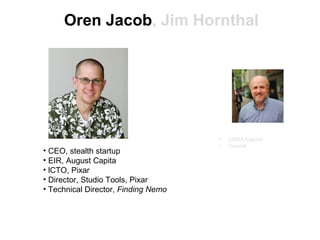
Oren Jacob , Jim Hornthal CEO, stealth startup EIR, August Capita lCTO, Pixar Director, Studio Tools, Pixar Technical Director,  Finding Nemo CMEA Capital Triporati
Oren Jacob,  Jim Hornthal CTO Pixar CMEA Capital Chairman Triporati
Teaching Assistant TA ’s role :  Class/lecture questions, Grading and attendance Bhavik Joshi Better Place (13th employee, first non-Israeli, non-Jewish, non ex-SAP, Asian employee) Berkeley/Columbia MBA class of 2008/09 Co-founder: Berkeley Stanford Cleantech Conference Series (since 2007) 2000 – 2007 Enterprise Software  1998 – 2000 Tata Motors India [email_address] http://about.me/bhavikjoshi
Mentors Mentors are people with real-world experience Mentors role is to: Help you  “Get you out of the building” Share contacts Offer  “Real-world” entrepreneurial advice Critical feedback You arrange your schedule for the mentors, not the other way around
Mentor Introductions Click Here for the Mentor Bios
Course Objectives Understand the real world aspects of Entrepreneurship by getting out of the building Analyze and assess an opportunity Build the product Get orders Work with a team Give you a framework and methodology Learn what entrepreneurship is to you
What Will you Learn? Opportunity evaluation Search for a Business Model Customer Discovery and Validation Operating and decision making in chaos with insufficient data Ruthless pursuit of an objective by a team
The Course  ‘By the Numbers’ 4 Instructors,  1 TA, 15+ Mentors,  8 Lectures 8 10-minute presentations per class 1 Final 20 minute presentation 2 Textbooks 10-15 hours of work a week  outside  the classroom
This Class is  Hard You can’ t pass by attending the lectures Your grade is determined by the work you do  outside the class There’ s a lot of it You are dependent on group success – communication is critical You don’t need to be friends you need to be partners
Class Logistics
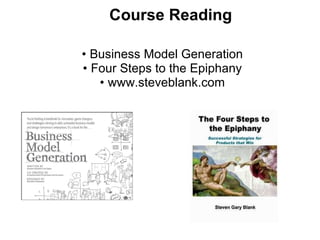
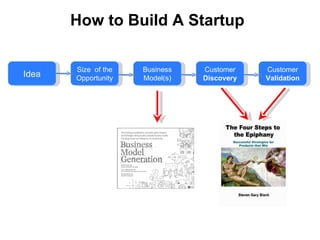
Course Reading Business Model Generation Four Steps to the Epiphany www.steveblank.com
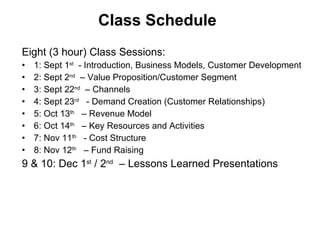
Class Schedule Eight (3 hour) Class Sessions:  1: Sept 1 st   - Introduction, Business Models, Customer Development 2: Sept 2 nd   – Value Proposition/Customer Segment 3: Sept 22 nd   – Channels 4: Sept 23 rd   - Demand Creation (Customer Relationships) 5: Oct 13 th   – Revenue Model 6: Oct 14 th   – Key Resources and Activities 7: Nov 11 th   - Cost Structure  8: Nov 12 th   – Fund Raising 9 & 10: Dec 1 st  / 2 nd   – Lessons Learned Presentations
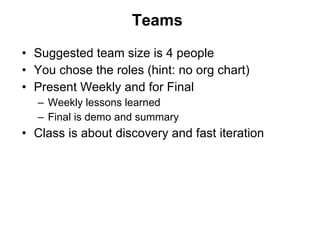
Teams Suggested team size is 4 people You chose the roles (hint: no org chart) Present Weekly and for Final Weekly lessons learned Final is demo and summary Class is about discovery and fast iteration
Team Projects Any  for-profit  scalable  startup If you are a domain expert, that ’s your best bet (but not required) If you pick a web project, you have to build it (and there needs to be some novelty)
Team Deliverables - Presentation Each Week Lessons Learned presentation 10 minutes Updated business model canvas Update blog/wiki 10 ’s of hours of “outside the building” progress Final Presentation 20 minute Lessons Learned Summary
Team Deliverables - Blog Each Week Business model canvas updates Interviews Photos/Videos A/B tests Strategy
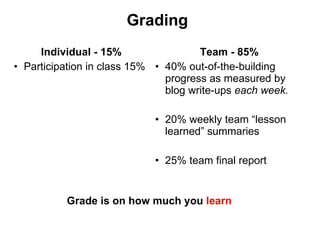
Grading Individual - 15% Participation in class 15% Team - 85% 40% out-of-the-building progress as measured by blog write-ups  each week.   20% weekly team “lesson learned” summaries 25% team final report  Grade is on how much you  learn
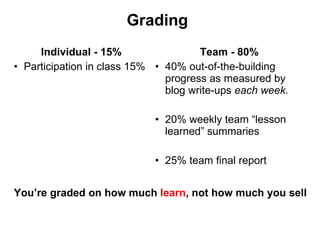
Grading Individual - 15% Participation in class 15% Team - 80% 40% out-of-the-building progress as measured by blog write-ups  each week.   20% weekly team  “lesson learned” summaries 25% team final report  You ’re graded on how much  learn , not how much you sell
Office Hours With your team Before and after class Look at availability  here Get on the calendar
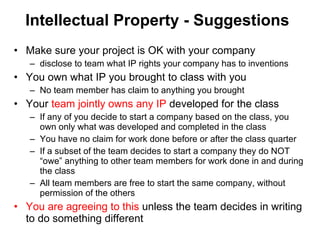
Intellectual Property - Suggestions Make sure your project is OK with your company disclose to team what IP rights your company has to inventions You own what IP you brought to class with you  No team member has claim to anything you brought Your  team jointly owns any IP  developed for the class If any of you decide to start a company based on the class, you own only what was developed and completed in the class You have no claim for work done before or after the class quarter If a subset of the team decides to start a company they do NOT “owe” anything to other team members for work done in and during the class All team members are free to start the same company, without permission of the others You are agreeing to this  unless the team decides in writing to do something different
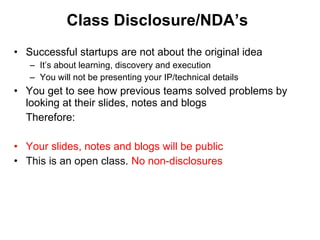
Class Disclosure/NDA’s Successful startups are not about the original idea  It’s about learning, discovery and execution You will not be presenting your IP/technical details You get to see how previous teams solved problems by looking at their slides, notes and blogs Therefore: Your slides, notes and blogs will be public This is an open class.  No non-disclosures
How to Build A Startup Idea Size Opportunity Business Model Customer Development
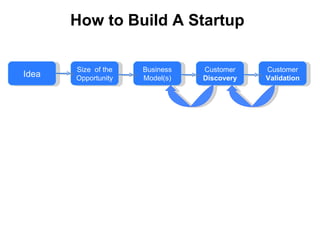
How to Build A Startup Idea Size  of the Opportunity Business Model(s) Customer  Discovery Customer  Validation
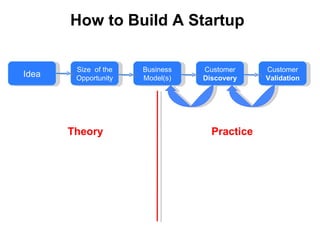
How to Build A Startup Idea Size  of the Opportunity Business Model(s) Customer  Discovery Customer  Validation Theory Practice
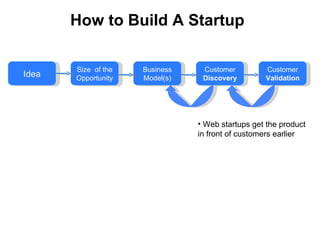
How to Build A Startup Idea Size  of the Opportunity Business Model(s) Customer  Discovery Customer  Validation Web startups get the product in front of customers earlier
How to Build A Startup Idea Size  of the Opportunity Business Model(s) Customer  Discovery Customer  Validation
Idea
We’ re Engineers Darn It! Aren ’t companies all about product? I have a great technology idea Teach me how to make a company around it Just like Facebook and Google (or Intel or Apple)
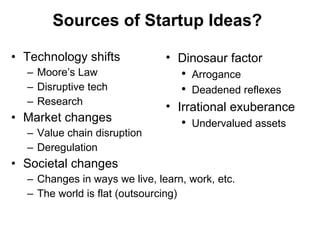
Sources of Startup Ideas? Technology shifts Moore ’s Law Disruptive tech Research Market changes Value chain disruption Deregulation Societal changes Changes in ways we live, learn, work, etc. The world is flat (outsourcing) Dinosaur factor Arrogance Deadened reflexes  Irrational exuberance Undervalued assets
An Idea is _Not_ a  Company
An Idea is _Not_ a Company It’s Just One of Many  Hypotheses
Size of Opportunity
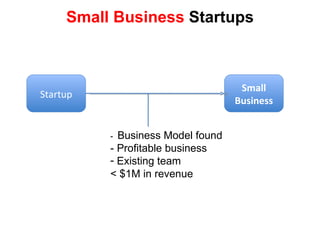
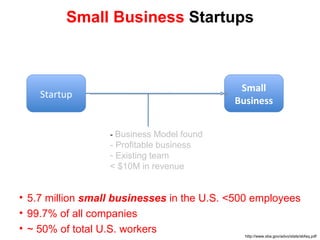
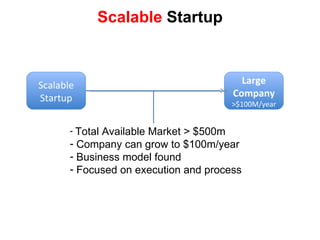
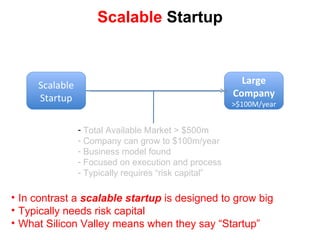
This Class is about  Scalable  Startups Not all startups are designed to scale Small business startups have different goals They are done by normal people Scalable startups are designed to grow big Typically require venture capital This means the size of the opportunity needs to be $100’s of millions to billions
Small Business  Startups Small Business Startup -  Business Model found - Profitable business Existing team < $1M in revenue
Small Business  Startups -  Business Model found - Profitable business Existing team < $10M in revenue 5.7 million  small businesses  in the U.S. <500 employees 99.7% of all companies ~ 50% of total U.S. workers http://www.sba.gov/advo/stats/sbfaq.pdf Small Business Startup
Scalable  Startup Scalable Startup Large Company >$100M/year Total Available Market > $500m Company can grow to $100m/year Business model found Focused on execution and process
Scalable  Startup Scalable Startup Large Company >$100M/year Total Available Market > $500m Company can grow to $100m/year Business model found Focused on execution and process Typically requires “risk capital” In contrast a  scalable startup  is designed to grow big Typically needs risk capital What Silicon Valley means when they say “Startup”
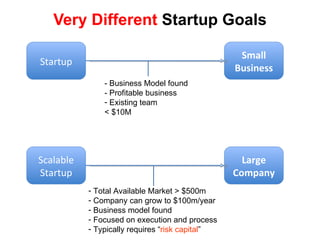
Very Different  Startup Goals Small Business Startup - Business Model found - Profitable business Existing team < $10M Scalable Startup Large Company Total Available Market > $500m Company can grow to $100m/year Business model found Focused on execution and process Typically requires “ risk capital ”
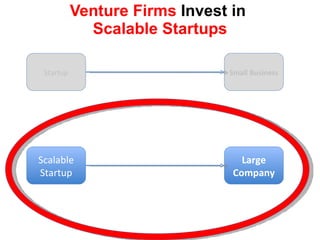
Venture Firms  Invest in  Scalable Startups Small Business Startup Scalable Startup Large Company
Market/Opportunity Analysis How Big is It?:  Market/Opportunity Analysis Identify a Customer and Market Need Size the Market Competitors Growth Potential
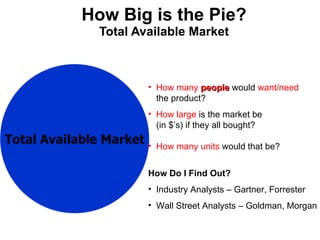
How Big is the Pie? Total Available Market Total Available Market How many   people  would  want/need   the product? How large  is the market be  (in $ ’s) if they all bought? How many units  would that be? How Do I Find Out? Industry Analysts – Gartner, Forrester Wall Street Analysts – Goldman, Morgan
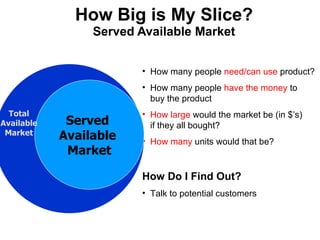
How Big is My Slice? Served Available Market How many people  need/can use  product? How many people  have the money  to  buy the product  How large  would the market be (in $ ’s)  if they all bought? How many  units would that be? How Do I Find Out? Talk to potential customers Served  Available  Market Total Available Market
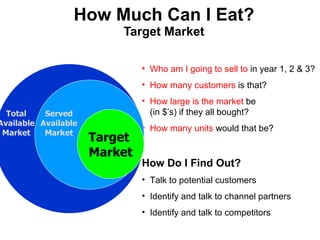
How Much Can I Eat? Target Market Who am I going to sell to  in year 1, 2 & 3?  How many customers  is that? How large   is the market  be  (in $ ’s) if they all bought? How many units  would that be? How Do I Find Out? Talk to potential customers Identify and talk to channel partners Identify and talk to competitors Total Available Market Target  Market Served Available Market
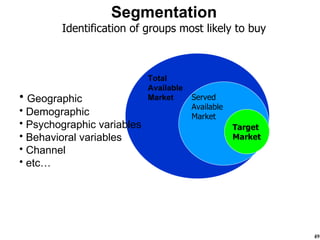
Segmentation Identification of groups most likely to buy Target  Market Geographic Demographic Psychographic variables Behavioral variables Channel etc… Total Available Market Served Available Market
Market Size: Summary Market Size Questions: How big can this market be?  How much of it can we get? Market growth rate Market structure (Mature or in flux?) Most important : Talk to Customers and Sales Channel Next important: Market size by competitive approximation Wall Street analyst reports are great And :  Market research firms  Like Forester, Gartner
Business Model
What Is a Business  Model ? Diagram  of flows between company and customers Scorecard  of hypotheses testing Rapid change  with each iteration and pivot Founder- driven * Alex Osterwalder
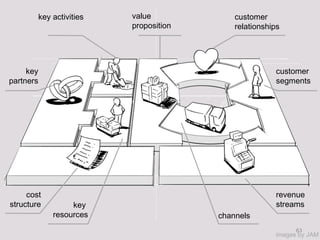
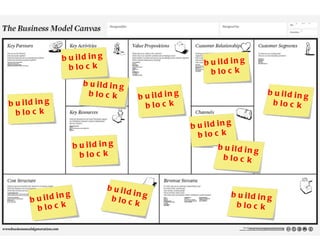
9 building blocks  of a business model:
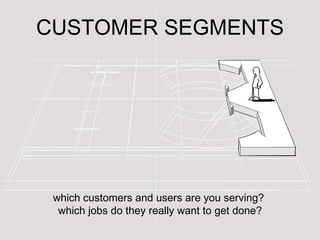
CUSTOMER SEGMENTS which customers and users are you serving?  which jobs do they really want to get done?
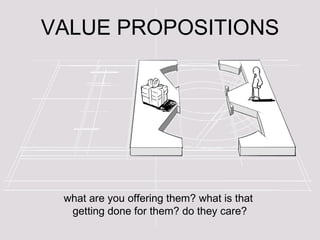
VALUE PROPOSITIONS what are you offering them? what is that  getting done for them? do they care?
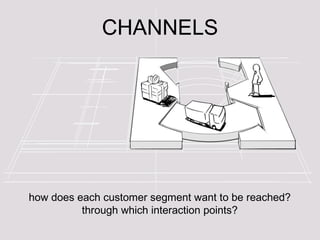
CHANNELS how does each customer segment want to be reached? through which interaction points?
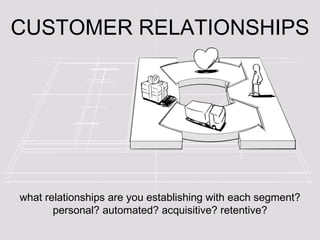
CUSTOMER RELATIONSHIPS what relationships are you establishing with each segment? personal? automated? acquisitive? retentive?
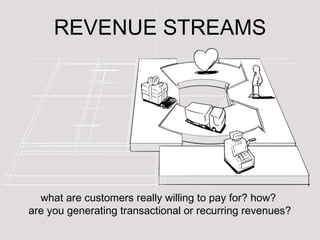
REVENUE STREAMS what are customers really willing to pay for? how?  are you generating transactional or recurring revenues?
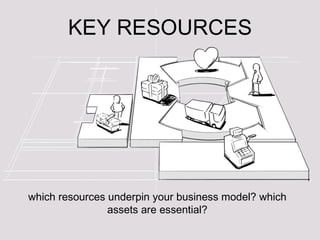
KEY RESOURCES which resources underpin your business model? which assets are essential?
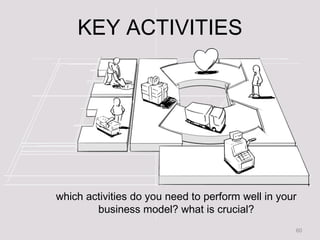
KEY ACTIVITIES which activities do you need to perform well in your business model? what is crucial?
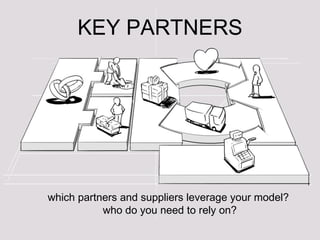
KEY PARTNERS which partners and suppliers leverage your model?  who do you need to rely on?
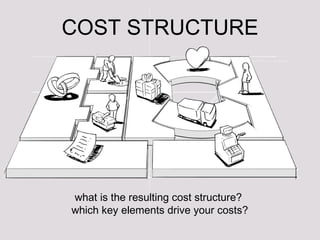
COST STRUCTURE what is the resulting cost structure?  which key elements drive your costs?
images by JAM customer segments key partners cost structure revenue streams channels customer relationships key activities key  resources value proposition
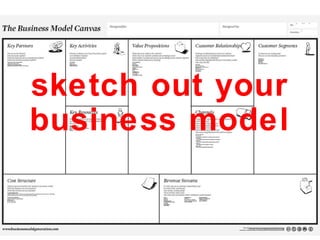
sketch out your business model
building block building block building block building block building block building block building block building block building block building block building block building block
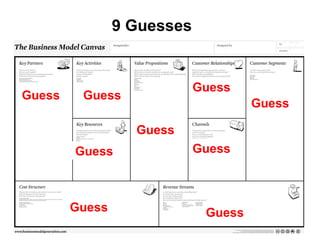
But, Realize They ’re Hypotheses
9 Guesses Guess Guess Guess Guess Guess Guess Guess Guess Guess
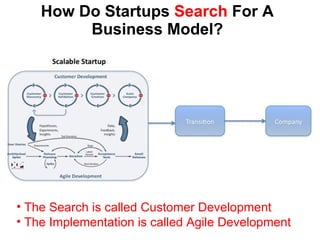
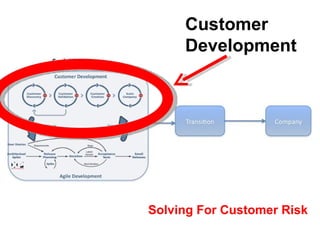
How Do Startups  Search  For A Business Model? The Search is called Customer Development The Implementation is called Agile Development
Customer  Development Solving For Customer Risk
Customer Development Get Out of the Building The founders ^
More startups  fail from  a lack of customers  than from a failure of product development (focus on “who” more than “what”)
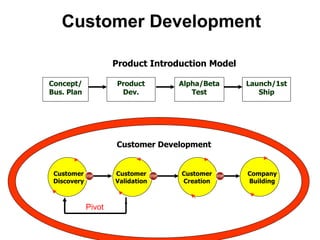
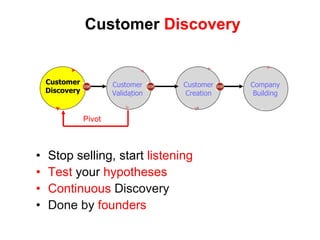
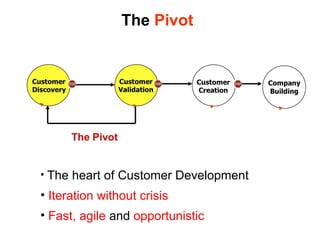
Customer Development Concept/ Bus. Plan Product Dev. Alpha/Beta Test Launch/1st Ship Product Introduction Model Customer   Development Company Building Customer Discovery Customer Validation Customer Creation Pivot
Stop selling, start  listening Test  your  hypotheses Continuous  Discovery Done by  founders Customer  Discovery Customer Discovery Customer Validation Company Building Customer Creation Pivot
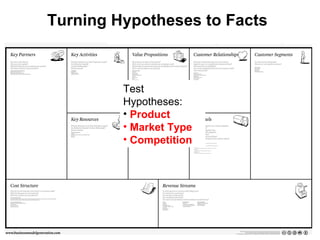
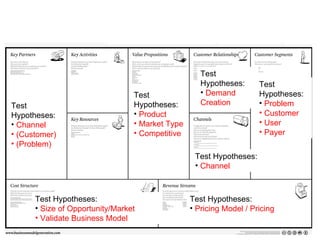
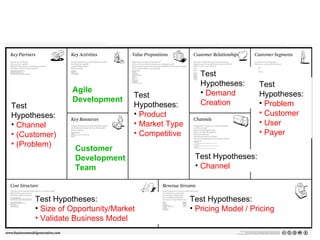
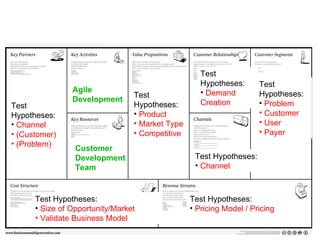
Turning Hypotheses to Facts Test Hypotheses: Product Market Type Competition
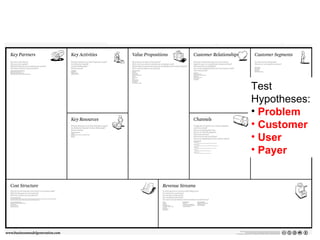
Test Hypotheses: Problem Customer User Payer
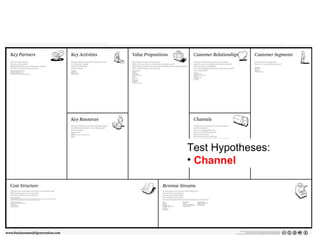
Test Hypotheses: Channel
Test Hypotheses: Problem Customer User Payer Test Hypotheses: Demand Creation Test Hypotheses: Channel Test Hypotheses: Product Market Type Competitive Test Hypotheses: Pricing Model / Pricing Test Hypotheses: Size of Opportunity/Market Validate Business Model Test Hypotheses: Channel (Customer) (Problem)
Test Hypotheses: Problem Customer User Payer Test Hypotheses: Demand Creation Test Hypotheses: Channel Test Hypotheses: Product Market Type Competitive Test Hypotheses: Pricing Model / Pricing Test Hypotheses: Size of Opportunity/Market Validate Business Model Test Hypotheses: Channel (Customer) (Problem) Customer Development Team Agile Development
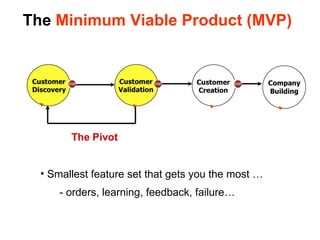
The  Minimum Viable Product (MVP) Smallest feature set that gets you the most … - orders, learning, feedback, failure…
The  Pivot The heart of Customer Development Iteration without crisis Fast, agile  and  opportunistic
The  Pivot A Pivot is the  change  of one or more  Business Model  Canvas Components
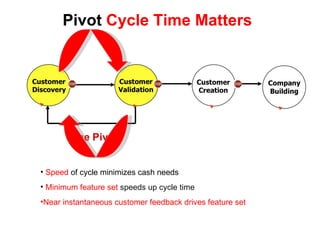
Pivot  Cycle Time Matters Speed  of cycle minimizes cash needs Minimum feature set  speeds up cycle time Near instantaneous customer feedback drives feature set
Tomorrow Team Deliverables Hypotheses for each part of business model Test for whether your business is worth  pursuing (market  size) Test for each of the hypotheses      -  What  constitutes a pass/fail signal for the  test  (e.g. at what point would you say your hypotheses wasn ’t even close to  correct)?
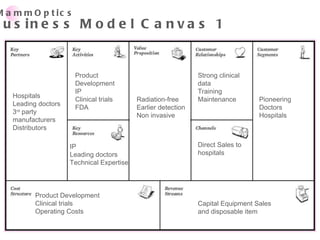
Radiation-free Earlier detection Non invasive Pioneering Doctors Hospitals Direct Sales to hospitals Strong clinical data Training Maintenance Product Development Clinical trials Operating Costs Capital Equipment Sales and disposable item Product Development IP Clinical trials FDA IP  Leading doctors Technical Expertise Hospitals Leading doctors 3 rd  party manufacturers Distributors MammOptics Business Model Canvas 1
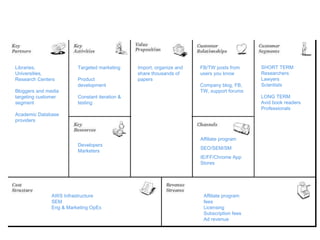
something-something-something.com Original idea SHORT TERM Researchers Lawyers Scientists  LONG TERM Avid book readers Professionals  Import, organize and share thousands of papers FB/TW posts from users you know Company blog, FB, TW, support forums Affiliate program SEO/SEM/SM IE/FF/Chrome App Stores Targeted marketing Product development Constant iteration & testing Developers Marketers Libraries, Universities, Research Centers Bloggers and media targeting customer segment Academic Database providers Affiliate program fees Licensing Subscription fees Ad revenue AWS Infrastructure SEM Eng & Marketing OpEx Invincible Business Model: Version 1.0
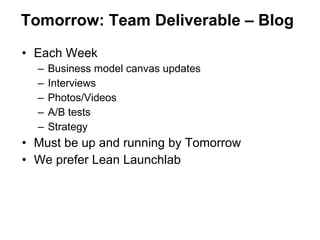
Tomorrow: Team Deliverable – Blog Each Week Business model canvas updates Interviews Photos/Videos A/B tests Strategy Must be up and running by Tomorrow We prefer Lean Launchlab
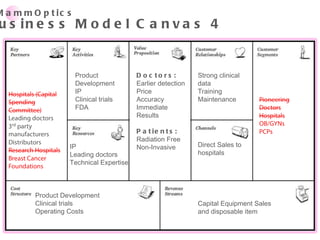
Direct Sales to hospitals Strong clinical data Training Maintenance Product Development Clinical trials Operating Costs Capital Equipment Sales and disposable item Product Development IP Clinical trials FDA IP  Leading doctors Technical Expertise Doctors: Earlier detection Price Accuracy Immediate Results Patients: Radiation Free Non-Invasive MammOptics Business Model Canvas 4
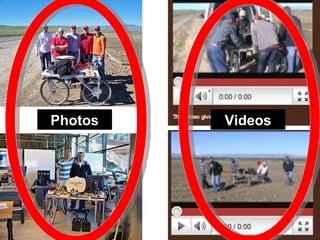
Photos Videos
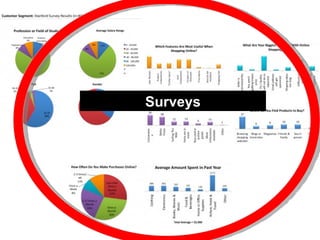
Surveys
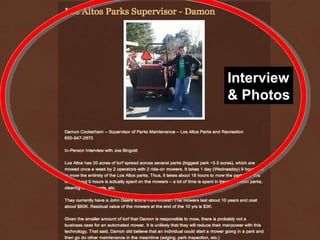
Interview & Photos

Class 1 - course overview Berkeley/Columbia Lean Launchpad Xmba 296t

  • 1.
    The Lean LaunchPadSession 1: Overview/Business Models/Customer Development Professors Steve Blank,Jon Feiber, Jim Hornthal, Oren Jacob https://sites.google.com/site/xmba296t / XMBA296T
  • 2.
    Agenda “ IsThis the Right Course for Me?” Introductions Course Objectives/teams/project Class Logistics Building a “Lean Startup” Idea Sizing the Opportunity Business Models Customer Development Class “Culture” and Next Steps
  • 3.
  • 4.
    Steve Blank ,Jon Feiber 8 startups in Silicon Valley Semiconductors Supercomputers Consumer electronics Video games Enterprise software Military intelligence [email_address] twitter @sgblank www.steveblank.com BS CS/Astro Physics U of Colorado VP Networking SUN V.C. @ MDV since 1991
  • 5.
    Steve Blank, Jon Feiber 8 startups - 32 years in Silicon Valley Semiconductors Supercomputers Consumer electronics Video games Enterprise software Military intelligence Teach: Stanford, Berkeley, Columbia Details at www.steveblank.com BS CS/Astro Physics U of Colorado 50 th employee, VP Networking @ Sun V.C. @ MDV since 1991 [email_address]
  • 6.
    Oren Jacob ,Jim Hornthal CEO, stealth startup EIR, August Capita lCTO, Pixar Director, Studio Tools, Pixar Technical Director, Finding Nemo CMEA Capital Triporati
  • 7.
    Oren Jacob, Jim Hornthal CTO Pixar CMEA Capital Chairman Triporati
  • 8.
    Teaching Assistant TA’s role : Class/lecture questions, Grading and attendance Bhavik Joshi Better Place (13th employee, first non-Israeli, non-Jewish, non ex-SAP, Asian employee) Berkeley/Columbia MBA class of 2008/09 Co-founder: Berkeley Stanford Cleantech Conference Series (since 2007) 2000 – 2007 Enterprise Software 1998 – 2000 Tata Motors India [email_address] http://about.me/bhavikjoshi
  • 9.
    Mentors Mentors arepeople with real-world experience Mentors role is to: Help you “Get you out of the building” Share contacts Offer “Real-world” entrepreneurial advice Critical feedback You arrange your schedule for the mentors, not the other way around
  • 10.
    Mentor Introductions ClickHere for the Mentor Bios
  • 11.
    Course Objectives Understandthe real world aspects of Entrepreneurship by getting out of the building Analyze and assess an opportunity Build the product Get orders Work with a team Give you a framework and methodology Learn what entrepreneurship is to you
  • 12.
    What Will youLearn? Opportunity evaluation Search for a Business Model Customer Discovery and Validation Operating and decision making in chaos with insufficient data Ruthless pursuit of an objective by a team
  • 13.
    The Course ‘By the Numbers’ 4 Instructors, 1 TA, 15+ Mentors, 8 Lectures 8 10-minute presentations per class 1 Final 20 minute presentation 2 Textbooks 10-15 hours of work a week outside the classroom
  • 14.
    This Class is Hard You can’ t pass by attending the lectures Your grade is determined by the work you do outside the class There’ s a lot of it You are dependent on group success – communication is critical You don’t need to be friends you need to be partners
  • 15.
  • 16.
    Course Reading BusinessModel Generation Four Steps to the Epiphany www.steveblank.com
  • 17.
    Class Schedule Eight(3 hour) Class Sessions: 1: Sept 1 st - Introduction, Business Models, Customer Development 2: Sept 2 nd – Value Proposition/Customer Segment 3: Sept 22 nd – Channels 4: Sept 23 rd - Demand Creation (Customer Relationships) 5: Oct 13 th – Revenue Model 6: Oct 14 th – Key Resources and Activities 7: Nov 11 th - Cost Structure 8: Nov 12 th – Fund Raising 9 & 10: Dec 1 st / 2 nd – Lessons Learned Presentations
  • 18.
    Teams Suggested teamsize is 4 people You chose the roles (hint: no org chart) Present Weekly and for Final Weekly lessons learned Final is demo and summary Class is about discovery and fast iteration
  • 19.
    Team Projects Any for-profit scalable startup If you are a domain expert, that ’s your best bet (but not required) If you pick a web project, you have to build it (and there needs to be some novelty)
  • 20.
    Team Deliverables -Presentation Each Week Lessons Learned presentation 10 minutes Updated business model canvas Update blog/wiki 10 ’s of hours of “outside the building” progress Final Presentation 20 minute Lessons Learned Summary
  • 21.
    Team Deliverables -Blog Each Week Business model canvas updates Interviews Photos/Videos A/B tests Strategy
  • 22.
    Grading Individual -15% Participation in class 15% Team - 85% 40% out-of-the-building progress as measured by blog write-ups each week. 20% weekly team “lesson learned” summaries 25% team final report Grade is on how much you learn
  • 23.
    Grading Individual -15% Participation in class 15% Team - 80% 40% out-of-the-building progress as measured by blog write-ups each week. 20% weekly team “lesson learned” summaries 25% team final report You ’re graded on how much learn , not how much you sell
  • 24.
    Office Hours Withyour team Before and after class Look at availability here Get on the calendar
  • 25.
    Intellectual Property -Suggestions Make sure your project is OK with your company disclose to team what IP rights your company has to inventions You own what IP you brought to class with you No team member has claim to anything you brought Your team jointly owns any IP developed for the class If any of you decide to start a company based on the class, you own only what was developed and completed in the class You have no claim for work done before or after the class quarter If a subset of the team decides to start a company they do NOT “owe” anything to other team members for work done in and during the class All team members are free to start the same company, without permission of the others You are agreeing to this unless the team decides in writing to do something different
  • 26.
    Class Disclosure/NDA’s Successfulstartups are not about the original idea It’s about learning, discovery and execution You will not be presenting your IP/technical details You get to see how previous teams solved problems by looking at their slides, notes and blogs Therefore: Your slides, notes and blogs will be public This is an open class. No non-disclosures
  • 27.
    How to BuildA Startup Idea Size Opportunity Business Model Customer Development
  • 28.
    How to BuildA Startup Idea Size of the Opportunity Business Model(s) Customer Discovery Customer Validation
  • 29.
    How to BuildA Startup Idea Size of the Opportunity Business Model(s) Customer Discovery Customer Validation Theory Practice
  • 30.
    How to BuildA Startup Idea Size of the Opportunity Business Model(s) Customer Discovery Customer Validation Web startups get the product in front of customers earlier
  • 31.
    How to BuildA Startup Idea Size of the Opportunity Business Model(s) Customer Discovery Customer Validation
  • 32.
  • 33.
    We’ re EngineersDarn It! Aren ’t companies all about product? I have a great technology idea Teach me how to make a company around it Just like Facebook and Google (or Intel or Apple)
  • 34.
    Sources of StartupIdeas? Technology shifts Moore ’s Law Disruptive tech Research Market changes Value chain disruption Deregulation Societal changes Changes in ways we live, learn, work, etc. The world is flat (outsourcing) Dinosaur factor Arrogance Deadened reflexes Irrational exuberance Undervalued assets
  • 35.
    An Idea is_Not_ a Company
  • 36.
    An Idea is_Not_ a Company It’s Just One of Many Hypotheses
  • 37.
  • 38.
    This Class isabout Scalable Startups Not all startups are designed to scale Small business startups have different goals They are done by normal people Scalable startups are designed to grow big Typically require venture capital This means the size of the opportunity needs to be $100’s of millions to billions
  • 39.
    Small Business Startups Small Business Startup - Business Model found - Profitable business Existing team < $1M in revenue
  • 40.
    Small Business Startups - Business Model found - Profitable business Existing team < $10M in revenue 5.7 million small businesses in the U.S. <500 employees 99.7% of all companies ~ 50% of total U.S. workers http://www.sba.gov/advo/stats/sbfaq.pdf Small Business Startup
  • 41.
    Scalable StartupScalable Startup Large Company >$100M/year Total Available Market > $500m Company can grow to $100m/year Business model found Focused on execution and process
  • 42.
    Scalable StartupScalable Startup Large Company >$100M/year Total Available Market > $500m Company can grow to $100m/year Business model found Focused on execution and process Typically requires “risk capital” In contrast a scalable startup is designed to grow big Typically needs risk capital What Silicon Valley means when they say “Startup”
  • 43.
    Very Different Startup Goals Small Business Startup - Business Model found - Profitable business Existing team < $10M Scalable Startup Large Company Total Available Market > $500m Company can grow to $100m/year Business model found Focused on execution and process Typically requires “ risk capital ”
  • 44.
    Venture Firms Invest in Scalable Startups Small Business Startup Scalable Startup Large Company
  • 45.
    Market/Opportunity Analysis HowBig is It?: Market/Opportunity Analysis Identify a Customer and Market Need Size the Market Competitors Growth Potential
  • 46.
    How Big isthe Pie? Total Available Market Total Available Market How many people would want/need the product? How large is the market be (in $ ’s) if they all bought? How many units would that be? How Do I Find Out? Industry Analysts – Gartner, Forrester Wall Street Analysts – Goldman, Morgan
  • 47.
    How Big isMy Slice? Served Available Market How many people need/can use product? How many people have the money to buy the product How large would the market be (in $ ’s) if they all bought? How many units would that be? How Do I Find Out? Talk to potential customers Served Available Market Total Available Market
  • 48.
    How Much CanI Eat? Target Market Who am I going to sell to in year 1, 2 & 3? How many customers is that? How large is the market be (in $ ’s) if they all bought? How many units would that be? How Do I Find Out? Talk to potential customers Identify and talk to channel partners Identify and talk to competitors Total Available Market Target Market Served Available Market
  • 49.
    Segmentation Identification ofgroups most likely to buy Target Market Geographic Demographic Psychographic variables Behavioral variables Channel etc… Total Available Market Served Available Market
  • 50.
    Market Size: SummaryMarket Size Questions: How big can this market be? How much of it can we get? Market growth rate Market structure (Mature or in flux?) Most important : Talk to Customers and Sales Channel Next important: Market size by competitive approximation Wall Street analyst reports are great And : Market research firms Like Forester, Gartner
  • 51.
  • 52.
    What Is aBusiness Model ? Diagram of flows between company and customers Scorecard of hypotheses testing Rapid change with each iteration and pivot Founder- driven * Alex Osterwalder
  • 53.
    9 building blocks of a business model:
  • 54.
    CUSTOMER SEGMENTS whichcustomers and users are you serving? which jobs do they really want to get done?
  • 55.
    VALUE PROPOSITIONS whatare you offering them? what is that getting done for them? do they care?
  • 56.
    CHANNELS how doeseach customer segment want to be reached? through which interaction points?
  • 57.
    CUSTOMER RELATIONSHIPS whatrelationships are you establishing with each segment? personal? automated? acquisitive? retentive?
  • 58.
    REVENUE STREAMS whatare customers really willing to pay for? how? are you generating transactional or recurring revenues?
  • 59.
    KEY RESOURCES whichresources underpin your business model? which assets are essential?
  • 60.
    KEY ACTIVITIES whichactivities do you need to perform well in your business model? what is crucial?
  • 61.
    KEY PARTNERS whichpartners and suppliers leverage your model? who do you need to rely on?
  • 62.
    COST STRUCTURE whatis the resulting cost structure? which key elements drive your costs?
  • 63.
    images by JAMcustomer segments key partners cost structure revenue streams channels customer relationships key activities key resources value proposition
  • 64.
    sketch out yourbusiness model
  • 65.
    building block buildingblock building block building block building block building block building block building block building block building block building block building block
  • 66.
    But, Realize They’re Hypotheses
  • 67.
    9 Guesses GuessGuess Guess Guess Guess Guess Guess Guess Guess
  • 68.
    How Do Startups Search For A Business Model? The Search is called Customer Development The Implementation is called Agile Development
  • 69.
    Customer DevelopmentSolving For Customer Risk
  • 70.
    Customer Development GetOut of the Building The founders ^
  • 71.
    More startups fail from a lack of customers than from a failure of product development (focus on “who” more than “what”)
  • 72.
    Customer Development Concept/Bus. Plan Product Dev. Alpha/Beta Test Launch/1st Ship Product Introduction Model Customer Development Company Building Customer Discovery Customer Validation Customer Creation Pivot
  • 73.
    Stop selling, start listening Test your hypotheses Continuous Discovery Done by founders Customer Discovery Customer Discovery Customer Validation Company Building Customer Creation Pivot
  • 74.
    Turning Hypotheses toFacts Test Hypotheses: Product Market Type Competition
  • 75.
    Test Hypotheses: ProblemCustomer User Payer
  • 76.
  • 77.
    Test Hypotheses: ProblemCustomer User Payer Test Hypotheses: Demand Creation Test Hypotheses: Channel Test Hypotheses: Product Market Type Competitive Test Hypotheses: Pricing Model / Pricing Test Hypotheses: Size of Opportunity/Market Validate Business Model Test Hypotheses: Channel (Customer) (Problem)
  • 78.
    Test Hypotheses: ProblemCustomer User Payer Test Hypotheses: Demand Creation Test Hypotheses: Channel Test Hypotheses: Product Market Type Competitive Test Hypotheses: Pricing Model / Pricing Test Hypotheses: Size of Opportunity/Market Validate Business Model Test Hypotheses: Channel (Customer) (Problem) Customer Development Team Agile Development
  • 79.
    Test Hypotheses: ProblemCustomer User Payer Test Hypotheses: Demand Creation Test Hypotheses: Channel Test Hypotheses: Product Market Type Competitive Test Hypotheses: Pricing Model / Pricing Test Hypotheses: Size of Opportunity/Market Validate Business Model Test Hypotheses: Channel (Customer) (Problem) Customer Development Team Agile Development
  • 80.
    The MinimumViable Product (MVP) Smallest feature set that gets you the most … - orders, learning, feedback, failure…
  • 81.
    The PivotThe heart of Customer Development Iteration without crisis Fast, agile and opportunistic
  • 82.
    The PivotA Pivot is the change of one or more Business Model Canvas Components
  • 83.
    Pivot CycleTime Matters Speed of cycle minimizes cash needs Minimum feature set speeds up cycle time Near instantaneous customer feedback drives feature set
  • 84.
    Tomorrow Team DeliverablesHypotheses for each part of business model Test for whether your business is worth  pursuing (market  size) Test for each of the hypotheses     - What  constitutes a pass/fail signal for the  test  (e.g. at what point would you say your hypotheses wasn ’t even close to  correct)?
  • 85.
    Radiation-free Earlier detectionNon invasive Pioneering Doctors Hospitals Direct Sales to hospitals Strong clinical data Training Maintenance Product Development Clinical trials Operating Costs Capital Equipment Sales and disposable item Product Development IP Clinical trials FDA IP Leading doctors Technical Expertise Hospitals Leading doctors 3 rd party manufacturers Distributors MammOptics Business Model Canvas 1
  • 86.
    something-something-something.com Original ideaSHORT TERM Researchers Lawyers Scientists LONG TERM Avid book readers Professionals Import, organize and share thousands of papers FB/TW posts from users you know Company blog, FB, TW, support forums Affiliate program SEO/SEM/SM IE/FF/Chrome App Stores Targeted marketing Product development Constant iteration & testing Developers Marketers Libraries, Universities, Research Centers Bloggers and media targeting customer segment Academic Database providers Affiliate program fees Licensing Subscription fees Ad revenue AWS Infrastructure SEM Eng & Marketing OpEx Invincible Business Model: Version 1.0
  • 87.
    Tomorrow: Team Deliverable– Blog Each Week Business model canvas updates Interviews Photos/Videos A/B tests Strategy Must be up and running by Tomorrow We prefer Lean Launchlab
  • 88.
    Direct Sales tohospitals Strong clinical data Training Maintenance Product Development Clinical trials Operating Costs Capital Equipment Sales and disposable item Product Development IP Clinical trials FDA IP Leading doctors Technical Expertise Doctors: Earlier detection Price Accuracy Immediate Results Patients: Radiation Free Non-Invasive MammOptics Business Model Canvas 4
  • 89.
  • 90.
  • 91.