3/1/2011
Team Members Alan Chiu Product management, enterprise software, storage, distributed systems Danielle Buckley Product management, business development, management consulting Evan Rosenfeld Machine learning, mobile / web app architecture Gabriel Yu Enterprise software development, web systems
Hypotheses needed for cloud compute marketplace Cloud IaaS has become a fungible commodity Large supply of excess capacity Willingness to purchase from various providers It’s possible to create a cloud marketplace
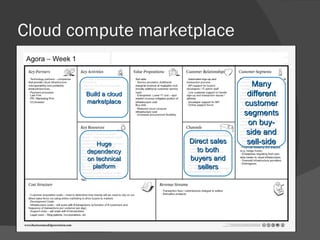
Cloud compute marketplace Build a cloud marketplace Direct sales to both buyers and sellers Many different customer segments on buy-side and sell-side Huge dependency on technical platform
We got out of the building… Interviewed potential buyers Zynga, Xambala, Greplin, Pulse, KISSMetrics, SumoLogic, Zencoder, Desktone, All Covered… Interviewed potential sellers Savvis, AWS, Azure, Yahoo, Addepar… Interviewed industry experts VMware, Zuora, NetApp, SolarWinds, telco consultant…
…  And found a challenging missionary market Diverse IaaS products Non-trivial switching costs Amazon default for many  Long-term vendor relationships dominate Enterprise IAAS
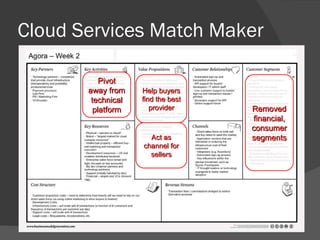
Cloud Services Match Maker Pivot away from technical platform Help buyers find the best provider Removed financial, consumer segments Act as channel for sellers
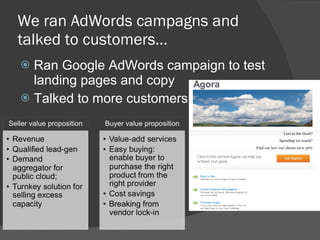
We ran AdWords campagns and talked to customers… Ran Google AdWords campaign to test landing pages and copy Talked to more customers
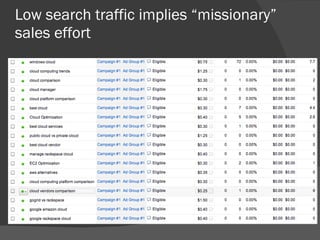
…  And struggled to identify a “hair on fire” problem Low search volume for IaaS comparison Interest from public sellers in new channel Private seller IT not revenue-driven Variable workloads impact opex
Low search traffic implies “missionary” sales effort
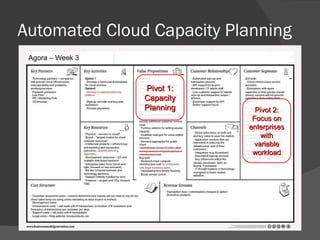
Automated Cloud Capacity Planning Pivot 1: Capacity Planning Pivot 2: Focus on enterprises with variable workload
We focused on demand creation and sales…  Researched demand prediction models Explored sales models with experts  Talked to more customers
…  And came up with a 2-tiered model Found traction for capacity planning business Identified sales strategy Field sales model to large enterprise Inside sales model for lower end offering
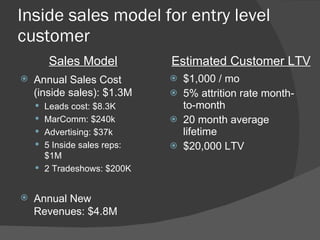
Inside sales model for entry level customer $1,000 / mo 5% attrition rate month-to-month 20 month average lifetime $20,000 LTV  Annual Sales Cost (inside sales): $1.3M  Leads cost: $8.3K MarComm: $240k Advertising: $37k 5 Inside sales reps: $1M 2 Tradeshows: $200K Annual New Revenues: $4.8M Sales Model Estimated Customer LTV
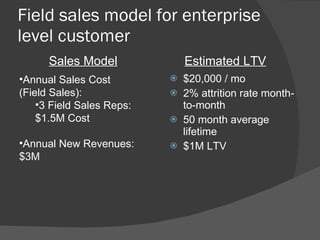
Field sales model for enterprise level customer $20,000 / mo 2% attrition rate month-to-month 50 month average lifetime $1M LTV  Annual Sales Cost (Field Sales): 3 Field Sales Reps: $1.5M Cost Annual New Revenues: $3M Sales Model Estimated LTV
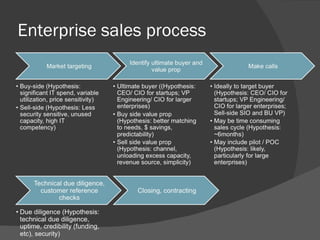
Enterprise sales process
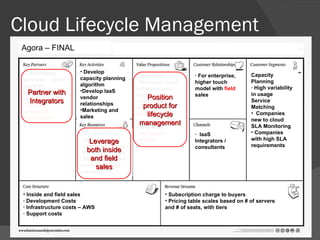
Cloud Lifecycle Management Capacity Planning · High variability in usage  Service Matching Companies new to cloud SLA Monitoring Companies with high SLA requirements  ·  IaaS Integrators / consultants Inside and field sales · Development Costs · Infrastructure costs – AWS · Support costs Subscription charge to buyers Pricing table scales based on # of servers and # of seats, with tiers · For enterprise, higher touch model with  field  sales Customers · Reduced cloud infrastructure cost · Increased visibility on service level  Integrators: · Increased revenue Develop capacity planning algorithm Develop IaaS vendor relationships Marketing and sales · Technology partners – cloud vendors, management tools · System integrators / Consultants · IP– prediction  · Developers · Inside sales force · Field sales force  · Biz dev (channel and technology partners) Agora – FINAL Partner with Integrators Leverage both inside and field sales Position product for lifecycle management
We got out of the building, and built a business model… Decided to use two-tier sales model Attended AWS meet-up Interviewed IT consultants Analyzed competitor and comparable models Selected strategic direction
… and validated a 2-tier sales model with integrator support  Ecosystem of cloud IT consultants / integrators willing to engage Our product makes integrators money Concerns about 2-tier sales model, though some examples of success Income statement passed test of reason
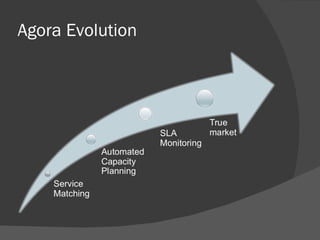
Agora Evolution
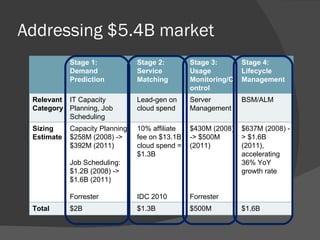
Addressing $5.4B market Stage 1: Demand Prediction Stage 2: Service Matching Stage 3: Usage Monitoring/Control Stage 4: Lifecycle Management Relevant Category IT Capacity Planning, Job Scheduling Lead-gen on cloud spend Server Management BSM/ALM Sizing Estimate Capacity Planning:  $258M (2008) -> $392M (2011) Job Scheduling: $1.2B (2008) -> $1.6B (2011) Forrester  10% affiliate fee on $13.1B cloud spend = $1.3B IDC 2010  $430M (2008) -> $500M (2011) Forrester $637M (2008) -> $1.6B (2011), accelerating 36% YoY growth rate Forrester Total $2B $1.3B $500M $1.6B
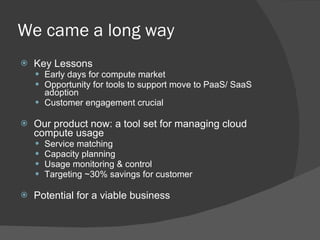
We came a long way Key Lessons Early days for compute market Opportunity for tools to support move to PaaS/ SaaS adoption  Customer engagement crucial Our product now: a tool set for managing cloud compute usage Service matching Capacity planning  Usage monitoring & control Targeting ~30% savings for customer Potential for a viable business
Thanks!
Appendix: Canvases
Week 1
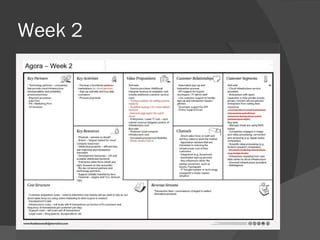
Week 2
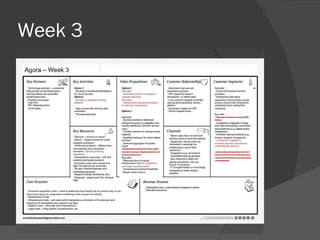
Week 3
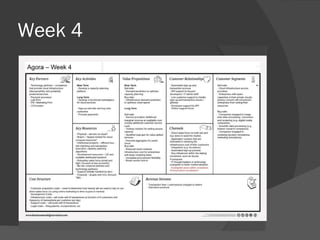
Week 4
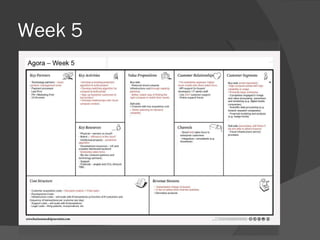
Week 5
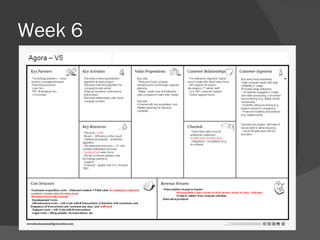
Week 6
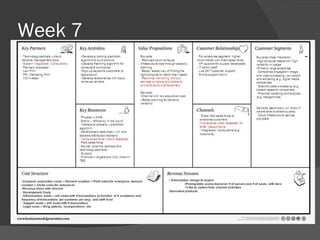
Week 7
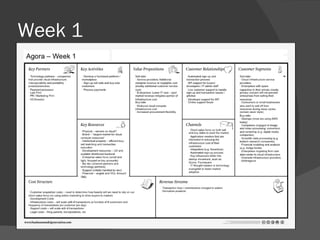
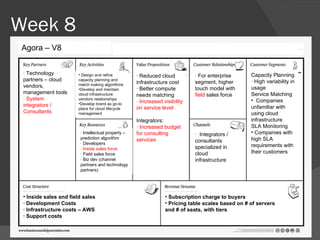
Week 8 Capacity Planning · High variability in usage  Service Matching Companies unfamiliar with using cloud infrastructure SLA Monitoring Companies with high SLA requirements with their customers ·  Integrators / consultants specialized in cloud infrastructure Inside sales and field sales · Development Costs · Infrastructure costs – AWS · Support costs Subscription charge to buyers Pricing table scales based on # of servers and # of seats, with tiers · For enterprise segment, higher touch model with  field  sales force · Reduced cloud infrastructure cost · Better compute needs matching · Increased visibility on service level  Integrators: · Increased budget for consulting services Design and refine capacity planning and match making algorithms Develop and maintain cloud infrastructure vendors relationships Develop brand as go-to place for cloud lifecycle management · Technology partners – cloud vendors, management tools · System integrators / Consultants · Intellectual property – prediction algorithm · Developers · Inside sales force · Field sales force  · Biz dev (channel partners and technology partners) Agora – V8

Agora E245 final presentation

  • 1.
  • 2.
    Team Members AlanChiu Product management, enterprise software, storage, distributed systems Danielle Buckley Product management, business development, management consulting Evan Rosenfeld Machine learning, mobile / web app architecture Gabriel Yu Enterprise software development, web systems
  • 3.
    Hypotheses needed forcloud compute marketplace Cloud IaaS has become a fungible commodity Large supply of excess capacity Willingness to purchase from various providers It’s possible to create a cloud marketplace
  • 4.
    Cloud compute marketplaceBuild a cloud marketplace Direct sales to both buyers and sellers Many different customer segments on buy-side and sell-side Huge dependency on technical platform
  • 5.
    We got outof the building… Interviewed potential buyers Zynga, Xambala, Greplin, Pulse, KISSMetrics, SumoLogic, Zencoder, Desktone, All Covered… Interviewed potential sellers Savvis, AWS, Azure, Yahoo, Addepar… Interviewed industry experts VMware, Zuora, NetApp, SolarWinds, telco consultant…
  • 6.
    … Andfound a challenging missionary market Diverse IaaS products Non-trivial switching costs Amazon default for many Long-term vendor relationships dominate Enterprise IAAS
  • 7.
    Cloud Services MatchMaker Pivot away from technical platform Help buyers find the best provider Removed financial, consumer segments Act as channel for sellers
  • 8.
    We ran AdWordscampagns and talked to customers… Ran Google AdWords campaign to test landing pages and copy Talked to more customers
  • 9.
    … Andstruggled to identify a “hair on fire” problem Low search volume for IaaS comparison Interest from public sellers in new channel Private seller IT not revenue-driven Variable workloads impact opex
  • 10.
    Low search trafficimplies “missionary” sales effort
  • 11.
    Automated Cloud CapacityPlanning Pivot 1: Capacity Planning Pivot 2: Focus on enterprises with variable workload
  • 12.
    We focused ondemand creation and sales… Researched demand prediction models Explored sales models with experts Talked to more customers
  • 13.
    … Andcame up with a 2-tiered model Found traction for capacity planning business Identified sales strategy Field sales model to large enterprise Inside sales model for lower end offering
  • 14.
    Inside sales modelfor entry level customer $1,000 / mo 5% attrition rate month-to-month 20 month average lifetime $20,000 LTV Annual Sales Cost (inside sales): $1.3M Leads cost: $8.3K MarComm: $240k Advertising: $37k 5 Inside sales reps: $1M 2 Tradeshows: $200K Annual New Revenues: $4.8M Sales Model Estimated Customer LTV
  • 15.
    Field sales modelfor enterprise level customer $20,000 / mo 2% attrition rate month-to-month 50 month average lifetime $1M LTV Annual Sales Cost (Field Sales): 3 Field Sales Reps: $1.5M Cost Annual New Revenues: $3M Sales Model Estimated LTV
  • 16.
  • 17.
    Cloud Lifecycle ManagementCapacity Planning · High variability in usage Service Matching Companies new to cloud SLA Monitoring Companies with high SLA requirements · IaaS Integrators / consultants Inside and field sales · Development Costs · Infrastructure costs – AWS · Support costs Subscription charge to buyers Pricing table scales based on # of servers and # of seats, with tiers · For enterprise, higher touch model with field sales Customers · Reduced cloud infrastructure cost · Increased visibility on service level Integrators: · Increased revenue Develop capacity planning algorithm Develop IaaS vendor relationships Marketing and sales · Technology partners – cloud vendors, management tools · System integrators / Consultants · IP– prediction · Developers · Inside sales force · Field sales force · Biz dev (channel and technology partners) Agora – FINAL Partner with Integrators Leverage both inside and field sales Position product for lifecycle management
  • 18.
    We got outof the building, and built a business model… Decided to use two-tier sales model Attended AWS meet-up Interviewed IT consultants Analyzed competitor and comparable models Selected strategic direction
  • 19.
    … and validateda 2-tier sales model with integrator support Ecosystem of cloud IT consultants / integrators willing to engage Our product makes integrators money Concerns about 2-tier sales model, though some examples of success Income statement passed test of reason
  • 20.
  • 21.
    Addressing $5.4B marketStage 1: Demand Prediction Stage 2: Service Matching Stage 3: Usage Monitoring/Control Stage 4: Lifecycle Management Relevant Category IT Capacity Planning, Job Scheduling Lead-gen on cloud spend Server Management BSM/ALM Sizing Estimate Capacity Planning: $258M (2008) -> $392M (2011) Job Scheduling: $1.2B (2008) -> $1.6B (2011) Forrester 10% affiliate fee on $13.1B cloud spend = $1.3B IDC 2010 $430M (2008) -> $500M (2011) Forrester $637M (2008) -> $1.6B (2011), accelerating 36% YoY growth rate Forrester Total $2B $1.3B $500M $1.6B
  • 22.
    We came along way Key Lessons Early days for compute market Opportunity for tools to support move to PaaS/ SaaS adoption Customer engagement crucial Our product now: a tool set for managing cloud compute usage Service matching Capacity planning Usage monitoring & control Targeting ~30% savings for customer Potential for a viable business
  • 23.
  • 24.
  • 25.
  • 26.
  • 27.
  • 28.
  • 29.
  • 30.
  • 31.
  • 32.
    Week 8 CapacityPlanning · High variability in usage Service Matching Companies unfamiliar with using cloud infrastructure SLA Monitoring Companies with high SLA requirements with their customers · Integrators / consultants specialized in cloud infrastructure Inside sales and field sales · Development Costs · Infrastructure costs – AWS · Support costs Subscription charge to buyers Pricing table scales based on # of servers and # of seats, with tiers · For enterprise segment, higher touch model with field sales force · Reduced cloud infrastructure cost · Better compute needs matching · Increased visibility on service level Integrators: · Increased budget for consulting services Design and refine capacity planning and match making algorithms Develop and maintain cloud infrastructure vendors relationships Develop brand as go-to place for cloud lifecycle management · Technology partners – cloud vendors, management tools · System integrators / Consultants · Intellectual property – prediction algorithm · Developers · Inside sales force · Field sales force · Biz dev (channel partners and technology partners) Agora – V8

Editor's Notes

  • #7 Diverse IaaS products Lack of standards and fungibility Non-trivial switching costs
  • #10 Status quo “good enough” No one is comparing IaaS providers Sellers Public sellers interested in using us as a channel Private sellers not interested – IT dept. not mandated to generate revenue Variable workloads impact opex Potential value in shifting on-demand instances to reserved instances
  • #14 Demand prediction model Apply Queuing Theory Analogous to capacity planning problem Traditional enterprise sales model Field sales – high cost Makes sense if average deal size is $100K+ Inside sales model Free offering as lead gen Outbound emails and calls to follow up and convert Works for lower cost products/services
  • #19 Decided on strategic direction Entice buyers through continuous, automatic optimization of cloud infrastructure opex Create market as industry standards and more sellers emerge
  • #20 Ecosystem of cloud IT consultants Provide holistic cloud solutions to SMBs Integrate cloud services from multiple vendors Own customer relationships Could be our channel if our service does reduce opex as promised