ENG 7 Q3, WEEK 2
Types and
Techniques
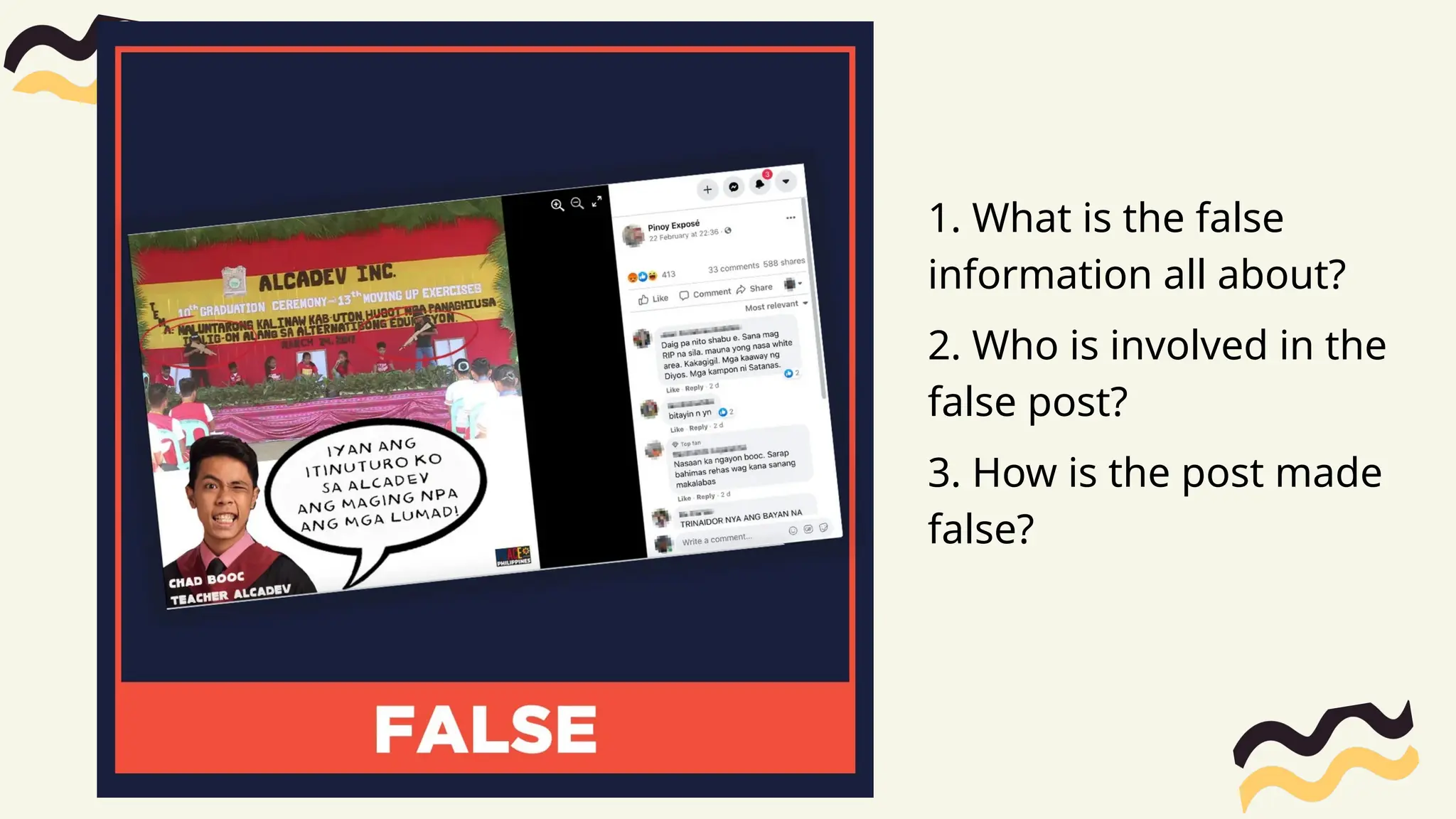
1. What is the false
information all about?
2. Who is involved in the
false post?
3. How is the post made
false?
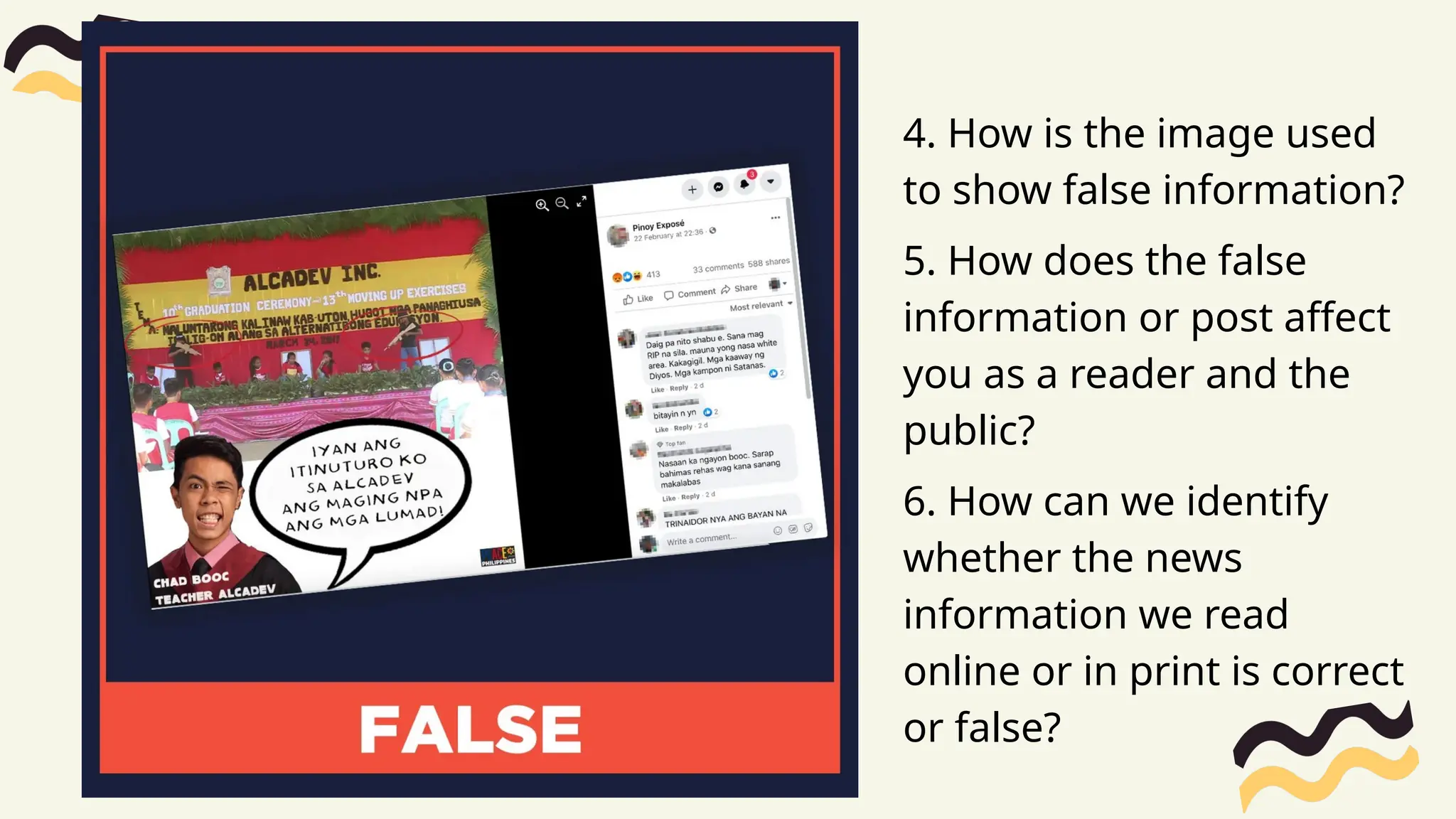
4. How is the image used
to show false information?
5. How does the false
information or post affect
you as a reader and the
public?
6. How can we identify
whether the news
information we read
online or in print is correct
or false?
Match the statements in Column A with their corresponding terms in
Column B.
Recall and Match!
1. The sentence/paragraph is a much shorter version
of the original writing.
2. Faulty data, such as misquote statements, must be
avoided.
3. Words should be plain, straightforward, and
understandable for public reading.
4. The rewritten sentence may be as long as the
original sentence.
5. The original text is enclosed in quotation marks (“ ”).
6. Words and sentences are short and direct to the
point.
a. quote
b. simplicity
c. paraphrase
d. brevity
e. summary
f. precision
The following sentences are taken from
the Rappler press release FALSE: Photo
proves Alcadev school teaches Lumad
kids how to become NPA. Using a
dictionary, look for the word whose
meaning is closest to the underlined
word in each sentence. Write the letter
of the correct answer on your paper.
Search Me Up!
A reverse image search shows that the graduation ceremony photo
was taken from a 2017 theater performance entitled Ang Bangugot.
A. forward
B. opposite
C. clear
D. blurry
Alcadev is a Lumad school in Surigao del Sur that provides
alternative education to indigenous students.
A. substitute
B. essential
C. expensive
D. compulsory
Chad Booc has been a volunteer mathematics teacher for Alcadev
since 2016.
A. forced
B. compensated
C. scholar
D. non-paid
As of writing, Booc and the other individuals are still detained and
have been sued in Davao del Norte.
A. acquitted
B. freed
C. summoned
D. killed
Pagaran denounced this accusation, saying it was a desperate
attempt to red-tag her and further justify worse attacks in the future.
A. promise
B. allegation
C. renumeration
D. innocence
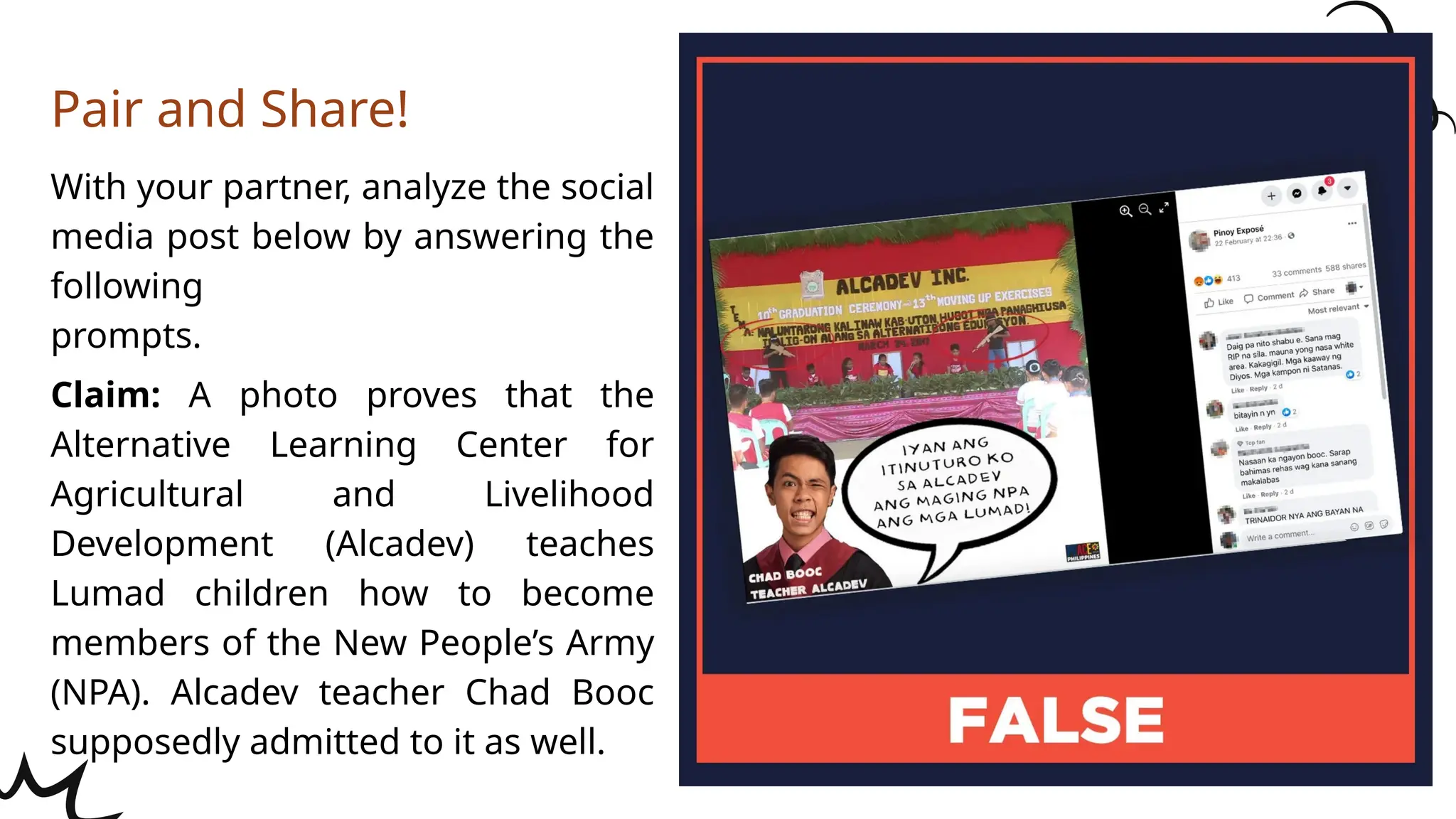
With your partner, analyze the social
media post below by answering the
following
prompts.
Claim: A photo proves that the
Alternative Learning Center for
Agricultural and Livelihood
Development (Alcadev) teaches
Lumad children how to become
members of the New People’s Army
(NPA). Alcadev teacher Chad Booc
supposedly admitted to it as well.
Pair and Share!
List down 3 signs that make the
information false.
List down 2 reasons why the false
information is posted on social media.
Write 1 possible impact of the false information:
To you as a reader
To the public
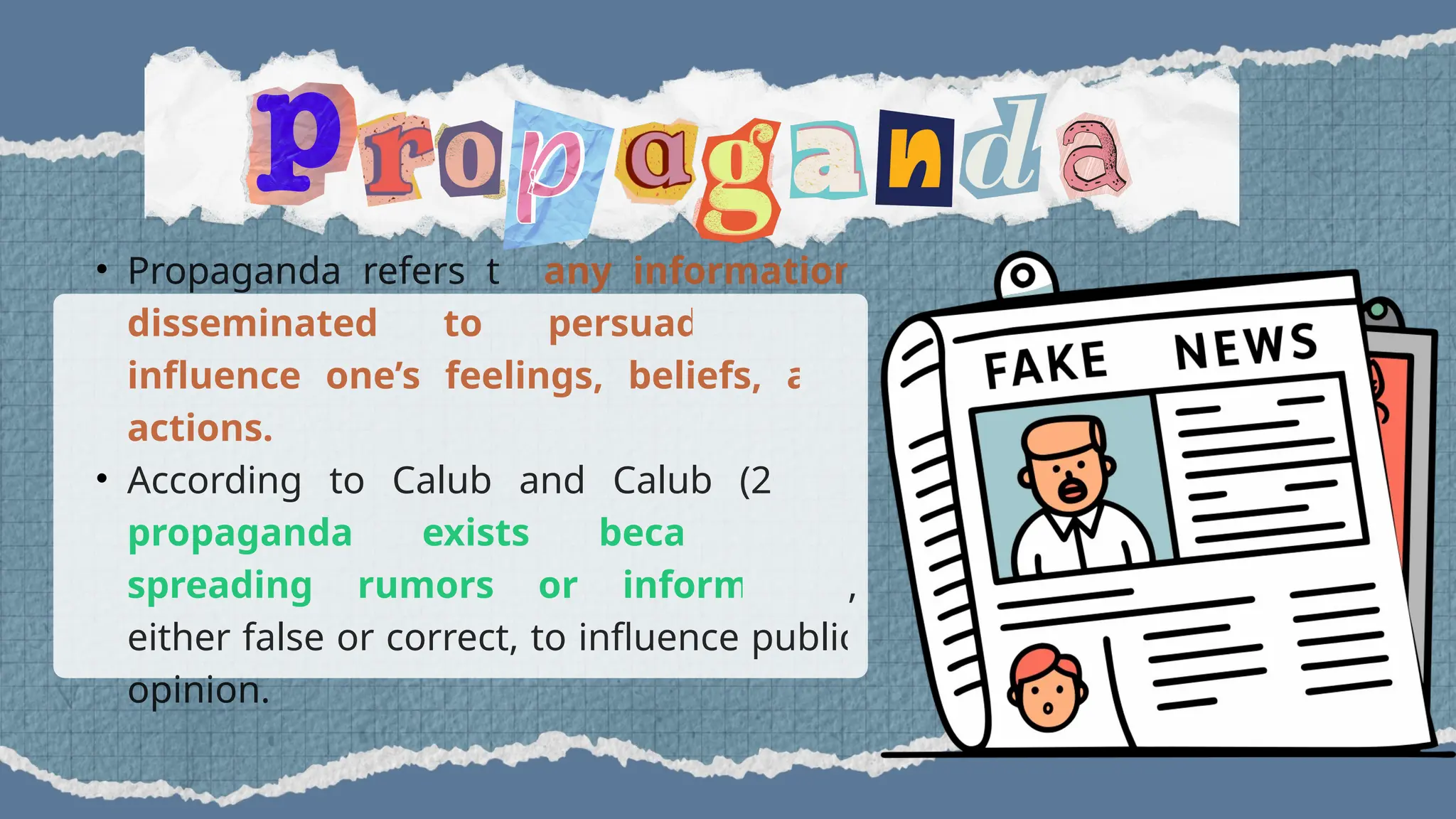
• Propaganda refers to any information
disseminated to persuade and
influence one’s feelings, beliefs, and
actions.
• According to Calub and Calub (2022),
propaganda exists because of
spreading rumors or information,
either false or correct, to influence public
opinion.
Two general types of propaganda
• White propaganda refers to disseminating information from a
credible and unbiased source; hence, the message is accurate.
• Black propaganda involves spreading false or misleading information
to deceive or manipulate the audience into spreading lies or
fabricated information.
Examine the information in the graphic below and the information from
the Rappler press release FALSE: Photo proves Alcadev school teaches
Lumad kids how to become NPA by identifying the propaganda techniques
used.
Check YES if the information uses the
propaganda technique; otherwise, check NO.
Then, answer the prompts that follow.
Think and Decide
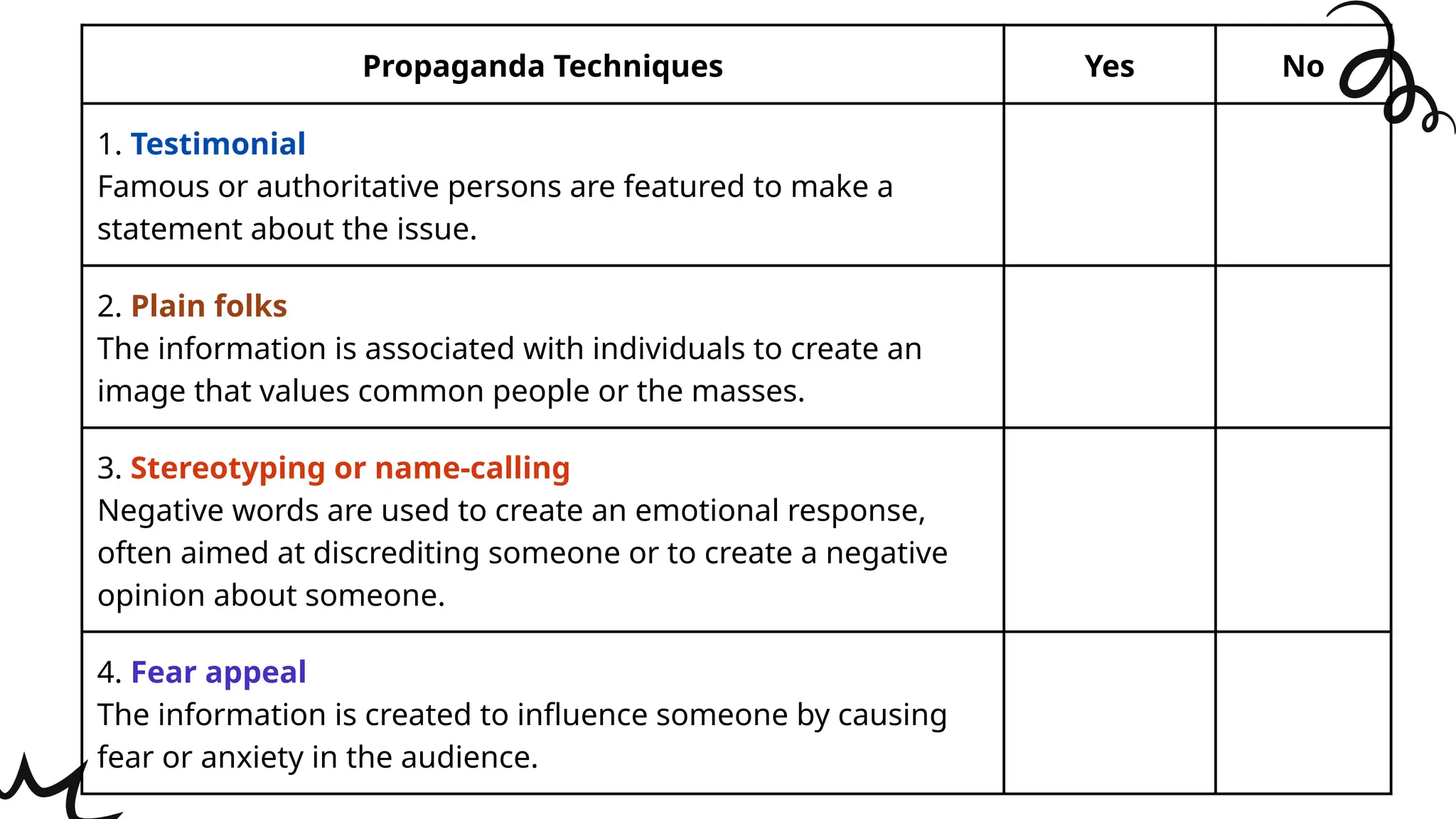
Propaganda Techniques Yes No
1. Testimonial
Famous or authoritative persons are featured to make a
statement about the issue.
2. Plain folks
The information is associated with individuals to create an
image that values common people or the masses.
3. Stereotyping or name-calling
Negative words are used to create an emotional response,
often aimed at discrediting someone or to create a negative
opinion about someone.
4. Fear appeal
The information is created to influence someone by causing
fear or anxiety in the audience.
The prevalent propaganda technique/s used is/are
______________________________________________________________________________
______________________________________________________________________________
_____________________________________.
The ______________________________________ is/are used because
________________________
______________________________________________________________________________
__________________
______________________________________________________________________________
__________________.
For me, the intention of the author for using the propaganda technique/s
Propaganda is a way to persuade people to think or do
something, often using emotional appeals rather than
facts.
1. Testimonial
• What it is: Using a famous person or expert to
endorse a product or idea. Using personalities to
attest to the issue or promote a product or service
increases the credibility and popularity of the issue
or product, which invites readers or audiences to
believe and be influenced
• Example: "K-Pop superstar, Jisoo, swears by this
new skincare line, saying it's the secret to her
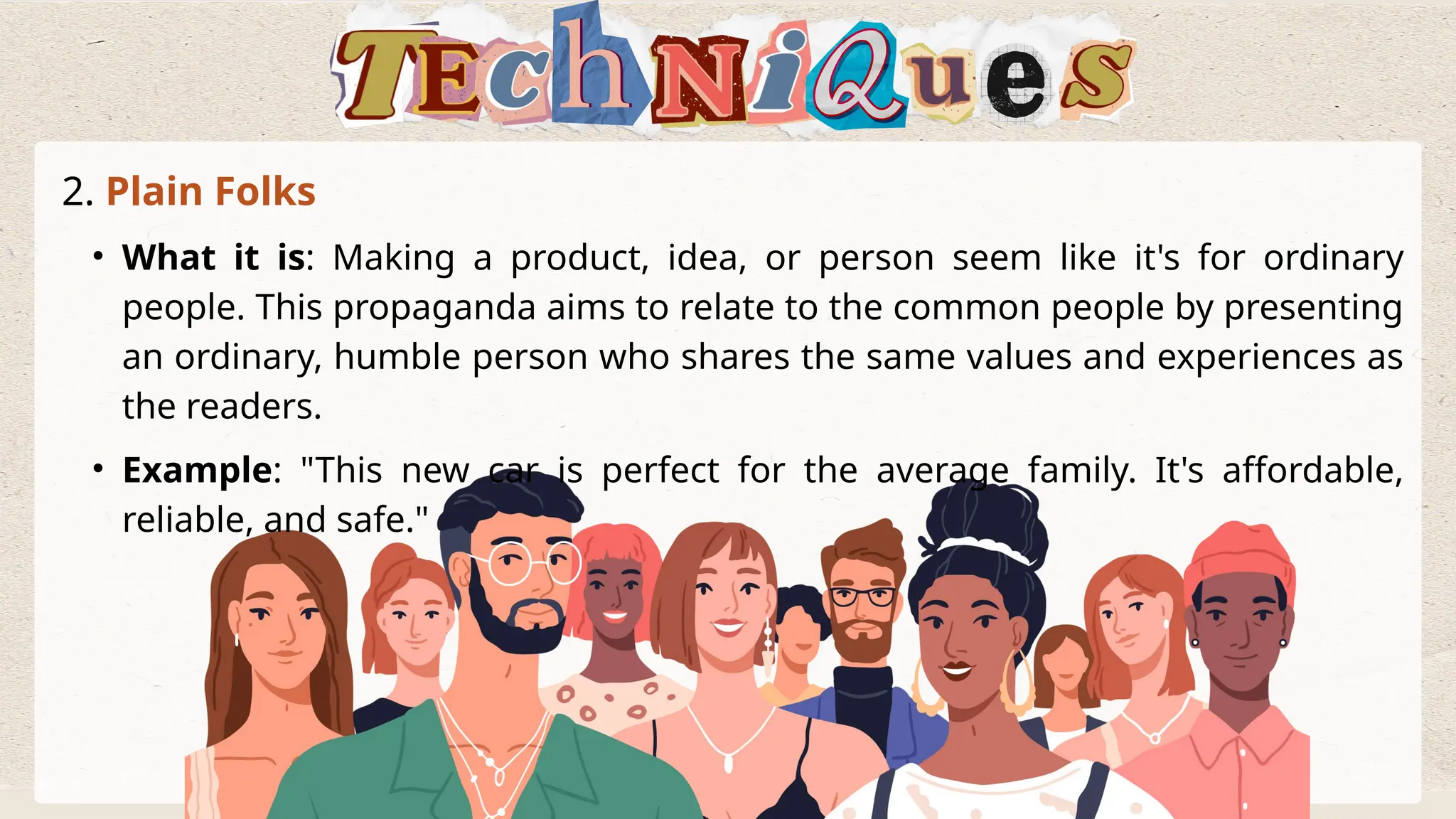
2. Plain Folks
• What it is: Making a product, idea, or person seem like it's for ordinary
people. This propaganda aims to relate to the common people by presenting
an ordinary, humble person who shares the same values and experiences as
the readers.
• Example: "This new car is perfect for the average family. It's affordable,
reliable, and safe."
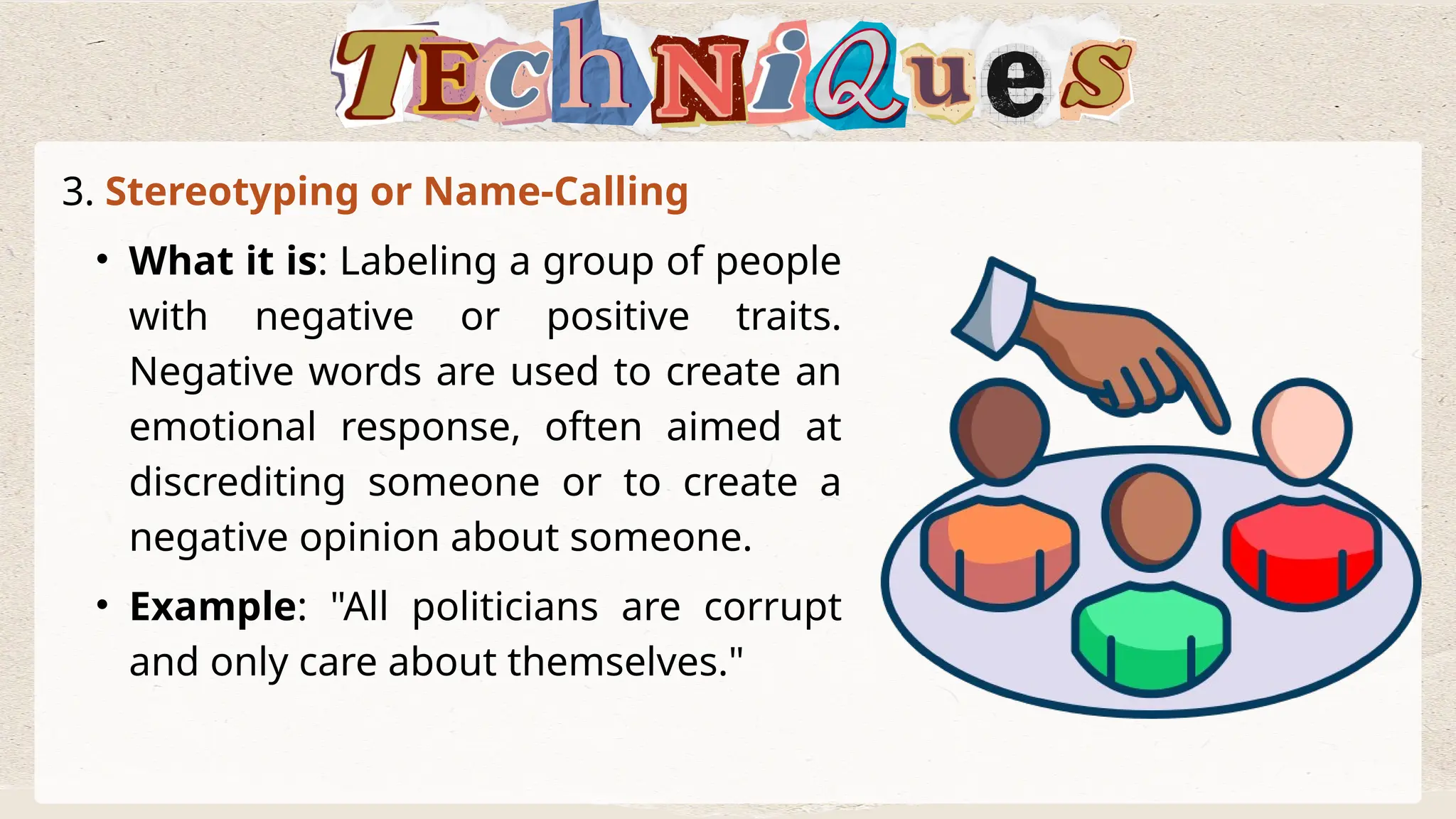
3. Stereotyping or Name-Calling
• What it is: Labeling a group of people
with negative or positive traits.
Negative words are used to create an
emotional response, often aimed at
discrediting someone or to create a
negative opinion about someone.
• Example: "All politicians are corrupt
and only care about themselves."
4. Fear Appeal
• What it is: Using fear to persuade
people to act a certain way. This
propaganda aims to give the readers
or audience an idea about the
possible frightening or horrible
circumstance and how it can be
avoided.
• Example: "If you don't buy this new
security system, your family could be
in danger!"
Examine the information in the graphics and the
information from the press releases. Identify the
type of propaganda and the propaganda
techniques used. Check YES if the information
uses the specific propaganda technique;
otherwise, check NO.
Surveying Propaganda Techniques
Press Release:
FALSE: Lumad is a word
made up by the CPP-NPA-
NDF
Type of Propaganda:
________________________________
________
Propaganda Techniques Yes No
1. Testimonial
Famous or authoritative persons are featured to make a
statement about the issue.
2. Plain folks
The information is associated with individuals to create an
image that values common people or the masses.
3. Stereotyping or name-calling
Negative words are used to create an emotional response,
often aimed at discrediting someone or to create a negative
opinion about someone.
4. Fear appeal
The information is created to influence someone by causing
fear or anxiety in the audience.
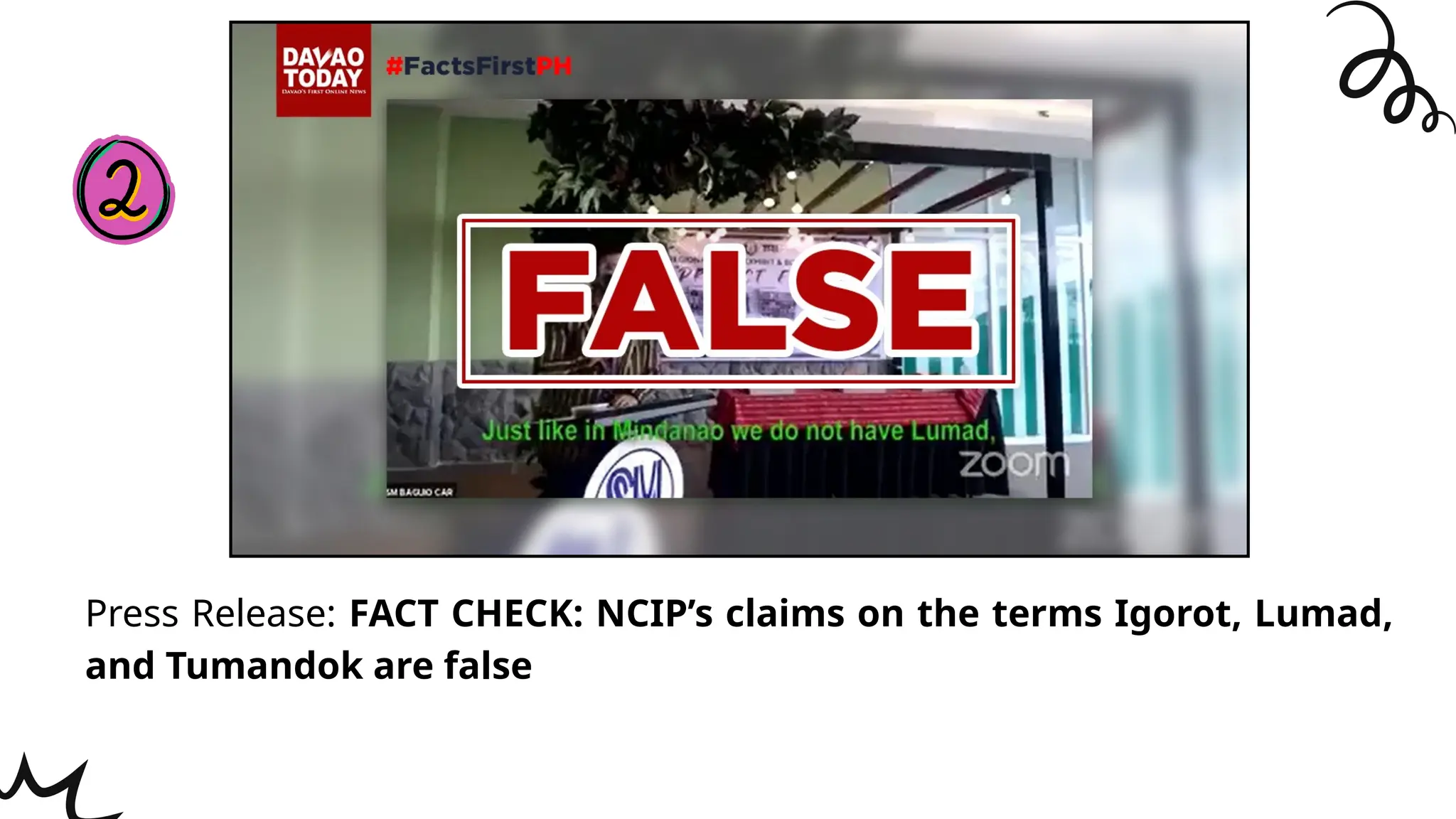
Press Release: FACT CHECK: NCIP’s claims on the terms Igorot, Lumad,
and Tumandok are false
CLAIM: A Facebook account named Manja Bayang shared a snippet of a
Zoom video on May 6, 2021, where the National Commission on
Indigenous People (NCIP) Commissioner Gaspar Cayat spoke in a Project
Epanaw activity in SM Baguio.
In the said video, Gayat, an appointee of outgoing President Rodrigo
Duterte, claimed the following:
1. The term Igorot in the Cordillera is a misnomer. Igorot to Spaniards
means savage, backward, and uncivilized people. It is not included in the
101 number of IPs in the country;
2. In Mindanao, we do not have Lumad. Lumad is a Visayan term that
refers to a native of a certain place. It is not included in the 101 number of
IPs in the country;
3. Tumandok refers to a collective group of people in Visayas. It is not
included in the 101 number of IPs in the country, and
4. Igorot, Lumads, and Tumandoks are the “very words” used by the
Communist Party of the Philippines (CPP)-New People’s Army (NPA)-
National Democratic Front (NDF).
In an apparent sarcasm, Bayang asked the people on FB to applaud the
NCIP and said, “I KENNAT” (I can’t accept/take), referring to Gayat’s claims,
especially on numbers 1 and 4. Bayang asked for someone to explain the
epistemology of NCIP’s claims.
Type of Propaganda:
_____________________________________________
Propaganda Techniques Yes No
1. Testimonial
Famous or authoritative persons are featured to make a
statement about the issue.
2. Plain folks
The information is associated with individuals to create an
image that values common people or the masses.
3. Stereotyping or name-calling
Negative words are used to create an emotional response,
often aimed at discrediting someone or to create a negative
opinion about someone.
4. Fear appeal
The information is created to influence someone by causing
fear or anxiety in the audience.
Examine the information in the two
images. Which image contains more
factual information? Write your
observations.
Pen Your Observation
Image Image
Image A
Image B
1. What makes the information in Image A more factual or
credible?
2. How are the facts presented in Image A?
3. Why is the information in Image B not reliable?
4. How does Image B affect you as a reader?
Guide Questions
Sort out the statement if it is Fact
or Opinion.
Fact or Opinion?
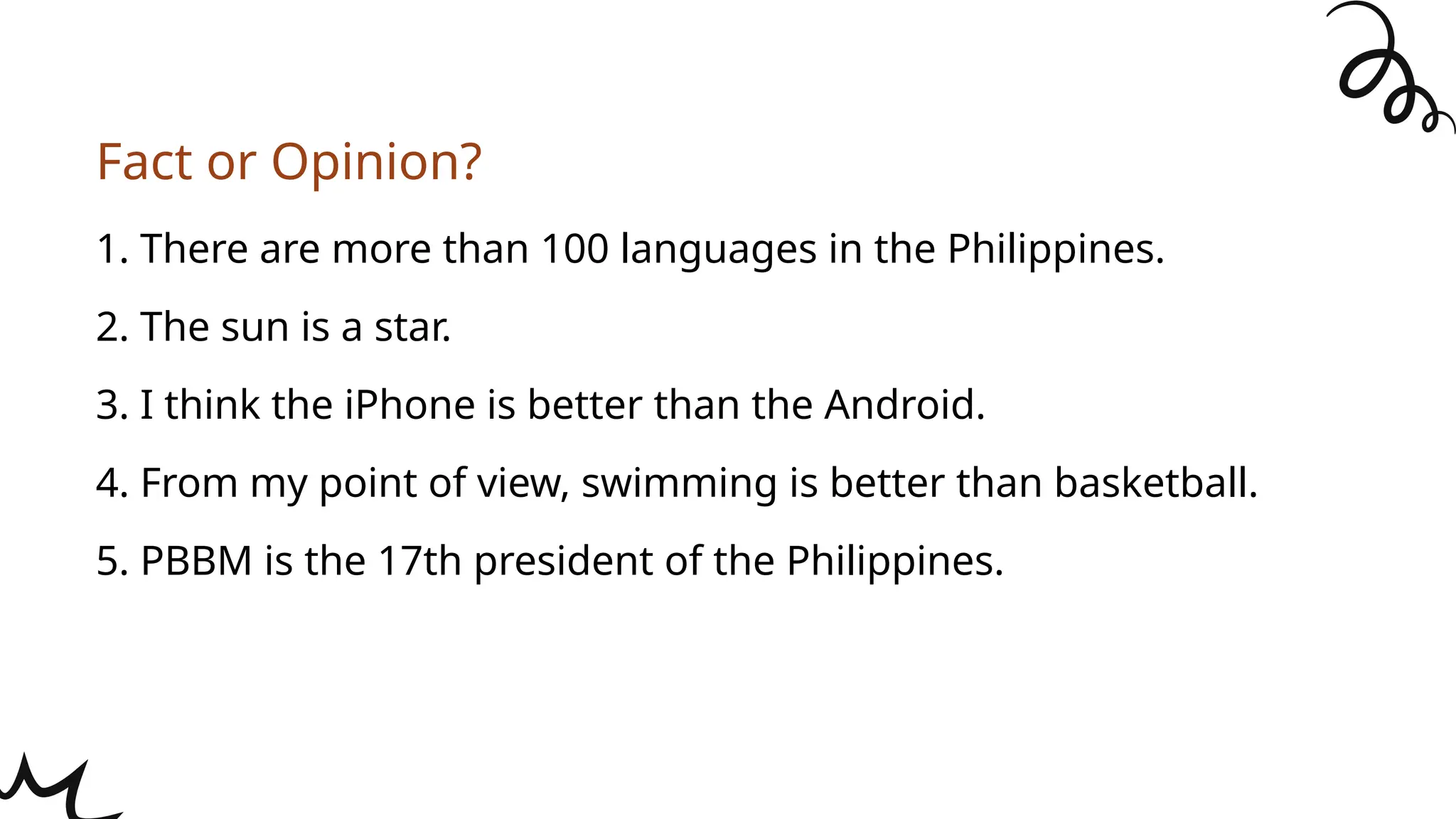
1. There are more than 100 languages in the Philippines.
2. The sun is a star.
3. I think the iPhone is better than the Android.
4. From my point of view, swimming is better than basketball.
5. PBBM is the 17th president of the Philippines.
Fact or Opinion?
6. I love reading books.
7. Aristotle said, “Happiness depends upon ourselves.”
8. Boxing is the most exciting sport in the Philippines.
9. Indonesia is part of Southeast Asia.
10. Banana is rich in potassium.
Fact or Opinion?
• A fact is a generally acceptable statement that can be proven true
based on objective evidence. In other words, the statement is verifiable
by truthful accounts (figures, dates, statistical reports, research
findings, etc.).
• A fact is an event that happens, is happening, or has happened.
• Facts are essential and crucial for understanding and evaluating
information from multimodal platforms and forming informed
opinions and decisions.
• Factual statements are supported with references and expressions
like ‘according to,’ ‘based on the study of,’ or ‘Einstein said.’
• An opinion, on the other hand, is a statement of feelings or
viewpoints about a subject that may not be based on evidence or may
not be verifiable by truthful accounts.
• An opinion may be believed to exist or have occurred, but the
evidence may not be objective and reliable.
• Most opinionated statements use signal phrases like, 'I think,' 'I
believe,' 'In my opinion,' 'In my viewpoint/point of view,' 'In my reason,'
or adjectives, such as 'good,' 'better,' 'the best' unless proven. These
words and phrases represent personal feelings, attitudes, or views.
The Davao Today press release lifted the
following texts. FACT CHECK: NCIP’s
claims regarding Igorot, Lumad, and
Tumandok are false.
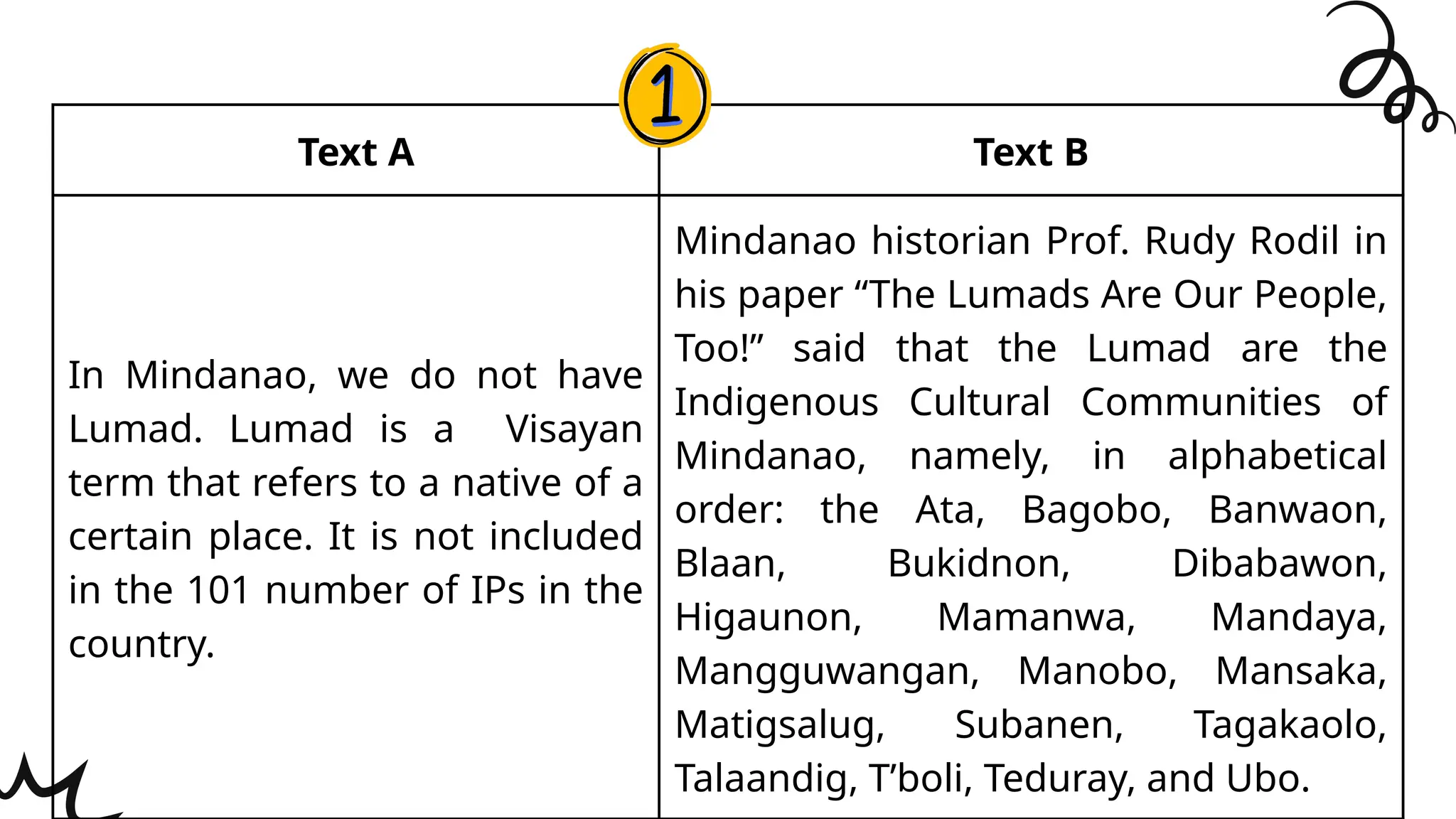
Examine the information from the two
texts in each item. Which text is factual
or opinionated? Write your observations
by answering the prompts that follow.
Let’s Fact-Check!
Text A Text B
In Mindanao, we do not have
Lumad. Lumad is a Visayan
term that refers to a native of a
certain place. It is not included
in the 101 number of IPs in the
country.
Mindanao historian Prof. Rudy Rodil in
his paper “The Lumads Are Our People,
Too!” said that the Lumad are the
Indigenous Cultural Communities of
Mindanao, namely, in alphabetical
order: the Ata, Bagobo, Banwaon,
Blaan, Bukidnon, Dibabawon,
Higaunon, Mamanwa, Mandaya,
Mangguwangan, Manobo, Mansaka,
Matigsalug, Subanen, Tagakaolo,
Talaandig, T’boli, Teduray, and Ubo.
The text that contains factual information is __________________ because
______________________________________________________________________________
______________________________________________________________________________
_____________________________________.
On the other hand, the text that contains opinionated information is
______________________ because
_________________________________________________________
______________________________________________________________________________
______________________________________________________________________________
_____________________________________.
Text A Text B
In a paper “Sugidanon (Epics) of Central
Panay” by anthropologist Dr. Alicia Magos,
the Tumandoks which literally means
“native born” or Pan-ayanon are the
mountain dwellers of Central Panay
(Capiz-Lambunao) who have resisted
various forms of foreign aggression by
moving to the interior and more remote
areas of Panay islands.
The term Tumandok refers
to a collective group of
people in Visayas. It is not
included in the 101 number
of IPs in the country.
The text that contains factual information is __________________ because
______________________________________________________________________________
______________________________________________________________________________
_____________________________________.
On the other hand, the text that contains opinionated information is
______________________ because
_________________________________________________________
______________________________________________________________________________
______________________________________________________________________________
_____________________________________.
Complete the prompts below to write
your strengths and weaknesses in
examining propaganda techniques and
factual and opinionated information in
texts.
How do I fair?
My strength/s My weakness/es
My strength/s in examining
propaganda techniques is/are
_________________________
My weakness/es in examining
propaganda techniques is/are
__________________________
My strength/s in examining
factual information is/are
________________________
My weakness/es in examining
factual information is/are
__________________________
My strength/s in examining
opinionated information is/are
_________________________
My weakness/es in examining
opinionated information is/are
__________________________
1. This refers to information disseminated to influence and convince one’s
feelings, beliefs, and actions.
2. Liza watches TV news programs to get updates on the Barangay and
Sangguniang Kabataan Elections 2023. What general type of propaganda is
shown in this situation?
3. When false information is posted on Facebook, it tends to mislead and
deceive readers. What general type of propaganda is exhibited in this
situation?
4. This propaganda technique uses negative words to create a negative
opinion about someone or something.
5. An authoritative person, like a politician, is featured to make a statement
about an issue.
A. Instructions: Identify what is described or asked in each item.
6. I think apple is sweeter than mango.
7. According to the Food and Nutrition Research Institute, green leafy
vegetables are rich in Vitamin A.
8. It is always good to start a day with coffee.
9. Cooking with wood or charcoal is more dangerous than using fuel gas.
10.Eggplant is botanically considered a fruit, not a vegetable.
Instructions: Write F if the statement contains a piece of factual
information; otherwise, write O if the statement contains a piece of
opinionated information.

ENG 7 Q3, WEEK 5.pptxRERJILHHUHUHUHUHUHU

  • 1.
    ENG 7 Q3,WEEK 2 Types and Techniques
  • 2.
    1. What isthe false information all about? 2. Who is involved in the false post? 3. How is the post made false?
  • 3.
    4. How isthe image used to show false information? 5. How does the false information or post affect you as a reader and the public? 6. How can we identify whether the news information we read online or in print is correct or false?
  • 4.
    Match the statementsin Column A with their corresponding terms in Column B. Recall and Match! 1. The sentence/paragraph is a much shorter version of the original writing. 2. Faulty data, such as misquote statements, must be avoided. 3. Words should be plain, straightforward, and understandable for public reading. 4. The rewritten sentence may be as long as the original sentence. 5. The original text is enclosed in quotation marks (“ ”). 6. Words and sentences are short and direct to the point. a. quote b. simplicity c. paraphrase d. brevity e. summary f. precision
  • 5.
    The following sentencesare taken from the Rappler press release FALSE: Photo proves Alcadev school teaches Lumad kids how to become NPA. Using a dictionary, look for the word whose meaning is closest to the underlined word in each sentence. Write the letter of the correct answer on your paper. Search Me Up!
  • 6.
    A reverse imagesearch shows that the graduation ceremony photo was taken from a 2017 theater performance entitled Ang Bangugot. A. forward B. opposite C. clear D. blurry
  • 7.
    Alcadev is aLumad school in Surigao del Sur that provides alternative education to indigenous students. A. substitute B. essential C. expensive D. compulsory
  • 8.
    Chad Booc hasbeen a volunteer mathematics teacher for Alcadev since 2016. A. forced B. compensated C. scholar D. non-paid
  • 9.
    As of writing,Booc and the other individuals are still detained and have been sued in Davao del Norte. A. acquitted B. freed C. summoned D. killed
  • 10.
    Pagaran denounced thisaccusation, saying it was a desperate attempt to red-tag her and further justify worse attacks in the future. A. promise B. allegation C. renumeration D. innocence
  • 11.
    With your partner,analyze the social media post below by answering the following prompts. Claim: A photo proves that the Alternative Learning Center for Agricultural and Livelihood Development (Alcadev) teaches Lumad children how to become members of the New People’s Army (NPA). Alcadev teacher Chad Booc supposedly admitted to it as well. Pair and Share!
  • 12.
    List down 3signs that make the information false. List down 2 reasons why the false information is posted on social media. Write 1 possible impact of the false information: To you as a reader To the public
  • 13.
    • Propaganda refersto any information disseminated to persuade and influence one’s feelings, beliefs, and actions. • According to Calub and Calub (2022), propaganda exists because of spreading rumors or information, either false or correct, to influence public opinion.
  • 14.
    Two general typesof propaganda • White propaganda refers to disseminating information from a credible and unbiased source; hence, the message is accurate. • Black propaganda involves spreading false or misleading information to deceive or manipulate the audience into spreading lies or fabricated information.
  • 15.
    Examine the informationin the graphic below and the information from the Rappler press release FALSE: Photo proves Alcadev school teaches Lumad kids how to become NPA by identifying the propaganda techniques used. Check YES if the information uses the propaganda technique; otherwise, check NO. Then, answer the prompts that follow. Think and Decide
  • 16.
    Propaganda Techniques YesNo 1. Testimonial Famous or authoritative persons are featured to make a statement about the issue. 2. Plain folks The information is associated with individuals to create an image that values common people or the masses. 3. Stereotyping or name-calling Negative words are used to create an emotional response, often aimed at discrediting someone or to create a negative opinion about someone. 4. Fear appeal The information is created to influence someone by causing fear or anxiety in the audience.
  • 17.
    The prevalent propagandatechnique/s used is/are ______________________________________________________________________________ ______________________________________________________________________________ _____________________________________. The ______________________________________ is/are used because ________________________ ______________________________________________________________________________ __________________ ______________________________________________________________________________ __________________. For me, the intention of the author for using the propaganda technique/s
  • 18.
    Propaganda is away to persuade people to think or do something, often using emotional appeals rather than facts. 1. Testimonial • What it is: Using a famous person or expert to endorse a product or idea. Using personalities to attest to the issue or promote a product or service increases the credibility and popularity of the issue or product, which invites readers or audiences to believe and be influenced • Example: "K-Pop superstar, Jisoo, swears by this new skincare line, saying it's the secret to her
  • 19.
    2. Plain Folks •What it is: Making a product, idea, or person seem like it's for ordinary people. This propaganda aims to relate to the common people by presenting an ordinary, humble person who shares the same values and experiences as the readers. • Example: "This new car is perfect for the average family. It's affordable, reliable, and safe."
  • 20.
    3. Stereotyping orName-Calling • What it is: Labeling a group of people with negative or positive traits. Negative words are used to create an emotional response, often aimed at discrediting someone or to create a negative opinion about someone. • Example: "All politicians are corrupt and only care about themselves."
  • 21.
    4. Fear Appeal •What it is: Using fear to persuade people to act a certain way. This propaganda aims to give the readers or audience an idea about the possible frightening or horrible circumstance and how it can be avoided. • Example: "If you don't buy this new security system, your family could be in danger!"
  • 23.
    Examine the informationin the graphics and the information from the press releases. Identify the type of propaganda and the propaganda techniques used. Check YES if the information uses the specific propaganda technique; otherwise, check NO. Surveying Propaganda Techniques
  • 24.
    Press Release: FALSE: Lumadis a word made up by the CPP-NPA- NDF Type of Propaganda: ________________________________ ________
  • 25.
    Propaganda Techniques YesNo 1. Testimonial Famous or authoritative persons are featured to make a statement about the issue. 2. Plain folks The information is associated with individuals to create an image that values common people or the masses. 3. Stereotyping or name-calling Negative words are used to create an emotional response, often aimed at discrediting someone or to create a negative opinion about someone. 4. Fear appeal The information is created to influence someone by causing fear or anxiety in the audience.
  • 26.
    Press Release: FACTCHECK: NCIP’s claims on the terms Igorot, Lumad, and Tumandok are false
  • 27.
    CLAIM: A Facebookaccount named Manja Bayang shared a snippet of a Zoom video on May 6, 2021, where the National Commission on Indigenous People (NCIP) Commissioner Gaspar Cayat spoke in a Project Epanaw activity in SM Baguio. In the said video, Gayat, an appointee of outgoing President Rodrigo Duterte, claimed the following: 1. The term Igorot in the Cordillera is a misnomer. Igorot to Spaniards means savage, backward, and uncivilized people. It is not included in the 101 number of IPs in the country;
  • 28.
    2. In Mindanao,we do not have Lumad. Lumad is a Visayan term that refers to a native of a certain place. It is not included in the 101 number of IPs in the country; 3. Tumandok refers to a collective group of people in Visayas. It is not included in the 101 number of IPs in the country, and 4. Igorot, Lumads, and Tumandoks are the “very words” used by the Communist Party of the Philippines (CPP)-New People’s Army (NPA)- National Democratic Front (NDF). In an apparent sarcasm, Bayang asked the people on FB to applaud the NCIP and said, “I KENNAT” (I can’t accept/take), referring to Gayat’s claims, especially on numbers 1 and 4. Bayang asked for someone to explain the epistemology of NCIP’s claims.
  • 29.
  • 30.
    Propaganda Techniques YesNo 1. Testimonial Famous or authoritative persons are featured to make a statement about the issue. 2. Plain folks The information is associated with individuals to create an image that values common people or the masses. 3. Stereotyping or name-calling Negative words are used to create an emotional response, often aimed at discrediting someone or to create a negative opinion about someone. 4. Fear appeal The information is created to influence someone by causing fear or anxiety in the audience.
  • 31.
    Examine the informationin the two images. Which image contains more factual information? Write your observations. Pen Your Observation
  • 32.
  • 33.
  • 34.
    1. What makesthe information in Image A more factual or credible? 2. How are the facts presented in Image A? 3. Why is the information in Image B not reliable? 4. How does Image B affect you as a reader? Guide Questions
  • 35.
    Sort out thestatement if it is Fact or Opinion. Fact or Opinion?
  • 36.
    1. There aremore than 100 languages in the Philippines. 2. The sun is a star. 3. I think the iPhone is better than the Android. 4. From my point of view, swimming is better than basketball. 5. PBBM is the 17th president of the Philippines. Fact or Opinion?
  • 37.
    6. I lovereading books. 7. Aristotle said, “Happiness depends upon ourselves.” 8. Boxing is the most exciting sport in the Philippines. 9. Indonesia is part of Southeast Asia. 10. Banana is rich in potassium. Fact or Opinion?
  • 38.
    • A factis a generally acceptable statement that can be proven true based on objective evidence. In other words, the statement is verifiable by truthful accounts (figures, dates, statistical reports, research findings, etc.). • A fact is an event that happens, is happening, or has happened. • Facts are essential and crucial for understanding and evaluating information from multimodal platforms and forming informed opinions and decisions. • Factual statements are supported with references and expressions like ‘according to,’ ‘based on the study of,’ or ‘Einstein said.’
  • 39.
    • An opinion,on the other hand, is a statement of feelings or viewpoints about a subject that may not be based on evidence or may not be verifiable by truthful accounts. • An opinion may be believed to exist or have occurred, but the evidence may not be objective and reliable. • Most opinionated statements use signal phrases like, 'I think,' 'I believe,' 'In my opinion,' 'In my viewpoint/point of view,' 'In my reason,' or adjectives, such as 'good,' 'better,' 'the best' unless proven. These words and phrases represent personal feelings, attitudes, or views.
  • 40.
    The Davao Todaypress release lifted the following texts. FACT CHECK: NCIP’s claims regarding Igorot, Lumad, and Tumandok are false. Examine the information from the two texts in each item. Which text is factual or opinionated? Write your observations by answering the prompts that follow. Let’s Fact-Check!
  • 41.
    Text A TextB In Mindanao, we do not have Lumad. Lumad is a Visayan term that refers to a native of a certain place. It is not included in the 101 number of IPs in the country. Mindanao historian Prof. Rudy Rodil in his paper “The Lumads Are Our People, Too!” said that the Lumad are the Indigenous Cultural Communities of Mindanao, namely, in alphabetical order: the Ata, Bagobo, Banwaon, Blaan, Bukidnon, Dibabawon, Higaunon, Mamanwa, Mandaya, Mangguwangan, Manobo, Mansaka, Matigsalug, Subanen, Tagakaolo, Talaandig, T’boli, Teduray, and Ubo.
  • 42.
    The text thatcontains factual information is __________________ because ______________________________________________________________________________ ______________________________________________________________________________ _____________________________________. On the other hand, the text that contains opinionated information is ______________________ because _________________________________________________________ ______________________________________________________________________________ ______________________________________________________________________________ _____________________________________.
  • 43.
    Text A TextB In a paper “Sugidanon (Epics) of Central Panay” by anthropologist Dr. Alicia Magos, the Tumandoks which literally means “native born” or Pan-ayanon are the mountain dwellers of Central Panay (Capiz-Lambunao) who have resisted various forms of foreign aggression by moving to the interior and more remote areas of Panay islands. The term Tumandok refers to a collective group of people in Visayas. It is not included in the 101 number of IPs in the country.
  • 44.
    The text thatcontains factual information is __________________ because ______________________________________________________________________________ ______________________________________________________________________________ _____________________________________. On the other hand, the text that contains opinionated information is ______________________ because _________________________________________________________ ______________________________________________________________________________ ______________________________________________________________________________ _____________________________________.
  • 45.
    Complete the promptsbelow to write your strengths and weaknesses in examining propaganda techniques and factual and opinionated information in texts. How do I fair?
  • 46.
    My strength/s Myweakness/es My strength/s in examining propaganda techniques is/are _________________________ My weakness/es in examining propaganda techniques is/are __________________________ My strength/s in examining factual information is/are ________________________ My weakness/es in examining factual information is/are __________________________ My strength/s in examining opinionated information is/are _________________________ My weakness/es in examining opinionated information is/are __________________________
  • 48.
    1. This refersto information disseminated to influence and convince one’s feelings, beliefs, and actions. 2. Liza watches TV news programs to get updates on the Barangay and Sangguniang Kabataan Elections 2023. What general type of propaganda is shown in this situation? 3. When false information is posted on Facebook, it tends to mislead and deceive readers. What general type of propaganda is exhibited in this situation? 4. This propaganda technique uses negative words to create a negative opinion about someone or something. 5. An authoritative person, like a politician, is featured to make a statement about an issue. A. Instructions: Identify what is described or asked in each item.
  • 49.
    6. I thinkapple is sweeter than mango. 7. According to the Food and Nutrition Research Institute, green leafy vegetables are rich in Vitamin A. 8. It is always good to start a day with coffee. 9. Cooking with wood or charcoal is more dangerous than using fuel gas. 10.Eggplant is botanically considered a fruit, not a vegetable. Instructions: Write F if the statement contains a piece of factual information; otherwise, write O if the statement contains a piece of opinionated information.