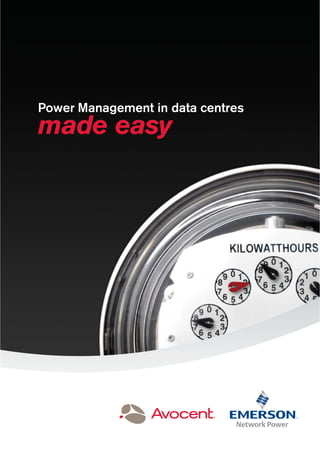
Power Management in data centres
made easy
1
A SIMPLE GUIDE TO POWER MANAGEMENT IN THE DATA CENTRE
Content
3 Introduction
3 – About this booklet
5 Chapter 1 – The principles of effective power management
5 – Why is power management so important?
5 – Turn darkness into light!
8 – Understanding your energy consumption – the benefits at a glance
8 – Uncovering efficiency
10 Chapter 2 – Intelligent power management –
increased efficiency, fewer downtimes
10 – What are the characteristics of good power management?
10 – Uninterrupted power supply – play it safe
11 – Getting the most out of your power distribution units
12 – Physical features – vertical versus horizontal
12 – Measuring function – identifying high power users
13 – Switching function – reducing downtimes
13 – Defining limit values – when PDUs trigger alarms
14 – Intelligent power distribution units – the benefits at a glance
14 – Allowing power to flow correctly – three-phase power at rack level
15 – Three-phase power – the benefits at a glance
15 – Intelligent cable routing – getting power flows right
16 Chapter 3 – Increasing efficiency with
the right kind of management
16 – An overview of the entire data centre
17 – Simple management
17 – Management at any time and from any location
18 – Remote power management
2
19 Chapter 4 – Ten good reasons to ensure
efficient power management
19 – Reducing downtimes
19 – Avoiding wasted investments
20 – Keeping energy bills low
21 – Minimising budget overspends
21 – Charging costs following the consumer pays principle
21 – Continuously improving efficiency
22 – Solving problems before they arise
22 – Making savings with the right kind of power supply
22 – Remote troubleshooting
23 – The right cable routing to reduce energy consumption
24 Conclusion
3
Introduction
Congratulations on picking up “Power Management in data centres made easy”. Here
we will explain to you how you can operate your data centre more efficiently and save
money with intelligent power management. A study conducted by the EPA (Environ-
mental Protection Agency) shows that the power costs of a data centre consume up
to 30 percent of a company’s IT budget. Surely you want to avoid this? Rather, you will
want to improve the economic viability of your data centre and avoid server crashes.
This booklet explains how you can analyse the power consumption of data centres,
ensure an optimum spread of energy load and retain reliability in the long term with the
right form of management.
About this booklet
This booklet is a simple guide to efficient power management in data centres. It is split
into four chapters:
Chapter 1 explains the principles of sustainable power management. Here you can
learn whether your data centre is efficient or not and what measures you can take to
cut costs.
Chapter 2 focuses on power. What makes power management good and what are the
benefits of good management? What should intelligent power distribution units be able
to do and why can you save money by using a three-phase power supply? This chapter
will answer all these questions.
Chapter 3 shows how you can easily manage local and remote data centres. You will
also learn how you can manage the power of a data centre 300 kilometres away from
the comfort of your own desk.
Chapter 4 summarises the ten main reasons to achieve efficient power management
in your data centre.
This bulb symbol draws your attention to benefits
4
5
Chapter 1 – The principles of effective power management
In this chapter you will learn
• that solving energy problems first means you need to understand the facts
• how you can tell if a data centre is efficient or not
Why is power management so important?
Most data centres consume too much energy. This increasingly causes problems when
data centres are extended, as sufficient extra energy isn’t available. High operating
costs coupled with energy prices which are set to increase in the long term can also
see IT costs shoot up. This is one area offering huge potential savings. Scope for opti-
misation comes from reducing IT use and the volume of IT equipment as it is one of the
largest power users.
Simply unplugging equipment however is not the solution because the requirements
regarding availability and power processing have risen enormously over the past few
years. Other promising strategies are on hand, including for example identifying those
areas where power and cost savings can be made. Alternatively you could optimise
existing infrastructures, through virtualisation or the use of workflow analyses so that
certain processes are run at cheaper off-peak times. But which strategy is most appro-
priate for your data centre? You can only answer this question when you have the infor-
mation you need to serve as a basis for your decisions.
Turn darkness into light!
The lack of accurate information about energy consumption in data centres is astoun-
dingly high: a fact proven in a survey carried out by Research Concepts1
amongst staff
responsible for IT found that around one third had no idea of the power costs of their
data centre. If you are going to optimise power consumption, it’s essential that you
are first aware of your precise energy requirements, right down to the smallest item of
1
Survey conducted on behalf of Avocent, a division of Emerson Network Power.
6
equipment. This can be done using power manager software tools2
. This works with
power distribution units and can be used to establish power consumption, capacity
utilisation and the energy costs of individual equipment, power distribution units, racks
and rows of racks and for the entire data centre. Once you’ve discovered what you
didn’t know, you can look forward to countless benefits.
The first step to reducing costs is to establish the power consumption of every single
device and the data centre as a whole. Once you know how much electricity you are
using, the data can be compared with the maximum amount of energy available. This
will help you in sustainable capacity planning. It will show you whether planned exten-
sions are actually needed or feasible. If additional equipment is connected to the wrong
place in the network, this may cause power circuits to overload, resulting in down-
times and loss of data. Protect yourself from wasted investments and server crashes
by knowing your data centre!
By using the right tools you can also learn when a rack, server or any other rack-level
equipment is operating at close to its capacity limit.To know this, you need simply define
a maximum power limit value for the equipment. Once power consumption approa-
ches this value, the software transmits an automatic alarm. This enables you to take
measures early on to prevent crashes and ensure the availability of IT resources. Such
measures might include moving certain server activities to cheaper off-peak times or
virtual servers. In principle, those applications which place only low utilisation demands
on the servers and thereby use power unnecessarily are suitable for virtualisation. It is
interesting to note at this point that an idle server can still consume up to 50 percent of
the power it needs when fully operating.
Given the ever-growing cost of energy, there is no harm in knowing how much power
the different parts of a company are using to raise cost-awareness amongst users. The
appropriate costs can then be billed to the right departments. Companies which do
not yet use what are known as chargebacks will presumably start doing so in the future
2
Avocent Power Manager®
is a software tool which collects real time metre data for use in reporting an automating power threshold
breach warnings.
7
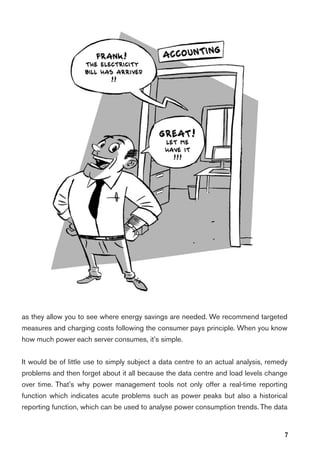
as they allow you to see where energy savings are needed. We recommend targeted
measures and charging costs following the consumer pays principle. When you know
how much power each server consumes, it’s simple.
It would be of little use to simply subject a data centre to an actual analysis, remedy
problems and then forget about it all because the data centre and load levels change
over time. That’s why power management tools not only offer a real-time reporting
function which indicates acute problems such as power peaks but also a historical
reporting function, which can be used to analyse power consumption trends. The data
8
collected can be used to identify equipment currently using disproportionate amounts
of power and also to generate statistics over longer periods. This can form the basis for
continually improving energy efficiency. The real-time and historical reporting functions
will assist you in remedying problems in the long term and making the right strategic
decisions for data centre resources.
Understanding your energy consumption – the benefits at a glance
H Avoid wasted investments and server crashes – with accurate capacity planning
H Take countermeasures before problems arise – with an automatic alarm
H Make the actual consumers pay – by assigning power costs
H Hunt out and remove high power users – with the real-time reporting function
H Improve energy efficiency on an ongoing basis – with the historical reporting function
Uncovering efficiency
Now you know what is going on in your data centre. You are aware of the power
consumption of individual IT equipment and the data centre as a whole. But how you
can tell if a data centre is efficient or not? The equation below will give you what is
known as a PUE (Power Usage Effectiveness) value, which you can use to estimate
how sustainable your data centre actually is.
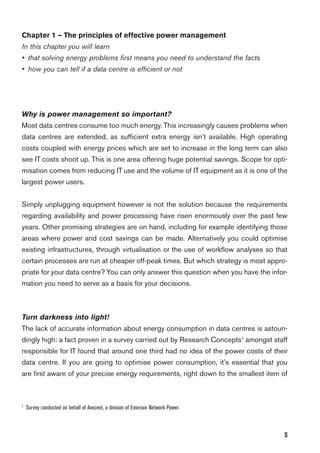
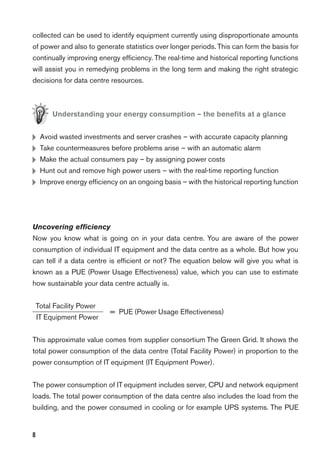
Total Facility Power
IT Equipment Power
= PUE (Power Usage Effectiveness)
This approximate value comes from supplier consortium The Green Grid. It shows the
total power consumption of the data centre (Total Facility Power) in proportion to the
power consumption of IT equipment (IT Equipment Power).
The power consumption of IT equipment includes server, CPU and network equipment
loads. The total power consumption of the data centre also includes the load from the
building, and the power consumed in cooling or for example UPS systems. The PUE
9
value is currently the main parameter used internationally to establish and compare the
energy efficiency of data centres.
A PUE value of 2 is usual for standard data centres. It means that two kilowatts of
power has to be supplied to the data centre for every kilowatt of power that the servers
need. The second kilowatt is used by the data centre infrastructure, predominantly by
the energy supply and air conditioning.
A PUE value of 3 would mean that only a third of the energy in the data centre is actually
being used directly by IT systems. If the value is greater than 2, there is an urgent need
for measures to save energy. The theoretical optimum is 1.4.
Please note however that optimisation measures such as virtualisation, which are
restricted to IT systems, do not impact positively on the PUE value but may in fact
increase it even if you are of course saving energy and money! The only way to reduce
the PUE value is to reduce the amount of power used in your data centre.
To make savings in all areas your goal should therefore be to achieve the lowest
possible PUE value. This will help the environment and your budget.
10
Chapter 2 – Intelligent power management –
increased efficiency, fewer downtimes
In this chapter you will learn
• the elements of efficient power management
• why you should dedicate more attention to power management
What are the characteristics of good power management?
Poor power management can prove to be very expensive. If a rack is using more power
than intended, it jeopardises the availability of all connected equipment and therefore
all the applications this equipment supports. Remember that system failure and the
associated downtime is often more costly that your normal electricity bill. What better
reason do you need to start paying attention to power consumption? It takes just a few
steps to improve your power management. These steps include correct use of uninter-
rupted power supplies, intelligent power distribution units, selecting the right power
supply and cabling that people can’t trip over.
Uninterrupted power supply – play it safe
The power supply is the Achilles’ heel of all IT equipment. Servers and other equipment
which need to be available whenever running should be fitted with an uninterrupted
power supply (UPS) to stave off a power cut or brief periods of insufficient or excess
power levels.
UPS systems are now commonplace in data centres but can be incorrectly used.
People are often not aware that different UPSs offer different levels of protection and
that various IT devices do not have the same protective needs. There are three esta-
blished types of UPSs: the standby or offline UPS, the line interactive UPS and the
double conversion or online UPS. If you want to minimise the costs of downtimes and
damage to equipment, it’s important that you use the different types correctly.
Standby UPSs offer restricted scope for use and only protect against mains power
failure and brief voltage fluctuations. They are primarily suited to non-critical desktop
11
applications. Line interactive UPSs are better suited to all other desktop, small network
and point-of-sale applications. They protect against mains power failure and peaks in
voltage and can constantly compensate for voltage fluctuations.
Double conversion UPSs should however be used with critical equipment and appli-
cations such as servers. These UPS systems first convert the AC voltage supplied into
DC voltage in order to use this to produce perfectly conditioned AC voltage, which has
multiple benefits.
One such benefit is a more constant voltage supply. Converting voltage within the UPS
isolates the integrated equipment from the source of power, which prevents voltage
problems from passing through the UPS to the equipment and restricting function
or causing damage. Many of the problems caused by voltage issues can thereby be
resolved without use of battery power. This in turn makes longer runtimes possible
during downtimes and extends the battery’s life.
Getting the most out of your power distribution units
The power distribution strategy is very important in terms of the efficiency of data
centres and the availability of IT equipment. Traditional methods of power distribution
with just one phase can be easily exhausted in the distribution of power to racks as
power density continues to rise. The following sections will explain the functions which
intelligent power distribution units (PDUs) should offer.
Basically they should provide you with all the tools you need to monitor, measure,
reduce and manage rising power costs and minimise downtimes. Power distribution
units3
can be used as standalone units or integrated into the power management soft-
ware. Integration also allows process-related trends over time to be tracked to measure
and monitor the power consumption, power capacity and power costs of IT equipment.
3
Avocent PM2000 and PM3000 units support outlet-level metering and switching capability to provide data center professionals the
tools they need to monitor, measure, reduce and manage their growing power consumption costs of IT equipment.
12
Physical features – vertical versus horizontal
Power distribution units fitted in racks are available in either a vertical or horizontal form.
The horizontal power distribution units normally have a maximum of ten sockets. If you
need more sockets, the vertical version is right for you. If using vertical configurations
however, you should ensure that there is enough space on the rack rails for the power
distribution units so as not to hamper the installation or movement of other IT equip-
ment.
Measuring function – identifying high power users
In order to individually determine the actual power consumption of IT equipment, at
phase level and at PDU level, these power distribution units must have a measurement
function. The right size for upstream electrical infrastructure can be determined using
the data relating to power consumption. This is extremely useful when installing new
13
racks for example. The electrical infrastructure is optimised and the efficiency of the
entire power supply chain enhanced, which in turn cuts power costs.
Of course power distribution units with a measurement function also identify IT equip-
ment consuming above-average levels of power, enabling you to reduce energy
consumption.
Switching function – reducing downtimes
In orderto ensure maximum possible availability of all equipment critical to the company’s
function, the power distribution units used should have both a measuring function and
a switching function. Switching functions allow you to switch equipment on and off or
restart it remotely. They are incredibly important for reducing the downtimes of servers
or networks which are no longer responding.
Using remote control, you can intervene straight away, saving you from having to travel
to the data centre in person. In other words, remote control eliminates staff travel and
the travel costs saved can be invested in something more useful. Another benefit of
power distribution units with switching capability is that they allow sockets to be swit-
ched on in a staggered manner such that the power limit values for the power supply
are not exceeded when the equipment in the rack is switched on. This is a huge benefit
to applications running on several servers, which are interdependent and therefore
have to be started or powered down in a particular order.
Defining limit values – when PDUs trigger alarms
A human being cannot keep track of everything that is happening all the time. So in
data centres, this becomes the job of power distribution units with their exact real-time
monitoring of all connected equipment.
All you need to do is define a threshold value for power and ambient parameters. Then
the power distribution unit will do the rest by issuing a message, should imminent over-
load problems arise. This allows problems to be detected in good time, and downtimes
resulting from overloaded power supplies to be minimised.
14
Intelligent power distribution units – the benefits at a glance
H Identify high power users in the data centre – using the measurement function.
H Reduce downtimes and save money – with the switching function.
H Solve problems before they cause damage – with the alarm function.
Allowing power to flow correctly – three-phase power at rack level
A redundant power supply is now a standard feature of most IT equipment. In order to
make best use of the equipment’s integrated redundancy, every single rack should be
connected to at least two, totally separate, power supplies. Ideally these two power
supplies should also be fed from different sources and they should be able to handle
the entire anticipated load capacity. As soon as you can estimate the loads you expect
per rack, you can take the next step towards efficient power management, and select
the right power supply for each rack by choosing from a single- or three-phase power
supply.
Racks with a low load can be easily powered with a single-phase current. But it is a
good idea to separate the phases at the output of the installed floor-mounted distribu-
tors and to supply the individual phases to different racks to ensure an even load.
However, if the load densities per rack exceed 5 kilowatts, you should use a three-
phase power supply.This offers several benefits, including lower cabling costs because
loads exceeding 5 kilowatts are supported by one single three-phase power supply
rather than several single-phase supplies. The fewer the power supplies that have to be
routed to the individual racks, the lower the cabling costs.
Another benefit is that the electrical infrastructure is more reliable. Using three-phase
current and power distributor units installed on the rack with a measurement function
will allow for an even distribution of load on all three phases. These balanced loads will
minimise harmonics and overheating on the neutral conductor, and therefore reduce
problems in the mains power supply and within the IT equipment. A further benefit of
three-phase current is that it improves the reliability of the IT infrastructure, since fewer
15
power supplies will improve the circulation of air, which in turn prevents equipment from
overheating. The greater capacity of the three-phase power supply also means that
downtimes are less likely thanks to additional power reserves, and it offers more scope
for future extensions, allowing additional equipment to be installed without the power
supply of the current equipment being impaired in any way.
Three-phase power – the benefits at a glance
H Keep your cabling costs down.
H Improve the reliability of the electronic infrastructure.
H Improve the reliability of the IT equipment.
H Extend your data centre without impairing the current power supply.
Intelligent cable routing – getting power flows right
Cables which are not routed intelligently not only give an impression of disorder but
can actually impact negatively on the energy balance. So tidy cable routing is a must.
We would recommend installing distributor elements for network cables, known as
patch fields, in the cabinet systems. These split the individual connections and lend the
cabling a structure. Power and data cables should also be kept separate so that when
used with copper wiring they don’t interfere with one another as the networks speed
up over time.
Routing cables under the ceiling of the data centre is a great solution. Provided that
the structural circumstances permit it, this is a better solution than false floors because
these are used for air conditioning and a multitude of cables will impair the flow of
cooling air required. This will automatically result in additional energy costs for recircu-
lating air to provide the necessary amount of cold air. You may also prefer to use wider
cabinets for cable routing within the rack for the very same reason. If space is tight, the
many cables behind the servers may act like a cable wall for the warm air that needs
to be dissipated. The IT equipment’s fans then have to work against a resistance and
consume considerably more energy. This in turn impacts negatively on the cooling and
power consumption of the IT equipment.
16
Chapter 3 – Increasing efficiency with the right kind of management
In this chapter you will learn
• how to make light work of complex management
• how to solve problems remotely
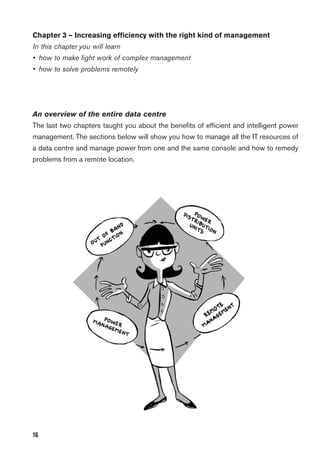
An overview of the entire data centre
The last two chapters taught you about the benefits of efficient and intelligent power
management. The sections below will show you how to manage all the IT resources of
a data centre and manage power from one and the same console and how to remedy
problems from a remote location.
17
Simple management
Integrated infrastructure control requires management software4
. This can present the
numerous heterogeneous systems and equipment together in an attractive format for
remote access via KVM-over-IP, console servers or service processors. In other words,
a wide range of IT equipment in the data centre such as network devices, physical
servers (with or without integrated service processors), blade servers or virtual servers
can be reliably and centrally managed from one console. Each user can use views that
they define themselves on the browser-based user interface.
Such tools also provide automatic alarms and scope for producing reports or graphics.
Audits into access, events or communication can also be produced. The tools also
simplify and speed up the preparation of new management appliances by providing
software configuration templates, preconfigured with known parameters. These func-
tions make data centre management straightforward and easy to understand.
Management at any time and from any location
Appropriate management software should also allow you to access all network equip-
ment at any time from anywhere in the world. Diagnosis and modifications should be
possible, regardless of the status of the operating system or network in which the
equipment is integrated.
If the software provides out-of-band functions, problems can be diagnosed and solved
even if servers are no longer able to communicate across the network or gateways,
routers and other equipment needed for IP connectivity are no longer available. Remote
management is one of the elementary functions of management software and is a huge
aid to troubleshooting because staff no longer have to be present in person. This is
turn impacts positively on both the operational continuity of your IT equipment and staff
productivity.
4
Avocents DSView®
3 management software consolidates data center management functionality into a single interface and delivers the
data center control necessary for the 24/7 data center.
18
Remote power management
Management software which allows virtually all equipment in local and remote data
centres to be accessed and controlled, therefore lies at the very heart of efficient
management. For example, these functions can be extended by the Power Manager
so that energy consumption, energy costs and the energy trends of IT equipment can
be monitored and measured using intelligent power distribution units at a multitude of
levels.
From a management standpoint, remote administration is an essential part of power
management. This is true for example for “lights-out” data centres, which are not
manned, as it reduces the risks of faults and improves safety. Many companies now
use such data centres for a whole host of reasons, be it for disaster recovery situations
or quite simply to save money, for example in a smaller data centre in a branch. If the IT
offers no scope for remote system management, including the ability to reset crashed
equipment and power it back up again, then lights-out data centres are simply not
feasible.
But if you have a management system which supports an out-of-band function and
power distribution units which allow for restarts or activation/deactivation from a remote
connection, the power can be conveniently managed from your desk. Detailed infor-
mation about power levels and the equipment’s surroundings arrives on your desk too.
This means that you can access all the data you need on power consumption, capacity
utilisation and energy costs from the comfort of your own office. All IT equipment in
local and remote data centres can then be controlled from one central console. And
you can avert the risk of server crashes from a distance!
19
Chapter 4 – Ten good reasons to ensure efficient power management
In this chapter you will learn
• why using intelligent power management is worth it
Reducing downtimes
Server downtimes in data centres need to be kept as short as possible to avoid idle
times and possible data losses as these may have serious financial consequences.
Intelligent power distribution units will help you to avoid this situation in many ways.
Firstly, measuring the power and energy consumption of the data centre will give you
valuable information about where new racks or servers can be added. If you have this
data, you won’t connect equipment in the wrong place and bring about downtimes
caused by power overloads.
Power distribution units which allow you to set threshold values offer additional protec-
tion by using an alarm function to draw your attention to imminent problems. You can
then respond in good time and guarantee uninterrupted availability. Another useful tool
in reducing downtimes is the switching function provided by power distribution units.
Through remote control, this allows you to restart equipment or to switch it on or off
remotely. Problems in lights-out or very remote data centres can then be quickly reme-
died before a failure causes more serious damage.
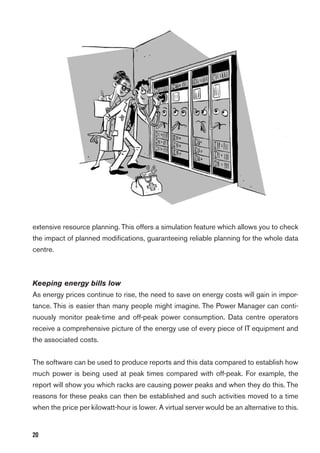
Avoiding wasted investments
You need to use your budget as efficiently as possible and avoid wasting any of it.
There are tools on the market which will help you avoid wasted investments in the data
centre. Intelligent power management software will show you how much power is being
used. You can then compare this data with the maximum amount of energy available,
be it for the whole data centre, one particular rack, a server or a group of servers.
This information makes effective capacity planning possible as you can see whether
planned extensions are really necessary or feasible. Other tools5
are available for more
5
Avocent’s Data Centre Planner®
3.0 gives you the power to actually see your IT. Capacity planning and visual modeling that delivers
insight, so you can simply plan and manage your data centre.
20
extensive resource planning. This offers a simulation feature which allows you to check
the impact of planned modifications, guaranteeing reliable planning for the whole data
centre.
Keeping energy bills low
As energy prices continue to rise, the need to save on energy costs will gain in impor-
tance. This is easier than many people might imagine. The Power Manager can conti-
nuously monitor peak-time and off-peak power consumption. Data centre operators
receive a comprehensive picture of the energy use of every piece of IT equipment and
the associated costs.
The software can be used to produce reports and this data compared to establish how
much power is being used at peak times compared with off-peak. For example, the
report will show you which racks are causing power peaks and when they do this. The
reasons for these peaks can then be established and such activities moved to a time
when the price per kilowatt-hour is lower. A virtual server would be an alternative to this.
21
Minimising budget overspends
Power distribution units which allow you to define threshold values and a maximum
power consumption limit will stem budget overspends. When the defined value is
reached or exceeded, a message is automatically issued and you can then respond
accordingly. Again you can move the activities in question to off-peak times, use virtual
servers or take other optimisation measures to save money.
Charging costs following the consumer pays principle
There is little sense in paying for something that you don’t use. There is just as little
sense in the marketing department paying the energy costs of the accounts department.
We would therefore highly recommend that the power consumption of a company’s
individual departments be evaluated, especially now that energy prices are on the rise.
For example, if all the servers for the accounts department are grouped in one rack,
the number of kilowatt-hours consumed can be used to work out the percentage of
the monthly bill for which accounts is responsible. The Power Manager and its ability to
accurately work out how much power each server uses allows the power costs incurred
to be easily charged using the consumer pays principle. In addition to correctly assig-
ning costs, you can also heighten staff awareness of energy costs and make them more
willing to use energy-efficient technology and working practices.
Continuously improving efficiency
If you can access all power consumption data in a data centre in real time, you can
easily minimise interruptions during operation, extend the operating hours and also
ensure optimum power management. The Power Manager provides you with live infor-
mation on IT power consumption at any time. A historical reporting function is useful for
a long-term and balanced overview of consumption. This will collate energy consump-
tion data over long periods and reproduce this as statistics.
Once the trends have been analysed and past and current power consumption
compared, any problems found can be remedied. This information can also be used
to make optimum decisions relating to data centre resources and you can continue to
improve your PUE value.
22
Solving problems before they arise
If you use intelligent power distribution units to set threshold values for power and
environmental parameters, not only can you prevent budget overspends, you can also
save money by solving problems before they cause any damage. The power distribu-
tion units issue a message and alarm to warn of imminent overload problems. This will
indicate problems at an early stage and you can respond appropriately to avoid costly
downtimes and idle times.
Making savings with the right kind of power supply
When selecting a power supply for a data centre, you can choose from single- and
three-phase current. Given the high loads encountered nowadays, most people opt
for three-phase current, which should be used for power densities of more than 5 kW.
This brings potential savings with it, including lower cabling costs through the use of
one single three-phase power supply rather than several single-phase ones. Increased
reliability of the electrical and IT infrastructure is another benefit of three-phase current
and you also stand to gain from less damage caused by overheating.
The greater capacity of the three-phase current also allows for more growth in the
future. More equipment can be connected without the power supply of existing equip-
ment having to be interrupted.
Remote troubleshooting
Crashed equipment or unresponsive servers may result in costly problems, but they
can be remedied remotely before damage sets in with the help of remote control and
power distribution units with a switching function. This allows you to respond quickly
and flexibly while simultaneously saving you money. There is also no need for staff to
travel to the centres, reducing the company’s travel budget accordingly.
Power distribution units with a switching function can also help you save money in
the face of rising power costs, since unused servers can be remotely switched off to
prevent energy being consumed for no reason.
23
The right cable routing to reduce energy consumption
The benefits you can enjoy from power management solutions can be further enhanced
by noting the following cable routing tips. If cables are intelligently routed in data
centres, energy efficiency can be further increased. Use patch fields to make your
cabling more structured. Ensure that power and data cables are kept separate so they
don’t interfere with one another and possibly cause failures.
If permitted by the structural circumstances, cables should be routed on the data
centre’s ceiling. By keeping cables out of false floors, you can avoid impairing the
supply of cool air through the floor and also prevent additional energy costs. If the
cables then converge in cabinets of a sufficient size without any “cable walls” where
dissipating heat can build up, you can be sure of intelligent cable routing.
24
Conclusion
As data centre managers are not usually responsible for paying the costs incurred,
there is often little motivation for change and very few of them use sustainable power
management. But pressure from management and also legislation is increasing. In the
UK, the Carbon Reduction Commitment (CRC) Energy Efficiency Scheme came into
effect in April 2010. This forces data centre operators to address the issue of energy
efficiency and calls them to account financially if their CO2 emissions are too high.
Acting towards immediate reduction in energy consumption today rather than putting
actions off until tomorrow is not only being forced by legislation, it is also driven by
the promise of major financial benefits and a pioneering corporate image. This booklet
shows that it’s hardly rocket science. There are many solutions to help reduce the
energy consumption of power-hungry data centres at little cost and effort.
25
About Emerson Network Power
Emerson Network Power, a business of Emerson (NYSE:EMR), is the global leader
in enabling Business-Critical Continuity™ from grid to chip for telecommunication
networks, data centers, health care and industrial facilities. Emerson Network Power
provides innovative solutions and expertise in areas including AC and DC power
and precision cooling systems, embedded computing and power, integrated racks
and enclosures, power switching and controls, infrastructure management, and
connectivity.
All solutions are supported globally by local Emerson Network Power service tech-
nicians. Aperture and Avocent solutions from Emerson Network Power simplify data
center infrastructure management by maximizing computing capacity and lowering
costs while enabling the data center to operate at peak performance. For more informa-
tion, visit www.Aperture.com, www.Avocent.com or www.EmersonNetworkPower.com.
About Emerson
Emerson (NYSE:EMR), based in St. Louis, Missouri (USA), is a global leader in
bringing technology and engineering together to provide innovative solutions for custo-
mers in industrial, commercial, and consumer markets through its network power,
process management, industrial automation, climate technologies, and appliance and
tools businesses. Sales in fiscal 2009 were $20.9 billion. For more information, visit
www.Emerson.com.
© Avocent Corporation. 2010
© Illustrations are the copyright of Frank Schmolke / Schmolke.Illustration
Solutions and tools you need to monitor energy
consumption, costs and trends across all levels
within the data centre and remote locations……..
made easy
‘A must read for anyone involved in
data centre management’
Avocent and the Avocent logo are registered trademarks of Avocent Corporation or its affiliates in the US or other countries.
All other marks are the property of their respective owners. ©2010 Avocent Corporation. Emerson Network Power and the Emerson
Network Power logo are trademarks and service marks of the Emerson Electric Co. ©2010 Emerson Electric Co. All rights reserved.

56022_Avocent_BookletA5_GB

  • 1.
    Power Management indata centres made easy
  • 3.
    1 A SIMPLE GUIDETO POWER MANAGEMENT IN THE DATA CENTRE Content 3 Introduction 3 – About this booklet 5 Chapter 1 – The principles of effective power management 5 – Why is power management so important? 5 – Turn darkness into light! 8 – Understanding your energy consumption – the benefits at a glance 8 – Uncovering efficiency 10 Chapter 2 – Intelligent power management – increased efficiency, fewer downtimes 10 – What are the characteristics of good power management? 10 – Uninterrupted power supply – play it safe 11 – Getting the most out of your power distribution units 12 – Physical features – vertical versus horizontal 12 – Measuring function – identifying high power users 13 – Switching function – reducing downtimes 13 – Defining limit values – when PDUs trigger alarms 14 – Intelligent power distribution units – the benefits at a glance 14 – Allowing power to flow correctly – three-phase power at rack level 15 – Three-phase power – the benefits at a glance 15 – Intelligent cable routing – getting power flows right 16 Chapter 3 – Increasing efficiency with the right kind of management 16 – An overview of the entire data centre 17 – Simple management 17 – Management at any time and from any location 18 – Remote power management
  • 4.
    2 19 Chapter 4– Ten good reasons to ensure efficient power management 19 – Reducing downtimes 19 – Avoiding wasted investments 20 – Keeping energy bills low 21 – Minimising budget overspends 21 – Charging costs following the consumer pays principle 21 – Continuously improving efficiency 22 – Solving problems before they arise 22 – Making savings with the right kind of power supply 22 – Remote troubleshooting 23 – The right cable routing to reduce energy consumption 24 Conclusion
  • 5.
    3 Introduction Congratulations on pickingup “Power Management in data centres made easy”. Here we will explain to you how you can operate your data centre more efficiently and save money with intelligent power management. A study conducted by the EPA (Environ- mental Protection Agency) shows that the power costs of a data centre consume up to 30 percent of a company’s IT budget. Surely you want to avoid this? Rather, you will want to improve the economic viability of your data centre and avoid server crashes. This booklet explains how you can analyse the power consumption of data centres, ensure an optimum spread of energy load and retain reliability in the long term with the right form of management. About this booklet This booklet is a simple guide to efficient power management in data centres. It is split into four chapters: Chapter 1 explains the principles of sustainable power management. Here you can learn whether your data centre is efficient or not and what measures you can take to cut costs. Chapter 2 focuses on power. What makes power management good and what are the benefits of good management? What should intelligent power distribution units be able to do and why can you save money by using a three-phase power supply? This chapter will answer all these questions. Chapter 3 shows how you can easily manage local and remote data centres. You will also learn how you can manage the power of a data centre 300 kilometres away from the comfort of your own desk. Chapter 4 summarises the ten main reasons to achieve efficient power management in your data centre. This bulb symbol draws your attention to benefits
  • 6.
  • 7.
    5 Chapter 1 –The principles of effective power management In this chapter you will learn • that solving energy problems first means you need to understand the facts • how you can tell if a data centre is efficient or not Why is power management so important? Most data centres consume too much energy. This increasingly causes problems when data centres are extended, as sufficient extra energy isn’t available. High operating costs coupled with energy prices which are set to increase in the long term can also see IT costs shoot up. This is one area offering huge potential savings. Scope for opti- misation comes from reducing IT use and the volume of IT equipment as it is one of the largest power users. Simply unplugging equipment however is not the solution because the requirements regarding availability and power processing have risen enormously over the past few years. Other promising strategies are on hand, including for example identifying those areas where power and cost savings can be made. Alternatively you could optimise existing infrastructures, through virtualisation or the use of workflow analyses so that certain processes are run at cheaper off-peak times. But which strategy is most appro- priate for your data centre? You can only answer this question when you have the infor- mation you need to serve as a basis for your decisions. Turn darkness into light! The lack of accurate information about energy consumption in data centres is astoun- dingly high: a fact proven in a survey carried out by Research Concepts1 amongst staff responsible for IT found that around one third had no idea of the power costs of their data centre. If you are going to optimise power consumption, it’s essential that you are first aware of your precise energy requirements, right down to the smallest item of 1 Survey conducted on behalf of Avocent, a division of Emerson Network Power.
  • 8.
    6 equipment. This canbe done using power manager software tools2 . This works with power distribution units and can be used to establish power consumption, capacity utilisation and the energy costs of individual equipment, power distribution units, racks and rows of racks and for the entire data centre. Once you’ve discovered what you didn’t know, you can look forward to countless benefits. The first step to reducing costs is to establish the power consumption of every single device and the data centre as a whole. Once you know how much electricity you are using, the data can be compared with the maximum amount of energy available. This will help you in sustainable capacity planning. It will show you whether planned exten- sions are actually needed or feasible. If additional equipment is connected to the wrong place in the network, this may cause power circuits to overload, resulting in down- times and loss of data. Protect yourself from wasted investments and server crashes by knowing your data centre! By using the right tools you can also learn when a rack, server or any other rack-level equipment is operating at close to its capacity limit.To know this, you need simply define a maximum power limit value for the equipment. Once power consumption approa- ches this value, the software transmits an automatic alarm. This enables you to take measures early on to prevent crashes and ensure the availability of IT resources. Such measures might include moving certain server activities to cheaper off-peak times or virtual servers. In principle, those applications which place only low utilisation demands on the servers and thereby use power unnecessarily are suitable for virtualisation. It is interesting to note at this point that an idle server can still consume up to 50 percent of the power it needs when fully operating. Given the ever-growing cost of energy, there is no harm in knowing how much power the different parts of a company are using to raise cost-awareness amongst users. The appropriate costs can then be billed to the right departments. Companies which do not yet use what are known as chargebacks will presumably start doing so in the future 2 Avocent Power Manager® is a software tool which collects real time metre data for use in reporting an automating power threshold breach warnings.
  • 9.
    7 as they allowyou to see where energy savings are needed. We recommend targeted measures and charging costs following the consumer pays principle. When you know how much power each server consumes, it’s simple. It would be of little use to simply subject a data centre to an actual analysis, remedy problems and then forget about it all because the data centre and load levels change over time. That’s why power management tools not only offer a real-time reporting function which indicates acute problems such as power peaks but also a historical reporting function, which can be used to analyse power consumption trends. The data
  • 10.
    8 collected can beused to identify equipment currently using disproportionate amounts of power and also to generate statistics over longer periods. This can form the basis for continually improving energy efficiency. The real-time and historical reporting functions will assist you in remedying problems in the long term and making the right strategic decisions for data centre resources. Understanding your energy consumption – the benefits at a glance H Avoid wasted investments and server crashes – with accurate capacity planning H Take countermeasures before problems arise – with an automatic alarm H Make the actual consumers pay – by assigning power costs H Hunt out and remove high power users – with the real-time reporting function H Improve energy efficiency on an ongoing basis – with the historical reporting function Uncovering efficiency Now you know what is going on in your data centre. You are aware of the power consumption of individual IT equipment and the data centre as a whole. But how you can tell if a data centre is efficient or not? The equation below will give you what is known as a PUE (Power Usage Effectiveness) value, which you can use to estimate how sustainable your data centre actually is. Total Facility Power IT Equipment Power = PUE (Power Usage Effectiveness) This approximate value comes from supplier consortium The Green Grid. It shows the total power consumption of the data centre (Total Facility Power) in proportion to the power consumption of IT equipment (IT Equipment Power). The power consumption of IT equipment includes server, CPU and network equipment loads. The total power consumption of the data centre also includes the load from the building, and the power consumed in cooling or for example UPS systems. The PUE
  • 11.
    9 value is currentlythe main parameter used internationally to establish and compare the energy efficiency of data centres. A PUE value of 2 is usual for standard data centres. It means that two kilowatts of power has to be supplied to the data centre for every kilowatt of power that the servers need. The second kilowatt is used by the data centre infrastructure, predominantly by the energy supply and air conditioning. A PUE value of 3 would mean that only a third of the energy in the data centre is actually being used directly by IT systems. If the value is greater than 2, there is an urgent need for measures to save energy. The theoretical optimum is 1.4. Please note however that optimisation measures such as virtualisation, which are restricted to IT systems, do not impact positively on the PUE value but may in fact increase it even if you are of course saving energy and money! The only way to reduce the PUE value is to reduce the amount of power used in your data centre. To make savings in all areas your goal should therefore be to achieve the lowest possible PUE value. This will help the environment and your budget.
  • 12.
    10 Chapter 2 –Intelligent power management – increased efficiency, fewer downtimes In this chapter you will learn • the elements of efficient power management • why you should dedicate more attention to power management What are the characteristics of good power management? Poor power management can prove to be very expensive. If a rack is using more power than intended, it jeopardises the availability of all connected equipment and therefore all the applications this equipment supports. Remember that system failure and the associated downtime is often more costly that your normal electricity bill. What better reason do you need to start paying attention to power consumption? It takes just a few steps to improve your power management. These steps include correct use of uninter- rupted power supplies, intelligent power distribution units, selecting the right power supply and cabling that people can’t trip over. Uninterrupted power supply – play it safe The power supply is the Achilles’ heel of all IT equipment. Servers and other equipment which need to be available whenever running should be fitted with an uninterrupted power supply (UPS) to stave off a power cut or brief periods of insufficient or excess power levels. UPS systems are now commonplace in data centres but can be incorrectly used. People are often not aware that different UPSs offer different levels of protection and that various IT devices do not have the same protective needs. There are three esta- blished types of UPSs: the standby or offline UPS, the line interactive UPS and the double conversion or online UPS. If you want to minimise the costs of downtimes and damage to equipment, it’s important that you use the different types correctly. Standby UPSs offer restricted scope for use and only protect against mains power failure and brief voltage fluctuations. They are primarily suited to non-critical desktop
  • 13.
    11 applications. Line interactiveUPSs are better suited to all other desktop, small network and point-of-sale applications. They protect against mains power failure and peaks in voltage and can constantly compensate for voltage fluctuations. Double conversion UPSs should however be used with critical equipment and appli- cations such as servers. These UPS systems first convert the AC voltage supplied into DC voltage in order to use this to produce perfectly conditioned AC voltage, which has multiple benefits. One such benefit is a more constant voltage supply. Converting voltage within the UPS isolates the integrated equipment from the source of power, which prevents voltage problems from passing through the UPS to the equipment and restricting function or causing damage. Many of the problems caused by voltage issues can thereby be resolved without use of battery power. This in turn makes longer runtimes possible during downtimes and extends the battery’s life. Getting the most out of your power distribution units The power distribution strategy is very important in terms of the efficiency of data centres and the availability of IT equipment. Traditional methods of power distribution with just one phase can be easily exhausted in the distribution of power to racks as power density continues to rise. The following sections will explain the functions which intelligent power distribution units (PDUs) should offer. Basically they should provide you with all the tools you need to monitor, measure, reduce and manage rising power costs and minimise downtimes. Power distribution units3 can be used as standalone units or integrated into the power management soft- ware. Integration also allows process-related trends over time to be tracked to measure and monitor the power consumption, power capacity and power costs of IT equipment. 3 Avocent PM2000 and PM3000 units support outlet-level metering and switching capability to provide data center professionals the tools they need to monitor, measure, reduce and manage their growing power consumption costs of IT equipment.
  • 14.
    12 Physical features –vertical versus horizontal Power distribution units fitted in racks are available in either a vertical or horizontal form. The horizontal power distribution units normally have a maximum of ten sockets. If you need more sockets, the vertical version is right for you. If using vertical configurations however, you should ensure that there is enough space on the rack rails for the power distribution units so as not to hamper the installation or movement of other IT equip- ment. Measuring function – identifying high power users In order to individually determine the actual power consumption of IT equipment, at phase level and at PDU level, these power distribution units must have a measurement function. The right size for upstream electrical infrastructure can be determined using the data relating to power consumption. This is extremely useful when installing new
  • 15.
    13 racks for example.The electrical infrastructure is optimised and the efficiency of the entire power supply chain enhanced, which in turn cuts power costs. Of course power distribution units with a measurement function also identify IT equip- ment consuming above-average levels of power, enabling you to reduce energy consumption. Switching function – reducing downtimes In orderto ensure maximum possible availability of all equipment critical to the company’s function, the power distribution units used should have both a measuring function and a switching function. Switching functions allow you to switch equipment on and off or restart it remotely. They are incredibly important for reducing the downtimes of servers or networks which are no longer responding. Using remote control, you can intervene straight away, saving you from having to travel to the data centre in person. In other words, remote control eliminates staff travel and the travel costs saved can be invested in something more useful. Another benefit of power distribution units with switching capability is that they allow sockets to be swit- ched on in a staggered manner such that the power limit values for the power supply are not exceeded when the equipment in the rack is switched on. This is a huge benefit to applications running on several servers, which are interdependent and therefore have to be started or powered down in a particular order. Defining limit values – when PDUs trigger alarms A human being cannot keep track of everything that is happening all the time. So in data centres, this becomes the job of power distribution units with their exact real-time monitoring of all connected equipment. All you need to do is define a threshold value for power and ambient parameters. Then the power distribution unit will do the rest by issuing a message, should imminent over- load problems arise. This allows problems to be detected in good time, and downtimes resulting from overloaded power supplies to be minimised.
  • 16.
    14 Intelligent power distributionunits – the benefits at a glance H Identify high power users in the data centre – using the measurement function. H Reduce downtimes and save money – with the switching function. H Solve problems before they cause damage – with the alarm function. Allowing power to flow correctly – three-phase power at rack level A redundant power supply is now a standard feature of most IT equipment. In order to make best use of the equipment’s integrated redundancy, every single rack should be connected to at least two, totally separate, power supplies. Ideally these two power supplies should also be fed from different sources and they should be able to handle the entire anticipated load capacity. As soon as you can estimate the loads you expect per rack, you can take the next step towards efficient power management, and select the right power supply for each rack by choosing from a single- or three-phase power supply. Racks with a low load can be easily powered with a single-phase current. But it is a good idea to separate the phases at the output of the installed floor-mounted distribu- tors and to supply the individual phases to different racks to ensure an even load. However, if the load densities per rack exceed 5 kilowatts, you should use a three- phase power supply.This offers several benefits, including lower cabling costs because loads exceeding 5 kilowatts are supported by one single three-phase power supply rather than several single-phase supplies. The fewer the power supplies that have to be routed to the individual racks, the lower the cabling costs. Another benefit is that the electrical infrastructure is more reliable. Using three-phase current and power distributor units installed on the rack with a measurement function will allow for an even distribution of load on all three phases. These balanced loads will minimise harmonics and overheating on the neutral conductor, and therefore reduce problems in the mains power supply and within the IT equipment. A further benefit of three-phase current is that it improves the reliability of the IT infrastructure, since fewer
  • 17.
    15 power supplies willimprove the circulation of air, which in turn prevents equipment from overheating. The greater capacity of the three-phase power supply also means that downtimes are less likely thanks to additional power reserves, and it offers more scope for future extensions, allowing additional equipment to be installed without the power supply of the current equipment being impaired in any way. Three-phase power – the benefits at a glance H Keep your cabling costs down. H Improve the reliability of the electronic infrastructure. H Improve the reliability of the IT equipment. H Extend your data centre without impairing the current power supply. Intelligent cable routing – getting power flows right Cables which are not routed intelligently not only give an impression of disorder but can actually impact negatively on the energy balance. So tidy cable routing is a must. We would recommend installing distributor elements for network cables, known as patch fields, in the cabinet systems. These split the individual connections and lend the cabling a structure. Power and data cables should also be kept separate so that when used with copper wiring they don’t interfere with one another as the networks speed up over time. Routing cables under the ceiling of the data centre is a great solution. Provided that the structural circumstances permit it, this is a better solution than false floors because these are used for air conditioning and a multitude of cables will impair the flow of cooling air required. This will automatically result in additional energy costs for recircu- lating air to provide the necessary amount of cold air. You may also prefer to use wider cabinets for cable routing within the rack for the very same reason. If space is tight, the many cables behind the servers may act like a cable wall for the warm air that needs to be dissipated. The IT equipment’s fans then have to work against a resistance and consume considerably more energy. This in turn impacts negatively on the cooling and power consumption of the IT equipment.
  • 18.
    16 Chapter 3 –Increasing efficiency with the right kind of management In this chapter you will learn • how to make light work of complex management • how to solve problems remotely An overview of the entire data centre The last two chapters taught you about the benefits of efficient and intelligent power management. The sections below will show you how to manage all the IT resources of a data centre and manage power from one and the same console and how to remedy problems from a remote location.
  • 19.
    17 Simple management Integrated infrastructurecontrol requires management software4 . This can present the numerous heterogeneous systems and equipment together in an attractive format for remote access via KVM-over-IP, console servers or service processors. In other words, a wide range of IT equipment in the data centre such as network devices, physical servers (with or without integrated service processors), blade servers or virtual servers can be reliably and centrally managed from one console. Each user can use views that they define themselves on the browser-based user interface. Such tools also provide automatic alarms and scope for producing reports or graphics. Audits into access, events or communication can also be produced. The tools also simplify and speed up the preparation of new management appliances by providing software configuration templates, preconfigured with known parameters. These func- tions make data centre management straightforward and easy to understand. Management at any time and from any location Appropriate management software should also allow you to access all network equip- ment at any time from anywhere in the world. Diagnosis and modifications should be possible, regardless of the status of the operating system or network in which the equipment is integrated. If the software provides out-of-band functions, problems can be diagnosed and solved even if servers are no longer able to communicate across the network or gateways, routers and other equipment needed for IP connectivity are no longer available. Remote management is one of the elementary functions of management software and is a huge aid to troubleshooting because staff no longer have to be present in person. This is turn impacts positively on both the operational continuity of your IT equipment and staff productivity. 4 Avocents DSView® 3 management software consolidates data center management functionality into a single interface and delivers the data center control necessary for the 24/7 data center.
  • 20.
    18 Remote power management Managementsoftware which allows virtually all equipment in local and remote data centres to be accessed and controlled, therefore lies at the very heart of efficient management. For example, these functions can be extended by the Power Manager so that energy consumption, energy costs and the energy trends of IT equipment can be monitored and measured using intelligent power distribution units at a multitude of levels. From a management standpoint, remote administration is an essential part of power management. This is true for example for “lights-out” data centres, which are not manned, as it reduces the risks of faults and improves safety. Many companies now use such data centres for a whole host of reasons, be it for disaster recovery situations or quite simply to save money, for example in a smaller data centre in a branch. If the IT offers no scope for remote system management, including the ability to reset crashed equipment and power it back up again, then lights-out data centres are simply not feasible. But if you have a management system which supports an out-of-band function and power distribution units which allow for restarts or activation/deactivation from a remote connection, the power can be conveniently managed from your desk. Detailed infor- mation about power levels and the equipment’s surroundings arrives on your desk too. This means that you can access all the data you need on power consumption, capacity utilisation and energy costs from the comfort of your own office. All IT equipment in local and remote data centres can then be controlled from one central console. And you can avert the risk of server crashes from a distance!
  • 21.
    19 Chapter 4 –Ten good reasons to ensure efficient power management In this chapter you will learn • why using intelligent power management is worth it Reducing downtimes Server downtimes in data centres need to be kept as short as possible to avoid idle times and possible data losses as these may have serious financial consequences. Intelligent power distribution units will help you to avoid this situation in many ways. Firstly, measuring the power and energy consumption of the data centre will give you valuable information about where new racks or servers can be added. If you have this data, you won’t connect equipment in the wrong place and bring about downtimes caused by power overloads. Power distribution units which allow you to set threshold values offer additional protec- tion by using an alarm function to draw your attention to imminent problems. You can then respond in good time and guarantee uninterrupted availability. Another useful tool in reducing downtimes is the switching function provided by power distribution units. Through remote control, this allows you to restart equipment or to switch it on or off remotely. Problems in lights-out or very remote data centres can then be quickly reme- died before a failure causes more serious damage. Avoiding wasted investments You need to use your budget as efficiently as possible and avoid wasting any of it. There are tools on the market which will help you avoid wasted investments in the data centre. Intelligent power management software will show you how much power is being used. You can then compare this data with the maximum amount of energy available, be it for the whole data centre, one particular rack, a server or a group of servers. This information makes effective capacity planning possible as you can see whether planned extensions are really necessary or feasible. Other tools5 are available for more 5 Avocent’s Data Centre Planner® 3.0 gives you the power to actually see your IT. Capacity planning and visual modeling that delivers insight, so you can simply plan and manage your data centre.
  • 22.
    20 extensive resource planning.This offers a simulation feature which allows you to check the impact of planned modifications, guaranteeing reliable planning for the whole data centre. Keeping energy bills low As energy prices continue to rise, the need to save on energy costs will gain in impor- tance. This is easier than many people might imagine. The Power Manager can conti- nuously monitor peak-time and off-peak power consumption. Data centre operators receive a comprehensive picture of the energy use of every piece of IT equipment and the associated costs. The software can be used to produce reports and this data compared to establish how much power is being used at peak times compared with off-peak. For example, the report will show you which racks are causing power peaks and when they do this. The reasons for these peaks can then be established and such activities moved to a time when the price per kilowatt-hour is lower. A virtual server would be an alternative to this.
  • 23.
    21 Minimising budget overspends Powerdistribution units which allow you to define threshold values and a maximum power consumption limit will stem budget overspends. When the defined value is reached or exceeded, a message is automatically issued and you can then respond accordingly. Again you can move the activities in question to off-peak times, use virtual servers or take other optimisation measures to save money. Charging costs following the consumer pays principle There is little sense in paying for something that you don’t use. There is just as little sense in the marketing department paying the energy costs of the accounts department. We would therefore highly recommend that the power consumption of a company’s individual departments be evaluated, especially now that energy prices are on the rise. For example, if all the servers for the accounts department are grouped in one rack, the number of kilowatt-hours consumed can be used to work out the percentage of the monthly bill for which accounts is responsible. The Power Manager and its ability to accurately work out how much power each server uses allows the power costs incurred to be easily charged using the consumer pays principle. In addition to correctly assig- ning costs, you can also heighten staff awareness of energy costs and make them more willing to use energy-efficient technology and working practices. Continuously improving efficiency If you can access all power consumption data in a data centre in real time, you can easily minimise interruptions during operation, extend the operating hours and also ensure optimum power management. The Power Manager provides you with live infor- mation on IT power consumption at any time. A historical reporting function is useful for a long-term and balanced overview of consumption. This will collate energy consump- tion data over long periods and reproduce this as statistics. Once the trends have been analysed and past and current power consumption compared, any problems found can be remedied. This information can also be used to make optimum decisions relating to data centre resources and you can continue to improve your PUE value.
  • 24.
    22 Solving problems beforethey arise If you use intelligent power distribution units to set threshold values for power and environmental parameters, not only can you prevent budget overspends, you can also save money by solving problems before they cause any damage. The power distribu- tion units issue a message and alarm to warn of imminent overload problems. This will indicate problems at an early stage and you can respond appropriately to avoid costly downtimes and idle times. Making savings with the right kind of power supply When selecting a power supply for a data centre, you can choose from single- and three-phase current. Given the high loads encountered nowadays, most people opt for three-phase current, which should be used for power densities of more than 5 kW. This brings potential savings with it, including lower cabling costs through the use of one single three-phase power supply rather than several single-phase ones. Increased reliability of the electrical and IT infrastructure is another benefit of three-phase current and you also stand to gain from less damage caused by overheating. The greater capacity of the three-phase current also allows for more growth in the future. More equipment can be connected without the power supply of existing equip- ment having to be interrupted. Remote troubleshooting Crashed equipment or unresponsive servers may result in costly problems, but they can be remedied remotely before damage sets in with the help of remote control and power distribution units with a switching function. This allows you to respond quickly and flexibly while simultaneously saving you money. There is also no need for staff to travel to the centres, reducing the company’s travel budget accordingly. Power distribution units with a switching function can also help you save money in the face of rising power costs, since unused servers can be remotely switched off to prevent energy being consumed for no reason.
  • 25.
    23 The right cablerouting to reduce energy consumption The benefits you can enjoy from power management solutions can be further enhanced by noting the following cable routing tips. If cables are intelligently routed in data centres, energy efficiency can be further increased. Use patch fields to make your cabling more structured. Ensure that power and data cables are kept separate so they don’t interfere with one another and possibly cause failures. If permitted by the structural circumstances, cables should be routed on the data centre’s ceiling. By keeping cables out of false floors, you can avoid impairing the supply of cool air through the floor and also prevent additional energy costs. If the cables then converge in cabinets of a sufficient size without any “cable walls” where dissipating heat can build up, you can be sure of intelligent cable routing.
  • 26.
    24 Conclusion As data centremanagers are not usually responsible for paying the costs incurred, there is often little motivation for change and very few of them use sustainable power management. But pressure from management and also legislation is increasing. In the UK, the Carbon Reduction Commitment (CRC) Energy Efficiency Scheme came into effect in April 2010. This forces data centre operators to address the issue of energy efficiency and calls them to account financially if their CO2 emissions are too high. Acting towards immediate reduction in energy consumption today rather than putting actions off until tomorrow is not only being forced by legislation, it is also driven by the promise of major financial benefits and a pioneering corporate image. This booklet shows that it’s hardly rocket science. There are many solutions to help reduce the energy consumption of power-hungry data centres at little cost and effort.
  • 27.
    25 About Emerson NetworkPower Emerson Network Power, a business of Emerson (NYSE:EMR), is the global leader in enabling Business-Critical Continuity™ from grid to chip for telecommunication networks, data centers, health care and industrial facilities. Emerson Network Power provides innovative solutions and expertise in areas including AC and DC power and precision cooling systems, embedded computing and power, integrated racks and enclosures, power switching and controls, infrastructure management, and connectivity. All solutions are supported globally by local Emerson Network Power service tech- nicians. Aperture and Avocent solutions from Emerson Network Power simplify data center infrastructure management by maximizing computing capacity and lowering costs while enabling the data center to operate at peak performance. For more informa- tion, visit www.Aperture.com, www.Avocent.com or www.EmersonNetworkPower.com. About Emerson Emerson (NYSE:EMR), based in St. Louis, Missouri (USA), is a global leader in bringing technology and engineering together to provide innovative solutions for custo- mers in industrial, commercial, and consumer markets through its network power, process management, industrial automation, climate technologies, and appliance and tools businesses. Sales in fiscal 2009 were $20.9 billion. For more information, visit www.Emerson.com. © Avocent Corporation. 2010 © Illustrations are the copyright of Frank Schmolke / Schmolke.Illustration
  • 28.
    Solutions and toolsyou need to monitor energy consumption, costs and trends across all levels within the data centre and remote locations…….. made easy ‘A must read for anyone involved in data centre management’ Avocent and the Avocent logo are registered trademarks of Avocent Corporation or its affiliates in the US or other countries. All other marks are the property of their respective owners. ©2010 Avocent Corporation. Emerson Network Power and the Emerson Network Power logo are trademarks and service marks of the Emerson Electric Co. ©2010 Emerson Electric Co. All rights reserved.