ELECTRICITY
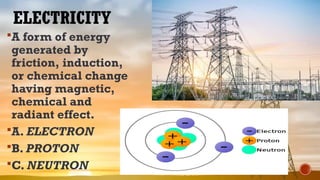
A form ofenergy
generated by
friction, induction,
or chemical change
having magnetic,
chemical and
radiant effect.
A. ELECTRON
B. PROTON
C. NEUTRON
3.
A. ELECTRON
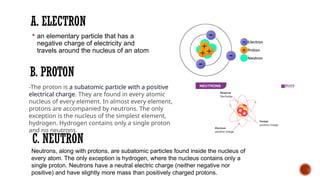
anelementary particle that has a
negative charge of electricity and
travels around the nucleus of an atom
B. PROTON
-The proton is a subatomic particle with a positive
electrical charge. They are found in every atomic
nucleus of every element. In almost every element,
protons are accompanied by neutrons. The only
exception is the nucleus of the simplest element,
hydrogen. Hydrogen contains only a single proton
and no neutrons.
C. NEUTRON
Neutrons, along with protons, are subatomic particles found inside the nucleus of
every atom. The only exception is hydrogen, where the nucleus contains only a
single proton. Neutrons have a neutral electric charge (neither negative nor
positive) and have slightly more mass than positively charged protons.
4.
2 TYPES OFELECTRICITY
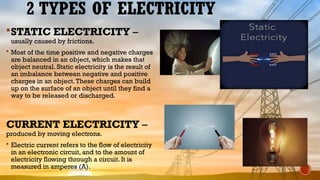
STATIC ELECTRICITY –
usually caused by frictions.
Most of the time positive and negative charges
are balanced in an object, which makes that
object neutral. Static electricity is the result of
an imbalance between negative and positive
charges in an object.These charges can build
up on the surface of an object until they find a
way to be released or discharged.
CURRENT ELECTRICITY –
produced by moving electrons.
Electric current refers to the flow of electricity
in an electronic circuit, and to the amount of
electricity flowing through a circuit. It is
measured in amperes (A).
5.
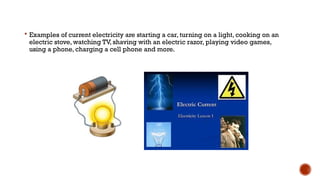
Examples ofcurrent electricity are starting a car, turning on a light, cooking on an
electric stove, watching TV, shaving with an electric razor, playing video games,
using a phone, charging a cell phone and more.
6.
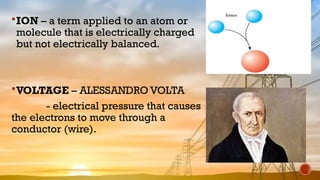
ION – aterm applied to an atom or
molecule that is electrically charged
but not electrically balanced.
VOLTAGE – ALESSANDRO VOLTA
- electrical pressure that causes
the electrons to move through a
conductor (wire).
7.
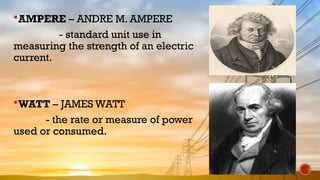
AMPERE – ANDREM. AMPERE
- standard unit use in
measuring the strength of an electric
current.
WATT – JAMES WATT
- the rate or measure of power
used or consumed.
8.
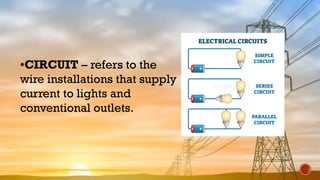
•CIRCUIT – refersto the
wire installations that supply
current to lights and
conventional outlets.
9.
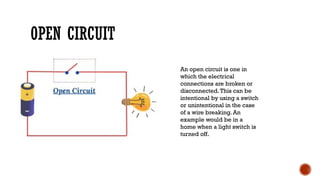
OPEN CIRCUIT
An opencircuit is one in
which the electrical
connections are broken or
disconnected.This can be
intentional by using a switch
or unintentional in the case
of a wire breaking. An
example would be in a
home when a light switch is
turned off.
10.
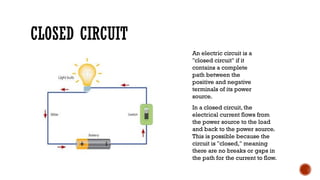
CLOSED CIRCUIT
An electriccircuit is a
"closed circuit" if it
contains a complete
path between the
positive and negative
terminals of its power
source.
In a closed circuit, the
electrical current flows from
the power source to the load
and back to the power source.
This is possible because the
circuit is "closed," meaning
there are no breaks or gaps in
the path for the current to flow.
11.
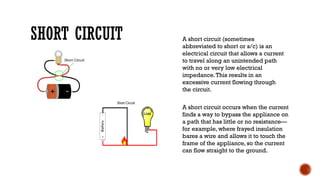
SHORT CIRCUIT Ashort circuit (sometimes
abbreviated to short or s/c) is an
electrical circuit that allows a current
to travel along an unintended path
with no or very low electrical
impedance.This results in an
excessive current flowing through
the circuit.
A short circuit occurs when the current
finds a way to bypass the appliance on
a path that has little or no resistance—
for example, where frayed insulation
bares a wire and allows it to touch the
frame of the appliance, so the current
can flow straight to the ground.
12.
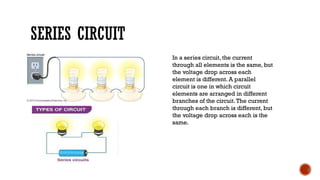
SERIES CIRCUIT
In aseries circuit, the current
through all elements is the same, but
the voltage drop across each
element is different. A parallel
circuit is one in which circuit
elements are arranged in different
branches of the circuit.The current
through each branch is different, but
the voltage drop across each is the
same.
13.
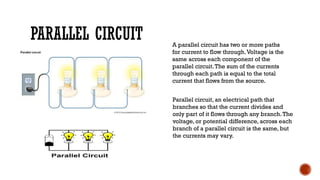
PARALLEL CIRCUIT Aparallel circuit has two or more paths
for current to flow through.Voltage is the
same across each component of the
parallel circuit.The sum of the currents
through each path is equal to the total
current that flows from the source.
Parallel circuit, an electrical path that
branches so that the current divides and
only part of it flows through any branch.The
voltage, or potential difference, across each
branch of a parallel circuit is the same, but
the currents may vary.
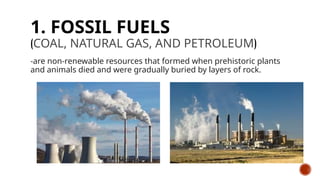
1. FOSSIL FUELS
(COAL,NATURAL GAS, AND PETROLEUM)
-are non-renewable resources that formed when prehistoric plants
and animals died and were gradually buried by layers of rock.
16.
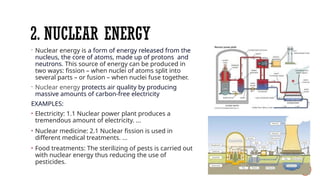
2. NUCLEAR ENERGY
-Nuclear energy is a form of energy released from the
nucleus, the core of atoms, made up of protons and
neutrons. This source of energy can be produced in
two ways: fission – when nuclei of atoms split into
several parts – or fusion – when nuclei fuse together.
- Nuclear energy protects air quality by producing
massive amounts of carbon-free electricity
EXAMPLES:
• Electricity: 1.1 Nuclear power plant produces a
tremendous amount of electricity. ...
• Nuclear medicine: 2.1 Nuclear fission is used in
different medical treatments. ...
• Food treatments: The sterilizing of pests is carried out
with nuclear energy thus reducing the use of
pesticides.
17.
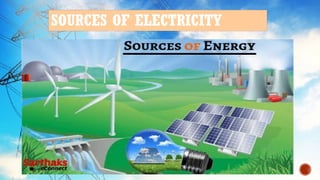
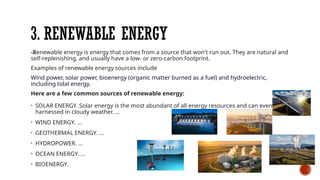
3. RENEWABLE ENERGY
-Renewableenergy is energy that comes from a source that won't run out. They are natural and
self-replenishing, and usually have a low- or zero-carbon footprint.
Examples of renewable energy sources include
Wind power, solar power, bioenergy (organic matter burned as a fuel) and hydroelectric,
including tidal energy.
Here are a few common sources of renewable energy:
• SOLAR ENERGY. Solar energy is the most abundant of all energy resources and can even be
harnessed in cloudy weather. ...
• WIND ENERGY. ...
• GEOTHERMAL ENERGY. ...
• HYDROPOWER. ...
• OCEAN ENERGY. ...
• BIOENERGY.
18.
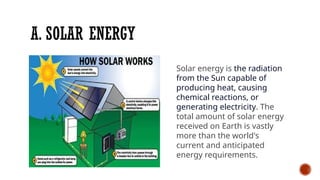
A. SOLAR ENERGY
Solarenergy is the radiation
from the Sun capable of
producing heat, causing
chemical reactions, or
generating electricity. The
total amount of solar energy
received on Earth is vastly
more than the world's
current and anticipated
energy requirements.
19.
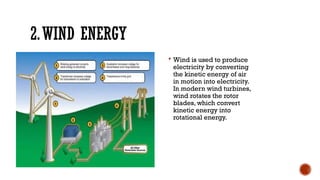
2.WIND ENERGY
Windis used to produce
electricity by converting
the kinetic energy of air
in motion into electricity.
In modern wind turbines,
wind rotates the rotor
blades, which convert
kinetic energy into
rotational energy.
20.
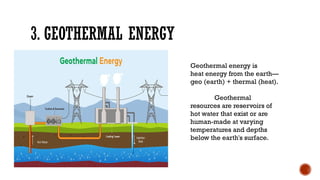
3. GEOTHERMAL ENERGY
Geothermalenergy is
heat energy from the earth—
geo (earth) + thermal (heat).
Geothermal
resources are reservoirs of
hot water that exist or are
human-made at varying
temperatures and depths
below the earth's surface.
21.
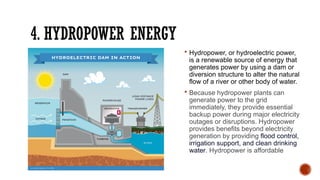
4. HYDROPOWER ENERGY
Hydropower, or hydroelectric power,
is a renewable source of energy that
generates power by using a dam or
diversion structure to alter the natural
flow of a river or other body of water.
Because hydropower plants can
generate power to the grid
immediately, they provide essential
backup power during major electricity
outages or disruptions. Hydropower
provides benefits beyond electricity
generation by providing flood control,
irrigation support, and clean drinking
water. Hydropower is affordable
22.
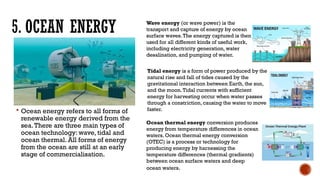
5. OCEAN ENERGY
Ocean energy refers to all forms of
renewable energy derived from the
sea.There are three main types of
ocean technology: wave, tidal and
ocean thermal. All forms of energy
from the ocean are still at an early
stage of commercialisation.
Wave energy (or wave power) is the
transport and capture of energy by ocean
surface waves.The energy captured is then
used for all different kinds of useful work,
including electricity generation, water
desalination, and pumping of water.
Tidal energy is a form of power produced by the
natural rise and fall of tides caused by the
gravitational interaction between Earth, the sun,
and the moon.Tidal currents with sufficient
energy for harvesting occur when water passes
through a constriction, causing the water to move
faster.
Ocean thermal energy conversion produces
energy from temperature differences in ocean
waters. Ocean thermal energy conversion
(OTEC) is a process or technology for
producing energy by harnessing the
temperature differences (thermal gradients)
between ocean surface waters and deep
ocean waters.
23.
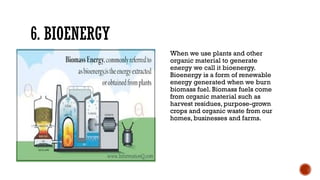
6. BIOENERGY
When weuse plants and other
organic material to generate
energy we call it bioenergy.
Bioenergy is a form of renewable
energy generated when we burn
biomass fuel. Biomass fuels come
from organic material such as
harvest residues, purpose-grown
crops and organic waste from our
homes, businesses and farms.
24.
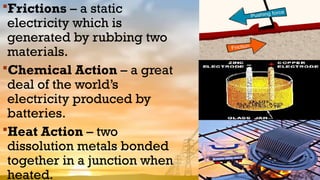
Frictions – astatic
electricity which is
generated by rubbing two
materials.
Chemical Action – a great
deal of the world’s
electricity produced by
batteries.
Heat Action – two
dissolution metals bonded
together in a junction when
heated.
25.
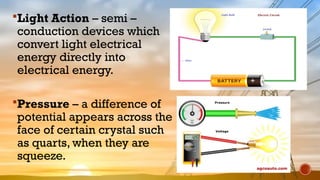
Light Action –semi –
conduction devices which
convert light electrical
energy directly into
electrical energy.
Pressure – a difference of
potential appears across the
face of certain crystal such
as quarts, when they are
squeeze.
A. DRIVING TOOLS
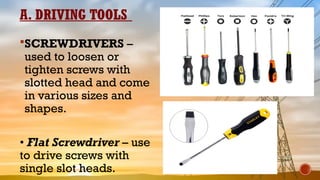
SCREWDRIVERS–
used to loosen or
tighten screws with
slotted head and come
in various sizes and
shapes.
• Flat Screwdriver – use
to drive screws with
single slot heads.
28.
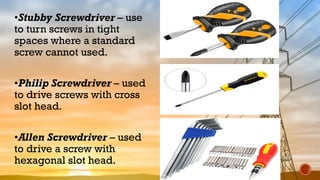
•Stubby Screwdriver –use
to turn screws in tight
spaces where a standard
screw cannot used.
•Philip Screwdriver – used
to drive screws with cross
slot head.
•Allen Screwdriver – used
to drive a screw with
hexagonal slot head.
29.
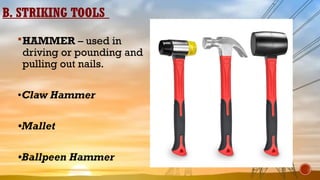
B. STRIKING TOOLS
HAMMER– used in
driving or pounding and
pulling out nails.
•Claw Hammer
•Mallet
•Ballpeen Hammer
30.
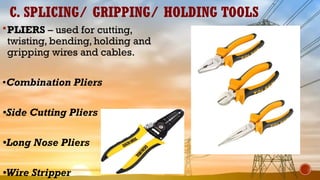
C. SPLICING/ GRIPPING/HOLDING TOOLS
PLIERS – used for cutting,
twisting, bending, holding and
gripping wires and cables.
•Combination Pliers
•Side Cutting Pliers
•Long Nose Pliers
•Wire Stripper
31.
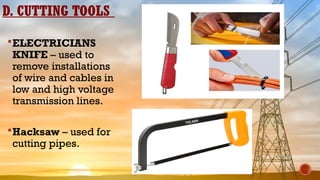
D. CUTTING TOOLS
ELECTRICIANS
KNIFE– used to
remove installations
of wire and cables in
low and high voltage
transmission lines.
Hacksaw – used for
cutting pipes.
32.
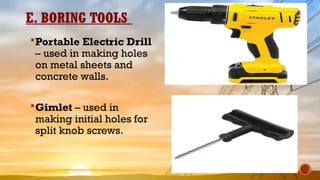
E. BORING TOOLS
PortableElectric Drill
– used in making holes
on metal sheets and
concrete walls.
Gimlet – used in
making initial holes for
split knob screws.
33.
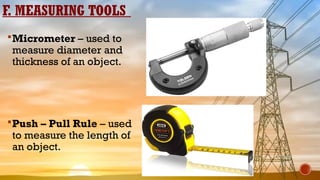
F. MEASURING TOOLS
Micrometer– used to
measure diameter and
thickness of an object.
Push – Pull Rule – used
to measure the length of
an object.
34.
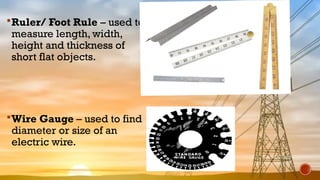
Ruler/ Foot Rule– used to
measure length, width,
height and thickness of
short flat objects.
Wire Gauge – used to find
diameter or size of an
electric wire.