Energy Efficient Design Education Through Architectural Design Studio Projects 
Dr. Khaled Ali Youssef Department of Architecture Faculty of Environmental Design King Andulaziz University Saudi Arabia
Presentation Outline 
1. Introduction 
1.1. Aim and Objectives 
1.2. Methodology 
2. „Energy Efficient Design‟ as a Design Studio Lesson 
3. The Experiment of Designing a Zero Net Energy Building 
3.1. Planning for the Experiment 
3.2. Design Process Activities 
4. Results and Attainments 
4.1 Objectives Achieved 
4.2. Obstacles and challenges 
4.3. Suggestions for future development 
Energy Efficient Design Education Through Architectural Design Studio Projects 
Slide 2 of 40 
Dr. Khaled Ali Youssef 
Department of Architecture 
Faculty of Environmental Design 
King Andulaziz University 
Saudi Arabia
1. Introduction 
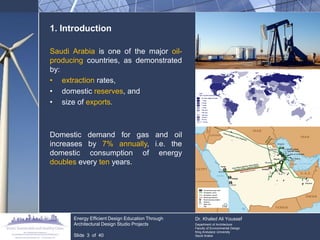
Saudi Arabia is one of the major oil- producing countries, as demonstrated by: 
•extraction rates, 
•domestic reserves, and 
•size of exports. 
Domestic demand for gas and oil increases by 7% annually, i.e. the domestic consumption of energy doubles every ten years. 
Energy Efficient Design Education Through Architectural Design Studio Projects 
Slide 3 of 40 
Dr. Khaled Ali Youssef Department of Architecture Faculty of Environmental Design King Andulaziz University Saudi Arabia
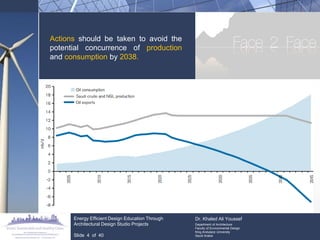
Actions should be taken to avoid the potential concurrence of production and consumption by 2038. 
Energy Efficient Design Education Through Architectural Design Studio Projects 
Slide 4 of 40 
Dr. Khaled Ali Youssef 
Department of Architecture 
Faculty of Environmental Design 
King Andulaziz University 
Saudi Arabia
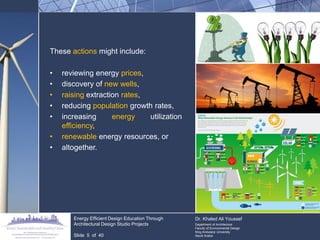
These actions might include: 
•reviewing energy prices, 
•discovery of new wells, 
•raising extraction rates, 
•reducing population growth rates, 
•increasing energy utilization efficiency, 
•renewable energy resources, or 
•altogether. 
Energy Efficient Design Education Through Architectural Design Studio Projects 
Slide 5 of 40 
Dr. Khaled Ali Youssef 
Department of Architecture 
Faculty of Environmental Design 
King Andulaziz University 
Saudi Arabia
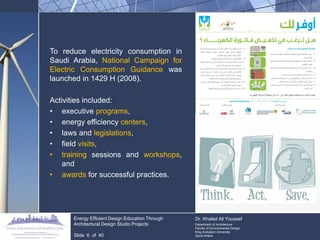
To reduce electricity consumption in Saudi Arabia, National Campaign for Electric Consumption Guidance was launched in 1429 H (2008). 
Activities included: 
•executive programs, 
•energy efficiency centers, 
•laws and legislations, 
•field visits, 
•training sessions and workshops, and 
•awards for successful practices. Energy Efficient Design Education Through Architectural Design Studio Projects Slide 6 of 40 
Dr. Khaled Ali Youssef 
Department of Architecture 
Faculty of Environmental Design 
King Andulaziz University 
Saudi Arabia
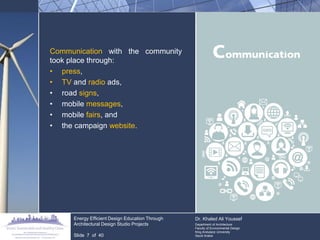
Communication with the community took place through: 
•press, 
•TV and radio ads, 
•road signs, 
•mobile messages, 
•mobile fairs, and 
•the campaign website. 
Energy Efficient Design Education Through Architectural Design Studio Projects 
Slide 7 of 40 
Dr. Khaled Ali Youssef Department of Architecture Faculty of Environmental Design King Andulaziz University Saudi Arabia
These efforts opened the door wide for all community groups to support. 
Higher Education institutions are argued to contribute in two main directions: 
(1)preparing the trained staff, and 
(2)raising public awareness. 
Energy Efficient Design Education Through Architectural Design Studio Projects 
Slide 8 of 40 
Dr. Khaled Ali Youssef Department of Architecture Faculty of Environmental Design King Andulaziz University Saudi Arabia
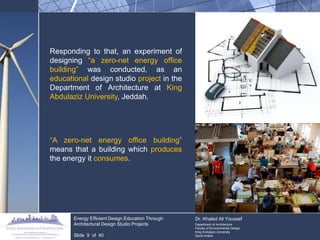
Responding to that, an experiment of designing “a zero-net energy office building” was conducted, as an educational design studio project in the Department of Architecture at King Abdulaziz University, Jeddah. 
“A zero-net energy office building” means that a building which produces the energy it consumes. 
Energy Efficient Design Education Through Architectural Design Studio Projects 
Slide 9 of 40 
Dr. Khaled Ali Youssef Department of Architecture Faculty of Environmental Design King Andulaziz University Saudi Arabia
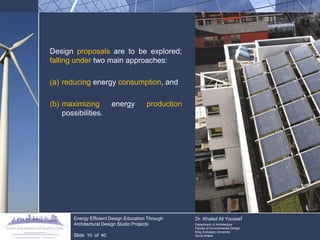
Design proposals are to be explored; falling under two main approaches: 
(a)reducing energy consumption, and 
(b)maximizing energy production possibilities. Energy Efficient Design Education Through Architectural Design Studio Projects Slide 10 of 40 Dr. Khaled Ali Youssef Department of Architecture Faculty of Environmental Design King Andulaziz University Saudi Arabia
1.1. Aim and Objectives 
The aim is to document and analyze the experiment of designing a zero net- energy building. 
Goals achieved are highlighted, obstacles and challenges are identified, and suggestions for future development are provided. 
Energy Efficient Design Education Through Architectural Design Studio Projects 
Slide 11 of 40 
Dr. Khaled Ali Youssef 
Department of Architecture 
Faculty of Environmental Design 
King Andulaziz University 
Saudi Arabia
1.2. Methodology 
•Identifying the motives behind the experiment 
•Addressing the reasons of selecting the design studio as an environment for investigation. 
•Giving a theoretical background: 
oThe VDS system, 
oSGU educational plan, and 
o„Energy efficient design‟ lesson. 
•Documenting the activities and outcomes of the design process . 
•Analysing the experiment Energy Efficient Design Education Through Architectural Design Studio Projects Slide 12 of 40 Dr. Khaled Ali Youssef Department of Architecture Faculty of Environmental Design King Andulaziz University Saudi Arabia
2. ‘Energy Efficient Design’ as a Design Studio Lesson 
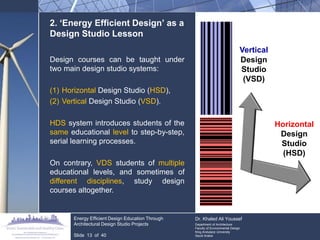
Design courses can be taught under two main design studio systems: 
(1)Horizontal Design Studio (HSD), 
(2)Vertical Design Studio (VSD). 
HDS system introduces students of the same educational level to step-by-step, serial learning processes. 
On contrary, VDS students of multiple educational levels, and sometimes of different disciplines, study design courses altogether. 
Horizontal Design Studio (HSD) 
Vertical Design Studio (VSD) Energy Efficient Design Education Through Architectural Design Studio Projects Slide 13 of 40 Dr. Khaled Ali Youssef Department of Architecture Faculty of Environmental Design King Andulaziz University Saudi Arabia
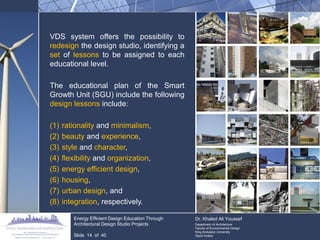
VDS system offers the possibility to redesign the design studio, identifying a set of lessons to be assigned to each educational level. 
The educational plan of the Smart Growth Unit (SGU) include the following design lessons include: 
(1)rationality and minimalism, 
(2)beauty and experience, 
(3)style and character, 
(4)flexibility and organization, 
(5)energy efficient design, 
(6)housing, 
(7)urban design, and 
(8)integration, respectively. Energy Efficient Design Education Through Architectural Design Studio Projects Slide 14 of 40 
Dr. Khaled Ali Youssef 
Department of Architecture 
Faculty of Environmental Design 
King Andulaziz University 
Saudi Arabia
3. A The Experiment of Designing a Zero Net Energy Building 
3.1. Planning for the Experiment 
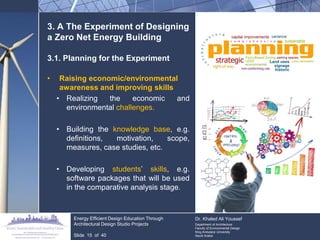
•Raising economic/environmental awareness and improving skills 
•Realizing the economic and environmental challenges. 
•Building the knowledge base, e.g. definitions, motivation, scope, measures, case studies, etc. 
•Developing students‟ skills, e.g. software packages that will be used in the comparative analysis stage. 
Energy Efficient Design Education Through Architectural Design Studio Projects 
Slide 15 of 40 
Dr. Khaled Ali Youssef 
Department of Architecture 
Faculty of Environmental Design 
King Andulaziz University 
Saudi Arabia
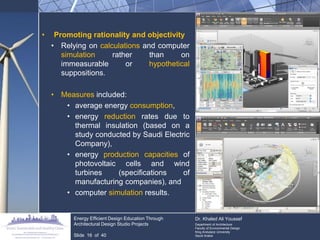
•Promoting rationality and objectivity 
•Relying on calculations and computer simulation rather than on immeasurable or hypothetical suppositions. 
•Measures included: 
•average energy consumption, 
•energy reduction rates due to thermal insulation (based on a study conducted by Saudi Electric Company), 
•energy production capacities of photovoltaic cells and wind turbines (specifications of manufacturing companies), and 
•computer simulation results. Energy Efficient Design Education Through Architectural Design Studio Projects Slide 16 of 40 Dr. Khaled Ali Youssef Department of Architecture Faculty of Environmental Design King Andulaziz University Saudi Arabia
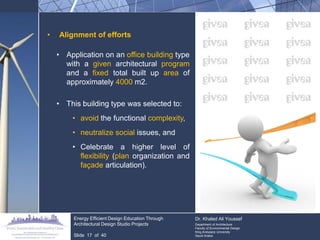
•Alignment of efforts 
•Application on an office building type with a given architectural program and a fixed total built up area of approximately 4000 m2. 
•This building type was selected to: 
•avoid the functional complexity, 
•neutralize social issues, and 
•Celebrate a higher level of flexibility (plan organization and façade articulation). 
given given given 
given given given 
given given given 
given given given 
given given given Energy Efficient Design Education Through Architectural Design Studio Projects Slide 17 of 40 Dr. Khaled Ali Youssef Department of Architecture Faculty of Environmental Design King Andulaziz University Saudi Arabia
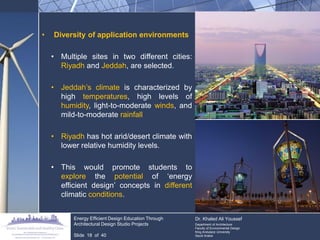
•Diversity of application environments 
•Multiple sites in two different cities: Riyadh and Jeddah, are selected. 
•Jeddah‟s climate is characterized by high temperatures, high levels of humidity, light-to-moderate winds, and mild-to-moderate rainfall 
•Riyadh has hot arid/desert climate with lower relative humidity levels. 
•This would promote students to explore the potential of „energy efficient design‟ concepts in different climatic conditions. 
Energy Efficient Design Education Through Architectural Design Studio Projects 
Slide 18 of 40 
Dr. Khaled Ali Youssef Department of Architecture Faculty of Environmental Design King Andulaziz University Saudi Arabia
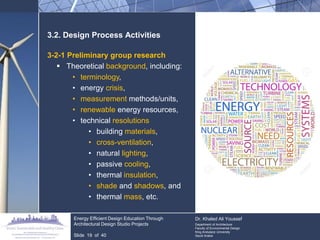
3.2. Design Process Activities 
3-2-1 Preliminary group research 
Theoretical background, including: 
•terminology, 
•energy crisis, 
•measurement methods/units, 
•renewable energy resources, 
•technical resolutions 
•building materials, 
•cross-ventilation, 
•natural lighting, 
•passive cooling, 
•thermal insulation, 
•shade and shadows, and 
•thermal mass, etc. 
Energy Efficient Design Education Through Architectural Design Studio Projects 
Slide 19 of 40 
Dr. Khaled Ali Youssef Department of Architecture Faculty of Environmental Design King Andulaziz University Saudi Arabia
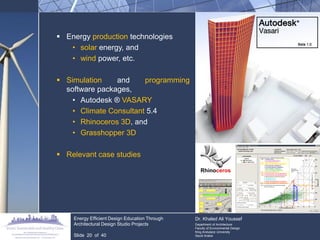
Energy production technologies 
•solar energy, and 
•wind power, etc. 
Simulation and programming software packages, 
•Autodesk ® VASARY 
•Climate Consultant 5.4 
•Rhinoceros 3D, and 
•Grasshopper 3D 
Relevant case studies 
Energy Efficient Design Education Through Architectural Design Studio Projects Slide 20 of 40 Dr. Khaled Ali Youssef Department of Architecture Faculty of Environmental Design King Andulaziz University Saudi Arabia
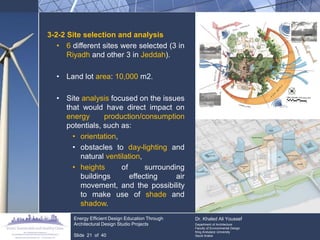
3-2-2 Site selection and analysis 
•6 different sites were selected (3 in Riyadh and other 3 in Jeddah). 
•Land lot area: 10,000 m2. 
•Site analysis focused on the issues that would have direct impact on energy production/consumption potentials, such as: 
•orientation, 
•obstacles to day-lighting and natural ventilation, 
•heights of surrounding buildings effecting air movement, and the possibility to make use of shade and shadow. Energy Efficient Design Education Through Architectural Design Studio Projects Slide 21 of 40 Dr. Khaled Ali Youssef Department of Architecture Faculty of Environmental Design King Andulaziz University Saudi Arabia
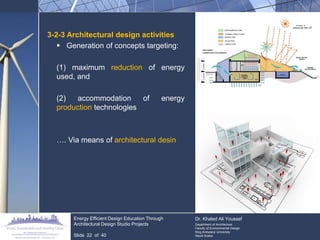
3-2-3 Architectural design activities 
Generation of concepts targeting: 
(1) maximum reduction of energy used, and 
(2) accommodation of energy production technologies 
…. Via means of architectural desin Energy Efficient Design Education Through Architectural Design Studio Projects Slide 22 of 40 
Dr. Khaled Ali Youssef 
Department of Architecture 
Faculty of Environmental Design 
King Andulaziz University 
Saudi Arabia
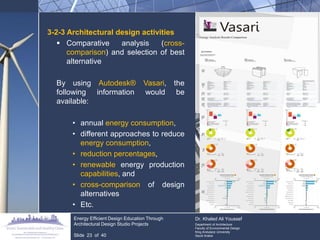
3-2-3 Architectural design activities 
Comparative analysis (cross- comparison) and selection of best alternative 
By using Autodesk® Vasari, the following information would be available: 
•annual energy consumption, 
•different approaches to reduce energy consumption, 
•reduction percentages, 
•renewable energy production capabilities, and 
•cross-comparison of design alternatives 
•Etc. Energy Efficient Design Education Through Architectural Design Studio Projects Slide 23 of 40 Dr. Khaled Ali Youssef Department of Architecture Faculty of Environmental Design King Andulaziz University Saudi Arabia
3-2-3 Architectural design activities 
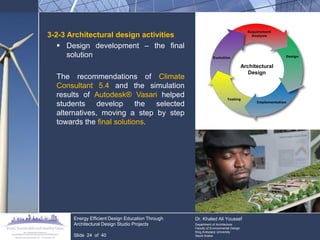
Design development – the final solution 
The recommendations of Climate Consultant 5.4 and the simulation results of Autodesk® Vasari helped students develop the selected alternatives, moving a step by step towards the final solutions. Architectural Design 
Energy Efficient Design Education Through Architectural Design Studio Projects 
Slide 24 of 40 
Dr. Khaled Ali Youssef Department of Architecture Faculty of Environmental Design King Andulaziz University Saudi Arabia
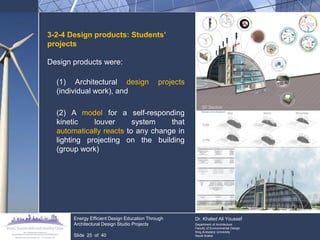
3-2-4 Design products: Students’ projects 
Design products were: 
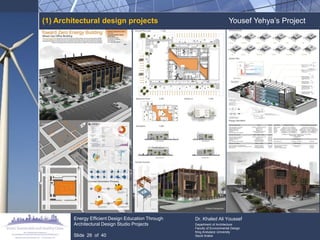
(1) Architectural design projects (individual work), and 
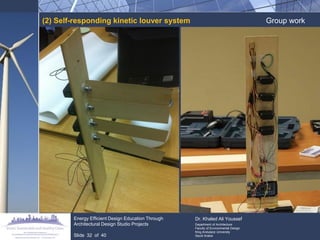
(2) A model for a self-responding kinetic louver system that automatically reacts to any change in lighting projecting on the building (group work) 
Energy Efficient Design Education Through Architectural Design Studio Projects Slide 25 of 40 Dr. Khaled Ali Youssef Department of Architecture Faculty of Environmental Design King Andulaziz University Saudi Arabia
(1) Architectural design projects Yousef Yehya‟s Project Energy Efficient Design Education Through Architectural Design Studio Projects Slide 26 of 40 
Dr. Khaled Ali Youssef 
Department of Architecture 
Faculty of Environmental Design 
King Andulaziz University 
Saudi Arabia
(1) Architectural design projects 
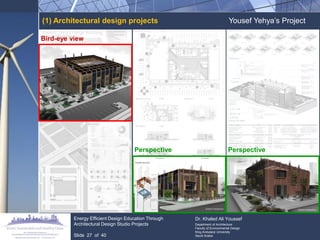
Yousef Yehya‟s Project Bird-eye view Perspective 
Perspective 
Energy Efficient Design Education Through Architectural Design Studio Projects Slide 27 of 40 Dr. Khaled Ali Youssef Department of Architecture Faculty of Environmental Design King Andulaziz University Saudi Arabia
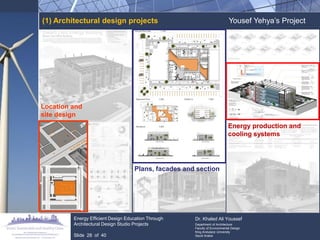
(1) Architectural design projects 
Yousef Yehya‟s Project 
Location and site design 
Plans, facades and section Energy production and cooling systems 
Energy Efficient Design Education Through Architectural Design Studio Projects 
Slide 28 of 40 
Dr. Khaled Ali Youssef Department of Architecture Faculty of Environmental Design King Andulaziz University Saudi Arabia
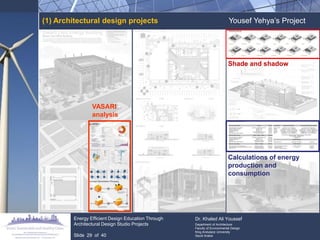
(1) Architectural design projects 
Yousef Yehya‟s Project 
VASARI analysis 
Shade and shadow 
Calculations of energy production and consumption Energy Efficient Design Education Through Architectural Design Studio Projects Slide 29 of 40 
Dr. Khaled Ali Youssef 
Department of Architecture 
Faculty of Environmental Design 
King Andulaziz University 
Saudi Arabia
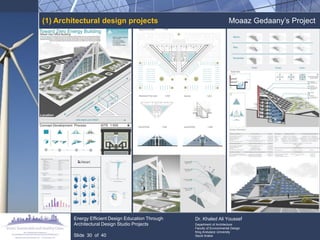
(1) Architectural design projects 
Moaaz Gedaany‟s Project 
Energy Efficient Design Education Through Architectural Design Studio Projects 
Slide 30 of 40 
Dr. Khaled Ali Youssef 
Department of Architecture 
Faculty of Environmental Design 
King Andulaziz University 
Saudi Arabia
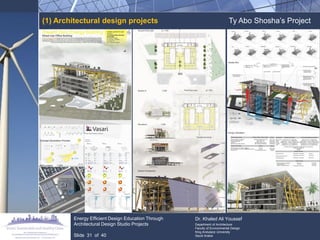
(1) Architectural design projects Ty Abo Shosha‟s Project Energy Efficient Design Education Through Architectural Design Studio Projects Slide 31 of 40 
Dr. Khaled Ali Youssef 
Department of Architecture 
Faculty of Environmental Design 
King Andulaziz University 
Saudi Arabia
(2) Self-responding kinetic louver system 
Group work 
Energy Efficient Design Education Through Architectural Design Studio Projects 
Slide 32 of 40 
Dr. Khaled Ali Youssef 
Department of Architecture 
Faculty of Environmental Design 
King Andulaziz University 
Saudi Arabia
4. Results and Attainments 
4.1 Goals Achieved 
•Students came to the conclusion that architects can play a vital role in addressing energy issues within their specialization. 
•Students have had the skills of calculating the consumed/ produced energy, with the help of software packages. 
•The experiment managed to raise the environmental awareness of: participating students, faculty students, staff, guests and jury members. Energy Efficient Design Education Through Architectural Design Studio Projects Slide 33 of 40 Dr. Khaled Ali Youssef Department of Architecture Faculty of Environmental Design King Andulaziz University Saudi Arabia
•A "hidden curriculum" is developed, i.e. linking the design studio to urgent domestic, regional, and global concerns. 
•There was a chance to “Re- design the design studio“; i.e. through the "Problematization" of design projects. 
•Both „explicit knowledge‟ (know- what), and „tacit knowledge‟ (know-how, know-why, know-who and know-when) were transferred from senior to junior students. 
Energy Efficient Design Education Through Architectural Design Studio Projects 
Slide 34 of 40 
Dr. Khaled Ali Youssef 
Department of Architecture 
Faculty of Environmental Design 
King Andulaziz University 
Saudi Arabia
•Explicit knowledge was in the form of theoretical background and direct results, whereas, tacit knowledge was in the form of experience, culture, and methods of performing tasks. 
•The interrelationship between architecture and other disciplines concerned with the topic was realized. 
Energy Efficient Design Education Through Architectural Design Studio Projects 
Slide 35 of 40 
Dr. Khaled Ali Youssef Department of Architecture Faculty of Environmental Design King Andulaziz University Saudi Arabia
Discussion: Results and Attainments 
4.2. Obstacles and challenges 
•Acquiring basic knowledge and building skills consumed much time and effort. 
•Nevertheless, repeating the experiment ensures aggregation and regular update of the knowledge base. 
•The absence of research infrastructure (labs, equipment and software) was a major challenge. Energy Efficient Design Education Through Architectural Design Studio Projects Slide 36 of 40 Dr. Khaled Ali Youssef Department of Architecture Faculty of Environmental Design King Andulaziz University Saudi Arabia
•Lack of infrastructure and specialized staff led to spending more time and effort to make the experiment succeed. 
•The absence of financial support. 
Energy Efficient Design Education Through Architectural Design Studio Projects 
Slide 37 of 40 
Dr. Khaled Ali Youssef Department of Architecture Faculty of Environmental Design King Andulaziz University Saudi Arabia
4.3. Suggestions for future development 
•Due to the importance and the complexity of the experiment, the engagement of post-graduate students is promoted. 
•It is worth mentioning that a M.Sc. program was recently launched in the department, with a track for awarding M.Sc. degree by architectural projects. Energy Efficient Design Education Through Architectural Design Studio Projects Slide 38 of 40 Dr. Khaled Ali Youssef Department of Architecture Faculty of Environmental Design King Andulaziz University Saudi Arabia
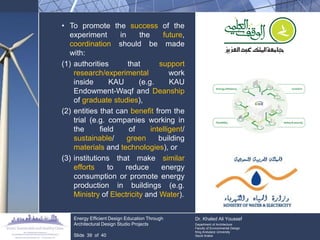
•To promote the success of the experiment in the future, coordination should be made with: 
(1)authorities that support research/experimental work inside KAU (e.g. KAU Endowment-Waqf and Deanship of graduate studies), 
(2)entities that can benefit from the trial (e.g. companies working in the field of intelligent/ sustainable/ green building materials and technologies), or 
(3)institutions that make similar efforts to reduce energy consumption or promote energy production in buildings (e.g. Ministry of Electricity and Water). Energy Efficient Design Education Through Architectural Design Studio Projects Slide 39 of 40 Dr. Khaled Ali Youssef Department of Architecture Faculty of Environmental Design King Andulaziz University Saudi Arabia
Acknowledgements 
The author would like to thank: 
Dr. Osman Khafagy, and 
Arch. Abdulaziz Afandi 
for their participation in 
performing the experiment 
of designing a zero net energy office building 
as an application to the 
„energy efficient design‟ lesson. 
Thanks for Attention

Energy Efficient Design Education Through Architectural Design Studio Projects

  • 1.
    Energy Efficient DesignEducation Through Architectural Design Studio Projects Dr. Khaled Ali Youssef Department of Architecture Faculty of Environmental Design King Andulaziz University Saudi Arabia
  • 2.
    Presentation Outline 1.Introduction 1.1. Aim and Objectives 1.2. Methodology 2. „Energy Efficient Design‟ as a Design Studio Lesson 3. The Experiment of Designing a Zero Net Energy Building 3.1. Planning for the Experiment 3.2. Design Process Activities 4. Results and Attainments 4.1 Objectives Achieved 4.2. Obstacles and challenges 4.3. Suggestions for future development Energy Efficient Design Education Through Architectural Design Studio Projects Slide 2 of 40 Dr. Khaled Ali Youssef Department of Architecture Faculty of Environmental Design King Andulaziz University Saudi Arabia
  • 3.
    1. Introduction SaudiArabia is one of the major oil- producing countries, as demonstrated by: •extraction rates, •domestic reserves, and •size of exports. Domestic demand for gas and oil increases by 7% annually, i.e. the domestic consumption of energy doubles every ten years. Energy Efficient Design Education Through Architectural Design Studio Projects Slide 3 of 40 Dr. Khaled Ali Youssef Department of Architecture Faculty of Environmental Design King Andulaziz University Saudi Arabia
  • 4.
    Actions should betaken to avoid the potential concurrence of production and consumption by 2038. Energy Efficient Design Education Through Architectural Design Studio Projects Slide 4 of 40 Dr. Khaled Ali Youssef Department of Architecture Faculty of Environmental Design King Andulaziz University Saudi Arabia
  • 5.
    These actions mightinclude: •reviewing energy prices, •discovery of new wells, •raising extraction rates, •reducing population growth rates, •increasing energy utilization efficiency, •renewable energy resources, or •altogether. Energy Efficient Design Education Through Architectural Design Studio Projects Slide 5 of 40 Dr. Khaled Ali Youssef Department of Architecture Faculty of Environmental Design King Andulaziz University Saudi Arabia
  • 6.
    To reduce electricityconsumption in Saudi Arabia, National Campaign for Electric Consumption Guidance was launched in 1429 H (2008). Activities included: •executive programs, •energy efficiency centers, •laws and legislations, •field visits, •training sessions and workshops, and •awards for successful practices. Energy Efficient Design Education Through Architectural Design Studio Projects Slide 6 of 40 Dr. Khaled Ali Youssef Department of Architecture Faculty of Environmental Design King Andulaziz University Saudi Arabia
  • 7.
    Communication with thecommunity took place through: •press, •TV and radio ads, •road signs, •mobile messages, •mobile fairs, and •the campaign website. Energy Efficient Design Education Through Architectural Design Studio Projects Slide 7 of 40 Dr. Khaled Ali Youssef Department of Architecture Faculty of Environmental Design King Andulaziz University Saudi Arabia
  • 8.
    These efforts openedthe door wide for all community groups to support. Higher Education institutions are argued to contribute in two main directions: (1)preparing the trained staff, and (2)raising public awareness. Energy Efficient Design Education Through Architectural Design Studio Projects Slide 8 of 40 Dr. Khaled Ali Youssef Department of Architecture Faculty of Environmental Design King Andulaziz University Saudi Arabia
  • 9.
    Responding to that,an experiment of designing “a zero-net energy office building” was conducted, as an educational design studio project in the Department of Architecture at King Abdulaziz University, Jeddah. “A zero-net energy office building” means that a building which produces the energy it consumes. Energy Efficient Design Education Through Architectural Design Studio Projects Slide 9 of 40 Dr. Khaled Ali Youssef Department of Architecture Faculty of Environmental Design King Andulaziz University Saudi Arabia
  • 10.
    Design proposals areto be explored; falling under two main approaches: (a)reducing energy consumption, and (b)maximizing energy production possibilities. Energy Efficient Design Education Through Architectural Design Studio Projects Slide 10 of 40 Dr. Khaled Ali Youssef Department of Architecture Faculty of Environmental Design King Andulaziz University Saudi Arabia
  • 11.
    1.1. Aim andObjectives The aim is to document and analyze the experiment of designing a zero net- energy building. Goals achieved are highlighted, obstacles and challenges are identified, and suggestions for future development are provided. Energy Efficient Design Education Through Architectural Design Studio Projects Slide 11 of 40 Dr. Khaled Ali Youssef Department of Architecture Faculty of Environmental Design King Andulaziz University Saudi Arabia
  • 12.
    1.2. Methodology •Identifyingthe motives behind the experiment •Addressing the reasons of selecting the design studio as an environment for investigation. •Giving a theoretical background: oThe VDS system, oSGU educational plan, and o„Energy efficient design‟ lesson. •Documenting the activities and outcomes of the design process . •Analysing the experiment Energy Efficient Design Education Through Architectural Design Studio Projects Slide 12 of 40 Dr. Khaled Ali Youssef Department of Architecture Faculty of Environmental Design King Andulaziz University Saudi Arabia
  • 13.
    2. ‘Energy EfficientDesign’ as a Design Studio Lesson Design courses can be taught under two main design studio systems: (1)Horizontal Design Studio (HSD), (2)Vertical Design Studio (VSD). HDS system introduces students of the same educational level to step-by-step, serial learning processes. On contrary, VDS students of multiple educational levels, and sometimes of different disciplines, study design courses altogether. Horizontal Design Studio (HSD) Vertical Design Studio (VSD) Energy Efficient Design Education Through Architectural Design Studio Projects Slide 13 of 40 Dr. Khaled Ali Youssef Department of Architecture Faculty of Environmental Design King Andulaziz University Saudi Arabia
  • 14.
    VDS system offersthe possibility to redesign the design studio, identifying a set of lessons to be assigned to each educational level. The educational plan of the Smart Growth Unit (SGU) include the following design lessons include: (1)rationality and minimalism, (2)beauty and experience, (3)style and character, (4)flexibility and organization, (5)energy efficient design, (6)housing, (7)urban design, and (8)integration, respectively. Energy Efficient Design Education Through Architectural Design Studio Projects Slide 14 of 40 Dr. Khaled Ali Youssef Department of Architecture Faculty of Environmental Design King Andulaziz University Saudi Arabia
  • 15.
    3. A TheExperiment of Designing a Zero Net Energy Building 3.1. Planning for the Experiment •Raising economic/environmental awareness and improving skills •Realizing the economic and environmental challenges. •Building the knowledge base, e.g. definitions, motivation, scope, measures, case studies, etc. •Developing students‟ skills, e.g. software packages that will be used in the comparative analysis stage. Energy Efficient Design Education Through Architectural Design Studio Projects Slide 15 of 40 Dr. Khaled Ali Youssef Department of Architecture Faculty of Environmental Design King Andulaziz University Saudi Arabia
  • 16.
    •Promoting rationality andobjectivity •Relying on calculations and computer simulation rather than on immeasurable or hypothetical suppositions. •Measures included: •average energy consumption, •energy reduction rates due to thermal insulation (based on a study conducted by Saudi Electric Company), •energy production capacities of photovoltaic cells and wind turbines (specifications of manufacturing companies), and •computer simulation results. Energy Efficient Design Education Through Architectural Design Studio Projects Slide 16 of 40 Dr. Khaled Ali Youssef Department of Architecture Faculty of Environmental Design King Andulaziz University Saudi Arabia
  • 17.
    •Alignment of efforts •Application on an office building type with a given architectural program and a fixed total built up area of approximately 4000 m2. •This building type was selected to: •avoid the functional complexity, •neutralize social issues, and •Celebrate a higher level of flexibility (plan organization and façade articulation). given given given given given given given given given given given given given given given Energy Efficient Design Education Through Architectural Design Studio Projects Slide 17 of 40 Dr. Khaled Ali Youssef Department of Architecture Faculty of Environmental Design King Andulaziz University Saudi Arabia
  • 18.
    •Diversity of applicationenvironments •Multiple sites in two different cities: Riyadh and Jeddah, are selected. •Jeddah‟s climate is characterized by high temperatures, high levels of humidity, light-to-moderate winds, and mild-to-moderate rainfall •Riyadh has hot arid/desert climate with lower relative humidity levels. •This would promote students to explore the potential of „energy efficient design‟ concepts in different climatic conditions. Energy Efficient Design Education Through Architectural Design Studio Projects Slide 18 of 40 Dr. Khaled Ali Youssef Department of Architecture Faculty of Environmental Design King Andulaziz University Saudi Arabia
  • 19.
    3.2. Design ProcessActivities 3-2-1 Preliminary group research Theoretical background, including: •terminology, •energy crisis, •measurement methods/units, •renewable energy resources, •technical resolutions •building materials, •cross-ventilation, •natural lighting, •passive cooling, •thermal insulation, •shade and shadows, and •thermal mass, etc. Energy Efficient Design Education Through Architectural Design Studio Projects Slide 19 of 40 Dr. Khaled Ali Youssef Department of Architecture Faculty of Environmental Design King Andulaziz University Saudi Arabia
  • 20.
    Energy production technologies •solar energy, and •wind power, etc. Simulation and programming software packages, •Autodesk ® VASARY •Climate Consultant 5.4 •Rhinoceros 3D, and •Grasshopper 3D Relevant case studies Energy Efficient Design Education Through Architectural Design Studio Projects Slide 20 of 40 Dr. Khaled Ali Youssef Department of Architecture Faculty of Environmental Design King Andulaziz University Saudi Arabia
  • 21.
    3-2-2 Site selectionand analysis •6 different sites were selected (3 in Riyadh and other 3 in Jeddah). •Land lot area: 10,000 m2. •Site analysis focused on the issues that would have direct impact on energy production/consumption potentials, such as: •orientation, •obstacles to day-lighting and natural ventilation, •heights of surrounding buildings effecting air movement, and the possibility to make use of shade and shadow. Energy Efficient Design Education Through Architectural Design Studio Projects Slide 21 of 40 Dr. Khaled Ali Youssef Department of Architecture Faculty of Environmental Design King Andulaziz University Saudi Arabia
  • 22.
    3-2-3 Architectural designactivities Generation of concepts targeting: (1) maximum reduction of energy used, and (2) accommodation of energy production technologies …. Via means of architectural desin Energy Efficient Design Education Through Architectural Design Studio Projects Slide 22 of 40 Dr. Khaled Ali Youssef Department of Architecture Faculty of Environmental Design King Andulaziz University Saudi Arabia
  • 23.
    3-2-3 Architectural designactivities Comparative analysis (cross- comparison) and selection of best alternative By using Autodesk® Vasari, the following information would be available: •annual energy consumption, •different approaches to reduce energy consumption, •reduction percentages, •renewable energy production capabilities, and •cross-comparison of design alternatives •Etc. Energy Efficient Design Education Through Architectural Design Studio Projects Slide 23 of 40 Dr. Khaled Ali Youssef Department of Architecture Faculty of Environmental Design King Andulaziz University Saudi Arabia
  • 24.
    3-2-3 Architectural designactivities Design development – the final solution The recommendations of Climate Consultant 5.4 and the simulation results of Autodesk® Vasari helped students develop the selected alternatives, moving a step by step towards the final solutions. Architectural Design Energy Efficient Design Education Through Architectural Design Studio Projects Slide 24 of 40 Dr. Khaled Ali Youssef Department of Architecture Faculty of Environmental Design King Andulaziz University Saudi Arabia
  • 25.
    3-2-4 Design products:Students’ projects Design products were: (1) Architectural design projects (individual work), and (2) A model for a self-responding kinetic louver system that automatically reacts to any change in lighting projecting on the building (group work) Energy Efficient Design Education Through Architectural Design Studio Projects Slide 25 of 40 Dr. Khaled Ali Youssef Department of Architecture Faculty of Environmental Design King Andulaziz University Saudi Arabia
  • 26.
    (1) Architectural designprojects Yousef Yehya‟s Project Energy Efficient Design Education Through Architectural Design Studio Projects Slide 26 of 40 Dr. Khaled Ali Youssef Department of Architecture Faculty of Environmental Design King Andulaziz University Saudi Arabia
  • 27.
    (1) Architectural designprojects Yousef Yehya‟s Project Bird-eye view Perspective Perspective Energy Efficient Design Education Through Architectural Design Studio Projects Slide 27 of 40 Dr. Khaled Ali Youssef Department of Architecture Faculty of Environmental Design King Andulaziz University Saudi Arabia
  • 28.
    (1) Architectural designprojects Yousef Yehya‟s Project Location and site design Plans, facades and section Energy production and cooling systems Energy Efficient Design Education Through Architectural Design Studio Projects Slide 28 of 40 Dr. Khaled Ali Youssef Department of Architecture Faculty of Environmental Design King Andulaziz University Saudi Arabia
  • 29.
    (1) Architectural designprojects Yousef Yehya‟s Project VASARI analysis Shade and shadow Calculations of energy production and consumption Energy Efficient Design Education Through Architectural Design Studio Projects Slide 29 of 40 Dr. Khaled Ali Youssef Department of Architecture Faculty of Environmental Design King Andulaziz University Saudi Arabia
  • 30.
    (1) Architectural designprojects Moaaz Gedaany‟s Project Energy Efficient Design Education Through Architectural Design Studio Projects Slide 30 of 40 Dr. Khaled Ali Youssef Department of Architecture Faculty of Environmental Design King Andulaziz University Saudi Arabia
  • 31.
    (1) Architectural designprojects Ty Abo Shosha‟s Project Energy Efficient Design Education Through Architectural Design Studio Projects Slide 31 of 40 Dr. Khaled Ali Youssef Department of Architecture Faculty of Environmental Design King Andulaziz University Saudi Arabia
  • 32.
    (2) Self-responding kineticlouver system Group work Energy Efficient Design Education Through Architectural Design Studio Projects Slide 32 of 40 Dr. Khaled Ali Youssef Department of Architecture Faculty of Environmental Design King Andulaziz University Saudi Arabia
  • 33.
    4. Results andAttainments 4.1 Goals Achieved •Students came to the conclusion that architects can play a vital role in addressing energy issues within their specialization. •Students have had the skills of calculating the consumed/ produced energy, with the help of software packages. •The experiment managed to raise the environmental awareness of: participating students, faculty students, staff, guests and jury members. Energy Efficient Design Education Through Architectural Design Studio Projects Slide 33 of 40 Dr. Khaled Ali Youssef Department of Architecture Faculty of Environmental Design King Andulaziz University Saudi Arabia
  • 34.
    •A "hidden curriculum"is developed, i.e. linking the design studio to urgent domestic, regional, and global concerns. •There was a chance to “Re- design the design studio“; i.e. through the "Problematization" of design projects. •Both „explicit knowledge‟ (know- what), and „tacit knowledge‟ (know-how, know-why, know-who and know-when) were transferred from senior to junior students. Energy Efficient Design Education Through Architectural Design Studio Projects Slide 34 of 40 Dr. Khaled Ali Youssef Department of Architecture Faculty of Environmental Design King Andulaziz University Saudi Arabia
  • 35.
    •Explicit knowledge wasin the form of theoretical background and direct results, whereas, tacit knowledge was in the form of experience, culture, and methods of performing tasks. •The interrelationship between architecture and other disciplines concerned with the topic was realized. Energy Efficient Design Education Through Architectural Design Studio Projects Slide 35 of 40 Dr. Khaled Ali Youssef Department of Architecture Faculty of Environmental Design King Andulaziz University Saudi Arabia
  • 36.
    Discussion: Results andAttainments 4.2. Obstacles and challenges •Acquiring basic knowledge and building skills consumed much time and effort. •Nevertheless, repeating the experiment ensures aggregation and regular update of the knowledge base. •The absence of research infrastructure (labs, equipment and software) was a major challenge. Energy Efficient Design Education Through Architectural Design Studio Projects Slide 36 of 40 Dr. Khaled Ali Youssef Department of Architecture Faculty of Environmental Design King Andulaziz University Saudi Arabia
  • 37.
    •Lack of infrastructureand specialized staff led to spending more time and effort to make the experiment succeed. •The absence of financial support. Energy Efficient Design Education Through Architectural Design Studio Projects Slide 37 of 40 Dr. Khaled Ali Youssef Department of Architecture Faculty of Environmental Design King Andulaziz University Saudi Arabia
  • 38.
    4.3. Suggestions forfuture development •Due to the importance and the complexity of the experiment, the engagement of post-graduate students is promoted. •It is worth mentioning that a M.Sc. program was recently launched in the department, with a track for awarding M.Sc. degree by architectural projects. Energy Efficient Design Education Through Architectural Design Studio Projects Slide 38 of 40 Dr. Khaled Ali Youssef Department of Architecture Faculty of Environmental Design King Andulaziz University Saudi Arabia
  • 39.
    •To promote thesuccess of the experiment in the future, coordination should be made with: (1)authorities that support research/experimental work inside KAU (e.g. KAU Endowment-Waqf and Deanship of graduate studies), (2)entities that can benefit from the trial (e.g. companies working in the field of intelligent/ sustainable/ green building materials and technologies), or (3)institutions that make similar efforts to reduce energy consumption or promote energy production in buildings (e.g. Ministry of Electricity and Water). Energy Efficient Design Education Through Architectural Design Studio Projects Slide 39 of 40 Dr. Khaled Ali Youssef Department of Architecture Faculty of Environmental Design King Andulaziz University Saudi Arabia
  • 40.
    Acknowledgements The authorwould like to thank: Dr. Osman Khafagy, and Arch. Abdulaziz Afandi for their participation in performing the experiment of designing a zero net energy office building as an application to the „energy efficient design‟ lesson. Thanks for Attention