Integrated
                                                                       Energy Design
                                                                   In Public Buildings

WWW.INTENDESING.COM
Hom   Backgroun   Download     Demo       Publicatio   Web            Internet
e     d           Guidelines   projects   ns           resources      database
FEW WORDS…
  HOME     Background   Download Guidelines   Demo projects   Publications   Web resources   Internet database


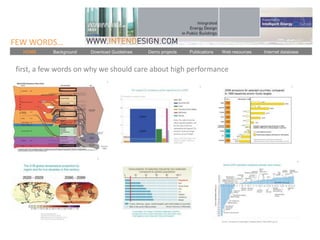
first, a few words on why we should care about high performance
BACKGROUND
  Home     BACKGROUND            Download Guidelines          Demo projects     Publications   Web resources       Internet database

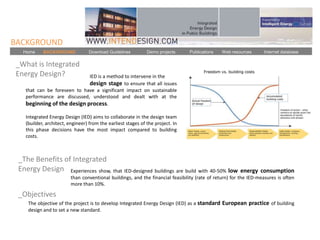
_What is Integrated
Energy Design?               IED is a method to intervene in the
                             design stage to ensure that all issues
   that can be foreseen to have a significant impact on sustainable
   performance are discussed, understood and dealt with at the
   beginning of the design process.

   Integrated Energy Design (IED) aims to collaborate in the design team
   (builder, architect, engineer) from the earliest stages of the project. In
   this phase decisions have the most impact compared to building
   costs.


 _The Benefits of Integrated
 Energy Design Experiences show, that IED-designed buildings are build with 40-50% low                  energy consumption
                         than conventional buildings, and the financial feasibility (rate of return) for the IED-measures is often
                         more than 10%.

 _Objectives
    The objective of the project is to develop Integrated Energy Design (IED) as a standard European practice of building
    design and to set a new standard.
BACKGROUND
  Home   BACKGROUND           Download Guidelines         Demo projects      Publications   Web resources       Internet database


 _Description
 of the work                 Tools and methods for IED will be developed for practical use by the participants involved
                             in a design process (building owners, architects, consulting engineers).
    To demonstrate how IED can be used in practice, the integrated design concept will be carried out in at least 12 building
    projects in the 6 participating countries.

    The IED-guidelines, the results and practical experiences from the demonstration projects will be disseminated
    through seminars and workshops for public real estate organizations and for architect and consulting engineering
    companies in each of the countries.


 _Expected                   It is expected that the project will clearly demonstrate awareness of the usage of IED as an
 results                     important method. The project will show that the design team together with developers
                             and users can provide outstanding results.


  _Targets groups            investors
                             developers/ building owner
                             architect
                             engineers
GUIDELINES
  Home   Background   DOWNLOAD GUIDELINES   Demo projects   Publications   Web resources       Internet database


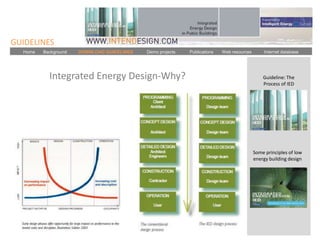
           Integrated Energy Design-Why?                                                       Guideline: The
                                                                                               Process of IED


                                                                                           Some principles of low
                                                                                           energy building design
GUIDELINES
   Home     Background   DOWNLOAD GUIDELINES       Demo projects   Publications   Web resources        Internet database


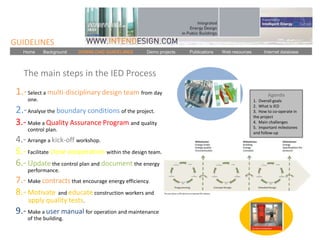
    The main steps in the IED Process
 1.- Select a multi-disciplinary design team from day                                                    Agenda
     one.                                                                                         1. Overall goals
                                                                                                  2. What is IED
 2.- Analyse the boundary conditions of the project.                                              3. How to co-operate in
                                                                                                  the project
 3.- Make a Quality Assurance Program and quality                                                 4. Main challenges
                                                                                                  5. Important milestones
     control plan.                                                                                and follow-up
 4.- Arrange a kick-off workshop.
 5.- Facilitate close cooperation within the design team.
 6.- Update the control plan and document the energy
     performance.
 7.- Make contracts that encourage energy efficiency.
 8.- Motivate and educate construction workers and
     apply quality tests.
 9.- Make a user manual for operation and maintenance
     of the building.
GUIDELINES
    Home   Background   DOWNLOAD GUIDELINES   Demo projects   Publications   Web resources   Internet database


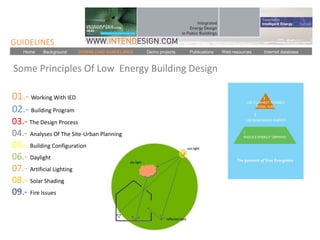
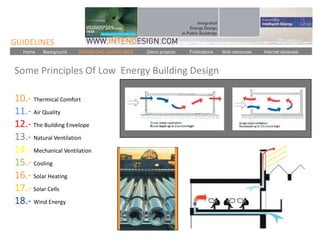
Some Principles Of Low Energy Building Design

01.- Working With IED
02.- Building Program
03.- The Design Process
04.- Analyses Of The Site-Urban Planning
05.- Building Configuration
06.- Daylight
07.- Artificial Lighting
08.- Solar Shading
09.- Fire Issues
GUIDELINES
   Home   Background   DOWNLOAD GUIDELINES   Demo projects   Publications   Web resources   Internet database


Some Principles Of Low Energy Building Design

10.- Thermical Comfort
11.- Air Quality
12.- The Building Envelope
13.- Natural Ventilation
14.- Mechanical Ventilation
15.- Cooling
16.- Solar Heating
17.- Solar Cells
18.- Wind Energy
WEB RESOURCES
                      Download
  Home   Background                 Demo projects   Publications   WEB RESOURCES   Internet database
                      Guidelines


                          Related projects funded by IEE:
INTERNET DATABASE
                       Download
   Home   Background                 Demo projects   Publications   Web resources   INTERNET DATABASE
                       Guidelines


                                                     is a database presenting best
  practice of European sustainable architecture - with a specific focus on integrated
  energy design.
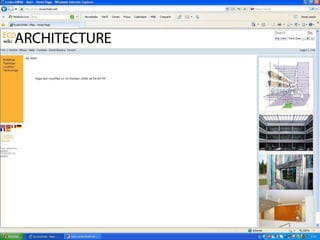
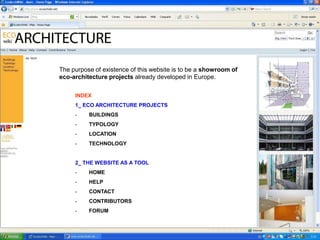
The purpose of existence of this website is to be a showroom of
eco-architecture projects already developed in Europe.

     INDEX
     1_ ECO ARCHITECTURE PROJECTS
     -    BUILDINGS
     -    TYPOLOGY
     -    LOCATION
     -    TECHNOLOGY


     2_ THE WEBSITE AS A TOOL
     -    HOME
     -    HELP
     -    CONTACT
     -    CONTRIBUTORS
     -    FORUM
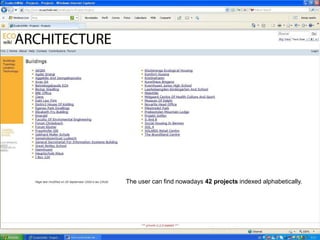
The user can find nowadays 42 projects indexed alphabetically.
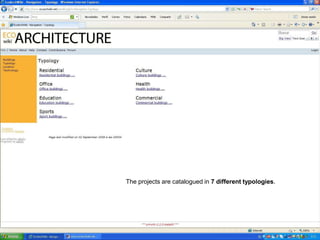
The projects are catalogued in 7 different typologies.
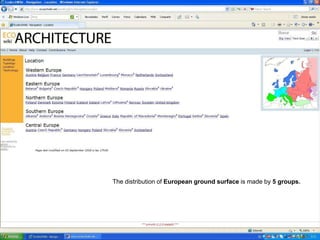
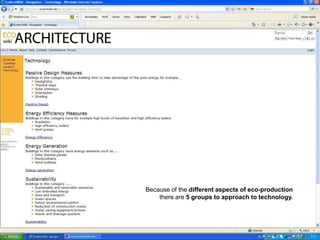
The distribution of European ground surface is made by 5 groups.
Because of the different aspects of eco-production
    there are 5 groups to approach to technology.
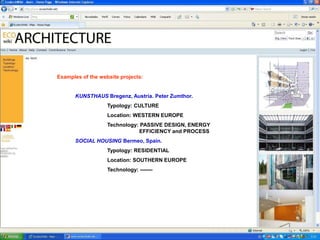
-   Examples of the website projects:


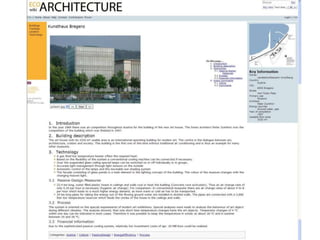
-          KUNSTHAUS Bregenz, Austria. Peter Zumthor.
-                      Typology: CULTURE
-                      Location: WESTERN EUROPE
-                      Technology: PASSIVE DESIGN, ENERGY
                                  EFFICIENCY and PROCESS
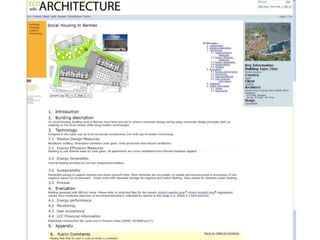
-          SOCIAL HOUSING Bermeo, Spain.
-                      Typology: RESIDENTIAL
-                      Location: SOUTHERN EUROPE
-                      Technology: -------
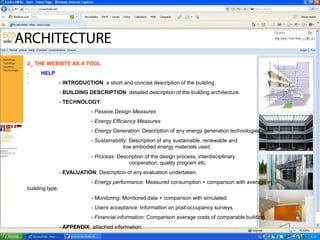
2_ THE WEBSITE AS A TOOL
-     HELP
-                - INTRODUCTION: a short and concise description of the building.
                 - BUILDING DESCRIPTION: detailed description of the building architecture.
                 - TECHNOLOGY:
                              - Passive Design Measures
                              - Energy Efficiency Measures
                              - Energy Generation: Description of any energy generation technologies used.
                              - Sustainability: Description of any sustainable, renewable and
                                             low embodied energy materials used.
                              - Process: Description of the design process, interdisciplinary
                                             cooperation, quality program etc.
                 - EVALUATION: Description of any evaluation undertaken.
                              - Energy performance: Measured consumption + comparison with average in
building type.
                              - Monitoring: Monitored data + comparison with simulated.
                              - Users acceptance: Information on post-occupancy surveys.
                              - Financial information: Comparison average costs of comparable building.
                 - APPENDIX: attached information.
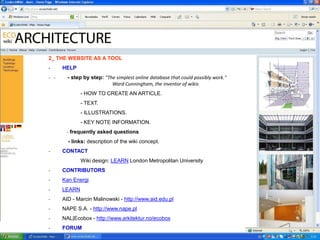
2_ THE WEBSITE AS A TOOL
-     HELP
- -     - step by step: "The simplest online database that could possibly work."
                           Ward Cunningham, the inventor of wikis
              - HOW TO CREATE AN ARTICLE.
              - TEXT.
              - ILLUSTRATIONS.
              - KEY NOTE INFORMATION.
       - frequently asked questions
        - links: description of the wiki concept.
-     CONTACT
              Wiki design: LEARN London Metropolitan University
-     CONTRIBUTORS
-     Kan Energi
-     LEARN
-     AID - Marcin Malinowski - http://www.aid.edu.pl
-     NAPE S.A. - http://www.nape.pl
-     NAL|Ecobox - http://www.arkitektur.no/ecobox
-     FORUM
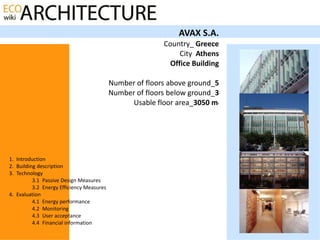
AVAX S.A.
                                                          Country_ Greece
                                                               City Athens
                                                            Office Building

                                           Number of floors above ground_5
                                           Number of floors below ground_3
                                                Usable floor area_3050 m  2


1. Introduction
2. Building description
3. Technology
          3.1 Passive Design Measures
          3.2 Energy Efficiency Measures
4. Evaluation
          4.1 Energy performance
          4.2 Monitoring
          4.3 User acceptance
          4.4 Financial information
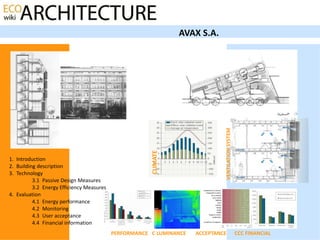
AVAX S.A.


                                                                              VENTILATION SYSTEM
                                                       CLIMATE
1. Introduction
2. Building description
3. Technology
          3.1 Passive Design Measures
          3.2 Energy Efficiency Measures
4. Evaluation
          4.1 Energy performance
          4.2 Monitoring
          4.3 User acceptance
          4.4 Financial information
                                           PERFORMANCE C LUMINANCE   ACCEPTANCE                    CCC FINANCIAL
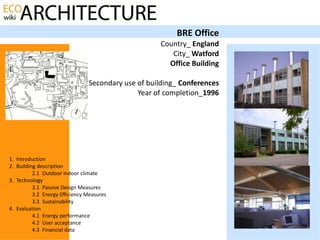
BRE Office
                                                    Country_ England
                                                       City_ Watford
                                                      Office Building

                                Secondary use of building_ Conferences
                                              Year of completion_1996


1. Introduction
2. Building description
          2.1 Outdoor indoor climate
3. Technology
          3.1 Passive Design Measures
          3.2 Energy Efficiency Measures
          3.3 Sustainability
4. Evaluation
          4.1 Energy performance
          4.2 User acceptance
          4.3 Financial data
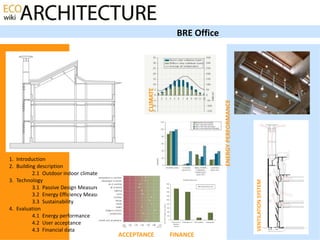
BRE Office


                                                   CLIMATE


                                                                            ENERGY PERFORMANCE
1. Introduction
2. Building description
          2.1 Outdoor indoor climate
3. Technology


                                                                                                 VENTILATION SYSTEM
          3.1 Passive Design Measures
          3.2 Energy Efficiency Measures
          3.3 Sustainability
4. Evaluation
          4.1 Energy performance
          4.2 User acceptance
          4.3 Financial data
                                           ACCEPTANCE        FINANCE
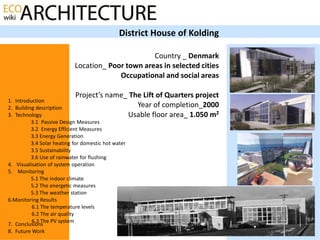
District House of Kolding

                                                   Country _ Denmark
                            Location_ Poor town areas in selected cities
                                         Occupational and social areas

                            Project’s name_ The Lift of Quarters project
1. Introduction
2. Building description                       Year of completion_2000
3. Technology                              Usable floor area_ 1.050 m2
          3.1 Passive Design Measures
          3.2 Energy Efficient Measures
          3.3 Energy Generation
          3.4 Solar heating for domestic hot water
          3.5 Sustainability
          3.6 Use of rainwater for flushing
4. Visualisation of system operation
5. Monitoring
          5.1 The indoor climate
          5.2 The energetic measures
          5.3 The weather station
6.Monitoring Results
          6.1 The temperature levels
          6.2 The air quality
          6.3 The PV system
7. Conclusions
8. Future Work
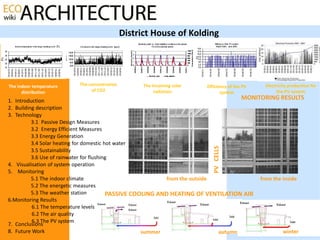
District House of Kolding


The indoor temperature   The concentration         The incoming solar   Efficiency of the PV     Electricity production for
      distribution            of CO2                    radiation              system                  the PV system
1. Introduction
                                                                                         MONITORING RESULTS
2. Building description
3. Technology
          3.1 Passive Design Measures
          3.2 Energy Efficient Measures
          3.3 Energy Generation
          3.4 Solar heating for domestic hot water


                                                                           PV CELLS
          3.5 Sustainability
          3.6 Use of rainwater for flushing
4. Visualisation of system operation
5. Monitoring
          5.1 The indoor climate                             from the outside                  from the inside
          5.2 The energetic measures
          5.3 The weather station         PASSIVE COOLING AND HEATING OF VENTILATION AIR
6.Monitoring Results
          6.1 The temperature levels
          6.2 The air quality
          6.3 The PV system
7. Conclusions
8. Future Work                                       summer                   autumn                     winter
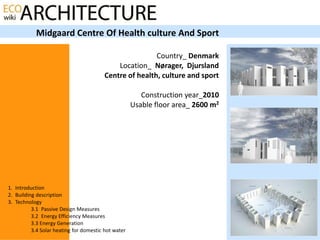
Midgaard Centre Of Health culture And Sport

                                                         Country_ Denmark
                                             Location_ Nørager, Djursland
                                         Centre of health, culture and sport

                                                        Construction year_2010
                                                     Usable floor area_ 2600 m2


1. Introduction
2. Building description
3. Technology
          3.1 Passive Design Measures
          3.2 Energy Efficiency Measures
          3.3 Energy Generation
          3.4 Solar heating for domestic hot water
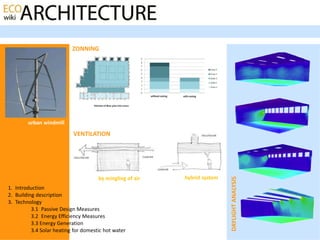
ZONNING


        urban windmill
                           VENTILATION


                                      by mingling of air   hybrid system


                                                                           DAYLIGHT ANALYSIS
1. Introduction
2. Building description
3. Technology
          3.1 Passive Design Measures
          3.2 Energy Efficiency Measures
          3.3 Energy Generation
          3.4 Solar heating for domestic hot water
BIM STORM
 Home      Background    Download Guidelines   Demo projects    Publications   Web resources   Internet database   NEWS


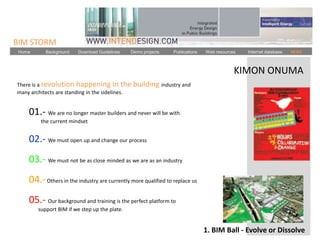
                                                                                           KIMON ONUMA
There is a revolution happening in the           building industry and
many architects are standing in the sidelines.


    01.- We are no longer master builders and never will be with
         the current mindset


    02.- We must open up and change our process
    03.- We must not be as close minded as we are as an industry
    04.- Others in the industry are currently more qualified to replace us
    05.- Our background and training is the perfect platform to
        support BIM if we step up the plate.


                                                                               1. BIM Ball - Evolve or Dissolve
BIM STORM
 Home       Background    Download Guidelines   Demo projects   Publications   Web resources   Internet database   NEWS


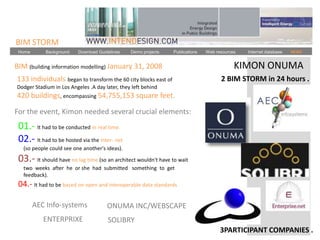
BIM (building information modelling) January 31, 2008                                      KIMON ONUMA
133 individuals began to transform the 60 city blocks east of                        2 BIM STORM in 24 hours .
Dodger Stadium in Los Angeles .A day later, they left behind
420 buildings, encompassing 54,755,153 square feet.

For the event, Kimon needed several crucial elements:
 01.- It had to be conducted in real time.
 02.- It had to be hosted via the Inter- net
   (so people could see one another's ideas).

 03.- It should have no lag time (so an architect wouldn't have to wait
   two weeks after he or she had submitted something to get
   feedback).
 04.- It had to be based on open and interoperable data standards

        AEC Info-systems               ONUMA INC/WEBSCAPE
           ENTERPRIXE                  SOLIBRY
                                                                                     3PARTICIPANT COMPANIES .

Intendesign

  • 1.
    Integrated Energy Design In Public Buildings WWW.INTENDESING.COM Hom Backgroun Download Demo Publicatio Web Internet e d Guidelines projects ns resources database
  • 2.
    FEW WORDS… HOME Background Download Guidelines Demo projects Publications Web resources Internet database first, a few words on why we should care about high performance
  • 3.
    BACKGROUND Home BACKGROUND Download Guidelines Demo projects Publications Web resources Internet database _What is Integrated Energy Design? IED is a method to intervene in the design stage to ensure that all issues that can be foreseen to have a significant impact on sustainable performance are discussed, understood and dealt with at the beginning of the design process. Integrated Energy Design (IED) aims to collaborate in the design team (builder, architect, engineer) from the earliest stages of the project. In this phase decisions have the most impact compared to building costs. _The Benefits of Integrated Energy Design Experiences show, that IED-designed buildings are build with 40-50% low energy consumption than conventional buildings, and the financial feasibility (rate of return) for the IED-measures is often more than 10%. _Objectives The objective of the project is to develop Integrated Energy Design (IED) as a standard European practice of building design and to set a new standard.
  • 4.
    BACKGROUND Home BACKGROUND Download Guidelines Demo projects Publications Web resources Internet database _Description of the work Tools and methods for IED will be developed for practical use by the participants involved in a design process (building owners, architects, consulting engineers). To demonstrate how IED can be used in practice, the integrated design concept will be carried out in at least 12 building projects in the 6 participating countries. The IED-guidelines, the results and practical experiences from the demonstration projects will be disseminated through seminars and workshops for public real estate organizations and for architect and consulting engineering companies in each of the countries. _Expected It is expected that the project will clearly demonstrate awareness of the usage of IED as an results important method. The project will show that the design team together with developers and users can provide outstanding results. _Targets groups investors developers/ building owner architect engineers
  • 5.
    GUIDELINES Home Background DOWNLOAD GUIDELINES Demo projects Publications Web resources Internet database Integrated Energy Design-Why? Guideline: The Process of IED Some principles of low energy building design
  • 6.
    GUIDELINES Home Background DOWNLOAD GUIDELINES Demo projects Publications Web resources Internet database The main steps in the IED Process 1.- Select a multi-disciplinary design team from day Agenda one. 1. Overall goals 2. What is IED 2.- Analyse the boundary conditions of the project. 3. How to co-operate in the project 3.- Make a Quality Assurance Program and quality 4. Main challenges 5. Important milestones control plan. and follow-up 4.- Arrange a kick-off workshop. 5.- Facilitate close cooperation within the design team. 6.- Update the control plan and document the energy performance. 7.- Make contracts that encourage energy efficiency. 8.- Motivate and educate construction workers and apply quality tests. 9.- Make a user manual for operation and maintenance of the building.
  • 7.
    GUIDELINES Home Background DOWNLOAD GUIDELINES Demo projects Publications Web resources Internet database Some Principles Of Low Energy Building Design 01.- Working With IED 02.- Building Program 03.- The Design Process 04.- Analyses Of The Site-Urban Planning 05.- Building Configuration 06.- Daylight 07.- Artificial Lighting 08.- Solar Shading 09.- Fire Issues
  • 8.
    GUIDELINES Home Background DOWNLOAD GUIDELINES Demo projects Publications Web resources Internet database Some Principles Of Low Energy Building Design 10.- Thermical Comfort 11.- Air Quality 12.- The Building Envelope 13.- Natural Ventilation 14.- Mechanical Ventilation 15.- Cooling 16.- Solar Heating 17.- Solar Cells 18.- Wind Energy
  • 9.
    WEB RESOURCES Download Home Background Demo projects Publications WEB RESOURCES Internet database Guidelines Related projects funded by IEE:
  • 10.
    INTERNET DATABASE Download Home Background Demo projects Publications Web resources INTERNET DATABASE Guidelines is a database presenting best practice of European sustainable architecture - with a specific focus on integrated energy design.
  • 12.
    The purpose ofexistence of this website is to be a showroom of eco-architecture projects already developed in Europe. INDEX 1_ ECO ARCHITECTURE PROJECTS - BUILDINGS - TYPOLOGY - LOCATION - TECHNOLOGY 2_ THE WEBSITE AS A TOOL - HOME - HELP - CONTACT - CONTRIBUTORS - FORUM
  • 13.
    The user canfind nowadays 42 projects indexed alphabetically.
  • 14.
    The projects arecatalogued in 7 different typologies.
  • 15.
    The distribution ofEuropean ground surface is made by 5 groups.
  • 16.
    Because of thedifferent aspects of eco-production there are 5 groups to approach to technology.
  • 17.
    - Examples of the website projects: - KUNSTHAUS Bregenz, Austria. Peter Zumthor. - Typology: CULTURE - Location: WESTERN EUROPE - Technology: PASSIVE DESIGN, ENERGY EFFICIENCY and PROCESS - SOCIAL HOUSING Bermeo, Spain. - Typology: RESIDENTIAL - Location: SOUTHERN EUROPE - Technology: -------
  • 20.
    2_ THE WEBSITEAS A TOOL - HELP - - INTRODUCTION: a short and concise description of the building. - BUILDING DESCRIPTION: detailed description of the building architecture. - TECHNOLOGY: - Passive Design Measures - Energy Efficiency Measures - Energy Generation: Description of any energy generation technologies used. - Sustainability: Description of any sustainable, renewable and low embodied energy materials used. - Process: Description of the design process, interdisciplinary cooperation, quality program etc. - EVALUATION: Description of any evaluation undertaken. - Energy performance: Measured consumption + comparison with average in building type. - Monitoring: Monitored data + comparison with simulated. - Users acceptance: Information on post-occupancy surveys. - Financial information: Comparison average costs of comparable building. - APPENDIX: attached information.
  • 21.
    2_ THE WEBSITEAS A TOOL - HELP - - - step by step: "The simplest online database that could possibly work." Ward Cunningham, the inventor of wikis - HOW TO CREATE AN ARTICLE. - TEXT. - ILLUSTRATIONS. - KEY NOTE INFORMATION. - frequently asked questions - links: description of the wiki concept. - CONTACT Wiki design: LEARN London Metropolitan University - CONTRIBUTORS - Kan Energi - LEARN - AID - Marcin Malinowski - http://www.aid.edu.pl - NAPE S.A. - http://www.nape.pl - NAL|Ecobox - http://www.arkitektur.no/ecobox - FORUM
  • 22.
    AVAX S.A. Country_ Greece City Athens Office Building Number of floors above ground_5 Number of floors below ground_3 Usable floor area_3050 m 2 1. Introduction 2. Building description 3. Technology 3.1 Passive Design Measures 3.2 Energy Efficiency Measures 4. Evaluation 4.1 Energy performance 4.2 Monitoring 4.3 User acceptance 4.4 Financial information
  • 23.
    AVAX S.A. VENTILATION SYSTEM CLIMATE 1. Introduction 2. Building description 3. Technology 3.1 Passive Design Measures 3.2 Energy Efficiency Measures 4. Evaluation 4.1 Energy performance 4.2 Monitoring 4.3 User acceptance 4.4 Financial information PERFORMANCE C LUMINANCE ACCEPTANCE CCC FINANCIAL
  • 24.
    BRE Office Country_ England City_ Watford Office Building Secondary use of building_ Conferences Year of completion_1996 1. Introduction 2. Building description 2.1 Outdoor indoor climate 3. Technology 3.1 Passive Design Measures 3.2 Energy Efficiency Measures 3.3 Sustainability 4. Evaluation 4.1 Energy performance 4.2 User acceptance 4.3 Financial data
  • 25.
    BRE Office CLIMATE ENERGY PERFORMANCE 1. Introduction 2. Building description 2.1 Outdoor indoor climate 3. Technology VENTILATION SYSTEM 3.1 Passive Design Measures 3.2 Energy Efficiency Measures 3.3 Sustainability 4. Evaluation 4.1 Energy performance 4.2 User acceptance 4.3 Financial data ACCEPTANCE FINANCE
  • 26.
    District House ofKolding Country _ Denmark Location_ Poor town areas in selected cities Occupational and social areas Project’s name_ The Lift of Quarters project 1. Introduction 2. Building description Year of completion_2000 3. Technology Usable floor area_ 1.050 m2 3.1 Passive Design Measures 3.2 Energy Efficient Measures 3.3 Energy Generation 3.4 Solar heating for domestic hot water 3.5 Sustainability 3.6 Use of rainwater for flushing 4. Visualisation of system operation 5. Monitoring 5.1 The indoor climate 5.2 The energetic measures 5.3 The weather station 6.Monitoring Results 6.1 The temperature levels 6.2 The air quality 6.3 The PV system 7. Conclusions 8. Future Work
  • 27.
    District House ofKolding The indoor temperature The concentration The incoming solar Efficiency of the PV Electricity production for distribution of CO2 radiation system the PV system 1. Introduction MONITORING RESULTS 2. Building description 3. Technology 3.1 Passive Design Measures 3.2 Energy Efficient Measures 3.3 Energy Generation 3.4 Solar heating for domestic hot water PV CELLS 3.5 Sustainability 3.6 Use of rainwater for flushing 4. Visualisation of system operation 5. Monitoring 5.1 The indoor climate from the outside from the inside 5.2 The energetic measures 5.3 The weather station PASSIVE COOLING AND HEATING OF VENTILATION AIR 6.Monitoring Results 6.1 The temperature levels 6.2 The air quality 6.3 The PV system 7. Conclusions 8. Future Work summer autumn winter
  • 28.
    Midgaard Centre OfHealth culture And Sport Country_ Denmark Location_ Nørager, Djursland Centre of health, culture and sport Construction year_2010 Usable floor area_ 2600 m2 1. Introduction 2. Building description 3. Technology 3.1 Passive Design Measures 3.2 Energy Efficiency Measures 3.3 Energy Generation 3.4 Solar heating for domestic hot water
  • 29.
    ZONNING urban windmill VENTILATION by mingling of air hybrid system DAYLIGHT ANALYSIS 1. Introduction 2. Building description 3. Technology 3.1 Passive Design Measures 3.2 Energy Efficiency Measures 3.3 Energy Generation 3.4 Solar heating for domestic hot water
  • 30.
    BIM STORM Home Background Download Guidelines Demo projects Publications Web resources Internet database NEWS KIMON ONUMA There is a revolution happening in the building industry and many architects are standing in the sidelines. 01.- We are no longer master builders and never will be with the current mindset 02.- We must open up and change our process 03.- We must not be as close minded as we are as an industry 04.- Others in the industry are currently more qualified to replace us 05.- Our background and training is the perfect platform to support BIM if we step up the plate. 1. BIM Ball - Evolve or Dissolve
  • 31.
    BIM STORM Home Background Download Guidelines Demo projects Publications Web resources Internet database NEWS BIM (building information modelling) January 31, 2008 KIMON ONUMA 133 individuals began to transform the 60 city blocks east of 2 BIM STORM in 24 hours . Dodger Stadium in Los Angeles .A day later, they left behind 420 buildings, encompassing 54,755,153 square feet. For the event, Kimon needed several crucial elements: 01.- It had to be conducted in real time. 02.- It had to be hosted via the Inter- net (so people could see one another's ideas). 03.- It should have no lag time (so an architect wouldn't have to wait two weeks after he or she had submitted something to get feedback). 04.- It had to be based on open and interoperable data standards AEC Info-systems ONUMA INC/WEBSCAPE ENTERPRIXE SOLIBRY 3PARTICIPANT COMPANIES .