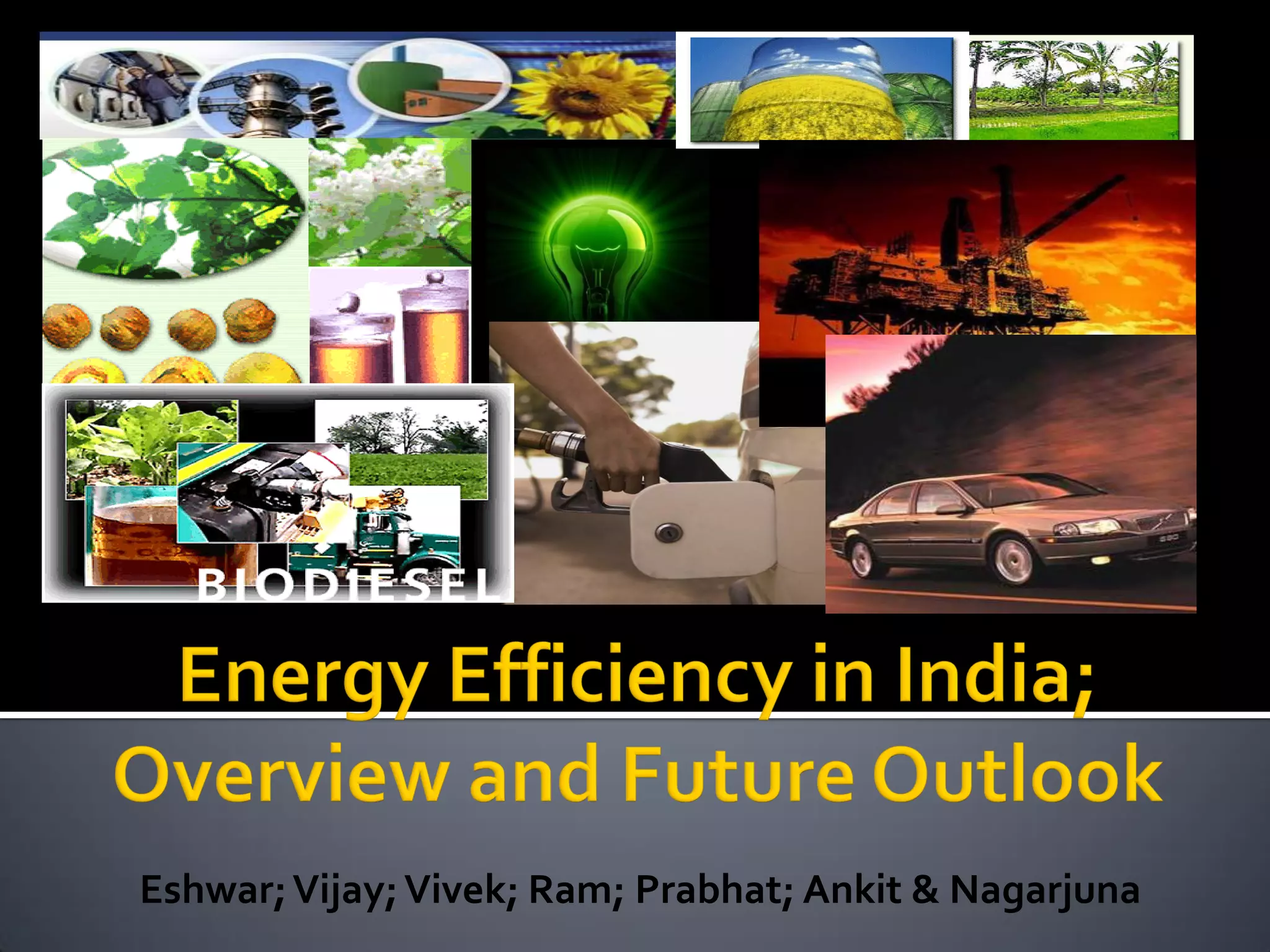
Eshwar;Vijay;Vivek; Ram; Prabhat; Ankit & Nagarjuna
„ 1965 - Energy Survey Committee of India (ESCI)
„ 1974 - Fuel Policy Committee (FPC)
„ 1979 - Working Group on Energy Policy (WGEP)
„ 1983 - Advisory Board on Energy (ABE)
„ 1987 – Advisory Board on Energy Efficiency in PMO
2001- Energy Conservation Act (ECA) – Bureau of Energy
efficiency operationalised in 2002
2008 – National Mission for Enhanced Energy Efficiency
 National Mission for Enhanced Energy Efficiency recently proposed an Energy
Efficiency Action Plan
 Perform Achieve and Trade scheme - market-based mechanism to enhance energy
efficiency
 Market Transformation for Energy Efficiency (MTEE) – CDM roadmap, Standards
and Labeling, ESCO promotion, capacity-building
 Financing Energy Efficiency- Tax exemptions, Revolving fund, Partial Risk
Guarantee Fund
 Power Sector Technology Strategy – fuel-shifting, focus on new as well as old
plants, IGCC demonstration plants,
 Development of know-how for advanced super-critical boilers
 I-1-Enhancing end-use efficiencies
 I-2-Adopting advanced coal- and gas-based power
generating technologies
 I-3-Enhancing the exploitation of renewable and
nuclear energy resources
 I-4 - Enhancing efficiency in the transport sector by
modal shifts
 For More MBA projects follow below link:
http://freembaprojectreports.blogspot.in/
I-2 - Adopting advanced coal- and gas-based power generating technologies
I-3 - Enhancing the exploitation of renewable and nuclear energy resources
I-4 - Enhancing efficiency in the transport sector by modal shifts
Commercial Energy
requirements (million
tones of oil requirement
•The Industrial Sector consumes about half of the total commercial energy available in India,
70% of which is in energy-intensive sectors - fertilizers, aluminium, textiles, cement, iron and
steel, and paper - 15-25% of this is avoidable
•5 - 10% energy saving is possible simply by better housekeeping measures
•Another 10-15% is possible with small investment like low cost retrofits, use of energy efficient
devices and controls etc.
•The quantum of saving is much higher if high cost measures are included (major retrofit, process
modifications etc.)
Industry and transport sectors have the highest potential for energy savings
Sector 2011 2021 2031
Industry 44% 42% 41%
Transport41% 44% 47%
 SSIs – Lack of appropriate technologies, financing
gaps and awareness – Immense potential for energy
efficiency
 Financing Gaps – Lack of technical knowledge in the
financial sectors makes financing for energy efficient
technologies a challenge
 Range of domestic energy-efficient technologies
across sectors
 Potential for increased role for ESCOs
 Lack of information
 Financial barriers
 Institutional Barriers
 Regulatory Barriers
 Technology and Access Barriers
 Energy Intensive sectors- Japanese technologies in energy intensive
industries – Japanese Steel industry can produce one ton of steel using 20
percent less fuel than American steelmakers, Paper industry is using waste-
based or alternative energies for 38 percent of its power
 SSIs – energy intensive SSIs include ceramic and glass industry, foundry,
forging, brick manufacture, food-processing - factories in the small-scale
sector in India are generally less efficient compared
 To larger enterprises, or to enterprises of equivalent capacity in other
countries - lack of technical capacity in these enterprises to identify,
access, and adopt better technologies and operating practices
 Projected Increasing demand in the Indian industry, combined with the
recent government initiatives, provide immense potential for technology
partnerships
 Increasing energy requirements
 Climate Change and other Environmental considerations
Energy Security
 Lack of Adequate Supply Options
Large scope for energy efficiency measures
 Population : 2500
 Before 1975 : 70 acres of land was irrigate, hardly one crop a year
 After 1975 : About 2500 acres of land is irrigated and 2 crops a year
 A model of environmental conservation
 Shramshakti dwara Gramin Vikas (Rural Development through Labour)
 Watershed development .
 Today a major pie of agricultural exports are from Ralegan sidhi
 Grain bank, a Milk bank
 Adarsh Gaon Yojana
 For energy , the village uses solar power, bio gas (Some
generated from the community toilet) and a windmill.
 The project is heralded as a sustainable model of a village
republic.
 Anna was awarded with Padmabhusan & Padmasri.
 Looking for More Academic MBA Projects ???
CLICK HERE to Download Free MBA Marketing
Project Reports, MBA HR Management Project
reports, MBA Supply Chain Management
Projects, MBA logistics Management Project
works

Energy Efficiency Initiatives in India

  • 1.
  • 2.
    „ 1965 -Energy Survey Committee of India (ESCI) „ 1974 - Fuel Policy Committee (FPC) „ 1979 - Working Group on Energy Policy (WGEP) „ 1983 - Advisory Board on Energy (ABE) „ 1987 – Advisory Board on Energy Efficiency in PMO 2001- Energy Conservation Act (ECA) – Bureau of Energy efficiency operationalised in 2002 2008 – National Mission for Enhanced Energy Efficiency
  • 3.
     National Missionfor Enhanced Energy Efficiency recently proposed an Energy Efficiency Action Plan  Perform Achieve and Trade scheme - market-based mechanism to enhance energy efficiency  Market Transformation for Energy Efficiency (MTEE) – CDM roadmap, Standards and Labeling, ESCO promotion, capacity-building  Financing Energy Efficiency- Tax exemptions, Revolving fund, Partial Risk Guarantee Fund  Power Sector Technology Strategy – fuel-shifting, focus on new as well as old plants, IGCC demonstration plants,  Development of know-how for advanced super-critical boilers
  • 4.
     I-1-Enhancing end-useefficiencies  I-2-Adopting advanced coal- and gas-based power generating technologies  I-3-Enhancing the exploitation of renewable and nuclear energy resources  I-4 - Enhancing efficiency in the transport sector by modal shifts  For More MBA projects follow below link: http://freembaprojectreports.blogspot.in/ I-2 - Adopting advanced coal- and gas-based power generating technologies I-3 - Enhancing the exploitation of renewable and nuclear energy resources I-4 - Enhancing efficiency in the transport sector by modal shifts Commercial Energy requirements (million tones of oil requirement
  • 6.
    •The Industrial Sectorconsumes about half of the total commercial energy available in India, 70% of which is in energy-intensive sectors - fertilizers, aluminium, textiles, cement, iron and steel, and paper - 15-25% of this is avoidable •5 - 10% energy saving is possible simply by better housekeeping measures •Another 10-15% is possible with small investment like low cost retrofits, use of energy efficient devices and controls etc. •The quantum of saving is much higher if high cost measures are included (major retrofit, process modifications etc.) Industry and transport sectors have the highest potential for energy savings Sector 2011 2021 2031 Industry 44% 42% 41% Transport41% 44% 47%
  • 7.
     SSIs –Lack of appropriate technologies, financing gaps and awareness – Immense potential for energy efficiency  Financing Gaps – Lack of technical knowledge in the financial sectors makes financing for energy efficient technologies a challenge  Range of domestic energy-efficient technologies across sectors  Potential for increased role for ESCOs
  • 8.
     Lack ofinformation  Financial barriers  Institutional Barriers  Regulatory Barriers  Technology and Access Barriers
  • 9.
     Energy Intensivesectors- Japanese technologies in energy intensive industries – Japanese Steel industry can produce one ton of steel using 20 percent less fuel than American steelmakers, Paper industry is using waste- based or alternative energies for 38 percent of its power  SSIs – energy intensive SSIs include ceramic and glass industry, foundry, forging, brick manufacture, food-processing - factories in the small-scale sector in India are generally less efficient compared  To larger enterprises, or to enterprises of equivalent capacity in other countries - lack of technical capacity in these enterprises to identify, access, and adopt better technologies and operating practices  Projected Increasing demand in the Indian industry, combined with the recent government initiatives, provide immense potential for technology partnerships
  • 10.
     Increasing energyrequirements  Climate Change and other Environmental considerations Energy Security  Lack of Adequate Supply Options Large scope for energy efficiency measures
  • 11.
     Population :2500  Before 1975 : 70 acres of land was irrigate, hardly one crop a year  After 1975 : About 2500 acres of land is irrigated and 2 crops a year  A model of environmental conservation  Shramshakti dwara Gramin Vikas (Rural Development through Labour)  Watershed development .  Today a major pie of agricultural exports are from Ralegan sidhi  Grain bank, a Milk bank
  • 12.
     Adarsh GaonYojana  For energy , the village uses solar power, bio gas (Some generated from the community toilet) and a windmill.  The project is heralded as a sustainable model of a village republic.  Anna was awarded with Padmabhusan & Padmasri.
  • 13.
     Looking forMore Academic MBA Projects ??? CLICK HERE to Download Free MBA Marketing Project Reports, MBA HR Management Project reports, MBA Supply Chain Management Projects, MBA logistics Management Project works