THE GLOBAL OIL & GAS INDUSTRY: PROSPECTS
    & CHALLENGES IN THE NEXT DECADE


                    Presented By: Theophilus Acheampong
                                              Aberdeen
                                           July 12, 2011
PRESENTATION OVERVIEW
     The Global Oil & Gas Value Chain

     Major Changes within the Oil and Gas Industry

     Company Strategy Framework

     Barriers to Change Within the Business

     Overcoming the Barriers to Change

     Summary and Conclusions

     Appendix


2
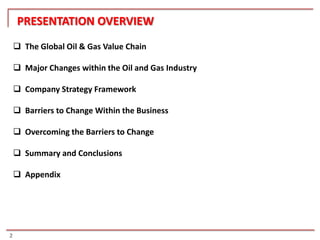
The Global Oil & Gas Value Chain
                          Upstream
                          Oil & Gas


                                                       Mid Stream

─ Exploration
─ Field Development
─ Production Operations
                                                                                    Downstream

                          ─ Transportation
                          ─ Processing
                          ─ Storage & Distribution


                                                     ─ Manufacturing
                                                     ─ Refining & Petro-Chemicals
                                                     ─ Wholesale & Marketing

3
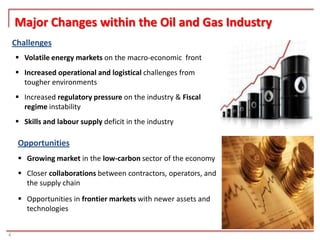
Major Changes within the Oil and Gas Industry
    Challenges
     Volatile energy markets on the macro-economic front
     Increased operational and logistical challenges from
      tougher environments
     Increased regulatory pressure on the industry & Fiscal
      regime instability
     Skills and labour supply deficit in the industry

     Opportunities
      Growing market in the low-carbon sector of the economy
      Closer collaborations between contractors, operators, and
       the supply chain
      Opportunities in frontier markets with newer assets and
       technologies


4
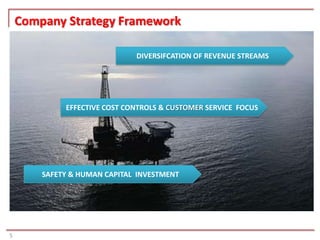
Company Strategy Framework

                              DIVERSIFCATION OF REVENUE STREAMS


             EFFECTIVE COST CONTROLS & CUSTOMER SERVICE FOCUS


        SAFETY & HUMAN CAPITAL INVESTMENT


5
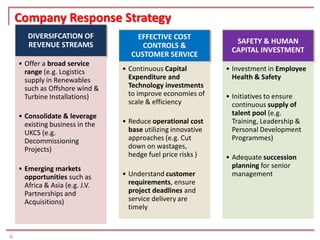
Company Response Strategy
       DIVERSIFCATION OF            EFFECTIVE COST
       REVENUE STREAMS                                           SAFETY & HUMAN
                                      CONTROLS &
                                                                CAPITAL INVESTMENT
                                   CUSTOMER SERVICE
    • Offer a broad service
      range (e.g. Logistics      • Continuous Capital          • Investment in Employee
      supply in Renewables         Expenditure and               Health & Safety
      such as Offshore wind &      Technology investments
      Turbine Installations)       to improve economies of     • Initiatives to ensure
                                   scale & efficiency            continuous supply of
    • Consolidate & leverage                                     talent pool (e.g.
      existing business in the   • Reduce operational cost       Training, Leadership &
      UKCS (e.g.                   base utilizing innovative     Personal Development
      Decommissioning              approaches (e.g. Cut          Programmes)
      Projects)                    down on wastages,
                                   hedge fuel price risks )    • Adequate succession
    • Emerging markets                                           planning for senior
      opportunities such as      • Understand customer           management
      Africa & Asia (e.g. J.V.     requirements, ensure
      Partnerships and             project deadlines and
      Acquisitions)                service delivery are
                                   timely


6
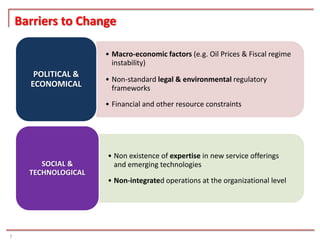
Barriers to Change

                      • Macro-economic factors (e.g. Oil Prices & Fiscal regime
                        instability)
       POLITICAL &
                      • Non-standard legal & environmental regulatory
      ECONOMICAL        frameworks
                      • Financial and other resource constraints


                      • Non existence of expertise in new service offerings
         SOCIAL &       and emerging technologies
      TECHNOLOGICAL
                      • Non-integrated operations at the organizational level


7
Overcoming the Barriers to Change
    Utilize integrated logistics policies to cut down project
     timelines.

    Bespoke risk & asset management strategies to address
     capital allocation decisions.

    Membership of industry bodies such as Oil & Gas UK to
     advocate on behalf of industry.

    Effective communication strategies to understand employee
     & customer needs.

    Training and human capital development.


8
Summary & Conclusions
 Price Risks, Capital Investments and Sustainable development
  will be industry drivers in the coming decade.

 Company strategy should focus on:
   ― Diversification of Revenue Streams
   ― Effective Cost Controls &Customer Service Excellence
   ― Safety & Human Capital Investment

 Benchmarks on supply chain focus, operational excellence, &
  regulatory compliance.

 UKCS will be pivotal in building on core competencies.

 Future growth in the industry will come from investments in new
  assets, technology & people.


9
Thank You:


Questions?
Resources & Other Useful links


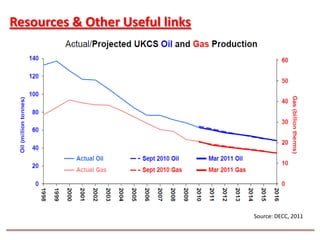
                                 Source: DECC, 2011
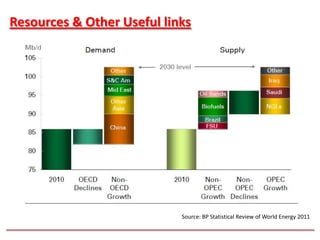
Resources & Other Useful links


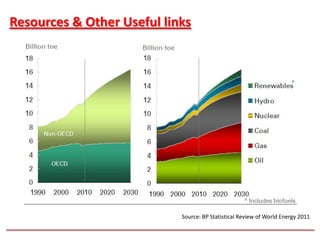
                            Source: BP Statistical Review of World Energy 2011
Resources & Other Useful links


                            Source: BP Statistical Review of World Energy 2011
Resources & Other Useful links
1.   http://www.oilandgasuk.co.uk/knowledgecentre/supplychain.cfm
2.   http://www.spe.org/jpt/print/archives/2011/04/16TalentTechnology.pdf
3.   http://www.pwc.com/en_GX/gx/transportation-logistics/pdf/hoisting-the-sails_final.pdf
4.   http://ax4energy.com/LinkClick.aspx?fileticket=vbON1Pl4Kj4%3D&tabid=67
5.   http://www.kpmg.no/arch/_img/9448852.pdf
6.   http://www.deloitte.com/assets/Dcom-
     Australia/Local%20Assets/Documents/Services/Risk%20services/220909_Deloitte_Oil_and_gas_reality_check.
     pdf
7.   http://www.ey.com/Publication/vwLUAssets/Top_10_risks_affecting_oil_and_gas_in_2010/$File/The%20top%
     2010%20risks%20for%20oil%20and%20gas.pdf
8.   http://www.energyinst.org/information-centre
9.   http://www.economist.com/node/4489659
10. http://www.abdn.ac.uk/~pec144/acreef/publications.html
11. http://www.bp.com/liveassets/bp_internet/globalbp/globalbp_uk_english/reports_and_publications/statistica
     l_energy_review_2011/STAGING/local_assets/pdf/2030_energy_outlook_booklet.pdf
12. https://www.og.decc.gov.uk/

THE GLOBAL OIL & GAS INDUSTRY: PROSPECTS & CHALLENGES IN THE NEXT DECADE

  • 1.
    THE GLOBAL OIL& GAS INDUSTRY: PROSPECTS & CHALLENGES IN THE NEXT DECADE Presented By: Theophilus Acheampong Aberdeen July 12, 2011
  • 2.
    PRESENTATION OVERVIEW  The Global Oil & Gas Value Chain  Major Changes within the Oil and Gas Industry  Company Strategy Framework  Barriers to Change Within the Business  Overcoming the Barriers to Change  Summary and Conclusions  Appendix 2
  • 3.
    The Global Oil& Gas Value Chain Upstream Oil & Gas Mid Stream ─ Exploration ─ Field Development ─ Production Operations Downstream ─ Transportation ─ Processing ─ Storage & Distribution ─ Manufacturing ─ Refining & Petro-Chemicals ─ Wholesale & Marketing 3
  • 4.
    Major Changes withinthe Oil and Gas Industry Challenges  Volatile energy markets on the macro-economic front  Increased operational and logistical challenges from tougher environments  Increased regulatory pressure on the industry & Fiscal regime instability  Skills and labour supply deficit in the industry Opportunities  Growing market in the low-carbon sector of the economy  Closer collaborations between contractors, operators, and the supply chain  Opportunities in frontier markets with newer assets and technologies 4
  • 5.
    Company Strategy Framework DIVERSIFCATION OF REVENUE STREAMS EFFECTIVE COST CONTROLS & CUSTOMER SERVICE FOCUS SAFETY & HUMAN CAPITAL INVESTMENT 5
  • 6.
    Company Response Strategy DIVERSIFCATION OF EFFECTIVE COST REVENUE STREAMS SAFETY & HUMAN CONTROLS & CAPITAL INVESTMENT CUSTOMER SERVICE • Offer a broad service range (e.g. Logistics • Continuous Capital • Investment in Employee supply in Renewables Expenditure and Health & Safety such as Offshore wind & Technology investments Turbine Installations) to improve economies of • Initiatives to ensure scale & efficiency continuous supply of • Consolidate & leverage talent pool (e.g. existing business in the • Reduce operational cost Training, Leadership & UKCS (e.g. base utilizing innovative Personal Development Decommissioning approaches (e.g. Cut Programmes) Projects) down on wastages, hedge fuel price risks ) • Adequate succession • Emerging markets planning for senior opportunities such as • Understand customer management Africa & Asia (e.g. J.V. requirements, ensure Partnerships and project deadlines and Acquisitions) service delivery are timely 6
  • 7.
    Barriers to Change • Macro-economic factors (e.g. Oil Prices & Fiscal regime instability) POLITICAL & • Non-standard legal & environmental regulatory ECONOMICAL frameworks • Financial and other resource constraints • Non existence of expertise in new service offerings SOCIAL & and emerging technologies TECHNOLOGICAL • Non-integrated operations at the organizational level 7
  • 8.
    Overcoming the Barriersto Change  Utilize integrated logistics policies to cut down project timelines.  Bespoke risk & asset management strategies to address capital allocation decisions.  Membership of industry bodies such as Oil & Gas UK to advocate on behalf of industry.  Effective communication strategies to understand employee & customer needs.  Training and human capital development. 8
  • 9.
    Summary & Conclusions Price Risks, Capital Investments and Sustainable development will be industry drivers in the coming decade.  Company strategy should focus on: ― Diversification of Revenue Streams ― Effective Cost Controls &Customer Service Excellence ― Safety & Human Capital Investment  Benchmarks on supply chain focus, operational excellence, & regulatory compliance.  UKCS will be pivotal in building on core competencies.  Future growth in the industry will come from investments in new assets, technology & people. 9
  • 10.
  • 11.
    Resources & OtherUseful links Source: DECC, 2011
  • 12.
    Resources & OtherUseful links Source: BP Statistical Review of World Energy 2011
  • 13.
    Resources & OtherUseful links Source: BP Statistical Review of World Energy 2011
  • 14.
    Resources & OtherUseful links 1. http://www.oilandgasuk.co.uk/knowledgecentre/supplychain.cfm 2. http://www.spe.org/jpt/print/archives/2011/04/16TalentTechnology.pdf 3. http://www.pwc.com/en_GX/gx/transportation-logistics/pdf/hoisting-the-sails_final.pdf 4. http://ax4energy.com/LinkClick.aspx?fileticket=vbON1Pl4Kj4%3D&tabid=67 5. http://www.kpmg.no/arch/_img/9448852.pdf 6. http://www.deloitte.com/assets/Dcom- Australia/Local%20Assets/Documents/Services/Risk%20services/220909_Deloitte_Oil_and_gas_reality_check. pdf 7. http://www.ey.com/Publication/vwLUAssets/Top_10_risks_affecting_oil_and_gas_in_2010/$File/The%20top% 2010%20risks%20for%20oil%20and%20gas.pdf 8. http://www.energyinst.org/information-centre 9. http://www.economist.com/node/4489659 10. http://www.abdn.ac.uk/~pec144/acreef/publications.html 11. http://www.bp.com/liveassets/bp_internet/globalbp/globalbp_uk_english/reports_and_publications/statistica l_energy_review_2011/STAGING/local_assets/pdf/2030_energy_outlook_booklet.pdf 12. https://www.og.decc.gov.uk/