Devitt and Genre Analysis

       Monday, 5/21
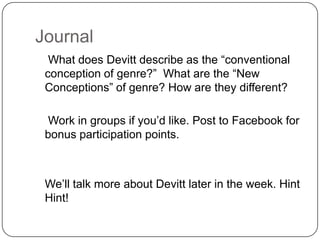
Journal
  What does Devitt describe as the “conventional
 conception of genre?” What are the “New
 Conceptions” of genre? How are they different?

  Work in groups if you’d like. Post to Facebook for
 bonus participation points.


 We’ll talk more about Devitt later in the week. Hint
 Hint!
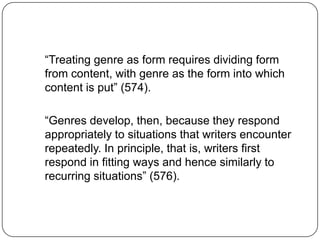
“Treating genre as form requires dividing form
from content, with genre as the form into which
content is put” (574).

“Genres develop, then, because they respond
appropriately to situations that writers encounter
repeatedly. In principle, that is, writers first
respond in fitting ways and hence similarly to
recurring situations” (576).
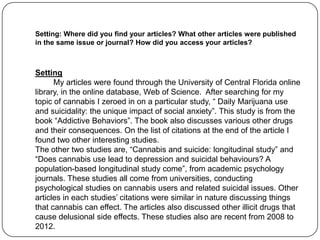
Setting: Where did you find your articles? What other articles were published
in the same issue or journal? How did you access your articles?


Setting
      My articles were found through the University of Central Florida online
library, in the online database, Web of Science. After searching for my
topic of cannabis I zeroed in on a particular study, “ Daily Marijuana use
and suicidality: the unique impact of social anxiety”. This study is from the
book “Addictive Behaviors”. The book also discusses various other drugs
and their consequences. On the list of citations at the end of the article I
found two other interesting studies.
The other two studies are, “Cannabis and suicide: longitudinal study” and
“Does cannabis use lead to depression and suicidal behaviours? A
population-based longitudinal study come”, from academic psychology
journals. These studies all come from universities, conducting
psychological studies on cannabis users and related suicidal issues. Other
articles in each studies’ citations were similar in nature discussing things
that cannabis can effect. The articles also discussed other illicit drugs that
cause delusional side effects. These studies also are recent from 2008 to
2012.
Subject: What topic(s) are discussed in your articles? What
issues, ideas, questions are addressed? When people read these
articles, what are they discussing?


Subject:
The article “Inpatient Psychiatric Treatment of Deaf Adults: Demographic
and Diagnostic Comparisons with Hearing Inpatients” by Sarah A.
Landsberger and David R Diaz and the article “Special Issues
Regarding Psychotherapy with the Deaf” by Micheael F Hoyt, Ellen Y.
Siegelman, and Hilde S. Schlesinger are both about the difficulties
philologists face when communicating and diagnosing deaf patients.
The third article “Comprehensive Mental Health Servives for the deaf
People with Major Mental illness” is explaining the program called
Thresholds that was created to help solve these difficulties. “Inpatient
Psychiatric Treatment of Deaf Adults: Demographic and Diagnostic
Comparisons with Hearing Inpatients” discusses a study that they
conducted analyzing the differences in diagnoses of a group of deaf
patients and a group of hearing patients. “Special Issues Regarding
Psychotherapy with the Deaf” mainly discussed some of the main
differences in treating a hearing person versus a deaf person. Someone
may read this when acquiring a deaf patient for the first time.
Participants: Who typically reads this journal? Who would be
interested in these articles? What characteristics must readers of this--
of this genre possess? Who writes texts in this genre? Who are the
authors (this might require you to do some outside research on the
authors)?
  Participants
  The authors of these studies are professors at the university level and
  psychiatrists. The professors are specifically psychology, sociology and
  human geography professors. These authors are from various universities
  such as University of Vermont, Florida State University, Louisiana State
  University and University of Oslo. The participants are from different
  countries including the US, Britain and Norway. The psychiatrists are from
  the Royal College of Psychiatrists in Britain.
  These studies are read by other psychology professors, sociology
  professors, psychiatrists, social workers and medical personnel. The
  study provides for a larger audience because it focuses on the
  psychological aspects of cannabis as well as the experimental/scientific
  aspects. The participants would be looking for scientific and intellectual
  information regarding societal use of cannabis. This study is also for
  psychologists or scientists to compare results with similar studies that they
  have conducted. The third study discussed for example is from Norway,
  American scholars may be looking to compare cannabis effects
  internationally.
Participants: Who typically reads this journal? Who would be
interested in these articles? What characteristics must readers of
this--of this genre possess? Who writes texts in this genre? Who
are the authors (this might require you to do some outside
research on the authors)?

Participants
When reading these articles the reader may be interested in deaf
psychiatry. They may be a student, such as myself, looking to go into the
research or the reader may be a mother of a deaf child who wants to
place them into some therapy. The common thread between the readers
would be some interest in the deaf and the problems they face when
communicating and how this and difference in culture may lead to a
misdiagnosis. The writers of these journals are mainly researchers that
have conducted studies on these topics. Sarah A. Landsberger and David
R. Diaz work at Indiana University School of Medicine in the psychiatry
department. Michael F. Hoyt Ellen Y. Siegelman and Hide S. Schlesinger
have each written a couple books on psychotherapy.
Features: What recurrent features do the articles share? For example, what content
is typically included? What is excluded? How is the content treated? How is evidence
provided? How are sources cited? What sorts of examples are used? In what format
are the texts of the genre presented? What layout or appearance is common? How
long are the texts? Are the sentences varied? Is a type of jargon used? How would
you describe the writer’s voice? What counts as evidence (personal testimony, facts,
etc.)?

Features
These studies all have similar formats. The studies include an
abstract, introduction, followed by method, results and conclusion of the
study. Each study uses graphs, charts and surveys that must be
dissected. The studies follow a true constancy in terms of scientific
method. The studies each ask a question and see if they can answer the
question through an experiment and analysis. The studies are straight to
the point with method, results and conclusion. The information is mainly
factual with examples and visual aids dealing with statistics.
 The language in each study is technical and hard to read for a non-
specialist. For example, “A hierarchical linear regression analysis was
conducted to examine whether social anxiety interacted with marijuana
use status (current users vs abstainers) to predict suicidality.” A non-
specialist may not know what a hierarchical linear regression is. All of the
articles have extensive citations at the end of their readings indicating
how much research went into the each study. Some of studies have the
authors and their prospective universities in the beginning for
Patterns: What do the genre features that you discussed reveal about the genre and the
situation in which it is used? Why are these patterns significant? What do the patterns
say about the people who use them, and how do you know? What arguments can you
make about these patterns? What do the readers of this genre have to know or believe
to understand or appreciate the genre? What values, beliefs, goals, and assumptions
are revealed through the genre’s patterns? What actions does the genre make
possible? What attitude toward readers is implied in the genre? What attitude toward
the world is implied in it?

Patterns:
The features show that the authors of these journals allow the readers to
be able to jump through and skim the journal to find the area that the
reader may be most interested in such as results or discussion. They
each have a section on the differences of having a hearing patient and a
deaf patient because this may be a focus for many readers having just
encountered a deaf patient. The focus on statistics and results show that
the importance they place on factual evidence to support their claims.
They also state the doctor’s names and past studies to increase the
credibility of their research. They do include a section of error that could
not be controlled within their study. This shows that they are concerned
with correctly informing the reader to the research to not falsely sway
their opinions.
Guidelines
 Length is not important, but details are


 Use MLA heading format for now (your name, my
 name, course name, date)

 Don’t worry about citations until tomorrow


 Use examples!
What now?
 Work on your draft, and ask questions


 Bring laptops tomorrow, with your draft saved so
 that you can peer review

 You can print a hard copy if you don’t want to use
 laptops for peer review

 Final copy printed for class on Wednesday!

Enc 1102 may 21

  • 1.
    Devitt and GenreAnalysis Monday, 5/21
  • 2.
    Journal Whatdoes Devitt describe as the “conventional conception of genre?” What are the “New Conceptions” of genre? How are they different? Work in groups if you’d like. Post to Facebook for bonus participation points. We’ll talk more about Devitt later in the week. Hint Hint!
  • 3.
    “Treating genre asform requires dividing form from content, with genre as the form into which content is put” (574). “Genres develop, then, because they respond appropriately to situations that writers encounter repeatedly. In principle, that is, writers first respond in fitting ways and hence similarly to recurring situations” (576).
  • 4.
    Setting: Where didyou find your articles? What other articles were published in the same issue or journal? How did you access your articles? Setting My articles were found through the University of Central Florida online library, in the online database, Web of Science. After searching for my topic of cannabis I zeroed in on a particular study, “ Daily Marijuana use and suicidality: the unique impact of social anxiety”. This study is from the book “Addictive Behaviors”. The book also discusses various other drugs and their consequences. On the list of citations at the end of the article I found two other interesting studies. The other two studies are, “Cannabis and suicide: longitudinal study” and “Does cannabis use lead to depression and suicidal behaviours? A population-based longitudinal study come”, from academic psychology journals. These studies all come from universities, conducting psychological studies on cannabis users and related suicidal issues. Other articles in each studies’ citations were similar in nature discussing things that cannabis can effect. The articles also discussed other illicit drugs that cause delusional side effects. These studies also are recent from 2008 to 2012.
  • 5.
    Subject: What topic(s)are discussed in your articles? What issues, ideas, questions are addressed? When people read these articles, what are they discussing? Subject: The article “Inpatient Psychiatric Treatment of Deaf Adults: Demographic and Diagnostic Comparisons with Hearing Inpatients” by Sarah A. Landsberger and David R Diaz and the article “Special Issues Regarding Psychotherapy with the Deaf” by Micheael F Hoyt, Ellen Y. Siegelman, and Hilde S. Schlesinger are both about the difficulties philologists face when communicating and diagnosing deaf patients. The third article “Comprehensive Mental Health Servives for the deaf People with Major Mental illness” is explaining the program called Thresholds that was created to help solve these difficulties. “Inpatient Psychiatric Treatment of Deaf Adults: Demographic and Diagnostic Comparisons with Hearing Inpatients” discusses a study that they conducted analyzing the differences in diagnoses of a group of deaf patients and a group of hearing patients. “Special Issues Regarding Psychotherapy with the Deaf” mainly discussed some of the main differences in treating a hearing person versus a deaf person. Someone may read this when acquiring a deaf patient for the first time.
  • 6.
    Participants: Who typicallyreads this journal? Who would be interested in these articles? What characteristics must readers of this-- of this genre possess? Who writes texts in this genre? Who are the authors (this might require you to do some outside research on the authors)? Participants The authors of these studies are professors at the university level and psychiatrists. The professors are specifically psychology, sociology and human geography professors. These authors are from various universities such as University of Vermont, Florida State University, Louisiana State University and University of Oslo. The participants are from different countries including the US, Britain and Norway. The psychiatrists are from the Royal College of Psychiatrists in Britain. These studies are read by other psychology professors, sociology professors, psychiatrists, social workers and medical personnel. The study provides for a larger audience because it focuses on the psychological aspects of cannabis as well as the experimental/scientific aspects. The participants would be looking for scientific and intellectual information regarding societal use of cannabis. This study is also for psychologists or scientists to compare results with similar studies that they have conducted. The third study discussed for example is from Norway, American scholars may be looking to compare cannabis effects internationally.
  • 7.
    Participants: Who typicallyreads this journal? Who would be interested in these articles? What characteristics must readers of this--of this genre possess? Who writes texts in this genre? Who are the authors (this might require you to do some outside research on the authors)? Participants When reading these articles the reader may be interested in deaf psychiatry. They may be a student, such as myself, looking to go into the research or the reader may be a mother of a deaf child who wants to place them into some therapy. The common thread between the readers would be some interest in the deaf and the problems they face when communicating and how this and difference in culture may lead to a misdiagnosis. The writers of these journals are mainly researchers that have conducted studies on these topics. Sarah A. Landsberger and David R. Diaz work at Indiana University School of Medicine in the psychiatry department. Michael F. Hoyt Ellen Y. Siegelman and Hide S. Schlesinger have each written a couple books on psychotherapy.
  • 8.
    Features: What recurrentfeatures do the articles share? For example, what content is typically included? What is excluded? How is the content treated? How is evidence provided? How are sources cited? What sorts of examples are used? In what format are the texts of the genre presented? What layout or appearance is common? How long are the texts? Are the sentences varied? Is a type of jargon used? How would you describe the writer’s voice? What counts as evidence (personal testimony, facts, etc.)? Features These studies all have similar formats. The studies include an abstract, introduction, followed by method, results and conclusion of the study. Each study uses graphs, charts and surveys that must be dissected. The studies follow a true constancy in terms of scientific method. The studies each ask a question and see if they can answer the question through an experiment and analysis. The studies are straight to the point with method, results and conclusion. The information is mainly factual with examples and visual aids dealing with statistics. The language in each study is technical and hard to read for a non- specialist. For example, “A hierarchical linear regression analysis was conducted to examine whether social anxiety interacted with marijuana use status (current users vs abstainers) to predict suicidality.” A non- specialist may not know what a hierarchical linear regression is. All of the articles have extensive citations at the end of their readings indicating how much research went into the each study. Some of studies have the authors and their prospective universities in the beginning for
  • 9.
    Patterns: What dothe genre features that you discussed reveal about the genre and the situation in which it is used? Why are these patterns significant? What do the patterns say about the people who use them, and how do you know? What arguments can you make about these patterns? What do the readers of this genre have to know or believe to understand or appreciate the genre? What values, beliefs, goals, and assumptions are revealed through the genre’s patterns? What actions does the genre make possible? What attitude toward readers is implied in the genre? What attitude toward the world is implied in it? Patterns: The features show that the authors of these journals allow the readers to be able to jump through and skim the journal to find the area that the reader may be most interested in such as results or discussion. They each have a section on the differences of having a hearing patient and a deaf patient because this may be a focus for many readers having just encountered a deaf patient. The focus on statistics and results show that the importance they place on factual evidence to support their claims. They also state the doctor’s names and past studies to increase the credibility of their research. They do include a section of error that could not be controlled within their study. This shows that they are concerned with correctly informing the reader to the research to not falsely sway their opinions.
  • 10.
    Guidelines  Length isnot important, but details are  Use MLA heading format for now (your name, my name, course name, date)  Don’t worry about citations until tomorrow  Use examples!
  • 11.
    What now?  Workon your draft, and ask questions  Bring laptops tomorrow, with your draft saved so that you can peer review  You can print a hard copy if you don’t want to use laptops for peer review  Final copy printed for class on Wednesday!