
Starting your
Genre Analysis
Tuesday, August 4th
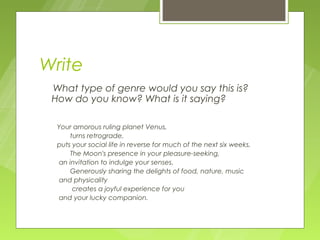
Write
 What type of genre would you say this is?
 How do you know? What is it saying?

  Your amorous ruling planet Venus,
      turns retrograde,
  puts your social life in reverse for much of the next six weeks.
      The Moon's presence in your pleasure-seeking,
  an invitation to indulge your senses.
      Generously sharing the delights of food, nature, music
  and physicality
       creates a joyful experience for you
  and your lucky companion.
From Carolyn Miller (quoted
by Bawarshi)
 “Genres  are not just forms. Genres are forms
 of life, ways of being. They are frames for
 social action […] locations within which
 meaning is constructed. Genres shape the
 thoughts we form and the communications
 by which we interact. Genres are the
 familiar places we go to create intellible
 communicative action with each other and
 the guideposts we use to explore the
 unfamiliar” (550).
Goals for today
   Discuss Devitt, Bawarshi, and Reiff

 Discuss   your three articles

 Understand   how to write your Preliminary
    Genre Analysis assignment

 Be  ready to work on this assignment as
    much as possible before Thursday.
Quiz
 What  is “genre analysis?” What does it
  allow us to do? Find a quote to support
  your response

 Hint:   Look at pg. 541-545 and 553-557.
Devitt, Bawarshi, and Reiff
   “Genre study allows students and researchers to recognize how ‘lived
    textuality’ plays a role in the lived experience of a group” (542).

   “But it is when genres encompass participants beyond a narrow
    community that the effects of those interests become most troublesome”
    (543).

   “Clashes of knowledge and perspective still result when specialists and
    nonspecialists meet, clashes that have consequences in terms of how
    participants interact, perform their actions, and produce certain effects
    in the world” (544).

   “Genre study gives us specific access to the sites of language use that
    make up communities, in all their complexity” (549).

   “genres appear to be transparent when they are understood as ways of
    classifying texts. But recent scholarship in genre theory has tried to dispel
    this view by stipulating genres to be language forms that have
    identifiable and changing roles in interpersonal relations and in larger
    collective contexts” (550).
Jury Instructions? “Might?”
   “Genre analysis strong suggests that the specialist and
    nonspecialist users have different beliefs, interests, and
    purposes as well as levels of knowledge” (543).
   “students should see the messiness and especially the
    exclusiveness of genres” (543).
   “Juries do not and cannot interpret the genre the way its
    creators intended, as lawyers would, and cannot render
    verdicts that follow those instructions fully and accurately,
    thus resulting in significant consequences, particularly for
    defendants” (544).
Bawarshi, the Patient Medical
History Form
 “isa good way to understand something
  about how doctors function and how
  they treat us as patients” (550).
In your groups
   Take a look at the sample PMHF

   Then, discuss and be ready to share:
     What issues, ideas, suggestions does the genre address?
     When people use this genre, what is it that they are interacting about?
     Who reads this genre? Who writes this genre? Is there more than one type
       of reader and/or writer?
     Why is the genre used? What purposes does the genre fulfill for the people
       who use it?
     What diction is most common? What types of words are most frequent? Is
       slang used? How would you describe the writer’s voice?
     What values, beliefs, goals, and assumptions are revealed through the
       genre’s patterns?
     How is the subject of the genre treated? What content is considered
       important? What content (topics or details) is ignored?
     What actions does the genre make possible?
What Bawarshi says about the
PMHF
 “The fact that the genre is mainly
 concerned with a patient’s physical
 symptoms suggests that one can isolate
 physical symptoms and treat them with
 little to no reference to the patient’s state
 of mind and the effect that state of mind
 might have on these symptoms” (551).
What Bawarshi says about the
PMHF
 “the PMHF reflects Western notions of
 medicine, notions that are rhetorically
 naturalized and reproduced by the genre
 and that are in turn embodied in the way
 the doctor recognizes, interacts with, and
 treats the patient as synecdoche of his or
 her physical symptoms” (551).
What Bawarshi says about the
PMHF
 “The form is at once a patient record, a
 legal document, and an element in a
 bureaucracy, helping the doctor treat the
 patient and presumably protecting the
 doctor from potential lawsuits” (551).
So…
 Analyzing genres allows us to see why
 individuals use language in specific
 settings to make specific practices
 possible.
Setting: Where did you find your articles? What other articles
were published in the same issue or journal? How did you
access your articles?


 The articles I found were all related to legal studies. They were located on the
 Internet in numerous legal databases and on some websites, making them easily
 accessible to those in the legal community. The UCF library database had many
 articles on the topic of hazing, as did Google Scholar. Cornell University has an
 entire website devoted to hazing, on which I found many related legal articles
 with different views on the topic. I even found presentations that were put
 together by law professors from around the country. The Cornell University
 website, which is open for public use, was my best source to find scholarly legal
 articles relating to hazing.
Subject: What topic(s) are discussed in your articles? What
issues, ideas, questions are addressed? When people read
these articles, what are they discussing?

   Each author focuses on a different part of hazing, but the consensus
   seems to be that people define hazing differently, and that no matter
   how one defines it, hazing is still wrong. There is a call for there to be
   stricter penalties on university administrators who do not take the
   necessary precautions to prevent hazing on and off of their campuses.
   The authors of “Hazing in Higher Education” call for college
   administrators to design more inclusive hazing prevention programs and
   to design and assess intervention and prevention strategies (Campbell,
   et al. 2010, p. 36). This is also seen in the statement made by the authors
   of “Hazing in the Internet Age” when they say, “Universities should also
   educate students, faculty, and staff about the adverse consequences
   of hazing” (Lake & Dickerson 2006, p. 2).
Participants: Who typically reads this journal? Who would be
interested in these articles? What characteristics must readers
of this--of this genre possess? Who writes texts in this genre?
Who are the authors (this might require you to do some
outside research on the authors)?

    The writers of these articles range from law professors at various
   universities to law librarians and legislative attorneys. Darby Dickerson,
   the author of “Prescription for Disaster” and coauthor of “Hazing in the
   Internet Age,” is the Dean and W. Frank Newton Professor of Law at
   Texas Tech and previously was a professor at the Stetson College of
   Law. Peter Lake, the coauthor of “Hazing in the Internet Age,” is a
   current professor of law at the Stetson College of Law. Jody Feder is an
   attorney in California and graduated from Yale Law School. She
   coauthored “Hazing in Schools” with Amy Bilyeau who has been a
   partner at three different law firms. Each author is well respected within
   their field and possesses outstanding accolades.
Features: What recurrent features do the articles share? For example,
what content is typically included? What is excluded? How is the
content treated? How is evidence provided? How are sources cited?
What sorts of examples are used? What counts as evidence
(personal testimony, facts, etc.)?

   Each article either has a cover page stating who wrote the article and
   the university from which they come from to establish credibility, or
   something parallel along those lines. This can show that the community
   values credibility. Darby Dickerson actually starts her article by stating
   facts in order to draw her audience in. Next, the authors give their own
   definition of hazing to fully define what they will be speaking about. For
   example, the authors of “Hazing in Higher Education” define hazing as,
   “Any activity expected of someone joining a group that humiliates,
   degrades or risks emotional and/or physical harm, regardless of the
   person’s willingness to participate” (Campbell, et al. 2010, p. 6). This is
   similar to Cornell University’s definition of hazing. Cornell defines hazing
   as:
Patterns: What do the genre features that you discussed reveal about the
genre and the situation in which it is used? Why are these patterns significant?
What do the patterns say about the people who use them, and how do you
know? What arguments can you make about these patterns? What do the
readers of this genre have to know or believe to understand or appreciate the
genre? What values, beliefs, goals, and assumptions are revealed through the
genre’s patterns? What actions does the genre make possible? What attitude
toward readers is implied in the genre? What attitude toward the world is
implied in it?

    The actual tone of all of the articles was informative and stern. Feder
   and Bilyeau state their facts and what they wish to see change. Darby
   Dickerson and the others do the same. There is no fluff put into their
   articles. Darby Dickerson says, “Hazing has become even more
   dangerous given current campus conditions” (Dickerson 2009, p. 3).
   After this, she continues to explain the changes she wishes to see take
   place. There was much respect given by the authors because they
   know how sensitive of a situation hazing is. Feder and Bilyeau show their
   understanding of the hurt felt by the families when they state, “In the
   absence of an explicit anti- hazing statute, some hazing victims have
   sought other federal legal solutions, although such efforts have not met
   with much success” (Feder & Bilyeau 2004, p. 7). This reveals that the
   authors actually do care about those they are trying to help and are
   trying to make a difference.
What to work on?
 Read Devitt before Thursday, and take
 notes in your journal.

 Work on one section of your paper. Raise
 your hand if you’d like me to read over
 what you have. Post on FB for bonus
 participation points.

Enc 1102 tuesday september 4th

  • 1.
  • 2.
    Write What typeof genre would you say this is? How do you know? What is it saying? Your amorous ruling planet Venus, turns retrograde, puts your social life in reverse for much of the next six weeks. The Moon's presence in your pleasure-seeking, an invitation to indulge your senses. Generously sharing the delights of food, nature, music and physicality creates a joyful experience for you and your lucky companion.
  • 3.
    From Carolyn Miller(quoted by Bawarshi)  “Genres are not just forms. Genres are forms of life, ways of being. They are frames for social action […] locations within which meaning is constructed. Genres shape the thoughts we form and the communications by which we interact. Genres are the familiar places we go to create intellible communicative action with each other and the guideposts we use to explore the unfamiliar” (550).
  • 4.
    Goals for today  Discuss Devitt, Bawarshi, and Reiff  Discuss your three articles  Understand how to write your Preliminary Genre Analysis assignment  Be ready to work on this assignment as much as possible before Thursday.
  • 5.
    Quiz  What is “genre analysis?” What does it allow us to do? Find a quote to support your response  Hint: Look at pg. 541-545 and 553-557.
  • 6.
    Devitt, Bawarshi, andReiff  “Genre study allows students and researchers to recognize how ‘lived textuality’ plays a role in the lived experience of a group” (542).  “But it is when genres encompass participants beyond a narrow community that the effects of those interests become most troublesome” (543).  “Clashes of knowledge and perspective still result when specialists and nonspecialists meet, clashes that have consequences in terms of how participants interact, perform their actions, and produce certain effects in the world” (544).  “Genre study gives us specific access to the sites of language use that make up communities, in all their complexity” (549).  “genres appear to be transparent when they are understood as ways of classifying texts. But recent scholarship in genre theory has tried to dispel this view by stipulating genres to be language forms that have identifiable and changing roles in interpersonal relations and in larger collective contexts” (550).
  • 7.
    Jury Instructions? “Might?”  “Genre analysis strong suggests that the specialist and nonspecialist users have different beliefs, interests, and purposes as well as levels of knowledge” (543).  “students should see the messiness and especially the exclusiveness of genres” (543).  “Juries do not and cannot interpret the genre the way its creators intended, as lawyers would, and cannot render verdicts that follow those instructions fully and accurately, thus resulting in significant consequences, particularly for defendants” (544).
  • 8.
    Bawarshi, the PatientMedical History Form  “isa good way to understand something about how doctors function and how they treat us as patients” (550).
  • 9.
    In your groups  Take a look at the sample PMHF  Then, discuss and be ready to share:  What issues, ideas, suggestions does the genre address?  When people use this genre, what is it that they are interacting about?  Who reads this genre? Who writes this genre? Is there more than one type of reader and/or writer?  Why is the genre used? What purposes does the genre fulfill for the people who use it?  What diction is most common? What types of words are most frequent? Is slang used? How would you describe the writer’s voice?  What values, beliefs, goals, and assumptions are revealed through the genre’s patterns?  How is the subject of the genre treated? What content is considered important? What content (topics or details) is ignored?  What actions does the genre make possible?
  • 10.
    What Bawarshi saysabout the PMHF “The fact that the genre is mainly concerned with a patient’s physical symptoms suggests that one can isolate physical symptoms and treat them with little to no reference to the patient’s state of mind and the effect that state of mind might have on these symptoms” (551).
  • 11.
    What Bawarshi saysabout the PMHF “the PMHF reflects Western notions of medicine, notions that are rhetorically naturalized and reproduced by the genre and that are in turn embodied in the way the doctor recognizes, interacts with, and treats the patient as synecdoche of his or her physical symptoms” (551).
  • 12.
    What Bawarshi saysabout the PMHF “The form is at once a patient record, a legal document, and an element in a bureaucracy, helping the doctor treat the patient and presumably protecting the doctor from potential lawsuits” (551).
  • 13.
    So…  Analyzing genresallows us to see why individuals use language in specific settings to make specific practices possible.
  • 14.
    Setting: Where didyou find your articles? What other articles were published in the same issue or journal? How did you access your articles? The articles I found were all related to legal studies. They were located on the Internet in numerous legal databases and on some websites, making them easily accessible to those in the legal community. The UCF library database had many articles on the topic of hazing, as did Google Scholar. Cornell University has an entire website devoted to hazing, on which I found many related legal articles with different views on the topic. I even found presentations that were put together by law professors from around the country. The Cornell University website, which is open for public use, was my best source to find scholarly legal articles relating to hazing.
  • 15.
    Subject: What topic(s)are discussed in your articles? What issues, ideas, questions are addressed? When people read these articles, what are they discussing? Each author focuses on a different part of hazing, but the consensus seems to be that people define hazing differently, and that no matter how one defines it, hazing is still wrong. There is a call for there to be stricter penalties on university administrators who do not take the necessary precautions to prevent hazing on and off of their campuses. The authors of “Hazing in Higher Education” call for college administrators to design more inclusive hazing prevention programs and to design and assess intervention and prevention strategies (Campbell, et al. 2010, p. 36). This is also seen in the statement made by the authors of “Hazing in the Internet Age” when they say, “Universities should also educate students, faculty, and staff about the adverse consequences of hazing” (Lake & Dickerson 2006, p. 2).
  • 16.
    Participants: Who typicallyreads this journal? Who would be interested in these articles? What characteristics must readers of this--of this genre possess? Who writes texts in this genre? Who are the authors (this might require you to do some outside research on the authors)? The writers of these articles range from law professors at various universities to law librarians and legislative attorneys. Darby Dickerson, the author of “Prescription for Disaster” and coauthor of “Hazing in the Internet Age,” is the Dean and W. Frank Newton Professor of Law at Texas Tech and previously was a professor at the Stetson College of Law. Peter Lake, the coauthor of “Hazing in the Internet Age,” is a current professor of law at the Stetson College of Law. Jody Feder is an attorney in California and graduated from Yale Law School. She coauthored “Hazing in Schools” with Amy Bilyeau who has been a partner at three different law firms. Each author is well respected within their field and possesses outstanding accolades.
  • 17.
    Features: What recurrentfeatures do the articles share? For example, what content is typically included? What is excluded? How is the content treated? How is evidence provided? How are sources cited? What sorts of examples are used? What counts as evidence (personal testimony, facts, etc.)? Each article either has a cover page stating who wrote the article and the university from which they come from to establish credibility, or something parallel along those lines. This can show that the community values credibility. Darby Dickerson actually starts her article by stating facts in order to draw her audience in. Next, the authors give their own definition of hazing to fully define what they will be speaking about. For example, the authors of “Hazing in Higher Education” define hazing as, “Any activity expected of someone joining a group that humiliates, degrades or risks emotional and/or physical harm, regardless of the person’s willingness to participate” (Campbell, et al. 2010, p. 6). This is similar to Cornell University’s definition of hazing. Cornell defines hazing as:
  • 18.
    Patterns: What dothe genre features that you discussed reveal about the genre and the situation in which it is used? Why are these patterns significant? What do the patterns say about the people who use them, and how do you know? What arguments can you make about these patterns? What do the readers of this genre have to know or believe to understand or appreciate the genre? What values, beliefs, goals, and assumptions are revealed through the genre’s patterns? What actions does the genre make possible? What attitude toward readers is implied in the genre? What attitude toward the world is implied in it? The actual tone of all of the articles was informative and stern. Feder and Bilyeau state their facts and what they wish to see change. Darby Dickerson and the others do the same. There is no fluff put into their articles. Darby Dickerson says, “Hazing has become even more dangerous given current campus conditions” (Dickerson 2009, p. 3). After this, she continues to explain the changes she wishes to see take place. There was much respect given by the authors because they know how sensitive of a situation hazing is. Feder and Bilyeau show their understanding of the hurt felt by the families when they state, “In the absence of an explicit anti- hazing statute, some hazing victims have sought other federal legal solutions, although such efforts have not met with much success” (Feder & Bilyeau 2004, p. 7). This reveals that the authors actually do care about those they are trying to help and are trying to make a difference.
  • 19.
    What to workon?  Read Devitt before Thursday, and take notes in your journal.  Work on one section of your paper. Raise your hand if you’d like me to read over what you have. Post on FB for bonus participation points.