
Communicating Science: Clarity, conciseness and objectivity ©Victoria Martínez Montaña
Background The analysis of distinct genres provides valuable insight into how and why members of discourse communities communicate in the way they do (Swales 1990) The studies of register and genre focused on the structural and grammatical features of texts  assist learners in  the interpretation and construction of genre-specific texts.
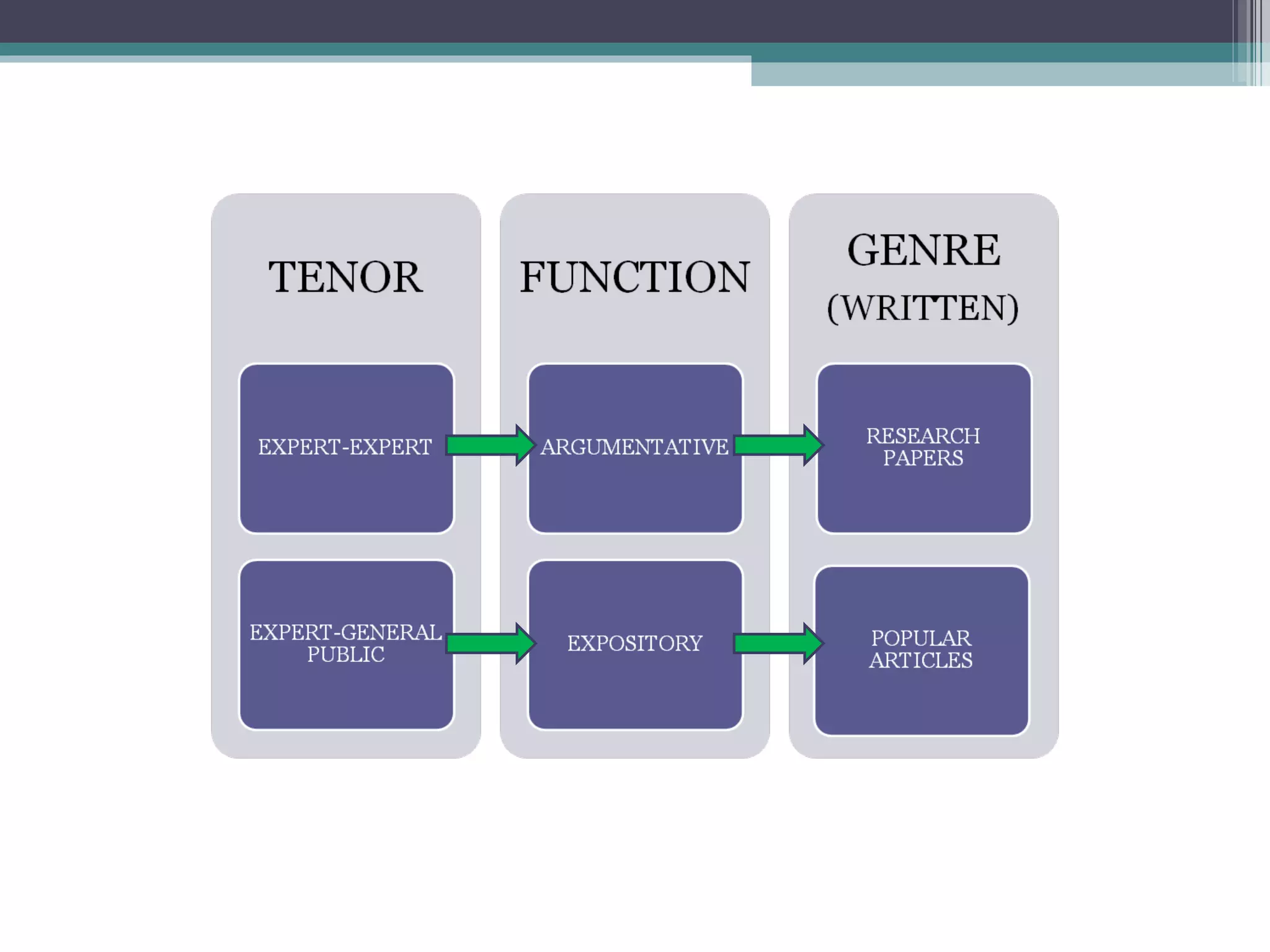
Aims Provide you with some insight into the characteristics of written medical genres. 2.  Compare medical research articles with public-oriented articles on medicine.
Genre: Definition By ‘genre’ or ‘text type’ we mean each of the specific classes of texts characteristic of a given scientific community or professional group and distinguished from each other by certain features of  vocabulary, form  and  style , which are wholly function-specific and conventional in nature.  (Alcaraz & Hughes 2002: 101)
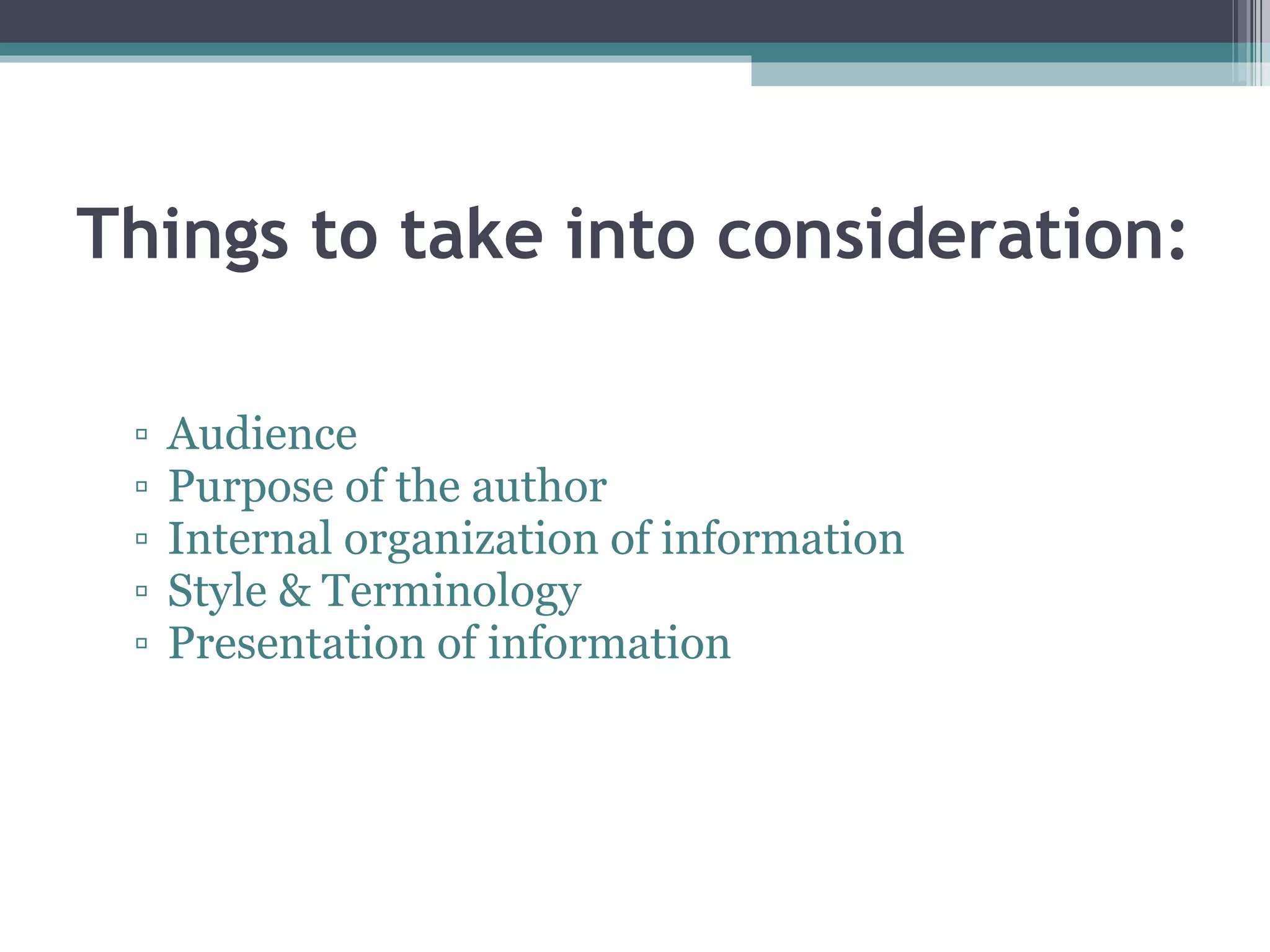
Things to take into consideration: Audience Purpose of the author Internal organization of information Style & Terminology Presentation of information
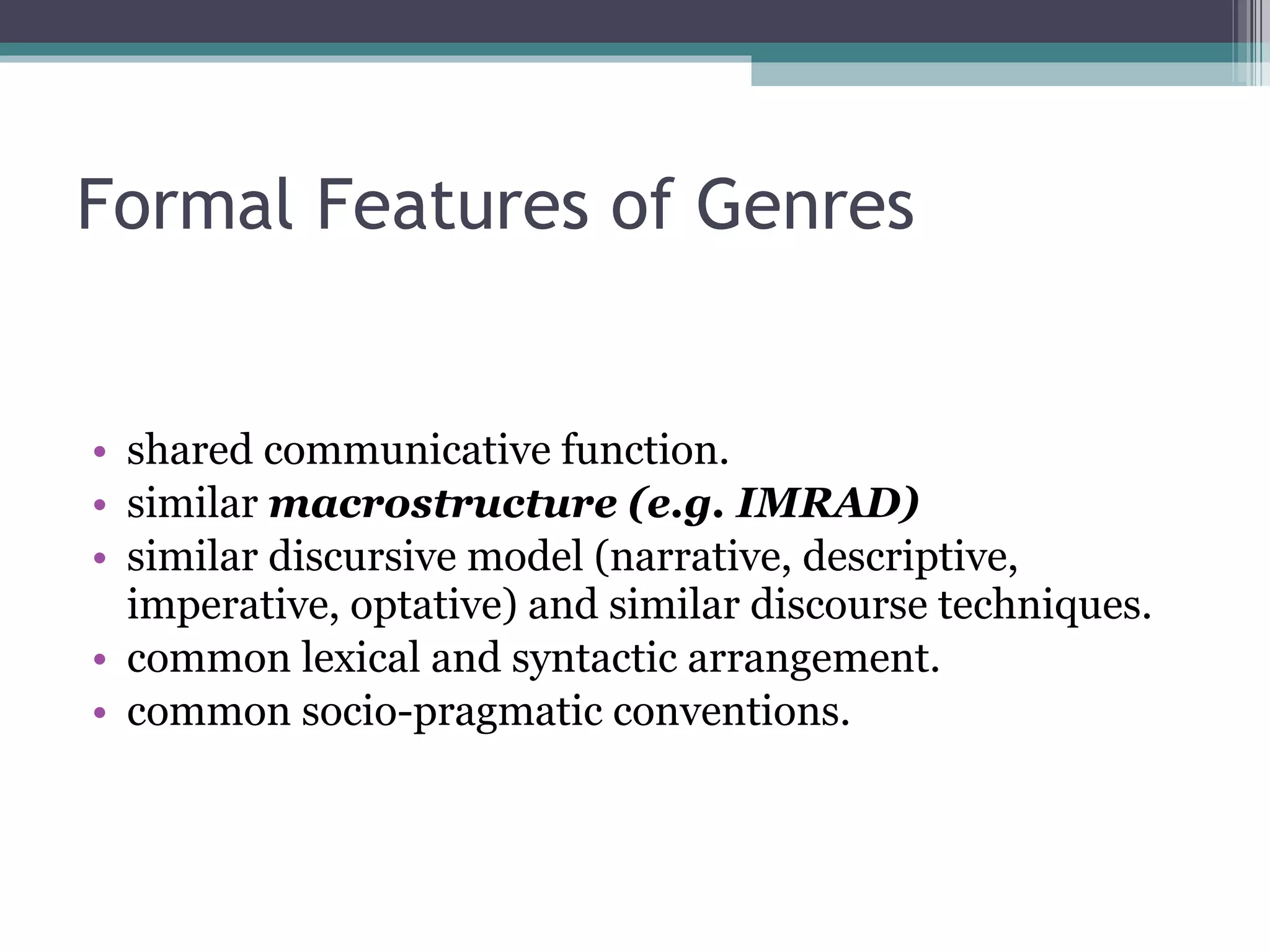
Formal Features of Genres shared communicative function. similar  macrostructure (e.g. IMRAD) similar discursive model (narrative, descriptive, imperative, optative) and similar discourse techniques. common lexical and syntactic arrangement. common socio-pragmatic conventions.
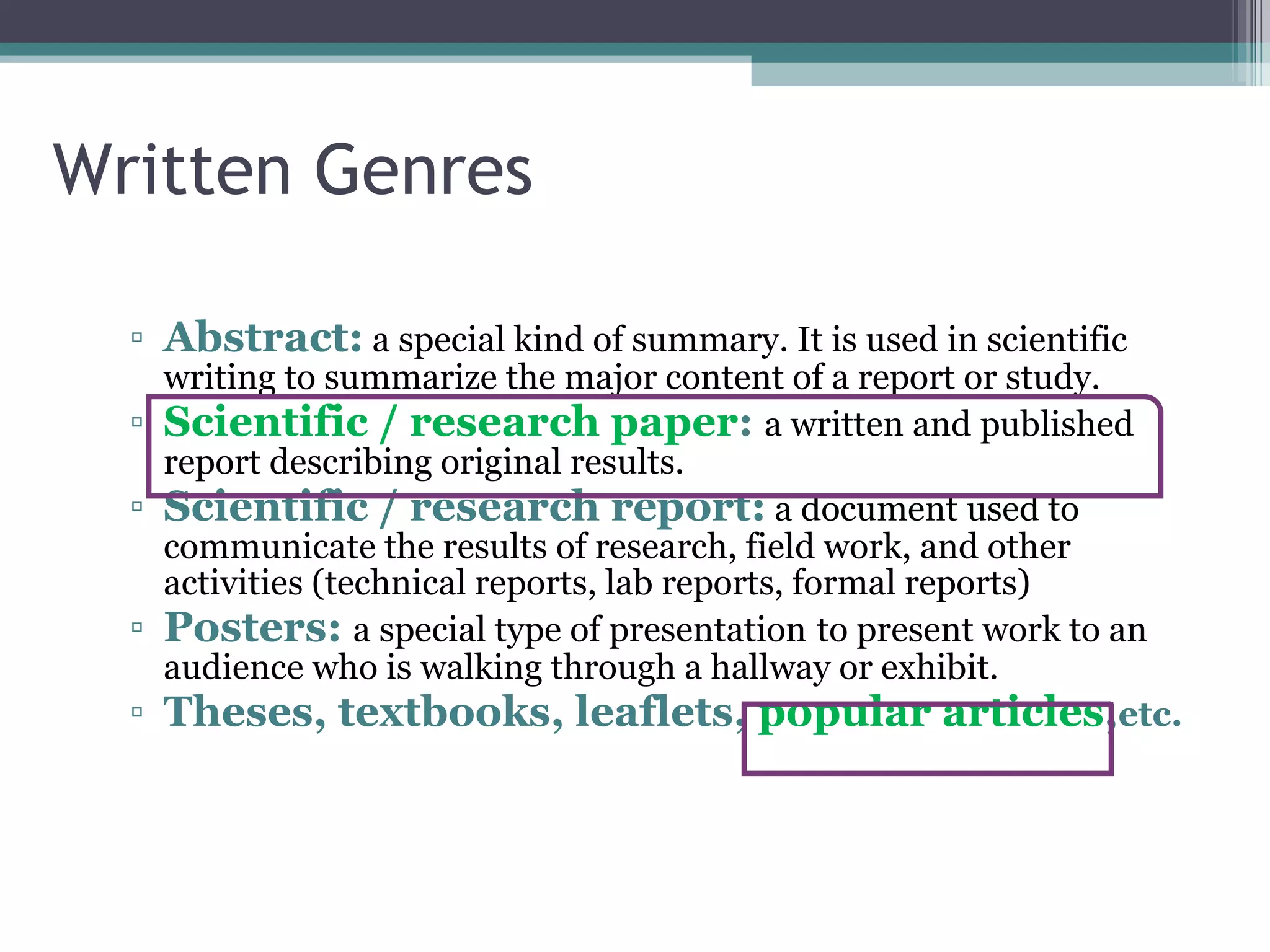
Written Genres Abstract:   a  special kind of summary. It is used in scientific writing to summarize the major content of a report or study.   Scientific / research paper :  a w ritten and published report describing original results.  Scientific / research report:   a document used  to communicate the results of research, field work, and other activities  ( technical reports, lab reports, formal reports)  Posters:  a special type of presentation   to present work to an audience who is walking through a hallway or exhibit.   Theses, textbooks, leaflets,  popular articles , etc.
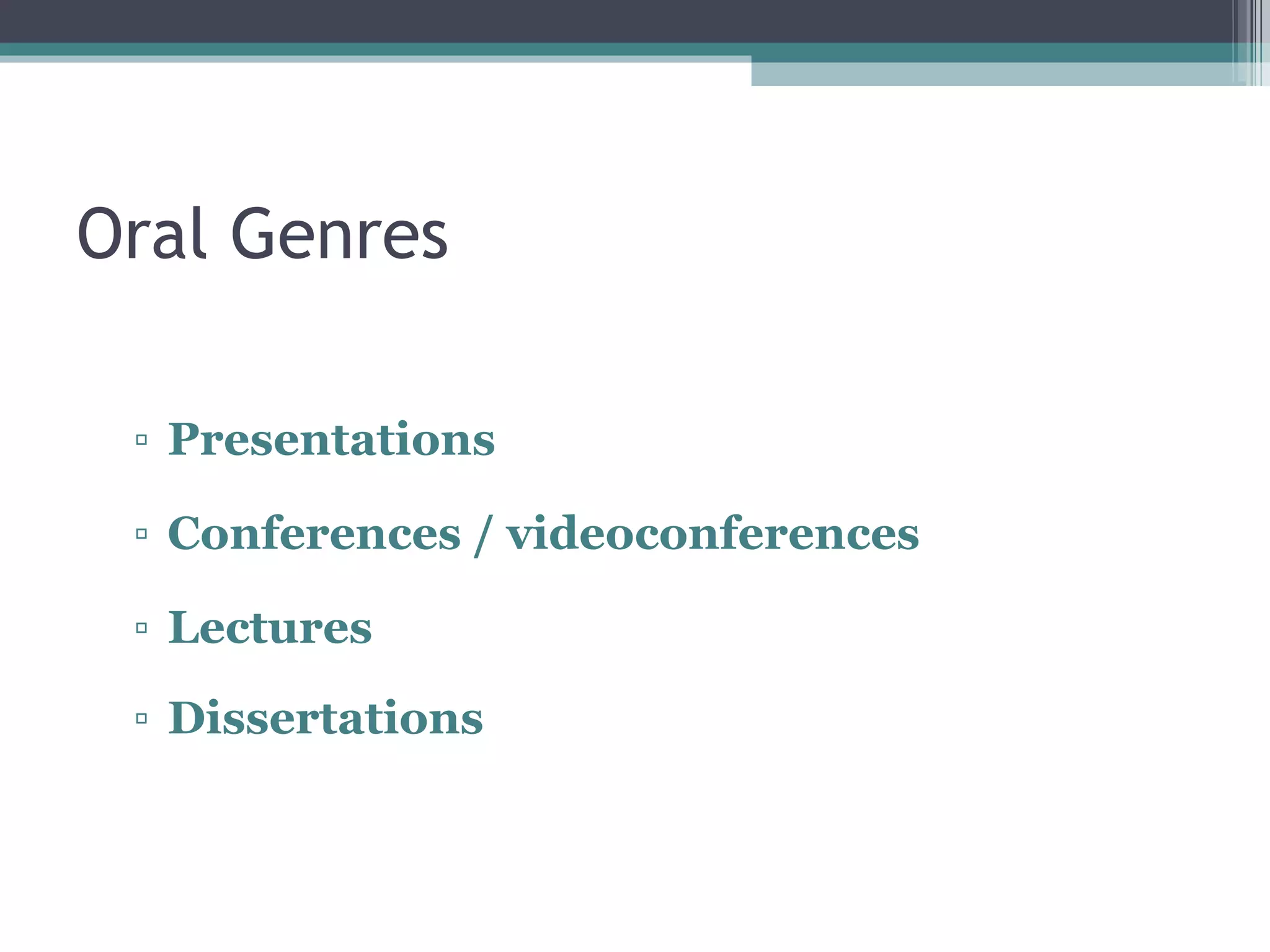
Oral Genres Presentations Conferences / videoconferences Lectures Dissertations
 
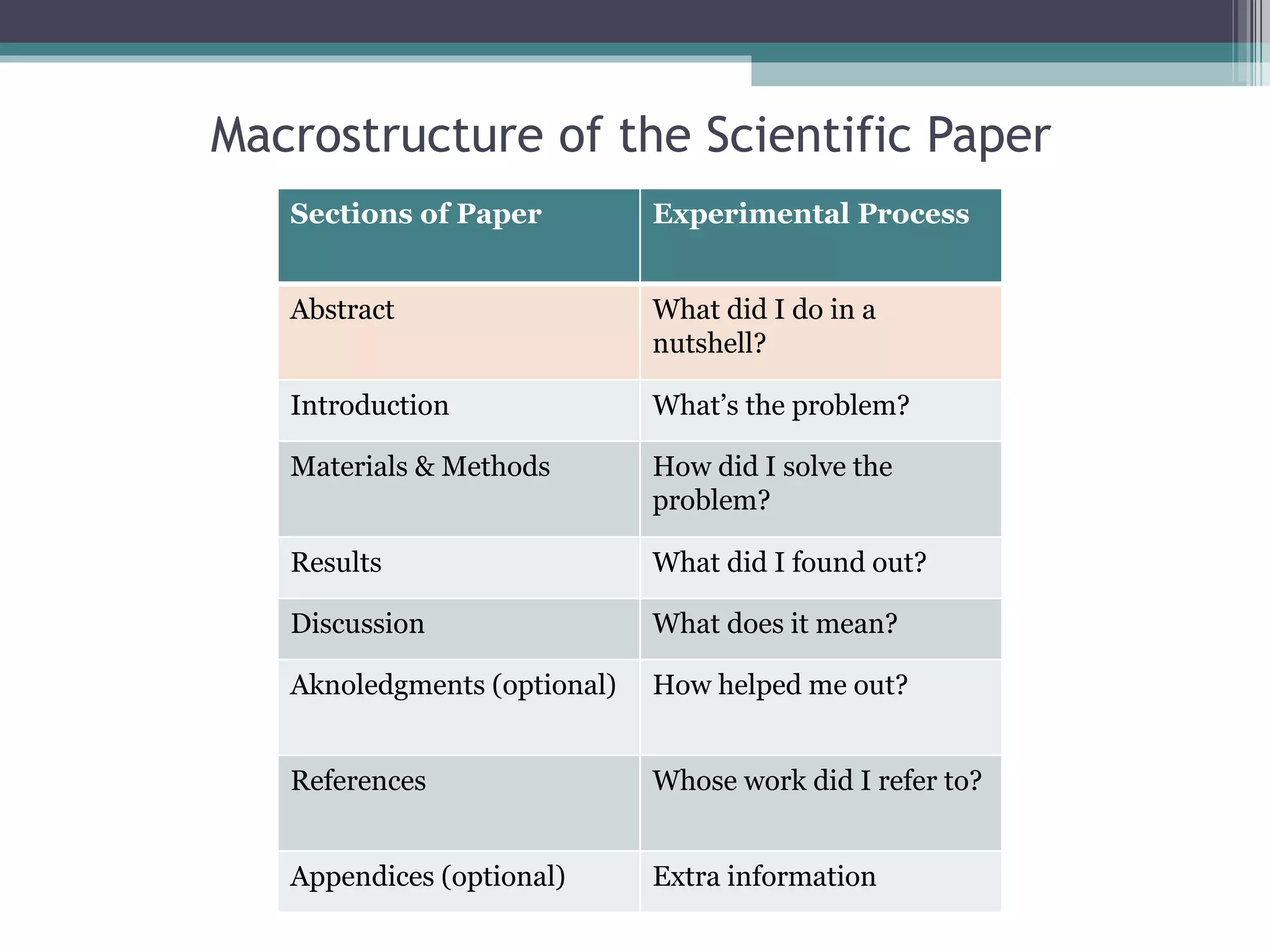
Macrostructure of the Scientific Paper Sections of Paper Experimental Process Abstract What did I do in a nutshell? Introduction What’s the problem? Materials & Methods How did I solve the problem? Results What did I found out? Discussion What does it mean? Aknoledgments (optional) How helped me out? References Whose work did I refer to? Appendices (optional) Extra information
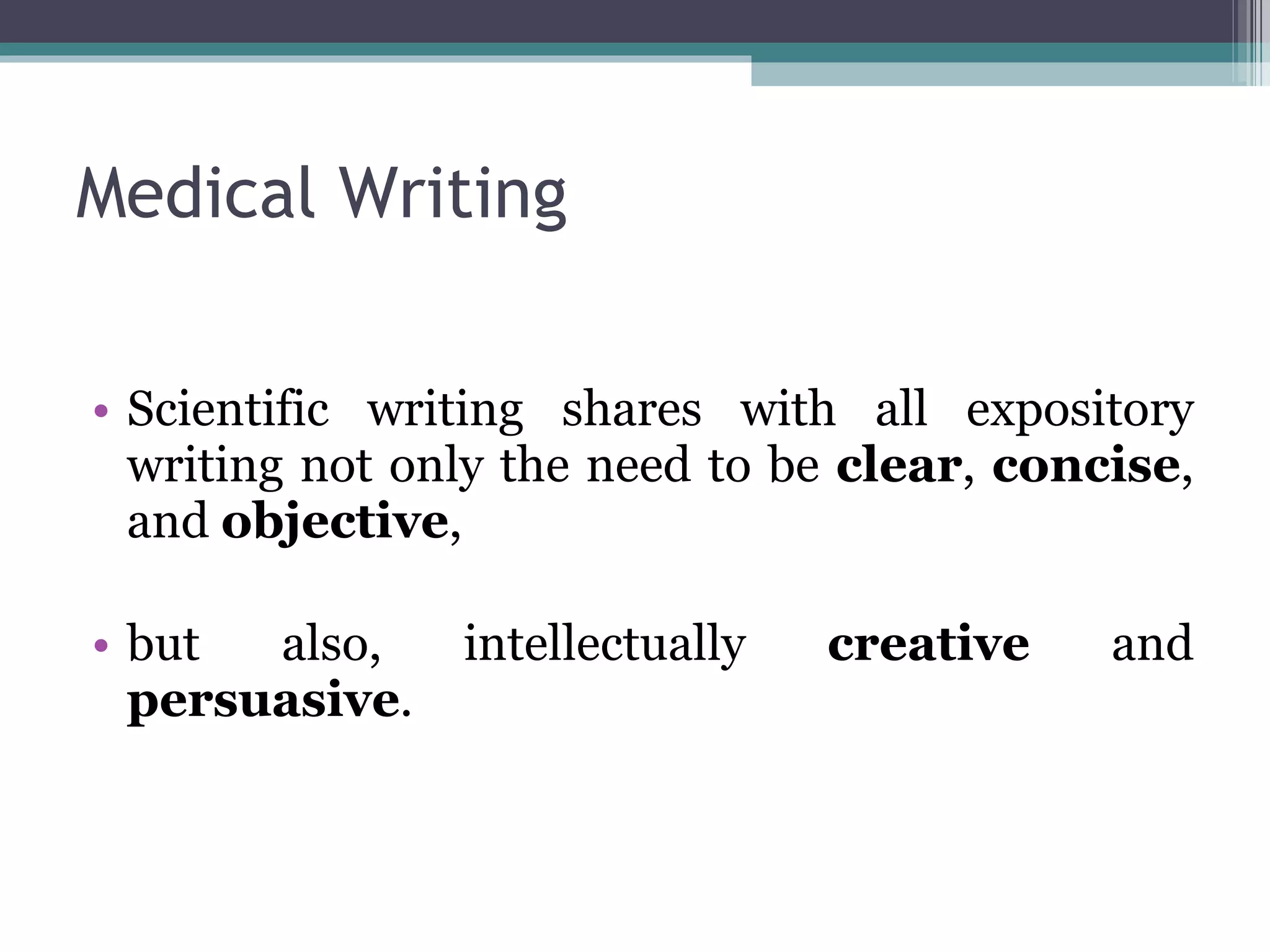
Medical Writing Scientific writing shares with all expository writing not only the need to be  clear ,  concise , and  objective , but also, intellectually  creative  and  persuasive .
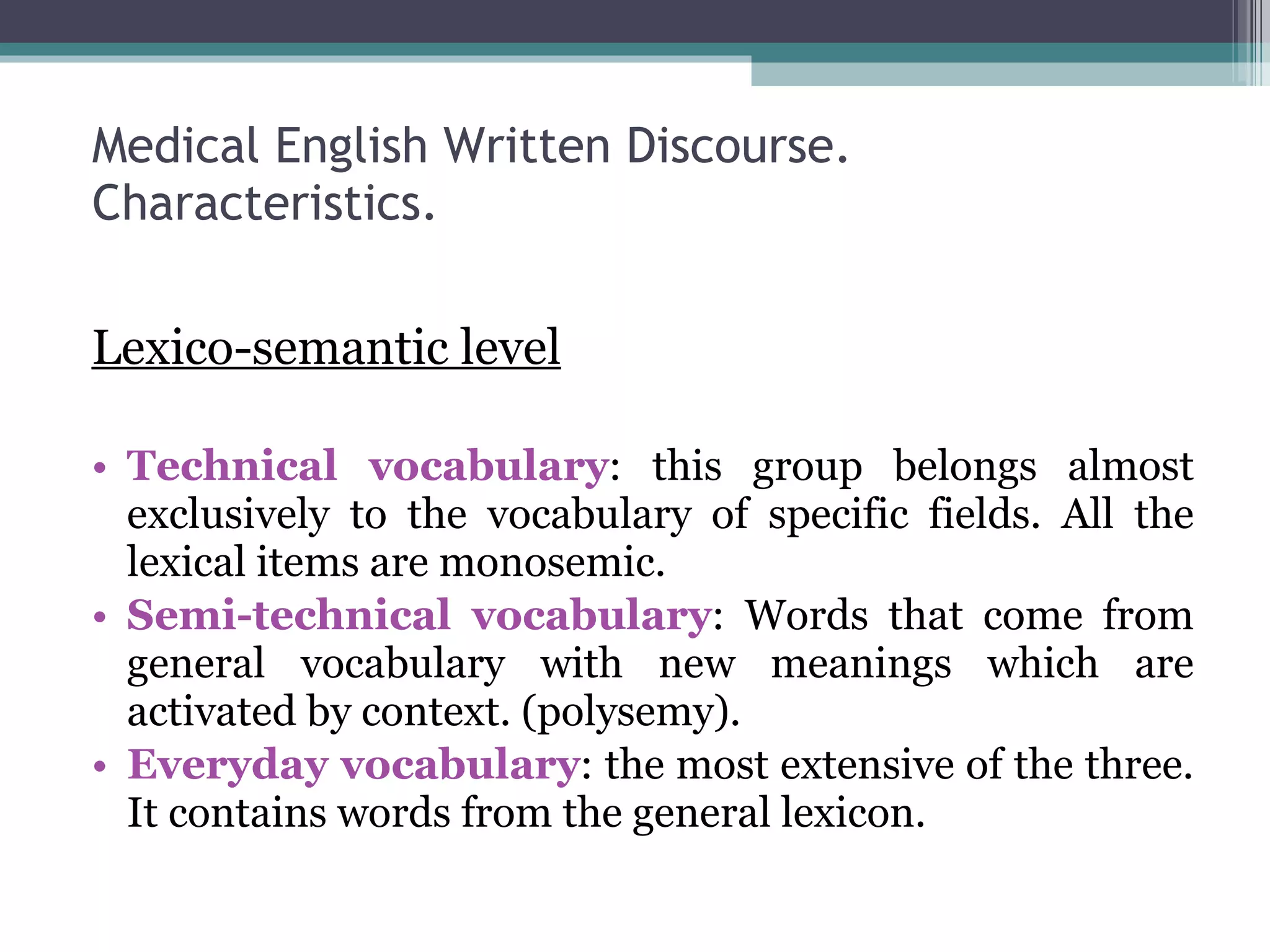
Medical English Written Discourse. Characteristics. Lexico-semantic level Technical vocabulary : this group belongs almost exclusively to the vocabulary of specific fields. All the lexical items are monosemic. Semi-technical vocabulary : Words that come from general vocabulary with new meanings which are activated by context. (polysemy). Everyday vocabulary : the most extensive of the three. It contains words from the general lexicon.
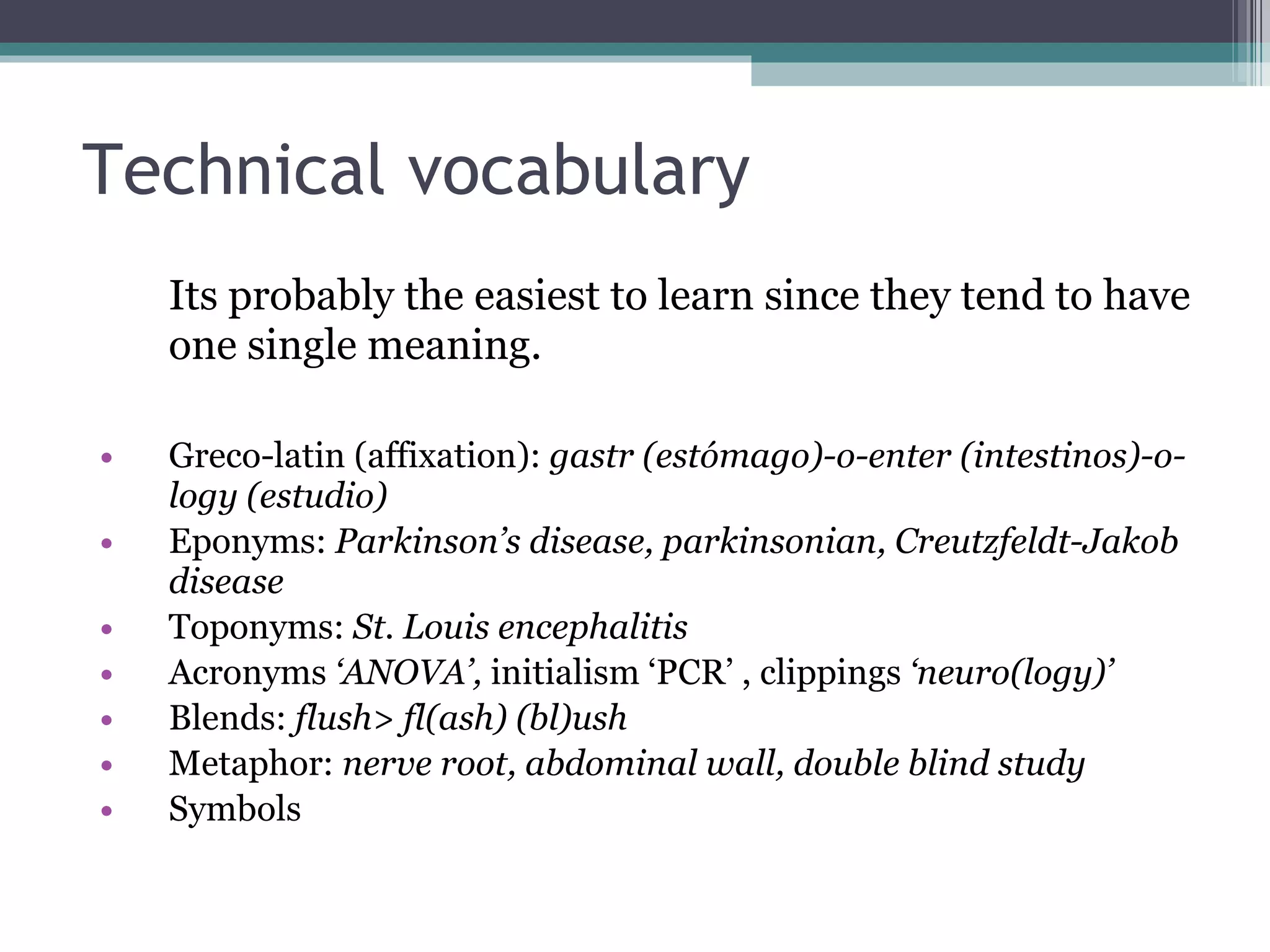
Technical vocabulary Its probably the easiest to learn since they tend to have one single meaning. Greco-latin (affixation):  gastr (estómago)-o-enter (intestinos)-o-logy (estudio) Eponyms:  Parkinson’s disease, parkinsonian, Creutzfeldt-Jakob disease Toponyms:  St. Louis encephalitis Acronyms  ‘ANOVA’,  initialism ‘PCR’ , clippings  ‘neuro(logy)’ Blends:  flush> fl(ash) (bl)ush Metaphor:  nerve root, abdominal wall, double blind study Symbols
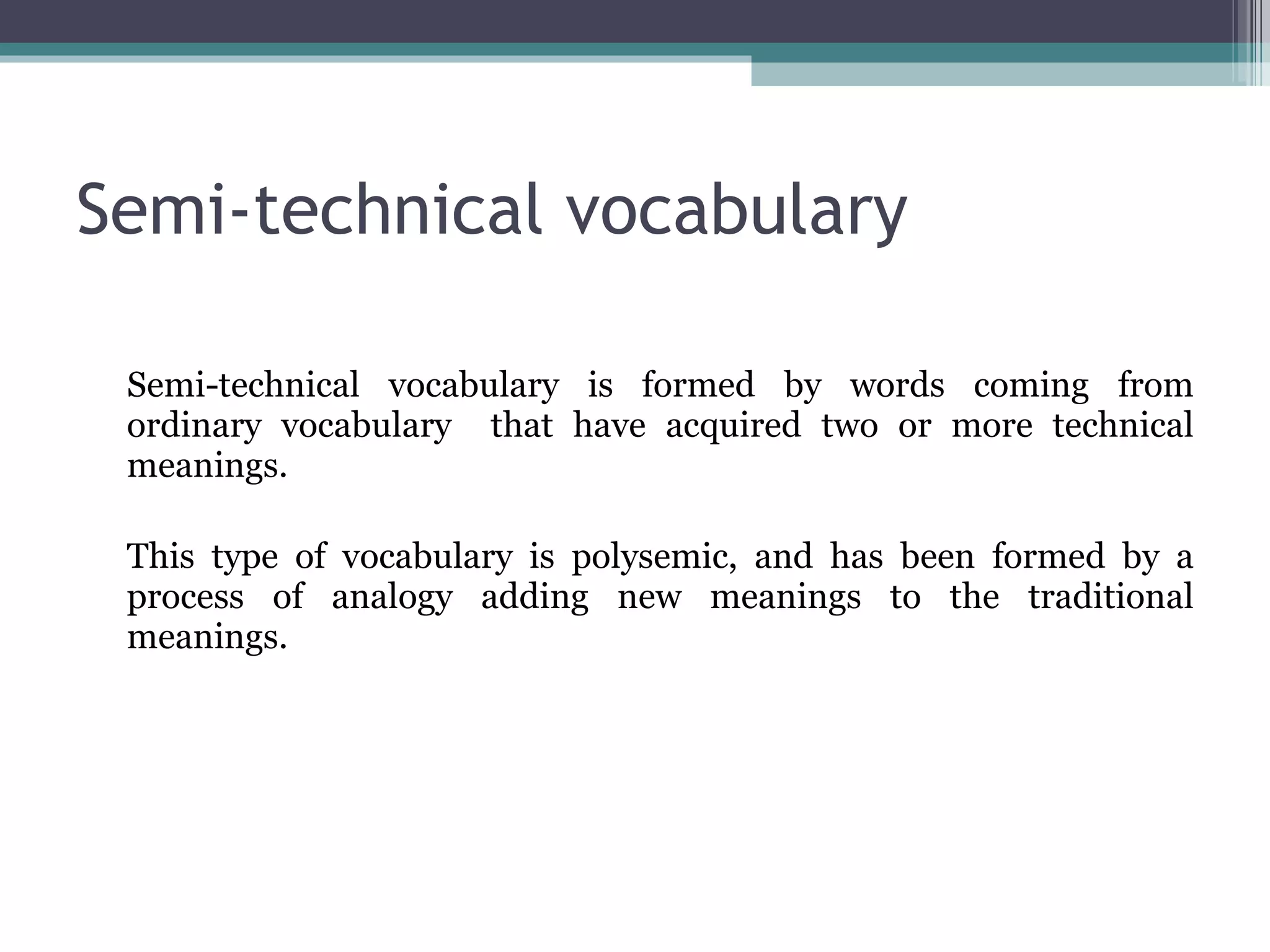
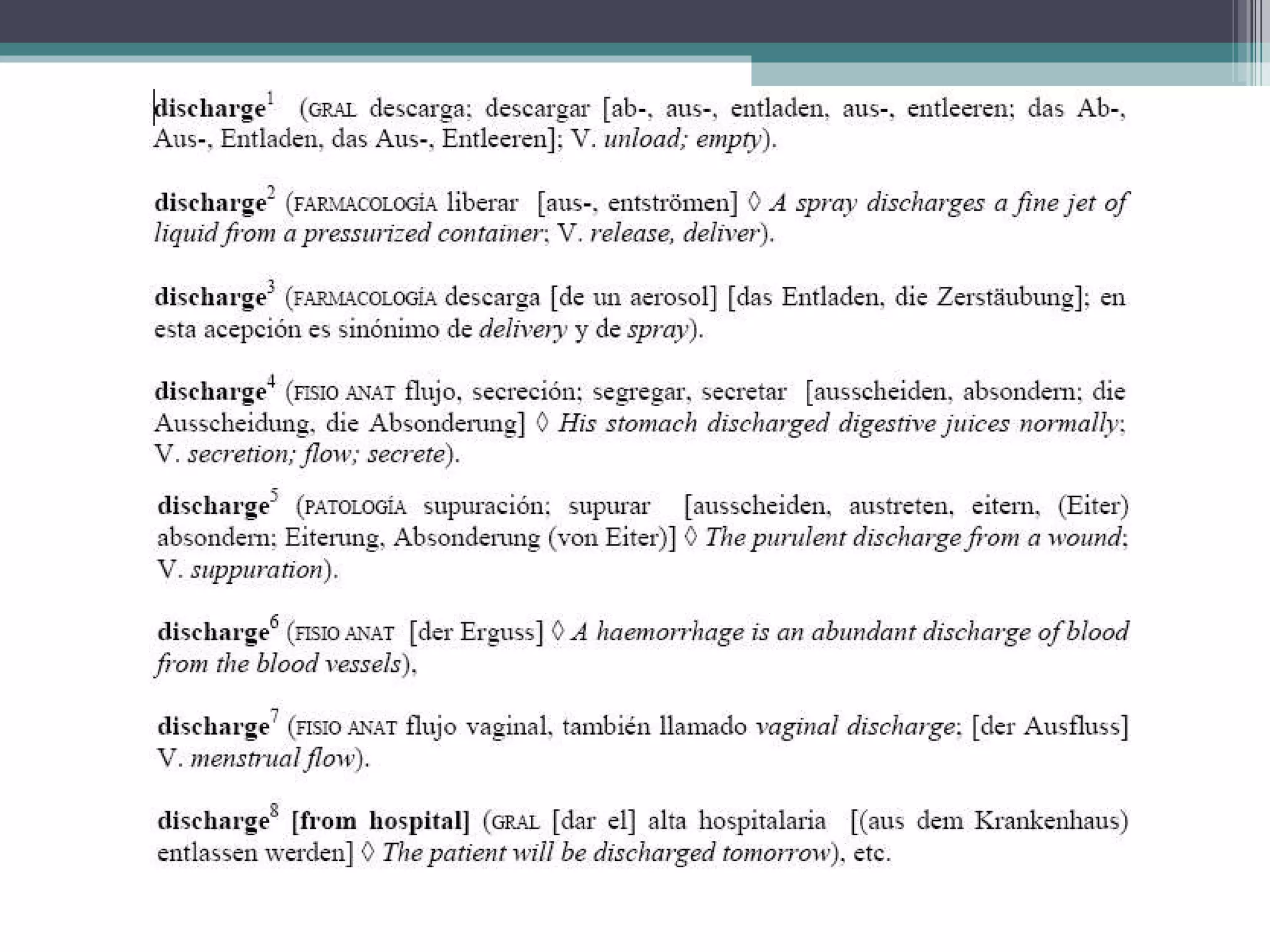
Semi-technical vocabulary Semi-technical vocabulary is formed by words coming from ordinary vocabulary  that have acquired two or more technical meanings.  This type of vocabulary is polysemic, and has been formed by a process of analogy adding new meanings to the traditional meanings.
 
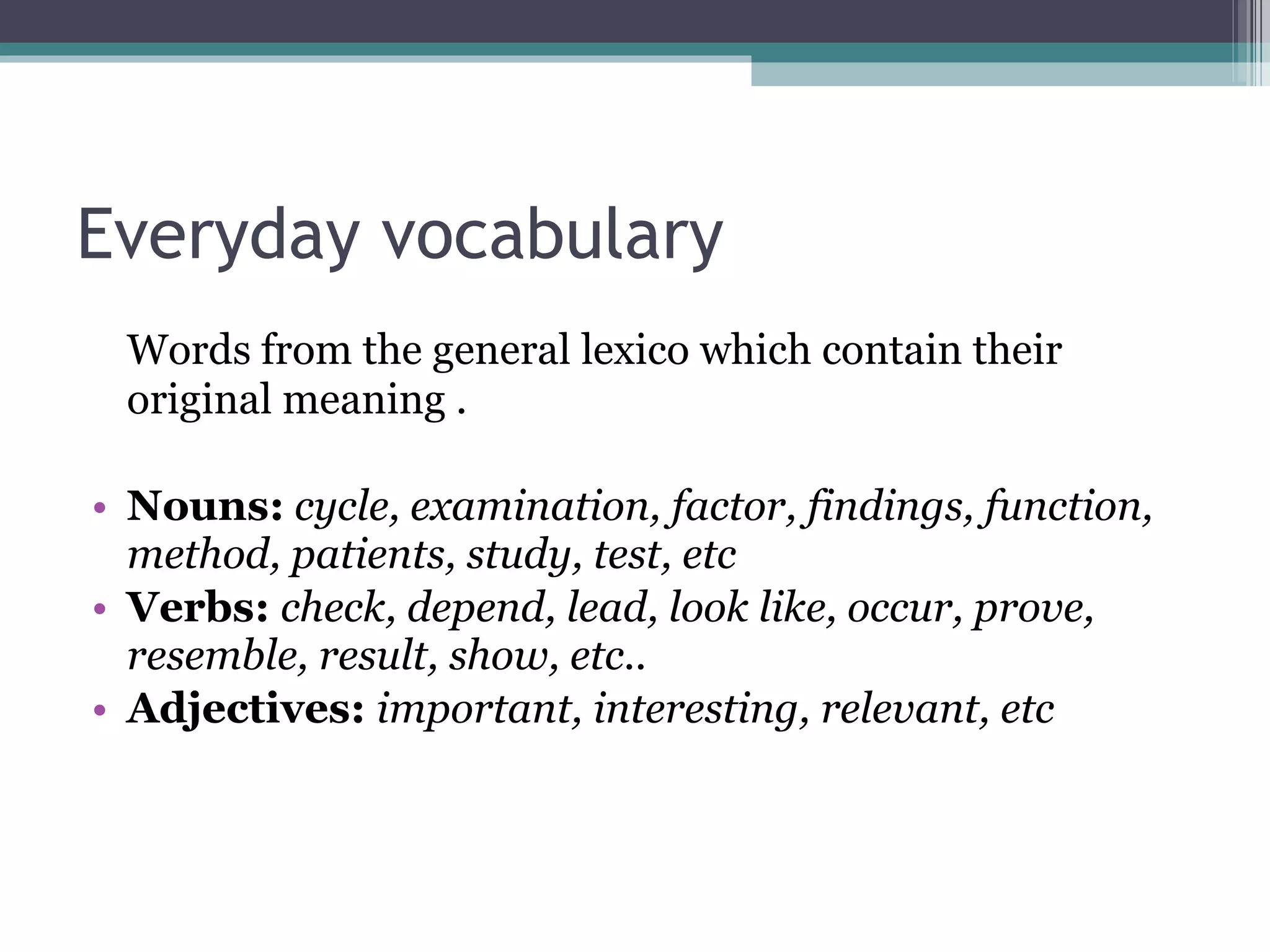
Everyday vocabulary Words from the general lexico which contain their original meaning . Nouns:   cycle, examination, factor, findings, function, method, patients, study, test, etc Verbs:  check, depend, lead, look like, occur, prove, resemble, result, show, etc.. Adjectives:   important, interesting, relevant, etc
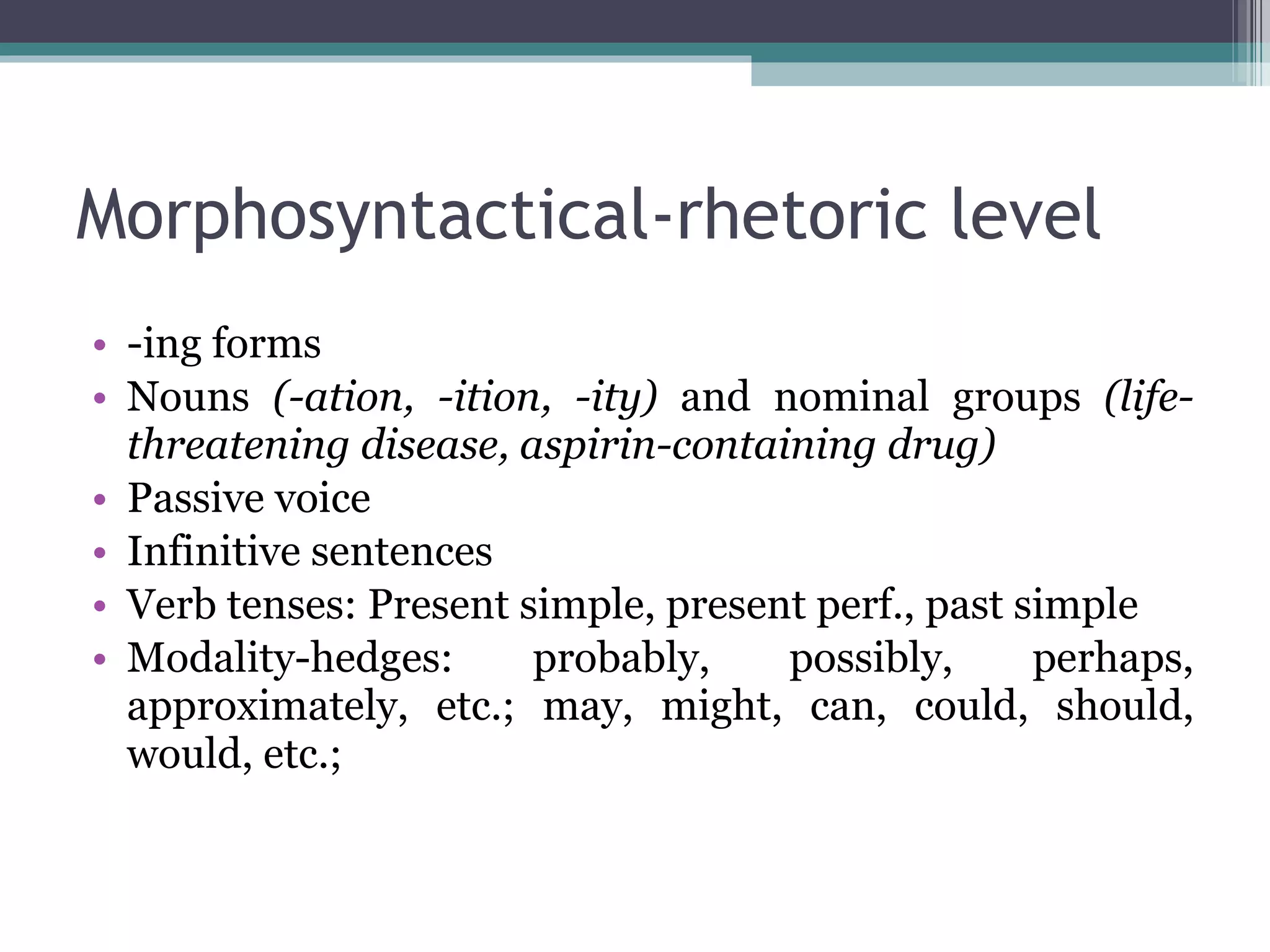
Morphosyntactical-rhetoric level -ing forms Nouns  (-ation, -ition, -ity)  and nominal groups  (life-threatening disease, aspirin-containing drug) Passive voice  Infinitive sentences Verb tenses: Present simple, present perf., past simple Modality-hedges: probably, possibly, perhaps, approximately, etc.; may, might, can, could, should, would, etc.;
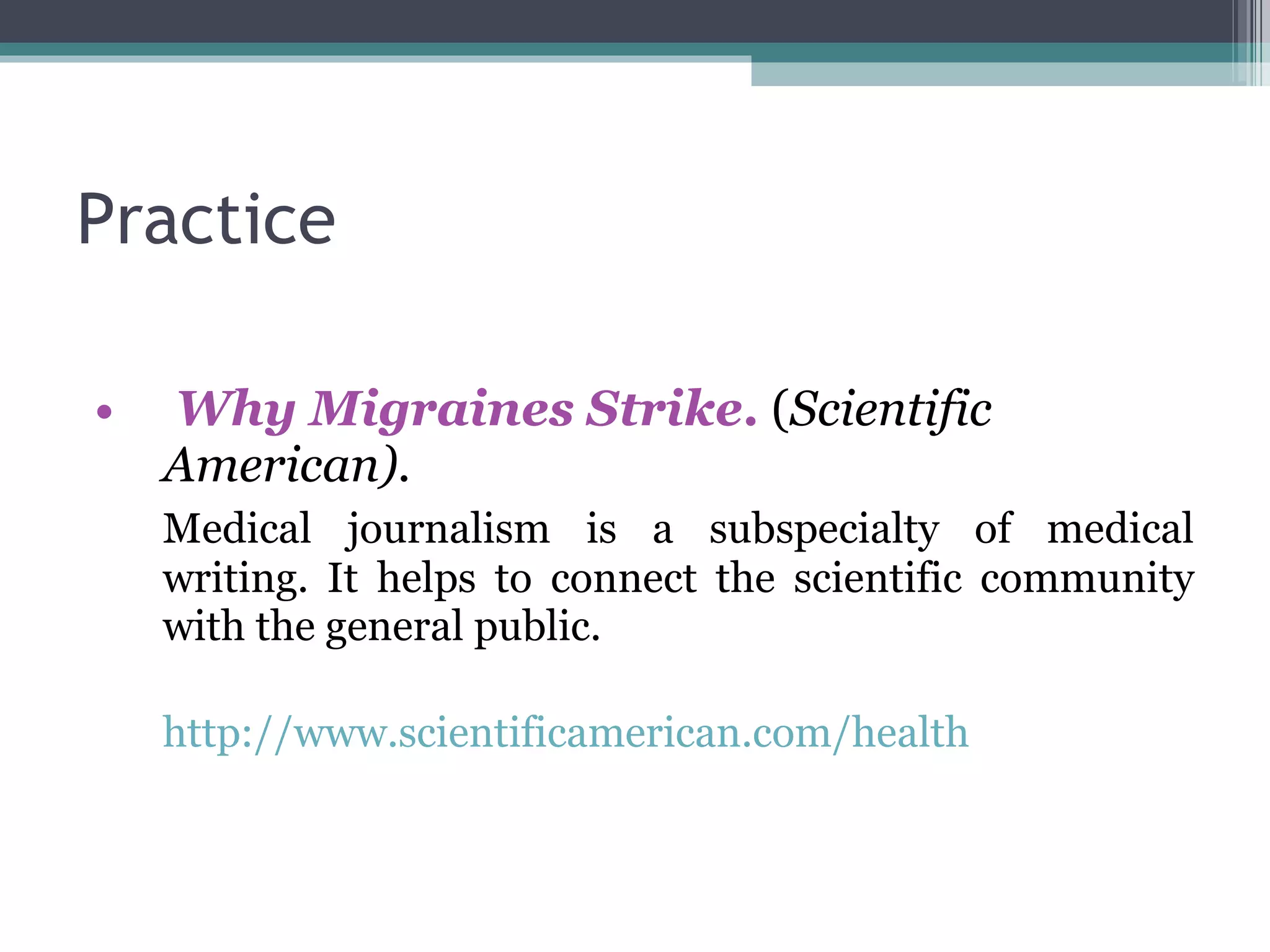
Practice Why Migraines Strike .   ( Scientific American). Medical journalism is a subspecialty of medical writing. It helps to connect the scientific community with the general public.  http://www.scientificamerican.com/health
 
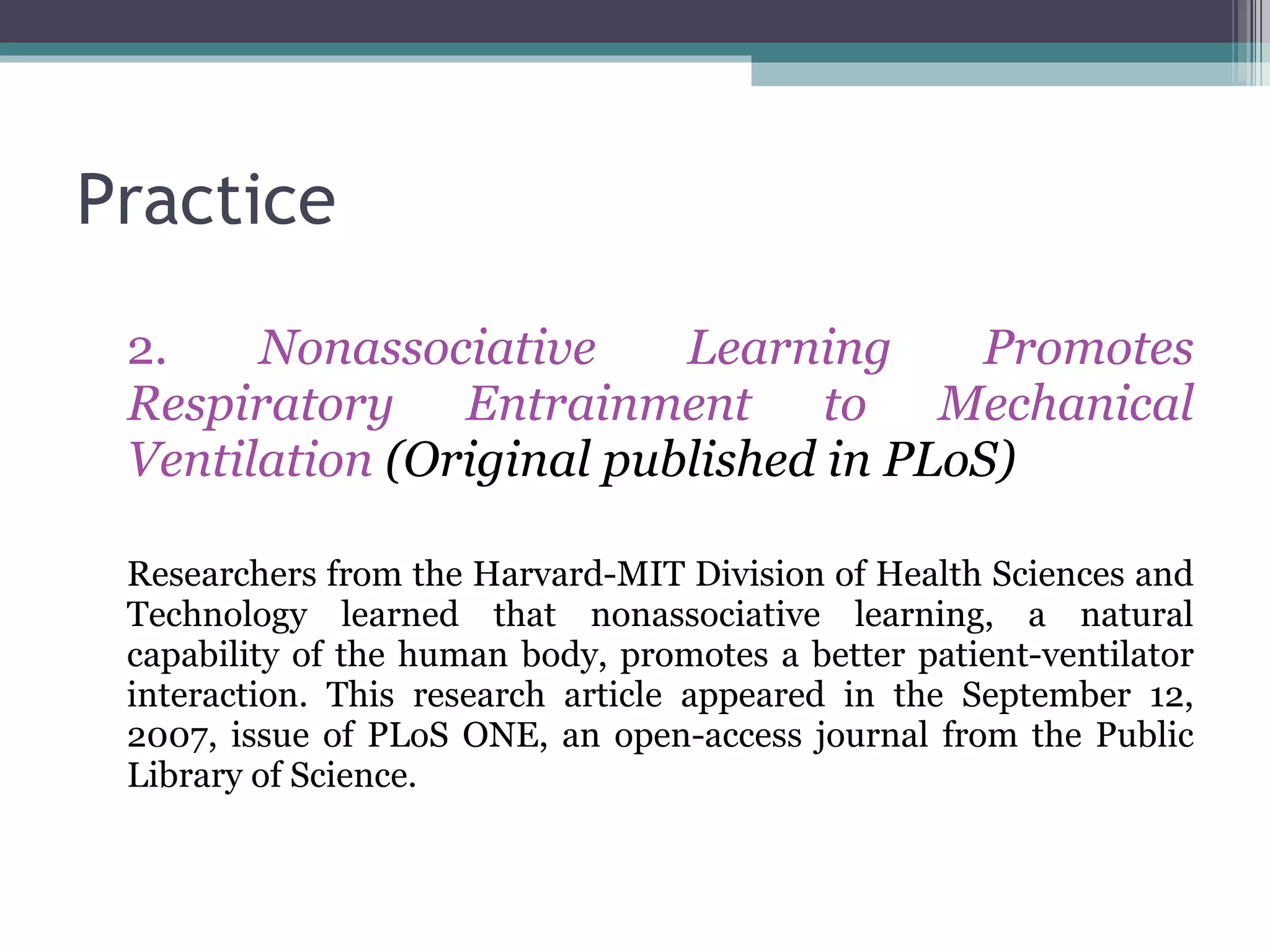
Practice 2.  Nonassociative Learning Promotes Respiratory Entrainment to Mechanical Ventilation  (Original published in PLoS) Researchers from the Harvard-MIT Division of Health Sciences and Technology learned that nonassociative learning, a natural capability of the human body, promotes a better patient-ventilator interaction. This research article appeared in the September 12, 2007, issue of PLoS ONE, an open-access journal from the Public Library of Science.
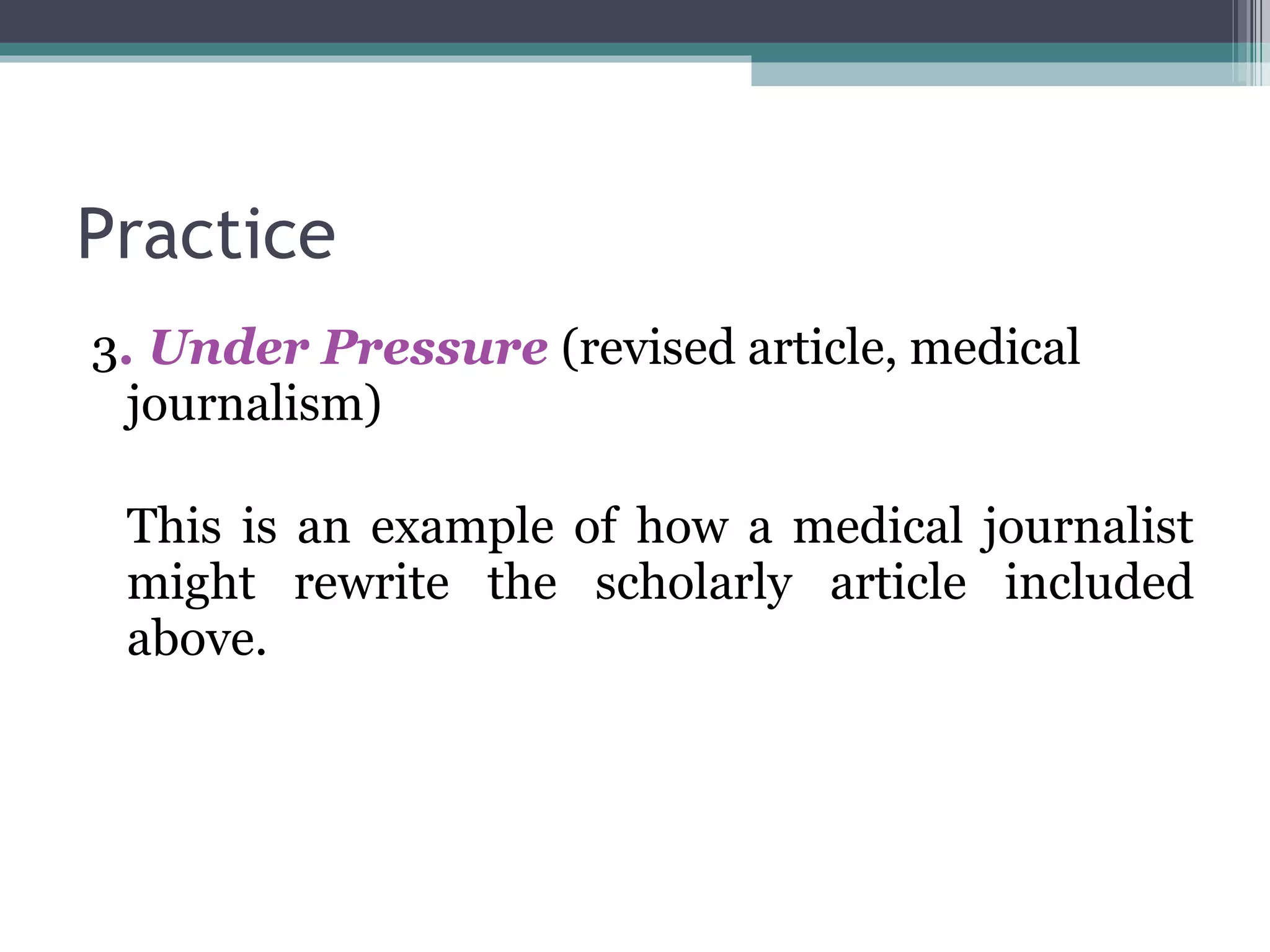
Practice 3 . Under Pressure  (revised article, medical journalism) This is an example of how a medical journalist might rewrite the scholarly article included above.
Practice The following examples show how a medical journalist might revise technical information for general purpose reading : Before Desensitization (converse of secondary sensitization) is distinguished from habituation (converse of primary sensitization) by the explicit expression of memory rebound and recovery effects in the post-stimulation response.
After "In the study, Poon and his colleagues use two types of nonassociative learning called habituation and desensitization to promote a better patient-ventilator interaction. Habituation refers to a person's decrease in responsiveness to a repeated stimulus.  In terms of the fireworks example, you may learn to successfully "block out" or become more accustomed to the loud, recurring noises over time. On the other hand, desensitization is a person's diminished response to a second stimulus as a result of the first stimulus. For instance, if you became more accustomed to the loud fireworks through repeated sounds, your ability to hear other noises might have decreased, too."
Practice 4.  A sampling design for a Sentinel General Practitioner Network  (Original) written by Spanish specialists in English. (Gaceta Sanitaria) Worksheets

Communicating Science

  • 1.
    Communicating Science: Clarity,conciseness and objectivity ©Victoria Martínez Montaña
  • 2.
    Background The analysisof distinct genres provides valuable insight into how and why members of discourse communities communicate in the way they do (Swales 1990) The studies of register and genre focused on the structural and grammatical features of texts assist learners in the interpretation and construction of genre-specific texts.
  • 3.
    Aims Provide youwith some insight into the characteristics of written medical genres. 2. Compare medical research articles with public-oriented articles on medicine.
  • 4.
    Genre: Definition By‘genre’ or ‘text type’ we mean each of the specific classes of texts characteristic of a given scientific community or professional group and distinguished from each other by certain features of vocabulary, form and style , which are wholly function-specific and conventional in nature. (Alcaraz & Hughes 2002: 101)
  • 5.
    Things to takeinto consideration: Audience Purpose of the author Internal organization of information Style & Terminology Presentation of information
  • 6.
    Formal Features ofGenres shared communicative function. similar macrostructure (e.g. IMRAD) similar discursive model (narrative, descriptive, imperative, optative) and similar discourse techniques. common lexical and syntactic arrangement. common socio-pragmatic conventions.
  • 7.
    Written Genres Abstract: a special kind of summary. It is used in scientific writing to summarize the major content of a report or study. Scientific / research paper : a w ritten and published report describing original results. Scientific / research report: a document used to communicate the results of research, field work, and other activities ( technical reports, lab reports, formal reports) Posters: a special type of presentation to present work to an audience who is walking through a hallway or exhibit. Theses, textbooks, leaflets, popular articles , etc.
  • 8.
    Oral Genres PresentationsConferences / videoconferences Lectures Dissertations
  • 9.
  • 10.
    Macrostructure of theScientific Paper Sections of Paper Experimental Process Abstract What did I do in a nutshell? Introduction What’s the problem? Materials & Methods How did I solve the problem? Results What did I found out? Discussion What does it mean? Aknoledgments (optional) How helped me out? References Whose work did I refer to? Appendices (optional) Extra information
  • 11.
    Medical Writing Scientificwriting shares with all expository writing not only the need to be clear , concise , and objective , but also, intellectually creative and persuasive .
  • 12.
    Medical English WrittenDiscourse. Characteristics. Lexico-semantic level Technical vocabulary : this group belongs almost exclusively to the vocabulary of specific fields. All the lexical items are monosemic. Semi-technical vocabulary : Words that come from general vocabulary with new meanings which are activated by context. (polysemy). Everyday vocabulary : the most extensive of the three. It contains words from the general lexicon.
  • 13.
    Technical vocabulary Itsprobably the easiest to learn since they tend to have one single meaning. Greco-latin (affixation): gastr (estómago)-o-enter (intestinos)-o-logy (estudio) Eponyms: Parkinson’s disease, parkinsonian, Creutzfeldt-Jakob disease Toponyms: St. Louis encephalitis Acronyms ‘ANOVA’, initialism ‘PCR’ , clippings ‘neuro(logy)’ Blends: flush> fl(ash) (bl)ush Metaphor: nerve root, abdominal wall, double blind study Symbols
  • 14.
    Semi-technical vocabulary Semi-technicalvocabulary is formed by words coming from ordinary vocabulary that have acquired two or more technical meanings. This type of vocabulary is polysemic, and has been formed by a process of analogy adding new meanings to the traditional meanings.
  • 15.
  • 16.
    Everyday vocabulary Wordsfrom the general lexico which contain their original meaning . Nouns: cycle, examination, factor, findings, function, method, patients, study, test, etc Verbs: check, depend, lead, look like, occur, prove, resemble, result, show, etc.. Adjectives: important, interesting, relevant, etc
  • 17.
    Morphosyntactical-rhetoric level -ingforms Nouns (-ation, -ition, -ity) and nominal groups (life-threatening disease, aspirin-containing drug) Passive voice Infinitive sentences Verb tenses: Present simple, present perf., past simple Modality-hedges: probably, possibly, perhaps, approximately, etc.; may, might, can, could, should, would, etc.;
  • 18.
    Practice Why MigrainesStrike . ( Scientific American). Medical journalism is a subspecialty of medical writing. It helps to connect the scientific community with the general public. http://www.scientificamerican.com/health
  • 19.
  • 20.
    Practice 2. Nonassociative Learning Promotes Respiratory Entrainment to Mechanical Ventilation (Original published in PLoS) Researchers from the Harvard-MIT Division of Health Sciences and Technology learned that nonassociative learning, a natural capability of the human body, promotes a better patient-ventilator interaction. This research article appeared in the September 12, 2007, issue of PLoS ONE, an open-access journal from the Public Library of Science.
  • 21.
    Practice 3 .Under Pressure (revised article, medical journalism) This is an example of how a medical journalist might rewrite the scholarly article included above.
  • 22.
    Practice The followingexamples show how a medical journalist might revise technical information for general purpose reading : Before Desensitization (converse of secondary sensitization) is distinguished from habituation (converse of primary sensitization) by the explicit expression of memory rebound and recovery effects in the post-stimulation response.
  • 23.
    After "In thestudy, Poon and his colleagues use two types of nonassociative learning called habituation and desensitization to promote a better patient-ventilator interaction. Habituation refers to a person's decrease in responsiveness to a repeated stimulus. In terms of the fireworks example, you may learn to successfully "block out" or become more accustomed to the loud, recurring noises over time. On the other hand, desensitization is a person's diminished response to a second stimulus as a result of the first stimulus. For instance, if you became more accustomed to the loud fireworks through repeated sounds, your ability to hear other noises might have decreased, too."
  • 24.
    Practice 4. A sampling design for a Sentinel General Practitioner Network (Original) written by Spanish specialists in English. (Gaceta Sanitaria) Worksheets