Enamel Proteins
Dr Muhammad Danial Khalid
BDS, MFGDP RCS (Eng), MSc (London)
Assistant Professor of Oral Biology
Introduction
• One of the main processes in the maturation of enamel is the
removal and modification of the initially formed proteinaceous matrix
• The composition of immature enamel matrix is imperative for
consideration given the fact that it is the enamel proteins which
regulate the mineralization as well as appositional growth in
amelogenesis.
• Must be remembered that developing enamel contains 90%
amelogenins and 10% non-amelogenins. A reversal of compostion
occurs in mature enamel.
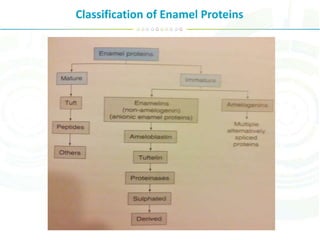
Classification of Enamel Proteins
Composition of the Immature Enamel matrix
Proteins and peptides account for 25-30% of early developing
enamel
By contrast, they are only 1% by weight of mature enamel
In the early secretory stage, the developing enamel matrix is entirely
proteinaceous
These constituent proteins are unique and are different from any
protein in the body
It is in the process of maturation, that the amelogenins are degraded
and removed so that in mature enamel, only 5-10% amelogenins
comprise the 1% protein component.
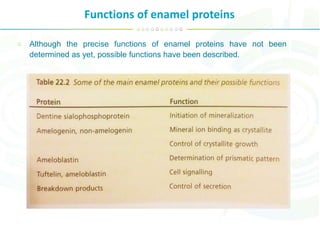
Functions of enamel proteins
Although the precise functions of enamel proteins have not been
determined as yet, possible functions have been described.
Functions of enamel proteins
Enamel matrix is secreted extracellularly and away from the
ameloblast surface
So the developing enamel matrix must contain the necessary
information to direct mineralization so that a complex microanatomy
of enamel is developed.
This information is required for the:
1. Nucleation of HAP crystals
2. Controlled growth of HAP
3. Relative orientation of HAP crystals to form a prismatic outline.
Functions of enamel proteins
It is, however difficult to precisely define the function of each enamel protein
because of a combination of following factors:
1. After initial secretion from the ameloblasts, these proteins undergo a series of
degradative changes carried out by proteolytic enzymes present in the
developing enamel matrix. This results in the accumulation of many smaller
enamel proteins and peptides.
2. Changes in the amino acid sequences or presence/absence of amino acids.
These changes are due to variable protein transcription.
3. Sexual dimorphism of the amelogenin protein itself. Amelogenin gene on the
X-chromosome has 106 base pairs while that on the Y-chromosome has 112
base pairs. Two types of amelogenin are present: male specific and female
specific
• Sexual characterization of amelogenin has no functional significance except
to some extent in forensic dentistry. Sex of an individual could be determined
from viable nuclear material derived from well protected pulps of dead
individuals.
Amelogenin Enamel Proteins
Prior to any processing, the newly secreted major amelogenin molecule has the
following features:
1. 25 kDa protein
2. 178 amino acids
3. Hydrophobic molecule
4. Proline rich molecule with high levels of histidine, glutamine and leucine
• The major molecule is broken down by proteolytic cleavage as it goes down the inner
layers of enamel matrix. The 25 kDa form is broken down to a 20 kDa form. Further
processing results in 3 forms:
1. 13 kDa (soluble)
2. 11 kDa (soluble)
3. 5 kDa (Tyrosine rich amelogenin peptide TRAP)
TRAP is thought to be important in HAP crystal growth.
Amelogenin Enamel Proteins
Amelogenins are hydrophobic and tend to aggregate or clump
Spread throughout the entire developing enamel thickness
Self assembly and formation of minute nanospheres which have a
diameter of 20 nm
Evidence is that these crystals interpose between developing enamel
crystals and regulate their mineralization and growth
It has been proposed that first crystals of enamel are formed between
these nanospheres and are also 20 nm apart.
Non Amelogenin Enamel Proteins
These are:
1. Enamelins
2. Ameloblastin (amelin, sheathlin)
3. Tuftelin
4. Sulphated enamel proteins
5. Proteolytic enzymes
6. Serum dervied products
7. Amelotin
Enamelins
Found in the outermost layers of newly secreted enamel
Primarily located in prism cores
Form aggregates with other enamel proteins and can control the
growth of enamel crystals (proposed inhibition)
Ameloblastin
Two transcripts amelin and sheathlin
Function in the generation of prism structure
Gene located on chromosome 4
Are also produced by epithelial root sheath during root formation
play a role in cell adhesion of ameloblasts
Tuftelin
Gene located on chromosome 1
One of the earliest proteins to be produced
Early functions are that it can act as a signalling molecule in epithelial
mesenchymal interactions
Retains in enamel tufts following maturation
Other Protiens
Function of sulphated enamel proteins is unknown
Proteolytic enzymes include enamelysin and kallikrein-4
(EMSP), and also alkaline phosphatase
Major serum dervied protein in enamel is albumin which has the
property of inhibtion of enamel growth
Amelotin may play a role in cell adhesion.

Enamel proteins

  • 1.
    Enamel Proteins Dr MuhammadDanial Khalid BDS, MFGDP RCS (Eng), MSc (London) Assistant Professor of Oral Biology
  • 2.
    Introduction • One ofthe main processes in the maturation of enamel is the removal and modification of the initially formed proteinaceous matrix • The composition of immature enamel matrix is imperative for consideration given the fact that it is the enamel proteins which regulate the mineralization as well as appositional growth in amelogenesis. • Must be remembered that developing enamel contains 90% amelogenins and 10% non-amelogenins. A reversal of compostion occurs in mature enamel.
  • 3.
  • 4.
    Composition of theImmature Enamel matrix Proteins and peptides account for 25-30% of early developing enamel By contrast, they are only 1% by weight of mature enamel In the early secretory stage, the developing enamel matrix is entirely proteinaceous These constituent proteins are unique and are different from any protein in the body It is in the process of maturation, that the amelogenins are degraded and removed so that in mature enamel, only 5-10% amelogenins comprise the 1% protein component.
  • 5.
    Functions of enamelproteins Although the precise functions of enamel proteins have not been determined as yet, possible functions have been described.
  • 6.
    Functions of enamelproteins Enamel matrix is secreted extracellularly and away from the ameloblast surface So the developing enamel matrix must contain the necessary information to direct mineralization so that a complex microanatomy of enamel is developed. This information is required for the: 1. Nucleation of HAP crystals 2. Controlled growth of HAP 3. Relative orientation of HAP crystals to form a prismatic outline.
  • 7.
    Functions of enamelproteins It is, however difficult to precisely define the function of each enamel protein because of a combination of following factors: 1. After initial secretion from the ameloblasts, these proteins undergo a series of degradative changes carried out by proteolytic enzymes present in the developing enamel matrix. This results in the accumulation of many smaller enamel proteins and peptides. 2. Changes in the amino acid sequences or presence/absence of amino acids. These changes are due to variable protein transcription. 3. Sexual dimorphism of the amelogenin protein itself. Amelogenin gene on the X-chromosome has 106 base pairs while that on the Y-chromosome has 112 base pairs. Two types of amelogenin are present: male specific and female specific • Sexual characterization of amelogenin has no functional significance except to some extent in forensic dentistry. Sex of an individual could be determined from viable nuclear material derived from well protected pulps of dead individuals.
  • 8.
    Amelogenin Enamel Proteins Priorto any processing, the newly secreted major amelogenin molecule has the following features: 1. 25 kDa protein 2. 178 amino acids 3. Hydrophobic molecule 4. Proline rich molecule with high levels of histidine, glutamine and leucine • The major molecule is broken down by proteolytic cleavage as it goes down the inner layers of enamel matrix. The 25 kDa form is broken down to a 20 kDa form. Further processing results in 3 forms: 1. 13 kDa (soluble) 2. 11 kDa (soluble) 3. 5 kDa (Tyrosine rich amelogenin peptide TRAP) TRAP is thought to be important in HAP crystal growth.
  • 9.
    Amelogenin Enamel Proteins Amelogeninsare hydrophobic and tend to aggregate or clump Spread throughout the entire developing enamel thickness Self assembly and formation of minute nanospheres which have a diameter of 20 nm Evidence is that these crystals interpose between developing enamel crystals and regulate their mineralization and growth It has been proposed that first crystals of enamel are formed between these nanospheres and are also 20 nm apart.
  • 10.
    Non Amelogenin EnamelProteins These are: 1. Enamelins 2. Ameloblastin (amelin, sheathlin) 3. Tuftelin 4. Sulphated enamel proteins 5. Proteolytic enzymes 6. Serum dervied products 7. Amelotin
  • 11.
    Enamelins Found in theoutermost layers of newly secreted enamel Primarily located in prism cores Form aggregates with other enamel proteins and can control the growth of enamel crystals (proposed inhibition)
  • 12.
    Ameloblastin Two transcripts amelinand sheathlin Function in the generation of prism structure Gene located on chromosome 4 Are also produced by epithelial root sheath during root formation play a role in cell adhesion of ameloblasts
  • 13.
    Tuftelin Gene located onchromosome 1 One of the earliest proteins to be produced Early functions are that it can act as a signalling molecule in epithelial mesenchymal interactions Retains in enamel tufts following maturation
  • 14.
    Other Protiens Function ofsulphated enamel proteins is unknown Proteolytic enzymes include enamelysin and kallikrein-4 (EMSP), and also alkaline phosphatase Major serum dervied protein in enamel is albumin which has the property of inhibtion of enamel growth Amelotin may play a role in cell adhesion.