Haya Ghazan
AMELOGENESIS
What?
The formation of enamel on teeth
When?
Begins when the crown is forming during ADVANCED BELL STAGE
After dentinogenesis forms the 1st layer of Dentin
Where?
On top of the 1st layer of dentin
Who?
By AMELOBLASTS differentiated from the IEE
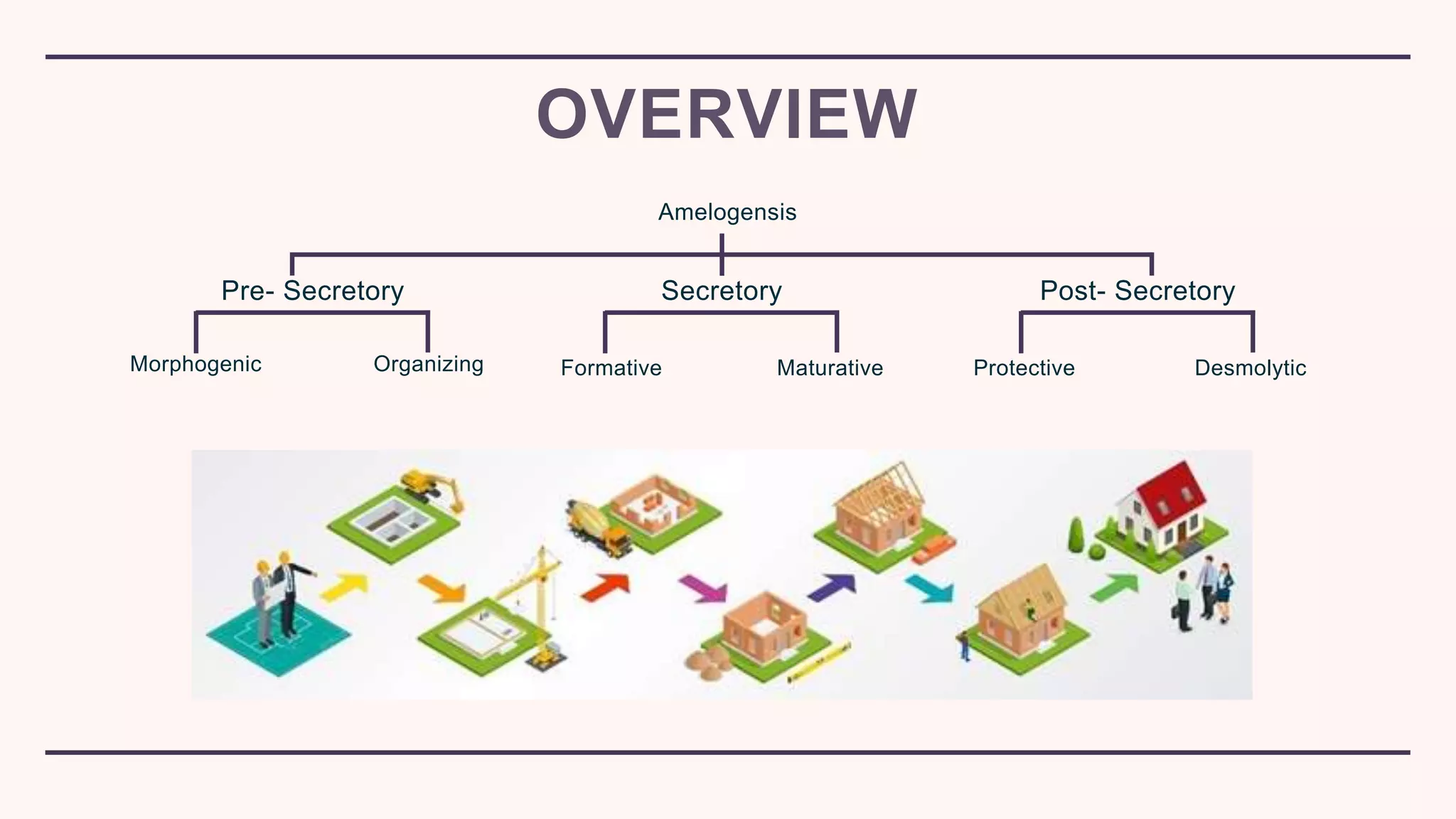
OVERVIEW
Amelogensis
Pre- Secretory Secretory Post- Secretory
Morphogenic Organizing Formative Maturative Protective Desmolytic
FORMATIVE STAGE
CELLULAR
CHANGES
Cell elongates further
Development of Tome’s Process:
• Blunt pyramidal cell process
• Penetrates the Basal lamina
• Enters the Pre- Dentin
• Incomplete septa separates it from the cell proper
• Contains secretory granules
• The ameloblasts start the synthesis and secretion of enamel matrix proteins
mRNA carries message
from nucleus to
cytoplasm
Ribosomes
translate mRNA
Protein synthesized in
RER and modified in
Golgi apparatus
Packed into secretory vesicles
and secreted via Tome’s Process
• Enamel matrix proteins
Amelogenins
• 90%
• Low molecular weight
• Hydrophobic
• Rich in Histidine, Glutamine,
Proline and Leucine
Non Amelogenins
• 10%
• High molecular weight
• Rich in Glycine, Aspartic acid and
Serine (GAS)
• Important proteins of this group are
Enamelin, Ameloblastin and Tuftelin
(EAT)
V
S
During formation, all
other calcified tissues (
bone, cartilages
cementum and dentin)
have an unmineralized
layer ( osteoid,
chondroid, cementoid
and pre-dentin)
No such layer is present
during enamel formation
as the secreted enamel
matrix proteins undergo
IMMEDIATE PARTIAL
MINERALIZATION
Occurs in Formative Stage, immediately after the matrix is laid down
Contributes 25%- 30% of eventual total mineral content of the enamel
Begins at the DEJ
First mineral molecule secreted is Octocalcium Phosphate, which is unstable and
hence converted to Hydroxyapatite form
IMMEDIATE PARTIAL MINERALIZATION
The Proximal Part releases interrod
The Distal Part releases enamel rod
1 Rod form 4 ameloblasts
Head is formed by 1, tail is formed by 3
ameloblasts
1 Ameloblast contributes to 4 different rods
Formative stage of amelogenesis

Formative stage of amelogenesis

  • 1.
  • 2.
    AMELOGENESIS What? The formation ofenamel on teeth When? Begins when the crown is forming during ADVANCED BELL STAGE After dentinogenesis forms the 1st layer of Dentin Where? On top of the 1st layer of dentin Who? By AMELOBLASTS differentiated from the IEE
  • 3.
    OVERVIEW Amelogensis Pre- Secretory SecretoryPost- Secretory Morphogenic Organizing Formative Maturative Protective Desmolytic
  • 4.
  • 5.
    CELLULAR CHANGES Cell elongates further Developmentof Tome’s Process: • Blunt pyramidal cell process • Penetrates the Basal lamina • Enters the Pre- Dentin • Incomplete septa separates it from the cell proper • Contains secretory granules
  • 6.
    • The ameloblastsstart the synthesis and secretion of enamel matrix proteins mRNA carries message from nucleus to cytoplasm Ribosomes translate mRNA Protein synthesized in RER and modified in Golgi apparatus Packed into secretory vesicles and secreted via Tome’s Process • Enamel matrix proteins Amelogenins • 90% • Low molecular weight • Hydrophobic • Rich in Histidine, Glutamine, Proline and Leucine Non Amelogenins • 10% • High molecular weight • Rich in Glycine, Aspartic acid and Serine (GAS) • Important proteins of this group are Enamelin, Ameloblastin and Tuftelin (EAT) V S
  • 7.
    During formation, all othercalcified tissues ( bone, cartilages cementum and dentin) have an unmineralized layer ( osteoid, chondroid, cementoid and pre-dentin) No such layer is present during enamel formation as the secreted enamel matrix proteins undergo IMMEDIATE PARTIAL MINERALIZATION
  • 8.
    Occurs in FormativeStage, immediately after the matrix is laid down Contributes 25%- 30% of eventual total mineral content of the enamel Begins at the DEJ First mineral molecule secreted is Octocalcium Phosphate, which is unstable and hence converted to Hydroxyapatite form IMMEDIATE PARTIAL MINERALIZATION
  • 9.
    The Proximal Partreleases interrod The Distal Part releases enamel rod 1 Rod form 4 ameloblasts Head is formed by 1, tail is formed by 3 ameloblasts 1 Ameloblast contributes to 4 different rods