EMPLOYING APPROPRIATE
COMMUNICATIVE STYLES
CASUAL
This is an informal language used by
friends and peers. Slang, vulgarities and
colloquialism, informal contractions (e.g.,
ain’t, dunno, gonna) are normal in this
type of speech style. This uses “group
language,” so only members of the group
can understand it. Here, nicknames are
used in addressing one another.
EXAMPLES OF CASUAL
Everyday conversation with buddies or friend
A personal message and personal emails
Blogs
Tweets
Letters to friends
Phone calls
CONSULTATIVE
This is used in semi-formal
communication, where sentences
tend to be shorter and
spontaneous. It happens in two-
way participation. It uses
unplanned speech. This is the
normal style for speaking to
strangers or persons who are
EXAMPLES OF CONSULTATIVE
Regular
classroom
discussions
Doctor-patient
Lawyer-client
Counselor-
client
Group
discussion
Teacher-
student
Expert-
apprentice
FORMAL
Formal speeches are straightforward
speeches. It is used in speaking to large
groups and is impersonal in nature.
Speaker must frame whole sentences
ahead before they are delivered. It avoids
using slang terminologies and uses formal
English. Language is comparatively rigid
and has a set, agreed-upon vocabulary
structured complex sentences and noun
phrases.
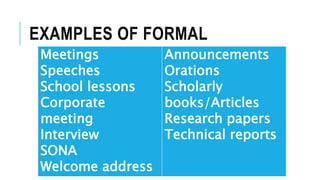
EXAMPLES OF FORMAL
Meetings
Speeches
School lessons
Corporate
meeting
Interview
SONA
Welcome address
Announcements
Orations
Scholarly
books/Articles
Research papers
Technical reports
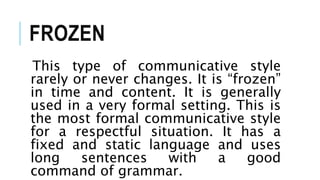
FROZEN
This type of communicative style
rarely or never changes. It is “frozen”
in time and content. It is generally
used in a very formal setting. This is
the most formal communicative style
for a respectful situation. It has a
fixed and static language and uses
long sentences with a good
command of grammar.
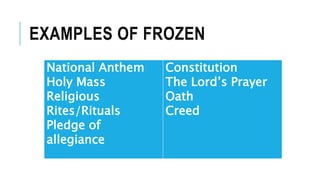
EXAMPLES OF FROZEN
National Anthem
Holy Mass
Religious
Rites/Rituals
Pledge of
allegiance
Constitution
The Lord’s Prayer
Oath
Creed
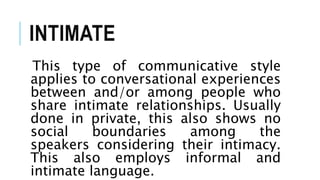
INTIMATE
This type of communicative style
applies to conversational experiences
between and/or among people who
share intimate relationships. Usually
done in private, this also shows no
social boundaries among the
speakers considering their intimacy.
This also employs informal and
intimate language.
EXAMPLES OF INTIMATE
Sharing of secrets between
friends
Parents talking about their
family goals
Meditation
QUIZ TIME
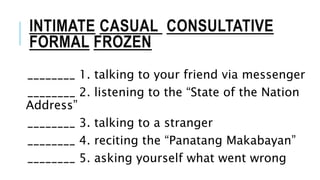
INTIMATE CASUAL CONSULTATIVE
FORMAL FROZEN
________ 1. talking to your friend via messenger
________ 2. listening to the “State of the Nation
Address”
________ 3. talking to a stranger
________ 4. reciting the “Panatang Makabayan”
________ 5. asking yourself what went wrong
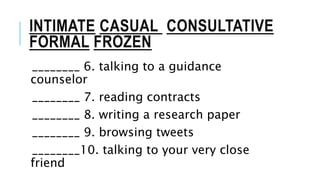
INTIMATE CASUAL CONSULTATIVE
FORMAL FROZEN
________ 6. talking to a guidance
counselor
________ 7. reading contracts
________ 8. writing a research paper
________ 9. browsing tweets
________10. talking to your very close
friend
INTIMATE CASUAL CONSULTATIVE
FORMAL FROZEN
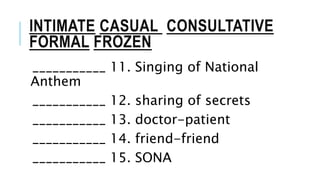
___________ 11. Singing of National
Anthem
___________ 12. sharing of secrets
___________ 13. doctor-patient
___________ 14. friend-friend
___________ 15. SONA
INTIMATE CASUAL CONSULTATIVE
FORMAL FROZEN
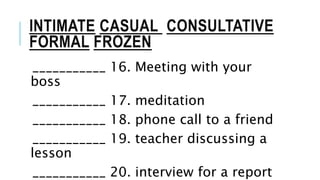
___________ 16. Meeting with your
boss
___________ 17. meditation
___________ 18. phone call to a friend
___________ 19. teacher discussing a
lesson
___________ 20. interview for a report

Employing Appropriate Communicative Styles.pptx

  • 1.
  • 2.
    CASUAL This is aninformal language used by friends and peers. Slang, vulgarities and colloquialism, informal contractions (e.g., ain’t, dunno, gonna) are normal in this type of speech style. This uses “group language,” so only members of the group can understand it. Here, nicknames are used in addressing one another.
  • 3.
    EXAMPLES OF CASUAL Everydayconversation with buddies or friend A personal message and personal emails Blogs Tweets Letters to friends Phone calls
  • 4.
    CONSULTATIVE This is usedin semi-formal communication, where sentences tend to be shorter and spontaneous. It happens in two- way participation. It uses unplanned speech. This is the normal style for speaking to strangers or persons who are
  • 5.
  • 6.
    FORMAL Formal speeches arestraightforward speeches. It is used in speaking to large groups and is impersonal in nature. Speaker must frame whole sentences ahead before they are delivered. It avoids using slang terminologies and uses formal English. Language is comparatively rigid and has a set, agreed-upon vocabulary structured complex sentences and noun phrases.
  • 7.
    EXAMPLES OF FORMAL Meetings Speeches Schoollessons Corporate meeting Interview SONA Welcome address Announcements Orations Scholarly books/Articles Research papers Technical reports
  • 8.
    FROZEN This type ofcommunicative style rarely or never changes. It is “frozen” in time and content. It is generally used in a very formal setting. This is the most formal communicative style for a respectful situation. It has a fixed and static language and uses long sentences with a good command of grammar.
  • 9.
    EXAMPLES OF FROZEN NationalAnthem Holy Mass Religious Rites/Rituals Pledge of allegiance Constitution The Lord’s Prayer Oath Creed
  • 10.
    INTIMATE This type ofcommunicative style applies to conversational experiences between and/or among people who share intimate relationships. Usually done in private, this also shows no social boundaries among the speakers considering their intimacy. This also employs informal and intimate language.
  • 11.
    EXAMPLES OF INTIMATE Sharingof secrets between friends Parents talking about their family goals Meditation
  • 12.
  • 13.
    INTIMATE CASUAL CONSULTATIVE FORMALFROZEN ________ 1. talking to your friend via messenger ________ 2. listening to the “State of the Nation Address” ________ 3. talking to a stranger ________ 4. reciting the “Panatang Makabayan” ________ 5. asking yourself what went wrong
  • 14.
    INTIMATE CASUAL CONSULTATIVE FORMALFROZEN ________ 6. talking to a guidance counselor ________ 7. reading contracts ________ 8. writing a research paper ________ 9. browsing tweets ________10. talking to your very close friend
  • 15.
    INTIMATE CASUAL CONSULTATIVE FORMALFROZEN ___________ 11. Singing of National Anthem ___________ 12. sharing of secrets ___________ 13. doctor-patient ___________ 14. friend-friend ___________ 15. SONA
  • 16.
    INTIMATE CASUAL CONSULTATIVE FORMALFROZEN ___________ 16. Meeting with your boss ___________ 17. meditation ___________ 18. phone call to a friend ___________ 19. teacher discussing a lesson ___________ 20. interview for a report