AMINA INSTITUTE OF TECHNOLOGYAMINA INSTITUTE OF TECHNOLOGY
EMPLOYEE RETNTION
PRESENTED BY Mahboob
ali khan MHA CPHQ
The picture states the latest statement
that corporate believes in “Love them or Lose them”
INTRODUCTIONINTRODUCTION
Employee Retention involves taking measures to encourage employees to remain in the
organization for the maximum period of time. Corporate is facing a lot of problems in
employee retention these days. Hiring knowledgeable people for the job is essential for an
employer. But retention is even more important than hiring.
In today’s environment it becomes very important for organizations to retain their
employees. The top organizations are on the top because they value their employees and they
know how to keep them glued to the organization. Employees stay and leave organizations
for some reasons. The reason may be personal or professional. These reasons should be
understood by the employer and should be taken care of. The organizations are becoming
aware of these reasons and adopting many strategies for employee retention.
Definition:-
“Employee retention is a process in which the employees are encouraged
to remain with the organization for the maximum period of time or until
the completion of the project”.
Employee retention is beneficial for the organization as well as the
employee.Employees today are different. They are not the ones who don’t
have good opportunities in hand. As soon as they feel dissatisfied with the
current employer or the job, they switch over to the next job. It is the
responsibility of the employer to retain their best employees. If they don’t,
they would be left with no good employees. A good employer should know
how to attract and retain its employees .
To be continued…
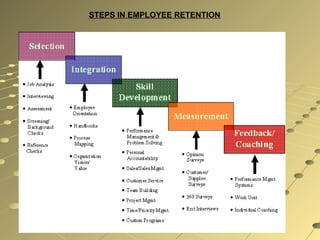
Steps in employees Retention :-
1. Compensation
2. Environment
3. Growth
To be continued….
4. Support
5. Relationship
STEPS IN EMPLOYEE RETENTION
IMPORTANCE OF EMPLOYEE RETNTIONIMPORTANCE OF EMPLOYEE RETNTION
Now that so much is being done by organizations to retain its employees, why is retention so
important? Is it just to reduce the turnover costs? Well, the answer is a definite no. It’s not only
the cost incurred by a company that emphasizes the need of retaining employees but also the
need to retain talented employees from getting poached.
The process of employee retention will benefit an organization in the following ways:
 The cost of turnover
 The loss of company knowledge
 Interruption of customer service
 Turnover lead to more Turnover
 Goodwill of the company
 Regaining Efficiency
What makes employee leave :-
Job is not what the employees expected to be
Job and person mismatch
No growth opportunities
Lack of appreciation
Lack of trust and support in co-workers, superiors and management
Stress from work and work life imbalance
Compensation
New job offer
Employee retention strategiesEmployee retention strategies:-:-
Hire the right people in the first place
Empower the employees: Give the employees the authority to get things done.
Make employees realize that they are the most valuable asset of the organization.
Provide them information and knowledge
Keep providing them feedback on their performance
Recognize and appreciate their achievements
Keep their morale high.
Have faith in them, trust them and respect them.
Create an environment where the employees want to work and have fun.
To be continued…
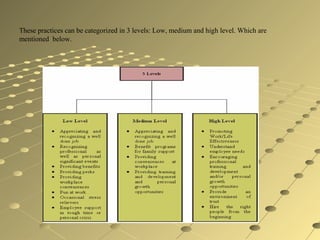
These practices can be categorized in 3 levels: Low, medium and high level. Which are
mentioned below.
Retention myths :-
Employees leave an organization for more pay
Incentives can increase productivity
Employees run away from responsibilities
Loyalty is a thing of the past
Taking measures to increase employee satisfaction will be expensive for the
organizations
Benefits of AttritionBenefits of Attrition :-:-
Attrition is not bad always if it happens in a controlled manner. Some attrition is always
desirable and necessary for organizational growth and development. The only concern is
how organizations differentiate “good attrition” from “bad attrition”. The term “healthy
attrition” or “good attrition” signifies the importance of less productive employees
voluntarily leaving the organization. This means if the ones who have left fall in the
category of low performers, the attrition in considered being healthy.
Attrition rates are considered to be beneficial in some ways:
•If all employees stay in the same organization for a very long time, most of them will
be at the top of their pay scale which will result in excessive manpower costs.
•When certain employees leave, whose continuation of service would have negatively
impacted productivity and profitability of the company, the company is benefited.
•New employees bring new ideas, approaches, abilities & attitudes which can keep the
organization from becoming stagnant.
To be continued….
•There are also some people in the organization who have a negative and demoralizing
influence on the work culture and team spirit. This, in the long-term, is detrimental to
organizational health.
•Desirable attrition also includes termination of employees with whom the organization does
not want to continue a relationship. It benefits the organization in the following ways:
It removes bottleneck in the progress of the company
 It creates space for the entry of new talents
 It assists in evolving high performance teams
RETENTION SUCCESS MANTRASRETENTION SUCCESS MANTRAS
Transparent work culture
Quality of work
Support employees
Feed back
Communication between employers and employees
ATTRITION RATEATTRITION RATE
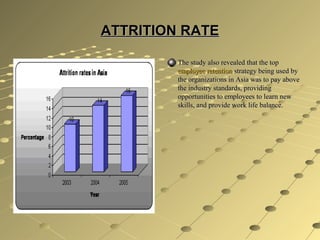
overall attrition rate of 16% in 2005. Attrition rate was 14% in 2004 and 10% in 2003.
According to Hewitt’s Attrition and Retention Study Asia Pacific 2006, the no.1 reason
for this growing attrition rate is compensation unfairness. 21% of the organizations
who took part in the survey said that their employee left the organization because they
got offers from other organizations offering better pay packages. The no. 2 reason was
less growth opportunities and no. 3 reason was role stagnation.
The study also revealed that the top employee retention strategy being used by the
organizations in Asia was to pay above the industry standards, providing opportunities
to employees to learn new skills, and provide work life balance.
To be continued…
ATTRITION RATEATTRITION RATE
The study also revealed that the topThe study also revealed that the top
employee retentionemployee retention strategy being used bystrategy being used by
the organizations in Asia was to pay abovethe organizations in Asia was to pay above
the industry standards, providingthe industry standards, providing
opportunities to employees to learn newopportunities to employees to learn new
skills, and provide work life balance.skills, and provide work life balance.
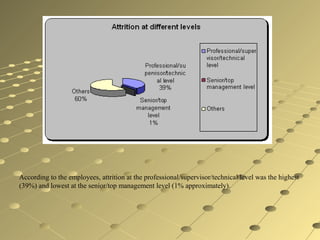
According to the employees, attrition at the professional/supervisor/technical level was the highest
(39%) and lowest at the senior/top management level (1% approximately).
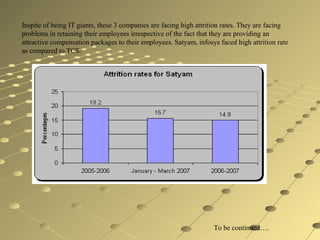
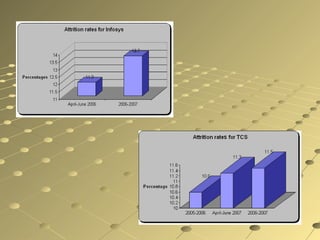
Inspite of being IT giants, these 3 companies are facing high attrition rates. They are facing
problems in retaining their employees irrespective of the fact that they are providing an
attractive compensation packages to their employees. Satyam, infosys faced high attrition rate
as compared to TCS.
To be continued….
HOW TO MANAGE RETENTIONSHOW TO MANAGE RETENTIONS
The task of managing employees can be understood as a three stage process:
1. Identify the cost of employee turnover
2. Understand why employee leave
3. Implement retention strategies
HOW TO INCREASE EMPLOYEEHOW TO INCREASE EMPLOYEE
RETENTIONRETENTION
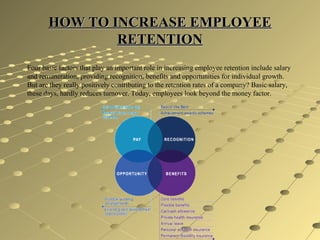
Four basic factors that play an important role in increasing employee retention include salary
and remuneration, providing recognition, benefits and opportunities for individual growth.
But are they really positively contributing to the retention rates of a company? Basic salary,
these days, hardly reduces turnover. Today, employees look beyond the money factor.
Employee retention can be increase by inculcating the
following practices:
Employee reward program
Career development program
Performance bonus
Recreational facilities
Gifts at some occasions
Open communication
Retention bonus
ROLE OF MANAGER IN RETENTIONSROLE OF MANAGER IN RETENTIONS
Managers and team leaders can reduce the attrition levels considerably by creating a
motivating team culture and improving the relationships with team members. This can
be done in a following way:
Creating a motivating environment
Standing up for the team
Providing coaching
Delegation
Extra responsibility
Focus on future career
Employee retetion by Mahboob ali khan

Employee retetion by Mahboob ali khan

  • 1.
    AMINA INSTITUTE OFTECHNOLOGYAMINA INSTITUTE OF TECHNOLOGY EMPLOYEE RETNTION PRESENTED BY Mahboob ali khan MHA CPHQ
  • 2.
    The picture statesthe latest statement that corporate believes in “Love them or Lose them”
  • 3.
    INTRODUCTIONINTRODUCTION Employee Retention involvestaking measures to encourage employees to remain in the organization for the maximum period of time. Corporate is facing a lot of problems in employee retention these days. Hiring knowledgeable people for the job is essential for an employer. But retention is even more important than hiring. In today’s environment it becomes very important for organizations to retain their employees. The top organizations are on the top because they value their employees and they know how to keep them glued to the organization. Employees stay and leave organizations for some reasons. The reason may be personal or professional. These reasons should be understood by the employer and should be taken care of. The organizations are becoming aware of these reasons and adopting many strategies for employee retention.
  • 4.
    Definition:- “Employee retention isa process in which the employees are encouraged to remain with the organization for the maximum period of time or until the completion of the project”. Employee retention is beneficial for the organization as well as the employee.Employees today are different. They are not the ones who don’t have good opportunities in hand. As soon as they feel dissatisfied with the current employer or the job, they switch over to the next job. It is the responsibility of the employer to retain their best employees. If they don’t, they would be left with no good employees. A good employer should know how to attract and retain its employees . To be continued…
  • 5.
    Steps in employeesRetention :- 1. Compensation 2. Environment 3. Growth To be continued….
  • 6.
  • 7.
  • 8.
    IMPORTANCE OF EMPLOYEERETNTIONIMPORTANCE OF EMPLOYEE RETNTION Now that so much is being done by organizations to retain its employees, why is retention so important? Is it just to reduce the turnover costs? Well, the answer is a definite no. It’s not only the cost incurred by a company that emphasizes the need of retaining employees but also the need to retain talented employees from getting poached. The process of employee retention will benefit an organization in the following ways:  The cost of turnover  The loss of company knowledge  Interruption of customer service  Turnover lead to more Turnover  Goodwill of the company  Regaining Efficiency
  • 9.
    What makes employeeleave :- Job is not what the employees expected to be Job and person mismatch No growth opportunities Lack of appreciation Lack of trust and support in co-workers, superiors and management Stress from work and work life imbalance Compensation New job offer
  • 10.
    Employee retention strategiesEmployeeretention strategies:-:- Hire the right people in the first place Empower the employees: Give the employees the authority to get things done. Make employees realize that they are the most valuable asset of the organization. Provide them information and knowledge Keep providing them feedback on their performance Recognize and appreciate their achievements Keep their morale high. Have faith in them, trust them and respect them. Create an environment where the employees want to work and have fun. To be continued…
  • 11.
    These practices canbe categorized in 3 levels: Low, medium and high level. Which are mentioned below.
  • 12.
    Retention myths :- Employeesleave an organization for more pay Incentives can increase productivity Employees run away from responsibilities Loyalty is a thing of the past Taking measures to increase employee satisfaction will be expensive for the organizations
  • 13.
    Benefits of AttritionBenefitsof Attrition :-:- Attrition is not bad always if it happens in a controlled manner. Some attrition is always desirable and necessary for organizational growth and development. The only concern is how organizations differentiate “good attrition” from “bad attrition”. The term “healthy attrition” or “good attrition” signifies the importance of less productive employees voluntarily leaving the organization. This means if the ones who have left fall in the category of low performers, the attrition in considered being healthy. Attrition rates are considered to be beneficial in some ways: •If all employees stay in the same organization for a very long time, most of them will be at the top of their pay scale which will result in excessive manpower costs. •When certain employees leave, whose continuation of service would have negatively impacted productivity and profitability of the company, the company is benefited. •New employees bring new ideas, approaches, abilities & attitudes which can keep the organization from becoming stagnant. To be continued….
  • 14.
    •There are alsosome people in the organization who have a negative and demoralizing influence on the work culture and team spirit. This, in the long-term, is detrimental to organizational health. •Desirable attrition also includes termination of employees with whom the organization does not want to continue a relationship. It benefits the organization in the following ways: It removes bottleneck in the progress of the company  It creates space for the entry of new talents  It assists in evolving high performance teams
  • 15.
    RETENTION SUCCESS MANTRASRETENTIONSUCCESS MANTRAS Transparent work culture Quality of work Support employees Feed back Communication between employers and employees
  • 16.
    ATTRITION RATEATTRITION RATE overallattrition rate of 16% in 2005. Attrition rate was 14% in 2004 and 10% in 2003. According to Hewitt’s Attrition and Retention Study Asia Pacific 2006, the no.1 reason for this growing attrition rate is compensation unfairness. 21% of the organizations who took part in the survey said that their employee left the organization because they got offers from other organizations offering better pay packages. The no. 2 reason was less growth opportunities and no. 3 reason was role stagnation. The study also revealed that the top employee retention strategy being used by the organizations in Asia was to pay above the industry standards, providing opportunities to employees to learn new skills, and provide work life balance. To be continued…
  • 17.
    ATTRITION RATEATTRITION RATE Thestudy also revealed that the topThe study also revealed that the top employee retentionemployee retention strategy being used bystrategy being used by the organizations in Asia was to pay abovethe organizations in Asia was to pay above the industry standards, providingthe industry standards, providing opportunities to employees to learn newopportunities to employees to learn new skills, and provide work life balance.skills, and provide work life balance.
  • 18.
    According to theemployees, attrition at the professional/supervisor/technical level was the highest (39%) and lowest at the senior/top management level (1% approximately).
  • 19.
    Inspite of beingIT giants, these 3 companies are facing high attrition rates. They are facing problems in retaining their employees irrespective of the fact that they are providing an attractive compensation packages to their employees. Satyam, infosys faced high attrition rate as compared to TCS. To be continued….
  • 21.
    HOW TO MANAGERETENTIONSHOW TO MANAGE RETENTIONS The task of managing employees can be understood as a three stage process: 1. Identify the cost of employee turnover 2. Understand why employee leave 3. Implement retention strategies
  • 22.
    HOW TO INCREASEEMPLOYEEHOW TO INCREASE EMPLOYEE RETENTIONRETENTION Four basic factors that play an important role in increasing employee retention include salary and remuneration, providing recognition, benefits and opportunities for individual growth. But are they really positively contributing to the retention rates of a company? Basic salary, these days, hardly reduces turnover. Today, employees look beyond the money factor.
  • 23.
    Employee retention canbe increase by inculcating the following practices: Employee reward program Career development program Performance bonus Recreational facilities Gifts at some occasions Open communication Retention bonus
  • 24.
    ROLE OF MANAGERIN RETENTIONSROLE OF MANAGER IN RETENTIONS Managers and team leaders can reduce the attrition levels considerably by creating a motivating team culture and improving the relationships with team members. This can be done in a following way: Creating a motivating environment Standing up for the team Providing coaching Delegation Extra responsibility Focus on future career