Emotional Intelligence
Introduction
⚫ Emotion is a wide range of observable behaviours, expressed feelings,
and changes in the state of mind and body.
⚫ Feelings, emotions, our likes, and dislikes, give our individual lives
meaning and cause us to be happy or unhappy, satisfied or
dissatisfied.
⚫ Intelligence is the ability to acquire and apply knowledge and skills.
⚫ Emotional Intelligence is the ability to deal with other people
successfully. By understanding one's own feelings they can
understand and evaluate others .
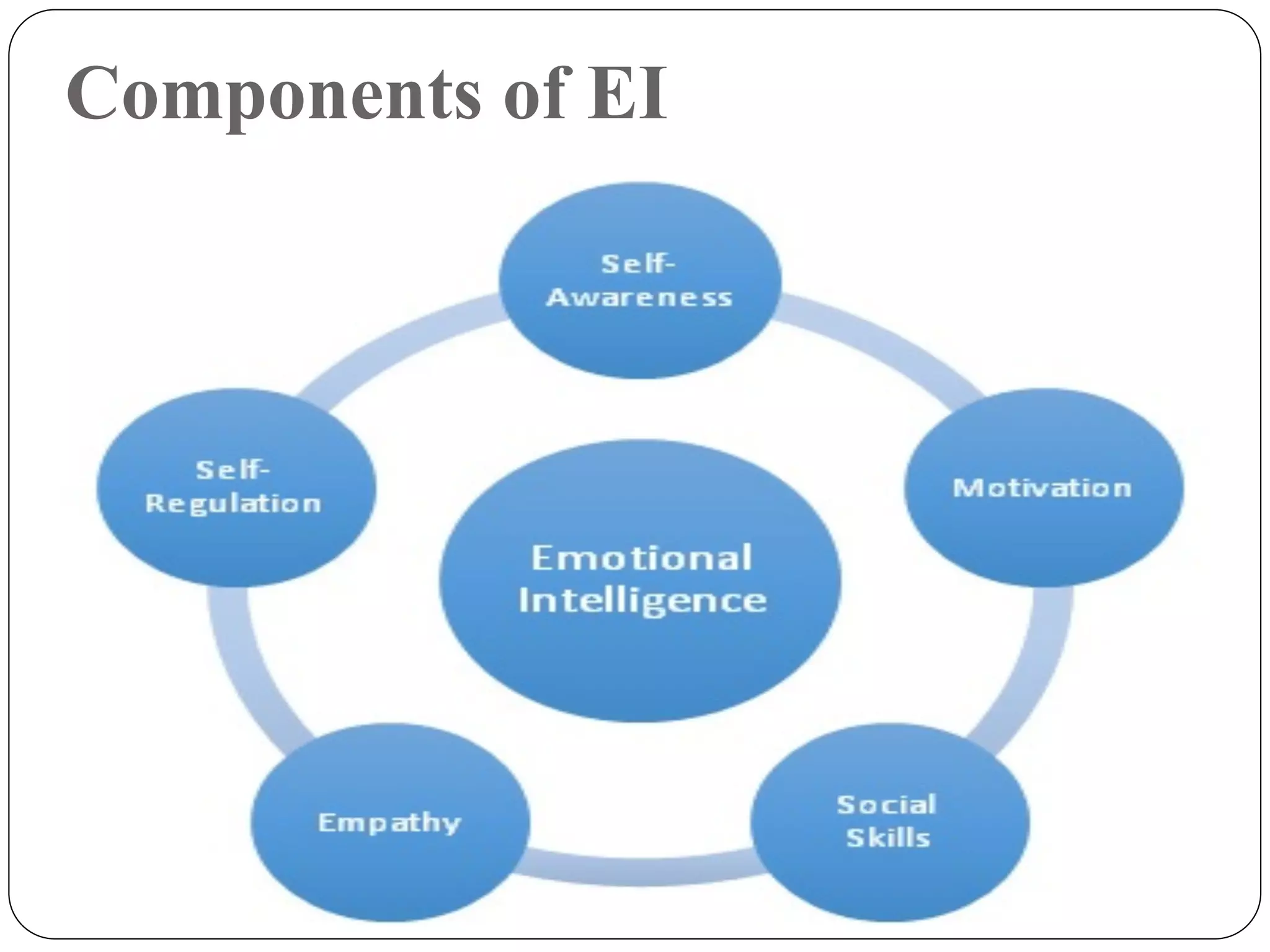
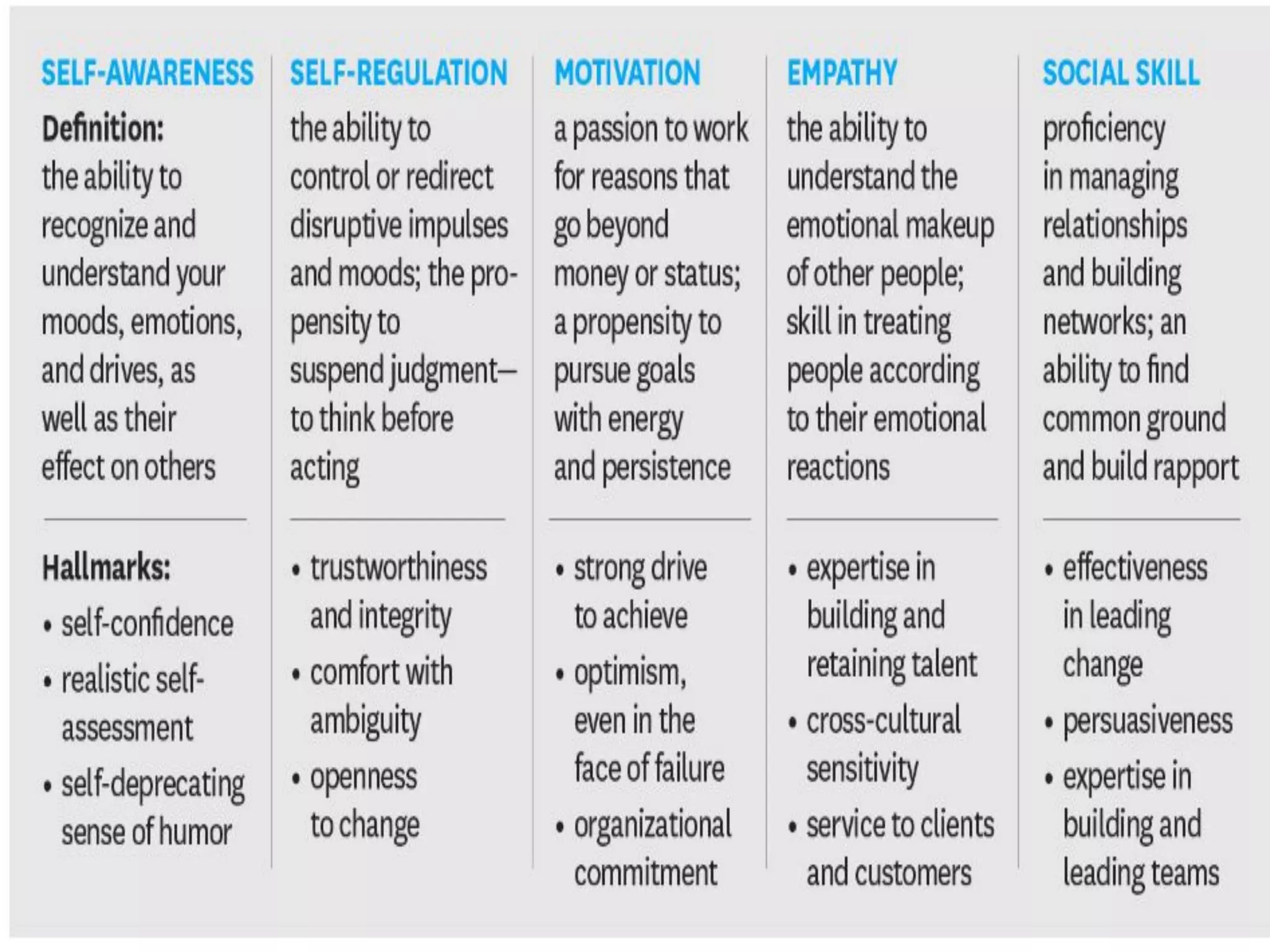
Components of EI
Self-Awareness
⚫ This is the ability to recognize and understand ones moods,
motivations, and abilities. Also understanding the effects they
have on others.
⚫ Goleman says to achieve a state of complete self-awareness, an
individual must be able to monitor their emotional state and
identify their emotions.
⚫ Traits that prove an individual as emotionally mature include:
confidence, the ability to laugh at ones self and their mistakes, and
the awareness of how you are perceived by others. Example: By
reading the reaction of someone else, you know how you are
perceived by them.
⚫ If you're self-aware, you always know how you feel, and you know
how your emotions and your actions can affect the people around you.
Being self-aware when you're in a leadership position also means
having a clear picture of your strengths and weaknesses, and it means
behaving with humility.
⚫ So, what can you do to improve your self-awareness?
⚫ Keep a journal – Journals help you improve your self-awareness. If
you spend just a few minutes each day writing down your thoughts,
this can move you to a higher degree of self-awareness.
⚫ Slow down – When you experience anger or other strong emotions,
slow down to examine why. Remember, no matter what the situation,
you can always choose how you react to it.
Self-regulation
⚫ This is the ability to control ones impulses, the ability to
think before you speak/react, and the ability to express
yourself appropriately.
⚫ Goleman defines emotional maturity in this component as
being able to take responsibility for your actions, being
able to adapt to change, and the ability to respond
appropriately to other peoples irrational emotions or
behaviour.
⚫ Example: If someone is screaming at you, you know that
they are not always angry at you. You have the ability to
understand they may be angry at a particular situation and
feel they need to take it out on someone. You do not take
this personally or react angry back.
⚫ So, how can you improve your ability to self-regulate?
⚫ Know your values – Do you have a clear idea of where you
absolutely will not compromise? Do you know what values are
most important to you? Spend some time examining your "code of
ethics." If you know what's most important to you, then you
probably won't have to think twice when you face a moral or ethical
decision – you'll make the right choice.
⚫ Hold yourself accountable – If you tend to blame others when
something goes wrong, stop. Make a commitment to admit to your
mistakes and to face the consequences, whatever they are. You'll
probably sleep better at night, and you'll quickly earn the respect of
⚫ Practice being calm – The next time you're in a
challenging situation, be very aware of how you act. Do
you relieve your stress by shouting at someone else?
Practice deep-breathing exercises to calm yourself. Also,
try to write down all of the negative things you want to say,
and then rip it up and throw it away. Expressing these
emotions on paper (and not showing them to anyone!) is
better than speaking them aloud to your team. What's more,
this helps you challenge your reactions to ensure that
they're fair!

emotional intelligence.pdf

  • 1.
  • 2.
    Introduction ⚫ Emotion isa wide range of observable behaviours, expressed feelings, and changes in the state of mind and body. ⚫ Feelings, emotions, our likes, and dislikes, give our individual lives meaning and cause us to be happy or unhappy, satisfied or dissatisfied. ⚫ Intelligence is the ability to acquire and apply knowledge and skills. ⚫ Emotional Intelligence is the ability to deal with other people successfully. By understanding one's own feelings they can understand and evaluate others .
  • 3.
  • 5.
    Self-Awareness ⚫ This isthe ability to recognize and understand ones moods, motivations, and abilities. Also understanding the effects they have on others. ⚫ Goleman says to achieve a state of complete self-awareness, an individual must be able to monitor their emotional state and identify their emotions. ⚫ Traits that prove an individual as emotionally mature include: confidence, the ability to laugh at ones self and their mistakes, and the awareness of how you are perceived by others. Example: By reading the reaction of someone else, you know how you are perceived by them.
  • 6.
    ⚫ If you'reself-aware, you always know how you feel, and you know how your emotions and your actions can affect the people around you. Being self-aware when you're in a leadership position also means having a clear picture of your strengths and weaknesses, and it means behaving with humility. ⚫ So, what can you do to improve your self-awareness? ⚫ Keep a journal – Journals help you improve your self-awareness. If you spend just a few minutes each day writing down your thoughts, this can move you to a higher degree of self-awareness. ⚫ Slow down – When you experience anger or other strong emotions, slow down to examine why. Remember, no matter what the situation, you can always choose how you react to it.
  • 7.
    Self-regulation ⚫ This isthe ability to control ones impulses, the ability to think before you speak/react, and the ability to express yourself appropriately. ⚫ Goleman defines emotional maturity in this component as being able to take responsibility for your actions, being able to adapt to change, and the ability to respond appropriately to other peoples irrational emotions or behaviour. ⚫ Example: If someone is screaming at you, you know that they are not always angry at you. You have the ability to understand they may be angry at a particular situation and feel they need to take it out on someone. You do not take this personally or react angry back.
  • 8.
    ⚫ So, howcan you improve your ability to self-regulate? ⚫ Know your values – Do you have a clear idea of where you absolutely will not compromise? Do you know what values are most important to you? Spend some time examining your "code of ethics." If you know what's most important to you, then you probably won't have to think twice when you face a moral or ethical decision – you'll make the right choice. ⚫ Hold yourself accountable – If you tend to blame others when something goes wrong, stop. Make a commitment to admit to your mistakes and to face the consequences, whatever they are. You'll probably sleep better at night, and you'll quickly earn the respect of
  • 9.
    ⚫ Practice beingcalm – The next time you're in a challenging situation, be very aware of how you act. Do you relieve your stress by shouting at someone else? Practice deep-breathing exercises to calm yourself. Also, try to write down all of the negative things you want to say, and then rip it up and throw it away. Expressing these emotions on paper (and not showing them to anyone!) is better than speaking them aloud to your team. What's more, this helps you challenge your reactions to ensure that they're fair!