














ENGAGINGHIGHPERFORMANCEINTHEWORKPLACE EMOTIONAL INTELLIGENCE
DRYVONNESUMCSP
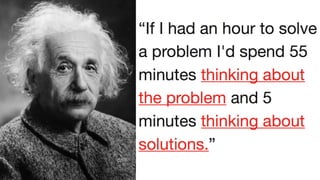
To Survive or Thrive - It’s all about attitude
5
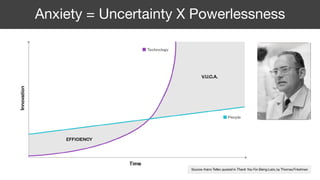
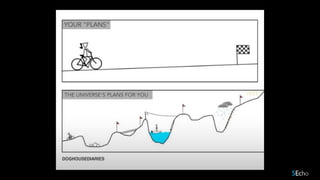
Anxiety = Uncertainty X Powerlessness
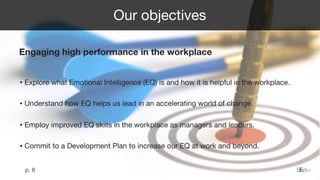
Engaging high performance in the workplace

• Explore what Emotional Intelligence (EQ) is and how it is helpful in the workplace.

• Understand how EQ helps us lead in an accelerating world of change.
• Employ improved EQ skills in the workplace as managers and leaders.

• Commit to a Development Plan to increase our EQ at work and beyond.
Our objectives
5Echop. 8
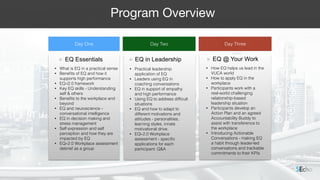
Program Overview
Day One Day Two Day Three
EQ Essentials EQ @ Your WorkEQ in Leadership
5Echo
• What is EQ in a practical sense
• Benefits of EQ and how it
supports high performance
• EQ-i2.0 framework
• Key EQ skills - Understanding
self & others
• Benefits to the workplace and
beyond
• EQ and neuroscience -
conversational intelligence
• EQ in decision making and
stress management
• Self expression and self
perception and how they are
impacted by EQ
• EQi-2.0 Workplace assessment
debrief as a group
• Practical leadership
application of EQ
• Leaders using EQ in
coaching conversations
• EQ in support of empathy
and high performance
• Using EQ to address difficult
situations
• EQ and how to adapt to
different motivations and
attitudes - personalities,
learning styles, innate
motivational drive.
• EQi-2.0 Workplace
assessment - specific
applications for each
participant: Q&A
• How EQ helps us lead in the
VUCA world
• How to apply EQ in the
workplace
• Participants work with a
real-world challenging
relationship-based
leadership situation
• Participants develop an
Action Plan and an agreed
Accountability Buddy to
assist with transference to
the workplace
• Introducing Actionable
Conversations - making EQ
a habit through leader-led
conversations and trackable
commitments to their KPIs
13
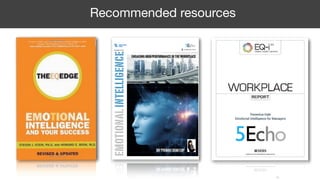
Recommended resources
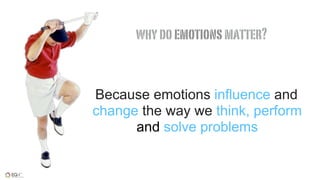
Because emotions influence and
change the way we think, perform
and solve problems
whydoemotionsmatter?
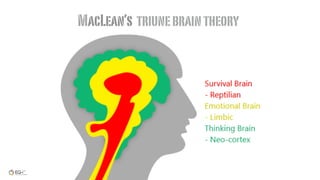
MacLean’s triunebraintheory
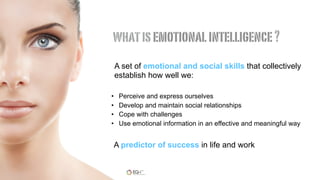
A set of emotional and social skills that collectively
establish how well we:
• Perceive and express ourselves
• Develop and maintain social relationships
• Cope with challenges
• Use emotional information in an effective and meaningful way
A predictor of success in life and work
whatisemotionalintelligence?
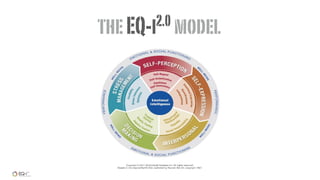
theEQ-i2.0 model
Accurate assessment of strengths &
blind spots: take assessment in 20 mins
Predictable way to measure current
level of emotional & social functioning:
receive feedback on your results
Vehicle for developing effectiveness to
improve performance: develop
customised action plan to ensure you are
focusing on the right development needs
whatistheEQ-i2.0 ?
Great rigor into research and
development of the tool
4,000 people took assessment to
ensure results accurate: compared
to your norm group
Checks & balances built into tool
to ensure most accurate results
howaccurateistheEQ-i2.0 ?
The EQ-i2.0 measures five distinct aspects of
emotional and social functioning:
Self-Perception – understanding your emotions
Self-Expression – expressing your emotions
Interpersonal – develop and maintain relationships
Decision Making – use emotions to make better decisions
Stress Management – cope with challenges
whatdoestheEQ-i2.0 measure?
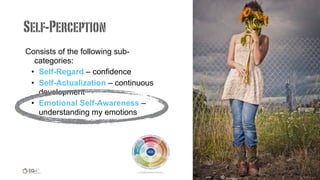
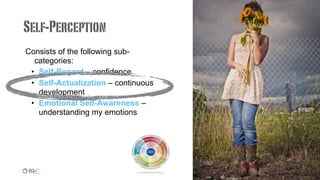
Consists of the following sub-
categories:
• Self-Regard – confidence
• Self-Actualization – continuous
development
• Emotional Self-Awareness –
understanding my emotions
.
Self-Perception
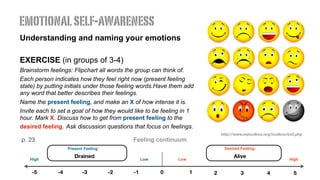
Understanding and naming your emotions
EXERCISE (in groups of 3-4)
Brainstorm feelings: Flipchart all words the group can think of.
Each person indicates how they feel right now (present feeling
state) by putting initials under those feeling words.Have them add
any word that better describes their feelings.
Name the present feeling, and make an X of how intense it is.
Invite each to set a goal of how they would like to be feeling in 1
hour. Mark X. Discuss how to get from present feeling to the
desired feeling. Ask discussion questions that focus on feelings.
http://www.eqtoolbox.org/toolbox/ex5.php
emotionalself-awareness
Present Feeling: Desired Feeling:
Feeling continuum
LowHigh Low High
p. 23
0 5-5 -3 3-1 1 2-2 4-4
Drained Alive
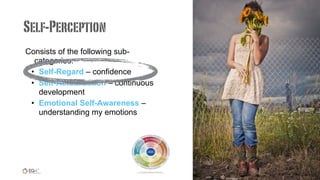
Consists of the following sub-
categories:
• Self-Regard – confidence
• Self-Actualization – continuous
development
• Emotional Self-Awareness –
understanding my emotions
.
Self-Perception
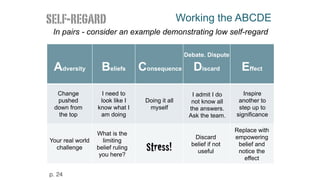
Working the ABCDE
Adversity
Change
pushed
down from
the top
Beliefs
I need to
look like I
know what I
am doing
Consequence
Doing it all
myself
Discard
I admit I do
not know all
the answers.
Ask the team.
Effect
Inspire
another to
step up to
significance
Your real world
challenge
What is the
limiting
belief ruling
you here?
Stress!
Discard
belief if not
useful
Replace with
empowering
belief and
notice the
effect
Debate. Dispute
In pairs - consider an example demonstrating low self-regard
self-regard
p. 24
Consists of the following sub-
categories:
• Self-Regard – confidence
• Self-Actualization – continuous
development
• Emotional Self-Awareness –
understanding my emotions
.
Self-Perception
35
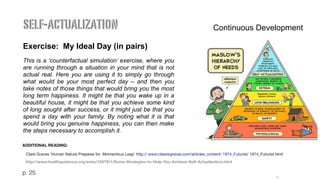
self-actualization Continuous Development
ADDITIONAL READING:
	 Clare Graves ‘Human Nature Prepares for Momentous Leap’ http:// www.clarewgraves.com/articles_content/ 1974_Futurist/ 1974_Futurist.html 

http://www.healthguidance.org/entry/16279/1/Some-Strategies-to-Help-You-Achieve-Self-Actualization.html
Exercise: My Ideal Day (in pairs)
This is a ‘counterfactual simulation’ exercise, where you
are running through a situation in your mind that is not
actual real. Here you are using it to simply go through
what would be your most perfect day – and then you
take notes of those things that would bring you the most
long term happiness. It might be that you wake up in a
beautiful house, it might be that you achieve some kind
of long sought after success, or it might just be that you
spend a day with your family. By noting what it is that
would bring you genuine happiness, you can then make
the steps necessary to accomplish it.
p. 25
Consists of the following:
Emotional Expression – saying how
you feel
Assertiveness – standing up for yourself
effectively
Independence – standing on your own
two feet
Self-Expression
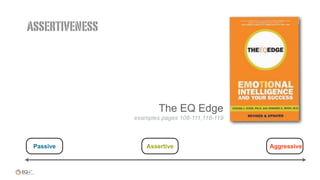
The EQ Edge
examples pages 108-111,118-119
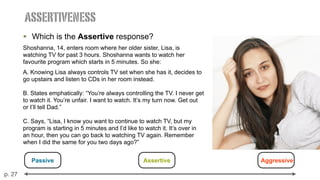
Passive Assertive Aggressive
assertiveness
! Which is the Assertive response?
Shoshanna, 14, enters room where her older sister, Lisa, is
watching TV for past 3 hours. Shoshanna wants to watch her
favourite program which starts in 5 minutes. So she:
A. Knowing Lisa always controls TV set when she has it, decides to
go upstairs and listen to CDs in her room instead.
B. States emphatically: “You’re always controlling the TV. I never get
to watch it. You’re unfair. I want to watch. It’s my turn now. Get out
or I’ll tell Dad.”
C. Says, “Lisa, I know you want to continue to watch TV, but my
program is starting in 5 minutes and I’d like to watch it. It’s over in
an hour, then you can go back to watching TV again. Remember
when I did the same for you two days ago?”
assertiveness
p. 27
Passive Assertive Aggressive
! Which is the Assertive response?
Shoshanna, 14, enters room where her older sister, Lisa, is watching
TV for past 3 hours. Shoshanna wants to watch her favourite
program which starts in 5 minutes. So she:
A. Knowing Lisa always controls TV set when she has it, decides to
go upstairs and listen to CDs in her room instead.
B. States emphatically: “You’re always controlling the TV. I never get
to watch it. You’re unfair. I want to watch. It’s my turn now. Get out
or I’ll tell Dad.”
C. Says, “Lisa, I know you want to continue to watch TV, but my
program is starting in 5 minutes and I’d like to watch it. It’s over in
an hour, then you can go back to watching TV again. Remember
when I did the same for you two days ago?”
Passive Assertive Aggressive
assertiveness
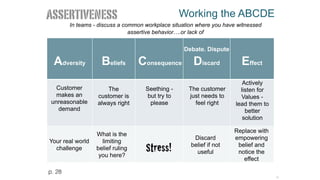
Working the ABCDE
41
Adversity
Customer
makes an
unreasonable
demand
Beliefs
The
customer is
always right
Consequence
Seething -
but try to
please
Discard
The customer
just needs to
feel right
Effect
Actively
listen for
Values -
lead them to
better
solution
Your real world
challenge
What is the
limiting
belief ruling
you here?
Stress!
Discard
belief if not
useful
Replace with
empowering
belief and
notice the
effect
Debate. Dispute
In teams - discuss a common workplace situation where you have witnessed
assertive behavior….or lack of
assertiveness
p. 28
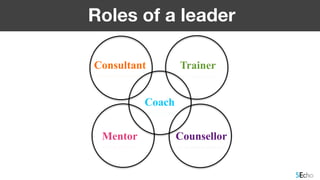
Consultant Trainer
Mentor Counsellor
Coach
Roles of a leader
HYPER-CHANGEACCELERATION is the new normal.
What is the
key role of a
leadeR in
hyperdrive ?
images courtesy of shutterstock
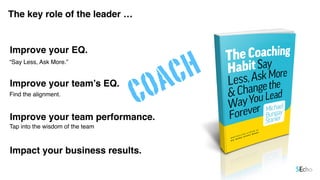
The key role of the leader …
“Say Less, Ask More.”
Find the alignment.
Tap into the wisdom of the team
5Echo
Improve your EQ.
Improve your team’s EQ.
Improve your team performance.
Impact your business results.
COACH
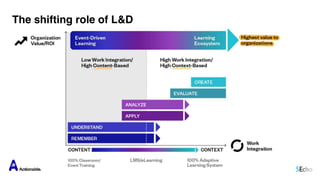
The shifting role of L&D
5Echo
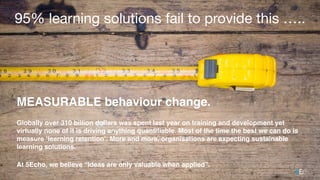
95% learning solutions fail to provide this …..
MEASURABLE behaviour change.
Globally over 310 billion dollars was spent last year on training and development yet
virtually none of it is driving anything quantifiable. Most of the time the best we can do is
measure ‘learning retention’. More and more, organisations are expecting sustainable
learning solutions.
At 5Echo, we believe “Ideas are only valuable when applied”.
images courtesy of shutterstock
The shifting role of L&D
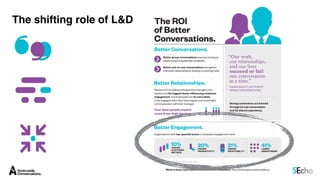
Better Engagement.
Want to learn more about Actionable Conversations? Visit conversations.actionable.co
The ROI
of Better
Conversations.
Research from Gallup indicates that managers and
leaders are the biggest factor influencing employee
engagement, and employees are 3x more likely
to be engaged when they have regular and meaningful
communication with their manager.
Better group conversations improve employee
relationships & leadership credibility.
Better one-to-one conversations strengthen
individual relationships & develop a coaching habit.
Better Conversations.
Better Relationships.
Your best people expect
more from their leaders.
Strong connections are formed
through (a) real conversation
and (b) shared experience.
“Our work,
our relationships,
and our lives
succeed or fail
one conversation
at a time.”
SUSAN SCOTT, AUTHOR OF
FIERCE CONVERSATIONS
Organisations with top-quartile teams in employee engagement have:
10%HIGHER
CUSTOMER
METRICS
20%HIGHER
PRODUCTIVITY
21%HIGHER
PROFITABILITY
41%LOWER
ABSENTEEISM
SUMMARISED FROM THE GALLUP Q12 SURVEY, 2016
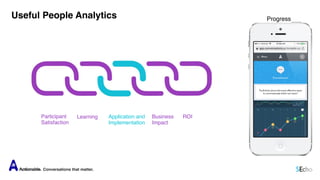
Useful People Analytics
Participant
Satisfaction
Learning Application and

Implementation
Business

Impact
ROI
Conversations that matter.
Progress
5Echo
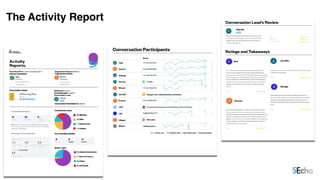
The Activity Report
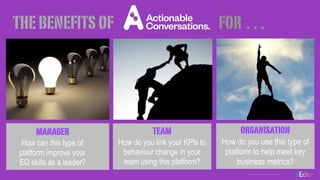
thebenefitsof for…
organisation
How do you use this type of
platform to help meet key
business metrics?
team
How do you link your KPIs to
behaviour change in your
team using this platform?
manager
How can this type of
platform improve your
EQ skills as a leader?
images courtesy of shutterstock
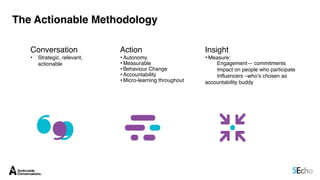
Insight
• Measure:
Engagement— commitments
Impact on people who participate
Influencers –who’s chosen as
accountability buddy
Conversation
• Strategic, relevant,
actionable
Action
• Autonomy
• Measurable
• Behaviour Change
• Accountability
• Micro-learning throughout
The Actionable Methodology
The Actionable Process
Beta Instant Commitment Engine Walkthrough
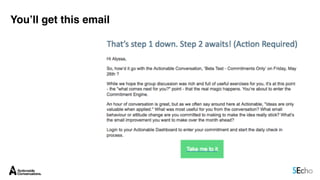
You’ll get this email
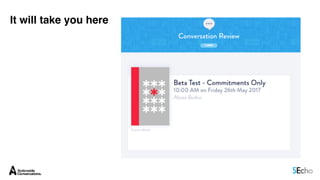
It will take you here
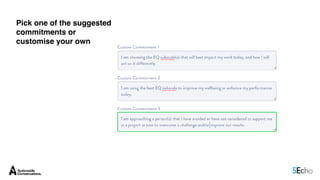
Pick one of the suggested
commitments or
customise your own
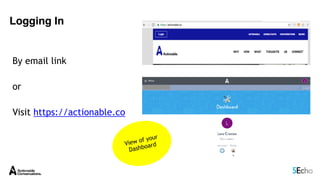
By email link
or
Visit https://actionable.co
View of your
Dashboard
Logging In
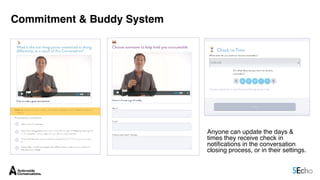
Commitment & Buddy System
Anyone can update the days &
times they receive check in
notifications in the conversation
closing process, or in their settings.
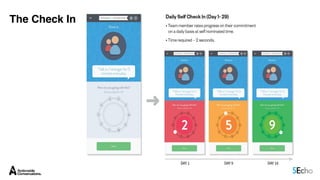
The Check In
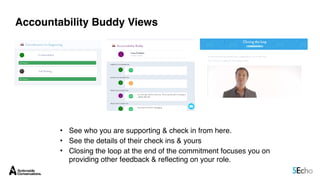
Accountability Buddy Views
• See who you are supporting & check in from here.
• See the details of their check ins & yours
• Closing the loop at the end of the commitment focuses you on
providing other feedback & reflecting on your role.
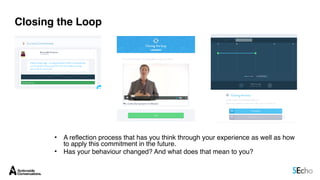
Closing the Loop
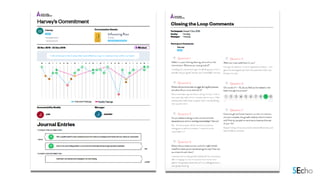
• A reflection process that has you think through your experience as well as how
to apply this commitment in the future.
• Has your behaviour changed? And what does that mean to you?
OUR 30DAYSCOMMITMENT
WHATDOYOUCOMMIT NOW TO
IMPROVEYOUREMOTIONAL
INTELLIGENCE?
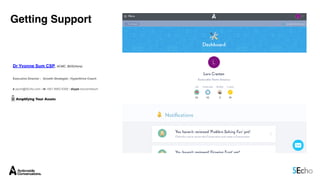
Dr Yvonne Sum CSP, ACMC, BDS(Hons)
Executive Director | Growth Strategist | HyperDrive Coach
e ysum@5Echo.com | m +601 6663 6306 | skype dryvonnesum
Getting Support
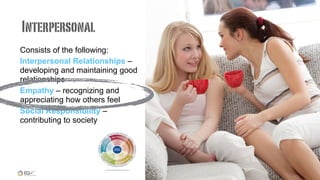
Consists of the following:
Interpersonal Relationships –
developing and maintaining good
relationships
Empathy – recognizing and
appreciating how others feel
Social Responsibility –
contributing to society
.
Interpersonal
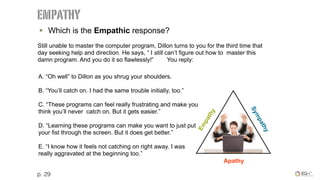
! Which is the Empathic response?
Still unable to master the computer program, Dillon turns to you for the third time that
day seeking help and direction. He says, “ I still can’t figure out how to master this
damn program. And you do it so flawlessly!” You reply:
A. “Oh well” to Dillon as you shrug your shoulders.
B. “You’ll catch on. I had the same trouble initially, too.”
C. “These programs can feel really frustrating and make you
think you’ll never catch on. But it gets easier.”
D. “Learning these programs can make you want to just put
your fist through the screen. But it does get better.”
E. “I know how it feels not catching on right away. I was
really aggravated at the beginning too.”
Apathy
Empathy
Sympathy
empathy
p. 29
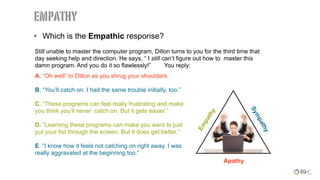
! Which is the Empathic response?
Still unable to master the computer program, Dillon turns to you for the third time that
day seeking help and direction. He says, “ I still can’t figure out how to master this
damn program. And you do it so flawlessly!” You reply:
A. “Oh well” to Dillon as you shrug your shoulders.
B. “You’ll catch on. I had the same trouble initially, too.”
C. “These programs can feel really frustrating and make
you think you’ll never catch on. But it gets easier.”
D. “Learning these programs can make you want to just
put your fist through the screen. But it does get better.”
E. “I know how it feels not catching on right away. I was
really aggravated at the beginning too.”
Apathy
Empathy
Sympathy
empathy
“
Your spouse gets home
at 5:30, turns to you and
sighs, “I didn’t get the
promotion; Ralph got it.
I just got a speeding
ticket on the way home,
and I’ve got a four-alarm
headache.”
! How would you respond with
Empathy?
empathy
p. 30
Possible responses:
“Oh, what a day you’ve had. You
must wonder if it can get worse.”
“Geez ... you must feel like
nothing’s going your way.”
“Boy, you must feel bad. Come here
and I’ll give you a back rub.”
....Any response that captures your spouse’s
internal experience or perspective:
Nothing is going right.
How would you respond with
Empathy?
Your spouse gets
home at 5:30, turns
to you and sighs, “I
didn’t get the
promotion; Ralph
got it. I just got a
speeding ticket on
the way home, and
I’ve got a four-alarm
headache.”
empathy
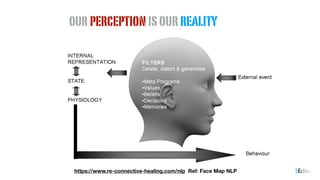
Perceptual Filters Empathizing different realities
5Echoimages courtesy of shutterstock
ourperceptionisourreality
5Echohttps://www.re-connective-healing.com/nlp Ref: Face Map NLP
Personality Filters
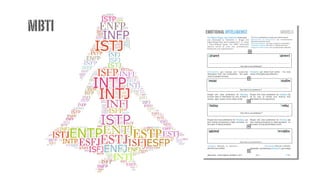
MBTI
Learning Styles
What if? How? What? Why?
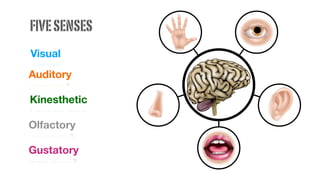
Visual
Auditory
Kinesthetic
Olfactory
Gustatory
FIVESENSES
102
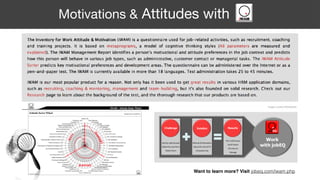
Motivation & Attitude Filters
Motivations & Attitudes with
Want to learn more? Visit jobeq.com/iwam.php
images courtesy iWAM/jobEQ
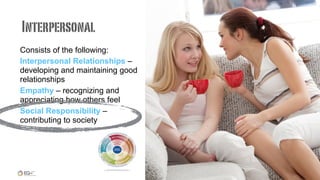
Consists of the following:
Interpersonal Relationships –
developing and maintaining good
relationships
Empathy – recognizing and
appreciating how others feel
Social Responsibility –
contributing to society
.
Interpersonal
106
socialresponsibility
Narcissism Volunteer
Where are you on this Social Responsibility continuum?
p. 30
Consists of the following:
Problem Solving – effectively
managing emotions when solving
problems
Reality Testing – seeing things
as they really are
Impulse Control – ability to resist
or delay impulses
.
DecisionMaking
Do the following statements apply to you?
Individually, respond with Never, Rarely, Seldom, Frequently
or Always.
1. I tend to leap before I look.
2. I become impatient easily.
3. Others seem too slow in making up their minds.
4. I often regret not giving more thought to
decisions.
5. I often make impulse purchases.
6. Others tell me I tend to be hot-headed.
7. If other drivers cut me off, I pursue and make
obscene gestures at them.
Answer the following with Yes or No.
8. During the past 3 years, I have struck someone in anger.
9. During the past 3 years, I have thrown objects out of a sense of frustration.
10. During the past 3 years, I have made a rash decision that I have regretted.
impulsecontrol
p. 31
Consists of the following:
Problem Solving – effectively
managing emotions when solving
problems
Reality Testing – seeing things
as they really are
Impulse Control – ability to resist
or delay impulses
.
DecisionMaking
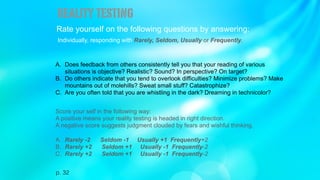
Rate yourself on the following questions by answering:
Individually, responding with Rarely, Seldom, Usually or Frequently.
A. Does feedback from others consistently tell you that your reading of various
situations is objective? Realistic? Sound? In perspective? On target?
B. Do others indicate that you tend to overlook difficulties? Minimize problems? Make
mountains out of molehills? Sweat small stuff? Catastrophize?
C. Are you often told that you are whistling in the dark? Dreaming in technicolor?
Score your self in the following way:
A positive means your reality testing is headed in right direction.
A negative score suggests judgment clouded by fears and wishful thinking.
A. Rarely -2 Seldom -1 Usually +1 Frequently+2
B. Rarely +2 Seldom +1 Usually -1 Frequently-2
C. Rarely +2 Seldom +1 Usually -1 Frequently-2
realitytesting
p. 32
Consists of the following:
Problem Solving – effectively
managing emotions when solving
problems
Reality Testing – seeing things
as they really are
Impulse Control – ability to resist
or delay impulses
.
DecisionMaking
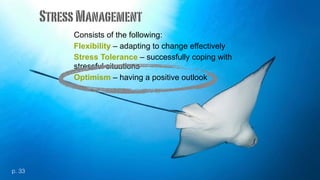
Consists of the following:
Flexibility – adapting to change effectively
Stress Tolerance – successfully coping with
stressful situations
Optimism – having a positive outlook
StressManagement
p. 33
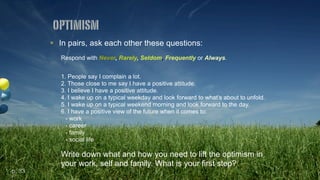
! In pairs, ask each other these questions:
Respond with Never, Rarely, Seldom, Frequently or Always.
1. People say I complain a lot.
2. Those close to me say I have a positive attitude.
3. I believe I have a positive attitude.
4. I wake up on a typical weekday and look forward to what’s about to unfold.
5. I wake up on a typical weekend morning and look forward to the day.
6. I have a positive view of the future when it comes to:
- work
- career
- family
- social life
Write down what and how you need to lift the optimism in
your work, self and family. What is your first step?
optimism
p. 33
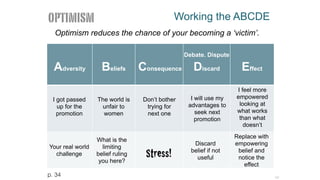
Working the ABCDE
122
Adversity
I got passed
up for the
promotion
Beliefs
The world is
unfair to
women
Consequence
Don’t bother
trying for
next one
Discard
I will use my
advantages to
seek next
promotion
Effect
I feel more
empowered
looking at
what works
than what
doesn’t
Your real world
challenge
What is the
limiting
belief ruling
you here?
Stress!
Discard
belief if not
useful
Replace with
empowering
belief and
notice the
effect
Debate. Dispute
Optimism reduces the chance of your becoming a ‘victim’.
optimism
p. 34
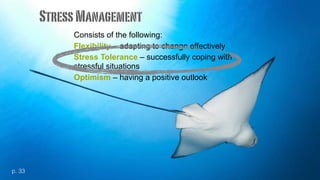
Consists of the following:
Flexibility – adapting to change effectively
Stress Tolerance – successfully coping with
stressful situations
Optimism – having a positive outlook
StressManagement
p. 33
PRESENCING PRACTICE
TAKE5NOW
ENERGYCHARGINGHERE&NOW
images courtesy of shutterstock
stresstolerance
EVENBREATH.
BEPRESENTNOW
TAKE5NOWimages courtesy of shutterstock images courtesy of shutterstock
IHAVENOTHINGTODEFEND
CLEARMIND.
BESTILLNOW
TAKE5NOWimages courtesy of shutterstock images courtesy of shutterstock
IHAVENOTHINGTOFEAR
OPENHEART.
BECENTREDNOW
TAKE5NOWimages courtesy of shutterstock images courtesy of shutterstock
IHAVENOTHINGTOPROMOTE
BEOPENNOW
SENSITIVESONAR.
TAKE5NOWimages courtesy of shutterstock images courtesy of shutterstock
IAMHERENOW
ENERGETICINDUCTION.
BEINFLOW
TAKE5NOWimages courtesy of shutterstock images courtesy of shutterstock
IAMWELLNOW
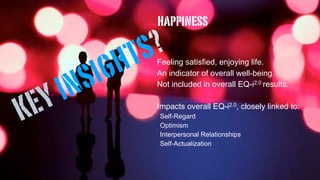
Feeling satisfied, enjoying life.
An indicator of overall well-being.
Not included in overall EQ-i2.0 results.
Impacts overall EQ-i2.0, closely linked to:
Self-Regard
Optimism
Interpersonal Relationships
Self-Actualization
happiness
KEY INSIGHTS?
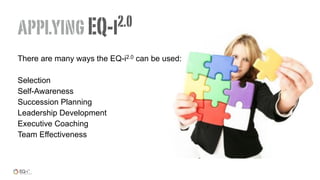
There are many ways the EQ-i2.0 can be used:
Selection
Self-Awareness
Succession Planning
Leadership Development
Executive Coaching
Team Effectiveness
applyingEQ-i2.0
136
Emotional Intelligence
images courtesy of shutterstock
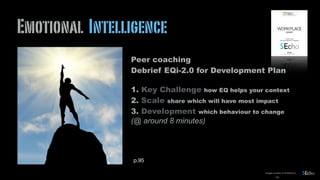
Peer coaching
Debrief EQi-2.0 for Development Plan
1. Key Challenge how EQ helps your context
2. Scale share which will have most impact
3. Development which behaviour to change
(@ around 8 minutes)
p.95
parents as high EQ leaders
EMERGING
TRENDS IN
PROFESSIONAL
SELLING
The latest innovation,
research and best practice
in selling and sales management
Compiled and edited by
Paul Sparks
VOLUME 1
If you sell for a living, you
manage a sales team, or are
responsible for the growth of
your business and you want
the best outcomes for your
sales efforts – this book is for
you.
Some of the world’s leading
sales trainers, consultants and
coaches bring you detailed ideas
on how you can improve your
personal performance, and the
performance of your sales team.
Inside this volume you’ll find
12 chapters to ensure you are
informed about the latest trends,
research and best practice in
professional selling and sales
management.
Each chapter is a book in
itself – with more up-to-date
information on personal selling
and sales management than any
single book published in the last
decade.
EMERGINGTRENDSINPROFESSIONALSELLING
Here’s what’s inside:
Paul Sparks. The evolution of professional selling:
understanding the past to inform our future sales
performance.
Michael Schiffner. Building high performance sales
teams: going beyond a training mindset to achieve
sustained sales success.
Julia Palmer. Strategic networks: the key to
sustainable sales success.
Mo Fox. See before you sell: how changing your
perception is the key to better sales results.
Michael Foulds. The sale is the negotiation:
reframing the sales process for better sales and
stronger customer relationships.
Malcolm Dawes. Sales leadership or sales
management? It does make a difference for high
performing sales teams.
Suzanne Mercier. Are your sales people sales
imposters? How to overcome fear to create great
sales results.
John Barraclough & Warwick Burgess. Gaining
the last yard in sales: the value of persuasive
communication.
Mark Purbrick. Simply the best: how to attract,
select and retain high performing salespeople.
Jason White & Giles Rhodes. Rewarding the sales
force: a taxonomy of sales roles to inform reward
and incentive programs.
Sally-Anne Cotton. The alchemy of 21st century
selling: transmuting balance, alignment and intent
into golden sales results.
Dr Yvonne Sum. Tribal insights for sales leaders: the
power of learning partnerships.
“The best book on modern selling and sales management I’ve seen in years with a great range of
relevant content. I can’t wait for Volume 2.” – Bob Bentley, 25 year sales veteran, ICT industry.
See inside for details on the 6 DVD companion set which contains over 12 hours of presentations,
discussions and interviews featuring the authors as they take a deeper and wider look at the
chapter topics. This professionally produced DVD set is an invaluable tool for sales training and
development and is also great for using in sales meetings to begin
discussion on critical topics in professional selling.
Australia $66.00 RRP Inc GST
COMPILEDANDEDITEDBY
PAULSPARKS
1
14217 EM_Trends Cvr 21mm.indd 1 9/5/11 12:51:43 PM
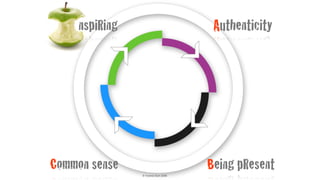
Authenticity
Being pResentCommon sense
nspiRing
Leadership
ESSENCE
© Yvonne Sum 2008
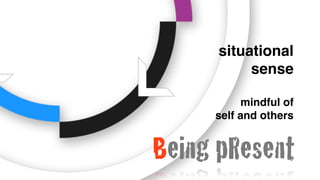
situational
sense
mindful of
self and others
Being pResent
Pause…Observe
Question
Record…Listen
OpenMind[nojudgement]
Key Skills
Storysell
Copyright © 2015 by Mobius. All rights reserved.
Philosopher’s Walk Sharing Learning
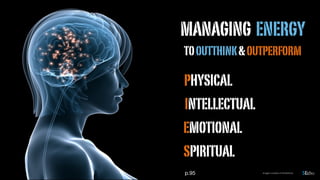
MANAGING ENERGY
PHYSICAL
INTELLECTUAL
EMOTIONAL
SPIRITUAL
TOOUTTHINK&OUTPERFORM
images courtesy of shutterstock
p.95
Pause…Observe
Question
Record…Listen
OpenMind[nojudgement]
Key Skills
Storysell
152
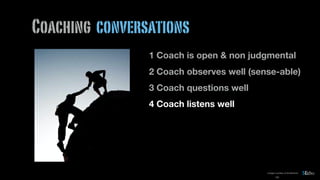
Coaching conversations
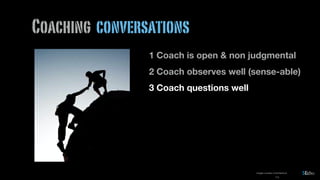
1 Coach is open & non judgmental
images courtesy of shutterstock
5Echohttps://www.re-connective-healing.com/nlp Ref: Face Map NLP
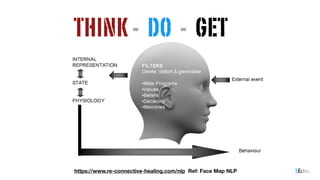
THINK - DO - GET
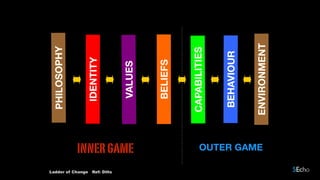
PHILOSOPHY
IDENTITY
VALUES
BELIEFS
CAPABILITIES
BEHAVIOUR
ENVIRONMENT
Ladder of Change Ref: Dilts
INNERGAME OUTER GAME
into OUTER GAME
THINK - DO - GET
images courtesy of shutterstock
INNERGAME
results
Finding the FLOW zone
Pause…Observe
Question
Record…Listen
OpenMind[nojudgement]
Key Skills
Storysell
158
Coaching conversations
1 Coach is open & non judgmental
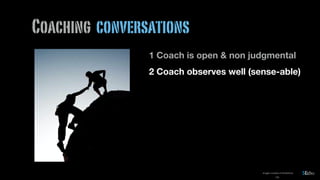
2 Coach observes well (sense-able)
images courtesy of shutterstock
IGNITING YOUR SENSORY CHANNELS
be sense-able
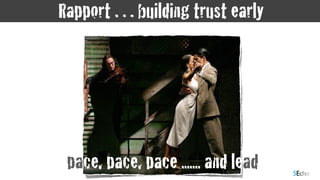
pace, pace, pace ....... and lead
Rapport … building trust early
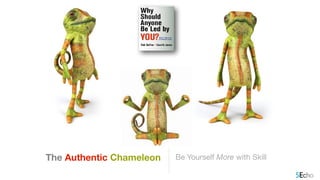
Be Yourself More with Skill
The Authentic Chameleon
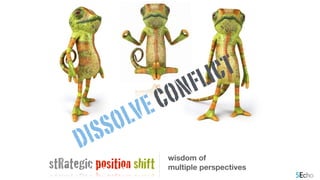
wisdom of
multiple perspectivesstRategic position shift
DISSOLVE CONFLICT
sense-able
Decision-making with
Facts & Emotions
Common sense
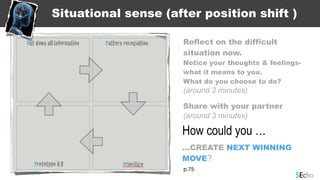
How could you …
Share with your partner
(around 3 minutes)
…CREATE NEXT WINNING
MOVE?
Situational sense (after position shift )
Reflect on the difficult
situation now.
Notice your thoughts & feelings-
what it means to you.
What do you choose to do?
(around 2 minutes)
p.75
Pause…Observe
Question
Record…Listen
OpenMind[nojudgement]
Key Skills
Storysell
173
Coaching conversations
1 Coach is open & non judgmental
2 Coach observes well (sense-able)
3 Coach questions well
images courtesy of shutterstock
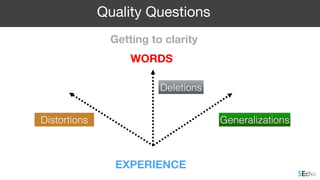
Questioning images courtesy of shutterstock
WORDS
EXPERIENCE
GeneralizationsDistortions
Deletions
Quality Questions
Getting to clarity
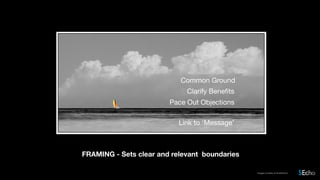
framing sets boundaries images courtesy of shutterstock
Common Ground
Clarify Benefits
Pace Out Objections
Link to ‘Message’
FRAMING - Sets clear and relevant boundaries
images courtesy of shutterstock
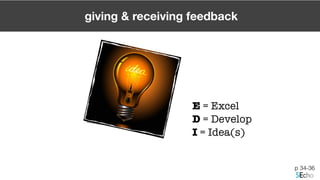
giving & receiving feedback
E = Excel
D = Develop
I = Idea(s)
p 34-36
images courtesy of shutterstock
Pause…Observe
Question
Record…Listen
OpenMind[nojudgement]
Key Skills
Storysell
188
Coaching conversations
1 Coach is open & non judgmental
2 Coach observes well (sense-able)
3 Coach questions well
4 Coach listens well
images courtesy of shutterstock
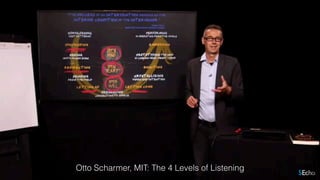
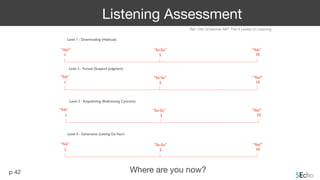
Otto Scharmer, MIT: The 4 Levels of Listening
Where are you now?
Level 1 - Downloading (Habitual)
Level 3 - Empathizing (Redirecting Cynicism)
Level 2 - Factual (Suspend Judgment)
Level 4 - Generative (Letting Go Fear)
1 5 10
“Yuk” “So-So” “Yes!”
1 5 10
“Yuk”“So-So”“Yes!”
1 5 10
“Yuk” “So-So” “Yes!”
1 5 10
“Yuk” “So-So” “Yes!”
Listening Assessment
Ref: Otto Scharmer, MIT: The 4 Levels of Listening
p 42
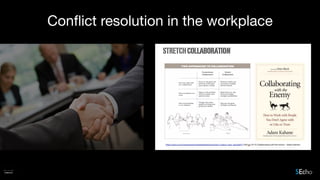
Conflict resolution in the workplace
We have all witnessed someone in conflict with another. Over time, the
relationship degrades and starts to impact on those around them. The conflict
spreads as people start to ally with one side or the other. Performance degrades
along with morale. The only things that seem to be increasing are workplace
absenteeism and the departure of high performers. Everyone seems to know
about it, but don’t know how to address it.
Mediation may be the answer.
Mediation is a confidential and voluntary process led by a respected individual
(the Mediator) between conflicting parties to promote mutually acceptable
agreements. It can encompass working and personal life.
The mediation process is nonjudgmental and without prejudice. The process
encourages each party to clarify their concerns while the mediator asks clarifying
questions to increase the understanding of those in attendance. Typically, their
will only be the two involved parties and the mediator present, however, there
increasing cases of group mediation.
Our mediators are trained and experience, not only in their mediation and related
skills, but also in business and life.
Pause…Observe
Question
Record…Listen
OpenMind[nojudgement]
Key Skills
Storysell
199
Coaching conversations
1 Coach is open & non judgmental
2 Coach observes well (sense-able)
3 Coach questions well
4 Coach listens well
5 Coach speaks well
images courtesy of shutterstock
magic formula story
Incident 80-90%
Point 5-10%
Benefit 5-10%
images courtesy of shutterstock
stoRy selling Inspire with full technicolour,
soundtrack, emotions......
vision
excite progress
empower others
nspiRing
207
Coaching conversations
1 Coach is open & non judgmental
2 Coach observes well (sense-able)
3 Coach questions well
4 Coach listens well
5 Coach speaks well
6 Coach thinks strategically
images courtesy of shutterstock
re-framing to new inner gameimages courtesy of shutterstock
common frames images courtesy of shutterstock
Ecology Frame
Does it fit with the person’s values? Will it cause any harm?
Are there any harmful effects that could happen?
Outcome Frame
What is the desired outcome? What do any other parties want?
Can you dovetail outcomes?
Evidence Frame
How do you know? What is the evidence base? What will you be seeing,
hearing, feeling?
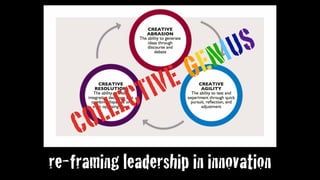
re-framing leadership in innovation
COLLECTIVE GENIUS
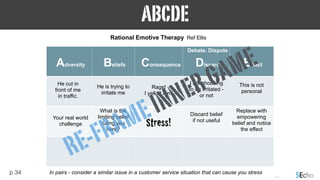
Rational Emotive Therapy Ref Ellis
213
Adversity
He cut in
front of me
in traffic.
Beliefs
He is trying to
irritate me
Consequence
Rage!
I yell at him.
Discard
Debate. Dispute
I am choosing
to be irritated -
or not
Effect
This is not
personal
Your real world
challenge
What is the
limiting belief
ruling you
here?
Stress!
Discard belief
if not useful
Replace with
empowering
belief and notice
the effect
In pairs - consider a similar issue in a customer service situation that can cause you stress
ABCDE
RE-FRAME INNER GAME
p 34
215
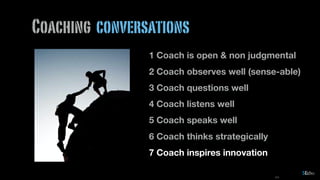
Coaching conversations
1 Coach is open & non judgmental
2 Coach observes well (sense-able)
3 Coach questions well
4 Coach listens well
5 Coach speaks well
6 Coach thinks strategically
7 Coach inspires innovation
216
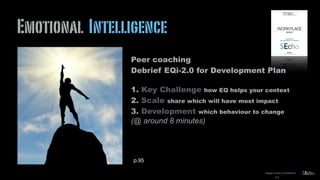
Emotional Intelligence
images courtesy of shutterstock
Peer coaching
Debrief EQi-2.0 for Development Plan
1. Key Challenge how EQ helps your context
2. Scale share which will have most impact
3. Development which behaviour to change
(@ around 8 minutes)
p.95
217
On your Birthday …
You are now 80.
220
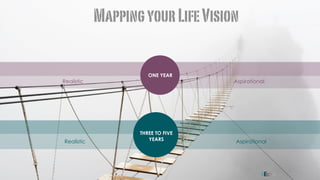
MappingyourLifeVision
THREE TO FIVE
YEARSRealistic Aspirational
AspirationalRealistic
ONE YEAR
226
MappingyourLifePlanWorksheet
Outcome Planning
Desired Outcome: What do I want specifically?
________________________________________________________________________________
________________________________________________________________________________
________________________________________________________________________________
________________________________________________________________________________
________________________________________________________________________________
________________________________________________________________________________
For what purpose: Why do I want it?
________________________________________________________________________________
________________________________________________________________________________
Blocks and Stops: What prevents me from getting it?
________________________________________________________________________________
________________________________________________________________________________
________________________________________________________________________________
________________________________________________________________________________
________________________________________________________________________________
Resources: What will help me get it?
________________________________________________________________________________
________________________________________________________________________________
________________________________________________________________________________
________________________________________________________________________________
________________________________________________________________________________
Action Plan: How do I go get it?
________________________________________________________________________________
________________________________________________________________________________
________________________________________________________________________________
________________________________________________________________________________
________________________________________________________________________________
________________________________________________________________________________
My First Step is
________________________________________________________________________________
________________________________________________________________________________
________________________________________________________________________________
Signed:__________________________________ Date: _________________________
©Dr Yvonne Sum 2009 www.dryvonnesum.com
p 64
truth
lose your mind
be yourself
Authenticity
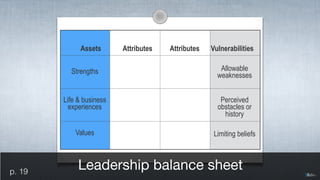
Assets Attributes Attributes Vulnerabilities
Strengths Allowable
weaknesses
Life & business
experiences
Perceived
obstacles or
history
Values Limiting beliefs
Leadership balance sheetp. 19
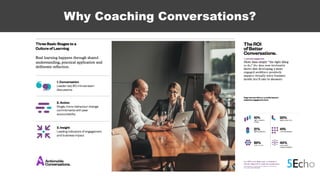
Why Coaching Conversations?
5Echo
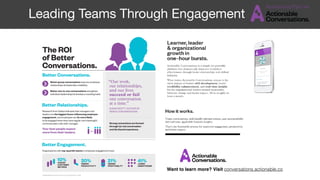
Better Engagement.
The ROI
of Better
Conversations.
Research from Gallup indicates that managers and
leaders are the biggest factor influencing employee
engagement, and employees are 3x more likely
to be engaged when they have regular and meaningful
communication with their manager.
Better group conversations improve employee
relationships & leadership credibility.
Better one-to-one conversations strengthen
individual relationships & develop a coaching habit.
Better Conversations.
Better Relationships.
Your best people expect
more from their leaders.
Strong connections are formed
through (a) real conversation
and (b) shared experience.
“Our work,
our relationships,
and our lives
succeed or fail
one conversation
at a time.”
SUSAN SCOTT, AUTHOR OF
FIERCE CONVERSATIONS
Organisations with top-quartile teams in employee engagement have:
10%HIGHER
CUSTOMER
METRICS
20%HIGHER
PRODUCTIVITY
21%HIGHER
PROFITABILITY
41%LOWER
ABSENTEEISM
SUMMARISED FROM THE GALLUP Q12 SURVEY, 2016
Want to learn more? Visit conversations.actionable.co
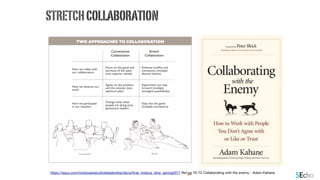
Leading Teams Through Engagement
235
Coaching conversations
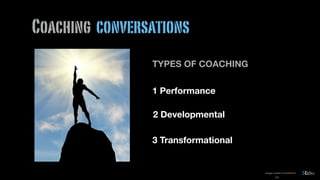
TYPES OF COACHING
1 Performance
2 Developmental
3 Transformational
images courtesy of shutterstock
Pre-program consulting
& on-going support
Facilitation &
Coaching
(1:1 & teams)
Mobile
First
Micro-
Learning
Measurable
Behaviour
Change
• Needs analysis
• Program design
• Program develop
• Online pre-course
• Ongoing tracking & advice
• Motivation alignment
• Curate optimal teams
• Business application
• Democratised strategy
• Incubating innovation
• Experienced facilitators
• In-person & virtual options
• Global network
• Curated, bite-sized
• Anytime, anywhere
• Any device
• Trackable
• Better relationships
• Dramatic improvement in
workplace effectiveness
• Led by your managers
• Conversations/ insights
• Work issues/projects
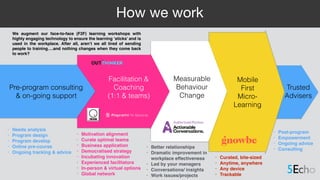
We augment our face-to-face (F2F) learning workshops with
highly engaging technology to ensure the learning ‘sticks’ and is
used in the workplace. After all, aren’t we all tired of sending
people to training….and nothing changes when they come back
to work?
How we work
5Echo
Trusted
Advisers
• Post-program
• Empowerment
• Ongoing advice
• Consulting
Questions? 

Comments? 

Insights?
ysum@5Echo.com
www.dryvonnesum.com
https://au.linkedin.com/in/dryvonnesum
images ourtesy of Headshot Guy

Emotional Intelligence for Leaders in HyperChange

  • 1.
  • 2.
    To Survive orThrive - It’s all about attitude
  • 3.
    5 Anxiety = UncertaintyX Powerlessness
  • 6.
    Engaging high performancein the workplace • Explore what Emotional Intelligence (EQ) is and how it is helpful in the workplace. • Understand how EQ helps us lead in an accelerating world of change. • Employ improved EQ skills in the workplace as managers and leaders. • Commit to a Development Plan to increase our EQ at work and beyond. Our objectives 5Echop. 8
  • 7.
    Program Overview Day OneDay Two Day Three EQ Essentials EQ @ Your WorkEQ in Leadership 5Echo • What is EQ in a practical sense • Benefits of EQ and how it supports high performance • EQ-i2.0 framework • Key EQ skills - Understanding self & others • Benefits to the workplace and beyond • EQ and neuroscience - conversational intelligence • EQ in decision making and stress management • Self expression and self perception and how they are impacted by EQ • EQi-2.0 Workplace assessment debrief as a group • Practical leadership application of EQ • Leaders using EQ in coaching conversations • EQ in support of empathy and high performance • Using EQ to address difficult situations • EQ and how to adapt to different motivations and attitudes - personalities, learning styles, innate motivational drive. • EQi-2.0 Workplace assessment - specific applications for each participant: Q&A • How EQ helps us lead in the VUCA world • How to apply EQ in the workplace • Participants work with a real-world challenging relationship-based leadership situation • Participants develop an Action Plan and an agreed Accountability Buddy to assist with transference to the workplace • Introducing Actionable Conversations - making EQ a habit through leader-led conversations and trackable commitments to their KPIs
  • 8.
  • 9.
    Because emotions influenceand change the way we think, perform and solve problems whydoemotionsmatter?
  • 10.
  • 11.
    A set ofemotional and social skills that collectively establish how well we: • Perceive and express ourselves • Develop and maintain social relationships • Cope with challenges • Use emotional information in an effective and meaningful way A predictor of success in life and work whatisemotionalintelligence?
  • 12.
  • 13.
    Accurate assessment ofstrengths & blind spots: take assessment in 20 mins Predictable way to measure current level of emotional & social functioning: receive feedback on your results Vehicle for developing effectiveness to improve performance: develop customised action plan to ensure you are focusing on the right development needs whatistheEQ-i2.0 ?
  • 14.
    Great rigor intoresearch and development of the tool 4,000 people took assessment to ensure results accurate: compared to your norm group Checks & balances built into tool to ensure most accurate results howaccurateistheEQ-i2.0 ?
  • 15.
    The EQ-i2.0 measuresfive distinct aspects of emotional and social functioning: Self-Perception – understanding your emotions Self-Expression – expressing your emotions Interpersonal – develop and maintain relationships Decision Making – use emotions to make better decisions Stress Management – cope with challenges whatdoestheEQ-i2.0 measure?
  • 16.
    Consists of thefollowing sub- categories: • Self-Regard – confidence • Self-Actualization – continuous development • Emotional Self-Awareness – understanding my emotions . Self-Perception
  • 17.
    Understanding and namingyour emotions EXERCISE (in groups of 3-4) Brainstorm feelings: Flipchart all words the group can think of. Each person indicates how they feel right now (present feeling state) by putting initials under those feeling words.Have them add any word that better describes their feelings. Name the present feeling, and make an X of how intense it is. Invite each to set a goal of how they would like to be feeling in 1 hour. Mark X. Discuss how to get from present feeling to the desired feeling. Ask discussion questions that focus on feelings. http://www.eqtoolbox.org/toolbox/ex5.php emotionalself-awareness Present Feeling: Desired Feeling: Feeling continuum LowHigh Low High p. 23 0 5-5 -3 3-1 1 2-2 4-4 Drained Alive
  • 18.
    Consists of thefollowing sub- categories: • Self-Regard – confidence • Self-Actualization – continuous development • Emotional Self-Awareness – understanding my emotions . Self-Perception
  • 19.
    Working the ABCDE Adversity Change pushed downfrom the top Beliefs I need to look like I know what I am doing Consequence Doing it all myself Discard I admit I do not know all the answers. Ask the team. Effect Inspire another to step up to significance Your real world challenge What is the limiting belief ruling you here? Stress! Discard belief if not useful Replace with empowering belief and notice the effect Debate. Dispute In pairs - consider an example demonstrating low self-regard self-regard p. 24
  • 20.
    Consists of thefollowing sub- categories: • Self-Regard – confidence • Self-Actualization – continuous development • Emotional Self-Awareness – understanding my emotions . Self-Perception
  • 21.
    35 self-actualization Continuous Development ADDITIONALREADING: Clare Graves ‘Human Nature Prepares for Momentous Leap’ http:// www.clarewgraves.com/articles_content/ 1974_Futurist/ 1974_Futurist.html 
 http://www.healthguidance.org/entry/16279/1/Some-Strategies-to-Help-You-Achieve-Self-Actualization.html Exercise: My Ideal Day (in pairs) This is a ‘counterfactual simulation’ exercise, where you are running through a situation in your mind that is not actual real. Here you are using it to simply go through what would be your most perfect day – and then you take notes of those things that would bring you the most long term happiness. It might be that you wake up in a beautiful house, it might be that you achieve some kind of long sought after success, or it might just be that you spend a day with your family. By noting what it is that would bring you genuine happiness, you can then make the steps necessary to accomplish it. p. 25
  • 22.
    Consists of thefollowing: Emotional Expression – saying how you feel Assertiveness – standing up for yourself effectively Independence – standing on your own two feet Self-Expression
  • 23.
    The EQ Edge examplespages 108-111,118-119 Passive Assertive Aggressive assertiveness
  • 24.
    ! Which isthe Assertive response? Shoshanna, 14, enters room where her older sister, Lisa, is watching TV for past 3 hours. Shoshanna wants to watch her favourite program which starts in 5 minutes. So she: A. Knowing Lisa always controls TV set when she has it, decides to go upstairs and listen to CDs in her room instead. B. States emphatically: “You’re always controlling the TV. I never get to watch it. You’re unfair. I want to watch. It’s my turn now. Get out or I’ll tell Dad.” C. Says, “Lisa, I know you want to continue to watch TV, but my program is starting in 5 minutes and I’d like to watch it. It’s over in an hour, then you can go back to watching TV again. Remember when I did the same for you two days ago?” assertiveness p. 27 Passive Assertive Aggressive
  • 25.
    ! Which isthe Assertive response? Shoshanna, 14, enters room where her older sister, Lisa, is watching TV for past 3 hours. Shoshanna wants to watch her favourite program which starts in 5 minutes. So she: A. Knowing Lisa always controls TV set when she has it, decides to go upstairs and listen to CDs in her room instead. B. States emphatically: “You’re always controlling the TV. I never get to watch it. You’re unfair. I want to watch. It’s my turn now. Get out or I’ll tell Dad.” C. Says, “Lisa, I know you want to continue to watch TV, but my program is starting in 5 minutes and I’d like to watch it. It’s over in an hour, then you can go back to watching TV again. Remember when I did the same for you two days ago?” Passive Assertive Aggressive assertiveness
  • 26.
    Working the ABCDE 41 Adversity Customer makesan unreasonable demand Beliefs The customer is always right Consequence Seething - but try to please Discard The customer just needs to feel right Effect Actively listen for Values - lead them to better solution Your real world challenge What is the limiting belief ruling you here? Stress! Discard belief if not useful Replace with empowering belief and notice the effect Debate. Dispute In teams - discuss a common workplace situation where you have witnessed assertive behavior….or lack of assertiveness p. 28
  • 27.
  • 28.
  • 29.
    What is the keyrole of a leadeR in hyperdrive ? images courtesy of shutterstock
  • 30.
    The key roleof the leader … “Say Less, Ask More.” Find the alignment. Tap into the wisdom of the team 5Echo Improve your EQ. Improve your team’s EQ. Improve your team performance. Impact your business results. COACH
  • 31.
    The shifting roleof L&D 5Echo
  • 32.
    95% learning solutionsfail to provide this ….. MEASURABLE behaviour change. Globally over 310 billion dollars was spent last year on training and development yet virtually none of it is driving anything quantifiable. Most of the time the best we can do is measure ‘learning retention’. More and more, organisations are expecting sustainable learning solutions. At 5Echo, we believe “Ideas are only valuable when applied”. images courtesy of shutterstock
  • 33.
    The shifting roleof L&D Better Engagement. Want to learn more about Actionable Conversations? Visit conversations.actionable.co The ROI of Better Conversations. Research from Gallup indicates that managers and leaders are the biggest factor influencing employee engagement, and employees are 3x more likely to be engaged when they have regular and meaningful communication with their manager. Better group conversations improve employee relationships & leadership credibility. Better one-to-one conversations strengthen individual relationships & develop a coaching habit. Better Conversations. Better Relationships. Your best people expect more from their leaders. Strong connections are formed through (a) real conversation and (b) shared experience. “Our work, our relationships, and our lives succeed or fail one conversation at a time.” SUSAN SCOTT, AUTHOR OF FIERCE CONVERSATIONS Organisations with top-quartile teams in employee engagement have: 10%HIGHER CUSTOMER METRICS 20%HIGHER PRODUCTIVITY 21%HIGHER PROFITABILITY 41%LOWER ABSENTEEISM SUMMARISED FROM THE GALLUP Q12 SURVEY, 2016
  • 34.
    Useful People Analytics Participant Satisfaction LearningApplication and
 Implementation Business
 Impact ROI Conversations that matter. Progress 5Echo
  • 35.
  • 37.
    thebenefitsof for… organisation How doyou use this type of platform to help meet key business metrics? team How do you link your KPIs to behaviour change in your team using this platform? manager How can this type of platform improve your EQ skills as a leader? images courtesy of shutterstock
  • 38.
    Insight • Measure: Engagement— commitments Impacton people who participate Influencers –who’s chosen as accountability buddy Conversation • Strategic, relevant, actionable Action • Autonomy • Measurable • Behaviour Change • Accountability • Micro-learning throughout The Actionable Methodology
  • 39.
  • 40.
    Beta Instant CommitmentEngine Walkthrough
  • 41.
  • 42.
    It will takeyou here
  • 43.
    Pick one ofthe suggested commitments or customise your own
  • 44.
    By email link or Visithttps://actionable.co View of your Dashboard Logging In
  • 45.
    Commitment & BuddySystem Anyone can update the days & times they receive check in notifications in the conversation closing process, or in their settings.
  • 46.
  • 47.
    Accountability Buddy Views •See who you are supporting & check in from here. • See the details of their check ins & yours • Closing the loop at the end of the commitment focuses you on providing other feedback & reflecting on your role.
  • 48.
    Closing the Loop •A reflection process that has you think through your experience as well as how to apply this commitment in the future. • Has your behaviour changed? And what does that mean to you?
  • 49.
    OUR 30DAYSCOMMITMENT WHATDOYOUCOMMIT NOWTO IMPROVEYOUREMOTIONAL INTELLIGENCE?
  • 50.
    Dr Yvonne SumCSP, ACMC, BDS(Hons) Executive Director | Growth Strategist | HyperDrive Coach e ysum@5Echo.com | m +601 6663 6306 | skype dryvonnesum Getting Support
  • 51.
    Consists of thefollowing: Interpersonal Relationships – developing and maintaining good relationships Empathy – recognizing and appreciating how others feel Social Responsibility – contributing to society . Interpersonal
  • 52.
    ! Which isthe Empathic response? Still unable to master the computer program, Dillon turns to you for the third time that day seeking help and direction. He says, “ I still can’t figure out how to master this damn program. And you do it so flawlessly!” You reply: A. “Oh well” to Dillon as you shrug your shoulders. B. “You’ll catch on. I had the same trouble initially, too.” C. “These programs can feel really frustrating and make you think you’ll never catch on. But it gets easier.” D. “Learning these programs can make you want to just put your fist through the screen. But it does get better.” E. “I know how it feels not catching on right away. I was really aggravated at the beginning too.” Apathy Empathy Sympathy empathy p. 29
  • 53.
    ! Which isthe Empathic response? Still unable to master the computer program, Dillon turns to you for the third time that day seeking help and direction. He says, “ I still can’t figure out how to master this damn program. And you do it so flawlessly!” You reply: A. “Oh well” to Dillon as you shrug your shoulders. B. “You’ll catch on. I had the same trouble initially, too.” C. “These programs can feel really frustrating and make you think you’ll never catch on. But it gets easier.” D. “Learning these programs can make you want to just put your fist through the screen. But it does get better.” E. “I know how it feels not catching on right away. I was really aggravated at the beginning too.” Apathy Empathy Sympathy empathy
  • 54.
    “ Your spouse getshome at 5:30, turns to you and sighs, “I didn’t get the promotion; Ralph got it. I just got a speeding ticket on the way home, and I’ve got a four-alarm headache.” ! How would you respond with Empathy? empathy p. 30
  • 55.
    Possible responses: “Oh, whata day you’ve had. You must wonder if it can get worse.” “Geez ... you must feel like nothing’s going your way.” “Boy, you must feel bad. Come here and I’ll give you a back rub.” ....Any response that captures your spouse’s internal experience or perspective: Nothing is going right. How would you respond with Empathy? Your spouse gets home at 5:30, turns to you and sighs, “I didn’t get the promotion; Ralph got it. I just got a speeding ticket on the way home, and I’ve got a four-alarm headache.” empathy
  • 56.
    Perceptual Filters Empathizingdifferent realities 5Echoimages courtesy of shutterstock
  • 57.
  • 58.
  • 59.
  • 60.
  • 61.
    What if? How?What? Why?
  • 62.
  • 63.
  • 64.
    Motivations & Attitudeswith Want to learn more? Visit jobeq.com/iwam.php images courtesy iWAM/jobEQ
  • 65.
    Consists of thefollowing: Interpersonal Relationships – developing and maintaining good relationships Empathy – recognizing and appreciating how others feel Social Responsibility – contributing to society . Interpersonal
  • 66.
    106 socialresponsibility Narcissism Volunteer Where areyou on this Social Responsibility continuum? p. 30
  • 67.
    Consists of thefollowing: Problem Solving – effectively managing emotions when solving problems Reality Testing – seeing things as they really are Impulse Control – ability to resist or delay impulses . DecisionMaking
  • 68.
    Do the followingstatements apply to you? Individually, respond with Never, Rarely, Seldom, Frequently or Always. 1. I tend to leap before I look. 2. I become impatient easily. 3. Others seem too slow in making up their minds. 4. I often regret not giving more thought to decisions. 5. I often make impulse purchases. 6. Others tell me I tend to be hot-headed. 7. If other drivers cut me off, I pursue and make obscene gestures at them. Answer the following with Yes or No. 8. During the past 3 years, I have struck someone in anger. 9. During the past 3 years, I have thrown objects out of a sense of frustration. 10. During the past 3 years, I have made a rash decision that I have regretted. impulsecontrol p. 31
  • 69.
    Consists of thefollowing: Problem Solving – effectively managing emotions when solving problems Reality Testing – seeing things as they really are Impulse Control – ability to resist or delay impulses . DecisionMaking
  • 70.
    Rate yourself onthe following questions by answering: Individually, responding with Rarely, Seldom, Usually or Frequently. A. Does feedback from others consistently tell you that your reading of various situations is objective? Realistic? Sound? In perspective? On target? B. Do others indicate that you tend to overlook difficulties? Minimize problems? Make mountains out of molehills? Sweat small stuff? Catastrophize? C. Are you often told that you are whistling in the dark? Dreaming in technicolor? Score your self in the following way: A positive means your reality testing is headed in right direction. A negative score suggests judgment clouded by fears and wishful thinking. A. Rarely -2 Seldom -1 Usually +1 Frequently+2 B. Rarely +2 Seldom +1 Usually -1 Frequently-2 C. Rarely +2 Seldom +1 Usually -1 Frequently-2 realitytesting p. 32
  • 71.
    Consists of thefollowing: Problem Solving – effectively managing emotions when solving problems Reality Testing – seeing things as they really are Impulse Control – ability to resist or delay impulses . DecisionMaking
  • 74.
    Consists of thefollowing: Flexibility – adapting to change effectively Stress Tolerance – successfully coping with stressful situations Optimism – having a positive outlook StressManagement p. 33
  • 75.
    ! In pairs,ask each other these questions: Respond with Never, Rarely, Seldom, Frequently or Always. 1. People say I complain a lot. 2. Those close to me say I have a positive attitude. 3. I believe I have a positive attitude. 4. I wake up on a typical weekday and look forward to what’s about to unfold. 5. I wake up on a typical weekend morning and look forward to the day. 6. I have a positive view of the future when it comes to: - work - career - family - social life Write down what and how you need to lift the optimism in your work, self and family. What is your first step? optimism p. 33
  • 76.
    Working the ABCDE 122 Adversity Igot passed up for the promotion Beliefs The world is unfair to women Consequence Don’t bother trying for next one Discard I will use my advantages to seek next promotion Effect I feel more empowered looking at what works than what doesn’t Your real world challenge What is the limiting belief ruling you here? Stress! Discard belief if not useful Replace with empowering belief and notice the effect Debate. Dispute Optimism reduces the chance of your becoming a ‘victim’. optimism p. 34
  • 77.
    Consists of thefollowing: Flexibility – adapting to change effectively Stress Tolerance – successfully coping with stressful situations Optimism – having a positive outlook StressManagement p. 33
  • 78.
  • 80.
    EVENBREATH. BEPRESENTNOW TAKE5NOWimages courtesy ofshutterstock images courtesy of shutterstock IHAVENOTHINGTODEFEND
  • 81.
    CLEARMIND. BESTILLNOW TAKE5NOWimages courtesy ofshutterstock images courtesy of shutterstock IHAVENOTHINGTOFEAR
  • 82.
    OPENHEART. BECENTREDNOW TAKE5NOWimages courtesy ofshutterstock images courtesy of shutterstock IHAVENOTHINGTOPROMOTE
  • 83.
    BEOPENNOW SENSITIVESONAR. TAKE5NOWimages courtesy ofshutterstock images courtesy of shutterstock IAMHERENOW
  • 84.
    ENERGETICINDUCTION. BEINFLOW TAKE5NOWimages courtesy ofshutterstock images courtesy of shutterstock IAMWELLNOW
  • 85.
    Feeling satisfied, enjoyinglife. An indicator of overall well-being. Not included in overall EQ-i2.0 results. Impacts overall EQ-i2.0, closely linked to: Self-Regard Optimism Interpersonal Relationships Self-Actualization happiness KEY INSIGHTS?
  • 86.
    There are manyways the EQ-i2.0 can be used: Selection Self-Awareness Succession Planning Leadership Development Executive Coaching Team Effectiveness applyingEQ-i2.0
  • 87.
    136 Emotional Intelligence images courtesyof shutterstock Peer coaching Debrief EQi-2.0 for Development Plan 1. Key Challenge how EQ helps your context 2. Scale share which will have most impact 3. Development which behaviour to change (@ around 8 minutes) p.95
  • 88.
    parents as highEQ leaders EMERGING TRENDS IN PROFESSIONAL SELLING The latest innovation, research and best practice in selling and sales management Compiled and edited by Paul Sparks VOLUME 1 If you sell for a living, you manage a sales team, or are responsible for the growth of your business and you want the best outcomes for your sales efforts – this book is for you. Some of the world’s leading sales trainers, consultants and coaches bring you detailed ideas on how you can improve your personal performance, and the performance of your sales team. Inside this volume you’ll find 12 chapters to ensure you are informed about the latest trends, research and best practice in professional selling and sales management. Each chapter is a book in itself – with more up-to-date information on personal selling and sales management than any single book published in the last decade. EMERGINGTRENDSINPROFESSIONALSELLING Here’s what’s inside: Paul Sparks. The evolution of professional selling: understanding the past to inform our future sales performance. Michael Schiffner. Building high performance sales teams: going beyond a training mindset to achieve sustained sales success. Julia Palmer. Strategic networks: the key to sustainable sales success. Mo Fox. See before you sell: how changing your perception is the key to better sales results. Michael Foulds. The sale is the negotiation: reframing the sales process for better sales and stronger customer relationships. Malcolm Dawes. Sales leadership or sales management? It does make a difference for high performing sales teams. Suzanne Mercier. Are your sales people sales imposters? How to overcome fear to create great sales results. John Barraclough & Warwick Burgess. Gaining the last yard in sales: the value of persuasive communication. Mark Purbrick. Simply the best: how to attract, select and retain high performing salespeople. Jason White & Giles Rhodes. Rewarding the sales force: a taxonomy of sales roles to inform reward and incentive programs. Sally-Anne Cotton. The alchemy of 21st century selling: transmuting balance, alignment and intent into golden sales results. Dr Yvonne Sum. Tribal insights for sales leaders: the power of learning partnerships. “The best book on modern selling and sales management I’ve seen in years with a great range of relevant content. I can’t wait for Volume 2.” – Bob Bentley, 25 year sales veteran, ICT industry. See inside for details on the 6 DVD companion set which contains over 12 hours of presentations, discussions and interviews featuring the authors as they take a deeper and wider look at the chapter topics. This professionally produced DVD set is an invaluable tool for sales training and development and is also great for using in sales meetings to begin discussion on critical topics in professional selling. Australia $66.00 RRP Inc GST COMPILEDANDEDITEDBY PAULSPARKS 1 14217 EM_Trends Cvr 21mm.indd 1 9/5/11 12:51:43 PM
  • 89.
  • 90.
  • 91.
  • 92.
    Copyright © 2015by Mobius. All rights reserved. Philosopher’s Walk Sharing Learning
  • 93.
  • 94.
  • 95.
    152 Coaching conversations 1 Coachis open & non judgmental images courtesy of shutterstock
  • 96.
  • 97.
  • 98.
    into OUTER GAME THINK- DO - GET images courtesy of shutterstock INNERGAME results Finding the FLOW zone
  • 99.
  • 100.
    158 Coaching conversations 1 Coachis open & non judgmental 2 Coach observes well (sense-able) images courtesy of shutterstock
  • 101.
    IGNITING YOUR SENSORYCHANNELS be sense-able
  • 102.
    pace, pace, pace....... and lead Rapport … building trust early
  • 103.
    Be Yourself Morewith Skill The Authentic Chameleon
  • 104.
    wisdom of multiple perspectivesstRategicposition shift DISSOLVE CONFLICT
  • 105.
  • 106.
    How could you… Share with your partner (around 3 minutes) …CREATE NEXT WINNING MOVE? Situational sense (after position shift ) Reflect on the difficult situation now. Notice your thoughts & feelings- what it means to you. What do you choose to do? (around 2 minutes) p.75
  • 107.
  • 108.
    173 Coaching conversations 1 Coachis open & non judgmental 2 Coach observes well (sense-able) 3 Coach questions well images courtesy of shutterstock
  • 109.
  • 110.
  • 111.
    framing sets boundariesimages courtesy of shutterstock
  • 112.
    Common Ground Clarify Benefits PaceOut Objections Link to ‘Message’ FRAMING - Sets clear and relevant boundaries images courtesy of shutterstock
  • 113.
    giving & receivingfeedback E = Excel D = Develop I = Idea(s) p 34-36 images courtesy of shutterstock
  • 114.
  • 115.
    188 Coaching conversations 1 Coachis open & non judgmental 2 Coach observes well (sense-able) 3 Coach questions well 4 Coach listens well images courtesy of shutterstock
  • 116.
    Otto Scharmer, MIT:The 4 Levels of Listening
  • 117.
    Where are younow? Level 1 - Downloading (Habitual) Level 3 - Empathizing (Redirecting Cynicism) Level 2 - Factual (Suspend Judgment) Level 4 - Generative (Letting Go Fear) 1 5 10 “Yuk” “So-So” “Yes!” 1 5 10 “Yuk”“So-So”“Yes!” 1 5 10 “Yuk” “So-So” “Yes!” 1 5 10 “Yuk” “So-So” “Yes!” Listening Assessment Ref: Otto Scharmer, MIT: The 4 Levels of Listening p 42
  • 119.
    Conflict resolution inthe workplace We have all witnessed someone in conflict with another. Over time, the relationship degrades and starts to impact on those around them. The conflict spreads as people start to ally with one side or the other. Performance degrades along with morale. The only things that seem to be increasing are workplace absenteeism and the departure of high performers. Everyone seems to know about it, but don’t know how to address it. Mediation may be the answer. Mediation is a confidential and voluntary process led by a respected individual (the Mediator) between conflicting parties to promote mutually acceptable agreements. It can encompass working and personal life. The mediation process is nonjudgmental and without prejudice. The process encourages each party to clarify their concerns while the mediator asks clarifying questions to increase the understanding of those in attendance. Typically, their will only be the two involved parties and the mediator present, however, there increasing cases of group mediation. Our mediators are trained and experience, not only in their mediation and related skills, but also in business and life.
  • 120.
  • 121.
    199 Coaching conversations 1 Coachis open & non judgmental 2 Coach observes well (sense-able) 3 Coach questions well 4 Coach listens well 5 Coach speaks well images courtesy of shutterstock
  • 122.
    magic formula story Incident80-90% Point 5-10% Benefit 5-10% images courtesy of shutterstock
  • 123.
    stoRy selling Inspirewith full technicolour, soundtrack, emotions......
  • 124.
  • 125.
    207 Coaching conversations 1 Coachis open & non judgmental 2 Coach observes well (sense-able) 3 Coach questions well 4 Coach listens well 5 Coach speaks well 6 Coach thinks strategically images courtesy of shutterstock
  • 126.
    re-framing to newinner gameimages courtesy of shutterstock
  • 127.
    common frames imagescourtesy of shutterstock Ecology Frame Does it fit with the person’s values? Will it cause any harm? Are there any harmful effects that could happen? Outcome Frame What is the desired outcome? What do any other parties want? Can you dovetail outcomes? Evidence Frame How do you know? What is the evidence base? What will you be seeing, hearing, feeling?
  • 128.
    re-framing leadership ininnovation COLLECTIVE GENIUS
  • 129.
    Rational Emotive TherapyRef Ellis 213 Adversity He cut in front of me in traffic. Beliefs He is trying to irritate me Consequence Rage! I yell at him. Discard Debate. Dispute I am choosing to be irritated - or not Effect This is not personal Your real world challenge What is the limiting belief ruling you here? Stress! Discard belief if not useful Replace with empowering belief and notice the effect In pairs - consider a similar issue in a customer service situation that can cause you stress ABCDE RE-FRAME INNER GAME p 34
  • 130.
    215 Coaching conversations 1 Coachis open & non judgmental 2 Coach observes well (sense-able) 3 Coach questions well 4 Coach listens well 5 Coach speaks well 6 Coach thinks strategically 7 Coach inspires innovation
  • 131.
    216 Emotional Intelligence images courtesyof shutterstock Peer coaching Debrief EQi-2.0 for Development Plan 1. Key Challenge how EQ helps your context 2. Scale share which will have most impact 3. Development which behaviour to change (@ around 8 minutes) p.95
  • 132.
    217 On your Birthday… You are now 80.
  • 133.
    220 MappingyourLifeVision THREE TO FIVE YEARSRealisticAspirational AspirationalRealistic ONE YEAR
  • 134.
    226 MappingyourLifePlanWorksheet Outcome Planning Desired Outcome:What do I want specifically? ________________________________________________________________________________ ________________________________________________________________________________ ________________________________________________________________________________ ________________________________________________________________________________ ________________________________________________________________________________ ________________________________________________________________________________ For what purpose: Why do I want it? ________________________________________________________________________________ ________________________________________________________________________________ Blocks and Stops: What prevents me from getting it? ________________________________________________________________________________ ________________________________________________________________________________ ________________________________________________________________________________ ________________________________________________________________________________ ________________________________________________________________________________ Resources: What will help me get it? ________________________________________________________________________________ ________________________________________________________________________________ ________________________________________________________________________________ ________________________________________________________________________________ ________________________________________________________________________________ Action Plan: How do I go get it? ________________________________________________________________________________ ________________________________________________________________________________ ________________________________________________________________________________ ________________________________________________________________________________ ________________________________________________________________________________ ________________________________________________________________________________ My First Step is ________________________________________________________________________________ ________________________________________________________________________________ ________________________________________________________________________________ Signed:__________________________________ Date: _________________________ ©Dr Yvonne Sum 2009 www.dryvonnesum.com p 64
  • 135.
    truth lose your mind beyourself Authenticity
  • 136.
    Assets Attributes AttributesVulnerabilities Strengths Allowable weaknesses Life & business experiences Perceived obstacles or history Values Limiting beliefs Leadership balance sheetp. 19
  • 137.
  • 138.
    Better Engagement. The ROI ofBetter Conversations. Research from Gallup indicates that managers and leaders are the biggest factor influencing employee engagement, and employees are 3x more likely to be engaged when they have regular and meaningful communication with their manager. Better group conversations improve employee relationships & leadership credibility. Better one-to-one conversations strengthen individual relationships & develop a coaching habit. Better Conversations. Better Relationships. Your best people expect more from their leaders. Strong connections are formed through (a) real conversation and (b) shared experience. “Our work, our relationships, and our lives succeed or fail one conversation at a time.” SUSAN SCOTT, AUTHOR OF FIERCE CONVERSATIONS Organisations with top-quartile teams in employee engagement have: 10%HIGHER CUSTOMER METRICS 20%HIGHER PRODUCTIVITY 21%HIGHER PROFITABILITY 41%LOWER ABSENTEEISM SUMMARISED FROM THE GALLUP Q12 SURVEY, 2016 Want to learn more? Visit conversations.actionable.co Leading Teams Through Engagement
  • 139.
    235 Coaching conversations TYPES OFCOACHING 1 Performance 2 Developmental 3 Transformational images courtesy of shutterstock
  • 140.
    Pre-program consulting & on-goingsupport Facilitation & Coaching (1:1 & teams) Mobile First Micro- Learning Measurable Behaviour Change • Needs analysis • Program design • Program develop • Online pre-course • Ongoing tracking & advice • Motivation alignment • Curate optimal teams • Business application • Democratised strategy • Incubating innovation • Experienced facilitators • In-person & virtual options • Global network • Curated, bite-sized • Anytime, anywhere • Any device • Trackable • Better relationships • Dramatic improvement in workplace effectiveness • Led by your managers • Conversations/ insights • Work issues/projects We augment our face-to-face (F2F) learning workshops with highly engaging technology to ensure the learning ‘sticks’ and is used in the workplace. After all, aren’t we all tired of sending people to training….and nothing changes when they come back to work? How we work 5Echo Trusted Advisers • Post-program • Empowerment • Ongoing advice • Consulting
  • 141.