Turn on your sound and press play once  the video loads…enjoy…
Emotional Intelligence  CLN Two Presentation
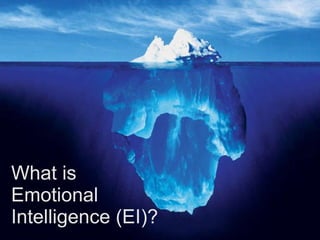
What is  Emotional  Intelligence (EI)?
Lets start with the history of EI
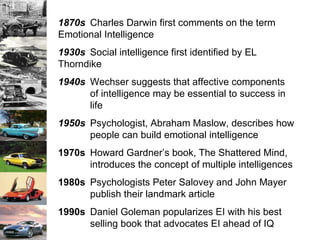
1870s Charles Darwin first comments on the term  Emotional Intelligence 1930s Social intelligence first identified by EL  Thorndike 1940s Wechser suggests that affective components  of intelligence may be essential to success in  life 1950s Psychologist, Abraham Maslow, describes how  people can build emotional intelligence 1970s Howard Gardner’s book, The Shattered Mind,  introduces the concept of multiple intelligences 1980s Psychologists Peter Salovey and John Mayer  publish their landmark article 1990s Daniel Goleman popularizes EI with his best  selling book that advocates EI ahead of IQ
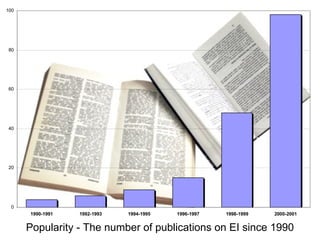
Popularity - The number of publications on EI since 1990
The top 3 EI models in use today are:
Salovey-Mayer Model Has four emotional branches  and suggests that your motions  make you smarter via:
emotional  perception  &  identification;
emotional facilitation of thought;
emotional understanding; and
emotional management.
The Bar-On Model Comprises five domains upon which to assess your emotional-social traits. These are:
self awareness and  self expression;
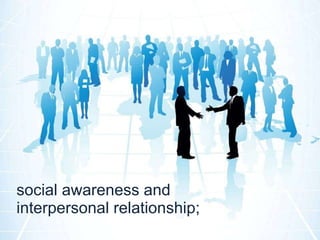
social awareness and  interpersonal relationship;
emotional management and regulation;
change management; and
self motivation.
The Goleman Model Takes the approach that  EI provides the foundation for competencies of personal and social  skills that lead to  superior performance  in the work place.
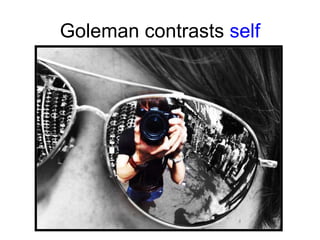
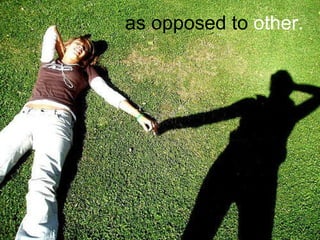
Goleman contrasts  self
as opposed to   other.
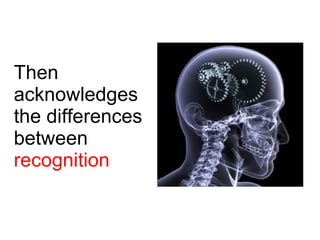
Then acknowledges the differences between  recognition
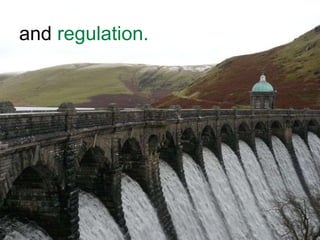
and  regulation.
What is  Emotional  Intelligence (EI)?
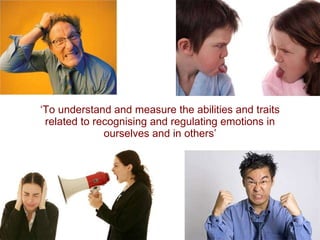
‘ To understand and measure the abilities and traits related to recognising and regulating emotions in ourselves and in others’
Some food for thought… Is EI a new science or something that’s always been inherent in psychological studies and methods?
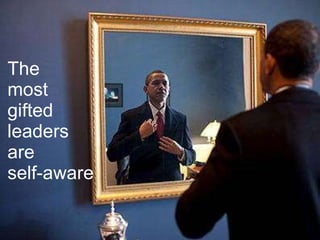
The  most  gifted leaders  are  self-aware
and empathetic.
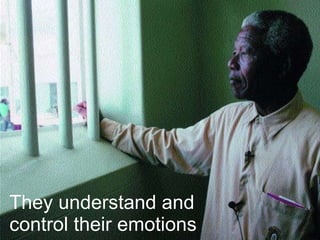
They understand and  control their emotions
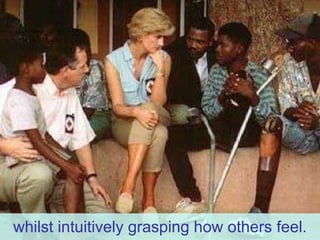
whilst intuitively grasping how others feel.
But what’s  in it for  you?
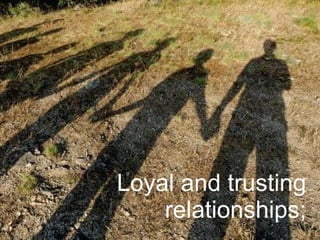
Loyal and trusting relationships;
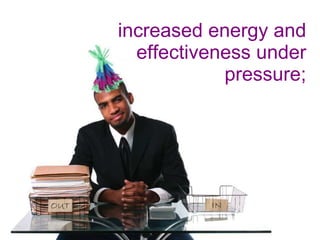
increased energy and effectiveness under pressure;
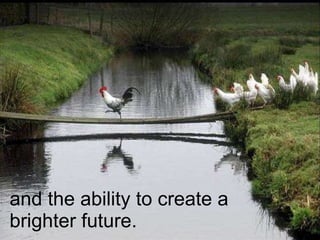
and the ability to create a brighter future.
It’s not too late
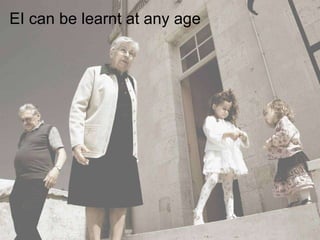
EI can be learnt at any age
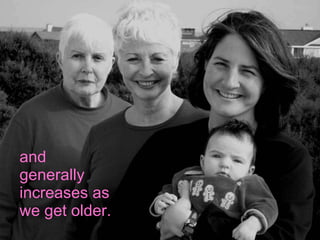
and  generally  increases as  we get older.
A Quick
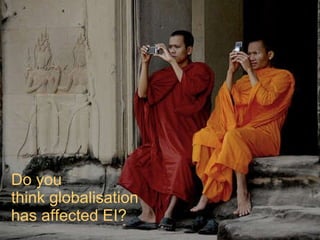
Do you  think globalisation has affected EI?
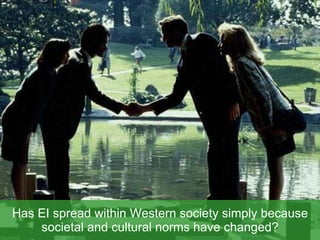
Has EI spread within Western society simply because societal and cultural norms have changed?
Is there a down side to EI?
Some think EI is too vague,
some think EI is difficult to measure,
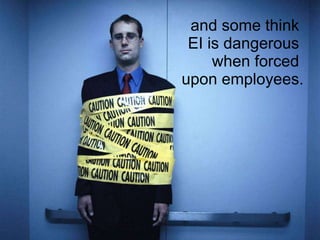
and some think  EI is dangerous  when forced  upon employees.
EI, what do you think?
References Caruso, D, Salovey, P, 2004, The Emotionally Intelligent Manager, Jassey-Bass, San Francisco, CA Plutchik, R, 1997, Circumplex Models of Personality and Emotions, American Psychological Association, Washington, DC http://psychology.about.com/od/personalitydevelopment/a/emotionalintell.htm, viewed 29th July 2009 Bar-On, R. ‘The Bar-On Model of Emotional-Social Intelligence’ (2007), Reuvenbaron.org, viewed 3 August 2009, http://www.reuvenbaron.org/bar-on-model Bar-On, R. (2006) ‘The Bar-On model of Emotional-Social Intelligence (ESI)’, Psicothema, 18, supl., 13-25. Caruso, D. (2004) ‘Defining the inkblot called Emotional Intelligence’, Consortium Emotional Intelligence website, viewed 3 August 2009, <http://www.eiconsortium.org/research/ei_issues_and_common_misunderstandings_caruso_comment.htm>. Chapman, A. ‘Emotional Intelligence (EQ)’ (2009), Businessballs.com, viewed 3 August 2009, <http://www.businessballs.com/eq.htm> Cherniss, C. ‘Emotional Intelligence: What it is and Why it Matters’, paper presented at the Annual Meeting of the Society for Industrial and Organisational Psychology, New Orleans, 15 April 2000. Consortium for Research on Emotional Intelligence in Organisations, ‘Measures: ECI2.0 and ESCI’, viewed 3 August 2009,  http://www.eiconsortium.org/measures/eci_360.html Cooper, R. K., (1997), Applying emotional intelligence in the workplace, Training and Development, Vol. 51, Issue. 12, pp 31-38 Emmerling, R.J. and Goleman, D. (2003) ‘Emotional intelligence: issues and common misunderstandings’, Consortium Emotional Intelligence website, viewed 3 August 2009, http://www.eiconsortium.org/research/ei_issues_and_common_misunderstandings.htm Goleman, D. (2004) “An EI based theory of performance’, Consortium for Emotional Intelligence website, viewed 3 August 2009, http://www.eiconsortium.org/research/ei_theory_performance.htm Matthews, G., Zeidner, M. and Roberts, R. (2004) Emotional Intelligence: science and myth, introduction/chapter 1: The MIT Press Web Site, viewed 3 August 2009, <http://mitpress.mit.edu/catalog/item/default.asp?ttype=2&tid=10191&mode=toc. Mayer, J., Salovey, P. and Caruso, D. (2000) ‘Models of Emotional Intelligence’, Handbook of Intelligence, ed. R. J. Sternberg, pp 396-420, Cambridge, Cambridge Uni Press. Conte J, 2005 ‘A Review and Critique of Emotional Intelligence Measures’  Journal of Organizational Behaviour, vol. 26 no.4 pp 433-40 Leading by Feel, Harvard Business Review, January 2004, Vol. 82, Issue. 1, pp 27-37 Kruml, S, Geddes, D, 2005 ‘Catching Fire without Burning out: Is there an ideal Way to perform Emotional Labour?’ in Organisational Behaviour Pearson Education Australia, Frenchs Forests, NSW. P279 Liao, H, Chuang, A, 2004, ‘A Multilevel Investigation of Factors Influencing Employee Service Performance and Customer Outcomes’, Academy management Journal, vol.47, no.1 pp 41-58. Locke E, 2005 ‘Why Emotional Intelligence is an invalid concept’ Journal of Organizational Behaviour, vol. 26 no.4 pp 425-31. Robbins, S, Judge, T,  Millet, B, Waters-Marsh, T 2008 Organisational Behaviour Pearson Education Australia, Frenchs Forests, NSW. Strack, F, Stepper, L, Martin, S, 1988, ‘Inhibiting and Facilitating Conditions of the Human Smile: A Nonobstrusive Test of the Facial Feedback Hypothesis’ Journal of Personality and Social Psychology, vol. 54, pp 768-77.
Image References 2 -  http://www.starstore.com/acatalog/iceberg-poster.jpg 3 –  http://www.copac.ac.uk/blog/uploaded_images/chethams_library_interior-734003.jpg 4 & 5 -  http:// images.google.com.au/imghp?hl = en&sa = N&tab =li 6 -  http://www.shinystyle.tv/Prada_Milan%20Fashion%20Week.JPG 7 -  http://www.coloring-pages-book-for-kids-boys.com/images 8 -  http://www.natures-desktop.com/images/Wallpaper/widescreen1920x1200/Tree-Wallpapers/oak-tree-branch.jpg 9 -  http://farm3.static.flickr.com/2295/2894804828_92dd652043_o.jpg 10 - http://rexhenrik.se/AHolmersSpace/Russia2007/Kolomenskoye/KolomenskoyeAppleTreeGarden.JPG 11 -  http://www.edwardtraub.com/blog/CIMG6288.JPG 12 -  http://www.coloring-pages-book-for-kids-boys.com/images 13 -  http://farm1.static.flickr.com/210/443459293_e5efbc8537_o.jpg 14 -  http://aprilbroussard.files.wordpress.com/2009/03/social-networking.jpg 15 -  http://ees.acadiau.ca/images/eqk-qc-08-01-05.gif 16 -  http://www.talentretention.com/images/Change%20Management%20Skills.jpg 17 -  http://www.wiltshirepct.nhs.uk/DentalService/Schools%20Page/girl%20sport.jpg 18 -  http://www.coloring-pages-book-for-kids-boys.com/images 19 -  http://fc00.deviantart.com/fs31/f/2008/208/0/f/Mirror_Sunglasses_Reflection_by_bender01101.jpg 20 -  http:// jarswebsite.com/holding_hands_with_shadow.jpg 21 -  http://www.2minuty.pl/assets/2007/7/26/brain-cogs.png 22 -  http://www.ies.aber.ac.uk/files/u11/Elan_River_Craig_Goch_Dam.jpg 23 -  http:// www.gtilley.co.uk/images/puzzled.jpg 24 –  http://quantumlearningblog.files.wordpress.com/2009/02/frustration3.jpg http://www.sciencedaily.com/images/2007/11/071106123725-large.jpg http://4.bp.blogspot.com/_XQ3onXl4zFs/SkB9ZAyh0SI/AAAAAAAAAI4/p_RfHOjicfU/s320/bad-boss-megaphone-yelling.jpg http://getentrepreneurial.com/images/defusing-angry-cust.jpg 25 -  http://urbanprankster.com/wp-content/uploads/2009/01/bal2-500x351.jpg 26 -  http://s3.amazonaws.com/twitter_production/profile_images/112247670/bubble_thought_l__Large__bigger.gif 27 -  http://images.mirror.co.uk/upl/m4/jan2009/9/6/0E178871-FD9F-97EB-314207CDF02D949C.jpg 28 -  http://starbozz.files.wordpress.com/2008/10/teresa.jpg 29 -  http://www.icmpa.umd.edu/salzburg/terrorism/wp-content/doc/2007/08/mandela21.jpg 30 -  http://www.jaunted.com/files/8742/diana_with_survivors.jpg 31 -  http://ladyfi.files.wordpress.com/2008/12/little_greedy_dog.jpg 32 -  http://www.gettyimages.com 33 -  http://www.sallywhite.com/ConstantContact/September_2008/Images/Article1.jpg 34 -  http://cache3.asset-cache.net/xc/AB21633.jpg?v=1&c= NewsMaker&k =2&d=92E67D7314DA3F2368D1FF3F77D4EEE6 35 -  http://www.fileguru.com/images/b/clock_screen_saver_desktop_screen_savers-844.gif 36 -  http://www.fundraisingseeds.com/wp-content/uploads/generations.jpg 37 -  http://farm1.static.flickr.com/46/132523614_2d1fe42895_b.jpg 38 -  http://gazette.unc.edu/archives/08jun18/6-18-webpix/detour.jpg 39 -  http://farm3.static.flickr.com/2183/2242496143_9e02e42697.jpg 40 -  http://www.gettyimages.com 41 -  http://thoughttrials.files.wordpress.com/2009/05/fotolia_4047782_subscription_l.jpg 42 -  http://farm4.static.flickr.com/3478/3199207013_60b5aca9d0_o.jpg 43 -  http://farm1.static.flickr.com/98/266823190_808a555947_o.jpg 44 -  http://lh5.ggpht.com/_bUTjf-hNPDk/R6td5OnBQtI/AAAAAAAAAqc/nCmh5erB1jA/j0407410.jpg

Emotional Intelligence

  • 1.
    Turn on yoursound and press play once the video loads…enjoy…
  • 2.
    Emotional Intelligence CLN Two Presentation
  • 3.
    What is Emotional Intelligence (EI)?
  • 4.
    Lets start withthe history of EI
  • 5.
    1870s Charles Darwinfirst comments on the term Emotional Intelligence 1930s Social intelligence first identified by EL Thorndike 1940s Wechser suggests that affective components of intelligence may be essential to success in life 1950s Psychologist, Abraham Maslow, describes how people can build emotional intelligence 1970s Howard Gardner’s book, The Shattered Mind, introduces the concept of multiple intelligences 1980s Psychologists Peter Salovey and John Mayer publish their landmark article 1990s Daniel Goleman popularizes EI with his best selling book that advocates EI ahead of IQ
  • 6.
    Popularity - Thenumber of publications on EI since 1990
  • 7.
    The top 3EI models in use today are:
  • 8.
    Salovey-Mayer Model Hasfour emotional branches and suggests that your motions make you smarter via:
  • 9.
    emotional perception & identification;
  • 10.
  • 11.
  • 12.
  • 13.
    The Bar-On ModelComprises five domains upon which to assess your emotional-social traits. These are:
  • 14.
    self awareness and self expression;
  • 15.
    social awareness and interpersonal relationship;
  • 16.
  • 17.
  • 18.
  • 19.
    The Goleman ModelTakes the approach that EI provides the foundation for competencies of personal and social skills that lead to superior performance in the work place.
  • 20.
  • 21.
  • 22.
    Then acknowledges thedifferences between recognition
  • 23.
  • 24.
    What is Emotional Intelligence (EI)?
  • 25.
    ‘ To understandand measure the abilities and traits related to recognising and regulating emotions in ourselves and in others’
  • 26.
    Some food forthought… Is EI a new science or something that’s always been inherent in psychological studies and methods?
  • 27.
    The most gifted leaders are self-aware
  • 28.
  • 29.
    They understand and control their emotions
  • 30.
  • 31.
    But what’s in it for you?
  • 32.
    Loyal and trustingrelationships;
  • 33.
    increased energy andeffectiveness under pressure;
  • 34.
    and the abilityto create a brighter future.
  • 35.
  • 36.
    EI can belearnt at any age
  • 37.
    and generally increases as we get older.
  • 38.
  • 39.
    Do you think globalisation has affected EI?
  • 40.
    Has EI spreadwithin Western society simply because societal and cultural norms have changed?
  • 41.
    Is there adown side to EI?
  • 42.
    Some think EIis too vague,
  • 43.
    some think EIis difficult to measure,
  • 44.
    and some think EI is dangerous when forced upon employees.
  • 45.
    EI, what doyou think?
  • 46.
    References Caruso, D,Salovey, P, 2004, The Emotionally Intelligent Manager, Jassey-Bass, San Francisco, CA Plutchik, R, 1997, Circumplex Models of Personality and Emotions, American Psychological Association, Washington, DC http://psychology.about.com/od/personalitydevelopment/a/emotionalintell.htm, viewed 29th July 2009 Bar-On, R. ‘The Bar-On Model of Emotional-Social Intelligence’ (2007), Reuvenbaron.org, viewed 3 August 2009, http://www.reuvenbaron.org/bar-on-model Bar-On, R. (2006) ‘The Bar-On model of Emotional-Social Intelligence (ESI)’, Psicothema, 18, supl., 13-25. Caruso, D. (2004) ‘Defining the inkblot called Emotional Intelligence’, Consortium Emotional Intelligence website, viewed 3 August 2009, <http://www.eiconsortium.org/research/ei_issues_and_common_misunderstandings_caruso_comment.htm>. Chapman, A. ‘Emotional Intelligence (EQ)’ (2009), Businessballs.com, viewed 3 August 2009, <http://www.businessballs.com/eq.htm> Cherniss, C. ‘Emotional Intelligence: What it is and Why it Matters’, paper presented at the Annual Meeting of the Society for Industrial and Organisational Psychology, New Orleans, 15 April 2000. Consortium for Research on Emotional Intelligence in Organisations, ‘Measures: ECI2.0 and ESCI’, viewed 3 August 2009, http://www.eiconsortium.org/measures/eci_360.html Cooper, R. K., (1997), Applying emotional intelligence in the workplace, Training and Development, Vol. 51, Issue. 12, pp 31-38 Emmerling, R.J. and Goleman, D. (2003) ‘Emotional intelligence: issues and common misunderstandings’, Consortium Emotional Intelligence website, viewed 3 August 2009, http://www.eiconsortium.org/research/ei_issues_and_common_misunderstandings.htm Goleman, D. (2004) “An EI based theory of performance’, Consortium for Emotional Intelligence website, viewed 3 August 2009, http://www.eiconsortium.org/research/ei_theory_performance.htm Matthews, G., Zeidner, M. and Roberts, R. (2004) Emotional Intelligence: science and myth, introduction/chapter 1: The MIT Press Web Site, viewed 3 August 2009, <http://mitpress.mit.edu/catalog/item/default.asp?ttype=2&tid=10191&mode=toc. Mayer, J., Salovey, P. and Caruso, D. (2000) ‘Models of Emotional Intelligence’, Handbook of Intelligence, ed. R. J. Sternberg, pp 396-420, Cambridge, Cambridge Uni Press. Conte J, 2005 ‘A Review and Critique of Emotional Intelligence Measures’ Journal of Organizational Behaviour, vol. 26 no.4 pp 433-40 Leading by Feel, Harvard Business Review, January 2004, Vol. 82, Issue. 1, pp 27-37 Kruml, S, Geddes, D, 2005 ‘Catching Fire without Burning out: Is there an ideal Way to perform Emotional Labour?’ in Organisational Behaviour Pearson Education Australia, Frenchs Forests, NSW. P279 Liao, H, Chuang, A, 2004, ‘A Multilevel Investigation of Factors Influencing Employee Service Performance and Customer Outcomes’, Academy management Journal, vol.47, no.1 pp 41-58. Locke E, 2005 ‘Why Emotional Intelligence is an invalid concept’ Journal of Organizational Behaviour, vol. 26 no.4 pp 425-31. Robbins, S, Judge, T, Millet, B, Waters-Marsh, T 2008 Organisational Behaviour Pearson Education Australia, Frenchs Forests, NSW. Strack, F, Stepper, L, Martin, S, 1988, ‘Inhibiting and Facilitating Conditions of the Human Smile: A Nonobstrusive Test of the Facial Feedback Hypothesis’ Journal of Personality and Social Psychology, vol. 54, pp 768-77.
  • 47.
    Image References 2- http://www.starstore.com/acatalog/iceberg-poster.jpg 3 – http://www.copac.ac.uk/blog/uploaded_images/chethams_library_interior-734003.jpg 4 & 5 - http:// images.google.com.au/imghp?hl = en&sa = N&tab =li 6 - http://www.shinystyle.tv/Prada_Milan%20Fashion%20Week.JPG 7 - http://www.coloring-pages-book-for-kids-boys.com/images 8 - http://www.natures-desktop.com/images/Wallpaper/widescreen1920x1200/Tree-Wallpapers/oak-tree-branch.jpg 9 - http://farm3.static.flickr.com/2295/2894804828_92dd652043_o.jpg 10 - http://rexhenrik.se/AHolmersSpace/Russia2007/Kolomenskoye/KolomenskoyeAppleTreeGarden.JPG 11 - http://www.edwardtraub.com/blog/CIMG6288.JPG 12 - http://www.coloring-pages-book-for-kids-boys.com/images 13 - http://farm1.static.flickr.com/210/443459293_e5efbc8537_o.jpg 14 - http://aprilbroussard.files.wordpress.com/2009/03/social-networking.jpg 15 - http://ees.acadiau.ca/images/eqk-qc-08-01-05.gif 16 - http://www.talentretention.com/images/Change%20Management%20Skills.jpg 17 - http://www.wiltshirepct.nhs.uk/DentalService/Schools%20Page/girl%20sport.jpg 18 - http://www.coloring-pages-book-for-kids-boys.com/images 19 - http://fc00.deviantart.com/fs31/f/2008/208/0/f/Mirror_Sunglasses_Reflection_by_bender01101.jpg 20 - http:// jarswebsite.com/holding_hands_with_shadow.jpg 21 - http://www.2minuty.pl/assets/2007/7/26/brain-cogs.png 22 - http://www.ies.aber.ac.uk/files/u11/Elan_River_Craig_Goch_Dam.jpg 23 - http:// www.gtilley.co.uk/images/puzzled.jpg 24 – http://quantumlearningblog.files.wordpress.com/2009/02/frustration3.jpg http://www.sciencedaily.com/images/2007/11/071106123725-large.jpg http://4.bp.blogspot.com/_XQ3onXl4zFs/SkB9ZAyh0SI/AAAAAAAAAI4/p_RfHOjicfU/s320/bad-boss-megaphone-yelling.jpg http://getentrepreneurial.com/images/defusing-angry-cust.jpg 25 - http://urbanprankster.com/wp-content/uploads/2009/01/bal2-500x351.jpg 26 - http://s3.amazonaws.com/twitter_production/profile_images/112247670/bubble_thought_l__Large__bigger.gif 27 - http://images.mirror.co.uk/upl/m4/jan2009/9/6/0E178871-FD9F-97EB-314207CDF02D949C.jpg 28 - http://starbozz.files.wordpress.com/2008/10/teresa.jpg 29 - http://www.icmpa.umd.edu/salzburg/terrorism/wp-content/doc/2007/08/mandela21.jpg 30 - http://www.jaunted.com/files/8742/diana_with_survivors.jpg 31 - http://ladyfi.files.wordpress.com/2008/12/little_greedy_dog.jpg 32 - http://www.gettyimages.com 33 - http://www.sallywhite.com/ConstantContact/September_2008/Images/Article1.jpg 34 - http://cache3.asset-cache.net/xc/AB21633.jpg?v=1&c= NewsMaker&k =2&d=92E67D7314DA3F2368D1FF3F77D4EEE6 35 - http://www.fileguru.com/images/b/clock_screen_saver_desktop_screen_savers-844.gif 36 - http://www.fundraisingseeds.com/wp-content/uploads/generations.jpg 37 - http://farm1.static.flickr.com/46/132523614_2d1fe42895_b.jpg 38 - http://gazette.unc.edu/archives/08jun18/6-18-webpix/detour.jpg 39 - http://farm3.static.flickr.com/2183/2242496143_9e02e42697.jpg 40 - http://www.gettyimages.com 41 - http://thoughttrials.files.wordpress.com/2009/05/fotolia_4047782_subscription_l.jpg 42 - http://farm4.static.flickr.com/3478/3199207013_60b5aca9d0_o.jpg 43 - http://farm1.static.flickr.com/98/266823190_808a555947_o.jpg 44 - http://lh5.ggpht.com/_bUTjf-hNPDk/R6td5OnBQtI/AAAAAAAAAqc/nCmh5erB1jA/j0407410.jpg

Editor's Notes

  • #20 The Goleman Model takes the approach that EQ provides the foundation for competencies of personal and social skills that lead to superior performance in the work place. In other words, a person’s EQ determines his or her potential for learning the practical emotional and social skills required to be a high performing individual. Goleman’s model comprises the four domains of Self Awareness, Self Management, Social Awareness and Relationship Management.
  • #26 ANGELA While the approaches of the three models differ and measure different aspects of the EQ construct, all “share a common desire to understand and measure the abilities and traits related to recognising and regulating emotions in ourselves and in others.” (Emmerling &amp; Goleman 2003). The different models tend be complementary rather than contradictory, and all three can contribute to improved leadership ability and creating a working environment that fosters high performance and success.
  • #28 KIRRA Leaders need to manage the mood of an organisation. One of the primary challenges facing managers and leaders is how to lead and learn through EI and reasoning, instead of through more traditional management methods. The most gifted leaders are self aware
  • #29 and empathetic.
  • #30 They understand and can control their emotions
  • #31 whilst intuitively grasping how others feel. It is the ability that enables leaders to know how they are feeling and why, and the impact their feelings have on their behaviour. So where does EI come from, and how do leaders learn to use it?
  • #33 KIRRA Building trusting relationships: Develops specific ways to create and sustain trust with current and potential customers, team members, and within the organisation. Fosters loyalty in authentic and straightforward ways.
  • #34 KIRRA Increasing energy and effectiveness under pressure: Develops specific, achievable ways to encourage mental awareness and expectancy. Encourages emotional commitment to the organisation’s strategic choices and vision.
  • #35 Creating the future: Utilise the power of divergent views, and encourage the strengths and talents in one-self and others.
  • #37 KIRRA Many studies suggest that EI is a skill that can be learned at almost any age, in fact, on average, people’s EI tends to increase as they age.
  • #40 Much of the theory is grounded in western ideology. Given the degree of globalisation that has occurred since the concept of EQ was first put forward, is it time to examine the relevance and applicability of EQ on a more global scale?