Emotional
Intelligence
The Emotions Behind the Future!
Siddharth Paul
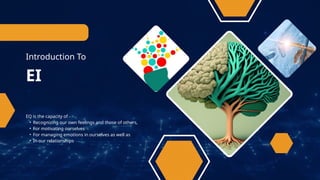
EI
Introduction To
EQ is the capacity of -
• Recognizing our own feelings and those of others,
• For motivating ourselves
• For managing emotions in ourselves as well as
• In our relationships
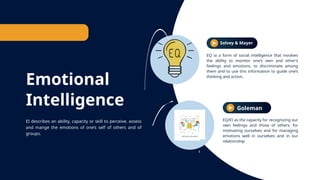
Emotional
Intelligence
EI describes an ability, capacity or skill to perceive, assess
and mange the emotions of one’s self of others and of
groups.
Solvey & Mayer
EQ ia a form of social intelligence that involves
the ability to monitor one’s own and other’s
feelings and emotions, to discriminate among
them and to use this information to guide one’s
thinking and action.
Goleman
EQ/EI as the capacity for recognizing our
own feelings and those of others, for
motivating ourselves and for managing
emotions well in ourselves and in our
relationship
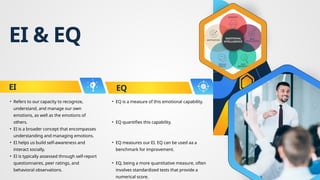
EI & EQ
• Refers to our capacity to recognize,
understand, and manage our own
emotions, as well as the emotions of
others.
• EI is a broader concept that encompasses
understanding and managing emotions.
• EI helps us build self-awareness and
interact socially.
• EI is typically assessed through self-report
questionnaires, peer ratings, and
behavioral observations.
• EQ is a measure of this emotional capability.
• EQ quantifies this capability.
• EQ measures our EI. EQ can be used aa a
benchmark for improvement.
• EQ, being a more quantitative measure, often
involves standardized tests that provide a
numerical score.
EI EQ
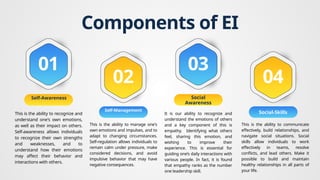
Components of EI
01
Self-Awareness
03
Social
Awareness
02
Self-Management
04
Social-Skills
This is the ability to recognize and
understand one's own emotions,
as well as their impact on others.
Self-awareness allows individuals
to recognize their own strengths
and weaknesses, and to
understand how their emotions
may affect their behavior and
interactions with others.
It is our ability to recognize and
understand the emotions of others
and a key component of this is
empathy. Identifying what others
feel, sharing this emotion, and
wishing to improve their
experience. This is essential for
guiding one’s daily interactions with
various people. In fact, it is found
that empathy ranks as the number
one leadership skill.
This is the ability to manage one's
own emotions and impulses, and to
adapt to changing circumstances.
Self-regulation allows individuals to
remain calm under pressure, make
considered decisions, and avoid
impulsive behavior that may have
negative consequences.
This is the ability to communicate
effectively, build relationships, and
navigate social situations. Social
skills allow individuals to work
effectively in teams, resolve
conflicts, and lead others. Make it
possible to build and maintain
healthy relationships in all parts of
your life.
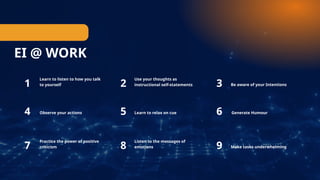
Learn to listen to how you talk
to yourself
Observe your actions
Use your thoughts as
instructional self-statements
Learn to relax on cue Generate Humour
1
4
2
5
Be aware of your Intentions
3
6
EI @ WORK
Practice the power of positive
criticism
Listen to the messages of
emotions
7 8 Make tasks underwhelming
9
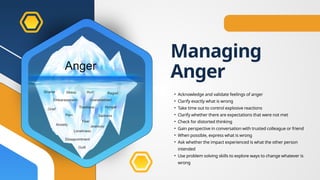
Managing
Anger
• Acknowledge and validate feelings of anger
• Clarify exactly what is wrong
• Take time out to control explosive reactions
• Clarify whether there are expectations that were not met
• Check for distorted thinking
• Gain perspective in conversation with trusted colleague or friend
• When possible, express what is wrong
• Ask whether the impact experienced is what the other person
intended
• Use problem solving skills to explore ways to change whatever is
wrong
Managing
Anxiety
• Acknowledge and validate feelings of anxiety
• Clarify what you feel uncertain about
• Get information from appropriate sources that reduce or clarify
uncertain areas
• Seek perspective or advice from trusted collegues or friends
• Remind yourself that uncertainty is a normal part of your work
experience
• Remind yourself about all the aspects of the situation about
which you do have certainty to keep this aspect in perspective
• Time Lock and focal lock to remain productive
Managing
Fear
• Acknowledge and validate sense of fear
• Clarify the nature of the threat
• If appropriate, reframe the fear as a less intense feeling such as
concern
• Remind yourself of previous similar situations that at first
appeared alarming, but where were less threatening as you
gained more information
• Seek data to make the nature of the threat more concrete
• Move into problem solving or action-planning
• Evaluate the risk of alternatives or of not doing what seems
threatening
• Seek coaching or advice, if appropriate
Gauge your EQ
Self-Reflecting on Emotional
Intelligence Exercise
The purpose of this exercise is to encourage you to
reflect on your emotional intelligence and assess
your skills/responses through an emotional
intelligence lens.
The Emotion Meter
One of the best ways to develop your emotional
intelligence is understanding why and when you
feel certain emotional responses and building a
framework of language and labels to help you
express yourself.
• How do you de-stress after a bad day at work?
• What’s something you’ve achieved that you’re most proud of
and why?
• Who are some of your top role models, why do they inspire
you?
• How do you celebrate success?
• How do you respond when a co-worker challenges you?
• Have you ever had to change your behavior, either at work
or home, if so, why did you have to change, and how did
you change?
• How do you recover from failure?
• When have you felt demotivated, and what did you do to
overcome this?
• How would some of your closest friends describe you?
• What kind of behavior makes you angry/annoyed?
• Mayer-Salovey-Caruso Emotional Intelligence Tests (MSCEIT)
• Self-report Emotional Intelligence Test (SREIT)
• Trait Emotional Intelligence Questionnaire (TEIQue)
• Bar-On Emotional Quotient Inventory (EQ-i)
EQ-i 2.0
The Bar-On Emotional Quotient Inventory (Bar-On, 1997) is a self-report measure of emotional intelligence for
individuals sixteen years of age and over. Developed as a measure of emotionally and socially competent behavior
that provides an estimate of one’s emotional and social intelligence, the Emotional Quotient Inventory is not meant to
measure personality traits or cognitive capacity, but rather to measure one’s ability to be successful in dealing with
environmental demands and pressures.
What is the EQ-i?
The EQ 360 assessment provides a more in-depth analysis by having those who work with the person being
assessed provide information as well. When observer ratings are compared with the results of an EQ-i 2.0 self-
report a more detailed profile emerges. Both assessments measure emotional intelligence (EI) using one total
score, five composite scores and 15 specific subscale scores. Item level results are also presented.
The reliability of the EQ-i (2.0)
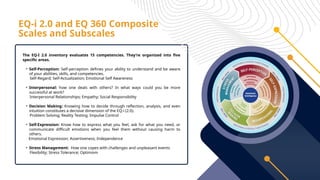
EQ-i 2.0 and EQ 360 Composite
Scales and Subscales
The EQ-I 2.0 inventory evaluates 15 competencies. They’re organized into five
specific areas.
• Self-Perception: Self-perception defines your ability to understand and be aware
of your abilities, skills, and competencies.
Self-Regard; Self-Actualization; Emotional Self Awareness
• Interpersonal: how one deals with others? In what ways could you be more
successful at work?
Interpersonal Relationships; Empathy; Social Responsibility
• Decision Making: Knowing how to decide through reflection, analysis, and even
intuition constitutes a decisive dimension of the EQ-i (2.0).
Problem Solving; Reality Testing; Impulse Control
• Self-Expression: Know how to express what you feel, ask for what you need, or
communicate difficult emotions when you feel them without causing harm to
others.
Emotional Expression; Assertiveness; Independence
• Stress Management: How one copes with challenges and unpleasant events
Flexibility; Stress Tolerance; Optimism
Case Study of MHS
Intrapersonal:
Average
Interpersonal:
High
Stress
Management:
High
Adaptability:
Average
General Mood:
Average
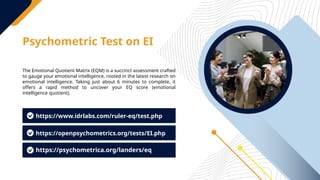
Psychometric Test on EI
The Emotional Quotient Matrix (EQM) is a succinct assessment crafted
to gauge your emotional intelligence, rooted in the latest research on
emotional intelligence. Taking just about 6 minutes to complete, it
offers a rapid method to uncover your EQ score (emotional
intelligence quotient).
https://www.idrlabs.com/ruler-eq/test.php
https://openpsychometrics.org/tests/EI.php
https://psychometrica.org/landers/eq
Thank You!
For Your Attention

Understanding Emotional Intelligence: A Comprehensive Overview

  • 1.
  • 2.
    EI Introduction To EQ isthe capacity of - • Recognizing our own feelings and those of others, • For motivating ourselves • For managing emotions in ourselves as well as • In our relationships
  • 3.
    Emotional Intelligence EI describes anability, capacity or skill to perceive, assess and mange the emotions of one’s self of others and of groups. Solvey & Mayer EQ ia a form of social intelligence that involves the ability to monitor one’s own and other’s feelings and emotions, to discriminate among them and to use this information to guide one’s thinking and action. Goleman EQ/EI as the capacity for recognizing our own feelings and those of others, for motivating ourselves and for managing emotions well in ourselves and in our relationship
  • 4.
    EI & EQ •Refers to our capacity to recognize, understand, and manage our own emotions, as well as the emotions of others. • EI is a broader concept that encompasses understanding and managing emotions. • EI helps us build self-awareness and interact socially. • EI is typically assessed through self-report questionnaires, peer ratings, and behavioral observations. • EQ is a measure of this emotional capability. • EQ quantifies this capability. • EQ measures our EI. EQ can be used aa a benchmark for improvement. • EQ, being a more quantitative measure, often involves standardized tests that provide a numerical score. EI EQ
  • 5.
    Components of EI 01 Self-Awareness 03 Social Awareness 02 Self-Management 04 Social-Skills Thisis the ability to recognize and understand one's own emotions, as well as their impact on others. Self-awareness allows individuals to recognize their own strengths and weaknesses, and to understand how their emotions may affect their behavior and interactions with others. It is our ability to recognize and understand the emotions of others and a key component of this is empathy. Identifying what others feel, sharing this emotion, and wishing to improve their experience. This is essential for guiding one’s daily interactions with various people. In fact, it is found that empathy ranks as the number one leadership skill. This is the ability to manage one's own emotions and impulses, and to adapt to changing circumstances. Self-regulation allows individuals to remain calm under pressure, make considered decisions, and avoid impulsive behavior that may have negative consequences. This is the ability to communicate effectively, build relationships, and navigate social situations. Social skills allow individuals to work effectively in teams, resolve conflicts, and lead others. Make it possible to build and maintain healthy relationships in all parts of your life.
  • 6.
    Learn to listento how you talk to yourself Observe your actions Use your thoughts as instructional self-statements Learn to relax on cue Generate Humour 1 4 2 5 Be aware of your Intentions 3 6 EI @ WORK Practice the power of positive criticism Listen to the messages of emotions 7 8 Make tasks underwhelming 9
  • 7.
    Managing Anger • Acknowledge andvalidate feelings of anger • Clarify exactly what is wrong • Take time out to control explosive reactions • Clarify whether there are expectations that were not met • Check for distorted thinking • Gain perspective in conversation with trusted colleague or friend • When possible, express what is wrong • Ask whether the impact experienced is what the other person intended • Use problem solving skills to explore ways to change whatever is wrong
  • 8.
    Managing Anxiety • Acknowledge andvalidate feelings of anxiety • Clarify what you feel uncertain about • Get information from appropriate sources that reduce or clarify uncertain areas • Seek perspective or advice from trusted collegues or friends • Remind yourself that uncertainty is a normal part of your work experience • Remind yourself about all the aspects of the situation about which you do have certainty to keep this aspect in perspective • Time Lock and focal lock to remain productive
  • 9.
    Managing Fear • Acknowledge andvalidate sense of fear • Clarify the nature of the threat • If appropriate, reframe the fear as a less intense feeling such as concern • Remind yourself of previous similar situations that at first appeared alarming, but where were less threatening as you gained more information • Seek data to make the nature of the threat more concrete • Move into problem solving or action-planning • Evaluate the risk of alternatives or of not doing what seems threatening • Seek coaching or advice, if appropriate
  • 10.
    Gauge your EQ Self-Reflectingon Emotional Intelligence Exercise The purpose of this exercise is to encourage you to reflect on your emotional intelligence and assess your skills/responses through an emotional intelligence lens. The Emotion Meter One of the best ways to develop your emotional intelligence is understanding why and when you feel certain emotional responses and building a framework of language and labels to help you express yourself. • How do you de-stress after a bad day at work? • What’s something you’ve achieved that you’re most proud of and why? • Who are some of your top role models, why do they inspire you? • How do you celebrate success? • How do you respond when a co-worker challenges you? • Have you ever had to change your behavior, either at work or home, if so, why did you have to change, and how did you change? • How do you recover from failure? • When have you felt demotivated, and what did you do to overcome this? • How would some of your closest friends describe you? • What kind of behavior makes you angry/annoyed? • Mayer-Salovey-Caruso Emotional Intelligence Tests (MSCEIT) • Self-report Emotional Intelligence Test (SREIT) • Trait Emotional Intelligence Questionnaire (TEIQue) • Bar-On Emotional Quotient Inventory (EQ-i)
  • 11.
    EQ-i 2.0 The Bar-OnEmotional Quotient Inventory (Bar-On, 1997) is a self-report measure of emotional intelligence for individuals sixteen years of age and over. Developed as a measure of emotionally and socially competent behavior that provides an estimate of one’s emotional and social intelligence, the Emotional Quotient Inventory is not meant to measure personality traits or cognitive capacity, but rather to measure one’s ability to be successful in dealing with environmental demands and pressures. What is the EQ-i? The EQ 360 assessment provides a more in-depth analysis by having those who work with the person being assessed provide information as well. When observer ratings are compared with the results of an EQ-i 2.0 self- report a more detailed profile emerges. Both assessments measure emotional intelligence (EI) using one total score, five composite scores and 15 specific subscale scores. Item level results are also presented. The reliability of the EQ-i (2.0)
  • 12.
    EQ-i 2.0 andEQ 360 Composite Scales and Subscales The EQ-I 2.0 inventory evaluates 15 competencies. They’re organized into five specific areas. • Self-Perception: Self-perception defines your ability to understand and be aware of your abilities, skills, and competencies. Self-Regard; Self-Actualization; Emotional Self Awareness • Interpersonal: how one deals with others? In what ways could you be more successful at work? Interpersonal Relationships; Empathy; Social Responsibility • Decision Making: Knowing how to decide through reflection, analysis, and even intuition constitutes a decisive dimension of the EQ-i (2.0). Problem Solving; Reality Testing; Impulse Control • Self-Expression: Know how to express what you feel, ask for what you need, or communicate difficult emotions when you feel them without causing harm to others. Emotional Expression; Assertiveness; Independence • Stress Management: How one copes with challenges and unpleasant events Flexibility; Stress Tolerance; Optimism
  • 13.
    Case Study ofMHS Intrapersonal: Average Interpersonal: High Stress Management: High Adaptability: Average General Mood: Average
  • 14.
    Psychometric Test onEI The Emotional Quotient Matrix (EQM) is a succinct assessment crafted to gauge your emotional intelligence, rooted in the latest research on emotional intelligence. Taking just about 6 minutes to complete, it offers a rapid method to uncover your EQ score (emotional intelligence quotient). https://www.idrlabs.com/ruler-eq/test.php https://openpsychometrics.org/tests/EI.php https://psychometrica.org/landers/eq
  • 15.