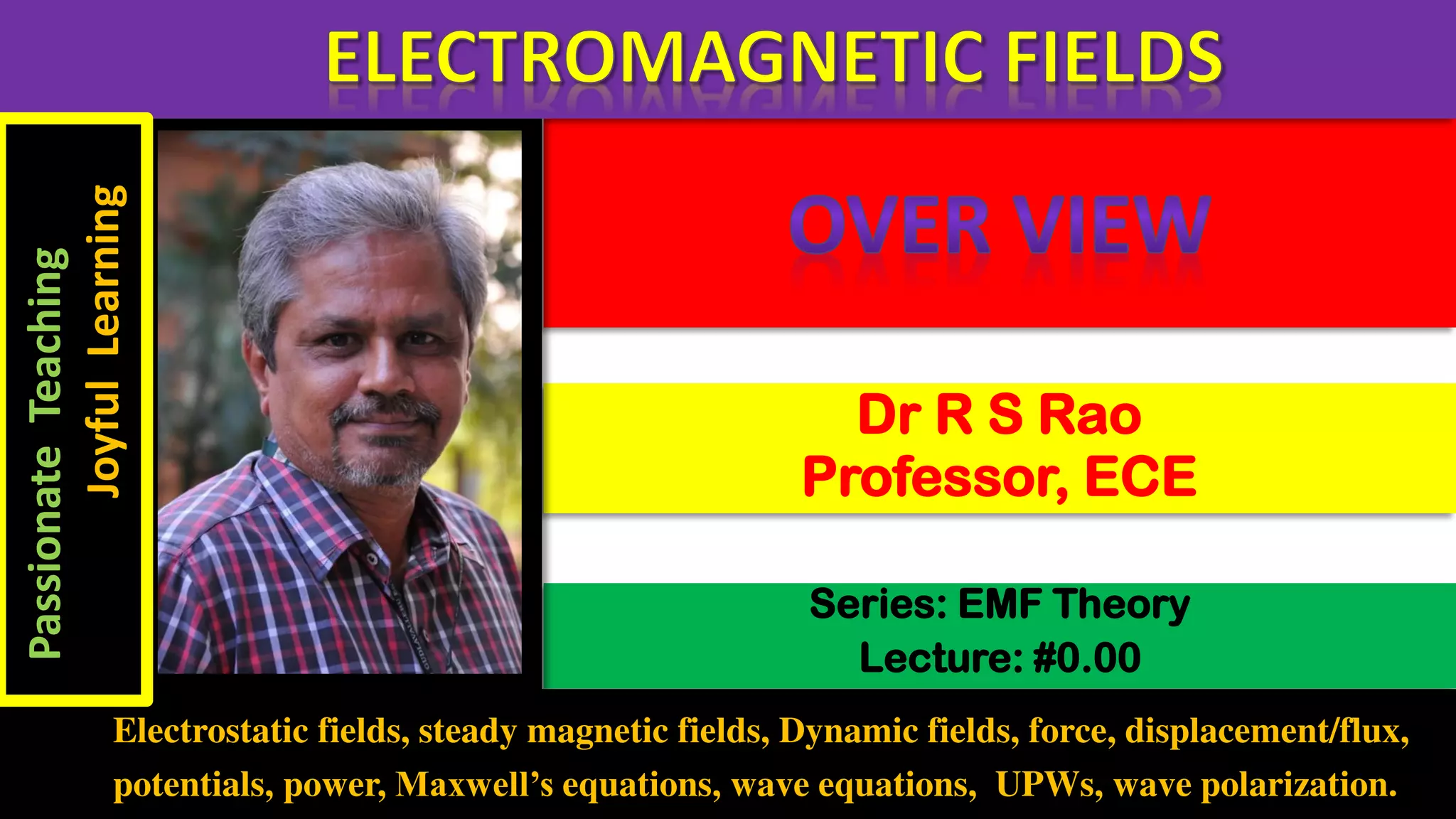
Series: EMF Theory
Lecture: #0.00
Dr R S Rao
Professor, ECE
Electrostatic fields, steady magnetic fields, Dynamic fields, force, displacement/flux,
potentials, power, Maxwell’s equations, wave equations, UPWs, wave polarization.
Passionate
Teaching
Joyful
Learning
Electromagnetic
Field
Theory
2
• Electromagnetic Field Theory,
in short, Field Theory
• Electromagnetic Wave Theory,
in short, Wave Theory
Title:
Electromagnetic
Field
Theory
3
• Communications are mostly electrical,
• Electrical Communications are mostly wireless,
• Wireless Communications use antennas,
• Antennas functioning is based on EM radiation,
• EM radiation is property of dynamic fields.
Why Study Field/Wave Theory:
Hence, ECE students & engineers need to have solid grip
over EM Wave theory
Electromagnetic
Field
Theory
4
Circuit Theory:
• Easy but approximate
• Low frequencies validity
• 1D and scalar
• Voltage and currents
• Lumped elements
• Negligible Radiation
• No wave phenomenon
Circuit theory versus
Field theory
Electromagnetic
Field
Theory
5
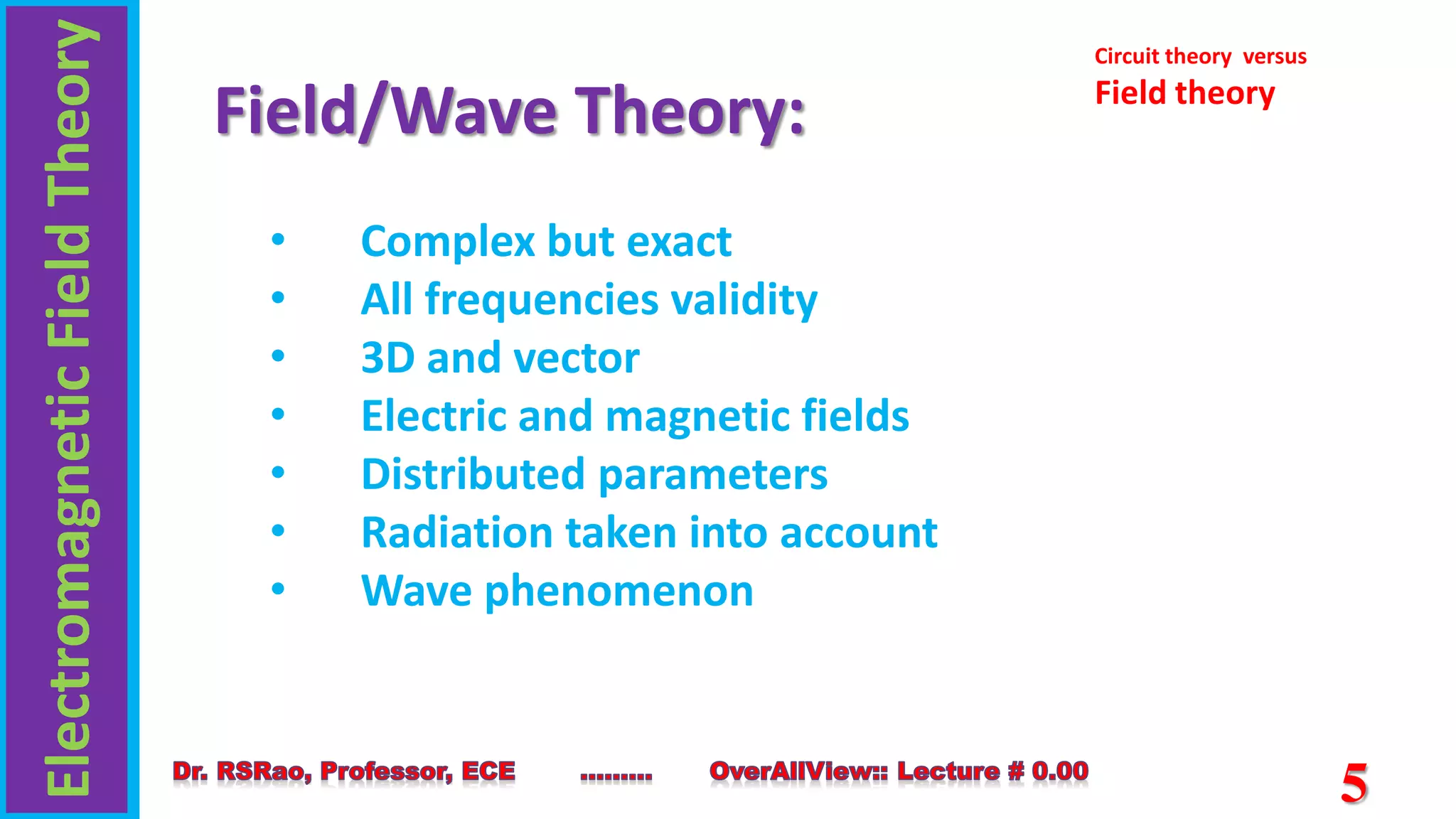
Field/Wave Theory:
Circuit theory versus
Field theory
• Complex but exact
• All frequencies validity
• 3D and vector
• Electric and magnetic fields
• Distributed parameters
• Radiation taken into account
• Wave phenomenon
Electromagnetic
Field
Theory
6
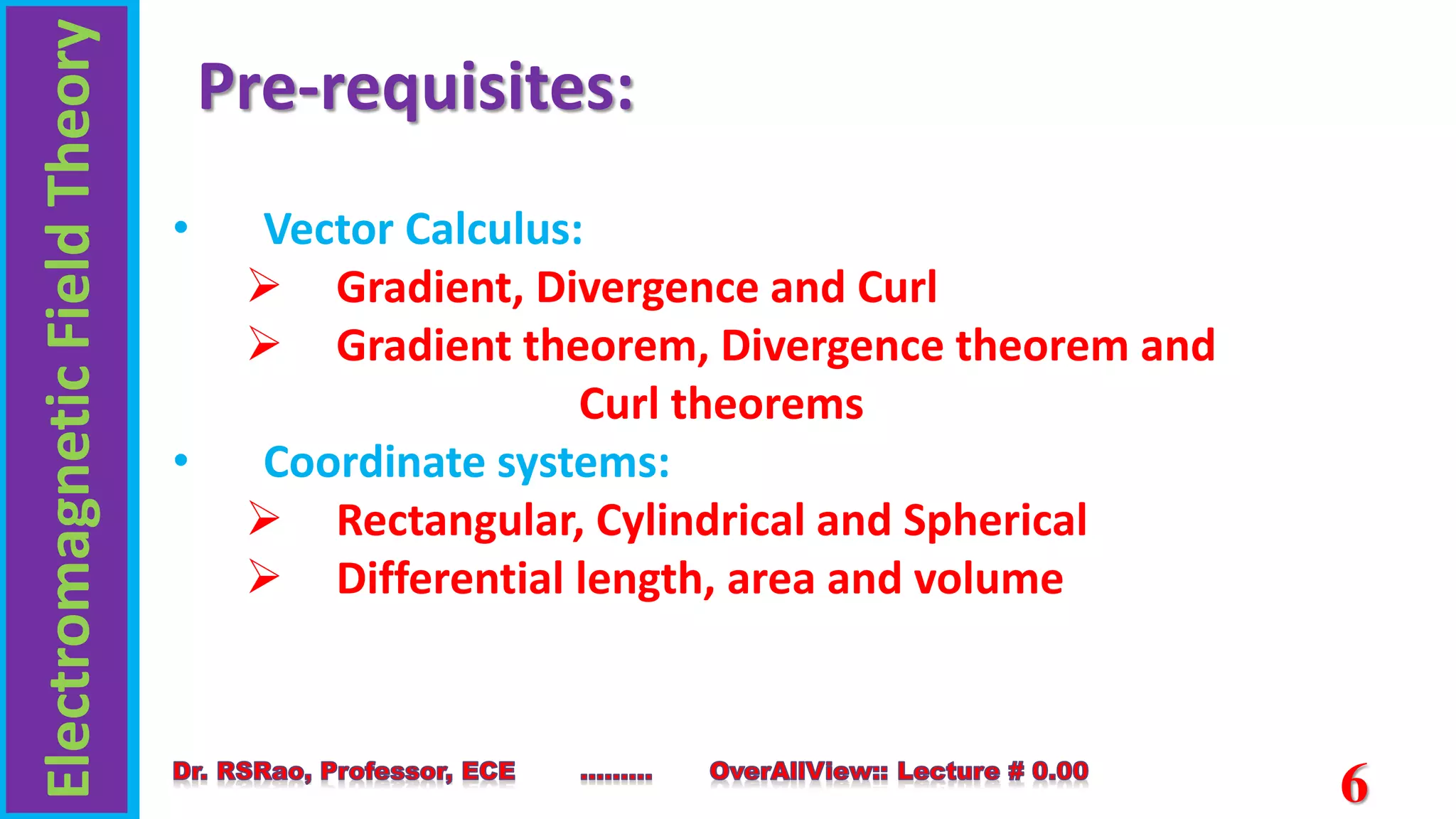
• Vector Calculus:
 Gradient, Divergence and Curl
 Gradient theorem, Divergence theorem and
Curl theorems
• Coordinate systems:
 Rectangular, Cylindrical and Spherical
 Differential length, area and volume
Pre-requisites:
Electromagnetic
Field
Theory
7
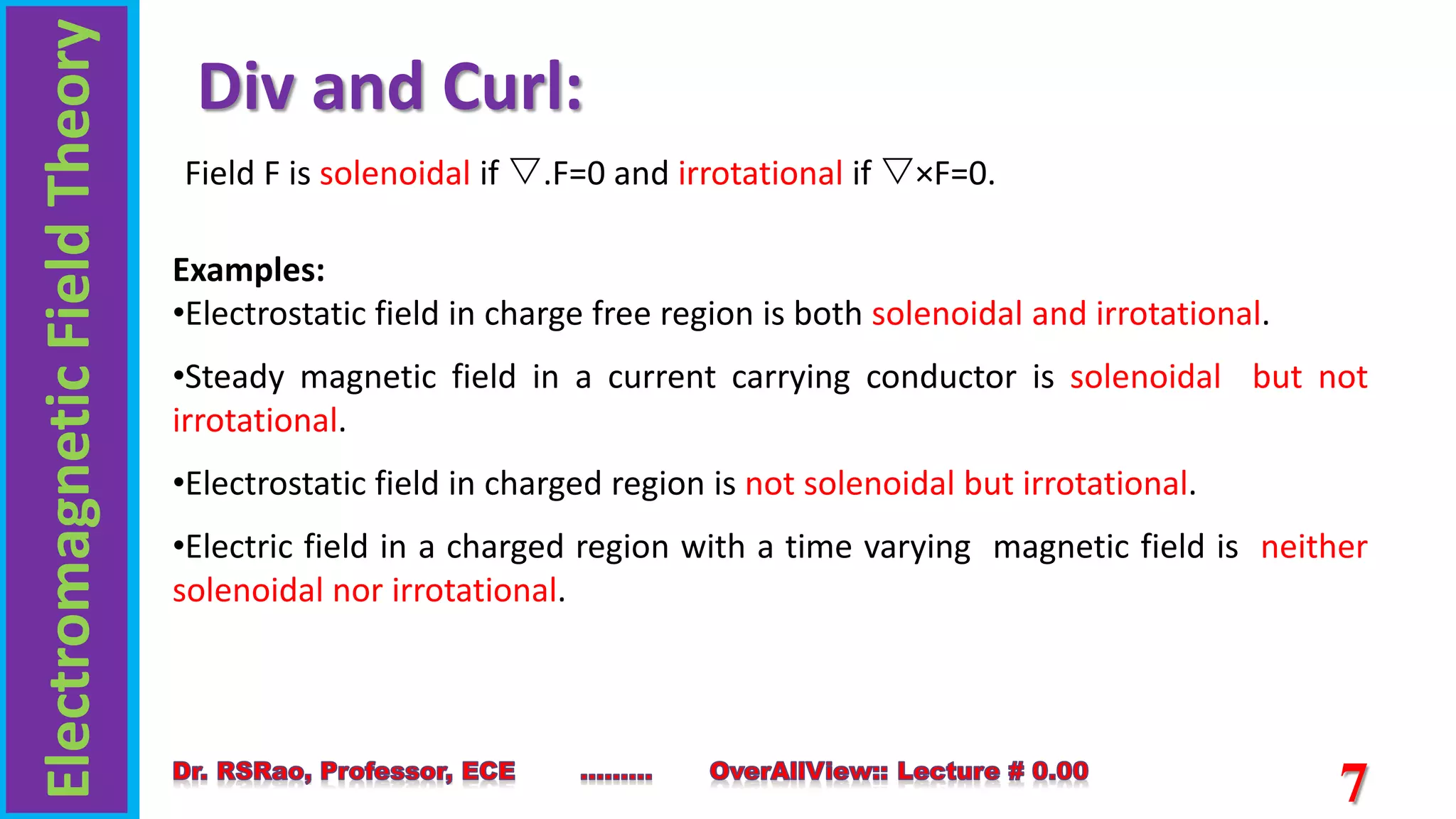
Div and Curl:
Examples:
•Electrostatic field in charge free region is both solenoidal and irrotational.
•Steady magnetic field in a current carrying conductor is solenoidal but not
irrotational.
•Electrostatic field in charged region is not solenoidal but irrotational.
•Electric field in a charged region with a time varying magnetic field is neither
solenoidal nor irrotational.
Field F is solenoidal if .F=0 and irrotational if ×F=0.
Electromagnetic
Field
Theory
8
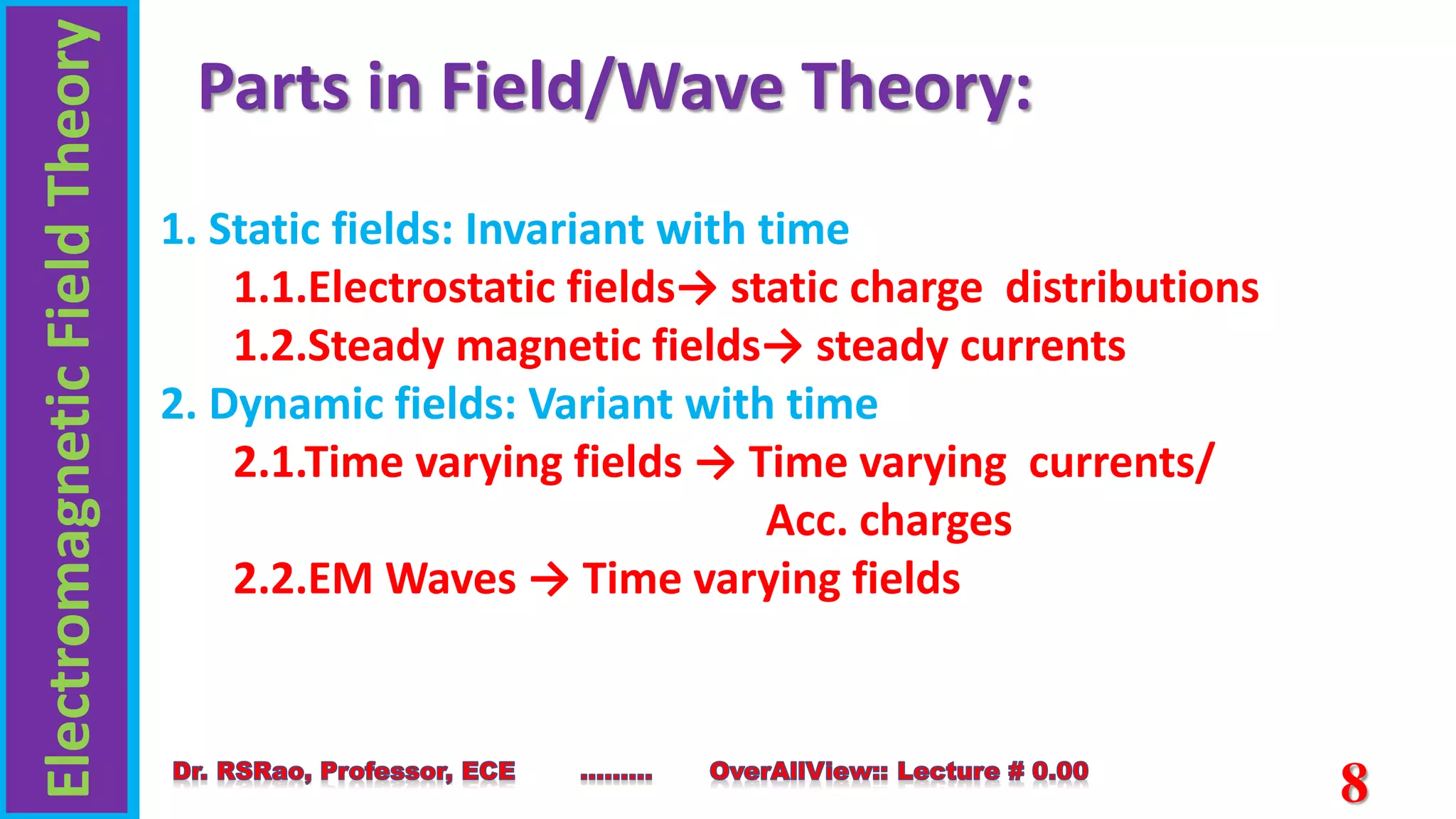
1. Static fields: Invariant with time
1.1.Electrostatic fields→ static charge distributions
1.2.Steady magnetic fields→ steady currents
2. Dynamic fields: Variant with time
2.1.Time varying fields → Time varying currents/
Acc. charges
2.2.EM Waves → Time varying fields
Parts in Field/Wave Theory:
Electromagnetic
Field
Theory
9
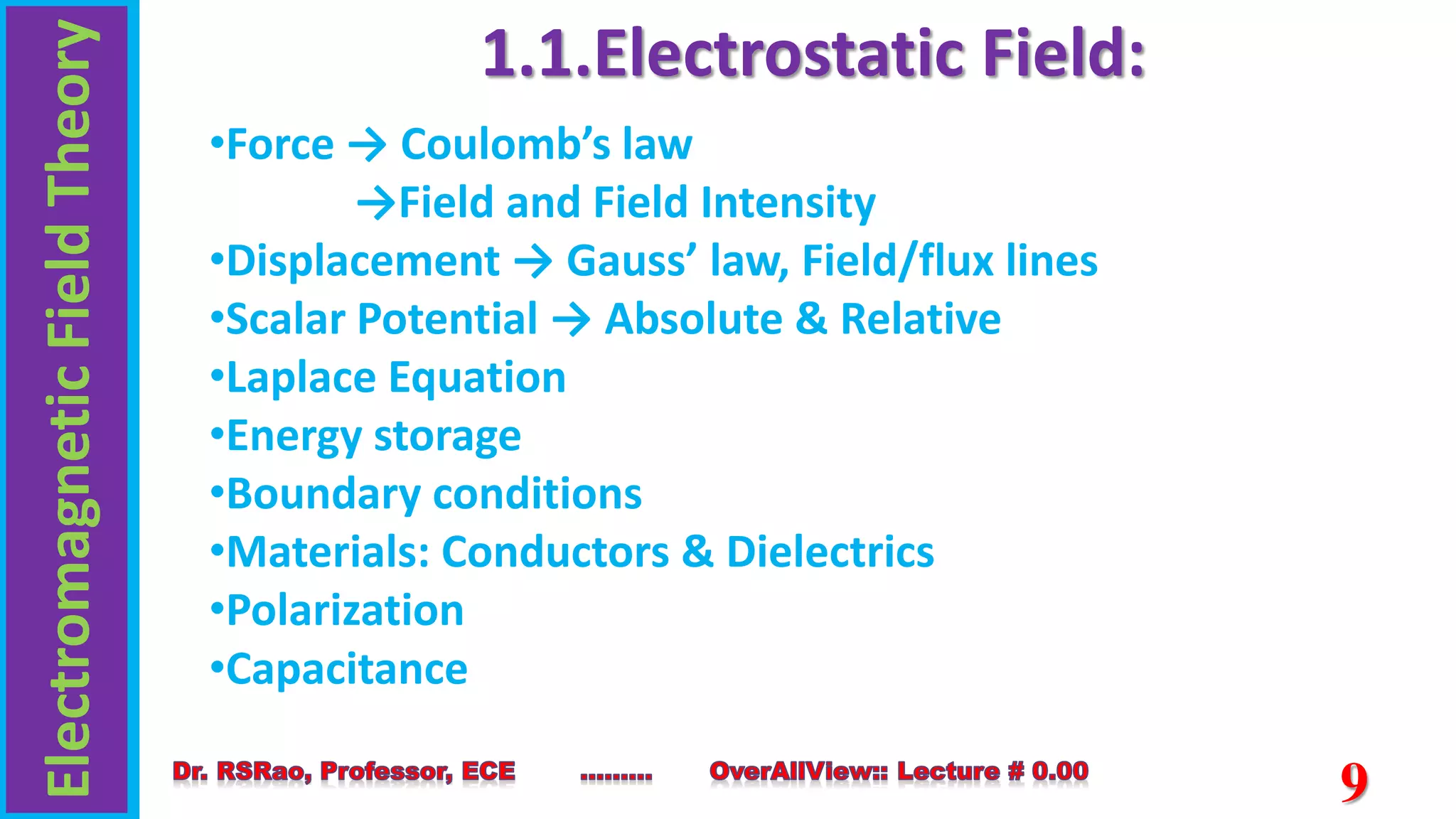
1.1.Electrostatic Field:
•Force → Coulomb’s law
→Field and Field Intensity
•Displacement → Gauss’ law, Field/flux lines
•Scalar Potential → Absolute & Relative
•Laplace Equation
•Energy storage
•Boundary conditions
•Materials: Conductors & Dielectrics
•Polarization
•Capacitance
Electromagnetic
Field
Theory
10
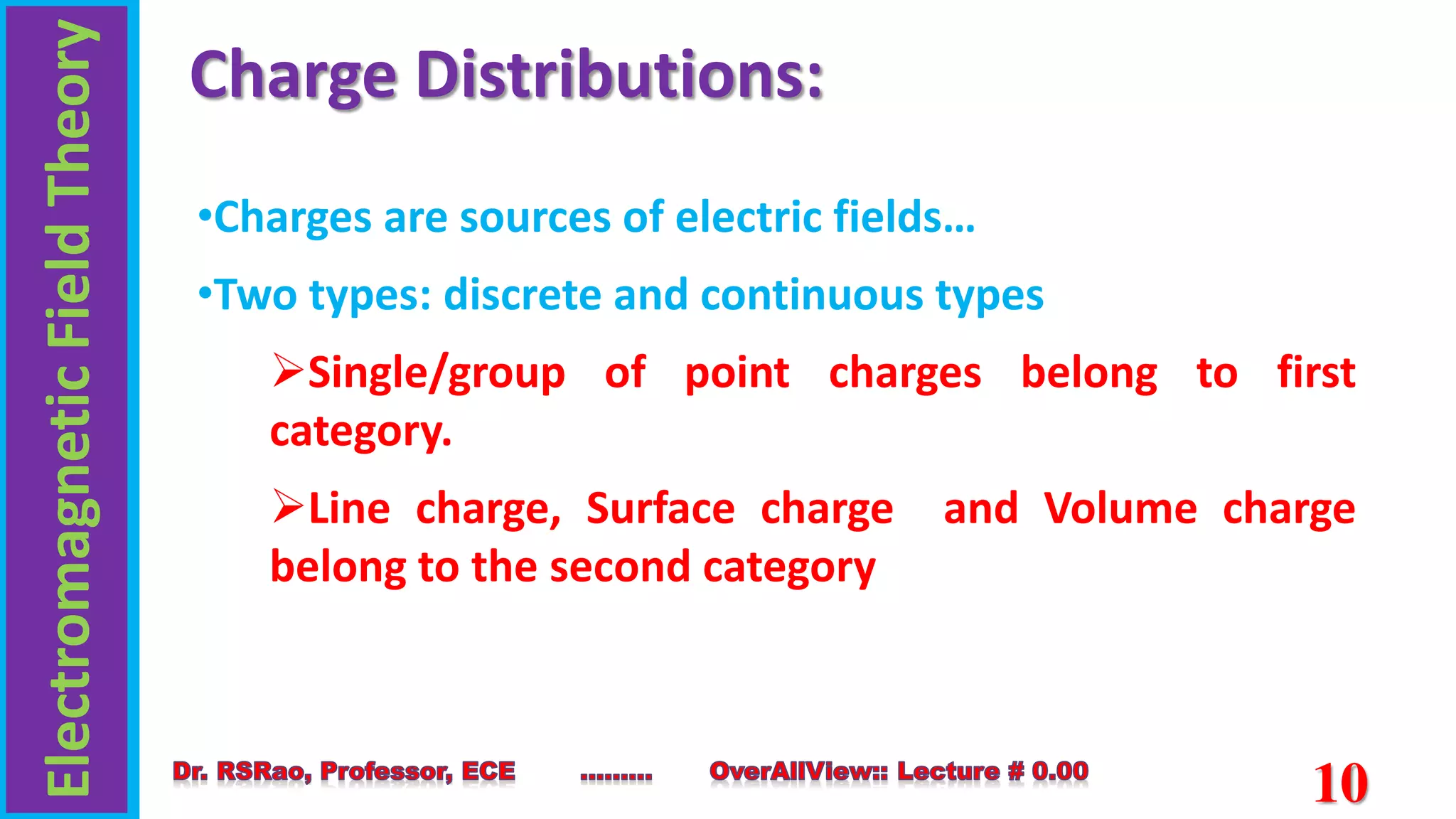
Charge Distributions:
•Charges are sources of electric fields…
•Two types: discrete and continuous types
Single/group of point charges belong to first
category.
Line charge, Surface charge and Volume charge
belong to the second category
Electromagnetic
Field
Theory
11
Charge Distributions:
Types of charge distributions.(a) Discrete, (b)line, (c) surface and(d) volume types.
Electromagnetic
Field
Theory
12
Line Charge:
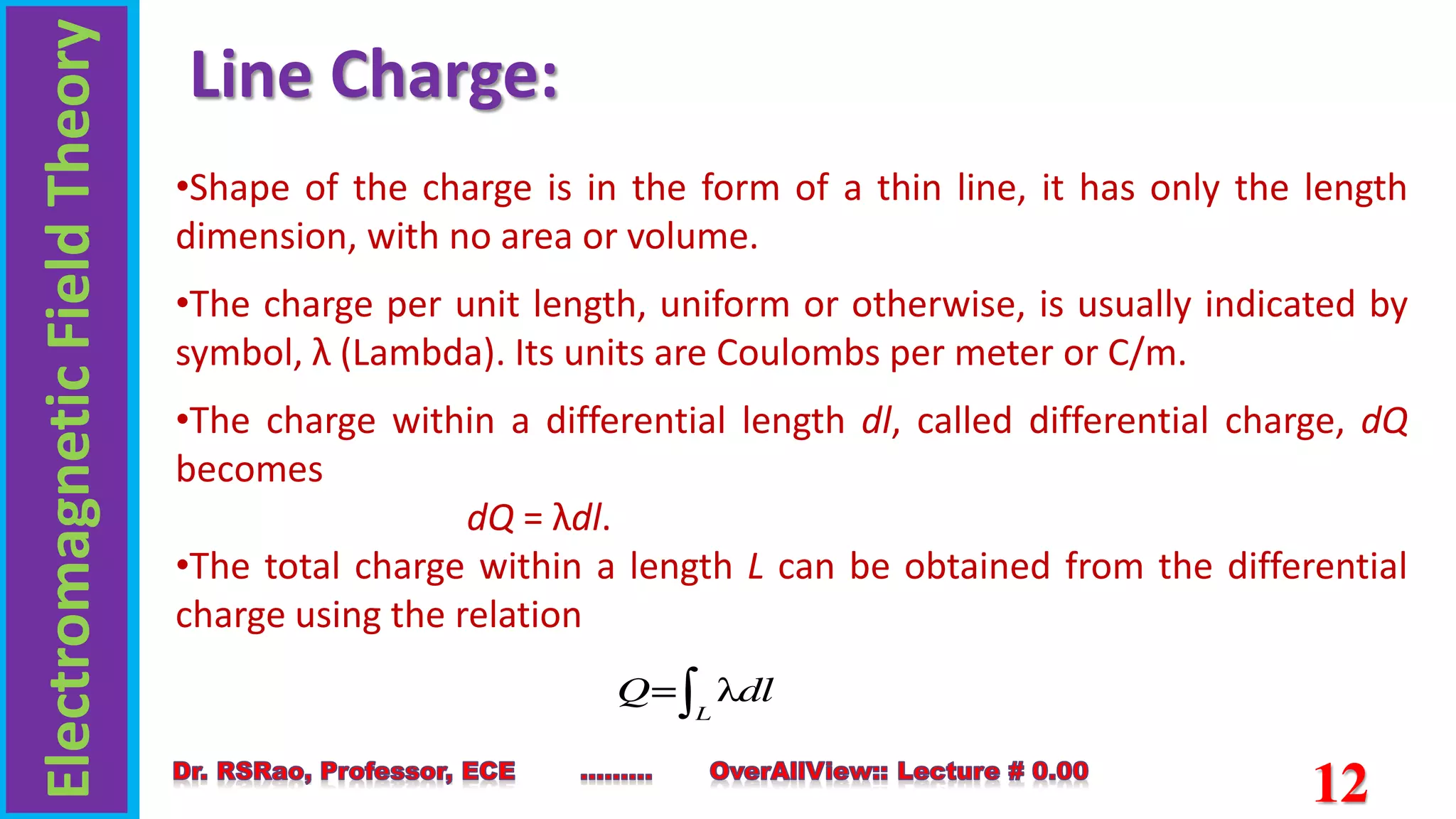
•Shape of the charge is in the form of a thin line, it has only the length
dimension, with no area or volume.
•The charge per unit length, uniform or otherwise, is usually indicated by
symbol, λ (Lambda). Its units are Coulombs per meter or C/m.
•The charge within a differential length dl, called differential charge, dQ
becomes
dQ = λdl.
•The total charge within a length L can be obtained from the differential
charge using the relation
= λ
L
Q dl

Electromagnetic
Field
Theory
13
Surface Charge:
•Charge exists in the form of a thin sheet. This distribution has both length
and width dimensions but no thickness.
•The charge per unit area is usually indicated by symbol, σ (Sigma). It can
be non uniform and its units are Coulombs per sq. meter or C/m2.
•The differential charge, dQ charge within differential area da, which can
also be considered as a point charge because of its small size, becomes
dQ = σ da.
•The total charge with in an area A then is
= σ
A
Q da

Electromagnetic
Field
Theory
14
Volume Charge:
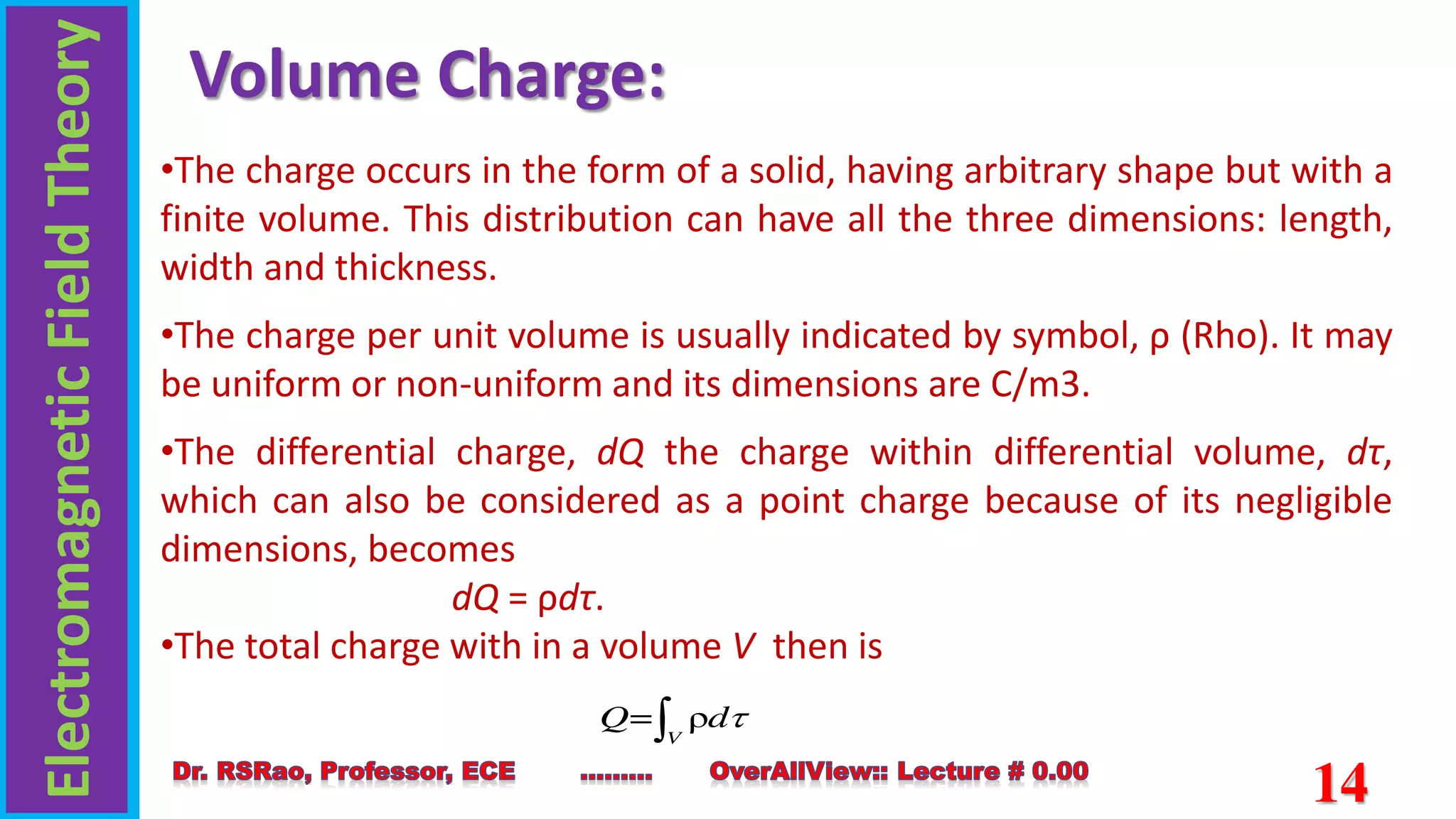
•The charge occurs in the form of a solid, having arbitrary shape but with a
finite volume. This distribution can have all the three dimensions: length,
width and thickness.
•The charge per unit volume is usually indicated by symbol, ρ (Rho). It may
be uniform or non-uniform and its dimensions are C/m3.
•The differential charge, dQ the charge within differential volume, dτ,
which can also be considered as a point charge because of its negligible
dimensions, becomes
dQ = ρdτ.
•The total charge with in a volume V then is
= ρ
V
Q d

Electromagnetic
Field
Theory
15
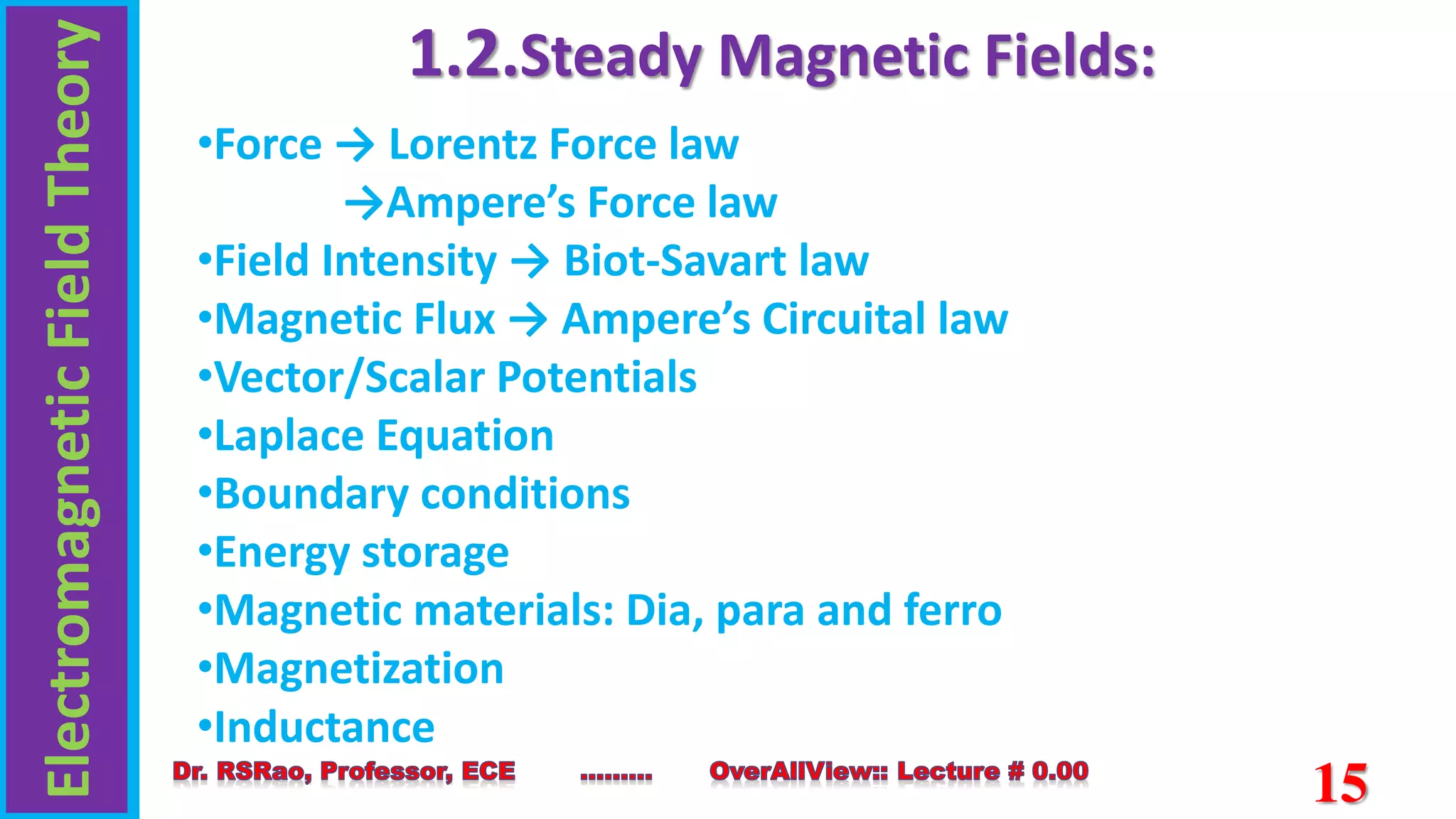
1.2.Steady Magnetic Fields:
•Force → Lorentz Force law
→Ampere’s Force law
•Field Intensity → Biot-Savart law
•Magnetic Flux → Ampere’s Circuital law
•Vector/Scalar Potentials
•Laplace Equation
•Boundary conditions
•Energy storage
•Magnetic materials: Dia, para and ferro
•Magnetization
•Inductance
Electromagnetic
Field
Theory
16
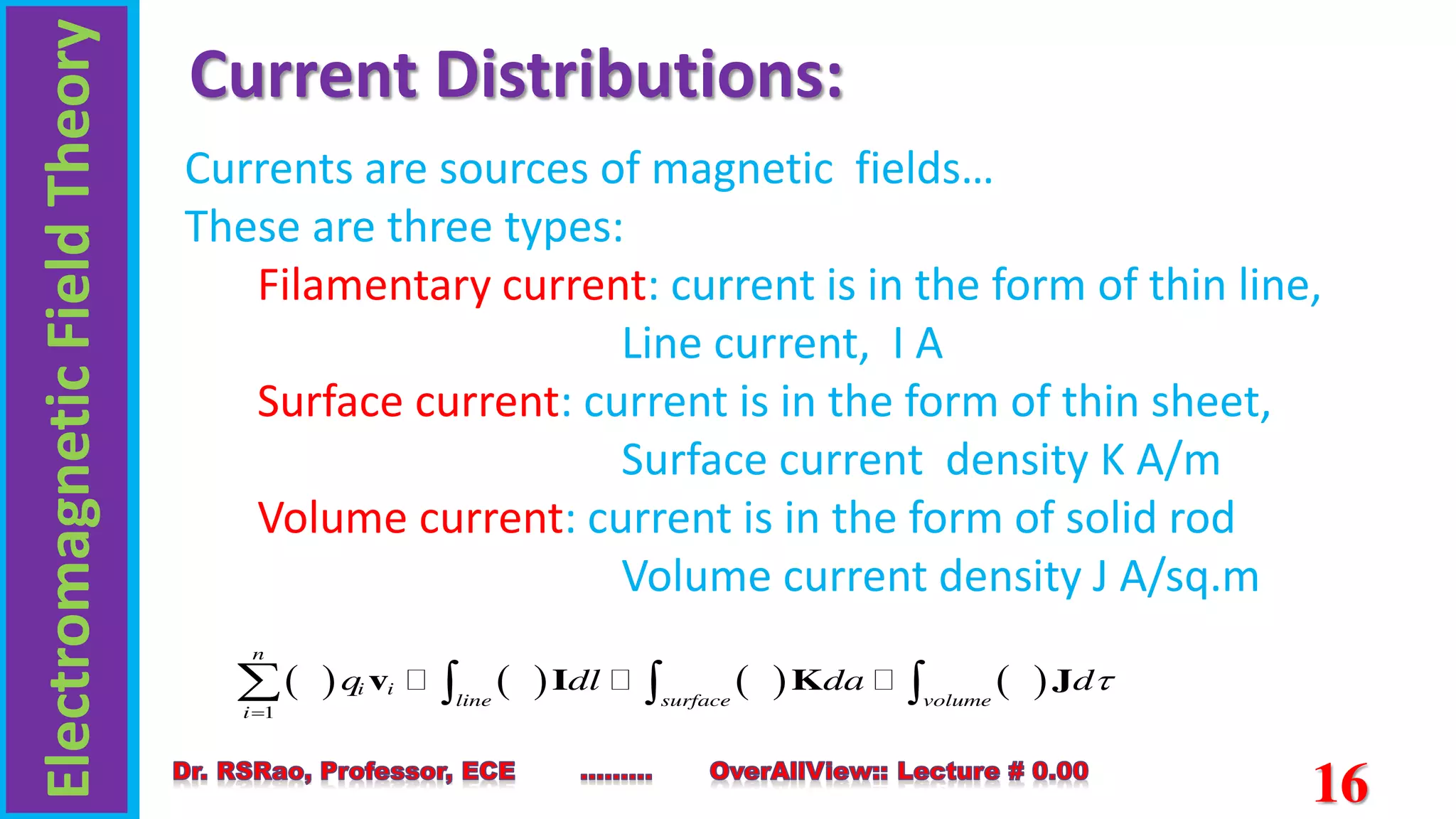
Current Distributions:
Currents are sources of magnetic fields…
These are three types:
Filamentary current: current is in the form of thin line,
Line current, I A
Surface current: current is in the form of thin sheet,
Surface current density K A/m
Volume current: current is in the form of solid rod
Volume current density J A/sq.m
       
1
n
i i
line surface volume
i
q dl da d

   
v I K J
Electromagnetic
Field
Theory
17
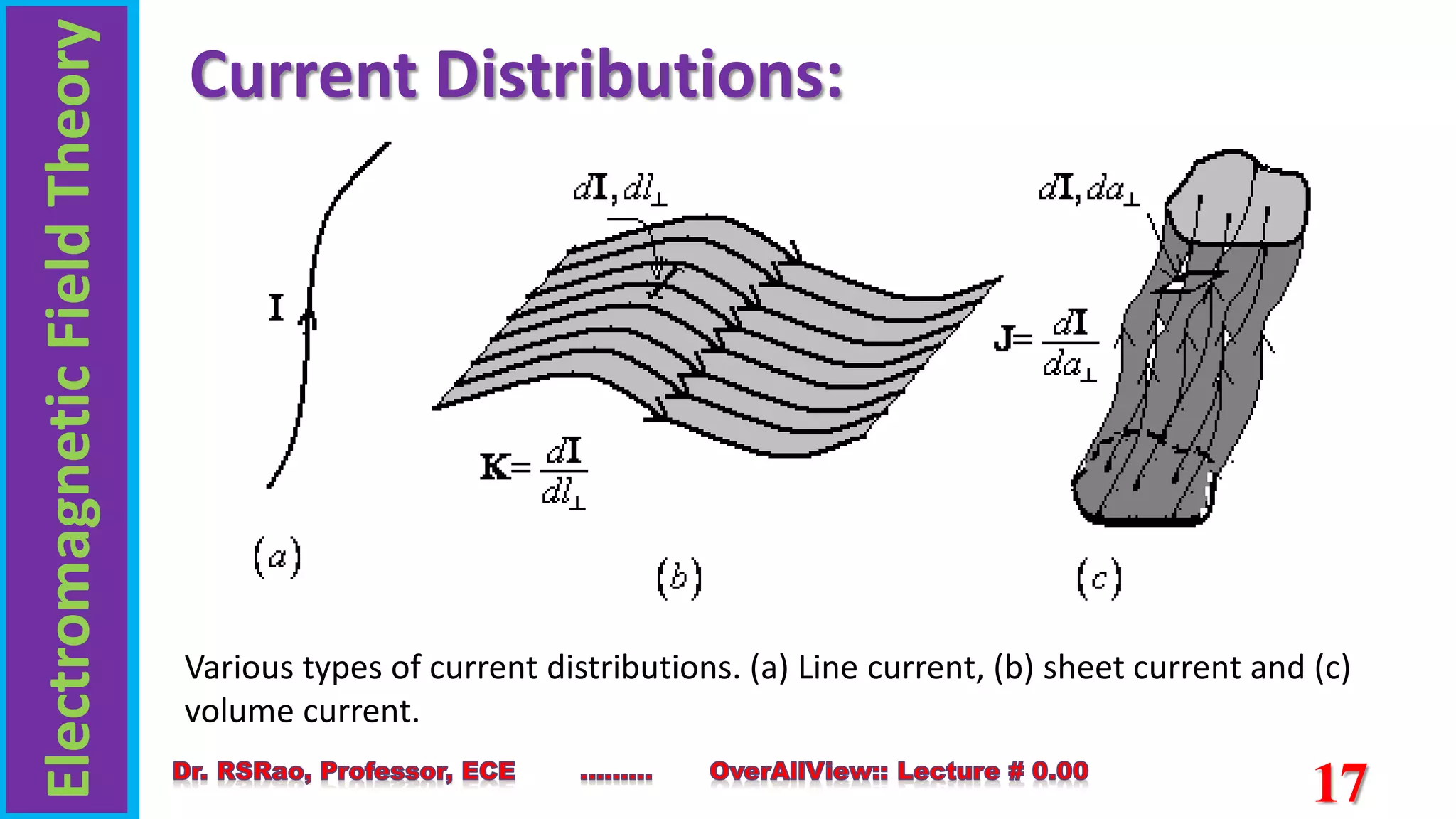
Current Distributions:
Various types of current distributions. (a) Line current, (b) sheet current and (c)
volume current.
Electromagnetic
Field
Theory
18
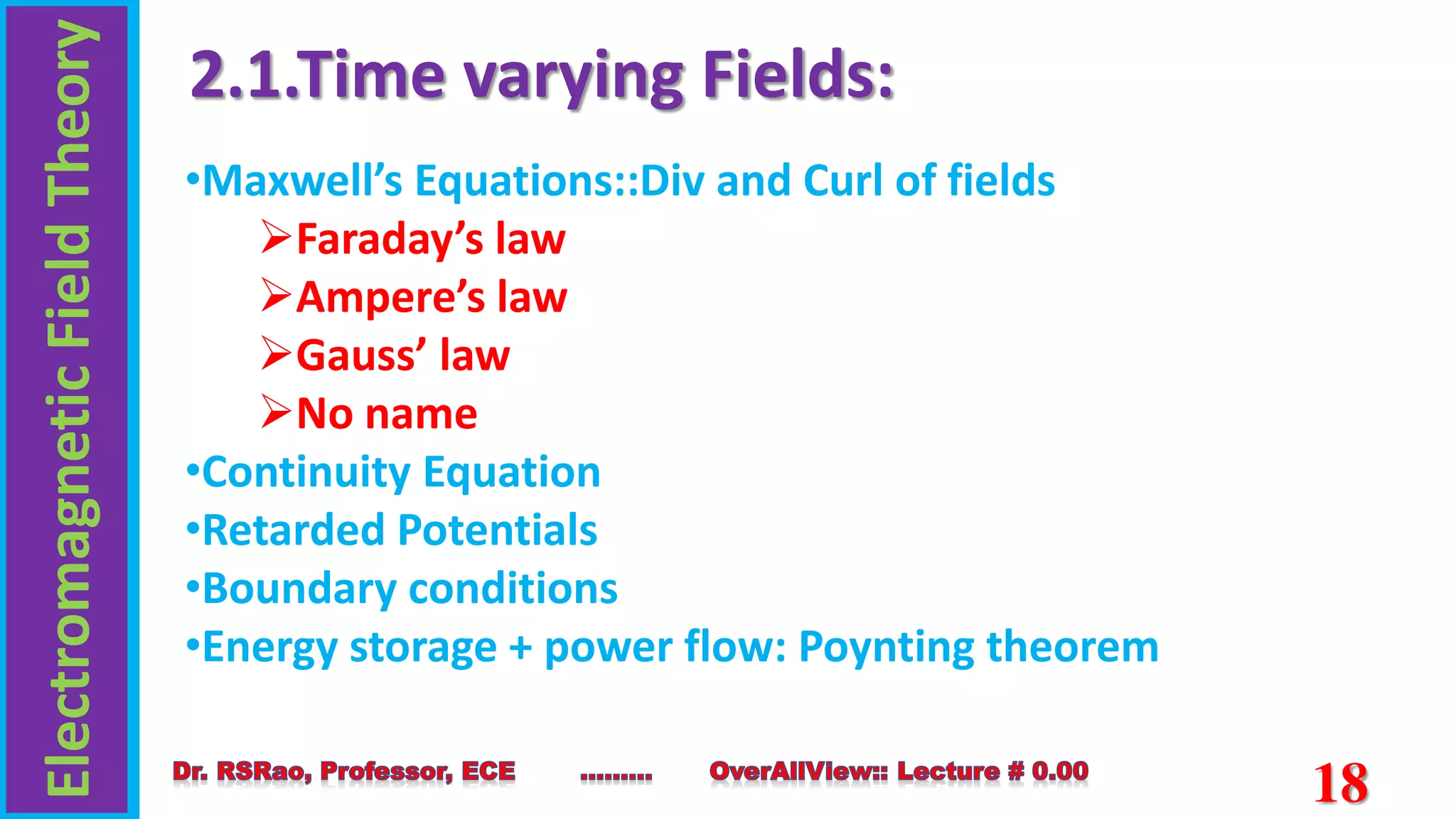
2.1.Time varying Fields:
•Maxwell’s Equations::Div and Curl of fields
Faraday’s law
Ampere’s law
Gauss’ law
No name
•Continuity Equation
•Retarded Potentials
•Boundary conditions
•Energy storage + power flow: Poynting theorem
Electromagnetic
Field
Theory
19
2.2.EM Waves:
•Wave Equations
•EM Waves, TEM and non-TEM
•Uniform plane waves
Depth of penetration
Surface impedance
•Wave polarization
Linear polarization
Non linear polarization and its sense
•Reflection & Refraction: Snell’s laws
Conductor surface
Dielectric surface
ENOUGH
FOR
TODAY
ENOUGH
FOR
TODAY
ENOUGH
FOR
TODAY
ENOUGH
FOR
TODAY
ENOUGH
FOR
TODAY
20

EMF.0.00.ElectroMagneticFields.pdf

  • 1.
    Series: EMF Theory Lecture:#0.00 Dr R S Rao Professor, ECE Electrostatic fields, steady magnetic fields, Dynamic fields, force, displacement/flux, potentials, power, Maxwell’s equations, wave equations, UPWs, wave polarization. Passionate Teaching Joyful Learning
  • 2.
    Electromagnetic Field Theory 2 • Electromagnetic FieldTheory, in short, Field Theory • Electromagnetic Wave Theory, in short, Wave Theory Title:
  • 3.
    Electromagnetic Field Theory 3 • Communications aremostly electrical, • Electrical Communications are mostly wireless, • Wireless Communications use antennas, • Antennas functioning is based on EM radiation, • EM radiation is property of dynamic fields. Why Study Field/Wave Theory: Hence, ECE students & engineers need to have solid grip over EM Wave theory
  • 4.
    Electromagnetic Field Theory 4 Circuit Theory: • Easybut approximate • Low frequencies validity • 1D and scalar • Voltage and currents • Lumped elements • Negligible Radiation • No wave phenomenon Circuit theory versus Field theory
  • 5.
    Electromagnetic Field Theory 5 Field/Wave Theory: Circuit theoryversus Field theory • Complex but exact • All frequencies validity • 3D and vector • Electric and magnetic fields • Distributed parameters • Radiation taken into account • Wave phenomenon
  • 6.
    Electromagnetic Field Theory 6 • Vector Calculus: Gradient, Divergence and Curl  Gradient theorem, Divergence theorem and Curl theorems • Coordinate systems:  Rectangular, Cylindrical and Spherical  Differential length, area and volume Pre-requisites:
  • 7.
    Electromagnetic Field Theory 7 Div and Curl: Examples: •Electrostaticfield in charge free region is both solenoidal and irrotational. •Steady magnetic field in a current carrying conductor is solenoidal but not irrotational. •Electrostatic field in charged region is not solenoidal but irrotational. •Electric field in a charged region with a time varying magnetic field is neither solenoidal nor irrotational. Field F is solenoidal if .F=0 and irrotational if ×F=0.
  • 8.
    Electromagnetic Field Theory 8 1. Static fields:Invariant with time 1.1.Electrostatic fields→ static charge distributions 1.2.Steady magnetic fields→ steady currents 2. Dynamic fields: Variant with time 2.1.Time varying fields → Time varying currents/ Acc. charges 2.2.EM Waves → Time varying fields Parts in Field/Wave Theory:
  • 9.
    Electromagnetic Field Theory 9 1.1.Electrostatic Field: •Force →Coulomb’s law →Field and Field Intensity •Displacement → Gauss’ law, Field/flux lines •Scalar Potential → Absolute & Relative •Laplace Equation •Energy storage •Boundary conditions •Materials: Conductors & Dielectrics •Polarization •Capacitance
  • 10.
    Electromagnetic Field Theory 10 Charge Distributions: •Charges aresources of electric fields… •Two types: discrete and continuous types Single/group of point charges belong to first category. Line charge, Surface charge and Volume charge belong to the second category
  • 11.
    Electromagnetic Field Theory 11 Charge Distributions: Types ofcharge distributions.(a) Discrete, (b)line, (c) surface and(d) volume types.
  • 12.
    Electromagnetic Field Theory 12 Line Charge: •Shape ofthe charge is in the form of a thin line, it has only the length dimension, with no area or volume. •The charge per unit length, uniform or otherwise, is usually indicated by symbol, λ (Lambda). Its units are Coulombs per meter or C/m. •The charge within a differential length dl, called differential charge, dQ becomes dQ = λdl. •The total charge within a length L can be obtained from the differential charge using the relation = λ L Q dl 
  • 13.
    Electromagnetic Field Theory 13 Surface Charge: •Charge existsin the form of a thin sheet. This distribution has both length and width dimensions but no thickness. •The charge per unit area is usually indicated by symbol, σ (Sigma). It can be non uniform and its units are Coulombs per sq. meter or C/m2. •The differential charge, dQ charge within differential area da, which can also be considered as a point charge because of its small size, becomes dQ = σ da. •The total charge with in an area A then is = σ A Q da 
  • 14.
    Electromagnetic Field Theory 14 Volume Charge: •The chargeoccurs in the form of a solid, having arbitrary shape but with a finite volume. This distribution can have all the three dimensions: length, width and thickness. •The charge per unit volume is usually indicated by symbol, ρ (Rho). It may be uniform or non-uniform and its dimensions are C/m3. •The differential charge, dQ the charge within differential volume, dτ, which can also be considered as a point charge because of its negligible dimensions, becomes dQ = ρdτ. •The total charge with in a volume V then is = ρ V Q d 
  • 15.
    Electromagnetic Field Theory 15 1.2.Steady Magnetic Fields: •Force→ Lorentz Force law →Ampere’s Force law •Field Intensity → Biot-Savart law •Magnetic Flux → Ampere’s Circuital law •Vector/Scalar Potentials •Laplace Equation •Boundary conditions •Energy storage •Magnetic materials: Dia, para and ferro •Magnetization •Inductance
  • 16.
    Electromagnetic Field Theory 16 Current Distributions: Currents aresources of magnetic fields… These are three types: Filamentary current: current is in the form of thin line, Line current, I A Surface current: current is in the form of thin sheet, Surface current density K A/m Volume current: current is in the form of solid rod Volume current density J A/sq.m         1 n i i line surface volume i q dl da d      v I K J
  • 17.
    Electromagnetic Field Theory 17 Current Distributions: Various typesof current distributions. (a) Line current, (b) sheet current and (c) volume current.
  • 18.
    Electromagnetic Field Theory 18 2.1.Time varying Fields: •Maxwell’sEquations::Div and Curl of fields Faraday’s law Ampere’s law Gauss’ law No name •Continuity Equation •Retarded Potentials •Boundary conditions •Energy storage + power flow: Poynting theorem
  • 19.
    Electromagnetic Field Theory 19 2.2.EM Waves: •Wave Equations •EMWaves, TEM and non-TEM •Uniform plane waves Depth of penetration Surface impedance •Wave polarization Linear polarization Non linear polarization and its sense •Reflection & Refraction: Snell’s laws Conductor surface Dielectric surface
  • 20.