Series: EMF Theory
Lecture: #1.22
Dr R S Rao
Professor, ECE
ELECTROSTATICS
Passionate
Teaching
Joyful
Learning
Using Gauss’ Law finding electric field intensity due to infinite straight line charge,
infinite plane sheet charge, spherical shell charge and solid spherical charge.
2
Dr. R S Rao
Electrostatics
Gauss'
Law An infinite straight line charge, located over z-axis, is carrying charge with a uniform density,
λ=111.26pC/m. Determine field density, D at point (a) (1,2,2)m (b) (3,π/4,2)(c) (2,π/4, π/4).
Solution:
Field density due to a line charge in cylindrical system is,
2
1 λ
ˆ C/m
2 

D 
It is in cylindrical coordinate system. To use this relation, it requires finding ρ and 𝛒 from
given coordinates of field point.
(a) Field point coordinates, (1,2,2)m are in Cartesian system.
2 2 2 2 1
2.24
ˆ ˆ ˆ
1 2 2.24m ; ( 2 )
x y
       
x y

2
2
1 λ 1 111.26
ˆ ˆ ˆ ˆ ˆ
( 2 ) 3.52( 2 )pC/m
2 2 2.24
  
    
D x y x y

(b) Field point coordinates, (3,π/4,2) are in cylindrical system.
2
1 λ 1 111.26
ˆ ˆ ˆ
5.93 pC/m
2 2 3
  
  
D   
(c) Field point coordinates, (2,π/4, π/4) are in spherical system.
ˆ ˆ
ˆ ˆ ˆ
sin 2sin( 4) 1.414 ; sin cos 0.707 0.707
r
    
      
r r
  
2
1 λ 1 111.26 ˆ ˆ
ˆ ˆ ˆ
(0.707 0.707 ) 12.52(0.707 0.707 )pC/m
2 2 1.414
  
    
D r r
  
Example I
3
Dr. R S Rao
Electrostatics
Gauss'
Law
Example II
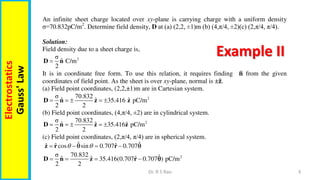
An infinite sheet charge located over xy-plane is carrying charge with a uniform density
σ=70.832pC/m2
. Determine field density, D at (a) (2,2, ±1)m (b) (4,π/4, ±2)(c) (2,π/4, π/4).
Solution:
Field density due to a sheet charge is,
2
σ
ˆ C/m
2

D n
It is in coordinate free form. To use this relation, it requires finding 𝐧 from the given
coordinates of field point. As the sheet is over xy-plane, normal is ±𝐳.
(a) Field point coordinates, (2,2,±1)m are in Cartesian system.
2
σ 70.832
ˆ ˆ ˆ
35.416 pC/m
2 2
    
D n z z
(b) Field point coordinates, (4,π/4, ±2) are in cylindrical system.
2
σ 70.832
ˆ ˆ ˆ
35.416 pC/m
2 2
    
D n z z
(c) Field point coordinates, (2,π/4, π/4) are in spherical system.
ˆ ˆ
ˆ ˆ
ˆ cos sin 0.707 0.707
 
   
z r r
 
2
σ 70.832 ˆ
ˆ ˆ
ˆ 35.416(0.707 0.707 ) pC/m
2 2
   
D n z r 
4
Dr. R S Rao
Electrostatics
Gauss'
Law
Example III
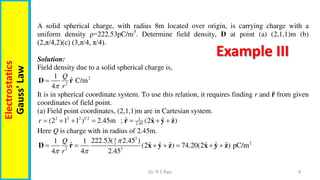
A solid spherical charge, with radius 8m located over origin, is carrying charge with a
uniform density ρ=222.53pC/m3
. Determine field density, D at point (a) (2,1,1)m (b)
(2,π/4,2)(c) (3,π/4, π/4).
Solution:
Field density due to a solid spherical charge is,
2
2
1
ˆ C/m
4
Q
r


D r
It is in spherical coordinate system. To use this relation, it requires finding r and 𝐫 from given
coordinates of field point.
(a) Field point coordinates, (2,1,1)m are in Cartesian system.
2 2 2 1 2 1
2.45
ˆ ˆ ˆ ˆ
(2 1 1 ) 2.45m ; (2 )
r       
r x y z
Here Q is charge with in radius of 2.45m.
3
4
2
3
2 3
222.53( 2.45 )
1 1
ˆ ˆ ˆ ˆ ˆ ˆ ˆ
(2 ) 74.20(2 ) pC/m
4 4 2.45
Q
r

 
      
D r x y z x y z
5
Dr. R S Rao
Electrostatics
Gauss'
Law
Example III
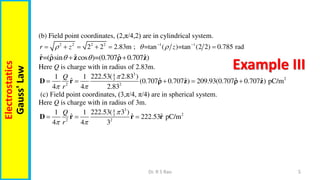
(b) Field point coordinates, (2,π/4,2) are in cylindrical system.
2 2 2 2 1 1
2 2 2.83m ; =tan ( )=tan (2 2) 0.785 rad
r z z
  
 
     
ˆ ˆ ˆ
ˆ ˆ
=( sin cos )=(0.707 0.707 )
 
 
r z z
 
Here Q is charge with in radius of 2.83m.
3
4
2
3
2 2
222.53( 2.83 )
1 1
ˆ ˆ ˆ
ˆ ˆ
(0.707 0.707 ) 209.93(0.707 0.707 ) pC/m
4 4 2.83
Q
r

 
    
D r z z
 
(c) Field point coordinates, (3,π/4, π/4) are in spherical system.
Here Q is charge with in radius of 3m.
3
4
2
3
2 2
222.53( 3 )
1 1
ˆ ˆ ˆ
222.53 pC/m
4 4 3
Q
r

 
  
D r r r
6
Dr. R S Rao
Electrostatics
Gauss'
Law
Example IV
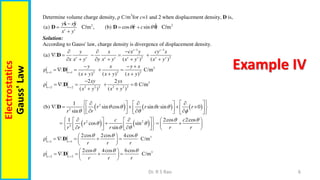
Determine volume charge density, ρ C/m3
for c=1 and 2 when displacement density, D is,
2 2
ˆ ˆ ˆ
ˆ
(a) C/m , (b) cos sin C/m
c c
y x
c
x y
 

  

x y
D D r 
Solution:
According to Gauss' law, charge density is divergence of displacement density.
1 1
2 2
(a)
( ) ( )
c c
c c c c c c c c
y x cx y cy x
x x y y x y x y x y
 
  
    
     
D
3
2 2 2
1 1
ρ C/m
( ) ( ) ( )
c c
y x y x
x y x y x y
 
  
    
  
D
3
2 2 2 2 2 2
2 2
2 2
ρ 0 C/m
( ) ( )
c c
xy yx
x y x y
 

    
 
D
     
2
2
1
(b) sin cos sin sin 0
sin
r r c r
r r
   
  
 
 
  
   
    
 
 
   
  
     
 
D
   
2 2
2
1 2cos 2cos
cos sin
sin
c c
r
r r r r r
 
 
 
   
     
   
   
   
 
     
 
3
1 1
2cos 2cos 4cos
ρ C/m
c c
r r r
  
 
 
    
 
 
D
3
2 2
2cos 4cos 6cos
ρ C/m
c c
r r r
  
 
 
    
 
 
D
7
Dr. R S Rao
Electrostatics
Gauss'
Law
Example V
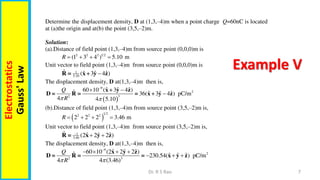
Determine the displacement density, D at (1,3,–4)m when a point charge Q=60nC is located
at (a)the origin and at(b) the point (3,5,–2)m.
Solution:
(a).Distance of field point (1,3,–4)m from source point (0,0,0)m is
2 2 2 1 2
(1 3 4 ) 5.10
R     m
Unit vector to field point (1,3,–4)m from source point (0,0,0)m is
1
5.10
ˆ ˆ ˆ ˆ
( +3 4 )

R = x y z
The displacement density, D at(1,3,–4)m then is,
 
9
2
3
2
ˆ ˆ ˆ
60 10 ( +3 4 )
ˆ ˆ ˆ ˆ
36( +3 4 ) pC/m
4 4 5.10
Q
R
 

 

x y z
D = R = = x y z
(b).Distance of field point (1,3,–4)m from source point (3,5,–2)m is,
 
1 2
2 2 2
2 2 2 3.46 m
R    
Unit vector to field point (1,3,–4)m from source point (3,5,–2)m is,
1
3.46
ˆ ˆ ˆ ˆ
(2 2 2 )

 
R = x y z
The displacement density, D at(1,3,–4)m then is,
9
2
2 3
ˆ ˆ ˆ
60 10 (2 2 2 )
ˆ ˆ ˆ ˆ
230.54( ) pC/m
4 4 (3.46)
Q
R
 

   
  
x y z
D = R = = x y z
8
Dr. R S Rao
Electrostatics
Gauss'
Law
Example VI
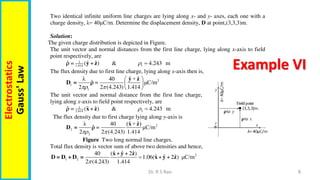
Two identical infinite uniform line charges are lying along x- and y- axes, each one with a
charge density, λ= 40μC/m. Determine the displacement density, D at point,(3,3,3)m.
Solution:
The given charge distribution is depicted in Figure.
The unit vector and normal distances from the first line charge, lying along x-axis to field
point respectively, are
1
1
1.414
ˆ ˆ ˆ
= ( + ) & 4.243 m
 
y z

The flux density due to first line charge, lying along x-axis then is,
2
1
1
ˆ ˆ
λ 40 +
ˆ = μC/m
2 2 (4.243) 1.414
 
 
 
 
y z
D = 
The unit vector and normal distance from the first line charge,
lying along x-axis to field point respectively, are
1
2
1.414
ˆ ˆ ˆ
= ( + ) & 4.243 m
 
x z

The flux density due to first charge lying along y-axis is
2
2
2
ˆ ˆ
λ 40 ( + )
ˆ = μC/m
2 2 (4.243) 1.414
 
x z
D = 
Figure Two long normal line charges.
Total flux density is vector sum of above two densities and hence,
2
1 2
ˆ ˆ ˆ
40 ( + + 2 )
ˆ ˆ ˆ
1.06( + + 2 ) μC/m
2 (4.243) 1.414


x y z
D = D + D = x y z
9
Dr. R S Rao
Electrostatics
Gauss'
Law
Example VII
Three cylindrical surfaces, located at radii ρ=1,3 and 6m carry uniform charge densities of σ1
=15nC/m2
, σ2 =‒3nC/m2
and σ3 C/m2
, respectively. Determine (a) displacement density D at
ρ=0.5m, 2m and 5m and also (b) σ3 C/m2
such that D =0 at ρ=8m.
Solution:
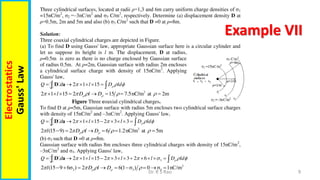
Three coaxial cylindrical charges are depicted in Figure.
(a) To find D using Gauss' law, appropriate Gaussian surface here is a circular cylinder and
let us suppose its height is l m. The displacement, D at radius,
ρ=0.5m is zero as there is no charge enclosed by Gaussian surface
of radius 0.5m. At ρ=2m, Gaussian surface with radius 2m encloses
a cylindrical surface charge with density of 15nC/m2
. Applying
Gauss' law,
2 1 15
Q d l D ld

  
     
 
D a
2
2 1 15 2 15 7.5nC/m at 2m
l D l D
 
    
       
Figure Three coaxial cylindrical charges.
To find D at ρ=5m, Gaussian surface with radius 5m encloses two cylindrical surface charges
with density of 15nC/m2
and ‒3nC/m2
. Applying Gauss' law,
2 1 15 2 3 3
Q d l l D ld

   
         
 
D a
2
2 (15 9) 2 6 1.2nC/m at 5m
l D l D
 
    
     
(b) σ3 such that D =0 at ρ=8m.
Gaussian surface with radius 8m encloses three cylindrical charges with density of 15nC/m2
,
‒3nC/m2
and σ3. Applying Gauss' law,
3
2 1 15 2 3 3 2 6
Q d l l l D ld

     
             
 
D a
2
3 3 3
2 (15 9 6σ ) 2 6(1 σ ) 0 σ 1nC/m
l D l D
 
   
        
10
Dr. R S Rao
Electrostatics
Gauss'
Law
Example VIII
Three spherical surfaces with radii, r=2,3 and 4m are carrying uniform charge densities of σ1
=15nC/m2
, σ2=8nC/m2
and σ3=‒5nC/m2
respectively. Determine (a) displacement ψ leaving
the spherical surface with radius, r=5m and (b) displacement density D at point, P (1,2,1)m.
Solution:
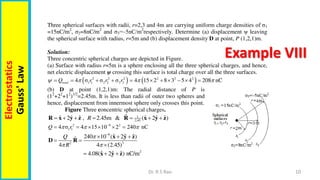
Three concentric spherical charges are depicted in Figure.
(a) Surface with radius r=5m is a sphere enclosing all the three spherical charges, and hence,
net electric displacement ψ crossing this surface is total charge over all the three surfaces.
 
2 2 2
1 1 2 2 3 3
4 σ σ σ
total
Q r r r
 
     
2 2 2
4 15 2 8 3 5 4 208 nC
 
      
(b) D at point (1,2,1)m: The radial distance of P is
(12
+22
+12
)1/2
=2.45m. It is less than radii of outer two spheres and
hence, displacement from innermost sphere only crosses this point.
Figure Three concentric spherical charges.
1
2.45
ˆ
ˆ ˆ ˆ ˆ ˆ ˆ
2 , 2.45m & ( 2 )
R
      
R x y z R x y z
2 9 2
1 1
4 σ 4 15 10 2 240 nC
Q r
  

     
9
2 3
ˆ ˆ ˆ
240 10 ( 2 )
ˆ
4 4 (2.45)
Q
R

 

  
 

x y z
D R
2
ˆ ˆ ˆ
4.08( 2 ) nC/m
  
x y z
ENOUGH
FOR
TODAY
ENOUGH
FOR
TODAY
ENOUGH
FOR
TODAY
ENOUGH
FOR
TODAY
ENOUGH
FOR
TODAY
11

EMF.1.22.GaussLaw-P.pdf

  • 1.
    Series: EMF Theory Lecture:#1.22 Dr R S Rao Professor, ECE ELECTROSTATICS Passionate Teaching Joyful Learning Using Gauss’ Law finding electric field intensity due to infinite straight line charge, infinite plane sheet charge, spherical shell charge and solid spherical charge.
  • 2.
    2 Dr. R SRao Electrostatics Gauss' Law An infinite straight line charge, located over z-axis, is carrying charge with a uniform density, λ=111.26pC/m. Determine field density, D at point (a) (1,2,2)m (b) (3,π/4,2)(c) (2,π/4, π/4). Solution: Field density due to a line charge in cylindrical system is, 2 1 λ ˆ C/m 2   D  It is in cylindrical coordinate system. To use this relation, it requires finding ρ and 𝛒 from given coordinates of field point. (a) Field point coordinates, (1,2,2)m are in Cartesian system. 2 2 2 2 1 2.24 ˆ ˆ ˆ 1 2 2.24m ; ( 2 ) x y         x y  2 2 1 λ 1 111.26 ˆ ˆ ˆ ˆ ˆ ( 2 ) 3.52( 2 )pC/m 2 2 2.24         D x y x y  (b) Field point coordinates, (3,π/4,2) are in cylindrical system. 2 1 λ 1 111.26 ˆ ˆ ˆ 5.93 pC/m 2 2 3       D    (c) Field point coordinates, (2,π/4, π/4) are in spherical system. ˆ ˆ ˆ ˆ ˆ sin 2sin( 4) 1.414 ; sin cos 0.707 0.707 r             r r    2 1 λ 1 111.26 ˆ ˆ ˆ ˆ ˆ (0.707 0.707 ) 12.52(0.707 0.707 )pC/m 2 2 1.414         D r r    Example I
  • 3.
    3 Dr. R SRao Electrostatics Gauss' Law Example II An infinite sheet charge located over xy-plane is carrying charge with a uniform density σ=70.832pC/m2 . Determine field density, D at (a) (2,2, ±1)m (b) (4,π/4, ±2)(c) (2,π/4, π/4). Solution: Field density due to a sheet charge is, 2 σ ˆ C/m 2  D n It is in coordinate free form. To use this relation, it requires finding 𝐧 from the given coordinates of field point. As the sheet is over xy-plane, normal is ±𝐳. (a) Field point coordinates, (2,2,±1)m are in Cartesian system. 2 σ 70.832 ˆ ˆ ˆ 35.416 pC/m 2 2      D n z z (b) Field point coordinates, (4,π/4, ±2) are in cylindrical system. 2 σ 70.832 ˆ ˆ ˆ 35.416 pC/m 2 2      D n z z (c) Field point coordinates, (2,π/4, π/4) are in spherical system. ˆ ˆ ˆ ˆ ˆ cos sin 0.707 0.707       z r r   2 σ 70.832 ˆ ˆ ˆ ˆ 35.416(0.707 0.707 ) pC/m 2 2     D n z r 
  • 4.
    4 Dr. R SRao Electrostatics Gauss' Law Example III A solid spherical charge, with radius 8m located over origin, is carrying charge with a uniform density ρ=222.53pC/m3 . Determine field density, D at point (a) (2,1,1)m (b) (2,π/4,2)(c) (3,π/4, π/4). Solution: Field density due to a solid spherical charge is, 2 2 1 ˆ C/m 4 Q r   D r It is in spherical coordinate system. To use this relation, it requires finding r and 𝐫 from given coordinates of field point. (a) Field point coordinates, (2,1,1)m are in Cartesian system. 2 2 2 1 2 1 2.45 ˆ ˆ ˆ ˆ (2 1 1 ) 2.45m ; (2 ) r        r x y z Here Q is charge with in radius of 2.45m. 3 4 2 3 2 3 222.53( 2.45 ) 1 1 ˆ ˆ ˆ ˆ ˆ ˆ ˆ (2 ) 74.20(2 ) pC/m 4 4 2.45 Q r           D r x y z x y z
  • 5.
    5 Dr. R SRao Electrostatics Gauss' Law Example III (b) Field point coordinates, (2,π/4,2) are in cylindrical system. 2 2 2 2 1 1 2 2 2.83m ; =tan ( )=tan (2 2) 0.785 rad r z z            ˆ ˆ ˆ ˆ ˆ =( sin cos )=(0.707 0.707 )     r z z   Here Q is charge with in radius of 2.83m. 3 4 2 3 2 2 222.53( 2.83 ) 1 1 ˆ ˆ ˆ ˆ ˆ (0.707 0.707 ) 209.93(0.707 0.707 ) pC/m 4 4 2.83 Q r         D r z z   (c) Field point coordinates, (3,π/4, π/4) are in spherical system. Here Q is charge with in radius of 3m. 3 4 2 3 2 2 222.53( 3 ) 1 1 ˆ ˆ ˆ 222.53 pC/m 4 4 3 Q r       D r r r
  • 6.
    6 Dr. R SRao Electrostatics Gauss' Law Example IV Determine volume charge density, ρ C/m3 for c=1 and 2 when displacement density, D is, 2 2 ˆ ˆ ˆ ˆ (a) C/m , (b) cos sin C/m c c y x c x y        x y D D r  Solution: According to Gauss' law, charge density is divergence of displacement density. 1 1 2 2 (a) ( ) ( ) c c c c c c c c c c y x cx y cy x x x y y x y x y x y                 D 3 2 2 2 1 1 ρ C/m ( ) ( ) ( ) c c y x y x x y x y x y              D 3 2 2 2 2 2 2 2 2 2 2 ρ 0 C/m ( ) ( ) c c xy yx x y x y           D       2 2 1 (b) sin cos sin sin 0 sin r r c r r r                                           D     2 2 2 1 2cos 2cos cos sin sin c c r r r r r r                                       3 1 1 2cos 2cos 4cos ρ C/m c c r r r                 D 3 2 2 2cos 4cos 6cos ρ C/m c c r r r                 D
  • 7.
    7 Dr. R SRao Electrostatics Gauss' Law Example V Determine the displacement density, D at (1,3,–4)m when a point charge Q=60nC is located at (a)the origin and at(b) the point (3,5,–2)m. Solution: (a).Distance of field point (1,3,–4)m from source point (0,0,0)m is 2 2 2 1 2 (1 3 4 ) 5.10 R     m Unit vector to field point (1,3,–4)m from source point (0,0,0)m is 1 5.10 ˆ ˆ ˆ ˆ ( +3 4 )  R = x y z The displacement density, D at(1,3,–4)m then is,   9 2 3 2 ˆ ˆ ˆ 60 10 ( +3 4 ) ˆ ˆ ˆ ˆ 36( +3 4 ) pC/m 4 4 5.10 Q R       x y z D = R = = x y z (b).Distance of field point (1,3,–4)m from source point (3,5,–2)m is,   1 2 2 2 2 2 2 2 3.46 m R     Unit vector to field point (1,3,–4)m from source point (3,5,–2)m is, 1 3.46 ˆ ˆ ˆ ˆ (2 2 2 )    R = x y z The displacement density, D at(1,3,–4)m then is, 9 2 2 3 ˆ ˆ ˆ 60 10 (2 2 2 ) ˆ ˆ ˆ ˆ 230.54( ) pC/m 4 4 (3.46) Q R           x y z D = R = = x y z
  • 8.
    8 Dr. R SRao Electrostatics Gauss' Law Example VI Two identical infinite uniform line charges are lying along x- and y- axes, each one with a charge density, λ= 40μC/m. Determine the displacement density, D at point,(3,3,3)m. Solution: The given charge distribution is depicted in Figure. The unit vector and normal distances from the first line charge, lying along x-axis to field point respectively, are 1 1 1.414 ˆ ˆ ˆ = ( + ) & 4.243 m   y z  The flux density due to first line charge, lying along x-axis then is, 2 1 1 ˆ ˆ λ 40 + ˆ = μC/m 2 2 (4.243) 1.414         y z D =  The unit vector and normal distance from the first line charge, lying along x-axis to field point respectively, are 1 2 1.414 ˆ ˆ ˆ = ( + ) & 4.243 m   x z  The flux density due to first charge lying along y-axis is 2 2 2 ˆ ˆ λ 40 ( + ) ˆ = μC/m 2 2 (4.243) 1.414   x z D =  Figure Two long normal line charges. Total flux density is vector sum of above two densities and hence, 2 1 2 ˆ ˆ ˆ 40 ( + + 2 ) ˆ ˆ ˆ 1.06( + + 2 ) μC/m 2 (4.243) 1.414   x y z D = D + D = x y z
  • 9.
    9 Dr. R SRao Electrostatics Gauss' Law Example VII Three cylindrical surfaces, located at radii ρ=1,3 and 6m carry uniform charge densities of σ1 =15nC/m2 , σ2 =‒3nC/m2 and σ3 C/m2 , respectively. Determine (a) displacement density D at ρ=0.5m, 2m and 5m and also (b) σ3 C/m2 such that D =0 at ρ=8m. Solution: Three coaxial cylindrical charges are depicted in Figure. (a) To find D using Gauss' law, appropriate Gaussian surface here is a circular cylinder and let us suppose its height is l m. The displacement, D at radius, ρ=0.5m is zero as there is no charge enclosed by Gaussian surface of radius 0.5m. At ρ=2m, Gaussian surface with radius 2m encloses a cylindrical surface charge with density of 15nC/m2 . Applying Gauss' law, 2 1 15 Q d l D ld             D a 2 2 1 15 2 15 7.5nC/m at 2m l D l D                Figure Three coaxial cylindrical charges. To find D at ρ=5m, Gaussian surface with radius 5m encloses two cylindrical surface charges with density of 15nC/m2 and ‒3nC/m2 . Applying Gauss' law, 2 1 15 2 3 3 Q d l l D ld                  D a 2 2 (15 9) 2 6 1.2nC/m at 5m l D l D              (b) σ3 such that D =0 at ρ=8m. Gaussian surface with radius 8m encloses three cylindrical charges with density of 15nC/m2 , ‒3nC/m2 and σ3. Applying Gauss' law, 3 2 1 15 2 3 3 2 6 Q d l l l D ld                        D a 2 3 3 3 2 (15 9 6σ ) 2 6(1 σ ) 0 σ 1nC/m l D l D               
  • 10.
    10 Dr. R SRao Electrostatics Gauss' Law Example VIII Three spherical surfaces with radii, r=2,3 and 4m are carrying uniform charge densities of σ1 =15nC/m2 , σ2=8nC/m2 and σ3=‒5nC/m2 respectively. Determine (a) displacement ψ leaving the spherical surface with radius, r=5m and (b) displacement density D at point, P (1,2,1)m. Solution: Three concentric spherical charges are depicted in Figure. (a) Surface with radius r=5m is a sphere enclosing all the three spherical charges, and hence, net electric displacement ψ crossing this surface is total charge over all the three surfaces.   2 2 2 1 1 2 2 3 3 4 σ σ σ total Q r r r         2 2 2 4 15 2 8 3 5 4 208 nC          (b) D at point (1,2,1)m: The radial distance of P is (12 +22 +12 )1/2 =2.45m. It is less than radii of outer two spheres and hence, displacement from innermost sphere only crosses this point. Figure Three concentric spherical charges. 1 2.45 ˆ ˆ ˆ ˆ ˆ ˆ ˆ 2 , 2.45m & ( 2 ) R        R x y z R x y z 2 9 2 1 1 4 σ 4 15 10 2 240 nC Q r           9 2 3 ˆ ˆ ˆ 240 10 ( 2 ) ˆ 4 4 (2.45) Q R           x y z D R 2 ˆ ˆ ˆ 4.08( 2 ) nC/m    x y z
  • 11.