Chapter 1
Technology-Driven Consumer Behavior
Reference Book
Leon G. Schiffman
Lesile Lazar Kanuk
S. Ramesh Kumar
11th
Edition
Consumer Behavior
• Consumer behavior is the study of consumers’
actions during searching for, purchasing, using,
evaluating, and disposing of products and services
that they expect will satisfy their needs.
• The core of marketing is identifying unfilled needs
and delivering products and services that satisfy
these needs.
Consumer
Behavior
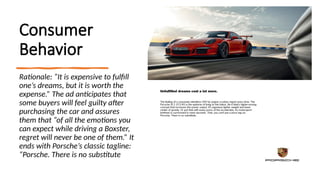
Rationale: “It is expensive to fulfill
one’s dreams, but it is worth the
expense.” The ad anticipates that
some buyers will feel guilty after
purchasing the car and assures
them that “of all the emotions you
can expect while driving a Boxster,
regret will never be one of them.” It
ends with Porsche’s classic tagline:
“Porsche. There is no substitute
Consumer
Behavior
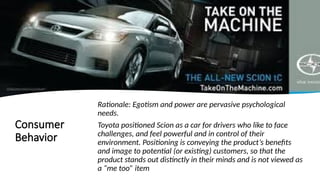
Rationale: Egotism and power are pervasive psychological
needs.
Toyota positioned Scion as a car for drivers who like to face
challenges, and feel powerful and in control of their
environment. Positioning is conveying the product’s benefits
and image to potential (or existing) customers, so that the
product stands out distinctly in their minds and is not viewed as
a “me too” item
Consumer Behavior
Personal Consumer
• Products are bought
for final consumption
Organizational
Consumer
• Profit and non-profit
businesses
• Government agencies,
institutes
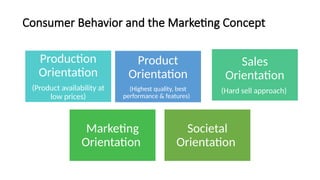
Consumer Behavior and the Marketing Concept
Product
Orientation
(Highest quality, best
performance & features)
Production
Orientation
(Product availability at
low prices)
Sales
Orientation
(Hard sell approach)
Marketing
Orientation
Societal
Orientation
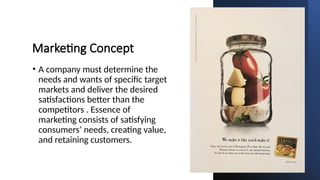
Marketing Concept
• A company must determine the
needs and wants of specific target
markets and deliver the desired
satisfactions better than the
competitors . Essence of
marketing consists of satisfying
consumers’ needs, creating value,
and retaining customers.
Consumer Research
• Consumers are complex individuals, subject
to a variety of psychological and social needs,
and the needs and priorities of different
consumer segments differ dramatically.
Consumer research refers to the process and
tools used to study consumer behavior.
Consumer research is a process that links the
consumer, customer, and public to the
marketer through information to identify
marketing opportunities and problems,
evaluate actions, and judge the performance
of strategies.
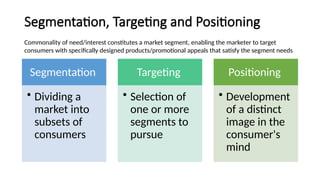
Segmentation, Targeting and Positioning
Segmentation
• Dividing a
market into
subsets of
consumers
Targeting
• Selection of
one or more
segments to
pursue
Positioning
• Development
of a distinct
image in the
consumer's
mind
Commonality of need/interest constitutes a market segment, enabling the marketer to target
consumers with specifically designed products/promotional appeals that satisfy the segment needs
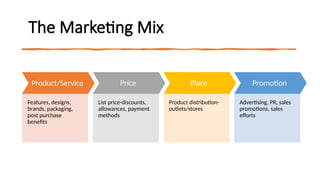
The Marketing Mix
Product/Service
Features, designs,
brands, packaging,
post purchase
benefits
Price
List price-discounts,
allowances, payment
methods
Place
Product distribution-
outlets/stores
Promotion
Advertising, PR, sales
promotions, sales
efforts
Socially
Responsible
Marketing
• The societal marketing concept requires marketers to
fulfill the needs of the target audience in ways that
improve, preserve, and enhance society’s well-being
while simultaneously meeting business objectives.
Technology Enriches the
Exchange Between
Consumers and Marketers
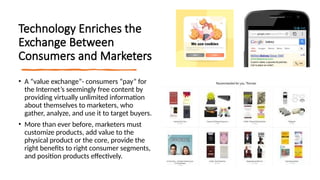
• A “value exchange”- consumers “pay” for
the Internet’s seemingly free content by
providing virtually unlimited information
about themselves to marketers, who
gather, analyze, and use it to target buyers.
• More than ever before, marketers must
customize products, add value to the
physical product or the core, provide the
right benefits to right consumer segments,
and position products effectively.
Behavioral Information
and Targeting
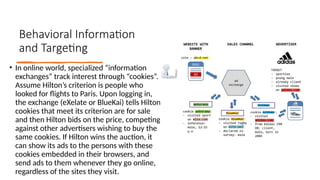
• In online world, specialized “information
exchanges” track interest through “cookies”.
Assume Hilton’s criterion is people who
looked for flights to Paris. Upon logging in,
the exchange (eXelate or BlueKai) tells Hilton
cookies that meet its criterion are for sale
and then Hilton bids on the price, competing
against other advertisers wishing to buy the
same cookies. If Hilton wins the auction, it
can show its ads to the persons with these
cookies embedded in their browsers, and
send ads to them whenever they go online,
regardless of the sites they visit.
Behavioral
Information
and
Targeting
• The Internet drastically improved consumers’
access to the information they need when
they buy products for the first time or replace
them. Simultaneously, the Internet enables
marketers to gather truly behavioral data
about consumers, because they can observe
shopping behavior.
Interactive and Novel
Communication
Channels
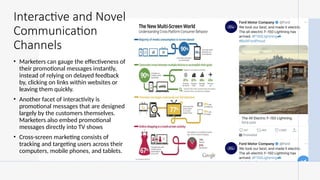
• Marketers can gauge the effectiveness of
their promotional messages instantly,
instead of relying on delayed feedback
by, clicking on links within websites or
leaving them quickly.
• Another facet of interactivity is
promotional messages that are designed
largely by the customers themselves.
Marketers also embed promotional
messages directly into TV shows
• Cross-screen marketing consists of
tracking and targeting users across their
computers, mobile phones, and tablets.
Customizing Products and
Promotional Messages
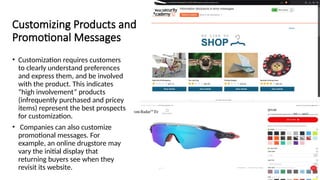
• Customization requires customers
to clearly understand preferences
and express them, and be involved
with the product. This indicates
“high involvement” products
(infrequently purchased and pricey
items) represent the best prospects
for customization.
• Companies can also customize
promotional messages. For
example, an online drugstore may
vary the initial display that
returning buyers see when they
revisit its website.
Better Prices and
Distribution
• The Internet allows consumers to compare prices more
effectively than ever before. Marketers have begun to
use advanced technologies-smartphone apps, to target
shoppers in stores.
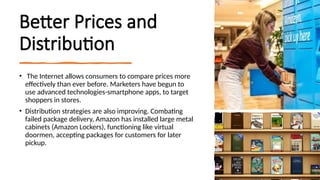
• Distribution strategies are also improving. Combating
failed package delivery, Amazon has installed large metal
cabinets (Amazon Lockers), functioning like virtual
doormen, accepting packages for customers for later
pickup.
Better Prices and
Distribution
• Electronic systems will replace cash and credit cards, several
retailers have developed mobile-payments systems to compete
with similar products from Google and cell phone companies.
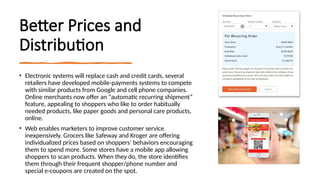
Online merchants now offer an “automatic recurring shipment”
feature, appealing to shoppers who like to order habitually
needed products, like paper goods and personal care products,
online.
• Web enables marketers to improve customer service
inexpensively. Grocers like Safeway and Kroger are offering
individualized prices based on shoppers’ behaviors encouraging
them to spend more. Some stores have a mobile app allowing
shoppers to scan products. When they do, the store identifies
them through their frequent shopper/phone number and
special e-coupons are created on the spot.
Customer Value, Satisfaction, Trust and Retention
1. Providing Customers with Value
The ratio between the customers’ perceived benefits
(economic, functional and psychological) and the
resources(monetary, time, effort, psychological) used to
obtain those benefits
Developing a value proposition (Unique Selling Proposition)
2. Securing Customer Retention
• A strategy of customer retention is designed to make it in the best interest of customers
to stay with a company rather than switch to another company
• Loyal customers buy more products
• Long-term customers are an asset when new products and services are developed and
tested
• Loyal customers are less price sensitive and pay less attention to competitors’
advertising
• Servicing existing customers, who are familiar with the company’s offerings and
processes, is cheaper
• Loyal customers spread positive WOM and refer customers
• Marketing efforts aimed at attracting new customers are expensive. Low customer
turnover is correlated with higher profit
• Increased customer retention & loyalty makes employees’ jobs easier and satisfying
Technology and Customer
Relationships
• Technologies often enhance customer relationships and
retention by engaging consumers with brands.
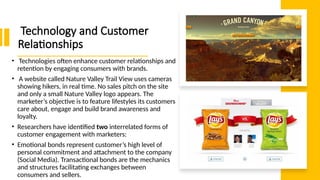
• A website called Nature Valley Trail View uses cameras
showing hikers, in real time. No sales pitch on the site
and only a small Nature Valley logo appears. The
marketer’s objective is to feature lifestyles its customers
care about, engage and build brand awareness and
loyalty.
• Researchers have identified two interrelated forms of
customer engagement with marketers:
• Emotional bonds represent customer’s high level of
personal commitment and attachment to the company
(Social Media). Transactional bonds are the mechanics
and structures facilitating exchanges between
consumers and sellers.
Emotional Bonds versus Transaction-Based
Relationships
Determinants of customer satisfaction with online websites and merchants
• Adaptation: Purchase recommendations match one’s needs
• Interactivity: Ability to view offerings from different perspectives
• Nurturing: making an effort to increase business with the customer
• Commitment: Delivering goods on time; taking good care of customers
• Network: Customers sharing experiences about product purchases on website
• Assortment: Merchant provides “one-stop shopping” for most online purchases
• Transaction ease: Merchant’s website can be navigated intuitively
• Engagement: The merchant’s site design is attractive; feel comfortable
• Loyalty: Seldom consider switching to another merchant
• Inertia: Unless becoming dissatisfied, changing merchants would not be worth the bother
• Trust: Counting on the merchant to complete purchase transactions successfully
Emotional
Bonds versus
Transaction-
Based
Relationships
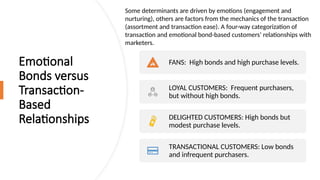
FANS: High bonds and high purchase levels.
LOYAL CUSTOMERS: Frequent purchasers,
but without high bonds.
DELIGHTED CUSTOMERS: High bonds but
modest purchase levels.
TRANSACTIONAL CUSTOMERS: Low bonds
and infrequent purchasers.
Some determinants are driven by emotions (engagement and
nurturing), others are factors from the mechanics of the transaction
(assortment and transaction ease). A four-way categorization of
transaction and emotional bond-based customers’ relationships with
marketers.
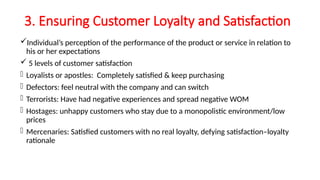
3. Ensuring Customer Loyalty and Satisfaction
Individual’s perception of the performance of the product or service in relation to
his or her expectations
 5 levels of customer satisfaction
- Loyalists or apostles: Completely satisfied & keep purchasing
- Defectors: feel neutral with the company and can switch
- Terrorists: Have had negative experiences and spread negative WOM
- Hostages: unhappy customers who stay due to a monopolistic environment/low
prices
- Mercenaries: Satisfied customers with no real loyalty, defying satisfaction–loyalty
rationale
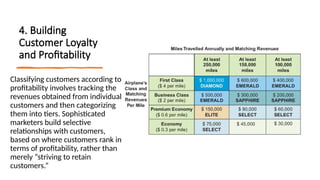
4. Building
Customer Loyalty
and Profitability
Classifying customers according to
profitability involves tracking the
revenues obtained from individual
customers and then categorizing
them into tiers. Sophisticated
marketers build selective
relationships with customers,
based on where customers rank in
terms of profitability, rather than
merely “striving to retain
customers.”
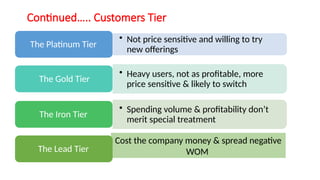
Continued….. Customers Tier
• Not price sensitive and willing to try
new offerings
The Platinum Tier
• Heavy users, not as profitable, more
price sensitive & likely to switch
The Gold Tier
• Spending volume & profitability don’t
merit special treatment
The Iron Tier
The Lead Tier
Cost the company money & spread negative
WOM
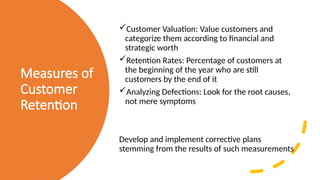
Measures of
Customer
Retention
Customer Valuation: Value customers and
categorize them according to financial and
strategic worth
Retention Rates: Percentage of customers at
the beginning of the year who are still
customers by the end of it
Analyzing Defections: Look for the root causes,
not mere symptoms
Develop and implement corrective plans
stemming from the results of such measurements
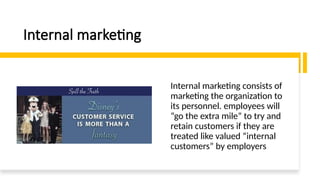
Internal marketing
Internal marketing consists of
marketing the organization to
its personnel. employees will
“go the extra mile” to try and
retain customers if they are
treated like valued “internal
customers” by employers
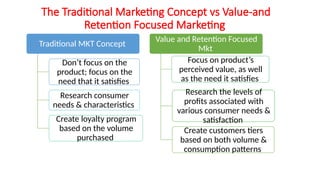
The Traditional Marketing Concept vs Value-and
Retention Focused Marketing
Traditional MKT Concept
Don’t focus on the
product; focus on the
need that it satisfies
Research consumer
needs & characteristics
Create loyalty program
based on the volume
purchased
Value and Retention Focused
Mkt
Focus on product’s
perceived value, as well
as the need it satisfies
Research the levels of
profits associated with
various consumer needs &
satisfaction
Create customers tiers
based on both volume &
consumption patterns
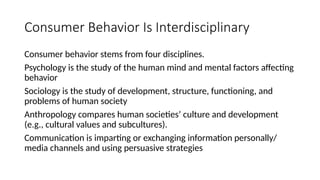
Consumer Behavior Is Interdisciplinary
Consumer behavior stems from four disciplines.
Psychology is the study of the human mind and mental factors affecting
behavior
Sociology is the study of development, structure, functioning, and
problems of human society
Anthropology compares human societies’ culture and development
(e.g., cultural values and subcultures).
Communication is imparting or exchanging information personally/
media channels and using persuasive strategies
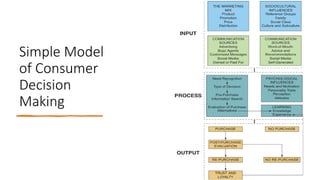
Simple Model
of Consumer
Decision
Making

CB Chapter 1 pptx on consumer behavior of BBA

  • 1.
    Chapter 1 Technology-Driven ConsumerBehavior Reference Book Leon G. Schiffman Lesile Lazar Kanuk S. Ramesh Kumar 11th Edition
  • 2.
    Consumer Behavior • Consumerbehavior is the study of consumers’ actions during searching for, purchasing, using, evaluating, and disposing of products and services that they expect will satisfy their needs. • The core of marketing is identifying unfilled needs and delivering products and services that satisfy these needs.
  • 3.
    Consumer Behavior Rationale: “It isexpensive to fulfill one’s dreams, but it is worth the expense.” The ad anticipates that some buyers will feel guilty after purchasing the car and assures them that “of all the emotions you can expect while driving a Boxster, regret will never be one of them.” It ends with Porsche’s classic tagline: “Porsche. There is no substitute
  • 4.
    Consumer Behavior Rationale: Egotism andpower are pervasive psychological needs. Toyota positioned Scion as a car for drivers who like to face challenges, and feel powerful and in control of their environment. Positioning is conveying the product’s benefits and image to potential (or existing) customers, so that the product stands out distinctly in their minds and is not viewed as a “me too” item
  • 5.
    Consumer Behavior Personal Consumer •Products are bought for final consumption Organizational Consumer • Profit and non-profit businesses • Government agencies, institutes
  • 6.
    Consumer Behavior andthe Marketing Concept Product Orientation (Highest quality, best performance & features) Production Orientation (Product availability at low prices) Sales Orientation (Hard sell approach) Marketing Orientation Societal Orientation
  • 7.
    Marketing Concept • Acompany must determine the needs and wants of specific target markets and deliver the desired satisfactions better than the competitors . Essence of marketing consists of satisfying consumers’ needs, creating value, and retaining customers.
  • 8.
    Consumer Research • Consumersare complex individuals, subject to a variety of psychological and social needs, and the needs and priorities of different consumer segments differ dramatically. Consumer research refers to the process and tools used to study consumer behavior. Consumer research is a process that links the consumer, customer, and public to the marketer through information to identify marketing opportunities and problems, evaluate actions, and judge the performance of strategies.
  • 9.
    Segmentation, Targeting andPositioning Segmentation • Dividing a market into subsets of consumers Targeting • Selection of one or more segments to pursue Positioning • Development of a distinct image in the consumer's mind Commonality of need/interest constitutes a market segment, enabling the marketer to target consumers with specifically designed products/promotional appeals that satisfy the segment needs
  • 10.
    The Marketing Mix Product/Service Features,designs, brands, packaging, post purchase benefits Price List price-discounts, allowances, payment methods Place Product distribution- outlets/stores Promotion Advertising, PR, sales promotions, sales efforts
  • 11.
    Socially Responsible Marketing • The societalmarketing concept requires marketers to fulfill the needs of the target audience in ways that improve, preserve, and enhance society’s well-being while simultaneously meeting business objectives.
  • 12.
    Technology Enriches the ExchangeBetween Consumers and Marketers • A “value exchange”- consumers “pay” for the Internet’s seemingly free content by providing virtually unlimited information about themselves to marketers, who gather, analyze, and use it to target buyers. • More than ever before, marketers must customize products, add value to the physical product or the core, provide the right benefits to right consumer segments, and position products effectively.
  • 13.
    Behavioral Information and Targeting •In online world, specialized “information exchanges” track interest through “cookies”. Assume Hilton’s criterion is people who looked for flights to Paris. Upon logging in, the exchange (eXelate or BlueKai) tells Hilton cookies that meet its criterion are for sale and then Hilton bids on the price, competing against other advertisers wishing to buy the same cookies. If Hilton wins the auction, it can show its ads to the persons with these cookies embedded in their browsers, and send ads to them whenever they go online, regardless of the sites they visit.
  • 14.
    Behavioral Information and Targeting • The Internetdrastically improved consumers’ access to the information they need when they buy products for the first time or replace them. Simultaneously, the Internet enables marketers to gather truly behavioral data about consumers, because they can observe shopping behavior.
  • 15.
    Interactive and Novel Communication Channels •Marketers can gauge the effectiveness of their promotional messages instantly, instead of relying on delayed feedback by, clicking on links within websites or leaving them quickly. • Another facet of interactivity is promotional messages that are designed largely by the customers themselves. Marketers also embed promotional messages directly into TV shows • Cross-screen marketing consists of tracking and targeting users across their computers, mobile phones, and tablets.
  • 16.
    Customizing Products and PromotionalMessages • Customization requires customers to clearly understand preferences and express them, and be involved with the product. This indicates “high involvement” products (infrequently purchased and pricey items) represent the best prospects for customization. • Companies can also customize promotional messages. For example, an online drugstore may vary the initial display that returning buyers see when they revisit its website.
  • 17.
    Better Prices and Distribution •The Internet allows consumers to compare prices more effectively than ever before. Marketers have begun to use advanced technologies-smartphone apps, to target shoppers in stores. • Distribution strategies are also improving. Combating failed package delivery, Amazon has installed large metal cabinets (Amazon Lockers), functioning like virtual doormen, accepting packages for customers for later pickup.
  • 18.
    Better Prices and Distribution •Electronic systems will replace cash and credit cards, several retailers have developed mobile-payments systems to compete with similar products from Google and cell phone companies. Online merchants now offer an “automatic recurring shipment” feature, appealing to shoppers who like to order habitually needed products, like paper goods and personal care products, online. • Web enables marketers to improve customer service inexpensively. Grocers like Safeway and Kroger are offering individualized prices based on shoppers’ behaviors encouraging them to spend more. Some stores have a mobile app allowing shoppers to scan products. When they do, the store identifies them through their frequent shopper/phone number and special e-coupons are created on the spot.
  • 19.
    Customer Value, Satisfaction,Trust and Retention 1. Providing Customers with Value The ratio between the customers’ perceived benefits (economic, functional and psychological) and the resources(monetary, time, effort, psychological) used to obtain those benefits Developing a value proposition (Unique Selling Proposition)
  • 20.
    2. Securing CustomerRetention • A strategy of customer retention is designed to make it in the best interest of customers to stay with a company rather than switch to another company • Loyal customers buy more products • Long-term customers are an asset when new products and services are developed and tested • Loyal customers are less price sensitive and pay less attention to competitors’ advertising • Servicing existing customers, who are familiar with the company’s offerings and processes, is cheaper • Loyal customers spread positive WOM and refer customers • Marketing efforts aimed at attracting new customers are expensive. Low customer turnover is correlated with higher profit • Increased customer retention & loyalty makes employees’ jobs easier and satisfying
  • 21.
    Technology and Customer Relationships •Technologies often enhance customer relationships and retention by engaging consumers with brands. • A website called Nature Valley Trail View uses cameras showing hikers, in real time. No sales pitch on the site and only a small Nature Valley logo appears. The marketer’s objective is to feature lifestyles its customers care about, engage and build brand awareness and loyalty. • Researchers have identified two interrelated forms of customer engagement with marketers: • Emotional bonds represent customer’s high level of personal commitment and attachment to the company (Social Media). Transactional bonds are the mechanics and structures facilitating exchanges between consumers and sellers.
  • 22.
    Emotional Bonds versusTransaction-Based Relationships Determinants of customer satisfaction with online websites and merchants • Adaptation: Purchase recommendations match one’s needs • Interactivity: Ability to view offerings from different perspectives • Nurturing: making an effort to increase business with the customer • Commitment: Delivering goods on time; taking good care of customers • Network: Customers sharing experiences about product purchases on website • Assortment: Merchant provides “one-stop shopping” for most online purchases • Transaction ease: Merchant’s website can be navigated intuitively • Engagement: The merchant’s site design is attractive; feel comfortable • Loyalty: Seldom consider switching to another merchant • Inertia: Unless becoming dissatisfied, changing merchants would not be worth the bother • Trust: Counting on the merchant to complete purchase transactions successfully
  • 23.
    Emotional Bonds versus Transaction- Based Relationships FANS: Highbonds and high purchase levels. LOYAL CUSTOMERS: Frequent purchasers, but without high bonds. DELIGHTED CUSTOMERS: High bonds but modest purchase levels. TRANSACTIONAL CUSTOMERS: Low bonds and infrequent purchasers. Some determinants are driven by emotions (engagement and nurturing), others are factors from the mechanics of the transaction (assortment and transaction ease). A four-way categorization of transaction and emotional bond-based customers’ relationships with marketers.
  • 24.
    3. Ensuring CustomerLoyalty and Satisfaction Individual’s perception of the performance of the product or service in relation to his or her expectations  5 levels of customer satisfaction - Loyalists or apostles: Completely satisfied & keep purchasing - Defectors: feel neutral with the company and can switch - Terrorists: Have had negative experiences and spread negative WOM - Hostages: unhappy customers who stay due to a monopolistic environment/low prices - Mercenaries: Satisfied customers with no real loyalty, defying satisfaction–loyalty rationale
  • 25.
    4. Building Customer Loyalty andProfitability Classifying customers according to profitability involves tracking the revenues obtained from individual customers and then categorizing them into tiers. Sophisticated marketers build selective relationships with customers, based on where customers rank in terms of profitability, rather than merely “striving to retain customers.”
  • 26.
    Continued….. Customers Tier •Not price sensitive and willing to try new offerings The Platinum Tier • Heavy users, not as profitable, more price sensitive & likely to switch The Gold Tier • Spending volume & profitability don’t merit special treatment The Iron Tier The Lead Tier Cost the company money & spread negative WOM
  • 27.
    Measures of Customer Retention Customer Valuation:Value customers and categorize them according to financial and strategic worth Retention Rates: Percentage of customers at the beginning of the year who are still customers by the end of it Analyzing Defections: Look for the root causes, not mere symptoms Develop and implement corrective plans stemming from the results of such measurements
  • 28.
    Internal marketing Internal marketingconsists of marketing the organization to its personnel. employees will “go the extra mile” to try and retain customers if they are treated like valued “internal customers” by employers
  • 29.
    The Traditional MarketingConcept vs Value-and Retention Focused Marketing Traditional MKT Concept Don’t focus on the product; focus on the need that it satisfies Research consumer needs & characteristics Create loyalty program based on the volume purchased Value and Retention Focused Mkt Focus on product’s perceived value, as well as the need it satisfies Research the levels of profits associated with various consumer needs & satisfaction Create customers tiers based on both volume & consumption patterns
  • 30.
    Consumer Behavior IsInterdisciplinary Consumer behavior stems from four disciplines. Psychology is the study of the human mind and mental factors affecting behavior Sociology is the study of development, structure, functioning, and problems of human society Anthropology compares human societies’ culture and development (e.g., cultural values and subcultures). Communication is imparting or exchanging information personally/ media channels and using persuasive strategies
  • 31.