Emerging Trends in Advanced
Technologies
TITLE:- Emerging Technologies for
Contact Tracing during COVID-19.
Author: Ishika Choudhary
COVID-19 pandemic in India
 Corona viruses are a large family of
viruses which may cause illness in
animals or humans which cause
respiratory infections .
 India began thermal screening of
passengers arriving from China on 21
January.
 On 17 March, The Government of India
issued an advisory urging to all Indian
states to take social distancing
measures as a preventive strategy .
 On 22 March 2020, India observed a 14-
hour voluntary public curfew at the
instance of the prime minister Narendra
Communication
:
 Indian Prime Minister Narendra Modi ,
the work being done by various sectors
during the outbreak,On 22nd March,2020
he urged people to gather in front of their
own doors, windows or balconies at 5 pm
and applaud them for five minutes .
Janta Curfew
 On 3 April,2020 PM Modi addressed
the nation to turn off the lights for
nine minutes and lighting the candles
on 5 April.d them for five minutes.
9-minute Diwali on April 5! PM
Modi asks people to light candles
Emerging Technologies Tackle
The Coronavirus Pandemic
Some of the key challenges that these emerging technologies
address include:
 To prevent people from getting infected or passing on the
infection. Technologies like remote health monitoring and
contactless temperature guns help slow down the spread of the
infection.
 To provide additional support for highly vulnerable groups of
society. Virtual doctor visits, and online patient engagement
tools, along with remote diagnostic solutions, helps reduce the
number of people required to visit a hospital.
 To maintain public safety, and public health in general, during
an outbreak. Support tools and mobile applications for
healthcare workers, using drones to deliver medical supplies,
and specialized isolation units help prevent frontline workers
from catching the infection.
 To prevent avoidable community transmission of the
coronavirus. Shared streaming services, remote work, along
with loneliness, stress, and anxiety management, enable
individuals and health workers to manage their mental and
HOW HAS IT BEEN EFFECTIVE
THROUGHOUT HISTORY?
 Contact tracing was also used as a “test, trace and
track” method to control Ebola outbreaks across
Africa and played a crucial role in the eradication of
Smallpox in 1980. Like COVID-19, the smallpox
virus was transmitted from “an infected person to
another person via respiratory droplets following
direct face-to-face contact” which typically occurred
in households and hospitals.
 Surveillance and containment measures were key
aspects of the campaign to eradicate the deadly
virus. Even after an effective vaccine was
developed, the “rigorous isolation of infected
persons to break the chain of transmission, and
close monitoring of patient contacts” proved to be
extremely effective in areas with low vaccine
coverage.
WHAT IS ‘RING
VACCINATION’?
 According to the WHO, tracing contacts of contacts
is important because it “captures a social
network of individuals and locations that may
include dwellings or workplaces, where the
index patient spent time while symptomatic.”
For each contact this “may be composed of an
average of 150 persons.”
 Ring vaccination tackles an outbreak by
vaccinating “a ring of people around each infected
individual” to target potential hotspots at a
community level. When someone tests positive,
their immediate contacts can be identified and
vaccinated. The ‘second ring’ of their contacts is
also vaccinated to target anyone that may have
been exposed to the virus.
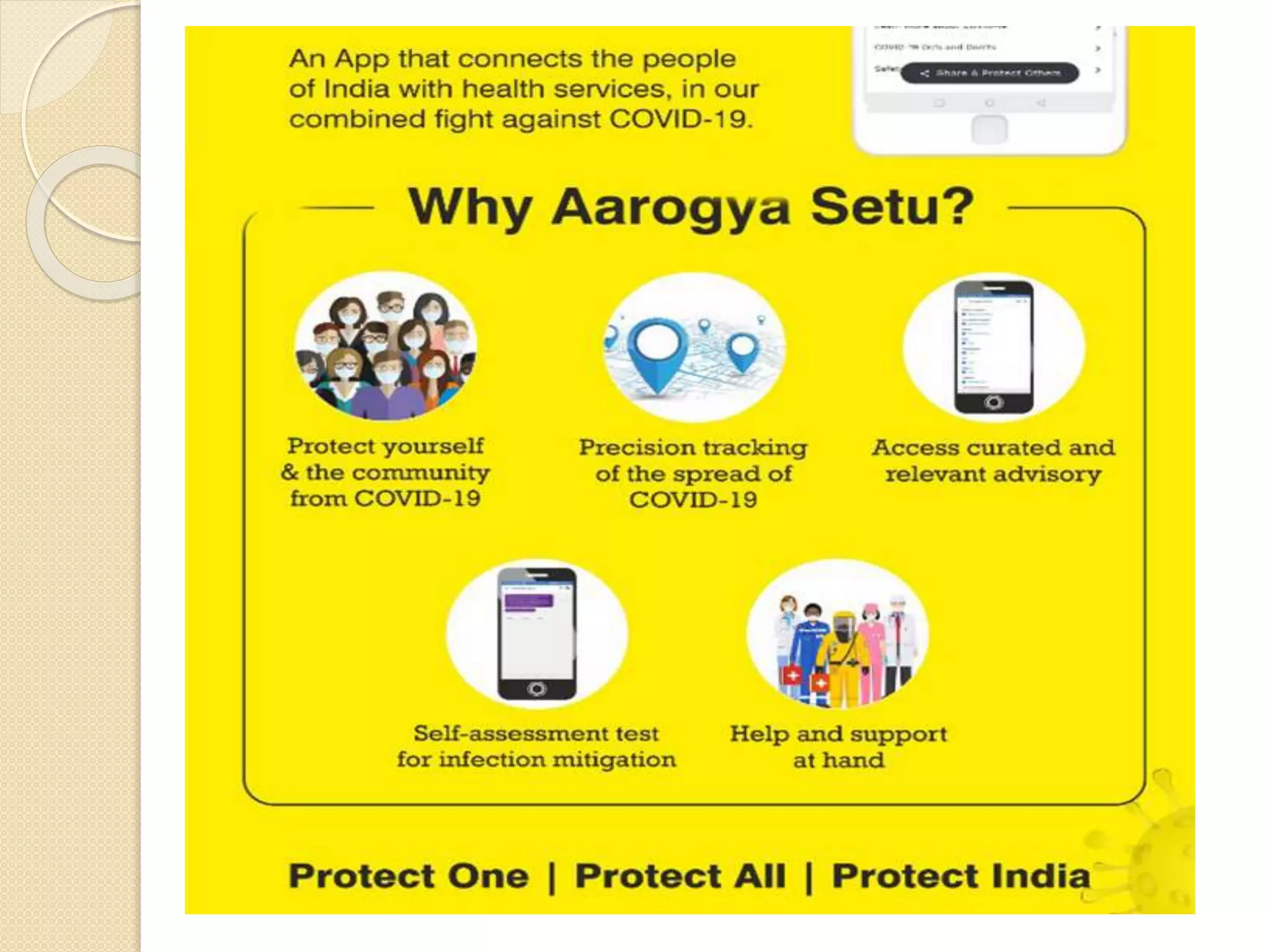
Coronavirus tracker app:
Aarogya Setu
 It is Indian COVID-19 tracking mobile application.
 It is developed by the National Informatics Centre which
comes under the Ministry of Electronics and Information
Technology.
 Purpose:
 To spread awareness of COVID-19
 To connect essential COVID-19 – related health services to
the people of India.
 It uses the smartphone’s GPS and Bluetooth features to track
the coronavirus infection.
 With Bluetooth, it determines the risk if one has been near
(within six feet of) a COVID-19 – infected person, by scanning
through a database of known cases across India.
 Using location information, one can determine whether a
particular location is one of the infected areas.
 It is an updated version of an earlier app called Corona
Kavach (now discontinued).
 Presymptomatic Patients Can Spread COVID-19:
Patients that are presymptomatic or asymptomatic can still
spread the virus to others, yet are unlikely to seek medical
attention. This makes it exceedingly difficult to trace chains
of transmission.
 Contact Tracing is Dependent on Availability of Testing
 Contact tracing originates from a time when the world was
less populated and people traveled less frequently. In the
past, contact tracing initiatives more typically dealt with
smaller numbers of diseased people who were
geographically confined, for example people with measles,
sexually transmitted diseases, or tuberculosis. Contact
tracing typically occurred without the general public even
being aware of it.COVID-19 is different. It has spread
internationally and is present other states. The need for
extensive contact tracing is being characterized as akin
to governmental mass surveillance.
 The story of COVID-19 contact tracing is still in progress,
and it’s not clear .
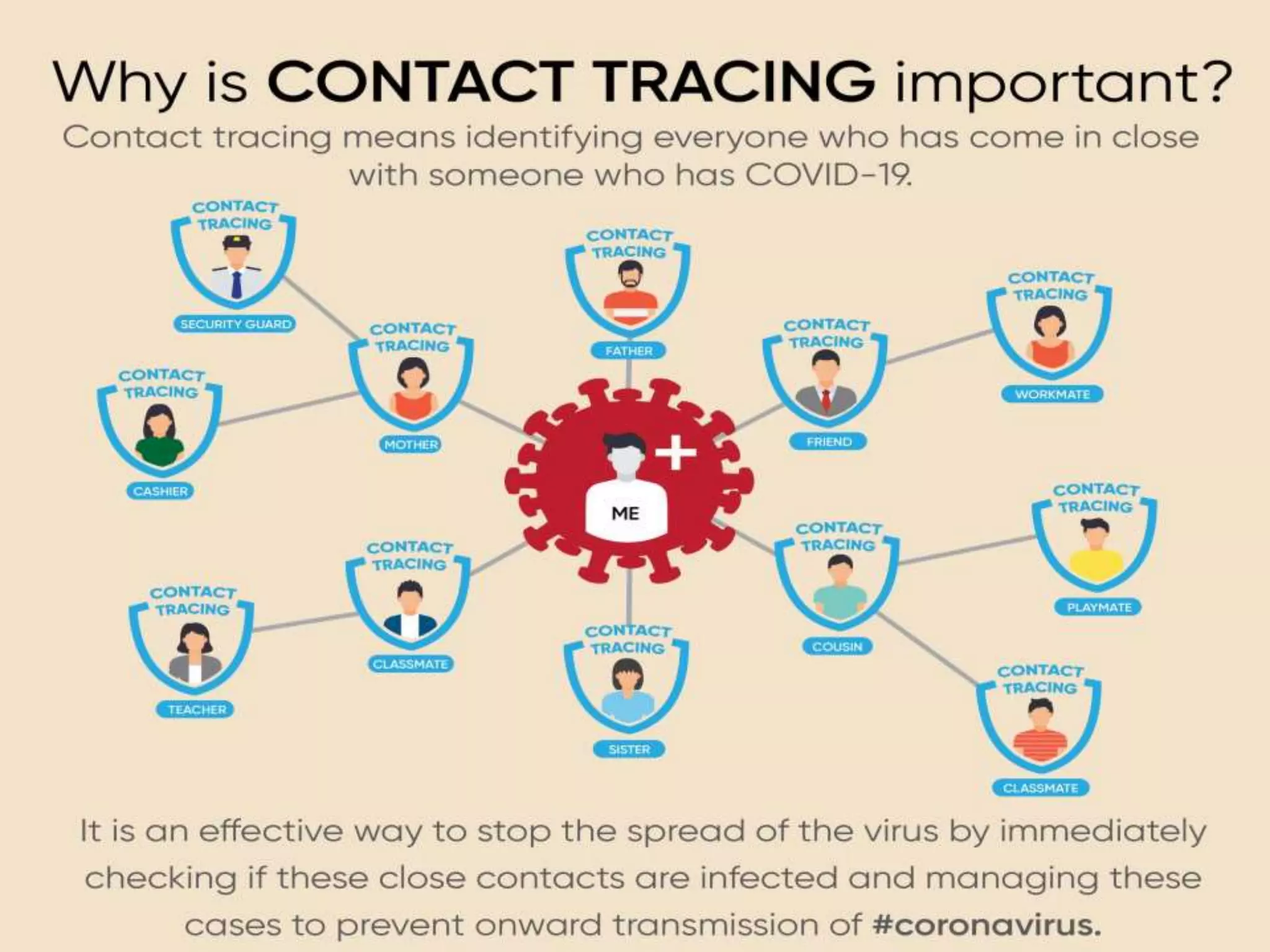
Contact Tracing: Challenges of
COVID-19
LOOKING TO THE FUTURE
 With COVID-19, contact tracing technologies like mobile
phone apps are now also being trialled to help identify
hotspots. This technology could help – provided privacy and
security concerns are respected – to quickly notify people
who may have been infected. For example, if a group of
people went to a gym class and someone tested positive, all
members could potentially be notified, informing them that
they may be at risk, and should therefore self-isolate and
get tested.
 This information can then potentially be used to inform
government policy as lockdown measures are gradually
lifted, as it can provide important insights into whether
certain types of business should remain open, or whether
the data suggests they pose a greater risk of transmission.
 Many of these digital tools are still being developed and
deployed. Read our explainer on how the technology in our
pockets can track COVID-19.
Emerging trends in advanced technologies

Emerging trends in advanced technologies

  • 1.
    Emerging Trends inAdvanced Technologies TITLE:- Emerging Technologies for Contact Tracing during COVID-19. Author: Ishika Choudhary
  • 2.
    COVID-19 pandemic inIndia  Corona viruses are a large family of viruses which may cause illness in animals or humans which cause respiratory infections .  India began thermal screening of passengers arriving from China on 21 January.  On 17 March, The Government of India issued an advisory urging to all Indian states to take social distancing measures as a preventive strategy .  On 22 March 2020, India observed a 14- hour voluntary public curfew at the instance of the prime minister Narendra
  • 3.
    Communication :  Indian PrimeMinister Narendra Modi , the work being done by various sectors during the outbreak,On 22nd March,2020 he urged people to gather in front of their own doors, windows or balconies at 5 pm and applaud them for five minutes . Janta Curfew  On 3 April,2020 PM Modi addressed the nation to turn off the lights for nine minutes and lighting the candles on 5 April.d them for five minutes. 9-minute Diwali on April 5! PM Modi asks people to light candles
  • 4.
    Emerging Technologies Tackle TheCoronavirus Pandemic Some of the key challenges that these emerging technologies address include:  To prevent people from getting infected or passing on the infection. Technologies like remote health monitoring and contactless temperature guns help slow down the spread of the infection.  To provide additional support for highly vulnerable groups of society. Virtual doctor visits, and online patient engagement tools, along with remote diagnostic solutions, helps reduce the number of people required to visit a hospital.  To maintain public safety, and public health in general, during an outbreak. Support tools and mobile applications for healthcare workers, using drones to deliver medical supplies, and specialized isolation units help prevent frontline workers from catching the infection.  To prevent avoidable community transmission of the coronavirus. Shared streaming services, remote work, along with loneliness, stress, and anxiety management, enable individuals and health workers to manage their mental and
  • 6.
    HOW HAS ITBEEN EFFECTIVE THROUGHOUT HISTORY?  Contact tracing was also used as a “test, trace and track” method to control Ebola outbreaks across Africa and played a crucial role in the eradication of Smallpox in 1980. Like COVID-19, the smallpox virus was transmitted from “an infected person to another person via respiratory droplets following direct face-to-face contact” which typically occurred in households and hospitals.  Surveillance and containment measures were key aspects of the campaign to eradicate the deadly virus. Even after an effective vaccine was developed, the “rigorous isolation of infected persons to break the chain of transmission, and close monitoring of patient contacts” proved to be extremely effective in areas with low vaccine coverage.
  • 7.
    WHAT IS ‘RING VACCINATION’? According to the WHO, tracing contacts of contacts is important because it “captures a social network of individuals and locations that may include dwellings or workplaces, where the index patient spent time while symptomatic.” For each contact this “may be composed of an average of 150 persons.”  Ring vaccination tackles an outbreak by vaccinating “a ring of people around each infected individual” to target potential hotspots at a community level. When someone tests positive, their immediate contacts can be identified and vaccinated. The ‘second ring’ of their contacts is also vaccinated to target anyone that may have been exposed to the virus.
  • 8.
    Coronavirus tracker app: AarogyaSetu  It is Indian COVID-19 tracking mobile application.  It is developed by the National Informatics Centre which comes under the Ministry of Electronics and Information Technology.  Purpose:  To spread awareness of COVID-19  To connect essential COVID-19 – related health services to the people of India.  It uses the smartphone’s GPS and Bluetooth features to track the coronavirus infection.  With Bluetooth, it determines the risk if one has been near (within six feet of) a COVID-19 – infected person, by scanning through a database of known cases across India.  Using location information, one can determine whether a particular location is one of the infected areas.  It is an updated version of an earlier app called Corona Kavach (now discontinued).
  • 10.
     Presymptomatic PatientsCan Spread COVID-19: Patients that are presymptomatic or asymptomatic can still spread the virus to others, yet are unlikely to seek medical attention. This makes it exceedingly difficult to trace chains of transmission.  Contact Tracing is Dependent on Availability of Testing  Contact tracing originates from a time when the world was less populated and people traveled less frequently. In the past, contact tracing initiatives more typically dealt with smaller numbers of diseased people who were geographically confined, for example people with measles, sexually transmitted diseases, or tuberculosis. Contact tracing typically occurred without the general public even being aware of it.COVID-19 is different. It has spread internationally and is present other states. The need for extensive contact tracing is being characterized as akin to governmental mass surveillance.  The story of COVID-19 contact tracing is still in progress, and it’s not clear . Contact Tracing: Challenges of COVID-19
  • 11.
    LOOKING TO THEFUTURE  With COVID-19, contact tracing technologies like mobile phone apps are now also being trialled to help identify hotspots. This technology could help – provided privacy and security concerns are respected – to quickly notify people who may have been infected. For example, if a group of people went to a gym class and someone tested positive, all members could potentially be notified, informing them that they may be at risk, and should therefore self-isolate and get tested.  This information can then potentially be used to inform government policy as lockdown measures are gradually lifted, as it can provide important insights into whether certain types of business should remain open, or whether the data suggests they pose a greater risk of transmission.  Many of these digital tools are still being developed and deployed. Read our explainer on how the technology in our pockets can track COVID-19.