Industry/Sector session
Emerging Technologies
An IIMB NSRCEL & Goldman Sachs Supported Firm
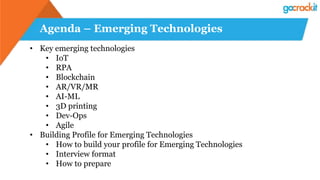
Agenda – Emerging Technologies
• Key emerging technologies
• IoT
• RPA
• Blockchain
• AR/VR/MR
• AI-ML
• 3D printing
• Dev-Ops
• Agile
• Building Profile for Emerging Technologies
• How to build your profile for Emerging Technologies
• Interview format
• How to prepare
Emerging Technologies
An IIMB NSRCEL & Goldman Sachs Supported Firm
What are emerging technologies?
 Emerging technologies are technologies whose development, practical
applications, or both are still largely unrealized, such that they are figuratively
emerging into prominence from a background of nonexistence or obscurity
 They are often perceived as capable of changing the status quo
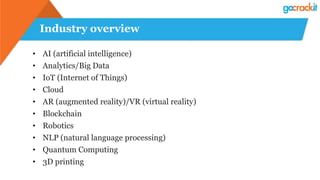
Industry overview
• AI (artificial intelligence)
• Analytics/Big Data
• IoT (Internet of Things)
• Cloud
• AR (augmented reality)/VR (virtual reality)
• Blockchain
• Robotics
• NLP (natural language processing)
• Quantum Computing
• 3D printing
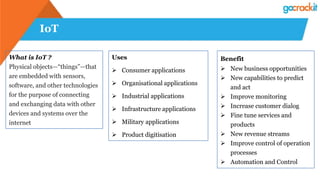
IoT
What is IoT ?
Physical objects—“things”—that
are embedded with sensors,
software, and other technologies
for the purpose of connecting
and exchanging data with other
devices and systems over the
internet
Uses
 Consumer applications
 Organisational applications
 Industrial applications
 Infrastructure applications
 Military applications
 Product digitisation
Benefit
 New business opportunities
 New capabilities to predict
and act
 Improve monitoring
 Increase customer dialog
 Fine tune services and
products
 New revenue streams
 Improve control of operation
processes
 Automation and Control
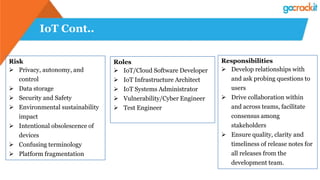
IoT Cont..
Risk
 Privacy, autonomy, and
control
 Data storage
 Security and Safety
 Environmental sustainability
impact
 Intentional obsolescence of
devices
 Confusing terminology
 Platform fragmentation
Roles
 IoT/Cloud Software Developer
 IoT Infrastructure Architect
 IoT Systems Administrator
 Vulnerability/Cyber Engineer
 Test Engineer
Responsibilities
 Develop relationships with
and ask probing questions to
users
 Drive collaboration within
and across teams, facilitate
consensus among
stakeholders
 Ensure quality, clarity and
timeliness of release notes for
all releases from the
development team.
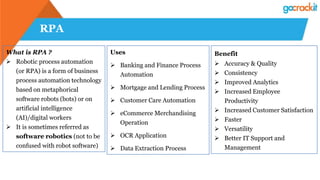
RPA
What is RPA ?
 Robotic process automation
(or RPA) is a form of business
process automation technology
based on metaphorical
software robots (bots) or on
artificial intelligence
(AI)/digital workers
 It is sometimes referred as
software robotics (not to be
confused with robot software)
Uses
 Banking and Finance Process
Automation
 Mortgage and Lending Process
 Customer Care Automation
 eCommerce Merchandising
Operation
 OCR Application
 Data Extraction Process
Benefit
 Accuracy & Quality
 Consistency
 Improved Analytics
 Increased Employee
Productivity
 Increased Customer Satisfaction
 Faster
 Versatility
 Better IT Support and
Management
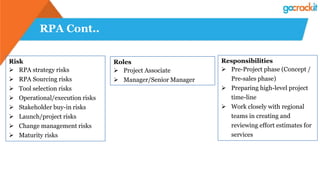
RPA Cont..
Risk
 RPA strategy risks
 RPA Sourcing risks
 Tool selection risks
 Operational/execution risks
 Stakeholder buy-in risks
 Launch/project risks
 Change management risks
 Maturity risks
Roles
 Project Associate
 Manager/Senior Manager
Responsibilities
 Pre-Project phase (Concept /
Pre-sales phase)
 Preparing high-level project
time-line
 Work closely with regional
teams in creating and
reviewing effort estimates for
services
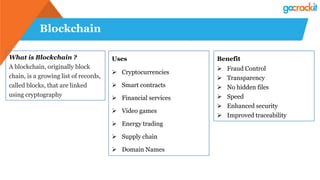
Blockchain
What is Blockchain ?
A blockchain, originally block
chain, is a growing list of records,
called blocks, that are linked
using cryptography
Uses
 Cryptocurrencies
 Smart contracts
 Financial services
 Video games
 Energy trading
 Supply chain
 Domain Names
Benefit
 Fraud Control
 Transparency
 No hidden files
 Speed
 Enhanced security
 Improved traceability
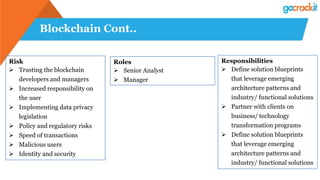
Blockchain Cont..
Risk
 Trusting the blockchain
developers and managers
 Increased responsibility on
the user
 Implementing data privacy
legislation
 Policy and regulatory risks
 Speed of transactions
 Malicious users
 Identity and security
Roles
 Senior Analyst
 Manager
Responsibilities
 Define solution blueprints
that leverage emerging
architecture patterns and
industry/ functional solutions
 Partner with clients on
business/ technology
transformation programs
 Define solution blueprints
that leverage emerging
architecture patterns and
industry/ functional solutions
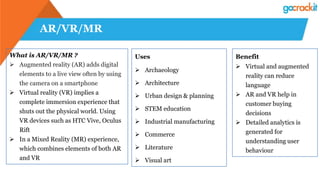
AR/VR/MR
What is AR/VR/MR ?
 Augmented reality (AR) adds digital
elements to a live view often by using
the camera on a smartphone
 Virtual reality (VR) implies a
complete immersion experience that
shuts out the physical world. Using
VR devices such as HTC Vive, Oculus
Rift
 In a Mixed Reality (MR) experience,
which combines elements of both AR
and VR
Uses
 Archaeology
 Architecture
 Urban design & planning
 STEM education
 Industrial manufacturing
 Commerce
 Literature
 Visual art
Benefit
 Virtual and augmented
reality can reduce
language
 AR and VR help in
customer buying
decisions
 Detailed analytics is
generated for
understanding user
behaviour
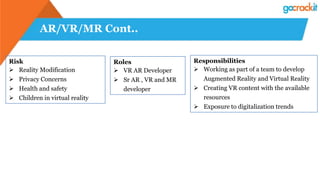
AR/VR/MR Cont..
Risk
 Reality Modification
 Privacy Concerns
 Health and safety
 Children in virtual reality
Roles
 VR AR Developer
 Sr AR , VR and MR
developer
Responsibilities
 Working as part of a team to develop
Augmented Reality and Virtual Reality
 Creating VR content with the available
resources
 Exposure to digitalization trends
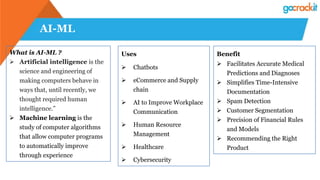
AI-ML
What is AI-ML ?
 Artificial intelligence is the
science and engineering of
making computers behave in
ways that, until recently, we
thought required human
intelligence.”
 Machine learning is the
study of computer algorithms
that allow computer programs
to automatically improve
through experience
Uses
 Chatbots
 eCommerce and Supply
chain
 AI to Improve Workplace
Communication
 Human Resource
Management
 Healthcare
 Cybersecurity
Benefit
 Facilitates Accurate Medical
Predictions and Diagnoses
 Simplifies Time-Intensive
Documentation
 Spam Detection
 Customer Segmentation
 Precision of Financial Rules
and Models
 Recommending the Right
Product
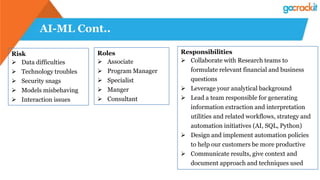
AI-ML Cont..
Risk
 Data difficulties
 Technology troubles
 Security snags
 Models misbehaving
 Interaction issues
Roles
 Associate
 Program Manager
 Specialist
 Manger
 Consultant
Responsibilities
 Collaborate with Research teams to
formulate relevant financial and business
questions
 Leverage your analytical background
 Lead a team responsible for generating
information extraction and interpretation
utilities and related workflows, strategy and
automation initiatives (AI, SQL, Python)
 Design and implement automation policies
to help our customers be more productive
 Communicate results, give context and
document approach and techniques used
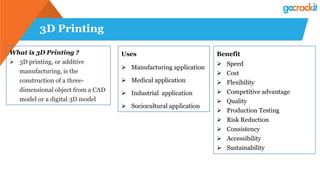
3D Printing
What is 3D Printing ?
 3D printing, or additive
manufacturing, is the
construction of a three-
dimensional object from a CAD
model or a digital 3D model
Uses
 Manufacturing application
 Medical application
 Industrial application
 Sociocultural application
Benefit
 Speed
 Cost
 Flexibility
 Competitive advantage
 Quality
 Production Testing
 Risk Reduction
 Consistency
 Accessibility
 Sustainability
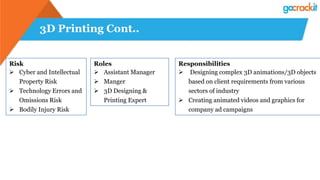
3D Printing Cont..
Risk
 Cyber and Intellectual
Property Risk
 Technology Errors and
Omissions Risk
 Bodily Injury Risk
Roles
 Assistant Manager
 Manger
 3D Designing &
Printing Expert
Responsibilities
 Designing complex 3D animations/3D objects
based on client requirements from various
sectors of industry
 Creating animated videos and graphics for
company ad campaigns
Delivery Methodology
An IIMB NSRCEL & Goldman Sachs Supported Firm
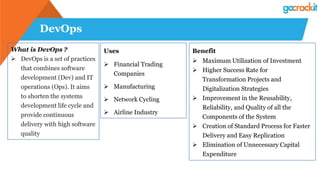
DevOps
What is DevOps ?
 DevOps is a set of practices
that combines software
development (Dev) and IT
operations (Ops). It aims
to shorten the systems
development life cycle and
provide continuous
delivery with high software
quality
Uses
 Financial Trading
Companies
 Manufacturing
 Network Cycling
 Airline Industry
Benefit
 Maximum Utilization of Investment
 Higher Success Rate for
Transformation Projects and
Digitalization Strategies
 Improvement in the Reusability,
Reliability, and Quality of all the
Components of the System
 Creation of Standard Process for Faster
Delivery and Easy Replication
 Elimination of Unnecessary Capital
Expenditure
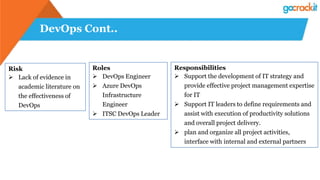
DevOps Cont..
Risk
 Lack of evidence in
academic literature on
the effectiveness of
DevOps
Roles
 DevOps Engineer
 Azure DevOps
Infrastructure
Engineer
 ITSC DevOps Leader
Responsibilities
 Support the development of IT strategy and
provide effective project management expertise
for IT
 Support IT leaders to define requirements and
assist with execution of productivity solutions
and overall project delivery.
 plan and organize all project activities,
interface with internal and external partners
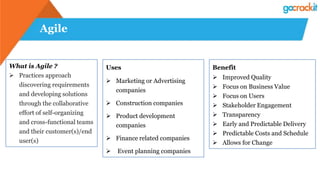
Agile
What is Agile ?
 Practices approach
discovering requirements
and developing solutions
through the collaborative
effort of self-organizing
and cross-functional teams
and their customer(s)/end
user(s)
Uses
 Marketing or Advertising
companies
 Construction companies
 Product development
companies
 Finance related companies
 Event planning companies
Benefit
 Improved Quality
 Focus on Business Value
 Focus on Users
 Stakeholder Engagement
 Transparency
 Early and Predictable Delivery
 Predictable Costs and Schedule
 Allows for Change
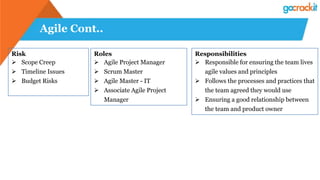
Agile Cont..
Risk
 Scope Creep
 Timeline Issues
 Budget Risks
Roles
 Agile Project Manager
 Scrum Master
 Agile Master - IT
 Associate Agile Project
Manager
Responsibilities
 Responsible for ensuring the team lives
agile values and principles
 Follows the processes and practices that
the team agreed they would use
 Ensuring a good relationship between
the team and product owner
Building profile for Emerging
Technologies
An IIMB NSRCEL & Goldman Sachs Supported Firm
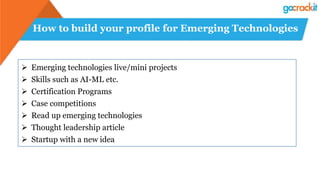
How to build your profile for Emerging Technologies
 Emerging technologies live/mini projects
 Skills such as AI-ML etc.
 Certification Programs
 Case competitions
 Read up emerging technologies
 Thought leadership article
 Startup with a new idea
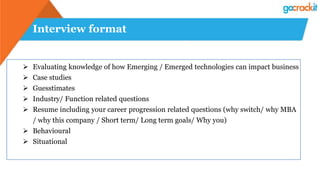
Interview format
 Evaluating knowledge of how Emerging / Emerged technologies can impact business
 Case studies
 Guesstimates
 Industry/ Function related questions
 Resume including your career progression related questions (why switch/ why MBA
/ why this company / Short term/ Long term goals/ Why you)
 Behavioural
 Situational
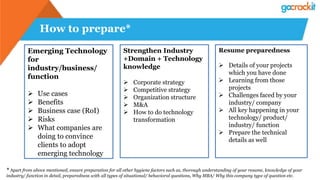
How to prepare*
Emerging Technology
for
industry/business/
function
 Use cases
 Benefits
 Business case (RoI)
 Risks
 What companies are
doing to convince
clients to adopt
emerging technology
Strengthen Industry
+Domain + Technology
knowledge
 Corporate strategy
 Competitive strategy
 Organization structure
 M&A
 How to do technology
transformation
Resume preparedness
 Details of your projects
which you have done
 Learning from those
projects
 Challenges faced by your
industry/ company
 All key happening in your
technology/ product/
industry/ function
 Prepare the technical
details as well
* Apart from above mentioned, ensure preparation for all other hygiene factors such as, thorough understanding of your resume, knowledge of your
industry/ function in detail, preparedness with all types of situational/ behavioral questions, Why MBA/ Why this company type of question etc.
Emerging tech industry sector sessions

Emerging tech industry sector sessions

  • 1.
    Industry/Sector session Emerging Technologies AnIIMB NSRCEL & Goldman Sachs Supported Firm
  • 2.
    Agenda – EmergingTechnologies • Key emerging technologies • IoT • RPA • Blockchain • AR/VR/MR • AI-ML • 3D printing • Dev-Ops • Agile • Building Profile for Emerging Technologies • How to build your profile for Emerging Technologies • Interview format • How to prepare
  • 3.
    Emerging Technologies An IIMBNSRCEL & Goldman Sachs Supported Firm
  • 4.
    What are emergingtechnologies?  Emerging technologies are technologies whose development, practical applications, or both are still largely unrealized, such that they are figuratively emerging into prominence from a background of nonexistence or obscurity  They are often perceived as capable of changing the status quo
  • 5.
    Industry overview • AI(artificial intelligence) • Analytics/Big Data • IoT (Internet of Things) • Cloud • AR (augmented reality)/VR (virtual reality) • Blockchain • Robotics • NLP (natural language processing) • Quantum Computing • 3D printing
  • 6.
    IoT What is IoT? Physical objects—“things”—that are embedded with sensors, software, and other technologies for the purpose of connecting and exchanging data with other devices and systems over the internet Uses  Consumer applications  Organisational applications  Industrial applications  Infrastructure applications  Military applications  Product digitisation Benefit  New business opportunities  New capabilities to predict and act  Improve monitoring  Increase customer dialog  Fine tune services and products  New revenue streams  Improve control of operation processes  Automation and Control
  • 7.
    IoT Cont.. Risk  Privacy,autonomy, and control  Data storage  Security and Safety  Environmental sustainability impact  Intentional obsolescence of devices  Confusing terminology  Platform fragmentation Roles  IoT/Cloud Software Developer  IoT Infrastructure Architect  IoT Systems Administrator  Vulnerability/Cyber Engineer  Test Engineer Responsibilities  Develop relationships with and ask probing questions to users  Drive collaboration within and across teams, facilitate consensus among stakeholders  Ensure quality, clarity and timeliness of release notes for all releases from the development team.
  • 8.
    RPA What is RPA?  Robotic process automation (or RPA) is a form of business process automation technology based on metaphorical software robots (bots) or on artificial intelligence (AI)/digital workers  It is sometimes referred as software robotics (not to be confused with robot software) Uses  Banking and Finance Process Automation  Mortgage and Lending Process  Customer Care Automation  eCommerce Merchandising Operation  OCR Application  Data Extraction Process Benefit  Accuracy & Quality  Consistency  Improved Analytics  Increased Employee Productivity  Increased Customer Satisfaction  Faster  Versatility  Better IT Support and Management
  • 9.
    RPA Cont.. Risk  RPAstrategy risks  RPA Sourcing risks  Tool selection risks  Operational/execution risks  Stakeholder buy-in risks  Launch/project risks  Change management risks  Maturity risks Roles  Project Associate  Manager/Senior Manager Responsibilities  Pre-Project phase (Concept / Pre-sales phase)  Preparing high-level project time-line  Work closely with regional teams in creating and reviewing effort estimates for services
  • 10.
    Blockchain What is Blockchain? A blockchain, originally block chain, is a growing list of records, called blocks, that are linked using cryptography Uses  Cryptocurrencies  Smart contracts  Financial services  Video games  Energy trading  Supply chain  Domain Names Benefit  Fraud Control  Transparency  No hidden files  Speed  Enhanced security  Improved traceability
  • 11.
    Blockchain Cont.. Risk  Trustingthe blockchain developers and managers  Increased responsibility on the user  Implementing data privacy legislation  Policy and regulatory risks  Speed of transactions  Malicious users  Identity and security Roles  Senior Analyst  Manager Responsibilities  Define solution blueprints that leverage emerging architecture patterns and industry/ functional solutions  Partner with clients on business/ technology transformation programs  Define solution blueprints that leverage emerging architecture patterns and industry/ functional solutions
  • 12.
    AR/VR/MR What is AR/VR/MR?  Augmented reality (AR) adds digital elements to a live view often by using the camera on a smartphone  Virtual reality (VR) implies a complete immersion experience that shuts out the physical world. Using VR devices such as HTC Vive, Oculus Rift  In a Mixed Reality (MR) experience, which combines elements of both AR and VR Uses  Archaeology  Architecture  Urban design & planning  STEM education  Industrial manufacturing  Commerce  Literature  Visual art Benefit  Virtual and augmented reality can reduce language  AR and VR help in customer buying decisions  Detailed analytics is generated for understanding user behaviour
  • 13.
    AR/VR/MR Cont.. Risk  RealityModification  Privacy Concerns  Health and safety  Children in virtual reality Roles  VR AR Developer  Sr AR , VR and MR developer Responsibilities  Working as part of a team to develop Augmented Reality and Virtual Reality  Creating VR content with the available resources  Exposure to digitalization trends
  • 14.
    AI-ML What is AI-ML?  Artificial intelligence is the science and engineering of making computers behave in ways that, until recently, we thought required human intelligence.”  Machine learning is the study of computer algorithms that allow computer programs to automatically improve through experience Uses  Chatbots  eCommerce and Supply chain  AI to Improve Workplace Communication  Human Resource Management  Healthcare  Cybersecurity Benefit  Facilitates Accurate Medical Predictions and Diagnoses  Simplifies Time-Intensive Documentation  Spam Detection  Customer Segmentation  Precision of Financial Rules and Models  Recommending the Right Product
  • 15.
    AI-ML Cont.. Risk  Datadifficulties  Technology troubles  Security snags  Models misbehaving  Interaction issues Roles  Associate  Program Manager  Specialist  Manger  Consultant Responsibilities  Collaborate with Research teams to formulate relevant financial and business questions  Leverage your analytical background  Lead a team responsible for generating information extraction and interpretation utilities and related workflows, strategy and automation initiatives (AI, SQL, Python)  Design and implement automation policies to help our customers be more productive  Communicate results, give context and document approach and techniques used
  • 16.
    3D Printing What is3D Printing ?  3D printing, or additive manufacturing, is the construction of a three- dimensional object from a CAD model or a digital 3D model Uses  Manufacturing application  Medical application  Industrial application  Sociocultural application Benefit  Speed  Cost  Flexibility  Competitive advantage  Quality  Production Testing  Risk Reduction  Consistency  Accessibility  Sustainability
  • 17.
    3D Printing Cont.. Risk Cyber and Intellectual Property Risk  Technology Errors and Omissions Risk  Bodily Injury Risk Roles  Assistant Manager  Manger  3D Designing & Printing Expert Responsibilities  Designing complex 3D animations/3D objects based on client requirements from various sectors of industry  Creating animated videos and graphics for company ad campaigns
  • 18.
    Delivery Methodology An IIMBNSRCEL & Goldman Sachs Supported Firm
  • 19.
    DevOps What is DevOps?  DevOps is a set of practices that combines software development (Dev) and IT operations (Ops). It aims to shorten the systems development life cycle and provide continuous delivery with high software quality Uses  Financial Trading Companies  Manufacturing  Network Cycling  Airline Industry Benefit  Maximum Utilization of Investment  Higher Success Rate for Transformation Projects and Digitalization Strategies  Improvement in the Reusability, Reliability, and Quality of all the Components of the System  Creation of Standard Process for Faster Delivery and Easy Replication  Elimination of Unnecessary Capital Expenditure
  • 20.
    DevOps Cont.. Risk  Lackof evidence in academic literature on the effectiveness of DevOps Roles  DevOps Engineer  Azure DevOps Infrastructure Engineer  ITSC DevOps Leader Responsibilities  Support the development of IT strategy and provide effective project management expertise for IT  Support IT leaders to define requirements and assist with execution of productivity solutions and overall project delivery.  plan and organize all project activities, interface with internal and external partners
  • 21.
    Agile What is Agile?  Practices approach discovering requirements and developing solutions through the collaborative effort of self-organizing and cross-functional teams and their customer(s)/end user(s) Uses  Marketing or Advertising companies  Construction companies  Product development companies  Finance related companies  Event planning companies Benefit  Improved Quality  Focus on Business Value  Focus on Users  Stakeholder Engagement  Transparency  Early and Predictable Delivery  Predictable Costs and Schedule  Allows for Change
  • 22.
    Agile Cont.. Risk  ScopeCreep  Timeline Issues  Budget Risks Roles  Agile Project Manager  Scrum Master  Agile Master - IT  Associate Agile Project Manager Responsibilities  Responsible for ensuring the team lives agile values and principles  Follows the processes and practices that the team agreed they would use  Ensuring a good relationship between the team and product owner
  • 23.
    Building profile forEmerging Technologies An IIMB NSRCEL & Goldman Sachs Supported Firm
  • 24.
    How to buildyour profile for Emerging Technologies  Emerging technologies live/mini projects  Skills such as AI-ML etc.  Certification Programs  Case competitions  Read up emerging technologies  Thought leadership article  Startup with a new idea
  • 25.
    Interview format  Evaluatingknowledge of how Emerging / Emerged technologies can impact business  Case studies  Guesstimates  Industry/ Function related questions  Resume including your career progression related questions (why switch/ why MBA / why this company / Short term/ Long term goals/ Why you)  Behavioural  Situational
  • 26.
    How to prepare* EmergingTechnology for industry/business/ function  Use cases  Benefits  Business case (RoI)  Risks  What companies are doing to convince clients to adopt emerging technology Strengthen Industry +Domain + Technology knowledge  Corporate strategy  Competitive strategy  Organization structure  M&A  How to do technology transformation Resume preparedness  Details of your projects which you have done  Learning from those projects  Challenges faced by your industry/ company  All key happening in your technology/ product/ industry/ function  Prepare the technical details as well * Apart from above mentioned, ensure preparation for all other hygiene factors such as, thorough understanding of your resume, knowledge of your industry/ function in detail, preparedness with all types of situational/ behavioral questions, Why MBA/ Why this company type of question etc.