Welcome
Emerging Technologies
Technology: Emerging, Trending ,Disruptive
Technology
o is no longer just a sector of
the economy
o Backbone of the economy.
o center of business
change.
o enables organizations to
transform their business
operating models and
respond to competitive
threats.
Emerging technology
o term generally used to describe a
new technology,
o may also refer to the continuing
development of an existing
technology.
Disruptive Technology
o one that displaces an
established technology and
shakes up the industry or a
ground-breaking product that
creates a completely new
industry
o E- Mail, Social Networking,
Cloud computing,
Smartphones ( replaced cell
phones and PDAs) , Laptop
and Mobile computing.
o Alters the way that
consumers, industries, or
businesses operate
OTT – Over the top Media
Services . Netflix, Amazon
Prime , Disney+Hotstar..
Airbnb , OYO .
Uber, OLA,
Blockchain , Ai are on the
way.
Trending Technologies
o ones that is recently
becoming popular and is
readily accepted in the
market or industry.
o The industry-wide
acceptance of a
particular technology can
be seen either as an
opportunity or as a threat
to an individual firm.
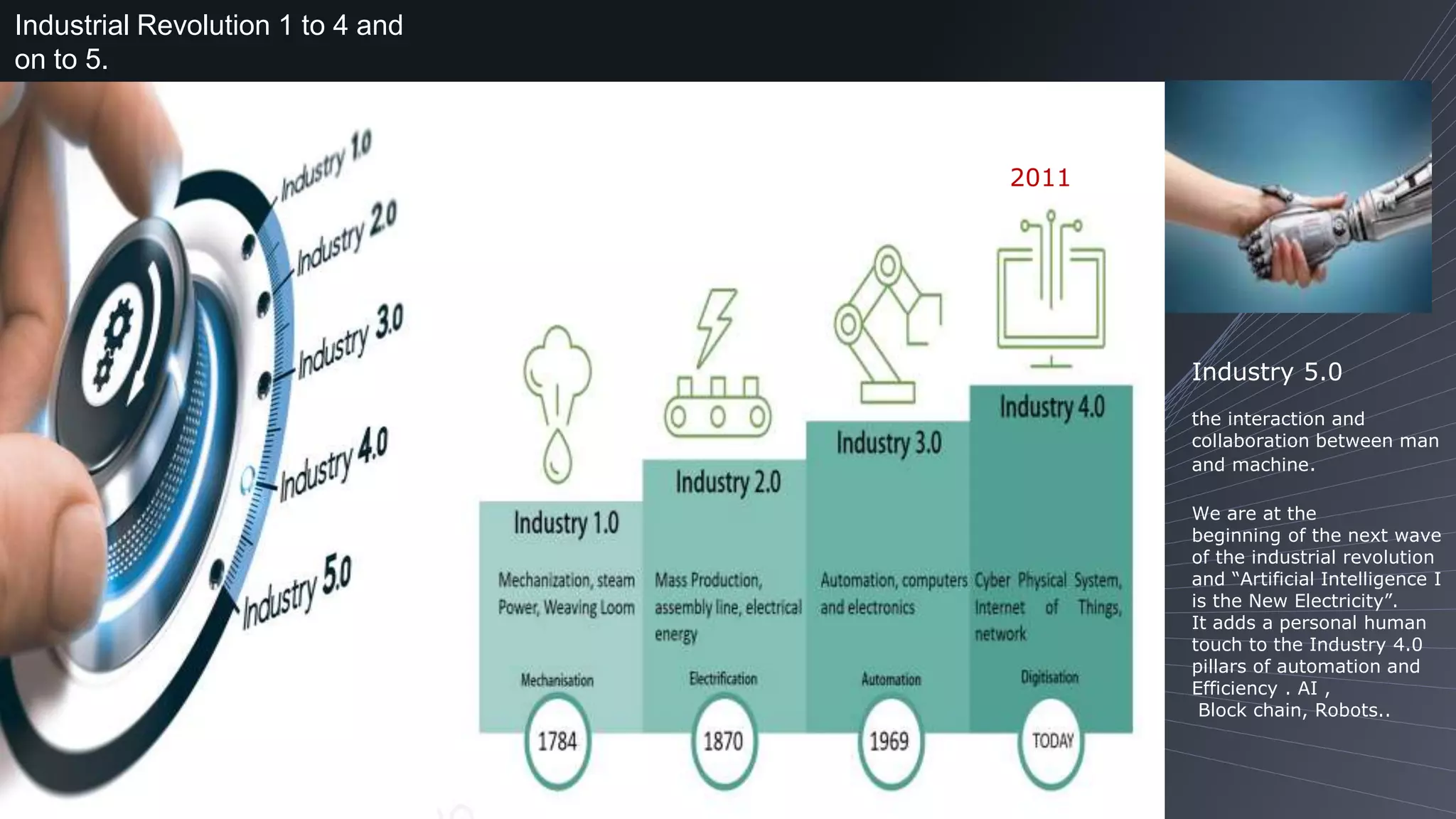
Industrial Revolution 1 to 4 and
on to 5.
Industry 5.0
the interaction and
collaboration between man
and machine.
We are at the
beginning of the next wave
of the industrial revolution
and “Artificial Intelligence I
is the New Electricity”.
It adds a personal human
touch to the Industry 4.0
pillars of automation and
Efficiency . AI ,
Block chain, Robots..
2011
The development in the information technology sector has given rise to new forms threats and dangers to the rights of
people.
Intellectual property (IP) is a category of property that includes intangible creations ( intangible asset) of the human
intellect. There are many types of intellectual property, and some countries recognize more than others. The most well-
known types are copyrights, patents, trademarks, and trade secrets..
Computer programs have a source code and an object code which are copyrightable under the Indian Copyright Act.
The most common forms of violation that occurs in the world of information technology are
Unauthorized reproduction
Software piracy
Theft of data and information
Digital Asset : is anything that exists in a binary format and comes with the right to use.
Types of digital assets include, but are not exclusive to: photography, logos, illustrations, animations, audiovisual
media, presentations, spreadsheets, word documents , e mails, websites, and a multitude of other digital formats.
Due to a lack of either legislation or legal precedent, there is a limited control over digital assets. Control issues relating to
access and transferability are maintained by individual companies
Intellectual Property in Information technology ( IP in IT)
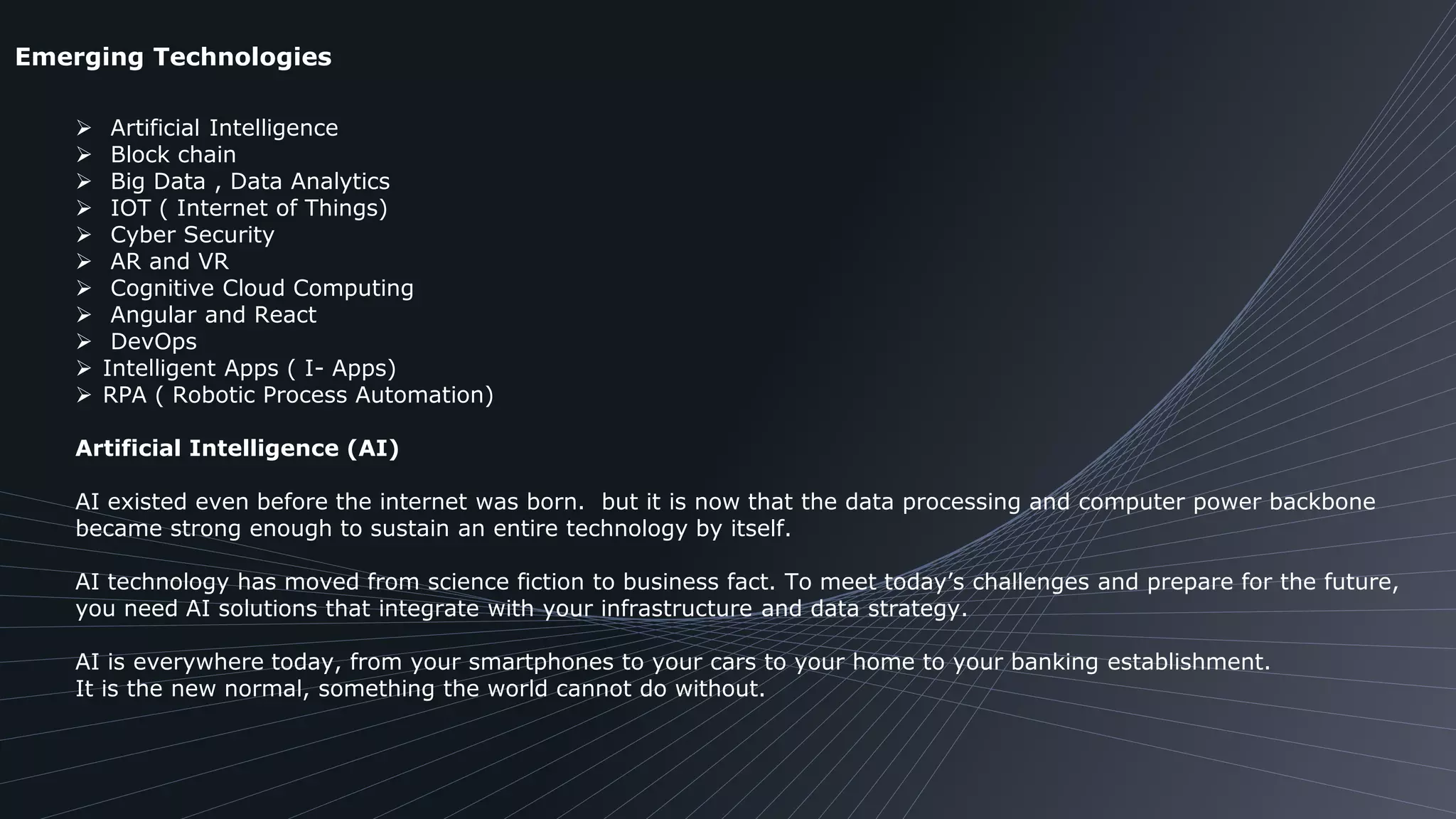
Emerging Technologies
 Artificial Intelligence
 Block chain
 Big Data , Data Analytics
 IOT ( Internet of Things)
 Cyber Security
 AR and VR
 Cognitive Cloud Computing
 Angular and React
 DevOps
 Intelligent Apps ( I- Apps)
 RPA ( Robotic Process Automation)
Artificial Intelligence (AI)
AI existed even before the internet was born. but it is now that the data processing and computer power backbone
became strong enough to sustain an entire technology by itself.
AI technology has moved from science fiction to business fact. To meet today’s challenges and prepare for the future,
you need AI solutions that integrate with your infrastructure and data strategy.
AI is everywhere today, from your smartphones to your cars to your home to your banking establishment.
It is the new normal, something the world cannot do without.
6
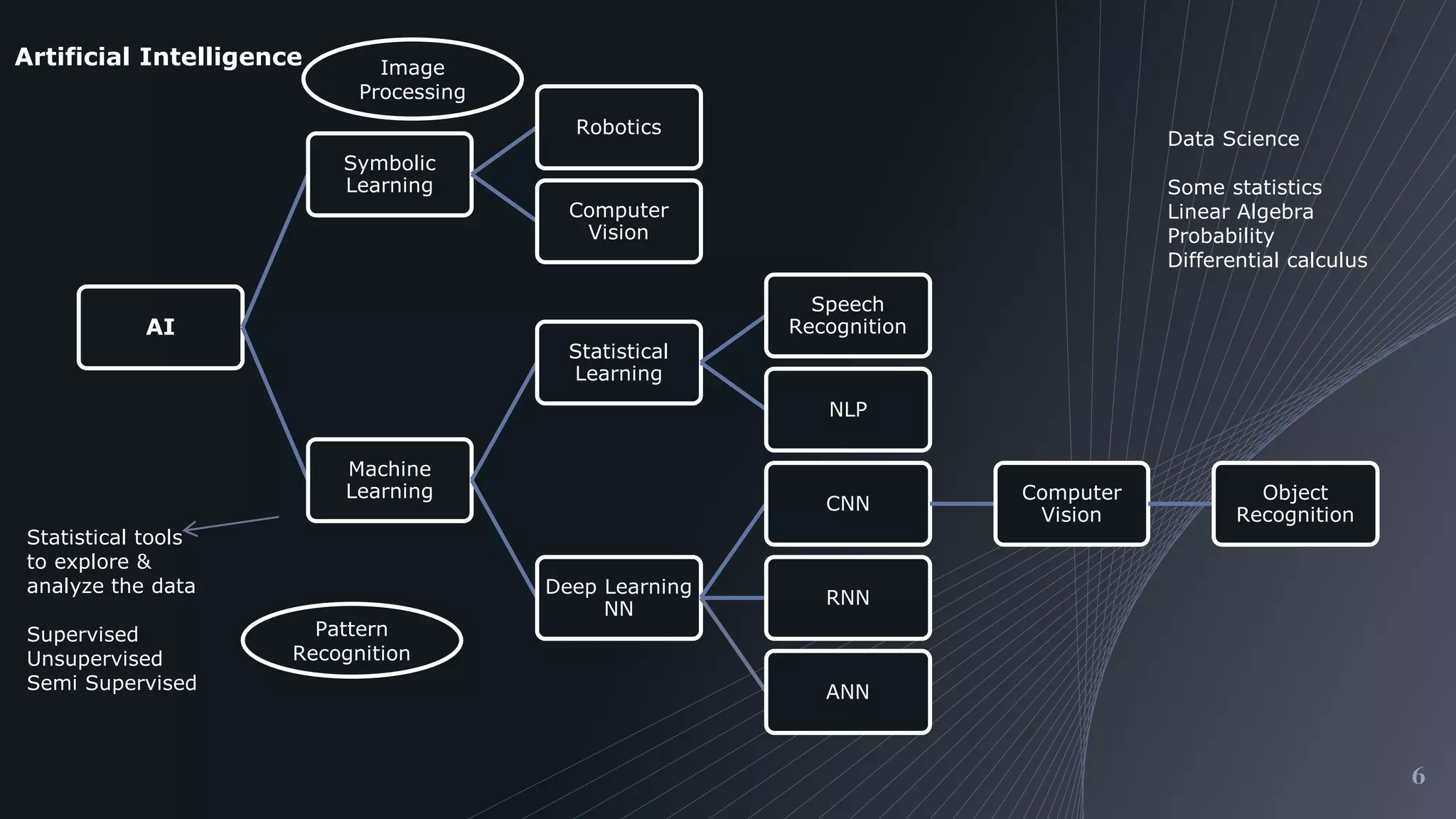
Artificial Intelligence
AI
Symbolic
Learning
Robotics
Computer
Vision
Machine
Learning
Statistical
Learning
Speech
Recognition
NLP
Deep Learning
NN
CNN
Computer
Vision
Object
Recognition
RNN
ANN
Pattern
Recognition
Image
Processing
Statistical tools
to explore &
analyze the data
Supervised
Unsupervised
Semi Supervised
Data Science
Some statistics
Linear Algebra
Probability
Differential calculus
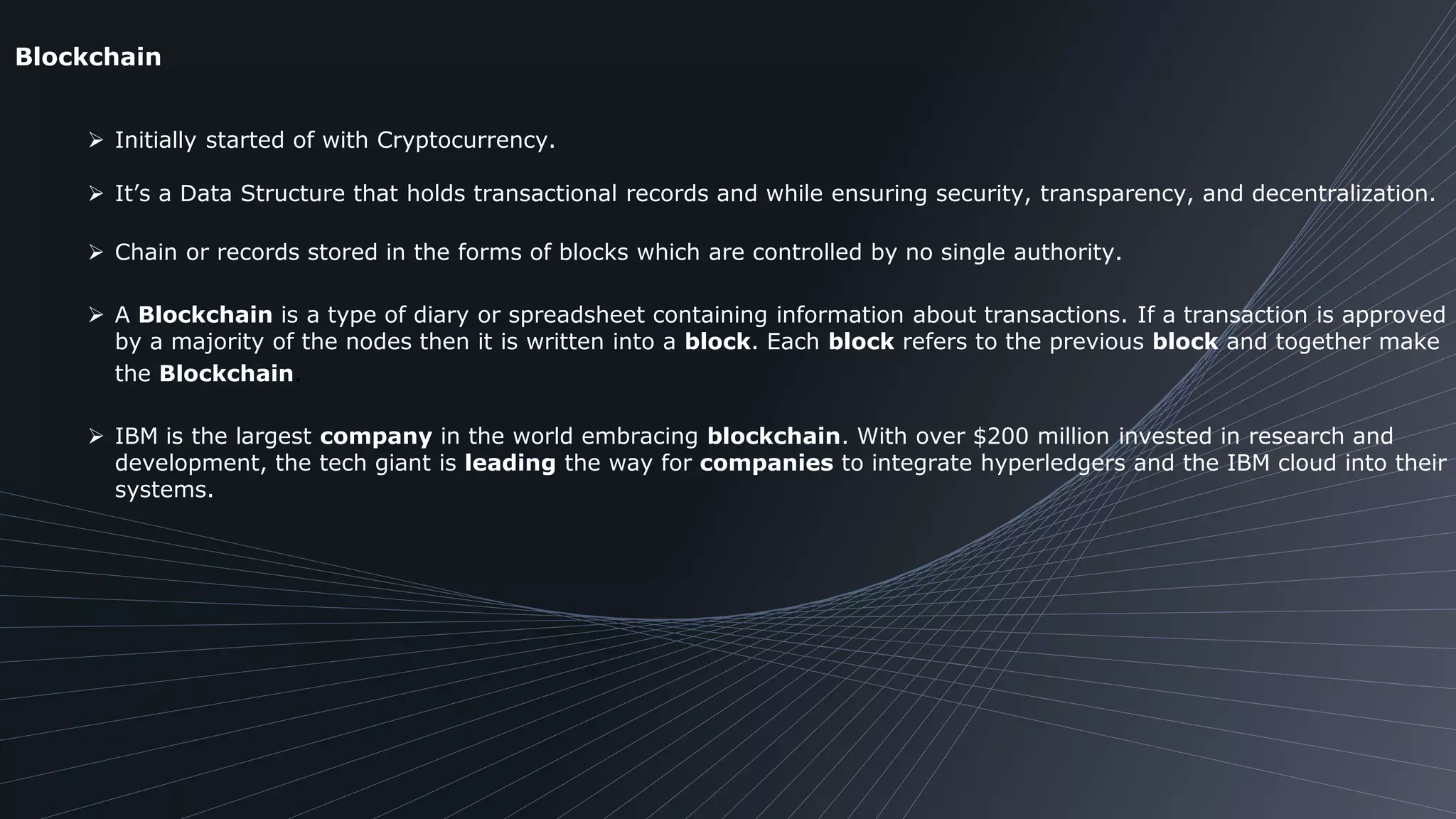
Blockchain
 Initially started of with Cryptocurrency.
 It’s a Data Structure that holds transactional records and while ensuring security, transparency, and decentralization.
 Chain or records stored in the forms of blocks which are controlled by no single authority.
 A Blockchain is a type of diary or spreadsheet containing information about transactions. If a transaction is approved
by a majority of the nodes then it is written into a block. Each block refers to the previous block and together make
the Blockchain.
 IBM is the largest company in the world embracing blockchain. With over $200 million invested in research and
development, the tech giant is leading the way for companies to integrate hyperledgers and the IBM cloud into their
systems.
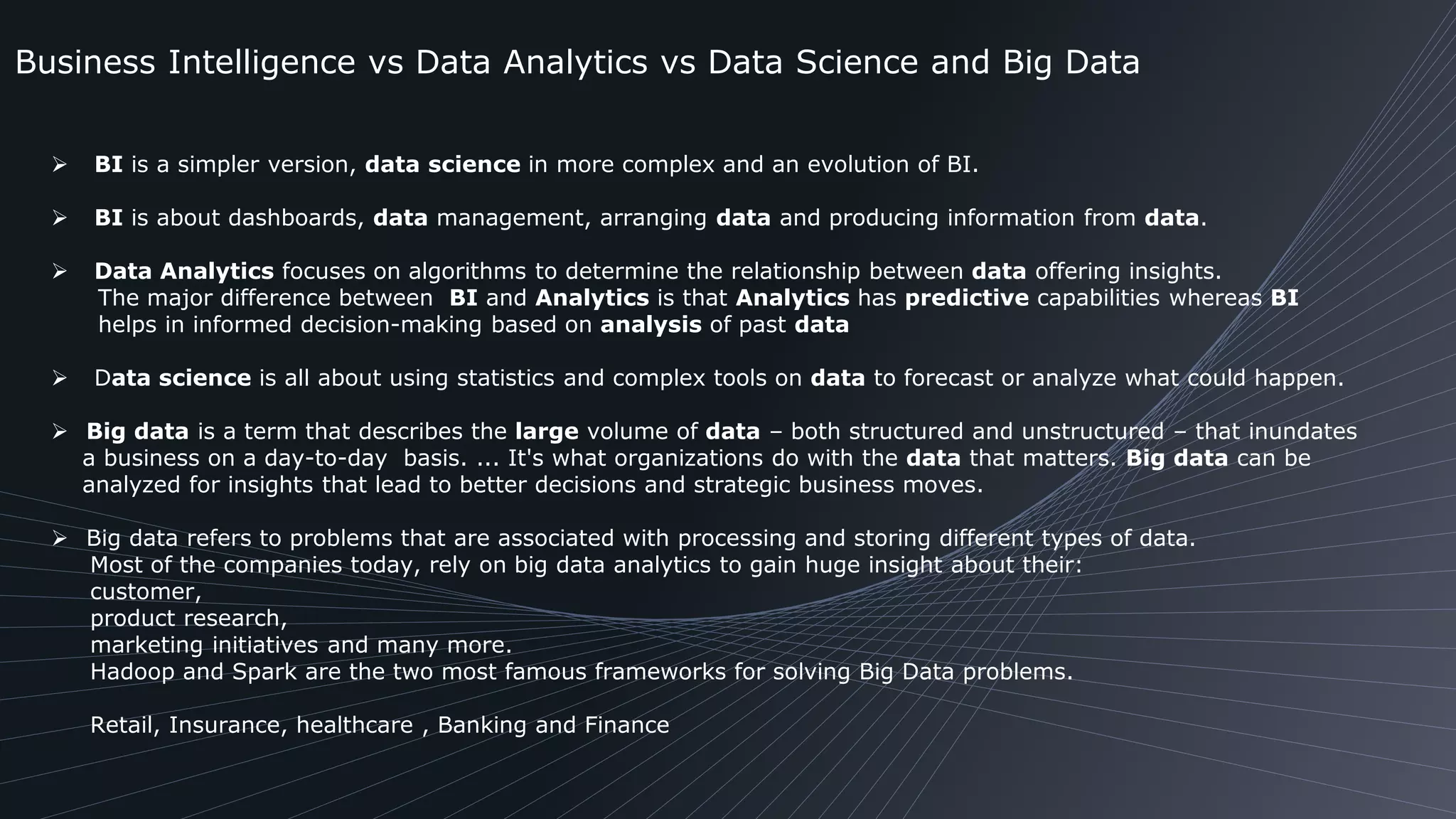
Business Intelligence vs Data Analytics vs Data Science and Big Data
 BI is a simpler version, data science in more complex and an evolution of BI.
 BI is about dashboards, data management, arranging data and producing information from data.
 Data Analytics focuses on algorithms to determine the relationship between data offering insights.
The major difference between BI and Analytics is that Analytics has predictive capabilities whereas BI
helps in informed decision-making based on analysis of past data
 Data science is all about using statistics and complex tools on data to forecast or analyze what could happen.
 Big data is a term that describes the large volume of data – both structured and unstructured – that inundates
a business on a day-to-day basis. ... It's what organizations do with the data that matters. Big data can be
analyzed for insights that lead to better decisions and strategic business moves.
 Big data refers to problems that are associated with processing and storing different types of data.
Most of the companies today, rely on big data analytics to gain huge insight about their:
customer,
product research,
marketing initiatives and many more.
Hadoop and Spark are the two most famous frameworks for solving Big Data problems.
Retail, Insurance, healthcare , Banking and Finance
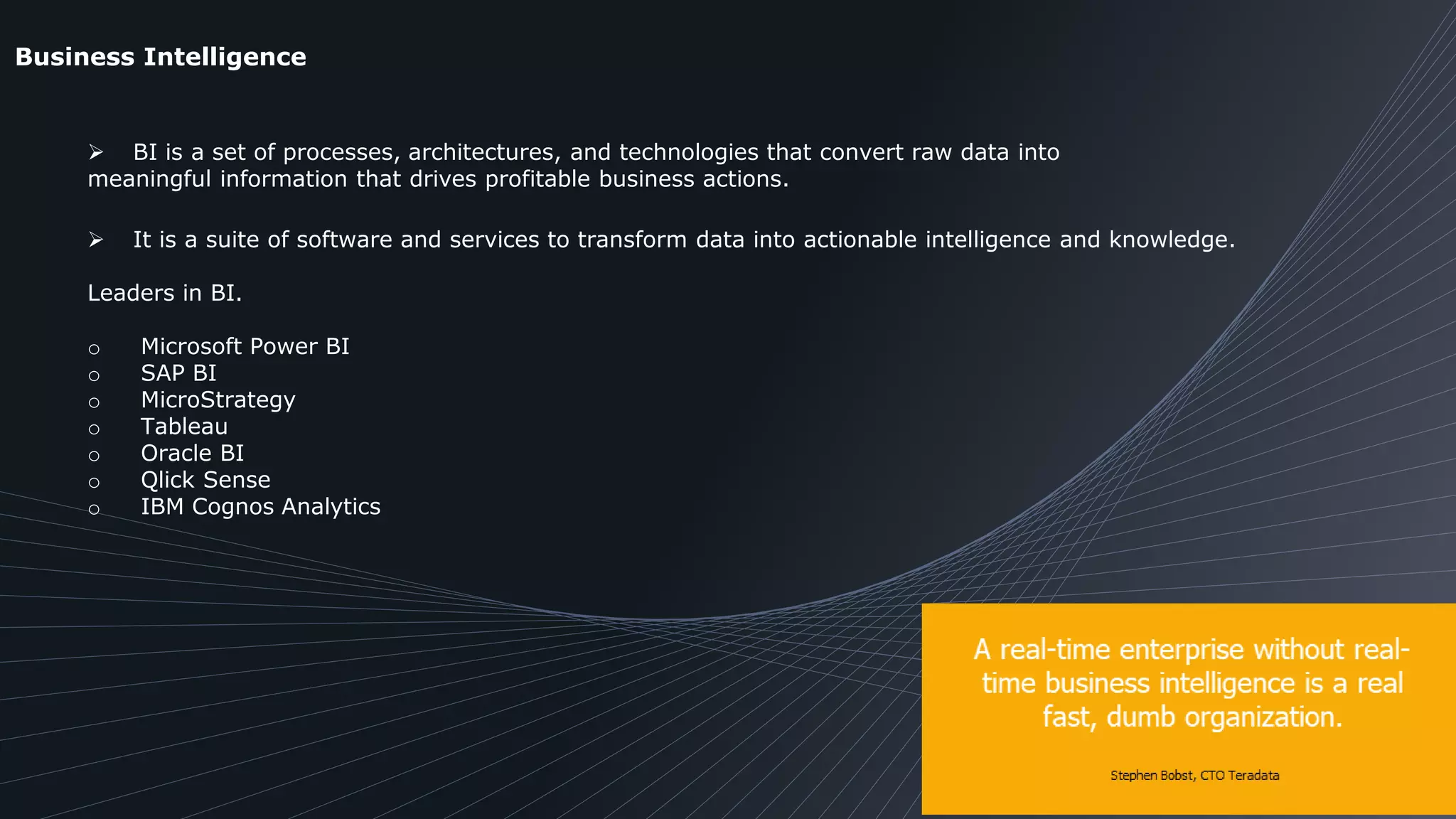
Business Intelligence
 BI is a set of processes, architectures, and technologies that convert raw data into
meaningful information that drives profitable business actions.
 It is a suite of software and services to transform data into actionable intelligence and knowledge.
Leaders in BI.
o Microsoft Power BI
o SAP BI
o MicroStrategy
o Tableau
o Oracle BI
o Qlick Sense
o IBM Cognos Analytics
IoT , Cybersecurity
 IoT is a giant network of connected devices – all of which gather and share data about how they are used and
the environments in which they are operated.
This includes everything from your:
mobile phones,
refrigerator,
washing machines to almost everything that you can think of.
With IoT, we can have smart cities with optimized:
traffic system,
efficient waste management and
energy use
 Cyber security is the practice of defending computers, servers, mobile devices, electronic systems, networks,
and data from malicious attacks. It's also known as information technology security or electronic information
security. The term applies in a variety of contexts, from business to mobile computing, and can be divided into a
few common categories.
Categories : Network Security , Application Security, Information Security, Operational Security, Disaster Recovery
and Business Continuity.
Cyber Threats: Cyber Crime, Cyber attack and Cyber terrorism.
AR and VR , Cognitive Cloud Computing
 Virtual is real! VR and AR, the twin technologies that let you experience things in virtual, that are
extremely close to real, are today being used by businesses of all sizes and shapes. But the underlying
technology can be quite complex.
Medical students use AR technology to practice surgery in a controlled environment.
VR on the other hand, opens up newer avenues for gaming and interactive marketing.
Jogging with a VR TV, Flight Simulation,
 Cognitive Cloud is an extended ecosystem of traditional Cloud and Cognitive Computing.
Big brands such as IBM, Google, Microsoft, Cisco have already started implementing this next-gen tech to
gear up for the upcoming market.
AWS - Amazon Web Services - Amazon Web Services (AWS) is a secure cloud services platform, offering compute power,
database storage, content delivery and other functionality to help businesses scale and grow. In simple words AWS
allows you to do the following things- Running web and application servers in the cloud to host dynamic websites.
Netflix, LinkedIn, FB, BBC, ESPN…use AWS
Angular and React, Dev Ops, I – Apps, RPA
 Angular and React
Angular and React are JavaScript based Frameworks for creating modern web applications.
Using React and Angular one can create a highly modular web app. So, you don’t need to go through a lot of changes in your
code base for adding a new feature.
Angular and React also allows you to create a native mobile application with the same JS, CSS & HTML knowledge.
Best part – Open source library with highly active community support.
 DevOps
DevOps is a methodology , not a technology. Ensures that both the development and operations go hand in hand. DevOps cycle is picturized as
an infinite loop representing the integration of developers and operation teams by:
automating infrastructure, workflows and continuously measuring application performance.
Popular tools : git, jenkins puppet, chef, docker, stack
 Intelligent Apps ( I- Apps)
I-Apps are pieces of software written for mobile devices based on artificial intelligence and machine learning technology,
aimed at making everyday tasks easier.
This involves tasks like organizing and prioritizing emails, scheduling meetings, logging interactions, content, etc. Some
familiar examples of I-Apps are Chatbots and virtual assistants.
 RPA ( Robotic Process Automation
Any industry involves tasks that are repetitive in nature and can be automated.
RPA or Robotic Process Automation allows you to automate such routine and repetitive tasks.
You don’t need to write any code to automate repetitive tasks.
Tools to implement RPA : UI Path, blue prism, Automation Anywhere
ERP – Enterprise Resource Program
 Enterprise resource planning (ERP) refers to a type of software that organizations use to manage day-to-day
business activities such as accounting, procurement, project management, risk management and compliance,
and supply chain operations.
o Improved business insight from real-time information generated by reports
o Lower operational costs through streamlined business processes and best practices
ERP’s : IBM, Microsoft, Oracle, IFS
CRM – Customer Relationship Management
 Manages company's interaction with current and potential customers.
 It uses data analysis about customers' history with a company to improve business
relationships with customers.
 Specifically focuses on customer retention and drives sales growth.
 Salesforce , MS Dynamics 365 , Oracle CRM
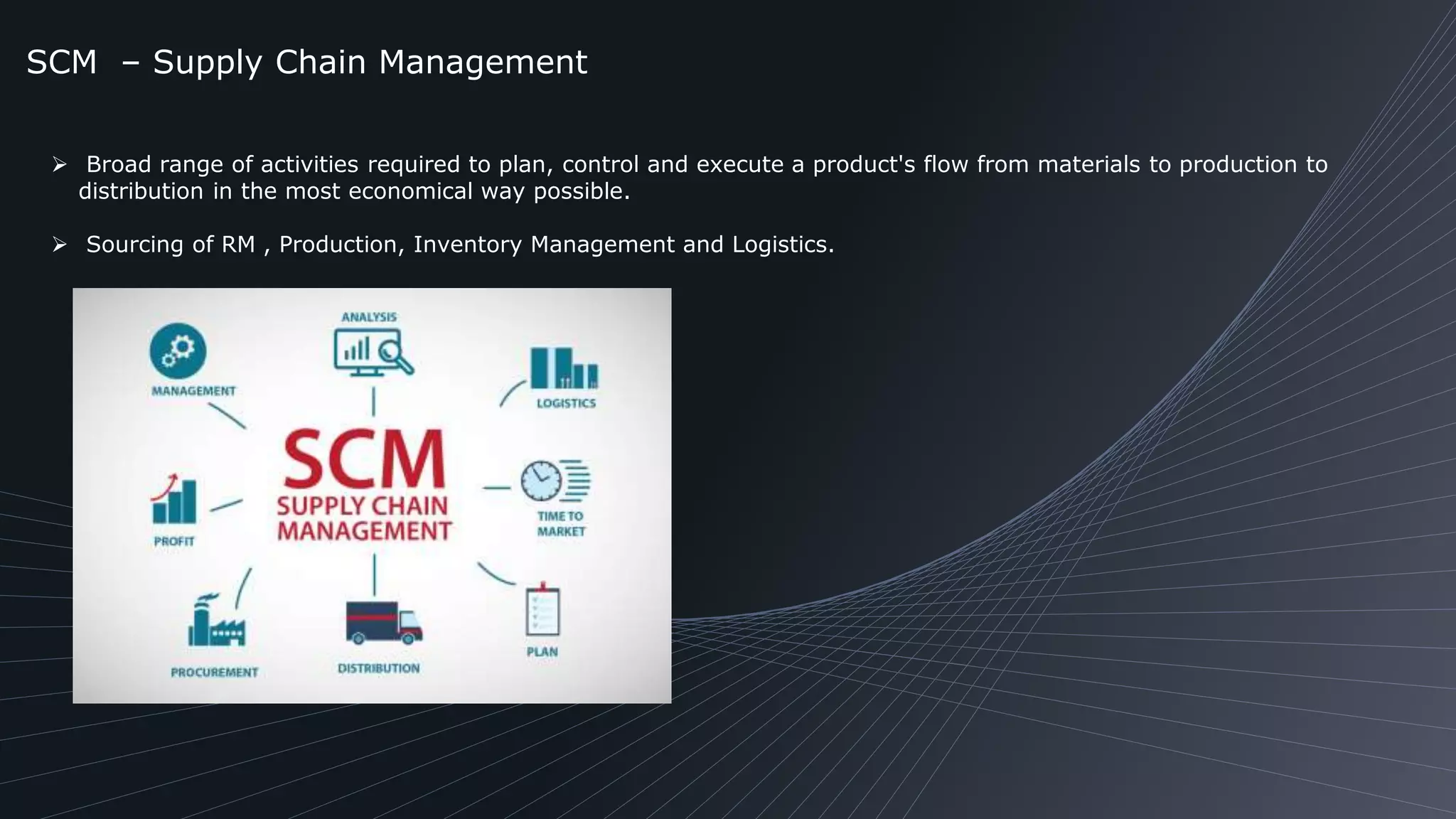
SCM – Supply Chain Management
 Broad range of activities required to plan, control and execute a product's flow from materials to production to
distribution in the most economical way possible.
 Sourcing of RM , Production, Inventory Management and Logistics.
Certification Bodies: MOOC – Massive open online courses
Coursera.org - Coursera is a world-wide online learning platform founded in 2012 by Stanford computer science professors Andrew
Ng and Daphne Koller that offers massive open online courses (MOOC), specializations, and degrees.
Coursera works with universities and other organizations to offer online courses, specializations, and degrees in a variety of subjects, such
as engineering, data science, machine learning, mathematics, business, computer science, digital
marketing, humanities, medicine, biology, social sciences, and others.
edX Relay Graduate School of education
Udacity University System of georgia
Linkedin Learning Class Central Inc
https://www.p2pu.org/en Peer to Peer University
National Programme on Technology Enhanced learning – NPTEL My MOOC
Future Learn University of Geneva
Alison https://get.vitalsource.com/acrobatiq
The Open University
NovED
Saylor Academy
UNED
College of St Scholastica Science Center
Aberta - Universidade Aberta
Miriadax
Open learning
Canvas Network
Kadenze
Aquent
Enhancing Entrepreneurship and Employability Skills
“Creativity is the root of entrepreneurship.”
 Join An Entrepreneur Community. Like OnlineGeniuses.com , , LinkedIn’s Bright Ideas and Entrepreneurs
 Find A Business Mentor.
 Increase Your Reading.
 Listen To Business Podcasts
 Learn From Your Mistakes
Find out the areas:
o Business
o Entrepreneurship
o Human Resources
o Finance
o Investing
o Operations
o Management
o Marketing
o Sales
o Information Technology
Thank You

Emerging Technologies

  • 1.
  • 2.
    Technology: Emerging, Trending,Disruptive Technology o is no longer just a sector of the economy o Backbone of the economy. o center of business change. o enables organizations to transform their business operating models and respond to competitive threats. Emerging technology o term generally used to describe a new technology, o may also refer to the continuing development of an existing technology. Disruptive Technology o one that displaces an established technology and shakes up the industry or a ground-breaking product that creates a completely new industry o E- Mail, Social Networking, Cloud computing, Smartphones ( replaced cell phones and PDAs) , Laptop and Mobile computing. o Alters the way that consumers, industries, or businesses operate OTT – Over the top Media Services . Netflix, Amazon Prime , Disney+Hotstar.. Airbnb , OYO . Uber, OLA, Blockchain , Ai are on the way. Trending Technologies o ones that is recently becoming popular and is readily accepted in the market or industry. o The industry-wide acceptance of a particular technology can be seen either as an opportunity or as a threat to an individual firm.
  • 3.
    Industrial Revolution 1to 4 and on to 5. Industry 5.0 the interaction and collaboration between man and machine. We are at the beginning of the next wave of the industrial revolution and “Artificial Intelligence I is the New Electricity”. It adds a personal human touch to the Industry 4.0 pillars of automation and Efficiency . AI , Block chain, Robots.. 2011
  • 4.
    The development inthe information technology sector has given rise to new forms threats and dangers to the rights of people. Intellectual property (IP) is a category of property that includes intangible creations ( intangible asset) of the human intellect. There are many types of intellectual property, and some countries recognize more than others. The most well- known types are copyrights, patents, trademarks, and trade secrets.. Computer programs have a source code and an object code which are copyrightable under the Indian Copyright Act. The most common forms of violation that occurs in the world of information technology are Unauthorized reproduction Software piracy Theft of data and information Digital Asset : is anything that exists in a binary format and comes with the right to use. Types of digital assets include, but are not exclusive to: photography, logos, illustrations, animations, audiovisual media, presentations, spreadsheets, word documents , e mails, websites, and a multitude of other digital formats. Due to a lack of either legislation or legal precedent, there is a limited control over digital assets. Control issues relating to access and transferability are maintained by individual companies Intellectual Property in Information technology ( IP in IT)
  • 5.
    Emerging Technologies  ArtificialIntelligence  Block chain  Big Data , Data Analytics  IOT ( Internet of Things)  Cyber Security  AR and VR  Cognitive Cloud Computing  Angular and React  DevOps  Intelligent Apps ( I- Apps)  RPA ( Robotic Process Automation) Artificial Intelligence (AI) AI existed even before the internet was born. but it is now that the data processing and computer power backbone became strong enough to sustain an entire technology by itself. AI technology has moved from science fiction to business fact. To meet today’s challenges and prepare for the future, you need AI solutions that integrate with your infrastructure and data strategy. AI is everywhere today, from your smartphones to your cars to your home to your banking establishment. It is the new normal, something the world cannot do without.
  • 6.
  • 7.
    Blockchain  Initially startedof with Cryptocurrency.  It’s a Data Structure that holds transactional records and while ensuring security, transparency, and decentralization.  Chain or records stored in the forms of blocks which are controlled by no single authority.  A Blockchain is a type of diary or spreadsheet containing information about transactions. If a transaction is approved by a majority of the nodes then it is written into a block. Each block refers to the previous block and together make the Blockchain.  IBM is the largest company in the world embracing blockchain. With over $200 million invested in research and development, the tech giant is leading the way for companies to integrate hyperledgers and the IBM cloud into their systems.
  • 8.
    Business Intelligence vsData Analytics vs Data Science and Big Data  BI is a simpler version, data science in more complex and an evolution of BI.  BI is about dashboards, data management, arranging data and producing information from data.  Data Analytics focuses on algorithms to determine the relationship between data offering insights. The major difference between BI and Analytics is that Analytics has predictive capabilities whereas BI helps in informed decision-making based on analysis of past data  Data science is all about using statistics and complex tools on data to forecast or analyze what could happen.  Big data is a term that describes the large volume of data – both structured and unstructured – that inundates a business on a day-to-day basis. ... It's what organizations do with the data that matters. Big data can be analyzed for insights that lead to better decisions and strategic business moves.  Big data refers to problems that are associated with processing and storing different types of data. Most of the companies today, rely on big data analytics to gain huge insight about their: customer, product research, marketing initiatives and many more. Hadoop and Spark are the two most famous frameworks for solving Big Data problems. Retail, Insurance, healthcare , Banking and Finance
  • 9.
    Business Intelligence  BIis a set of processes, architectures, and technologies that convert raw data into meaningful information that drives profitable business actions.  It is a suite of software and services to transform data into actionable intelligence and knowledge. Leaders in BI. o Microsoft Power BI o SAP BI o MicroStrategy o Tableau o Oracle BI o Qlick Sense o IBM Cognos Analytics
  • 10.
    IoT , Cybersecurity IoT is a giant network of connected devices – all of which gather and share data about how they are used and the environments in which they are operated. This includes everything from your: mobile phones, refrigerator, washing machines to almost everything that you can think of. With IoT, we can have smart cities with optimized: traffic system, efficient waste management and energy use  Cyber security is the practice of defending computers, servers, mobile devices, electronic systems, networks, and data from malicious attacks. It's also known as information technology security or electronic information security. The term applies in a variety of contexts, from business to mobile computing, and can be divided into a few common categories. Categories : Network Security , Application Security, Information Security, Operational Security, Disaster Recovery and Business Continuity. Cyber Threats: Cyber Crime, Cyber attack and Cyber terrorism.
  • 11.
    AR and VR, Cognitive Cloud Computing  Virtual is real! VR and AR, the twin technologies that let you experience things in virtual, that are extremely close to real, are today being used by businesses of all sizes and shapes. But the underlying technology can be quite complex. Medical students use AR technology to practice surgery in a controlled environment. VR on the other hand, opens up newer avenues for gaming and interactive marketing. Jogging with a VR TV, Flight Simulation,  Cognitive Cloud is an extended ecosystem of traditional Cloud and Cognitive Computing. Big brands such as IBM, Google, Microsoft, Cisco have already started implementing this next-gen tech to gear up for the upcoming market. AWS - Amazon Web Services - Amazon Web Services (AWS) is a secure cloud services platform, offering compute power, database storage, content delivery and other functionality to help businesses scale and grow. In simple words AWS allows you to do the following things- Running web and application servers in the cloud to host dynamic websites. Netflix, LinkedIn, FB, BBC, ESPN…use AWS
  • 12.
    Angular and React,Dev Ops, I – Apps, RPA  Angular and React Angular and React are JavaScript based Frameworks for creating modern web applications. Using React and Angular one can create a highly modular web app. So, you don’t need to go through a lot of changes in your code base for adding a new feature. Angular and React also allows you to create a native mobile application with the same JS, CSS & HTML knowledge. Best part – Open source library with highly active community support.  DevOps DevOps is a methodology , not a technology. Ensures that both the development and operations go hand in hand. DevOps cycle is picturized as an infinite loop representing the integration of developers and operation teams by: automating infrastructure, workflows and continuously measuring application performance. Popular tools : git, jenkins puppet, chef, docker, stack  Intelligent Apps ( I- Apps) I-Apps are pieces of software written for mobile devices based on artificial intelligence and machine learning technology, aimed at making everyday tasks easier. This involves tasks like organizing and prioritizing emails, scheduling meetings, logging interactions, content, etc. Some familiar examples of I-Apps are Chatbots and virtual assistants.  RPA ( Robotic Process Automation Any industry involves tasks that are repetitive in nature and can be automated. RPA or Robotic Process Automation allows you to automate such routine and repetitive tasks. You don’t need to write any code to automate repetitive tasks. Tools to implement RPA : UI Path, blue prism, Automation Anywhere
  • 13.
    ERP – EnterpriseResource Program  Enterprise resource planning (ERP) refers to a type of software that organizations use to manage day-to-day business activities such as accounting, procurement, project management, risk management and compliance, and supply chain operations. o Improved business insight from real-time information generated by reports o Lower operational costs through streamlined business processes and best practices ERP’s : IBM, Microsoft, Oracle, IFS
  • 14.
    CRM – CustomerRelationship Management  Manages company's interaction with current and potential customers.  It uses data analysis about customers' history with a company to improve business relationships with customers.  Specifically focuses on customer retention and drives sales growth.  Salesforce , MS Dynamics 365 , Oracle CRM
  • 15.
    SCM – SupplyChain Management  Broad range of activities required to plan, control and execute a product's flow from materials to production to distribution in the most economical way possible.  Sourcing of RM , Production, Inventory Management and Logistics.
  • 16.
    Certification Bodies: MOOC– Massive open online courses Coursera.org - Coursera is a world-wide online learning platform founded in 2012 by Stanford computer science professors Andrew Ng and Daphne Koller that offers massive open online courses (MOOC), specializations, and degrees. Coursera works with universities and other organizations to offer online courses, specializations, and degrees in a variety of subjects, such as engineering, data science, machine learning, mathematics, business, computer science, digital marketing, humanities, medicine, biology, social sciences, and others. edX Relay Graduate School of education Udacity University System of georgia Linkedin Learning Class Central Inc https://www.p2pu.org/en Peer to Peer University National Programme on Technology Enhanced learning – NPTEL My MOOC Future Learn University of Geneva Alison https://get.vitalsource.com/acrobatiq The Open University NovED Saylor Academy UNED College of St Scholastica Science Center Aberta - Universidade Aberta Miriadax Open learning Canvas Network Kadenze Aquent
  • 17.
    Enhancing Entrepreneurship andEmployability Skills “Creativity is the root of entrepreneurship.”  Join An Entrepreneur Community. Like OnlineGeniuses.com , , LinkedIn’s Bright Ideas and Entrepreneurs  Find A Business Mentor.  Increase Your Reading.  Listen To Business Podcasts  Learn From Your Mistakes Find out the areas: o Business o Entrepreneurship o Human Resources o Finance o Investing o Operations o Management o Marketing o Sales o Information Technology
  • 18.