RESEARCH METHODS AND
THE LIBRARY PROFESSIONAL
Elisabeth Jones
elisjone@umich.edu
July 22, 2013
Monday, July 22, 13
WHERE I’M COMING FROM
• All sorts of academic
library jobs at all sorts of
places
• No real methodological
training before doctoral
level
• In retrospect...
Intro | Observation | Interviews | Focus Groups | Unobtrusive Measures | Surveys | Experiments | Discussion
Monday, July 22, 13
RESEARCH METHODS FOR
INFORMATION PROFESSIONALS (SI 623)
• 2013 = Second time the class had been offered in its
current form
• Students tended to have quite low interest in taking it
• Hard to see why, as a future librarian or archivist, they
might ever have a use for traditional research methods
• Plus, you know, methods. Boring.
• However...
Intro | Observation | Interviews | Focus Groups | Unobtrusive Measures | Surveys | Experiments | Discussion
Monday, July 22, 13
RESEARCH METHODS FOR
INFORMATION PROFESSIONALS (SI 623)
• The course centers around each student assembling a
proposal for some piece of research related to their
professional interests
• At least three students had already begun to implement
their proposed studies by the time the class ended in April
• Several others developed feasible - and even possibly fundable -
proposals
• Students noted in the evaluations that the course actually
seemed much more applicable looking back than it had
seemed at the beginning of the term (and also more fun…)
Intro | Observation | Interviews | Focus Groups | Unobtrusive Measures | Surveys | Experiments | Discussion
Monday, July 22, 13
ANDYOU?
• Did you have any kind of research methods training
in your college or grad school coursework?
• Have you participated in conducting research in your
professional life?
• What kind(s)?
• What motivated you to do it?
• How have you come away feeling about the
experience(s)?
Intro | Observation | Interviews | Focus Groups | Unobtrusive Measures | Surveys | Experiments | Discussion
Monday, July 22, 13
TODAY’STALK
• The 10,000-foot view of six data collection methods one might
use to inform library practice
• What they are
• What they’re good for
• What they’re not so good for
• Discussion:
• Where do these methods fit into library professional life? (Do they?)
• Should libraries be building internal expertise or hiring external
consultants? (Both? Neither?)
• Thoughts on the inclusion of methodology in MLIS/MSI curricula?
Intro | Observation | Interviews | Focus Groups | Unobtrusive Measures | Surveys | Experiments | Discussion
Monday, July 22, 13
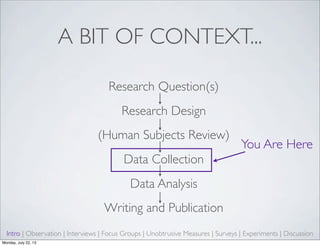
A BIT OF CONTEXT...
Research Question(s)
Research Design
(Human Subjects Review)
Data Collection
Data Analysis
Writing and Publication
You Are Here
Intro | Observation | Interviews | Focus Groups | Unobtrusive Measures | Surveys | Experiments | Discussion
Monday, July 22, 13
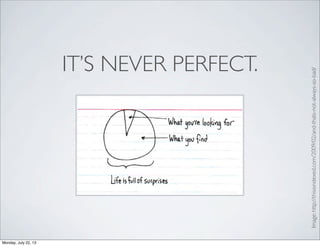
IT’S NEVER PERFECT.
Image:http://thisisindexed.com/2009/02/and-thats-not-always-so-bad/
Monday, July 22, 13
DATA COLLECTION METHODS:
A QUICK AND DIRTY OVERVIEW
Monday, July 22, 13
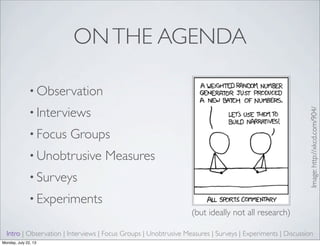
ONTHE AGENDA
• Observation
• Interviews
• Focus Groups
• Unobtrusive Measures
• Surveys
• Experiments
(but ideally not all research)
Intro | Observation | Interviews | Focus Groups | Unobtrusive Measures | Surveys | Experiments | Discussion
Image:http://xkcd.com/904/
Monday, July 22, 13
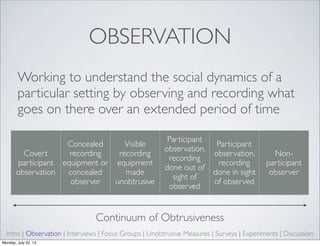
OBSERVATION
Working to understand the social dynamics of a
particular setting by observing and recording what
goes on there over an extended period of time
Covert
participant
observation
Concealed
recording
equipment or
concealed
observer
Visible
recording
equipment
made
unobtrusive
Participant
observation,
recording
done out of
sight of
observed
Participant
observation,
recording
done in sight
of observed
Non-
participant
observer
Continuum of Obtrusiveness
Intro | Observation | Interviews | Focus Groups | Unobtrusive Measures | Surveys | Experiments | Discussion
Monday, July 22, 13
OBSERVATION:
WHAT IS IT GOOD FOR?
• Nuanced understanding of behavior within a particular
setting
• Situations where flexibility in approach is useful (e.g. in
dealing with the unexpected)
• Problems or settings about which extremely little is known
• Situations in which individuals’ self-report may not match
their actual behavior
• Plus one practicality...
Intro | Observation | Interviews | Focus Groups | Unobtrusive Measures | Surveys | Experiments | Discussion
Monday, July 22, 13
OBSERVATION: WHAT IS IT
LESS GOOD FOR?
• Understanding motivations (unlike interviews)
• Seeing beyond the immediate present (unlike
interviews, historical research, predictive modeling)
• Comparisons of highly pre-specified characteristics
or behaviors across large populations (unlike
surveys)
• Producing broadly generalizable findings (unlike
some surveys and experiments)
Intro | Observation | Interviews | Focus Groups | Unobtrusive Measures | Surveys | Experiments | Discussion
Monday, July 22, 13
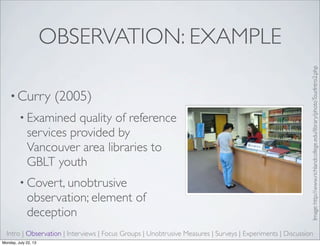
OBSERVATION: EXAMPLE
• Curry (2005)
• Examined quality of reference
services provided by
Vancouver area libraries to
GBLT youth
• Covert, unobtrusive
observation; element of
deception
Intro | Observation | Interviews | Focus Groups | Unobtrusive Measures | Surveys | Experiments | Discussion
Image:http://www.richlandcollege.edu/library/photoTourIntro2.php
Monday, July 22, 13
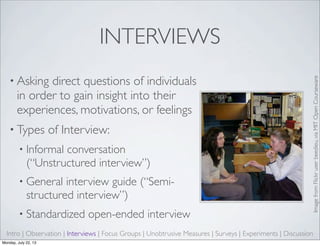
INTERVIEWS
• Asking direct questions of individuals
in order to gain insight into their
experiences, motivations, or feelings
• Types of Interview:
• Informal conversation
(“Unstructured interview”)
• General interview guide (“Semi-
structured interview”)
• Standardized open-ended interview
Intro | Observation | Interviews | Focus Groups | Unobtrusive Measures | Surveys | Experiments | Discussion
ImagefromFlickruserbeedieu,viaMITOpenCourseware
Monday, July 22, 13
INTERVIEWS:WHAT ARETHEY
GOOD FOR?
• When you want to find something out that you
cannot directly observe
• E.g. feelings, thoughts, intentions, past behavior, activities in
private settings, individual sense-making processes
• To find out what is on someone else’s mind; to gather
their stories
• Underlying assumption: the perspective of others is
meaningful, knowable, and able to be made explicit
(Patton, 341)
Intro | Observation | Interviews | Focus Groups | Unobtrusive Measures | Surveys | Experiments | Discussion
Monday, July 22, 13
INTERVIEWS:WHAT ARETHEY
LESS GOOD FOR?
• Understanding social or physical context (unlike
observation)
• Comparisons of highly pre-specified characteristics
or behaviors across large populations (unlike
surveys)
• Producing broadly generalizable findings (unlike
some surveys and experiments)
Intro | Observation | Interviews | Focus Groups | Unobtrusive Measures | Surveys | Experiments | Discussion
Monday, July 22, 13
INTERVIEWS: EXAMPLE
• Hara et al (2003)
• Semi-structured interviews used to study collaboration in a
multidisciplinary, geographically dispersed research center
• Study participants included faculty, postdocs, and students
• Interviews explored reasons for imbalances in collaborative
relationships found through earlier sociometric analysis of
the research group, by collecting participants’ general
impressions of and stories about collaboration
Intro | Observation | Interviews | Focus Groups | Unobtrusive Measures | Surveys | Experiments | Discussion
Monday, July 22, 13
FOCUS GROUPS
• Researcher asks direct questions of a group of
people, all at once
• Not just a group interview
• Serve different purposes, and have different pros and
cons
• Generally proceed from broad to narrow Q’s
• Relatively homogeneous demographics, if possible
• Video recording = near-essential
Intro | Observation | Interviews | Focus Groups | Unobtrusive Measures | Surveys | Experiments | Discussion
Monday, July 22, 13
FOCUS GROUPS:WHAT ARE
THEY GOOD FOR?
• Obtaining general background information about a topic of
interest
• Stimulating new ideas and creative concepts
• Diagnosing the potential for problems with a new program,
service or product
• Generating impressions of products, programs, services,
institutions or other objects of interest
• Learning how respondents talk about the phenomenon of
interest
Intro | Observation | Interviews | Focus Groups | Unobtrusive Measures | Surveys | Experiments | Discussion
Monday, July 22, 13
FOCUS GROUPS:WHAT ARE
THEY LESS GOOD FOR?
• Highly sensitive or personal information (unlike any method where
confidentiality can be ensured)
• Questions where additional observers are likely to have a significant
effect on responses (unlike any method with ≤1 observer present)
• Questions requiring in-depth, detailed information from each informant
(unlike interviews, some surveys)
• Understanding social or physical context (unlike observation)
• Comparisons of highly pre-specified characteristics or behaviors across
large populations (unlike surveys)
• Producing broadly generalizable findings (unlike some surveys and
experiments)
Intro | Observation | Interviews | Focus Groups | Unobtrusive Measures | Surveys | Experiments | Discussion
Monday, July 22, 13
FOCUS GROUPS: EXAMPLE
• Shoaf (2003)
• Used focus groups to evaluate the performance of an
academic library (at Brown U.)
• No library or university staff with focus group expertise, so
hired an outside consultant
• Article reports on lessons learned regarding the procedures
and strategies involved in running a focus group, and
assesses the decision to pay for outside help (they came out
in favor of it in this case)
Intro | Observation | Interviews | Focus Groups | Unobtrusive Measures | Surveys | Experiments | Discussion
Monday, July 22, 13
UNOBTRUSIVE MEASURES
• Using data that already exists to answer a new question
• For example:
• Internal library data
• Circulation, Gate, Collections
• Web analytics
• Internal documents
• Archival materials
• Existing datasets and databases
• Can take a lot of work to convert data into re-usable form
Intro | Observation | Interviews | Focus Groups | Unobtrusive Measures | Surveys | Experiments | Discussion
Monday, July 22, 13
UNOBTRUSIVE MEASURES:
WHAT ARETHEY GOOD FOR?
• Non-reactive data can be easier to gather (no pesky
people!)
• Can provide longitudinal perspective beyond the
time scope of the research itself
• There is so, so much of this kind of data in libraries
• Differently biased than other measures
Intro | Observation | Interviews | Focus Groups | Unobtrusive Measures | Surveys | Experiments | Discussion
Monday, July 22, 13
PROBLEMS WITH
UNOBTRUSIVE MEASURES
• Data = human construction
• Original purpose affects interpretation
• Their “signal” might be your “noise”
• Not everything important is documented; not everything
documented is kept; not everything kept is accurate
• Mixing sources = risky
• Ethics, privacy, etc.
Intro | Observation | Interviews | Focus Groups | Unobtrusive Measures | Surveys | Experiments | Discussion
Monday, July 22, 13
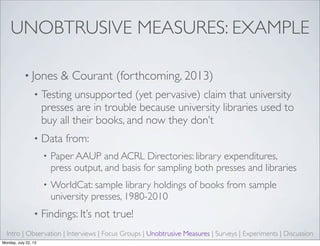
UNOBTRUSIVE MEASURES: EXAMPLE
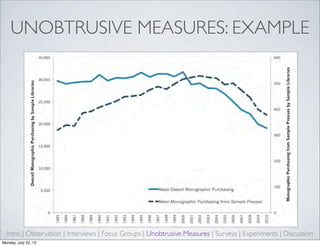
• Jones & Courant (forthcoming, 2013)
• Testing unsupported (yet pervasive) claim that university
presses are in trouble because university libraries used to
buy all their books, and now they don’t
• Data from:
• Paper AAUP and ACRL Directories: library expenditures,
press output, and basis for sampling both presses and libraries
• WorldCat: sample library holdings of books from sample
university presses, 1980-2010
• Findings: It’s not true!
Intro | Observation | Interviews | Focus Groups | Unobtrusive Measures | Surveys | Experiments | Discussion
Monday, July 22, 13
UNOBTRUSIVE MEASURES: EXAMPLE
• Jones & Courant (forthcoming, 2013)
• Testing unsupported (yet pervasive) claim that university
presses are in trouble because university libraries used to
buy all their books, and now they don’t
• Data from:
• Paper AAUP and ACRL Directories: library expenditures,
press output, and basis for sampling both presses and libraries
• WorldCat: sample library holdings of books from sample
university presses, 1980-2010
• Findings: It’s not true!
Intro | Observation | Interviews | Focus Groups | Unobtrusive Measures | Surveys | Experiments | Discussion
Monday, July 22, 13
SURVEYS
• Obtaining information from a sample of individuals
through their responses to a set list of questions
• Quite possibly the most common type of research
done in library settings
• Can be done in person, by mail, over the phone, or
online
• Sampling strategy and sample size are crucial to
validity and generalizability
Intro | Observation | Interviews | Focus Groups | Unobtrusive Measures | Surveys | Experiments | Discussion
Monday, July 22, 13
SURVEYS:WHAT ARETHEY
GOOD FOR?
• Many different kinds of questions, on many different topics
• Research questions that call for a relatively limited amount
of information to be collected from a relatively large
number of individuals
• Situations with significant resource constraints
(interviews, observations, etc. can get very expensive)
• Desire to generalize results beyond the immediate setting
or sample population
(Schutt, 256-260)
Intro | Observation | Interviews | Focus Groups | Unobtrusive Measures | Surveys | Experiments | Discussion
Monday, July 22, 13
SURVEYS:WHAT ARETHEY
LESS GOOD FOR?
• Demonstrating causation (unlike experiments)
• Capturing nonverbal cues (unlike interviews and
observations)
• Understanding social or physical context (unlike
observations)
• Questions requiring in-depth, detailed information from each
informant (unlike interviews) - with some exceptions
• Very common method; also very commonly poorly executed
Intro | Observation | Interviews | Focus Groups | Unobtrusive Measures | Surveys | Experiments | Discussion
Monday, July 22, 13
SURVEYS: EXAMPLE
• D’Elia et al (2002)
• Objective: to collect descriptive information on the consumer market
for public library services and Internet services
• Telephone survey of 3,097 English- and Spanish-speaking adults in the
continental U.S.
• Survey instrument informed by prior focus groups conducted by same
researchers, as well as other similar surveys conducted by others; 3
pilot tests run to refine the instrument
• Findings: use of library and use of the internet are complementary, not
necessarily competing; however, the data also showed shifting
consumer preferences between the two
Intro | Observation | Interviews | Focus Groups | Unobtrusive Measures | Surveys | Experiments | Discussion
Monday, July 22, 13
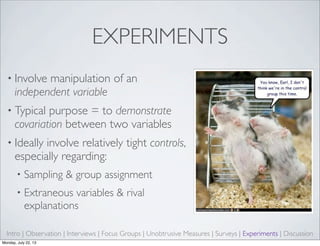
EXPERIMENTS
• Involve manipulation of an
independent variable
• Typical purpose = to demonstrate
covariation between two variables
• Ideally involve relatively tight controls,
especially regarding:
• Sampling & group assignment
• Extraneous variables & rival
explanations
Intro | Observation | Interviews | Focus Groups | Unobtrusive Measures | Surveys | Experiments | Discussion
Monday, July 22, 13
WITHIN-VS. BETWEEN-SUBJECTS
DESIGNS
• Within-Subjects
• Same subject sample utilized throughout
• Complete control over variation among subjects (since subjects do not
vary), but more chance of muddling the data due to subjects dropping out,
learning, hypothesis guessing, etc.
• Between-Subjects
• Multiple sample groups compared against one another (e.g. designs
involving experimental vs. control group)
• Less chance of subjects “catching on,” but higher error rates due to
variability among human beings
• Many designs combine the two
Intro | Observation | Interviews | Focus Groups | Unobtrusive Measures | Surveys | Experiments | Discussion
Monday, July 22, 13
EXPERIMENTS: STRENGTHS &
WEAKNESSES
• Strengths:
• Control
• Ability to establish causality (most important by far)
• Weaknesses
• Artificiality
• Often lacking in external validity
Intro | Observation | Interviews | Focus Groups | Unobtrusive Measures | Surveys | Experiments | Discussion
Monday, July 22, 13
FIELD EXPERIMENTS
• Take place in an existing environment, with
independent variable manipulated by researcher
• Less artificial than lab experiments
• Example: Bertrand & Mullainathan (2004)
• Similar resumes sent to different companies with
distinctly black or white names
• Observe callback rates for different races
• Another example:A/B testing
Intro | Observation | Interviews | Focus Groups | Unobtrusive Measures | Surveys | Experiments | Discussion
Monday, July 22, 13
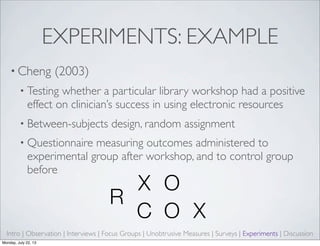
EXPERIMENTS: EXAMPLE
• Cheng (2003)
• Testing whether a particular library workshop had a positive
effect on clinician’s success in using electronic resources
• Between-subjects design, random assignment
• Questionnaire measuring outcomes administered to
experimental group after workshop, and to control group
before
R
X O
R
C O X
Intro | Observation | Interviews | Focus Groups | Unobtrusive Measures | Surveys | Experiments | Discussion
Monday, July 22, 13
YOURTHOUGHTS?
• Where do these methods fit into
library professional life? (do they?)
• Should libraries be building internal
expertise or hiring external
consultants? (Both? Neither?)
• Thoughts on the inclusion of
methodology in MLIS/MSI curricula?
• Other questions, comments, advice
for others?
Intro | Observation | Interviews | Focus Groups | Unobtrusive Measures | Surveys | Experiments | Discussion
Imagefrom:http://parentesis.zonalibre.org/archives/074011.html(originalsourceunknown)
Monday, July 22, 13
THANKS!
Elisabeth Jones
elisjone@umich.edu
Monday, July 22, 13

Research Methods and the Library Professional

  • 1.
    RESEARCH METHODS AND THELIBRARY PROFESSIONAL Elisabeth Jones elisjone@umich.edu July 22, 2013 Monday, July 22, 13
  • 2.
    WHERE I’M COMINGFROM • All sorts of academic library jobs at all sorts of places • No real methodological training before doctoral level • In retrospect... Intro | Observation | Interviews | Focus Groups | Unobtrusive Measures | Surveys | Experiments | Discussion Monday, July 22, 13
  • 3.
    RESEARCH METHODS FOR INFORMATIONPROFESSIONALS (SI 623) • 2013 = Second time the class had been offered in its current form • Students tended to have quite low interest in taking it • Hard to see why, as a future librarian or archivist, they might ever have a use for traditional research methods • Plus, you know, methods. Boring. • However... Intro | Observation | Interviews | Focus Groups | Unobtrusive Measures | Surveys | Experiments | Discussion Monday, July 22, 13
  • 4.
    RESEARCH METHODS FOR INFORMATIONPROFESSIONALS (SI 623) • The course centers around each student assembling a proposal for some piece of research related to their professional interests • At least three students had already begun to implement their proposed studies by the time the class ended in April • Several others developed feasible - and even possibly fundable - proposals • Students noted in the evaluations that the course actually seemed much more applicable looking back than it had seemed at the beginning of the term (and also more fun…) Intro | Observation | Interviews | Focus Groups | Unobtrusive Measures | Surveys | Experiments | Discussion Monday, July 22, 13
  • 5.
    ANDYOU? • Did youhave any kind of research methods training in your college or grad school coursework? • Have you participated in conducting research in your professional life? • What kind(s)? • What motivated you to do it? • How have you come away feeling about the experience(s)? Intro | Observation | Interviews | Focus Groups | Unobtrusive Measures | Surveys | Experiments | Discussion Monday, July 22, 13
  • 6.
    TODAY’STALK • The 10,000-footview of six data collection methods one might use to inform library practice • What they are • What they’re good for • What they’re not so good for • Discussion: • Where do these methods fit into library professional life? (Do they?) • Should libraries be building internal expertise or hiring external consultants? (Both? Neither?) • Thoughts on the inclusion of methodology in MLIS/MSI curricula? Intro | Observation | Interviews | Focus Groups | Unobtrusive Measures | Surveys | Experiments | Discussion Monday, July 22, 13
  • 7.
    A BIT OFCONTEXT... Research Question(s) Research Design (Human Subjects Review) Data Collection Data Analysis Writing and Publication You Are Here Intro | Observation | Interviews | Focus Groups | Unobtrusive Measures | Surveys | Experiments | Discussion Monday, July 22, 13
  • 8.
  • 9.
    DATA COLLECTION METHODS: AQUICK AND DIRTY OVERVIEW Monday, July 22, 13
  • 10.
    ONTHE AGENDA • Observation •Interviews • Focus Groups • Unobtrusive Measures • Surveys • Experiments (but ideally not all research) Intro | Observation | Interviews | Focus Groups | Unobtrusive Measures | Surveys | Experiments | Discussion Image:http://xkcd.com/904/ Monday, July 22, 13
  • 11.
    OBSERVATION Working to understandthe social dynamics of a particular setting by observing and recording what goes on there over an extended period of time Covert participant observation Concealed recording equipment or concealed observer Visible recording equipment made unobtrusive Participant observation, recording done out of sight of observed Participant observation, recording done in sight of observed Non- participant observer Continuum of Obtrusiveness Intro | Observation | Interviews | Focus Groups | Unobtrusive Measures | Surveys | Experiments | Discussion Monday, July 22, 13
  • 12.
    OBSERVATION: WHAT IS ITGOOD FOR? • Nuanced understanding of behavior within a particular setting • Situations where flexibility in approach is useful (e.g. in dealing with the unexpected) • Problems or settings about which extremely little is known • Situations in which individuals’ self-report may not match their actual behavior • Plus one practicality... Intro | Observation | Interviews | Focus Groups | Unobtrusive Measures | Surveys | Experiments | Discussion Monday, July 22, 13
  • 13.
    OBSERVATION: WHAT ISIT LESS GOOD FOR? • Understanding motivations (unlike interviews) • Seeing beyond the immediate present (unlike interviews, historical research, predictive modeling) • Comparisons of highly pre-specified characteristics or behaviors across large populations (unlike surveys) • Producing broadly generalizable findings (unlike some surveys and experiments) Intro | Observation | Interviews | Focus Groups | Unobtrusive Measures | Surveys | Experiments | Discussion Monday, July 22, 13
  • 14.
    OBSERVATION: EXAMPLE • Curry(2005) • Examined quality of reference services provided by Vancouver area libraries to GBLT youth • Covert, unobtrusive observation; element of deception Intro | Observation | Interviews | Focus Groups | Unobtrusive Measures | Surveys | Experiments | Discussion Image:http://www.richlandcollege.edu/library/photoTourIntro2.php Monday, July 22, 13
  • 15.
    INTERVIEWS • Asking directquestions of individuals in order to gain insight into their experiences, motivations, or feelings • Types of Interview: • Informal conversation (“Unstructured interview”) • General interview guide (“Semi- structured interview”) • Standardized open-ended interview Intro | Observation | Interviews | Focus Groups | Unobtrusive Measures | Surveys | Experiments | Discussion ImagefromFlickruserbeedieu,viaMITOpenCourseware Monday, July 22, 13
  • 16.
    INTERVIEWS:WHAT ARETHEY GOOD FOR? •When you want to find something out that you cannot directly observe • E.g. feelings, thoughts, intentions, past behavior, activities in private settings, individual sense-making processes • To find out what is on someone else’s mind; to gather their stories • Underlying assumption: the perspective of others is meaningful, knowable, and able to be made explicit (Patton, 341) Intro | Observation | Interviews | Focus Groups | Unobtrusive Measures | Surveys | Experiments | Discussion Monday, July 22, 13
  • 17.
    INTERVIEWS:WHAT ARETHEY LESS GOODFOR? • Understanding social or physical context (unlike observation) • Comparisons of highly pre-specified characteristics or behaviors across large populations (unlike surveys) • Producing broadly generalizable findings (unlike some surveys and experiments) Intro | Observation | Interviews | Focus Groups | Unobtrusive Measures | Surveys | Experiments | Discussion Monday, July 22, 13
  • 18.
    INTERVIEWS: EXAMPLE • Haraet al (2003) • Semi-structured interviews used to study collaboration in a multidisciplinary, geographically dispersed research center • Study participants included faculty, postdocs, and students • Interviews explored reasons for imbalances in collaborative relationships found through earlier sociometric analysis of the research group, by collecting participants’ general impressions of and stories about collaboration Intro | Observation | Interviews | Focus Groups | Unobtrusive Measures | Surveys | Experiments | Discussion Monday, July 22, 13
  • 19.
    FOCUS GROUPS • Researcherasks direct questions of a group of people, all at once • Not just a group interview • Serve different purposes, and have different pros and cons • Generally proceed from broad to narrow Q’s • Relatively homogeneous demographics, if possible • Video recording = near-essential Intro | Observation | Interviews | Focus Groups | Unobtrusive Measures | Surveys | Experiments | Discussion Monday, July 22, 13
  • 20.
    FOCUS GROUPS:WHAT ARE THEYGOOD FOR? • Obtaining general background information about a topic of interest • Stimulating new ideas and creative concepts • Diagnosing the potential for problems with a new program, service or product • Generating impressions of products, programs, services, institutions or other objects of interest • Learning how respondents talk about the phenomenon of interest Intro | Observation | Interviews | Focus Groups | Unobtrusive Measures | Surveys | Experiments | Discussion Monday, July 22, 13
  • 21.
    FOCUS GROUPS:WHAT ARE THEYLESS GOOD FOR? • Highly sensitive or personal information (unlike any method where confidentiality can be ensured) • Questions where additional observers are likely to have a significant effect on responses (unlike any method with ≤1 observer present) • Questions requiring in-depth, detailed information from each informant (unlike interviews, some surveys) • Understanding social or physical context (unlike observation) • Comparisons of highly pre-specified characteristics or behaviors across large populations (unlike surveys) • Producing broadly generalizable findings (unlike some surveys and experiments) Intro | Observation | Interviews | Focus Groups | Unobtrusive Measures | Surveys | Experiments | Discussion Monday, July 22, 13
  • 22.
    FOCUS GROUPS: EXAMPLE •Shoaf (2003) • Used focus groups to evaluate the performance of an academic library (at Brown U.) • No library or university staff with focus group expertise, so hired an outside consultant • Article reports on lessons learned regarding the procedures and strategies involved in running a focus group, and assesses the decision to pay for outside help (they came out in favor of it in this case) Intro | Observation | Interviews | Focus Groups | Unobtrusive Measures | Surveys | Experiments | Discussion Monday, July 22, 13
  • 23.
    UNOBTRUSIVE MEASURES • Usingdata that already exists to answer a new question • For example: • Internal library data • Circulation, Gate, Collections • Web analytics • Internal documents • Archival materials • Existing datasets and databases • Can take a lot of work to convert data into re-usable form Intro | Observation | Interviews | Focus Groups | Unobtrusive Measures | Surveys | Experiments | Discussion Monday, July 22, 13
  • 24.
    UNOBTRUSIVE MEASURES: WHAT ARETHEYGOOD FOR? • Non-reactive data can be easier to gather (no pesky people!) • Can provide longitudinal perspective beyond the time scope of the research itself • There is so, so much of this kind of data in libraries • Differently biased than other measures Intro | Observation | Interviews | Focus Groups | Unobtrusive Measures | Surveys | Experiments | Discussion Monday, July 22, 13
  • 25.
    PROBLEMS WITH UNOBTRUSIVE MEASURES •Data = human construction • Original purpose affects interpretation • Their “signal” might be your “noise” • Not everything important is documented; not everything documented is kept; not everything kept is accurate • Mixing sources = risky • Ethics, privacy, etc. Intro | Observation | Interviews | Focus Groups | Unobtrusive Measures | Surveys | Experiments | Discussion Monday, July 22, 13
  • 26.
    UNOBTRUSIVE MEASURES: EXAMPLE •Jones & Courant (forthcoming, 2013) • Testing unsupported (yet pervasive) claim that university presses are in trouble because university libraries used to buy all their books, and now they don’t • Data from: • Paper AAUP and ACRL Directories: library expenditures, press output, and basis for sampling both presses and libraries • WorldCat: sample library holdings of books from sample university presses, 1980-2010 • Findings: It’s not true! Intro | Observation | Interviews | Focus Groups | Unobtrusive Measures | Surveys | Experiments | Discussion Monday, July 22, 13
  • 27.
    UNOBTRUSIVE MEASURES: EXAMPLE •Jones & Courant (forthcoming, 2013) • Testing unsupported (yet pervasive) claim that university presses are in trouble because university libraries used to buy all their books, and now they don’t • Data from: • Paper AAUP and ACRL Directories: library expenditures, press output, and basis for sampling both presses and libraries • WorldCat: sample library holdings of books from sample university presses, 1980-2010 • Findings: It’s not true! Intro | Observation | Interviews | Focus Groups | Unobtrusive Measures | Surveys | Experiments | Discussion Monday, July 22, 13
  • 28.
    SURVEYS • Obtaining informationfrom a sample of individuals through their responses to a set list of questions • Quite possibly the most common type of research done in library settings • Can be done in person, by mail, over the phone, or online • Sampling strategy and sample size are crucial to validity and generalizability Intro | Observation | Interviews | Focus Groups | Unobtrusive Measures | Surveys | Experiments | Discussion Monday, July 22, 13
  • 29.
    SURVEYS:WHAT ARETHEY GOOD FOR? •Many different kinds of questions, on many different topics • Research questions that call for a relatively limited amount of information to be collected from a relatively large number of individuals • Situations with significant resource constraints (interviews, observations, etc. can get very expensive) • Desire to generalize results beyond the immediate setting or sample population (Schutt, 256-260) Intro | Observation | Interviews | Focus Groups | Unobtrusive Measures | Surveys | Experiments | Discussion Monday, July 22, 13
  • 30.
    SURVEYS:WHAT ARETHEY LESS GOODFOR? • Demonstrating causation (unlike experiments) • Capturing nonverbal cues (unlike interviews and observations) • Understanding social or physical context (unlike observations) • Questions requiring in-depth, detailed information from each informant (unlike interviews) - with some exceptions • Very common method; also very commonly poorly executed Intro | Observation | Interviews | Focus Groups | Unobtrusive Measures | Surveys | Experiments | Discussion Monday, July 22, 13
  • 31.
    SURVEYS: EXAMPLE • D’Eliaet al (2002) • Objective: to collect descriptive information on the consumer market for public library services and Internet services • Telephone survey of 3,097 English- and Spanish-speaking adults in the continental U.S. • Survey instrument informed by prior focus groups conducted by same researchers, as well as other similar surveys conducted by others; 3 pilot tests run to refine the instrument • Findings: use of library and use of the internet are complementary, not necessarily competing; however, the data also showed shifting consumer preferences between the two Intro | Observation | Interviews | Focus Groups | Unobtrusive Measures | Surveys | Experiments | Discussion Monday, July 22, 13
  • 32.
    EXPERIMENTS • Involve manipulationof an independent variable • Typical purpose = to demonstrate covariation between two variables • Ideally involve relatively tight controls, especially regarding: • Sampling & group assignment • Extraneous variables & rival explanations Intro | Observation | Interviews | Focus Groups | Unobtrusive Measures | Surveys | Experiments | Discussion Monday, July 22, 13
  • 33.
    WITHIN-VS. BETWEEN-SUBJECTS DESIGNS • Within-Subjects •Same subject sample utilized throughout • Complete control over variation among subjects (since subjects do not vary), but more chance of muddling the data due to subjects dropping out, learning, hypothesis guessing, etc. • Between-Subjects • Multiple sample groups compared against one another (e.g. designs involving experimental vs. control group) • Less chance of subjects “catching on,” but higher error rates due to variability among human beings • Many designs combine the two Intro | Observation | Interviews | Focus Groups | Unobtrusive Measures | Surveys | Experiments | Discussion Monday, July 22, 13
  • 34.
    EXPERIMENTS: STRENGTHS & WEAKNESSES •Strengths: • Control • Ability to establish causality (most important by far) • Weaknesses • Artificiality • Often lacking in external validity Intro | Observation | Interviews | Focus Groups | Unobtrusive Measures | Surveys | Experiments | Discussion Monday, July 22, 13
  • 35.
    FIELD EXPERIMENTS • Takeplace in an existing environment, with independent variable manipulated by researcher • Less artificial than lab experiments • Example: Bertrand & Mullainathan (2004) • Similar resumes sent to different companies with distinctly black or white names • Observe callback rates for different races • Another example:A/B testing Intro | Observation | Interviews | Focus Groups | Unobtrusive Measures | Surveys | Experiments | Discussion Monday, July 22, 13
  • 36.
    EXPERIMENTS: EXAMPLE • Cheng(2003) • Testing whether a particular library workshop had a positive effect on clinician’s success in using electronic resources • Between-subjects design, random assignment • Questionnaire measuring outcomes administered to experimental group after workshop, and to control group before R X O R C O X Intro | Observation | Interviews | Focus Groups | Unobtrusive Measures | Surveys | Experiments | Discussion Monday, July 22, 13
  • 37.
    YOURTHOUGHTS? • Where dothese methods fit into library professional life? (do they?) • Should libraries be building internal expertise or hiring external consultants? (Both? Neither?) • Thoughts on the inclusion of methodology in MLIS/MSI curricula? • Other questions, comments, advice for others? Intro | Observation | Interviews | Focus Groups | Unobtrusive Measures | Surveys | Experiments | Discussion Imagefrom:http://parentesis.zonalibre.org/archives/074011.html(originalsourceunknown) Monday, July 22, 13
  • 38.