


Is a specialty of medicine concerned with physical, mental, functional & social conditions in acute, chronic, rehabilitative, preventative & end of life care of older patients www.geriatrics.org
is the progressive decline in functional reserve and function in an organisms over time biochemical composition of tissues changes  ability to maintain homeostasis in adapting to stressors declines vulnerability to disease processes increases with age
Older adults is expected to increase from 420 to 974 M in 2030 At present 59% of older adults live in the developing countries  13% of 80 years old live in the US >40% of those 80 yo live in Asia
chronic diseases causes 20M deaths worldwide among  70 yo The major disease contributors:  >Cardiovascular disease -30%, >Cancer-13% >Chronic respiratory disease-7% >DM-2%
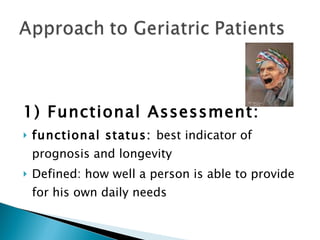
1) Functional Assessment:  functional status:  best indicator of prognosis and longevity Defined: how well a person is able to provide for his own daily needs
Changes in function may signal a medical illness, advancing cognitive impairment, changes in social support, depression, substance abuse, or a combination Documentation of a patient's baseline functional status is essential so that changes can be identified and addressed.
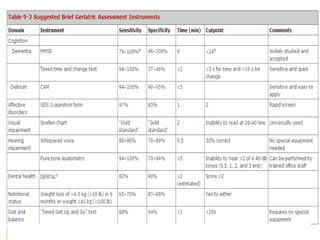
is a clinical measure of balance in older adults Pt is observed and timed as he rises from a chair, walks 3m, turns around, & returns to sit down in the chair Healthy: should be able to complete the test in <10 s Difficulty doing the test: increased fall risk & warrants further evaluation of mobility.
consists of three item recall test followed by a clock-drawing test   Pt is then asked to recall the 3 words. PT receives 2 points for a normal clock A score of 0–2 is a positive screen for dementia.
is used for diagnosing delirium in a patient with altered mental status. DX:  when the confusional state is:  1) acute in onset with a fluctuating course  2) associated with inattention 3) manifested by disorganized thinking 4) an altered level of consciousness
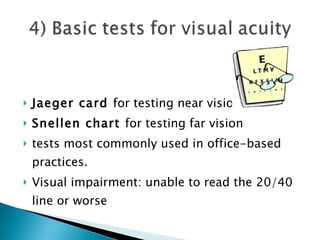
Jaeger card  for testing near vision Snellen chart  for testing far vision  tests most commonly used in office-based practices.  Visual impairment: unable to read the 20/40 line or worse
the examiner covers the opposite ear of the patient being tested, exhales completely, & whispers an easily answered question from a distance of 2 ft from the ear being tested Treatment:  amplification by a hearing aid Hearing impairment can lead to decreased physical function, depression, and social isolation.
Definition: (1) involuntary wt loss 4.5 kg over 6 mos or  4%  in 1 year (2) abnormal BMI:  < 22 or > 27 (3) hypoalbuminemia : <38 g/L (4) hypocholesterolemia (<160 mg/dL) (5) specific vitamin or micronutrient deficiency (Vit B 12 ). If any one of these is present, a multidimensional assessment should be undertaken
MD should review the patient's access to food. Are there any barriers? Any dental problems that interfere with eating? Are there any medical illnesses interfere with digestion/absorption of food?  Is the pt unable to prepare meals/feed himself?  Does the pt have food preferences?
 
a symptom presentation that is common in older adults, mostly multifactorial in origin Dementia and Delirium Falls Urinary Incontinence Pressure Ulcers
Dementia : a syndrome of progressive decline in w/c multiple intellectual abilities deteriorate, causing cognitive & functional impairment Delirium : an acute state of confusion, impaired attention, and altered level of consciousness. Both : char by disorientation, memory impairment, paranoia, hallucinations, emotional lability, & sleep-wake cycle reversal.
to maintain an optimal quality of life to maximize cognitive & physical functioning key goal:  older patient w/ cognitive impairment is to identify & treat reversible causes: infections, electrolyte abno, vit def, thyroid dse, substance abuse, meds & psychiatric illnesses
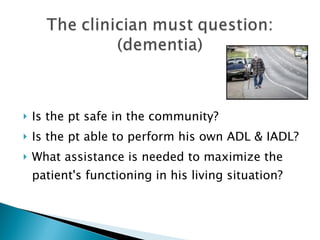
Is the pt safe in the community? Is the pt able to perform his own ADL & IADL? What assistance is needed to maximize the patient's functioning in his living situation?
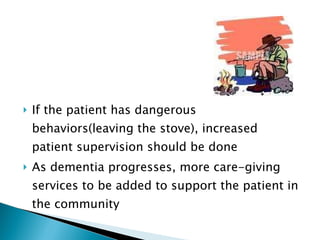
If the patient has dangerous behaviors(leaving the stove), increased patient supervision should be done As dementia progresses, more care-giving services to be added to support the patient in the community
Predictors of nursing home admission (Alzheimer's dse):  aggression, assault, paranoia, nighttime wandering & loss of capacity to recognize the caregiver Adult day care programs  &  Support groups  help educate caregivers & decrease stress.
When dementia pts has agitated behaviors, medical illnesses(infections, pain) must be ruled out  If agitated behavior is harmful to patient/others & unresponsive to non-pharmacologic tx, then low doses psychotropic medication is helpful.
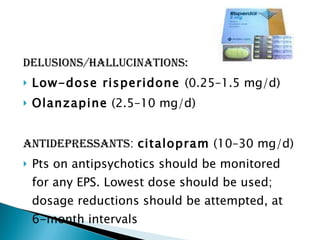
Delusions/hallucinations:   Low-dose risperidone  (0.25–1.5 mg/d)  Olanzapine  (2.5–10 mg/d)  Antidepressants :  citalopram  (10–30 mg/d) Pts on antipsychotics should be monitored for any EPS. Lowest dose should be used; dosage reductions should be attempted, at 6-month intervals
Fall rates & risk of injury increases with age Yearly, 30% of community dwelling adults >65 years fall 50% of individuals >80 years fall Injuries in 20–30% of fallers reduce subsequent mobility and independence  3–5% of falls resulting in fracture.
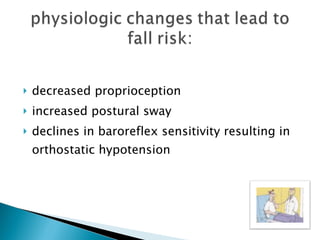
decreased proprioception increased postural sway declines in baroreflex sensitivity resulting in orthostatic hypotension
History the circumstances at the time of the fall any associated symptoms thorough medication review(prescription & over-the-counter meds). PE:  postural vital signs, vision evaluation, gait and balance testing, & musculoskeletal evaluation (joint stability & range of motion)
low creatinine clearance (< 65 mL/min) low serum 25-hydroxyvitamin D levels (< 39 nmol/L) and high serum PTH levels Insomnia fear of falling
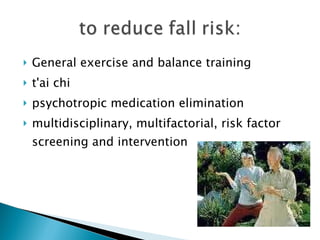
General exercise and balance training t'ai chi psychotropic medication elimination multidisciplinary, multifactorial, risk factor screening and intervention
&quot;DRIIIPP&quot; mnemonic  is useful when evaluating patient for reversible conditions that may cause/contribute to UI If these conditions are identified & treated, the older adult benefits from relief of UI and symptoms of other comorbidities
D elirium  R estricted mobility  -illness, injury, gait disorder, restraint   I nfection —acute, symptomatic UTI I nflammation  -atrophic vaginitis   I mpaction  -of feces  P olyuria  -diabetes, caffeine intake, volume overload P harmaceuticals —diuretics, adrenergic agonists or antagonists, anticholinergic agents (psychotropics, antidepressants, anti-Parkinsonians)
 
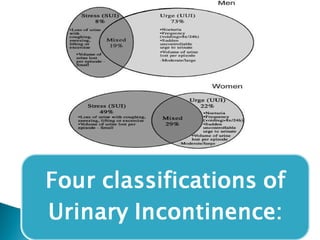
results when the urethral sphincter are inadequate to hold urine during bladder filling SX: leaking small amounts of urine during activities that increase intraabdominal pressure (coughing, laughing, sneezing, lifting)
Stress Test:  let the patient stand with a full bladder and cough.  (+):  if urine leakage coincides with the cough causes: insufficient pelvic support due to childbearing, gynecologic surgery & decreased effects of estrogen on the lower urinary tract tissues Surgery: most effective treatments Pelvic muscle exercises can be helpful
Char by uninhibited bladder contractions  most common form of UI  SX: uncontrollable need to void. Urinary frequency and nocturnal incontinence accompanied by loss of larger urine volumes (>100 mL) idiopathic, lesions of CNS(stroke), bladder irritation from infection, stones, or tumors.  DX: based on a patient's symptoms in the absence of urinary retention and the leakage of urine with stress maneuvers.
Measurement of postvoid residual should be part of an incontinence evaluation Patient's bladder is catheterized 5–10 min after the patient has voided. PVR > 200 mL suggests detrusor underactivity or obstruction.
TX:  bladder retraining by voiding q2 h or based on the patient's symptom frequency If no incontinence for 2 days, the voiding interval can be increased by 30–60 minutes until the patient is only voiding every 3–4 h Anticholinergic: (oxybutinin & tolterodine) which cause bladder relaxation.
SX:  stress & urge incontinence are present 3 incontinence questions (3IQ) may help to classify Q1 : asks if pt has leaked urine in the past 3 months Q2 : familiarizes patients with types of incontinence: stress, urge, or other Q3 : asks the patient for the category of incontinence based on symptoms during the past 3 months: stress, urge, mixed, or other The 3IQ improved the chance of a positive diagnosis of urge incontinence (+likelihood ratio of 3.29) and of stress incontinence (+likelihood ratio of 2.13).
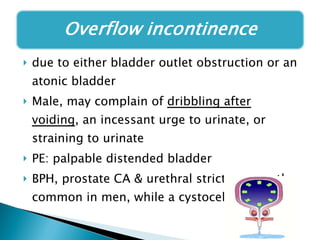
due to either bladder outlet obstruction or an atonic bladder Male, may complain of  dribbling after voiding , an incessant urge to urinate, or straining to urinate PE: palpable distended bladder BPH, prostate CA & urethral strictures are the common in men, while a cystocele in women
Urodynamic testing  used to distinguish urethral obstruction from detrusor underactivity TX: bladder outlet obstruction: surgical removal of obstruction BPH and are not in retention:  Adrenergic blockers : terazosin, doxazosin, or tamulosin can decrease symptoms of urinary frequency and nocturia. 5-reductase inhibitor : Finasteride  w/ doxazosin for decreasing LUTS due to BPH w/ a prostate volume of 25 mL.
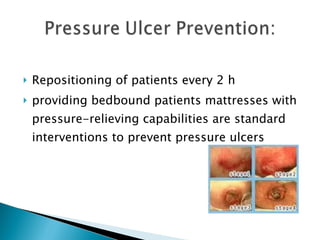
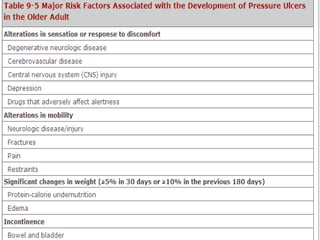
Increased pressure between skin & bony prominence produces tissue necrosis.  occur in 80% over the heels, lateral malleoli, sacrum, ischia, and greater trochanters Shear forces, cause stretching & angulation of blood vessels, frictional forces cause separation of the epidermal/dermal layers    tissue necrosis & open ulceration.  Osteomyelitis & sepsis: morbid complications
Repositioning of patients every 2 h  providing bedbound patients mattresses with pressure-relieving capabilities are standard interventions to prevent pressure ulcers
 
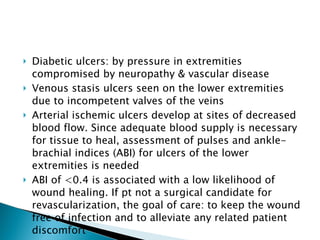
Diabetic ulcers: by pressure in extremities compromised by neuropathy & vascular disease Venous stasis ulcers seen on the lower extremities due to incompetent valves of the veins Arterial ischemic ulcers develop at sites of decreased blood flow. Since adequate blood supply is necessary for tissue to heal, assessment of pulses and ankle-brachial indices (ABI) for ulcers of the lower extremities is needed ABI of <0.4 is associated with a low likelihood of wound healing. If pt not a surgical candidate for revascularization, the goal of care: to keep the wound free of infection and to alleviate any related patient discomfort
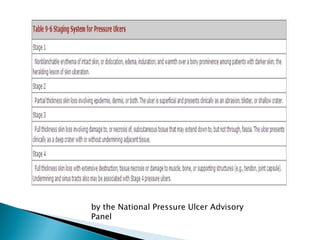
by the National Pressure Ulcer Advisory Panel
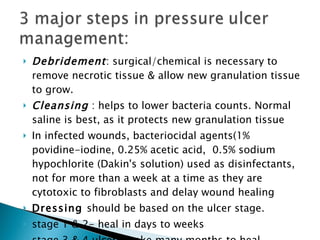
Debridement : surgical/chemical is necessary to remove necrotic tissue & allow new granulation tissue to grow. Cleansing   : helps to lower bacteria counts. Normal saline is best, as it protects new granulation tissue In infected wounds, bacteriocidal agents(1% povidine-iodine, 0.25% acetic acid,  0.5% sodium hypochlorite (Dakin's solution) used as disinfectants, not for more than a week at a time as they are cytotoxic to fibroblasts and delay wound healing Dressing  should be based on the ulcer stage.  stage 1 & 2- heal in days to weeks stage 3 & 4 ulcers -take many months to heal.
Adequate nutrition is fundamental to healthy aging.  In general, energy req decrease w/ age due to a dec in lean body mass & physical activity Older adults may be at risk of undernutrition due to medication side effects; functional, visual, or cognitive impairment; oral disease, swallowing disorders,; depression & social isolation; & chronic illnesses.
The requirements of protein, fat, and carbohydrates do not change with age, calories from carbohydrate sources gradually substitute for those from fat
To maintain adequate caloric intake and promote cardiovascular health, substitution of monounsaturated (olive oil), omega-3 (sardines) & omega-6 (liquid vegetable oils) fatty acids for  trans  fatty acids may be beneficial.
Although vitamin requirements do not change with age, older adults are particularly prone to inadequate intake of vitamins D, B 12  and calcium, and supplementation should be considered
Exercise improves body composition, psychological well-being & disease outcomes, and reduces risk of injurious falls Physical and cognitive exercise reduces risk of dementia An exercise prescription may be beneficial & should consider flexibility, endurance, strength, and balance but should be preceded by attention to musculoskeletal problems, footwear, and risk factors for cardiovascular disease
Falls risk assessment is addressed Exercise decreases risk Seatbelt use should be encouraged Moderate alcohol consumption has many salutary effects, but has many consequences for older adults who are at risk for alcohol side effects at lower levels of consumption
 
Immunizations: Influenza vaccination is recommended annually all adults > 65 should receive the pneumococcal vaccine at least once Tetanus vaccinations should be administered every 10 years
Bone Health: 70% of women 80 years have osteoporosis all women >65 years should receive dual-energy x-ray absorptiometry (DEXA) screening at least once minimum of 2 years: recommended to measure a change in bone density
Breast Cancer: incidence of breast cancer increases with age & peaks in the eighth decade Sensitivity&specificity of mammography reaches its maximum in the ninth decade Annual clinical breast examination (CBE) is a screening alternative to mammography, since the postmenopausal atrophy of breast tissue improves CBE sensitivity in older women
Prostate Cancer: U.S. Preventive Services Task Force has concluded that evidence to recommend for or against screening is lacking American Cancer Society and American Urological Society recommend screening among those with at least a 10-year life expectancy
Colorectal Cancer: Annual or biennial fecal occult blood testing (FOBT) reduces mortality in those >80 sigmoidoscopy (every 5 years) colonoscopy (every 10 years) No one method has been shown to be superior, and all methods are cost effective.  (DRE) alone or with FOBT is not recommended
Colonoscopy: colon can be completely visualized and biopsies taken if the examination is positive If negative, it does not need to be repeated for 10 years
Lung Cancer: Although lung cancer is also a leading killer, no screening interventions have been shown to be effective.
Smoking cessation & BP reduction, results in greater gains in life-years than do medical and surgical therapies, especially in men lower levels of risk factors in mid-life are associated with survival free of major morbidity to age 85.  A person is never too old to benefit from smoking cessation.
 

Geriatric Medicine

  • 1.
  • 2.
    Is a specialtyof medicine concerned with physical, mental, functional & social conditions in acute, chronic, rehabilitative, preventative & end of life care of older patients www.geriatrics.org
  • 3.
    is the progressivedecline in functional reserve and function in an organisms over time biochemical composition of tissues changes ability to maintain homeostasis in adapting to stressors declines vulnerability to disease processes increases with age
  • 4.
    Older adults isexpected to increase from 420 to 974 M in 2030 At present 59% of older adults live in the developing countries 13% of 80 years old live in the US >40% of those 80 yo live in Asia
  • 5.
    chronic diseases causes20M deaths worldwide among 70 yo The major disease contributors: >Cardiovascular disease -30%, >Cancer-13% >Chronic respiratory disease-7% >DM-2%
  • 6.
    1) Functional Assessment: functional status: best indicator of prognosis and longevity Defined: how well a person is able to provide for his own daily needs
  • 7.
    Changes in functionmay signal a medical illness, advancing cognitive impairment, changes in social support, depression, substance abuse, or a combination Documentation of a patient's baseline functional status is essential so that changes can be identified and addressed.
  • 8.
    is a clinicalmeasure of balance in older adults Pt is observed and timed as he rises from a chair, walks 3m, turns around, & returns to sit down in the chair Healthy: should be able to complete the test in <10 s Difficulty doing the test: increased fall risk & warrants further evaluation of mobility.
  • 9.
    consists of threeitem recall test followed by a clock-drawing test Pt is then asked to recall the 3 words. PT receives 2 points for a normal clock A score of 0–2 is a positive screen for dementia.
  • 10.
    is used fordiagnosing delirium in a patient with altered mental status. DX: when the confusional state is: 1) acute in onset with a fluctuating course 2) associated with inattention 3) manifested by disorganized thinking 4) an altered level of consciousness
  • 11.
    Jaeger card for testing near vision Snellen chart for testing far vision tests most commonly used in office-based practices. Visual impairment: unable to read the 20/40 line or worse
  • 12.
    the examiner coversthe opposite ear of the patient being tested, exhales completely, & whispers an easily answered question from a distance of 2 ft from the ear being tested Treatment: amplification by a hearing aid Hearing impairment can lead to decreased physical function, depression, and social isolation.
  • 13.
    Definition: (1) involuntarywt loss 4.5 kg over 6 mos or 4% in 1 year (2) abnormal BMI: < 22 or > 27 (3) hypoalbuminemia : <38 g/L (4) hypocholesterolemia (<160 mg/dL) (5) specific vitamin or micronutrient deficiency (Vit B 12 ). If any one of these is present, a multidimensional assessment should be undertaken
  • 14.
    MD should reviewthe patient's access to food. Are there any barriers? Any dental problems that interfere with eating? Are there any medical illnesses interfere with digestion/absorption of food? Is the pt unable to prepare meals/feed himself? Does the pt have food preferences?
  • 15.
  • 16.
    a symptom presentationthat is common in older adults, mostly multifactorial in origin Dementia and Delirium Falls Urinary Incontinence Pressure Ulcers
  • 17.
    Dementia : asyndrome of progressive decline in w/c multiple intellectual abilities deteriorate, causing cognitive & functional impairment Delirium : an acute state of confusion, impaired attention, and altered level of consciousness. Both : char by disorientation, memory impairment, paranoia, hallucinations, emotional lability, & sleep-wake cycle reversal.
  • 18.
    to maintain anoptimal quality of life to maximize cognitive & physical functioning key goal: older patient w/ cognitive impairment is to identify & treat reversible causes: infections, electrolyte abno, vit def, thyroid dse, substance abuse, meds & psychiatric illnesses
  • 19.
    Is the ptsafe in the community? Is the pt able to perform his own ADL & IADL? What assistance is needed to maximize the patient's functioning in his living situation?
  • 20.
    If the patienthas dangerous behaviors(leaving the stove), increased patient supervision should be done As dementia progresses, more care-giving services to be added to support the patient in the community
  • 21.
    Predictors of nursinghome admission (Alzheimer's dse): aggression, assault, paranoia, nighttime wandering & loss of capacity to recognize the caregiver Adult day care programs & Support groups help educate caregivers & decrease stress.
  • 22.
    When dementia ptshas agitated behaviors, medical illnesses(infections, pain) must be ruled out If agitated behavior is harmful to patient/others & unresponsive to non-pharmacologic tx, then low doses psychotropic medication is helpful.
  • 23.
    Delusions/hallucinations: Low-dose risperidone (0.25–1.5 mg/d) Olanzapine (2.5–10 mg/d) Antidepressants : citalopram (10–30 mg/d) Pts on antipsychotics should be monitored for any EPS. Lowest dose should be used; dosage reductions should be attempted, at 6-month intervals
  • 24.
    Fall rates &risk of injury increases with age Yearly, 30% of community dwelling adults >65 years fall 50% of individuals >80 years fall Injuries in 20–30% of fallers reduce subsequent mobility and independence 3–5% of falls resulting in fracture.
  • 25.
    decreased proprioception increasedpostural sway declines in baroreflex sensitivity resulting in orthostatic hypotension
  • 26.
    History the circumstancesat the time of the fall any associated symptoms thorough medication review(prescription & over-the-counter meds). PE: postural vital signs, vision evaluation, gait and balance testing, & musculoskeletal evaluation (joint stability & range of motion)
  • 27.
    low creatinine clearance(< 65 mL/min) low serum 25-hydroxyvitamin D levels (< 39 nmol/L) and high serum PTH levels Insomnia fear of falling
  • 28.
    General exercise andbalance training t'ai chi psychotropic medication elimination multidisciplinary, multifactorial, risk factor screening and intervention
  • 29.
    &quot;DRIIIPP&quot; mnemonic is useful when evaluating patient for reversible conditions that may cause/contribute to UI If these conditions are identified & treated, the older adult benefits from relief of UI and symptoms of other comorbidities
  • 30.
    D elirium  Restricted mobility -illness, injury, gait disorder, restraint  I nfection —acute, symptomatic UTI I nflammation -atrophic vaginitis  I mpaction -of feces  P olyuria -diabetes, caffeine intake, volume overload P harmaceuticals —diuretics, adrenergic agonists or antagonists, anticholinergic agents (psychotropics, antidepressants, anti-Parkinsonians)
  • 31.
  • 32.
    results when theurethral sphincter are inadequate to hold urine during bladder filling SX: leaking small amounts of urine during activities that increase intraabdominal pressure (coughing, laughing, sneezing, lifting)
  • 33.
    Stress Test: let the patient stand with a full bladder and cough. (+): if urine leakage coincides with the cough causes: insufficient pelvic support due to childbearing, gynecologic surgery & decreased effects of estrogen on the lower urinary tract tissues Surgery: most effective treatments Pelvic muscle exercises can be helpful
  • 34.
    Char by uninhibitedbladder contractions most common form of UI SX: uncontrollable need to void. Urinary frequency and nocturnal incontinence accompanied by loss of larger urine volumes (>100 mL) idiopathic, lesions of CNS(stroke), bladder irritation from infection, stones, or tumors. DX: based on a patient's symptoms in the absence of urinary retention and the leakage of urine with stress maneuvers.
  • 35.
    Measurement of postvoidresidual should be part of an incontinence evaluation Patient's bladder is catheterized 5–10 min after the patient has voided. PVR > 200 mL suggests detrusor underactivity or obstruction.
  • 36.
    TX: bladderretraining by voiding q2 h or based on the patient's symptom frequency If no incontinence for 2 days, the voiding interval can be increased by 30–60 minutes until the patient is only voiding every 3–4 h Anticholinergic: (oxybutinin & tolterodine) which cause bladder relaxation.
  • 37.
    SX: stress& urge incontinence are present 3 incontinence questions (3IQ) may help to classify Q1 : asks if pt has leaked urine in the past 3 months Q2 : familiarizes patients with types of incontinence: stress, urge, or other Q3 : asks the patient for the category of incontinence based on symptoms during the past 3 months: stress, urge, mixed, or other The 3IQ improved the chance of a positive diagnosis of urge incontinence (+likelihood ratio of 3.29) and of stress incontinence (+likelihood ratio of 2.13).
  • 38.
    due to eitherbladder outlet obstruction or an atonic bladder Male, may complain of dribbling after voiding , an incessant urge to urinate, or straining to urinate PE: palpable distended bladder BPH, prostate CA & urethral strictures are the common in men, while a cystocele in women
  • 39.
    Urodynamic testing used to distinguish urethral obstruction from detrusor underactivity TX: bladder outlet obstruction: surgical removal of obstruction BPH and are not in retention: Adrenergic blockers : terazosin, doxazosin, or tamulosin can decrease symptoms of urinary frequency and nocturia. 5-reductase inhibitor : Finasteride w/ doxazosin for decreasing LUTS due to BPH w/ a prostate volume of 25 mL.
  • 40.
    Increased pressure betweenskin & bony prominence produces tissue necrosis. occur in 80% over the heels, lateral malleoli, sacrum, ischia, and greater trochanters Shear forces, cause stretching & angulation of blood vessels, frictional forces cause separation of the epidermal/dermal layers  tissue necrosis & open ulceration. Osteomyelitis & sepsis: morbid complications
  • 41.
    Repositioning of patientsevery 2 h providing bedbound patients mattresses with pressure-relieving capabilities are standard interventions to prevent pressure ulcers
  • 42.
  • 43.
    Diabetic ulcers: bypressure in extremities compromised by neuropathy & vascular disease Venous stasis ulcers seen on the lower extremities due to incompetent valves of the veins Arterial ischemic ulcers develop at sites of decreased blood flow. Since adequate blood supply is necessary for tissue to heal, assessment of pulses and ankle-brachial indices (ABI) for ulcers of the lower extremities is needed ABI of <0.4 is associated with a low likelihood of wound healing. If pt not a surgical candidate for revascularization, the goal of care: to keep the wound free of infection and to alleviate any related patient discomfort
  • 44.
    by the NationalPressure Ulcer Advisory Panel
  • 45.
    Debridement : surgical/chemicalis necessary to remove necrotic tissue & allow new granulation tissue to grow. Cleansing : helps to lower bacteria counts. Normal saline is best, as it protects new granulation tissue In infected wounds, bacteriocidal agents(1% povidine-iodine, 0.25% acetic acid, 0.5% sodium hypochlorite (Dakin's solution) used as disinfectants, not for more than a week at a time as they are cytotoxic to fibroblasts and delay wound healing Dressing should be based on the ulcer stage. stage 1 & 2- heal in days to weeks stage 3 & 4 ulcers -take many months to heal.
  • 46.
    Adequate nutrition isfundamental to healthy aging. In general, energy req decrease w/ age due to a dec in lean body mass & physical activity Older adults may be at risk of undernutrition due to medication side effects; functional, visual, or cognitive impairment; oral disease, swallowing disorders,; depression & social isolation; & chronic illnesses.
  • 47.
    The requirements ofprotein, fat, and carbohydrates do not change with age, calories from carbohydrate sources gradually substitute for those from fat
  • 48.
    To maintain adequatecaloric intake and promote cardiovascular health, substitution of monounsaturated (olive oil), omega-3 (sardines) & omega-6 (liquid vegetable oils) fatty acids for trans fatty acids may be beneficial.
  • 49.
    Although vitamin requirementsdo not change with age, older adults are particularly prone to inadequate intake of vitamins D, B 12 and calcium, and supplementation should be considered
  • 50.
    Exercise improves bodycomposition, psychological well-being & disease outcomes, and reduces risk of injurious falls Physical and cognitive exercise reduces risk of dementia An exercise prescription may be beneficial & should consider flexibility, endurance, strength, and balance but should be preceded by attention to musculoskeletal problems, footwear, and risk factors for cardiovascular disease
  • 51.
    Falls risk assessmentis addressed Exercise decreases risk Seatbelt use should be encouraged Moderate alcohol consumption has many salutary effects, but has many consequences for older adults who are at risk for alcohol side effects at lower levels of consumption
  • 52.
  • 53.
    Immunizations: Influenza vaccinationis recommended annually all adults > 65 should receive the pneumococcal vaccine at least once Tetanus vaccinations should be administered every 10 years
  • 54.
    Bone Health: 70%of women 80 years have osteoporosis all women >65 years should receive dual-energy x-ray absorptiometry (DEXA) screening at least once minimum of 2 years: recommended to measure a change in bone density
  • 55.
    Breast Cancer: incidenceof breast cancer increases with age & peaks in the eighth decade Sensitivity&specificity of mammography reaches its maximum in the ninth decade Annual clinical breast examination (CBE) is a screening alternative to mammography, since the postmenopausal atrophy of breast tissue improves CBE sensitivity in older women
  • 56.
    Prostate Cancer: U.S.Preventive Services Task Force has concluded that evidence to recommend for or against screening is lacking American Cancer Society and American Urological Society recommend screening among those with at least a 10-year life expectancy
  • 57.
    Colorectal Cancer: Annualor biennial fecal occult blood testing (FOBT) reduces mortality in those >80 sigmoidoscopy (every 5 years) colonoscopy (every 10 years) No one method has been shown to be superior, and all methods are cost effective. (DRE) alone or with FOBT is not recommended
  • 58.
    Colonoscopy: colon canbe completely visualized and biopsies taken if the examination is positive If negative, it does not need to be repeated for 10 years
  • 59.
    Lung Cancer: Althoughlung cancer is also a leading killer, no screening interventions have been shown to be effective.
  • 60.
    Smoking cessation &BP reduction, results in greater gains in life-years than do medical and surgical therapies, especially in men lower levels of risk factors in mid-life are associated with survival free of major morbidity to age 85. A person is never too old to benefit from smoking cessation.
  • 61.