1
Embedded Networking
Serial Bus Communication
Protocols – I2C Bus
References:
1. Marilyn Wolf, “Computers as Components - Principles of Embedded Computing System Design”, Third Edition, Morgan
Kaufmann Publisher
2. Rajkamal, ‘Embedded System-Architecture, Programming, Design’, McGraw Hill
3. Shibu. K.V, “Introduction to Embedded Systems”, Tata Mcgraw Hill
2
3
4
5
6
7
REAL TIME CONCEPTS FOR EMBEDDED SYSTEMS
7/15/2025 8
The I2C Bus
 Structure of an I2C bus system
 Electrical interface to the I2C bus
 Format of an I2C address transmission
 State transition graph for an I2C bus master
 Typical bus transactions on the I2C bus
 Transmitting a byte on the I2C bus
 An I2C interface in a microcontroller
REAL TIME CONCEPTS FOR EMBEDDED SYSTEMS
7/15/2025 9
Several interconnect networks have been developed especially for
distributed embedded computing:
■ The I2C bus is used in microcontroller-based systems.
■ The Controller Area Network (CAN) bus was developed for automotive
electronics.
 It provides megabit rates and can handle large numbers of devices.
■ Ethernet and variations of standard Ethernet are used for a variety of
control applications.
REAL TIME CONCEPTS FOR EMBEDDED SYSTEMS
7/15/2025 10
I2C bus
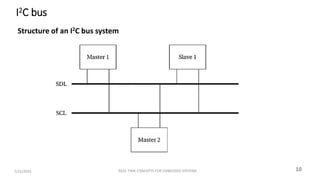
Structure of an I2C bus system
I2C bus
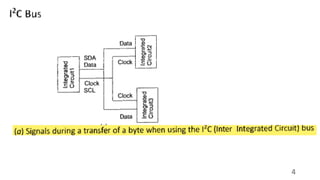
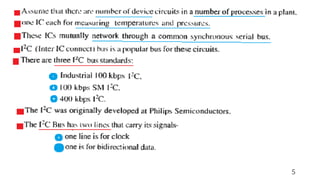
●I2C bus used to link microcontrollers into systems.
●I2C is designed to be low cost, easy to implement, and of moderate
speed (up to 100kbps for the standard bus and up to 400 kbps for
the extended bus).
● Serial data line (SDL) for data transmission.
●Serial clock line (SCL) indicates when valid data are on the data
line.
● Every node in the network is connected to both SCL and SDL.
●Some nodes may act as bus masters .
●Other nodes may act as slaves that only respond to requests from
masters.
REAL TIME CONCEPTS FOR EMBEDDED SYSTEMS
7/15/2025 12
Electrical interface to the I2C bus
●Both bus lines are defined by an electrical signal.
●Both bus signals use open collector/open drain circuits.
●The open collector/open drain circuitry allows a slave device to stretch a clock signal during
a read.
●The master is responsible forgenerating the SCL clock.
●The slave can stretch the low period of the clock.
●It is a multi master bus so different devices may act as the master at various times.
●Masterdrives both SCL and SDL when it is sending data.
●When the bus is idle, both SCL and SDL remain high.
●When two devices try to drive either SCL or SDL , the open collector/open drain circuitry
prevents errors.
●Each masterdevice make sure that it is not interfering with another message.
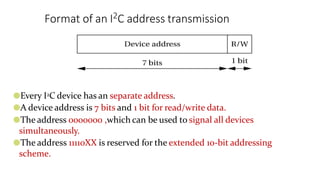
Format of an I2C address transmission
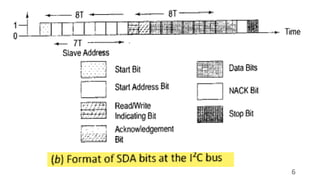
●Every I2C device has an separate address.
●A device address is 7 bits and 1 bit for read/write data.
●The address 0000000 ,which can be used to signal all devices
simultaneously.
●The address 11110XX is reserved for the extended 10-bit addressing
scheme.
State transition graph for an I2C bus master
●Starts and stops must be paired.
●A mastercan write and then read by sending a start after the
data transmission, followed by another address transmission
and then more data.
16
REAL TIME CONCEPTS FOR EMBEDDED SYSTEMS
7/15/2025 17
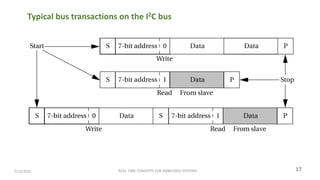
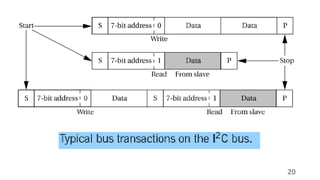
Typical bus transactions on the I2C bus
Bus transactions on the I2C bus
●When a masterwants to write a slave, it transmits the slave’s address followed
by the data.
●When a mastersend a read requestwith the slave’saddress and the slave
transmit the data.
●Transmission address has 7-bit and 1 bit for data direction.( 0 forwriting
from the master to the slave and 1 for reading from the slave to the master)
●A bus transaction is initiated by a start signal and completed with an end
signal.
●A start is signaled by leaving the SCL high and sending a 1 to 0 transition on
SDL.
●A stop is signaled by setting the SCL high and sending a 0 to 1 transition on
SDL.
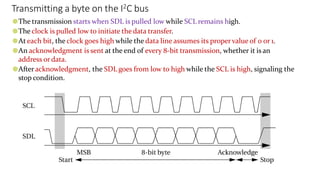
Transmitting a byte on the I2C bus
●The transmission starts when SDL is pulled low while SCL remains high.
●The clock is pulled low to initiate the data transfer.
●At each bit, the clock goes high while the data line assumes its propervalue of 0 or 1.
●An acknowledgment is sent at the end of every 8-bit transmission, whether it is an
address or data.
●Afteracknowledgment, the SDL goes from low to high while the SCL is high, signaling the
stop condition.
20
21
22
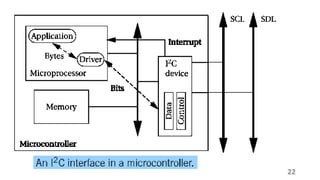
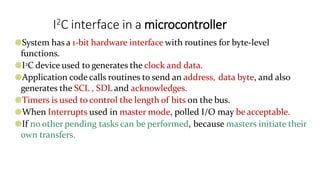
I2C interface in a microcontroller
●System has a 1-bit hardware interface with routines for byte-level
functions.
●I2C device used to generates the clock and data.
●Application code calls routines to send an address, data byte, and also
generates the SCL , SDL and acknowledges.
●Timers is used to control the length of bits on the bus.
●When Interrupts used in master mode, polled I/O may be acceptable.
●If no other pending tasks can be performed, because masters initiate their
own transfers.
Embedded Networking - Serial Bus Communication Protocols – I2C Bus

  • 1.
    1 Embedded Networking Serial BusCommunication Protocols – I2C Bus References: 1. Marilyn Wolf, “Computers as Components - Principles of Embedded Computing System Design”, Third Edition, Morgan Kaufmann Publisher 2. Rajkamal, ‘Embedded System-Architecture, Programming, Design’, McGraw Hill 3. Shibu. K.V, “Introduction to Embedded Systems”, Tata Mcgraw Hill
  • 2.
  • 3.
  • 4.
  • 5.
  • 6.
  • 7.
  • 8.
    REAL TIME CONCEPTSFOR EMBEDDED SYSTEMS 7/15/2025 8 The I2C Bus  Structure of an I2C bus system  Electrical interface to the I2C bus  Format of an I2C address transmission  State transition graph for an I2C bus master  Typical bus transactions on the I2C bus  Transmitting a byte on the I2C bus  An I2C interface in a microcontroller
  • 9.
    REAL TIME CONCEPTSFOR EMBEDDED SYSTEMS 7/15/2025 9 Several interconnect networks have been developed especially for distributed embedded computing: ■ The I2C bus is used in microcontroller-based systems. ■ The Controller Area Network (CAN) bus was developed for automotive electronics.  It provides megabit rates and can handle large numbers of devices. ■ Ethernet and variations of standard Ethernet are used for a variety of control applications.
  • 10.
    REAL TIME CONCEPTSFOR EMBEDDED SYSTEMS 7/15/2025 10 I2C bus Structure of an I2C bus system
  • 11.
    I2C bus ●I2C busused to link microcontrollers into systems. ●I2C is designed to be low cost, easy to implement, and of moderate speed (up to 100kbps for the standard bus and up to 400 kbps for the extended bus). ● Serial data line (SDL) for data transmission. ●Serial clock line (SCL) indicates when valid data are on the data line. ● Every node in the network is connected to both SCL and SDL. ●Some nodes may act as bus masters . ●Other nodes may act as slaves that only respond to requests from masters.
  • 12.
    REAL TIME CONCEPTSFOR EMBEDDED SYSTEMS 7/15/2025 12 Electrical interface to the I2C bus
  • 13.
    Electrical interface tothe I2C bus ●Both bus lines are defined by an electrical signal. ●Both bus signals use open collector/open drain circuits. ●The open collector/open drain circuitry allows a slave device to stretch a clock signal during a read. ●The master is responsible forgenerating the SCL clock. ●The slave can stretch the low period of the clock. ●It is a multi master bus so different devices may act as the master at various times. ●Masterdrives both SCL and SDL when it is sending data. ●When the bus is idle, both SCL and SDL remain high. ●When two devices try to drive either SCL or SDL , the open collector/open drain circuitry prevents errors. ●Each masterdevice make sure that it is not interfering with another message.
  • 14.
    Format of anI2C address transmission ●Every I2C device has an separate address. ●A device address is 7 bits and 1 bit for read/write data. ●The address 0000000 ,which can be used to signal all devices simultaneously. ●The address 11110XX is reserved for the extended 10-bit addressing scheme.
  • 15.
    State transition graphfor an I2C bus master ●Starts and stops must be paired. ●A mastercan write and then read by sending a start after the data transmission, followed by another address transmission and then more data.
  • 16.
  • 17.
    REAL TIME CONCEPTSFOR EMBEDDED SYSTEMS 7/15/2025 17 Typical bus transactions on the I2C bus
  • 18.
    Bus transactions onthe I2C bus ●When a masterwants to write a slave, it transmits the slave’s address followed by the data. ●When a mastersend a read requestwith the slave’saddress and the slave transmit the data. ●Transmission address has 7-bit and 1 bit for data direction.( 0 forwriting from the master to the slave and 1 for reading from the slave to the master) ●A bus transaction is initiated by a start signal and completed with an end signal. ●A start is signaled by leaving the SCL high and sending a 1 to 0 transition on SDL. ●A stop is signaled by setting the SCL high and sending a 0 to 1 transition on SDL.
  • 19.
    Transmitting a byteon the I2C bus ●The transmission starts when SDL is pulled low while SCL remains high. ●The clock is pulled low to initiate the data transfer. ●At each bit, the clock goes high while the data line assumes its propervalue of 0 or 1. ●An acknowledgment is sent at the end of every 8-bit transmission, whether it is an address or data. ●Afteracknowledgment, the SDL goes from low to high while the SCL is high, signaling the stop condition.
  • 20.
  • 21.
  • 22.
  • 23.
    I2C interface ina microcontroller ●System has a 1-bit hardware interface with routines for byte-level functions. ●I2C device used to generates the clock and data. ●Application code calls routines to send an address, data byte, and also generates the SCL , SDL and acknowledges. ●Timers is used to control the length of bits on the bus. ●When Interrupts used in master mode, polled I/O may be acceptable. ●If no other pending tasks can be performed, because masters initiate their own transfers.