EMBEDDED SYSTEM
AND IT’S APPLICATION


       PRESENTED BY
   VIVEK R. CHAMORSHIKAR
POINTS TO BE COVERED
   Introduction
   Characteristics of Embedded System
   Classification of Embedded System
   Components of Embedded System
   Applications of Embedded System
   Temperature Programmer
   Advantages
   Conclusion
INTRODUCTION
   An Embedded System is one that has
    computer-hardware with software
    embedded in it as one of its most
    important component. It is dedicated
    computer-based system for an
    application's or product. It may be either
    an independent system or a part of larger
    system. An Embedded System is a
    special-purpose computer system
    designed to perform one or a few
    dedicated functions.
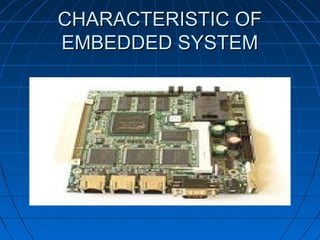
CHARACTERISTIC OF
EMBEDDED SYSTEM
CLASSIFICATION OF
       EMBEDDED SYSTEM


   Small Scale Embedded System
   Medium Scale Embedded System
   Sophisticated Embedded System
COMPONENTS OF
     EMBEDDED SYSTEM
 An Embedded System has following
  three main components:
 Hardware

 Application Software

 Real Time Operating System
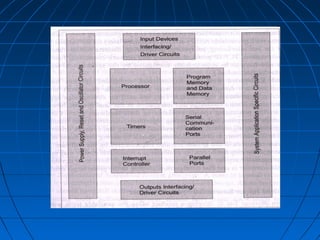
HARDWARE OF EMBEDDED
           SYSTEM
   PROCESSOR
       MICROPROCESSOR
       MICROCONTROLLER
    OTHER HARDWARE UNIT
       POWER SUPPLY
       CLOCK OSCILLATOR CKT
       REAL TIME CLOCK AND TIMERS
       RESET CIRCUIT
       MEMORIES
       INPUT,OUTPUT AND I/O PORTS
       APPLICATION SOFTWARE
       RTOS
APPLICATIONS OF EMBEDDED
             SYSTEMS
   Audio like mp3 players
   Cellular telephones and telephone switches
   Engine controllers and antilock brake controllers
    for automobiles
   Home automation products, such as thermostats,
    air conditioners, sprinklers
   Handheld calculators
   DVD players and recorders
   Medical equipment
   Computer peripherals such as routers and
    printers
TEMPERATURE PROGRAMMER
   In many area’s of daily and technical life, making
    temperature measurements is the most
    important instrumentation task.”Intelegent”digital
    sensors, which can do more than just output
    temperature readings, are winning more ground
    as compliments to classical analogue techniques.
    An example of such a sensor is the Dallas
    Semiconductor DS1621.
   Naturally, the main job of a modern digital
    temperature sensor is to determine the current
    temperature. It does this by measuring its own
    temperature, which is nearly the same as the
    temperature of its surroundings, and converting
    this analogue temperature value into a digital
    word that it sends to a microcontroller via a serial
    interface.
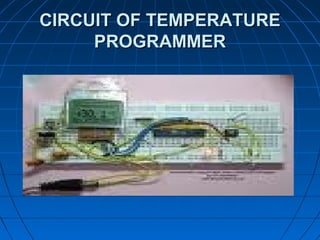
CIRCUIT OF TEMPERATURE
     PROGRAMMER
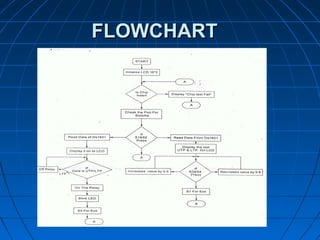
FLOWCHART
ADVANTAGES
   Debugging: Embedded Debugging may be
    performed at different levels from simplest to
    most sophisticated depending on the facilities
    available.
   Reliability: Embedded systems often reside in
    machines that are expected to run continuously
    for years without errors and in some cases
    recover by themselves if an error occurs. Thus
    are reliable.
   Portability: Embedded System have greatly
    reduced the size of its’ various application. Thus it
    has become easy to handle.
   Economic: Recent technologies have reduced the
    prices to a great extent.
CONCLUSION
   Today in this fast moving world, everyone wants
    to handle small and portable products which are
    comfortable to them. Thus embedded systems
    are proving blessings for them. The growing
    needs of various applications such as home
    appliances, various hard wares, industrial needs
    etc have demanded development in this field.
    Satellite developments are also demanding the
    growth of embedded system. It has become part
    of our life in form of mobile phones, laptops and
    various other appliances. Temperature
    Programmer is project that employ embedded
    system. There are lots many projects based on
    embedded system and have some or other
    application and can be used in various products
Embedded and vlsi design 1

Embedded and vlsi design 1

  • 1.
    EMBEDDED SYSTEM AND IT’SAPPLICATION PRESENTED BY VIVEK R. CHAMORSHIKAR
  • 2.
    POINTS TO BECOVERED  Introduction  Characteristics of Embedded System  Classification of Embedded System  Components of Embedded System  Applications of Embedded System  Temperature Programmer  Advantages  Conclusion
  • 3.
    INTRODUCTION  An Embedded System is one that has computer-hardware with software embedded in it as one of its most important component. It is dedicated computer-based system for an application's or product. It may be either an independent system or a part of larger system. An Embedded System is a special-purpose computer system designed to perform one or a few dedicated functions.
  • 4.
  • 5.
    CLASSIFICATION OF EMBEDDED SYSTEM  Small Scale Embedded System  Medium Scale Embedded System  Sophisticated Embedded System
  • 6.
    COMPONENTS OF EMBEDDED SYSTEM An Embedded System has following three main components:  Hardware  Application Software  Real Time Operating System
  • 8.
    HARDWARE OF EMBEDDED SYSTEM  PROCESSOR MICROPROCESSOR MICROCONTROLLER  OTHER HARDWARE UNIT POWER SUPPLY CLOCK OSCILLATOR CKT REAL TIME CLOCK AND TIMERS RESET CIRCUIT MEMORIES INPUT,OUTPUT AND I/O PORTS APPLICATION SOFTWARE RTOS
  • 9.
    APPLICATIONS OF EMBEDDED SYSTEMS  Audio like mp3 players  Cellular telephones and telephone switches  Engine controllers and antilock brake controllers for automobiles  Home automation products, such as thermostats, air conditioners, sprinklers  Handheld calculators  DVD players and recorders  Medical equipment  Computer peripherals such as routers and printers
  • 10.
    TEMPERATURE PROGRAMMER  In many area’s of daily and technical life, making temperature measurements is the most important instrumentation task.”Intelegent”digital sensors, which can do more than just output temperature readings, are winning more ground as compliments to classical analogue techniques. An example of such a sensor is the Dallas Semiconductor DS1621.  Naturally, the main job of a modern digital temperature sensor is to determine the current temperature. It does this by measuring its own temperature, which is nearly the same as the temperature of its surroundings, and converting this analogue temperature value into a digital word that it sends to a microcontroller via a serial interface.
  • 11.
  • 12.
  • 13.
    ADVANTAGES  Debugging: Embedded Debugging may be performed at different levels from simplest to most sophisticated depending on the facilities available.  Reliability: Embedded systems often reside in machines that are expected to run continuously for years without errors and in some cases recover by themselves if an error occurs. Thus are reliable.  Portability: Embedded System have greatly reduced the size of its’ various application. Thus it has become easy to handle.  Economic: Recent technologies have reduced the prices to a great extent.
  • 14.
    CONCLUSION  Today in this fast moving world, everyone wants to handle small and portable products which are comfortable to them. Thus embedded systems are proving blessings for them. The growing needs of various applications such as home appliances, various hard wares, industrial needs etc have demanded development in this field. Satellite developments are also demanding the growth of embedded system. It has become part of our life in form of mobile phones, laptops and various other appliances. Temperature Programmer is project that employ embedded system. There are lots many projects based on embedded system and have some or other application and can be used in various products