



SHUBHAM JAIN
VIIITH B
Gyandeep Vidya Bhawan Senior Secondary
School
AJANTA AND ELLORA CAVES
AJANTA CAVES
Location
Contry-India
State-Maharastra
District-Aurangabad
Caves-30
AJANTA CAVES
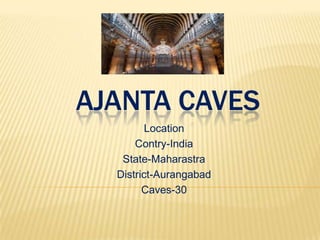
The Ajanta Caves in Aurangabad district of Maharashtra, India
are about 30 rock-cut Buddhist cave monuments which date
from the 2nd century BCE to about 480 or 650 CE.The caves
include paintings and sculptures described by the government
Archaeological Survey of India as "the finest surviving examples
of Indian art, particularly painting",[which are masterpieces of
Buddhist religious art, with figures of the Buddha and depictions
of the Jataka tales.[The caves were built in two phases starting
around the 2nd century BCE, with the second group of caves
built around 400–650 CE according to older accounts, or all in a
brief period of 460 to 480 according to the recent proposals of
Walter M. Spink. The site is a protected monument in the care of
the Archaeological Survey of India,and since 1983, the Ajanta
Caves have been a UNESCO World Heritage Site.
The caves are located in the Indian state of Maharashtra, near
Jalgaon and just outside the village of Ajinṭhā 20°31′56″N
75°44′44″E), about 59 kilometres (36 miles) from Jalgaon railway
station on the Delhi – Mumbai line and Howrah-Nagpur-Mumbai
line of the Central Railway zone, and 104 kilometres (64 miles)
from the city of Aurangabad. They are 100 kilometres (62 miles)
from the Ellora Caves, which contain Hindu and Jain temples as
well as Buddhist caves, the last dating from a period similar to
Ajanta. The Ajanta caves are cut into the side of a cliff that is on
the south side of a U-shaped gorge on the small river Waghora
(or Wagura), and although they are now along and above a
modern pathway running across the cliff they were originally
reached by individual stairs or ladders from the side of the river
35 to 110 feet below.
HISTORY





Stupa in cave 10
Like the other ancient Buddhist monasteries, Ajanta had a large
emphasis on teaching, and was divided into several different caves for
living, education and worship, under a central direction. Monks were
probably assigned to specific caves for living. The layout reflects this
organizational structure, with most of the caves only connected through
the exterior. The 7th-century travelling Chinese scholar Xuanzang
informs us that Dinnaga, a celebrated Buddhist philosopher and
controversialist, author of well-known books on logic, lived at Ajanta in
the 5th century. In its prime the settlement would have accommodated
several hundred teachers and pupils. Many monks who had finished
their first training may have returned to Ajanta during the monsoon
season from an itinerant lifestyle.
The caves are generally agreed to have been made in two distinct
periods, separated by several centuries.
ELLORA CAVES
Location
Country-India
State-Maharastra
District-Aurangabad
Caves-34
ELLORA CAVES
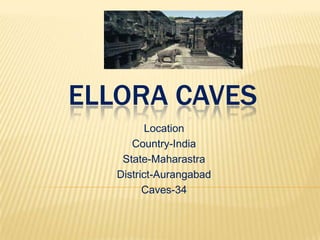
Ellora is an archaeological site, 29 km (18 mi) NorthWest of the city of Aurangabad in the Indian state of
Maharashtra built by the Rashtrakuta dynasty. It is also
known as Elapura (in the Rashtrakuta literatureKannada). Well known for its monumental caves, Ellora
is a World Heritage Site. Ellora represents the epitome of
Indian rock-cut architecture. The 34 "caves" are actually
structures excavated out of the vertical face of the
Charanandri hills. Buddhist, Hindu and Jain rock-cut
temples and viharas and mathas were built between the
5th century and 10th century. The 12 Buddhist (caves 1–
12), 17 Hindu (caves 13–29) and 5 Jain (caves 30–34)
caves, built in proximity, demonstrate the religious
harmony prevalent during this period of Indian history. It
is a protected monument under the Archaeological
Survey of India.
HISTORY


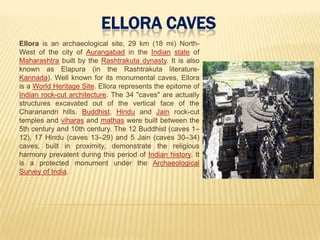
Ellora is known for Hindu, Buddhist and Jain cave temples
built during (6th and 9th centuries) the rule of the Kalachuri,
Chalukya and Rashtrakuta dynasties. The Jagannatha
Sabha a group of five Jain cave temples of 9th century built
by Rashtrakuta.
THANK YOU
Submited by:Shubham Jain

Ajant and ellora caves

  • 1.
    SHUBHAM JAIN VIIITH B GyandeepVidya Bhawan Senior Secondary School
  • 2.
  • 3.
  • 4.
    AJANTA CAVES The AjantaCaves in Aurangabad district of Maharashtra, India are about 30 rock-cut Buddhist cave monuments which date from the 2nd century BCE to about 480 or 650 CE.The caves include paintings and sculptures described by the government Archaeological Survey of India as "the finest surviving examples of Indian art, particularly painting",[which are masterpieces of Buddhist religious art, with figures of the Buddha and depictions of the Jataka tales.[The caves were built in two phases starting around the 2nd century BCE, with the second group of caves built around 400–650 CE according to older accounts, or all in a brief period of 460 to 480 according to the recent proposals of Walter M. Spink. The site is a protected monument in the care of the Archaeological Survey of India,and since 1983, the Ajanta Caves have been a UNESCO World Heritage Site. The caves are located in the Indian state of Maharashtra, near Jalgaon and just outside the village of Ajinṭhā 20°31′56″N 75°44′44″E), about 59 kilometres (36 miles) from Jalgaon railway station on the Delhi – Mumbai line and Howrah-Nagpur-Mumbai line of the Central Railway zone, and 104 kilometres (64 miles) from the city of Aurangabad. They are 100 kilometres (62 miles) from the Ellora Caves, which contain Hindu and Jain temples as well as Buddhist caves, the last dating from a period similar to Ajanta. The Ajanta caves are cut into the side of a cliff that is on the south side of a U-shaped gorge on the small river Waghora (or Wagura), and although they are now along and above a modern pathway running across the cliff they were originally reached by individual stairs or ladders from the side of the river 35 to 110 feet below.
  • 5.
    HISTORY    Stupa in cave10 Like the other ancient Buddhist monasteries, Ajanta had a large emphasis on teaching, and was divided into several different caves for living, education and worship, under a central direction. Monks were probably assigned to specific caves for living. The layout reflects this organizational structure, with most of the caves only connected through the exterior. The 7th-century travelling Chinese scholar Xuanzang informs us that Dinnaga, a celebrated Buddhist philosopher and controversialist, author of well-known books on logic, lived at Ajanta in the 5th century. In its prime the settlement would have accommodated several hundred teachers and pupils. Many monks who had finished their first training may have returned to Ajanta during the monsoon season from an itinerant lifestyle. The caves are generally agreed to have been made in two distinct periods, separated by several centuries.
  • 6.
  • 7.
    ELLORA CAVES Ellora isan archaeological site, 29 km (18 mi) NorthWest of the city of Aurangabad in the Indian state of Maharashtra built by the Rashtrakuta dynasty. It is also known as Elapura (in the Rashtrakuta literatureKannada). Well known for its monumental caves, Ellora is a World Heritage Site. Ellora represents the epitome of Indian rock-cut architecture. The 34 "caves" are actually structures excavated out of the vertical face of the Charanandri hills. Buddhist, Hindu and Jain rock-cut temples and viharas and mathas were built between the 5th century and 10th century. The 12 Buddhist (caves 1– 12), 17 Hindu (caves 13–29) and 5 Jain (caves 30–34) caves, built in proximity, demonstrate the religious harmony prevalent during this period of Indian history. It is a protected monument under the Archaeological Survey of India.
  • 8.
    HISTORY  Ellora is knownfor Hindu, Buddhist and Jain cave temples built during (6th and 9th centuries) the rule of the Kalachuri, Chalukya and Rashtrakuta dynasties. The Jagannatha Sabha a group of five Jain cave temples of 9th century built by Rashtrakuta.
  • 9.