19/05/2023 1
semiconductors
wyvern
semi
wyvern
Error Detection and Correction
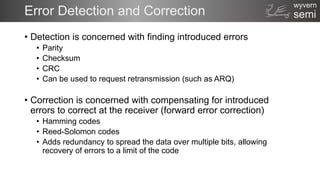
• Detection is concerned with finding introduced errors
• Parity
• Checksum
• CRC
• Can be used to request retransmission (such as ARQ)
• Correction is concerned with compensating for introduced
errors to correct at the receiver (forward error correction)
• Hamming codes
• Reed-Solomon codes
• Adds redundancy to spread the data over multiple bits, allowing
recovery of errors to a limit of the code
semi
wyvern
Basic Detection
• Parity
• XOR (or XNOR) data bits to
produce a parity bit.
• Even or Odd
• Can detect only 1 bit error.
• Good for channels with disparate
random low level noise
• Checksum
• Add together data words in a
block, modulo checksum width
• E.g. Add bytes over 4Kbyte block to
produce a 32 bit checksum (i.e.
module. 232)
• Performance is a function of block
size and checksum width.
// Parity
wire [7:0] byte;
wire parity_even = ^byte;
wire parity_odd = ~^byte;
// Check sum (behavioural)
reg [7:0] data [0:255];
reg [15:0] chksum = 16'h0000;
integer i;
always (posedge clk)
begin
for(i = 0; i < 256; i = i+1)
chksum = chksum + data[i];
end
semi
wyvern
Detection: CRC
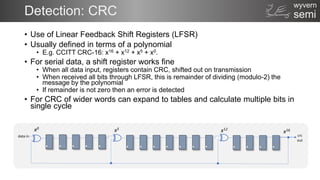
• Use of Linear Feedback Shift Registers (LFSR)
• Usually defined in terms of a polynomial
• E.g. CCITT CRC-16: x16 + x12 + x5 + x0.
• For serial data, a shift register works fine
• When all data input, registers contain CRC, shifted out on transmission
• When received all bits through LFSR, this is remainder of dividing (modulo-2) the
message by the polynomial
• If remainder is not zero then an error is detected
• For CRC of wider words can expand to tables and calculate multiple bits in
single cycle
data in crc
out
x0
x5
x12
x16
semi
wyvern
Error Correction
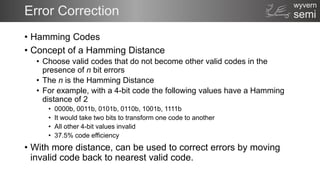
• Hamming Codes
• Concept of a Hamming Distance
• Choose valid codes that do not become other valid codes in the
presence of n bit errors
• The n is the Hamming Distance
• For example, with a 4-bit code the following values have a Hamming
distance of 2
• 0000b, 0011b, 0101b, 0110b, 1001b, 1111b
• It would take two bits to transform one code to another
• All other 4-bit values invalid
• 37.5% code efficiency
• With more distance, can be used to correct errors by moving
invalid code back to nearest valid code.
semi
wyvern
Hamming Encoding of 8 bit Data
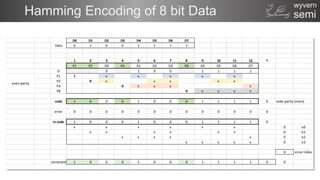
D0 D1 D2 D3 D4 D5 D6 D7
Data 0 1 0 0 1 1 1 1
1 2 3 4 5 6 7 8 9 10 11 12 P
P1 P2 D0 P4 D1 D2 D3 P8 D4 D5 D6 D7
D 0 1 0 0 1 1 1 1
P1 1 x x x x x
P2 0 x x x x x
P4 0 x x x x
P8 0 x x x x
code 1 0 0 0 1 0 0 0 1 1 1 1 0 code parity (even)
error 0 0 0 0 0 0 0 0 0 0 0 0 0
rx code 1 0 0 0 1 0 0 0 1 1 1 1 0
x x x x x x 0 e0
x x x x x x 0 e1
x x x x x 0 e2
x x x x x 0 e3
0 error index
corrected 1 0 0 0 1 0 0 0 1 1 1 1 0 0
even parity
semi
wyvern
Encoder Logic for Hamming Code
// ------------------------------
// Encoder
// ------------------------------
module hamming8_encoder(
input [7:0] data,
output [12:0] code);
wire p1 = data[0] ^ data[1] ^ data[3] ^ data[4] ^ data[6];
wire p2 = data[0] ^ data[2] ^ data[3] ^ data[5] ^ data[6];
wire p4 = data[1] ^ data[2] ^ data[3] ^ data[7];
wire p8 = data[4] ^ data[5] ^ data[6] ^ data[7];
wire [11:0] hamm_code = {data[7], data[6], data[5], data[4], p8, data[3],
data[2], data[1], p4, data[0], p2, p1};
wire parity = ^hamm_code;
assign code = {parity, hamm_code};
endmodule
full code, with comments and TB at: http://www.anita-simulators.org.uk/ecc.zip
semi
wyvern
Decoder Logic for Hamming Code
// ------------------------------
// Decoder
// ------------------------------
module hamming8_decoder (
input [12:0] code,
output [7:0] data,
output error);
wire [3:0] e;
assign e[0] = code[0] ^ code[2] ^ code[4] ^ code[6] ^ code[8] ^ code[10];
assign e[1] = code[1] ^ code[2] ^ code[5] ^ code[6] ^ code[9] ^ code[10];
assign e[2] = code[3] ^ code[4] ^ code[5] ^ code[6] ^ code[11];
assign e[3] = code[7] ^ code[8] ^ code[9] ^ code[10] ^ code[11];
wire [15:0] flip_mask = 16'h0001 << e;
wire [11:0] corr_code = code[11:0] ^ flip_mask[12:1];
wire corr_parity = ^{code[12], corr_code};
assign data = {corr_code[11], corr_code[10], corr_code[9], corr_code[8],
corr_code[6], corr_code[5], corr_code[4], corr_code[2]};
// Error if parity on a corrected code fails, or index into codeword invalid (i.e. > 12)
assign error = (|e & corr_parity) | (|flip_mask[15:13]);
endmodule
full code, with comments and TB at: http://www.anita-simulators.org.uk/ecc.zip
semi
wyvern
ECC for Larger Data Widths
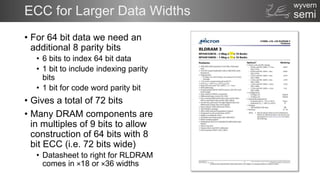
• For 64 bit data we need an
additional 8 parity bits
• 6 bits to index 64 bit data
• 1 bit to include indexing parity
bits
• 1 bit for code word parity bit
• Gives a total of 72 bits
• Many DRAM components are
in multiples of 9 bits to allow
construction of 64 bits with 8
bit ECC (i.e. 72 bits wide)
• Datasheet to right for RLDRAM
comes in ×18 or ×36 widths
semi
wyvern
Reed-Solomon Codes
• Beyond Hamming codes there are block codes with better properties
• More complex to compute
• Reed-Solomon codes are a form of block code
• Encodes message multi-bit symbols (e.g. bytes) as a block
• Adds redundancy parity/check symbols
• Corrective ability is half the number of parity symbols
• A type of Reed-Solomon code might be RS(255,223)
• 255 symbol message
• 32 symbol parity
• Can correct up to 16 symbols
• Used in optical and other storage (CD, DDS (DAT), DVD, QR codes)
• Good for burst errors
• Message and parity often interleaved across tracks for better burst robustness
• Sometimes have two layers of encoding between interleave to allow for random, as
well as burst, errors
semi
wyvern
Reed-Solomon Terminology
• Most explanations of Reed-Solomon Codes are very mathematical
and it's hard to extract the information for a logic implementation
• Mapping the terminology
• Galois Field ⇒ a pseudo-random table generated from an LFSR defined as a
polynomial (as per CRC)
• Used as the powers (or logs) of a
• Primitive element a ⇒ constant (usually 2) used as the seed to the pseudo-
random number generator (PRNG)
• P and Q ⇒ The parity symbols added to the message symbols
• P is used to determine the error pattern (corrector)
• Q is used to determine the location of the symbol in error (locator)
• Calculated from the generator polynomials
• Generator polynomials ⇒ polynomials calculated from a set procedure
(solving simultaneous equations)
• used to generate the parity symbols
semi
wyvern
Reed-Solomon Simple Example
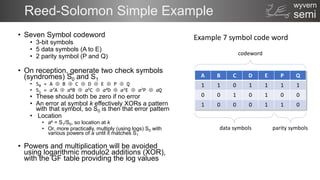
• Seven Symbol codeword
• 3-bit symbols
• 5 data symbols (A to E)
• 2 parity symbol (P and Q)
• On reception, generate two check symbols
(syndromes) S0 and S1
• S0 = A  B  C  D  E  P  Q
• S1 = a7A  a6B  a5C  a4D  a3E  a2P  aQ
• These should both be zero if no error
• An error at symbol k effectively XORs a pattern
with that symbol, so S0 is then that error pattern
• Location
• ak = S1/S0, so location at k
• Or, more practically, multiply (using logs) S0 with
various powers of a until it matches S1
• Powers and multiplication will be avoided
using logarithmic modulo2 additions (XOR),
with the GF table providing the log values
A B C D E P Q
1 1 0 1 1 1 1
0 0 1 0 1 0 0
1 0 0 0 1 1 0
Example 7 symbol code word
codeword
data symbols parity symbols
semi
wyvern
Reed-Solomon Parity Symbol Calculation
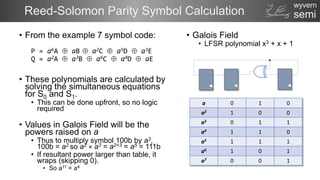
• From the example 7 symbol code:
P = a6A  aB  a2C  a5D  a3E
Q = a2A  a3B  a6C  a4D  aE
• These polynomials are calculated by
solving the simultaneous equations
for S0 and S1.
• This can be done upfront, so no logic
required
• Values in Galois Field will be the
powers raised on a
• Thus to multiply symbol 100b by a3,
100b = a2 so a2 × a3 = a2+3 = a5 = 111b
• If resultant power larger than table, it
wraps (skipping 0).
• So a11 = a4
• Galois Field
• LFSR polynomial x3 + x + 1
a 0 1 0
a2 1 0 0
a3 0 1 1
a4 1 1 0
a5 1 1 1
a6 1 0 1
a7 0 0 1
semi
wyvern
Reed-Solomon Multiplication
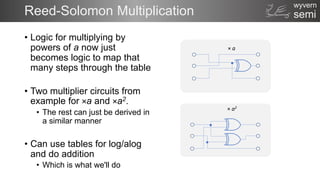
• Logic for multiplying by
powers of a now just
becomes logic to map that
many steps through the table
• Two multiplier circuits from
example for ×a and ×a2.
• The rest can just be derived in
a similar manner
• Can use tables for log/alog
and do addition
• Which is what we'll do
× a
× a2
semi
wyvern
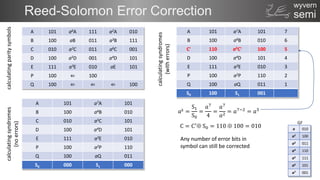
Reed-Solomon Error Correction
A 101 a7A 101
B 100 a6B 010
C 010 a5C 101
D 100 a4D 101
E 111 a3E 010
P 100 a2P 110
Q 100 aQ 011
S0 000 S1 000
A 101 a6A 111 a2A 010
B 100 aB 011 a3B 111
C 010 a2C 011 a6C 001
D 100 a5D 001 a4D 101
E 111 a3E 010 aE 101
P 100 ⇐ 100
Q 100 ⇐ ⇐ ⇐ 100
A 101 a7A 101 7
B 100 a6B 010 6
C' 110 a5C' 100 5
D 100 a4D 101 4
E 111 a3E 010 3
P 100 a2P 110 2
Q 100 aQ 011 1
S0 100 S1 001
𝑎𝑘 =
S1
S0
=
𝑎7
4
=
𝑎7
𝑎2
= 𝑎7−2
= 𝑎5
C = C′ S0 = 110  100 = 010
Any number of error bits in
symbol can still be corrected
calculating
parity
symbols
calculating
syndromes
(no
errors)
calculating
syndromes
(with
errors)
a 010
a2 100
a3 011
a4 110
a5 111
a6 101
a7 001
GF
semi
wyvern
Reed-Solomon encoder (RS(7,5))
module rs_7_5_encoder
(
input [14:0] idata,
output[20:0] ocode
);
wire [2:0] s [0:6];
integer idx;
reg [2:0] GF_log [1:7];
reg [2:0] GF_alog [1:7];
reg [2:0] p_poly [0:4];
reg [2:0] q_poly [0:4];
reg [3:0] p_data [0:4];
reg [3:0] q_data [0:4];
reg [2:0] P, Q;
assign s[0] = idata[2:0];
assign s[1] = idata[5:3];
assign s[2] = idata[8:6];
assign s[3] = idata[11:9];
assign s[4] = idata[14:12];
assign s[5] = P;
assign s[6] = Q;
assign ocode = {s[6], s[5], s[4], s[3],
s[2], s[1], s[0]};
initial
begin
// Galois field for x3 + x + 1
GF_alog[1] = 3'b010; GF_alog[2] = 3'b100;
GF_alog[3] = 3'b011; GF_alog[4] = 3'b110;
GF_alog[5] = 3'b111; GF_alog[6] = 3'b101;
GF_alog[7] = 3'b001;
// Inverse (log) Galois field for
// x3 + x + 1
GF_log[1] = 3'b111; GF_log[2] = 3'b001;
GF_log[3] = 3'b011; GF_log[4] = 3'b010;
GF_log[5] = 3'b110; GF_log[6] = 3'b100;
GF_log[7] = 3'b101;
// Corrector polynomial (log):
// a6 + a + a2 + a5 + a3
p_poly[0] = 6; p_poly[1] = 1;
p_poly[2] = 2; p_poly[3] = 5;
p_poly[4] = 3;
// Locator polynomial (log):
// a2 + a3 + a6 + a4 + a
q_poly[0] = 2; q_poly[1] = 3;
q_poly[2] = 6; q_poly[3] = 4;
q_poly[4] = 1;
end
always @(*)
begin
P = 3'b000;
Q = 3'b000;
for (idx = 0; idx < 5; idx = idx + 1)
begin
// Calulate P
p_data[idx] = p_poly[idx] + GF_log[s[idx]];
p_data[idx] = p_data[idx][2:0] + p_data[idx][3];
p_data[idx] = GF_alog[p_data[idx]];
P = P ^ p_data[idx];
// Calculate Q
q_data[idx] = q_poly[idx] + GF_log[s[idx]];
q_data[idx] = q_data[idx][2:0] + q_data[idx][3];
q_data[idx] = GF_alog[q_data[idx]];
Q = Q ^ q_data[idx];
end
end
endmodule
full code, with comments and TB at: http://www.anita-simulators.org.uk/ecc.zip
semi
wyvern
Reed-Solomon decoder (RS(7,5))
module rs_7_5_decoder
(
input [20:0] icode,
output [14:0] odata
);
reg [2:0] s [0:6];
integer idx;
reg [2:0] GF_log [1:7];
reg [2:0] GF_alog [1:7];
reg [3:0] S1_poly [0:6];
reg [3:0] k;
reg [2:0] S0;
reg [2:0] S1;
assign odata = {s[4], s[3], s[2], s[1], s[0]};
initial
begin
// Galois field for x3 + x + 1
GF_alog[1] = 3'b010; GF_alog[2] = 3'b100;
GF_alog[3] = 3'b011; GF_alog[4] = 3'b110;
GF_alog[5] = 3'b111; GF_alog[6] = 3'b101;
GF_alog[7] = 3'b001;
// Inverse (log) Galois field for
// x3 + x + 1
GF_log[1] = 3'b111; GF_log[2] = 3'b001;
GF_log[3] = 3'b011; GF_log[4] = 3'b010;
GF_log[5] = 3'b110; GF_log[6] = 3'b100;
GF_log[7] = 3'b101;
end
always @(icode)
begin
s[0] = icode[2:0]; s[1] = icode[5:3];
s[2] = icode[8:6]; s[3] = icode[11:9];
s[4] = icode[14:12]; s[5] = icode[17:15];
s[6] = icode[20:18];
S0 = s[0] ^ s[1] ^ s[2] ^ s[3] ^
s[4] ^ s[5] ^ s[6];
S1 = 3'b000;
for (idx = 0; idx < 7; idx = idx + 1)
begin
S1_poly[idx] = (7 - idx) + GF_log[s[idx]];
S1_poly[idx] = S1_poly[idx][2:0] + S1_poly[idx][3];
S1_poly[idx] = s[idx] ? GF_alog[S1_poly[idx]] : 3'b000;
S1 = S1 ^ S1_poly[idx];
end
if (S0 != 3'b000)
begin
k = GF_log[S1] - GF_log[S0];
k = k[2:0] - k[3];
k = (k == 4'b0000) ? GF_log[3'b001] : k;
s[7-k] = s[7-k] ^ S0;
end
end
endmodule
full code, with comments and TB at: http://www.anita-simulators.org.uk/ecc.zip
semi
wyvern
Reed-Solomon Codes for DAT/DDS
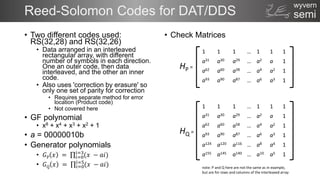
• Two different codes used:
RS(32,28) and RS(32,26)
• Data arranged in an interleaved
rectangular array, with different
number of symbols in each direction.
One an outer code, then data
interleaved, and the other an inner
code.
• Also uses 'correction by erasure' so
only one set of parity for correction
• Requires separate method for error
location (Product code)
• Not covered here
• GF polynomial
• x8 + x4 + x3 + x2 + 1
• a = 00000010b
• Generator polynomials
• 𝐺P 𝑥 = 𝑖=0
𝑖=3
(𝑥 − 𝑎𝑖)
• 𝐺Q 𝑥 = 𝑖=0
𝑖=5
(𝑥 − 𝑎𝑖)
• Check Matrices
1 1 1 … 1 1 1
a31 a30 a29 … a2 a 1
a62 a60 a58 … a4 a2 1
a93 a90 a87 … a6 a3 1
HP =
1 1 1 … 1 1 1
a31 a30 a29 … a2 a 1
a62 a60 a58 … a4 a2 1
a93 a90 a87 … a6 a3 1
a124 a120 a116 … a8 a4 1
a155 a145 a140 … a10 a5 1
HQ =
note: P and Q here are not the same as in example,
but are for rows and columns of the interleaved array
semi
wyvern
Other Topics That Might Be Of Interest
• Data Compression Articles on LinkedIn
• Lossless Data Compression Overview
• Lempel-Ziv-Welch (LZW) Algorithm
• LZW Implementation in C
• JPEG Image Compression
• JPEG/JFIF Decoder Implementation in C++
• Logic Simulator Programming Interface Articles on LinkedIn
• Introduction to SystemVerilog's DPI, Verilog's PLI and VPI, and VHDL's FLI
• A "Virtual Processor" Simulation Verification IP Component
• Co-simulating Embedded Software with Logic
• Planned LinkedIn Articles to look out for
• Instruction Set Simulator Architecture and C/C++ system models
• Using make for front-end chip development
• C++ for Logic Engineers
• Logic Design for High Speed
• TCP/IPv4 Protocol with Pattern Generator Verification IP
• PCIe 2.0 Protocol with Root Complex model Verification IP
• Auto-generation of source code
• Some of the topics covered in the mentoring sessions may also appear as articles on LinkedIn
semi
wyvern
References
[1] Hamming, R.W., Error-detecting and error-correcting codes. Bell System
Tech. J., 26,147–160 (1950)
[2] Watkinson, J., The Art of Digital Audio (3rd Edition), Focal Press (2001)
[3] Anon., Standard ECMA-139, 3,81mm Wide Magnetic Tape Cartridge for
Information Interchange – Helical Scan Recording – DDS Format, ECMA
(June 1990)
semi
wyvern
end
semi
wyvern
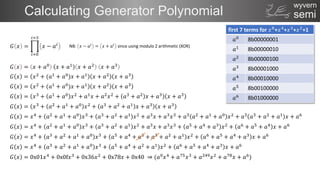
Calculating Generator Polynomial
𝐺 𝑥 =
𝑖=0
𝑖=3
𝑥 − 𝑎𝑖
𝐺 𝑥 = 𝑥 + 𝑎0 𝑥 + 𝑎1 𝑥 + 𝑎2 𝑥 + 𝑎3
𝐺 𝑥 = 𝑥2 + (𝑎1 + 𝑎0)𝑥 + 𝑎1 𝑥 + 𝑎2 𝑥 + 𝑎3
𝐺 𝑥 = 𝑥2
+ (𝑎1
+ 𝑎0
)𝑥 + 𝑎1
𝑥 + 𝑎2
𝑥 + 𝑎3
𝐺 𝑥 = 𝑥3
+ 𝑎1
+ 𝑎0
𝑥2
+ 𝑎1
𝑥 + 𝑎2
𝑥2
+ 𝑎3
+ 𝑎2
𝑥 + 𝑎3
𝑥 + 𝑎3
𝐺 𝑥 = 𝑥3 + 𝑎2 + 𝑎1 + 𝑎0 𝑥2 + 𝑎3 + 𝑎2 + 𝑎1 𝑥 + 𝑎3 𝑥 + 𝑎3
𝐺 𝑥 = 𝑥4 + 𝑎2 + 𝑎1 + 𝑎0 𝑥3 + 𝑎3 + 𝑎2 + 𝑎1 𝑥2 + 𝑎3𝑥 + 𝑎3𝑥3 + 𝑎3 𝑎2 + 𝑎1 + 𝑎0 𝑥2 + 𝑎3 𝑎3 + 𝑎2 + 𝑎1 𝑥 + 𝑎6
𝐺 𝑥 = 𝑥4
+ 𝑎2
+ 𝑎1
+ 𝑎0
𝑥3
+ 𝑎3
+ 𝑎2
+ 𝑎1
𝑥2
+ 𝑎3
𝑥 + 𝑎3
𝑥3
+ 𝑎5
+ 𝑎4
+ 𝑎3
𝑥2
+ 𝑎6
+ 𝑎5
+ 𝑎4
𝑥 + 𝑎6
𝐺 𝑥 = 𝑥4 + 𝑎3 + 𝑎2 + 𝑎1 + 𝑎0 𝑥3 + 𝑎5 + 𝑎4 + 𝑎3 + 𝑎3 + 𝑎2 + 𝑎1 𝑥2 + 𝑎6 + 𝑎5 + 𝑎4 + 𝑎3 𝑥 + 𝑎6
first 7 terms for 𝑥8
+𝑥4
+𝑥3
+𝑥2
+1
𝑎0 8b00000001
𝑎1 8b00000010
𝑎2 8b00000100
𝑎3 8b00001000
𝑎4 8b00010000
𝑎5 8b00100000
𝑎6 8b01000000
𝐺 𝑥 = 0x01𝑥4
+ 0x0f𝑥3
+ 0x36𝑥2
+ 0x78𝑥 + 0x40 ⇒ (𝑎0
𝑥4
+ 𝑎75
𝑥3
+ 𝑎249
𝑥2
+ 𝑎78
𝑥 + 𝑎6
)
𝐺 𝑥 = 𝑥4
+ 𝑎3
+ 𝑎2
+ 𝑎1
+ 𝑎0
𝑥3
+ 𝑎5
+ 𝑎4
+ 𝑎2
+ 𝑎1
𝑥2
+ 𝑎6
+ 𝑎5
+ 𝑎4
+ 𝑎3
𝑥 + 𝑎6
NB: 𝑥 − 𝑎𝑖
= 𝑥 + 𝑎𝑖
since using modulo 2 arithmetic (XOR)

error_detection_correction.pptx

  • 1.
  • 2.
    semi wyvern Error Detection andCorrection • Detection is concerned with finding introduced errors • Parity • Checksum • CRC • Can be used to request retransmission (such as ARQ) • Correction is concerned with compensating for introduced errors to correct at the receiver (forward error correction) • Hamming codes • Reed-Solomon codes • Adds redundancy to spread the data over multiple bits, allowing recovery of errors to a limit of the code
  • 3.
    semi wyvern Basic Detection • Parity •XOR (or XNOR) data bits to produce a parity bit. • Even or Odd • Can detect only 1 bit error. • Good for channels with disparate random low level noise • Checksum • Add together data words in a block, modulo checksum width • E.g. Add bytes over 4Kbyte block to produce a 32 bit checksum (i.e. module. 232) • Performance is a function of block size and checksum width. // Parity wire [7:0] byte; wire parity_even = ^byte; wire parity_odd = ~^byte; // Check sum (behavioural) reg [7:0] data [0:255]; reg [15:0] chksum = 16'h0000; integer i; always (posedge clk) begin for(i = 0; i < 256; i = i+1) chksum = chksum + data[i]; end
  • 4.
    semi wyvern Detection: CRC • Useof Linear Feedback Shift Registers (LFSR) • Usually defined in terms of a polynomial • E.g. CCITT CRC-16: x16 + x12 + x5 + x0. • For serial data, a shift register works fine • When all data input, registers contain CRC, shifted out on transmission • When received all bits through LFSR, this is remainder of dividing (modulo-2) the message by the polynomial • If remainder is not zero then an error is detected • For CRC of wider words can expand to tables and calculate multiple bits in single cycle data in crc out x0 x5 x12 x16
  • 5.
    semi wyvern Error Correction • HammingCodes • Concept of a Hamming Distance • Choose valid codes that do not become other valid codes in the presence of n bit errors • The n is the Hamming Distance • For example, with a 4-bit code the following values have a Hamming distance of 2 • 0000b, 0011b, 0101b, 0110b, 1001b, 1111b • It would take two bits to transform one code to another • All other 4-bit values invalid • 37.5% code efficiency • With more distance, can be used to correct errors by moving invalid code back to nearest valid code.
  • 6.
    semi wyvern Hamming Encoding of8 bit Data D0 D1 D2 D3 D4 D5 D6 D7 Data 0 1 0 0 1 1 1 1 1 2 3 4 5 6 7 8 9 10 11 12 P P1 P2 D0 P4 D1 D2 D3 P8 D4 D5 D6 D7 D 0 1 0 0 1 1 1 1 P1 1 x x x x x P2 0 x x x x x P4 0 x x x x P8 0 x x x x code 1 0 0 0 1 0 0 0 1 1 1 1 0 code parity (even) error 0 0 0 0 0 0 0 0 0 0 0 0 0 rx code 1 0 0 0 1 0 0 0 1 1 1 1 0 x x x x x x 0 e0 x x x x x x 0 e1 x x x x x 0 e2 x x x x x 0 e3 0 error index corrected 1 0 0 0 1 0 0 0 1 1 1 1 0 0 even parity
  • 7.
    semi wyvern Encoder Logic forHamming Code // ------------------------------ // Encoder // ------------------------------ module hamming8_encoder( input [7:0] data, output [12:0] code); wire p1 = data[0] ^ data[1] ^ data[3] ^ data[4] ^ data[6]; wire p2 = data[0] ^ data[2] ^ data[3] ^ data[5] ^ data[6]; wire p4 = data[1] ^ data[2] ^ data[3] ^ data[7]; wire p8 = data[4] ^ data[5] ^ data[6] ^ data[7]; wire [11:0] hamm_code = {data[7], data[6], data[5], data[4], p8, data[3], data[2], data[1], p4, data[0], p2, p1}; wire parity = ^hamm_code; assign code = {parity, hamm_code}; endmodule full code, with comments and TB at: http://www.anita-simulators.org.uk/ecc.zip
  • 8.
    semi wyvern Decoder Logic forHamming Code // ------------------------------ // Decoder // ------------------------------ module hamming8_decoder ( input [12:0] code, output [7:0] data, output error); wire [3:0] e; assign e[0] = code[0] ^ code[2] ^ code[4] ^ code[6] ^ code[8] ^ code[10]; assign e[1] = code[1] ^ code[2] ^ code[5] ^ code[6] ^ code[9] ^ code[10]; assign e[2] = code[3] ^ code[4] ^ code[5] ^ code[6] ^ code[11]; assign e[3] = code[7] ^ code[8] ^ code[9] ^ code[10] ^ code[11]; wire [15:0] flip_mask = 16'h0001 << e; wire [11:0] corr_code = code[11:0] ^ flip_mask[12:1]; wire corr_parity = ^{code[12], corr_code}; assign data = {corr_code[11], corr_code[10], corr_code[9], corr_code[8], corr_code[6], corr_code[5], corr_code[4], corr_code[2]}; // Error if parity on a corrected code fails, or index into codeword invalid (i.e. > 12) assign error = (|e & corr_parity) | (|flip_mask[15:13]); endmodule full code, with comments and TB at: http://www.anita-simulators.org.uk/ecc.zip
  • 9.
    semi wyvern ECC for LargerData Widths • For 64 bit data we need an additional 8 parity bits • 6 bits to index 64 bit data • 1 bit to include indexing parity bits • 1 bit for code word parity bit • Gives a total of 72 bits • Many DRAM components are in multiples of 9 bits to allow construction of 64 bits with 8 bit ECC (i.e. 72 bits wide) • Datasheet to right for RLDRAM comes in ×18 or ×36 widths
  • 10.
    semi wyvern Reed-Solomon Codes • BeyondHamming codes there are block codes with better properties • More complex to compute • Reed-Solomon codes are a form of block code • Encodes message multi-bit symbols (e.g. bytes) as a block • Adds redundancy parity/check symbols • Corrective ability is half the number of parity symbols • A type of Reed-Solomon code might be RS(255,223) • 255 symbol message • 32 symbol parity • Can correct up to 16 symbols • Used in optical and other storage (CD, DDS (DAT), DVD, QR codes) • Good for burst errors • Message and parity often interleaved across tracks for better burst robustness • Sometimes have two layers of encoding between interleave to allow for random, as well as burst, errors
  • 11.
    semi wyvern Reed-Solomon Terminology • Mostexplanations of Reed-Solomon Codes are very mathematical and it's hard to extract the information for a logic implementation • Mapping the terminology • Galois Field ⇒ a pseudo-random table generated from an LFSR defined as a polynomial (as per CRC) • Used as the powers (or logs) of a • Primitive element a ⇒ constant (usually 2) used as the seed to the pseudo- random number generator (PRNG) • P and Q ⇒ The parity symbols added to the message symbols • P is used to determine the error pattern (corrector) • Q is used to determine the location of the symbol in error (locator) • Calculated from the generator polynomials • Generator polynomials ⇒ polynomials calculated from a set procedure (solving simultaneous equations) • used to generate the parity symbols
  • 12.
    semi wyvern Reed-Solomon Simple Example •Seven Symbol codeword • 3-bit symbols • 5 data symbols (A to E) • 2 parity symbol (P and Q) • On reception, generate two check symbols (syndromes) S0 and S1 • S0 = A  B  C  D  E  P  Q • S1 = a7A  a6B  a5C  a4D  a3E  a2P  aQ • These should both be zero if no error • An error at symbol k effectively XORs a pattern with that symbol, so S0 is then that error pattern • Location • ak = S1/S0, so location at k • Or, more practically, multiply (using logs) S0 with various powers of a until it matches S1 • Powers and multiplication will be avoided using logarithmic modulo2 additions (XOR), with the GF table providing the log values A B C D E P Q 1 1 0 1 1 1 1 0 0 1 0 1 0 0 1 0 0 0 1 1 0 Example 7 symbol code word codeword data symbols parity symbols
  • 13.
    semi wyvern Reed-Solomon Parity SymbolCalculation • From the example 7 symbol code: P = a6A  aB  a2C  a5D  a3E Q = a2A  a3B  a6C  a4D  aE • These polynomials are calculated by solving the simultaneous equations for S0 and S1. • This can be done upfront, so no logic required • Values in Galois Field will be the powers raised on a • Thus to multiply symbol 100b by a3, 100b = a2 so a2 × a3 = a2+3 = a5 = 111b • If resultant power larger than table, it wraps (skipping 0). • So a11 = a4 • Galois Field • LFSR polynomial x3 + x + 1 a 0 1 0 a2 1 0 0 a3 0 1 1 a4 1 1 0 a5 1 1 1 a6 1 0 1 a7 0 0 1
  • 14.
    semi wyvern Reed-Solomon Multiplication • Logicfor multiplying by powers of a now just becomes logic to map that many steps through the table • Two multiplier circuits from example for ×a and ×a2. • The rest can just be derived in a similar manner • Can use tables for log/alog and do addition • Which is what we'll do × a × a2
  • 15.
    semi wyvern Reed-Solomon Error Correction A101 a7A 101 B 100 a6B 010 C 010 a5C 101 D 100 a4D 101 E 111 a3E 010 P 100 a2P 110 Q 100 aQ 011 S0 000 S1 000 A 101 a6A 111 a2A 010 B 100 aB 011 a3B 111 C 010 a2C 011 a6C 001 D 100 a5D 001 a4D 101 E 111 a3E 010 aE 101 P 100 ⇐ 100 Q 100 ⇐ ⇐ ⇐ 100 A 101 a7A 101 7 B 100 a6B 010 6 C' 110 a5C' 100 5 D 100 a4D 101 4 E 111 a3E 010 3 P 100 a2P 110 2 Q 100 aQ 011 1 S0 100 S1 001 𝑎𝑘 = S1 S0 = 𝑎7 4 = 𝑎7 𝑎2 = 𝑎7−2 = 𝑎5 C = C′ S0 = 110  100 = 010 Any number of error bits in symbol can still be corrected calculating parity symbols calculating syndromes (no errors) calculating syndromes (with errors) a 010 a2 100 a3 011 a4 110 a5 111 a6 101 a7 001 GF
  • 16.
    semi wyvern Reed-Solomon encoder (RS(7,5)) modulers_7_5_encoder ( input [14:0] idata, output[20:0] ocode ); wire [2:0] s [0:6]; integer idx; reg [2:0] GF_log [1:7]; reg [2:0] GF_alog [1:7]; reg [2:0] p_poly [0:4]; reg [2:0] q_poly [0:4]; reg [3:0] p_data [0:4]; reg [3:0] q_data [0:4]; reg [2:0] P, Q; assign s[0] = idata[2:0]; assign s[1] = idata[5:3]; assign s[2] = idata[8:6]; assign s[3] = idata[11:9]; assign s[4] = idata[14:12]; assign s[5] = P; assign s[6] = Q; assign ocode = {s[6], s[5], s[4], s[3], s[2], s[1], s[0]}; initial begin // Galois field for x3 + x + 1 GF_alog[1] = 3'b010; GF_alog[2] = 3'b100; GF_alog[3] = 3'b011; GF_alog[4] = 3'b110; GF_alog[5] = 3'b111; GF_alog[6] = 3'b101; GF_alog[7] = 3'b001; // Inverse (log) Galois field for // x3 + x + 1 GF_log[1] = 3'b111; GF_log[2] = 3'b001; GF_log[3] = 3'b011; GF_log[4] = 3'b010; GF_log[5] = 3'b110; GF_log[6] = 3'b100; GF_log[7] = 3'b101; // Corrector polynomial (log): // a6 + a + a2 + a5 + a3 p_poly[0] = 6; p_poly[1] = 1; p_poly[2] = 2; p_poly[3] = 5; p_poly[4] = 3; // Locator polynomial (log): // a2 + a3 + a6 + a4 + a q_poly[0] = 2; q_poly[1] = 3; q_poly[2] = 6; q_poly[3] = 4; q_poly[4] = 1; end always @(*) begin P = 3'b000; Q = 3'b000; for (idx = 0; idx < 5; idx = idx + 1) begin // Calulate P p_data[idx] = p_poly[idx] + GF_log[s[idx]]; p_data[idx] = p_data[idx][2:0] + p_data[idx][3]; p_data[idx] = GF_alog[p_data[idx]]; P = P ^ p_data[idx]; // Calculate Q q_data[idx] = q_poly[idx] + GF_log[s[idx]]; q_data[idx] = q_data[idx][2:0] + q_data[idx][3]; q_data[idx] = GF_alog[q_data[idx]]; Q = Q ^ q_data[idx]; end end endmodule full code, with comments and TB at: http://www.anita-simulators.org.uk/ecc.zip
  • 17.
    semi wyvern Reed-Solomon decoder (RS(7,5)) modulers_7_5_decoder ( input [20:0] icode, output [14:0] odata ); reg [2:0] s [0:6]; integer idx; reg [2:0] GF_log [1:7]; reg [2:0] GF_alog [1:7]; reg [3:0] S1_poly [0:6]; reg [3:0] k; reg [2:0] S0; reg [2:0] S1; assign odata = {s[4], s[3], s[2], s[1], s[0]}; initial begin // Galois field for x3 + x + 1 GF_alog[1] = 3'b010; GF_alog[2] = 3'b100; GF_alog[3] = 3'b011; GF_alog[4] = 3'b110; GF_alog[5] = 3'b111; GF_alog[6] = 3'b101; GF_alog[7] = 3'b001; // Inverse (log) Galois field for // x3 + x + 1 GF_log[1] = 3'b111; GF_log[2] = 3'b001; GF_log[3] = 3'b011; GF_log[4] = 3'b010; GF_log[5] = 3'b110; GF_log[6] = 3'b100; GF_log[7] = 3'b101; end always @(icode) begin s[0] = icode[2:0]; s[1] = icode[5:3]; s[2] = icode[8:6]; s[3] = icode[11:9]; s[4] = icode[14:12]; s[5] = icode[17:15]; s[6] = icode[20:18]; S0 = s[0] ^ s[1] ^ s[2] ^ s[3] ^ s[4] ^ s[5] ^ s[6]; S1 = 3'b000; for (idx = 0; idx < 7; idx = idx + 1) begin S1_poly[idx] = (7 - idx) + GF_log[s[idx]]; S1_poly[idx] = S1_poly[idx][2:0] + S1_poly[idx][3]; S1_poly[idx] = s[idx] ? GF_alog[S1_poly[idx]] : 3'b000; S1 = S1 ^ S1_poly[idx]; end if (S0 != 3'b000) begin k = GF_log[S1] - GF_log[S0]; k = k[2:0] - k[3]; k = (k == 4'b0000) ? GF_log[3'b001] : k; s[7-k] = s[7-k] ^ S0; end end endmodule full code, with comments and TB at: http://www.anita-simulators.org.uk/ecc.zip
  • 18.
    semi wyvern Reed-Solomon Codes forDAT/DDS • Two different codes used: RS(32,28) and RS(32,26) • Data arranged in an interleaved rectangular array, with different number of symbols in each direction. One an outer code, then data interleaved, and the other an inner code. • Also uses 'correction by erasure' so only one set of parity for correction • Requires separate method for error location (Product code) • Not covered here • GF polynomial • x8 + x4 + x3 + x2 + 1 • a = 00000010b • Generator polynomials • 𝐺P 𝑥 = 𝑖=0 𝑖=3 (𝑥 − 𝑎𝑖) • 𝐺Q 𝑥 = 𝑖=0 𝑖=5 (𝑥 − 𝑎𝑖) • Check Matrices 1 1 1 … 1 1 1 a31 a30 a29 … a2 a 1 a62 a60 a58 … a4 a2 1 a93 a90 a87 … a6 a3 1 HP = 1 1 1 … 1 1 1 a31 a30 a29 … a2 a 1 a62 a60 a58 … a4 a2 1 a93 a90 a87 … a6 a3 1 a124 a120 a116 … a8 a4 1 a155 a145 a140 … a10 a5 1 HQ = note: P and Q here are not the same as in example, but are for rows and columns of the interleaved array
  • 19.
    semi wyvern Other Topics ThatMight Be Of Interest • Data Compression Articles on LinkedIn • Lossless Data Compression Overview • Lempel-Ziv-Welch (LZW) Algorithm • LZW Implementation in C • JPEG Image Compression • JPEG/JFIF Decoder Implementation in C++ • Logic Simulator Programming Interface Articles on LinkedIn • Introduction to SystemVerilog's DPI, Verilog's PLI and VPI, and VHDL's FLI • A "Virtual Processor" Simulation Verification IP Component • Co-simulating Embedded Software with Logic • Planned LinkedIn Articles to look out for • Instruction Set Simulator Architecture and C/C++ system models • Using make for front-end chip development • C++ for Logic Engineers • Logic Design for High Speed • TCP/IPv4 Protocol with Pattern Generator Verification IP • PCIe 2.0 Protocol with Root Complex model Verification IP • Auto-generation of source code • Some of the topics covered in the mentoring sessions may also appear as articles on LinkedIn
  • 20.
    semi wyvern References [1] Hamming, R.W.,Error-detecting and error-correcting codes. Bell System Tech. J., 26,147–160 (1950) [2] Watkinson, J., The Art of Digital Audio (3rd Edition), Focal Press (2001) [3] Anon., Standard ECMA-139, 3,81mm Wide Magnetic Tape Cartridge for Information Interchange – Helical Scan Recording – DDS Format, ECMA (June 1990)
  • 21.
  • 22.
    semi wyvern Calculating Generator Polynomial 𝐺𝑥 = 𝑖=0 𝑖=3 𝑥 − 𝑎𝑖 𝐺 𝑥 = 𝑥 + 𝑎0 𝑥 + 𝑎1 𝑥 + 𝑎2 𝑥 + 𝑎3 𝐺 𝑥 = 𝑥2 + (𝑎1 + 𝑎0)𝑥 + 𝑎1 𝑥 + 𝑎2 𝑥 + 𝑎3 𝐺 𝑥 = 𝑥2 + (𝑎1 + 𝑎0 )𝑥 + 𝑎1 𝑥 + 𝑎2 𝑥 + 𝑎3 𝐺 𝑥 = 𝑥3 + 𝑎1 + 𝑎0 𝑥2 + 𝑎1 𝑥 + 𝑎2 𝑥2 + 𝑎3 + 𝑎2 𝑥 + 𝑎3 𝑥 + 𝑎3 𝐺 𝑥 = 𝑥3 + 𝑎2 + 𝑎1 + 𝑎0 𝑥2 + 𝑎3 + 𝑎2 + 𝑎1 𝑥 + 𝑎3 𝑥 + 𝑎3 𝐺 𝑥 = 𝑥4 + 𝑎2 + 𝑎1 + 𝑎0 𝑥3 + 𝑎3 + 𝑎2 + 𝑎1 𝑥2 + 𝑎3𝑥 + 𝑎3𝑥3 + 𝑎3 𝑎2 + 𝑎1 + 𝑎0 𝑥2 + 𝑎3 𝑎3 + 𝑎2 + 𝑎1 𝑥 + 𝑎6 𝐺 𝑥 = 𝑥4 + 𝑎2 + 𝑎1 + 𝑎0 𝑥3 + 𝑎3 + 𝑎2 + 𝑎1 𝑥2 + 𝑎3 𝑥 + 𝑎3 𝑥3 + 𝑎5 + 𝑎4 + 𝑎3 𝑥2 + 𝑎6 + 𝑎5 + 𝑎4 𝑥 + 𝑎6 𝐺 𝑥 = 𝑥4 + 𝑎3 + 𝑎2 + 𝑎1 + 𝑎0 𝑥3 + 𝑎5 + 𝑎4 + 𝑎3 + 𝑎3 + 𝑎2 + 𝑎1 𝑥2 + 𝑎6 + 𝑎5 + 𝑎4 + 𝑎3 𝑥 + 𝑎6 first 7 terms for 𝑥8 +𝑥4 +𝑥3 +𝑥2 +1 𝑎0 8b00000001 𝑎1 8b00000010 𝑎2 8b00000100 𝑎3 8b00001000 𝑎4 8b00010000 𝑎5 8b00100000 𝑎6 8b01000000 𝐺 𝑥 = 0x01𝑥4 + 0x0f𝑥3 + 0x36𝑥2 + 0x78𝑥 + 0x40 ⇒ (𝑎0 𝑥4 + 𝑎75 𝑥3 + 𝑎249 𝑥2 + 𝑎78 𝑥 + 𝑎6 ) 𝐺 𝑥 = 𝑥4 + 𝑎3 + 𝑎2 + 𝑎1 + 𝑎0 𝑥3 + 𝑎5 + 𝑎4 + 𝑎2 + 𝑎1 𝑥2 + 𝑎6 + 𝑎5 + 𝑎4 + 𝑎3 𝑥 + 𝑎6 NB: 𝑥 − 𝑎𝑖 = 𝑥 + 𝑎𝑖 since using modulo 2 arithmetic (XOR)