Instructed by prof. Pich Bunroeun
Presentation by
1. Den Nai ID: 0691377
2. Pen Rotha ID:011633
សាកលវ ិទ្យាល័យបញ្ញ
ា សាស្ត្រ កម្
ព ុជា
PAÑÑĀSĀSTRA UNIVERSITY OF CAMBODIA
Wednesday, December 02nd,
2020
Receptive Activities
I. Reading
II. Beginning L2 reading
III.Academic reading
IV.Listening
V. Begin L2 listening
VI.Academic listening
• After presentation, you will be able to:
 Productive activities: is the labeling of reading and listening.
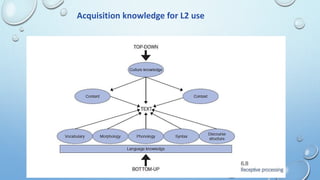
 Bottom-up process: is the prior knowledge of a language system such as vocabulary,
morphology, phonology, syntax, and discourse structure.
 Top-down process: is the knowledge of content, context, and cultures which are essential
components for communicative competence.
• What is receptive activity?
• The comprehension of reading and listening involve both bottom-up process
and top-down process.
• We can generally assume that sufficient prior linguistic knowledge-except
perhaps vocabulary – is automatically available to l1 learners, but it is often
insufficient to l2 learners such as incapability of interpretation of meaning,
comprehending written or spoken outcome.
• Vocabulary: of vocabulary is needed to recognize words and to understand what they mean.
• Morphology is needed to interpret complex lexical elements and grammar.
• Phonology is needed to recognize spoken words, to segment speech into grammatical units,
and to relate written symbols to their spoken form.
• Knowledge of syntax is needed to recognize how words relate to one another, and how they
are constituted as phrases and clauses.
• Knowledge of discourse structure is needed to interpret parts of language that are longer than
a single sentence.
 Bottom-up process
 Top-down Process
 Content knowledge is background information about the topic that is being read about or
listened so new information is perceived and interpreted in relation to this base.
 Context knowledge includes information learned from what has already been read or
heard in a specific text or situation, understand writer and speakers’ attention, overall
structure of discourse, and predictions.
 Culture knowledge subsumes content and context in many ways but also includes an
understanding of the wider social setting.
Acquisition knowledge for L2 use
I. Reading
Reading is the most important activity for learning a
language:
• Engage in L2 academic competence
• Interpersonal function and merely getting along in literate society
• Primary channel for L2 input
• Major sources to associated literature, other aspects of L2 cultures.
• Provide technological development, news, scientific discoveries.
• Literacy (reading ability) is needed for access to printed recourse,
books, journal, and access PC and internet.
I. Reading (Cont.)
Grabe Reviews Research (1991): fluent academic reading is involved in
terms of six component abilities and types of knowledge.
1. Automatic recognition ability
2. Vocabulary and structural knowledge
3. Formal discourse structure knowledge
4. Content/world background knowledge
5. Synthesis and evaluation processes/strategies
6. Metacognitive knowledge and comprehension monitoring.
Chapter 6 Acquiring Knowledge For L2 Use..pptx

Chapter 6 Acquiring Knowledge For L2 Use..pptx

  • 1.
    Instructed by prof.Pich Bunroeun Presentation by 1. Den Nai ID: 0691377 2. Pen Rotha ID:011633 សាកលវ ិទ្យាល័យបញ្ញ ា សាស្ត្រ កម្ ព ុជា PAÑÑĀSĀSTRA UNIVERSITY OF CAMBODIA Wednesday, December 02nd, 2020
  • 2.
    Receptive Activities I. Reading II.Beginning L2 reading III.Academic reading IV.Listening V. Begin L2 listening VI.Academic listening
  • 3.
    • After presentation,you will be able to:
  • 4.
     Productive activities:is the labeling of reading and listening.  Bottom-up process: is the prior knowledge of a language system such as vocabulary, morphology, phonology, syntax, and discourse structure.  Top-down process: is the knowledge of content, context, and cultures which are essential components for communicative competence.
  • 5.
    • What isreceptive activity?
  • 6.
    • The comprehensionof reading and listening involve both bottom-up process and top-down process. • We can generally assume that sufficient prior linguistic knowledge-except perhaps vocabulary – is automatically available to l1 learners, but it is often insufficient to l2 learners such as incapability of interpretation of meaning, comprehending written or spoken outcome.
  • 7.
    • Vocabulary: ofvocabulary is needed to recognize words and to understand what they mean. • Morphology is needed to interpret complex lexical elements and grammar. • Phonology is needed to recognize spoken words, to segment speech into grammatical units, and to relate written symbols to their spoken form. • Knowledge of syntax is needed to recognize how words relate to one another, and how they are constituted as phrases and clauses. • Knowledge of discourse structure is needed to interpret parts of language that are longer than a single sentence.  Bottom-up process
  • 8.
     Top-down Process Content knowledge is background information about the topic that is being read about or listened so new information is perceived and interpreted in relation to this base.  Context knowledge includes information learned from what has already been read or heard in a specific text or situation, understand writer and speakers’ attention, overall structure of discourse, and predictions.  Culture knowledge subsumes content and context in many ways but also includes an understanding of the wider social setting.
  • 9.
  • 10.
    I. Reading Reading isthe most important activity for learning a language: • Engage in L2 academic competence • Interpersonal function and merely getting along in literate society • Primary channel for L2 input • Major sources to associated literature, other aspects of L2 cultures. • Provide technological development, news, scientific discoveries. • Literacy (reading ability) is needed for access to printed recourse, books, journal, and access PC and internet.
  • 11.
    I. Reading (Cont.) GrabeReviews Research (1991): fluent academic reading is involved in terms of six component abilities and types of knowledge. 1. Automatic recognition ability 2. Vocabulary and structural knowledge 3. Formal discourse structure knowledge 4. Content/world background knowledge 5. Synthesis and evaluation processes/strategies 6. Metacognitive knowledge and comprehension monitoring.