Sarah Filchak, MSN CPNP-PC
November 3, 2017
 Review the resuscitation and NICU
admission/stay of Baby Girl M
 Discuss criteria for therapeutic hypothermia
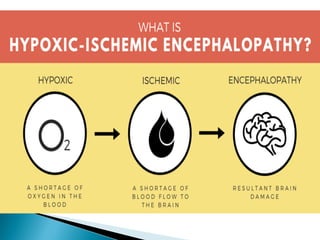
 Review hypoxic-ischemic encephalopathy
(HIE)
 Discuss goals of treatment for infants with
HIE
 Maternal history
◦ Evaluated in triage x 2 on 5/21 for bleeding but
discharged home undelivered
◦ Seen in OB office on 5/22 for routine visit 
decreased heart tones
◦ Admitted to MHSB
◦ C-section for non-reassuring fetal status
◦ 23 minutes from arrival to OB floor to delivery of
infant
 C-section for non-reassuring fetal status
 Complete abruption
 Apgars 1 – 2- 5
◦ Occasional gasps at delivery
◦ Initial heart rate ~20
◦ Given PPV to improve heart rate but gasping
respirations continue
◦ Intubated at 7 minutes of age
◦ At 10 minutes of age was having more spontaneous
respirations but apgar score was 5 so passive
cooling initiated
 Occurs in approximately 1.5/1000 live births
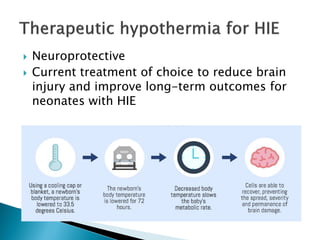
 Neuroprotective
 Current treatment of choice to reduce brain
injury and improve long-term outcomes for
neonates with HIE
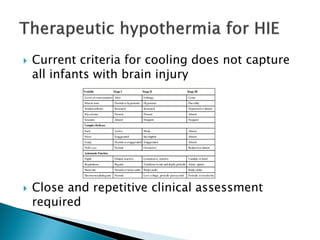
 Current criteria for cooling does not capture
all infants with brain injury
 Close and repetitive clinical assessment
required
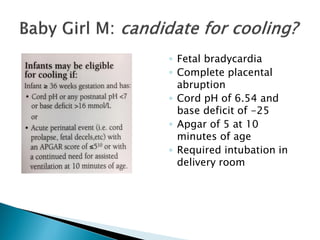
◦ Fetal bradycardia
◦ Complete placental
abruption
◦ Cord pH of 6.54 and
base deficit of -25
◦ Apgar of 5 at 10
minutes of age
◦ Required intubation in
delivery room
 Passive cooling continues
 CPAP per ETT
 Placement of umbilical venous catheter
 VBG: pH 7.13 and base deficit -20
 Started on aEEG
 Clinical presentation
 Total body cooling began at ~90 minutes of
age
 Respiratory management
◦ Attempt to maintain normal blood gas values
 Circulatory
◦ Decreased cardiac output
◦ Maintain arterial blood pressure 40-60 mmHg
 Fluid/Electrolyte/Nutrition
◦ Fluid restriction
◦ Monitor electrolytes every 8-12 hr
◦ Glucose
◦ Delayed feedings
 Renal
◦ Follow serum creatinine rather than urinary output
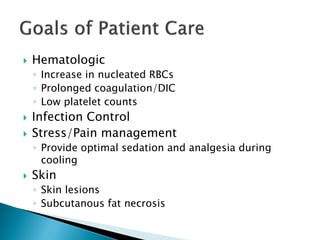
 Hematologic
◦ Increase in nucleated RBCs
◦ Prolonged coagulation/DIC
◦ Low platelet counts
 Infection Control
 Stress/Pain management
◦ Provide optimal sedation and analgesia during
cooling
 Skin
◦ Skin lesions
◦ Subcutanous fat necrosis
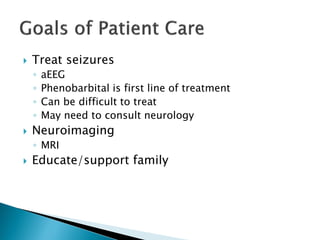
 Treat seizures
◦ aEEG
◦ Phenobarbital is first line of treatment
◦ Can be difficult to treat
◦ May need to consult neurology
 Neuroimaging
◦ MRI
 Educate/support family
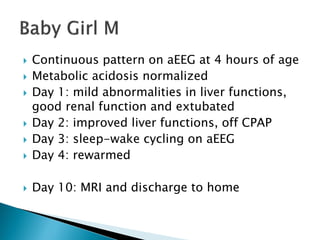
 Continuous pattern on aEEG at 4 hours of age
 Metabolic acidosis normalized
 Day 1: mild abnormalities in liver functions,
good renal function and extubated
 Day 2: improved liver functions, off CPAP
 Day 3: sleep-wake cycling on aEEG
 Day 4: rewarmed
 Day 10: MRI and discharge to home
 Ahearne, C., Boylan, G., & Murray, D. Short and
long term prognosis in perinatal asphyxia: an
update. (2013) World Journal of Clinical Pediatrics
5 (1), 67-74.
 Natarajan, G., et al. (2013). Apgar scores at 10
minutes and outcomes at 6-7 years following
hypoxic-ischaemic encephalopathy. Archives of
Disease in Childhood: Fetal and Neonatal edition
98(6), F473-479.
 Pappas, A., et al. (2014). Cognitive outcomes
after neonatal encephalopathy. Pediatrics 135 3),
e624-634.
 Robertson, C. & Perlman, M. (2006). Follow-up of
the term infant after hypoxic-ischemic
encephalopathy. Paediatrics & Child Health 11
(5), 278-282.
 Shankaran, S., et al. (2012). Childhood outcomes
after hypothermia for neonatal encephalopathy.
New England Journal of Medicine 366 (22), 2085-
2092.
 van Laerhoven, H., de Haan, T., Offringa, M.,
Post, B., & van der Lee, J. (2013). Pediatrics 131
(1), 88-98.
 Verklan, M.T., & Walden, M. (2010). Core
curriculum for Neonatal Intensive Care Nursing
(4th ed). St. Louis: Saunders.

Filchak Symposium 1.pdf

  • 1.
    Sarah Filchak, MSNCPNP-PC November 3, 2017
  • 2.
     Review theresuscitation and NICU admission/stay of Baby Girl M  Discuss criteria for therapeutic hypothermia  Review hypoxic-ischemic encephalopathy (HIE)  Discuss goals of treatment for infants with HIE
  • 3.
     Maternal history ◦Evaluated in triage x 2 on 5/21 for bleeding but discharged home undelivered ◦ Seen in OB office on 5/22 for routine visit  decreased heart tones ◦ Admitted to MHSB ◦ C-section for non-reassuring fetal status ◦ 23 minutes from arrival to OB floor to delivery of infant
  • 4.
     C-section fornon-reassuring fetal status  Complete abruption  Apgars 1 – 2- 5 ◦ Occasional gasps at delivery ◦ Initial heart rate ~20 ◦ Given PPV to improve heart rate but gasping respirations continue ◦ Intubated at 7 minutes of age ◦ At 10 minutes of age was having more spontaneous respirations but apgar score was 5 so passive cooling initiated
  • 5.
     Occurs inapproximately 1.5/1000 live births
  • 8.
     Neuroprotective  Currenttreatment of choice to reduce brain injury and improve long-term outcomes for neonates with HIE
  • 9.
     Current criteriafor cooling does not capture all infants with brain injury  Close and repetitive clinical assessment required
  • 10.
    ◦ Fetal bradycardia ◦Complete placental abruption ◦ Cord pH of 6.54 and base deficit of -25 ◦ Apgar of 5 at 10 minutes of age ◦ Required intubation in delivery room
  • 11.
     Passive coolingcontinues  CPAP per ETT  Placement of umbilical venous catheter  VBG: pH 7.13 and base deficit -20  Started on aEEG  Clinical presentation  Total body cooling began at ~90 minutes of age
  • 12.
     Respiratory management ◦Attempt to maintain normal blood gas values  Circulatory ◦ Decreased cardiac output ◦ Maintain arterial blood pressure 40-60 mmHg  Fluid/Electrolyte/Nutrition ◦ Fluid restriction ◦ Monitor electrolytes every 8-12 hr ◦ Glucose ◦ Delayed feedings  Renal ◦ Follow serum creatinine rather than urinary output
  • 13.
     Hematologic ◦ Increasein nucleated RBCs ◦ Prolonged coagulation/DIC ◦ Low platelet counts  Infection Control  Stress/Pain management ◦ Provide optimal sedation and analgesia during cooling  Skin ◦ Skin lesions ◦ Subcutanous fat necrosis
  • 14.
     Treat seizures ◦aEEG ◦ Phenobarbital is first line of treatment ◦ Can be difficult to treat ◦ May need to consult neurology  Neuroimaging ◦ MRI  Educate/support family
  • 15.
     Continuous patternon aEEG at 4 hours of age  Metabolic acidosis normalized  Day 1: mild abnormalities in liver functions, good renal function and extubated  Day 2: improved liver functions, off CPAP  Day 3: sleep-wake cycling on aEEG  Day 4: rewarmed  Day 10: MRI and discharge to home
  • 16.
     Ahearne, C.,Boylan, G., & Murray, D. Short and long term prognosis in perinatal asphyxia: an update. (2013) World Journal of Clinical Pediatrics 5 (1), 67-74.  Natarajan, G., et al. (2013). Apgar scores at 10 minutes and outcomes at 6-7 years following hypoxic-ischaemic encephalopathy. Archives of Disease in Childhood: Fetal and Neonatal edition 98(6), F473-479.  Pappas, A., et al. (2014). Cognitive outcomes after neonatal encephalopathy. Pediatrics 135 3), e624-634.
  • 17.
     Robertson, C.& Perlman, M. (2006). Follow-up of the term infant after hypoxic-ischemic encephalopathy. Paediatrics & Child Health 11 (5), 278-282.  Shankaran, S., et al. (2012). Childhood outcomes after hypothermia for neonatal encephalopathy. New England Journal of Medicine 366 (22), 2085- 2092.  van Laerhoven, H., de Haan, T., Offringa, M., Post, B., & van der Lee, J. (2013). Pediatrics 131 (1), 88-98.  Verklan, M.T., & Walden, M. (2010). Core curriculum for Neonatal Intensive Care Nursing (4th ed). St. Louis: Saunders.