Elementary Properties of
Groups
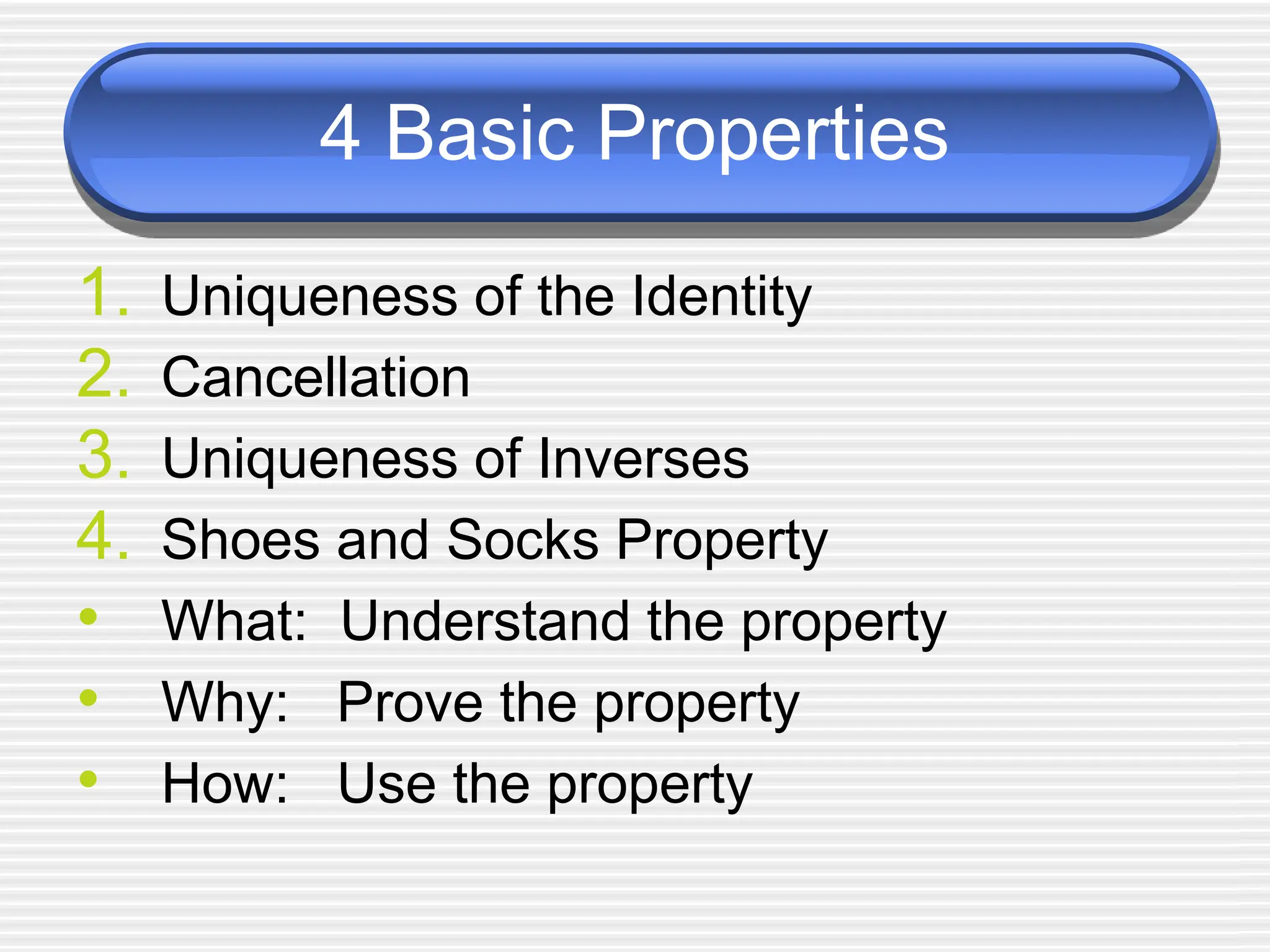
4 Basic Properties
1. Uniqueness of the Identity
2. Cancellation
3. Uniqueness of Inverses
4. Shoes and Socks Property
• What: Understand the property
• Why: Prove the property
• How: Use the property
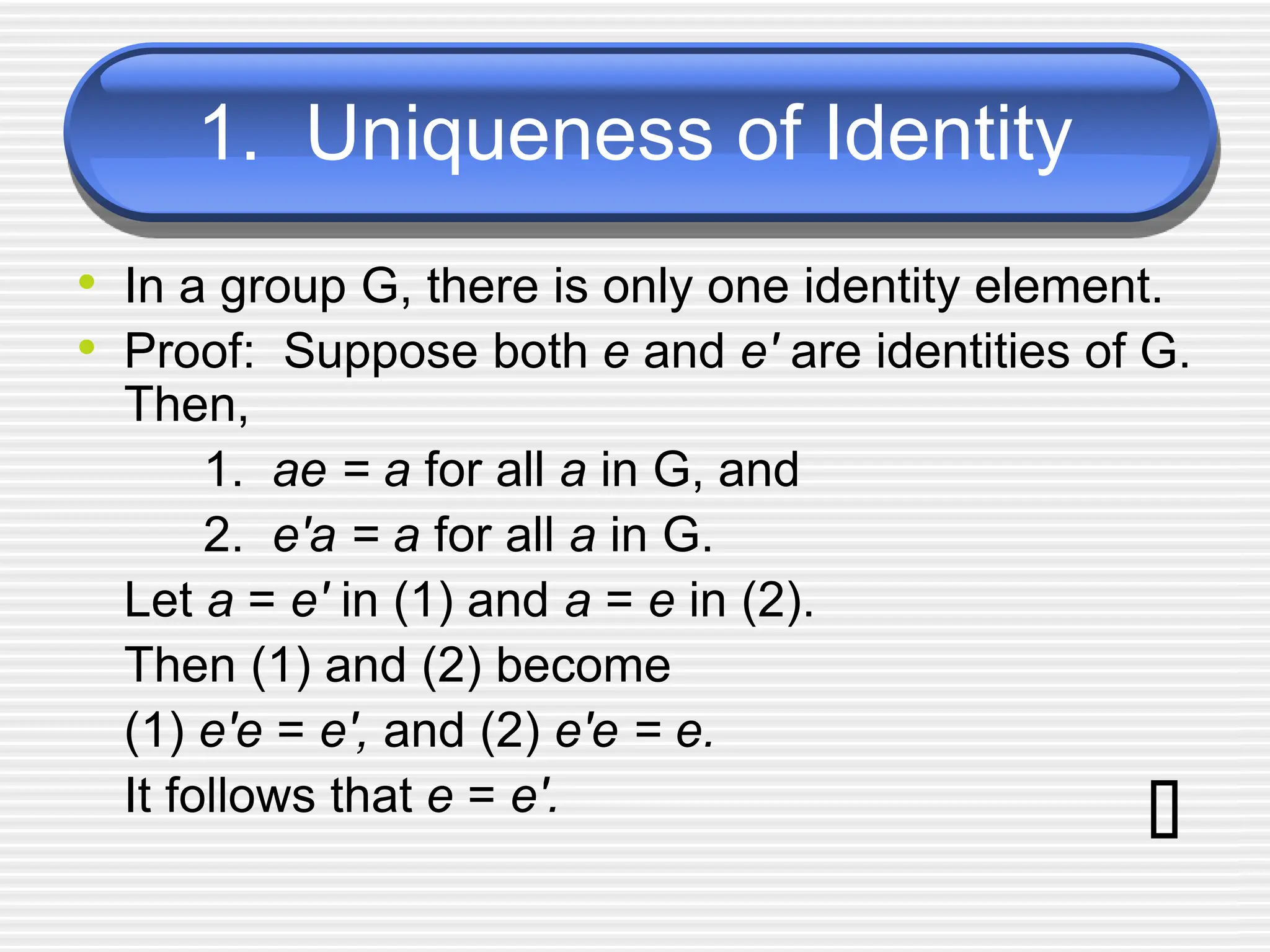
1. Uniqueness of Identity
• In a group G, there is only one identity element.
• Proof: Suppose both e and e' are identities of G.
Then,
1. ae = a for all a in G, and
2. e'a = a for all a in G.
Let a = e' in (1) and a = e in (2).
Then (1) and (2) become
(1) e'e = e', and (2) e'e = e.
It follows that e = e'.
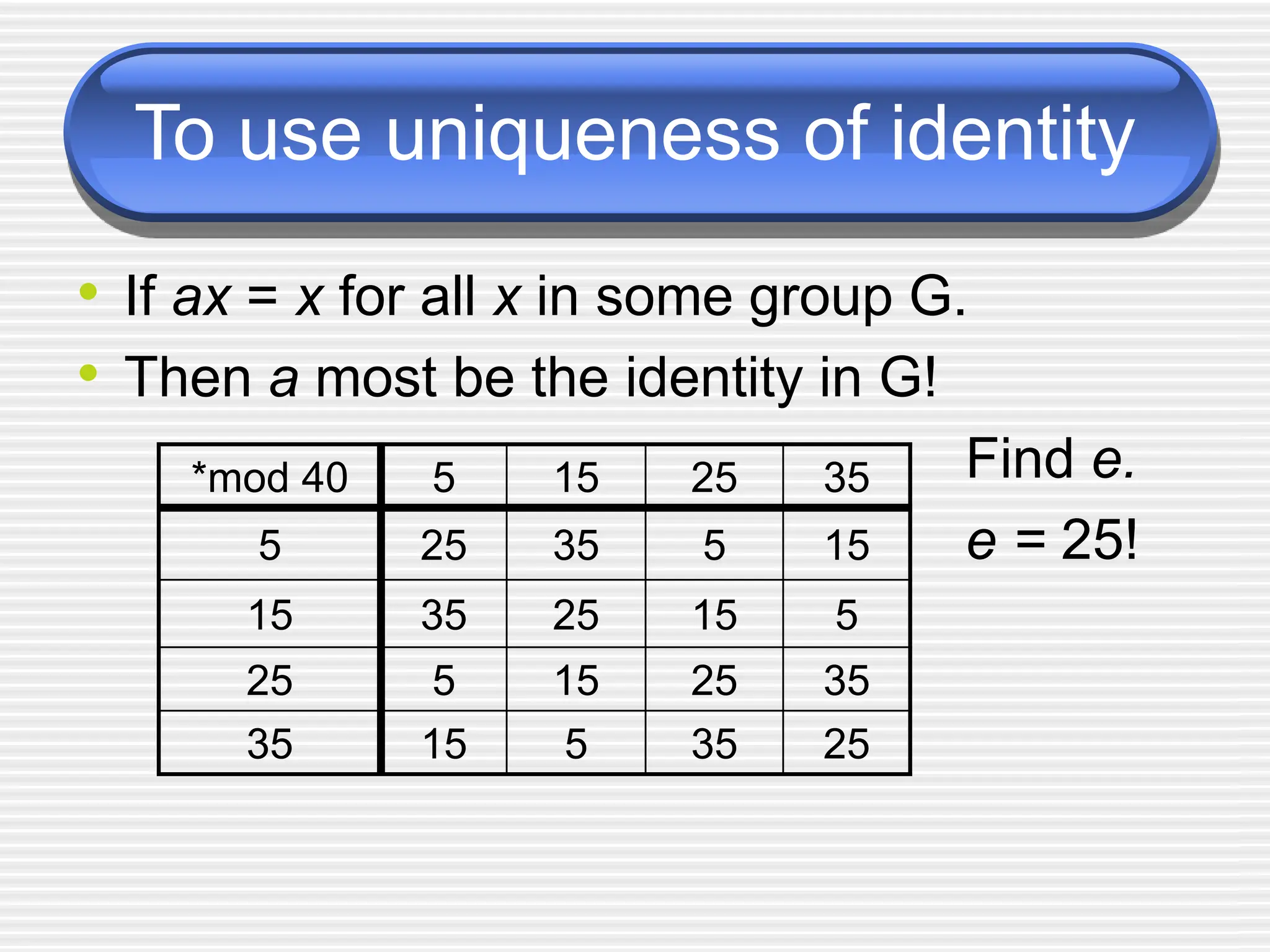
To use uniqueness of identity
• If ax = x for all x in some group G.
• Then a most be the identity in G!
Find e.
e = 25!
*mod 40 5 15 25 35
5 25 35 5 15
15 35 25 15 5
25 5 15 25 35
35 15 5 35 25
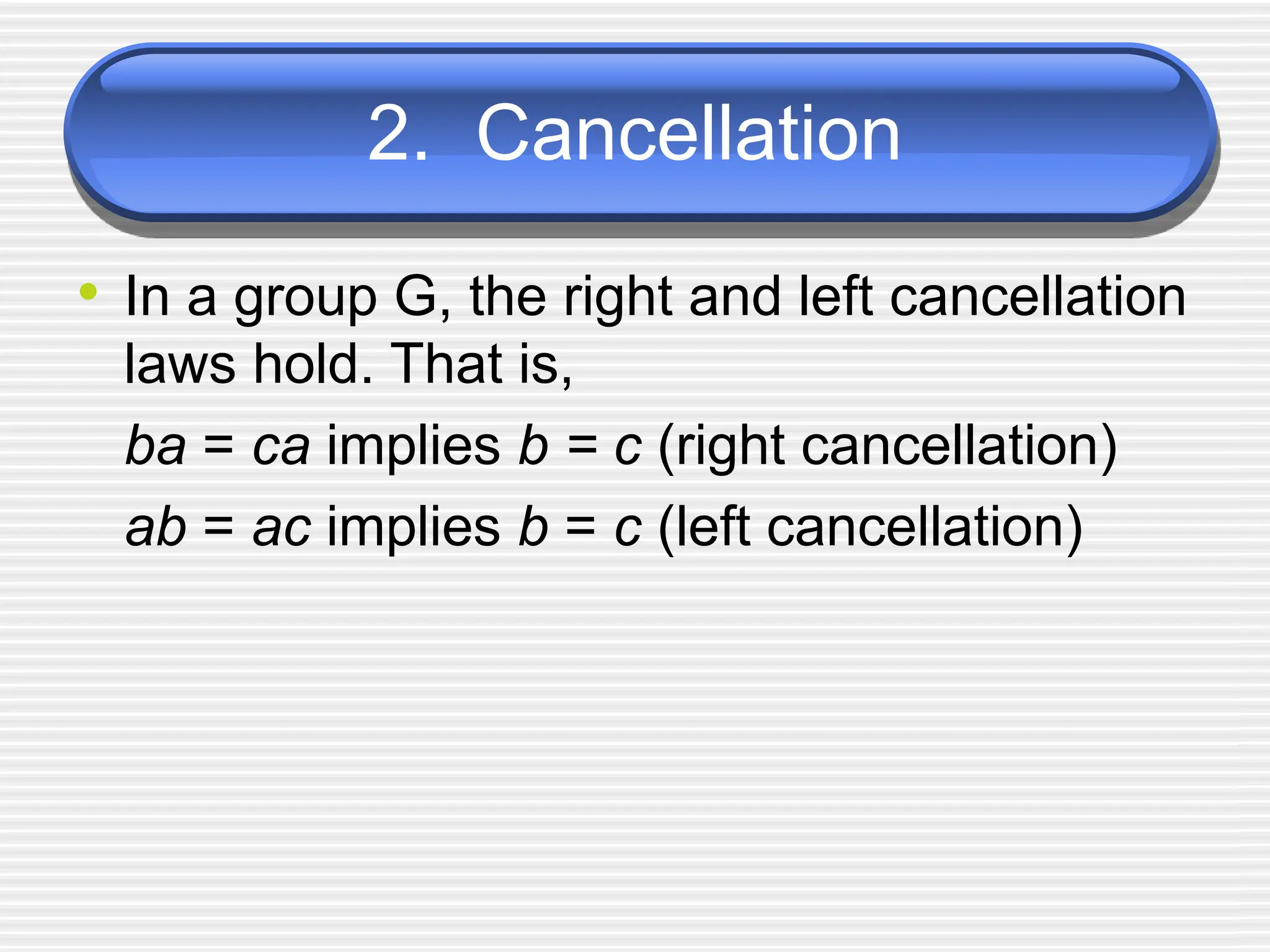
2. Cancellation
• In a group G, the right and left cancellation
laws hold. That is,
ba = ca implies b = c (right cancellation)
ab = ac implies b = c (left cancellation)
Proof: Right cancellation
• Let G be a group with identity element e.
Suppose ba=ca.
Let a' be an inverse of a. Then
(ba)a' = (ca)a'
=> b(aa') = c(aa') by associativity
=> be = ce by the definition of inverses
=> b = c by the definition of the identity.
Proof of left cancellation
• Similar.
• Put it in your proof notebook.
When not to use cancellation
• In D4
R90D = D'R90
• You cannot cross cancel, since D ≠ D'
• Order matters!
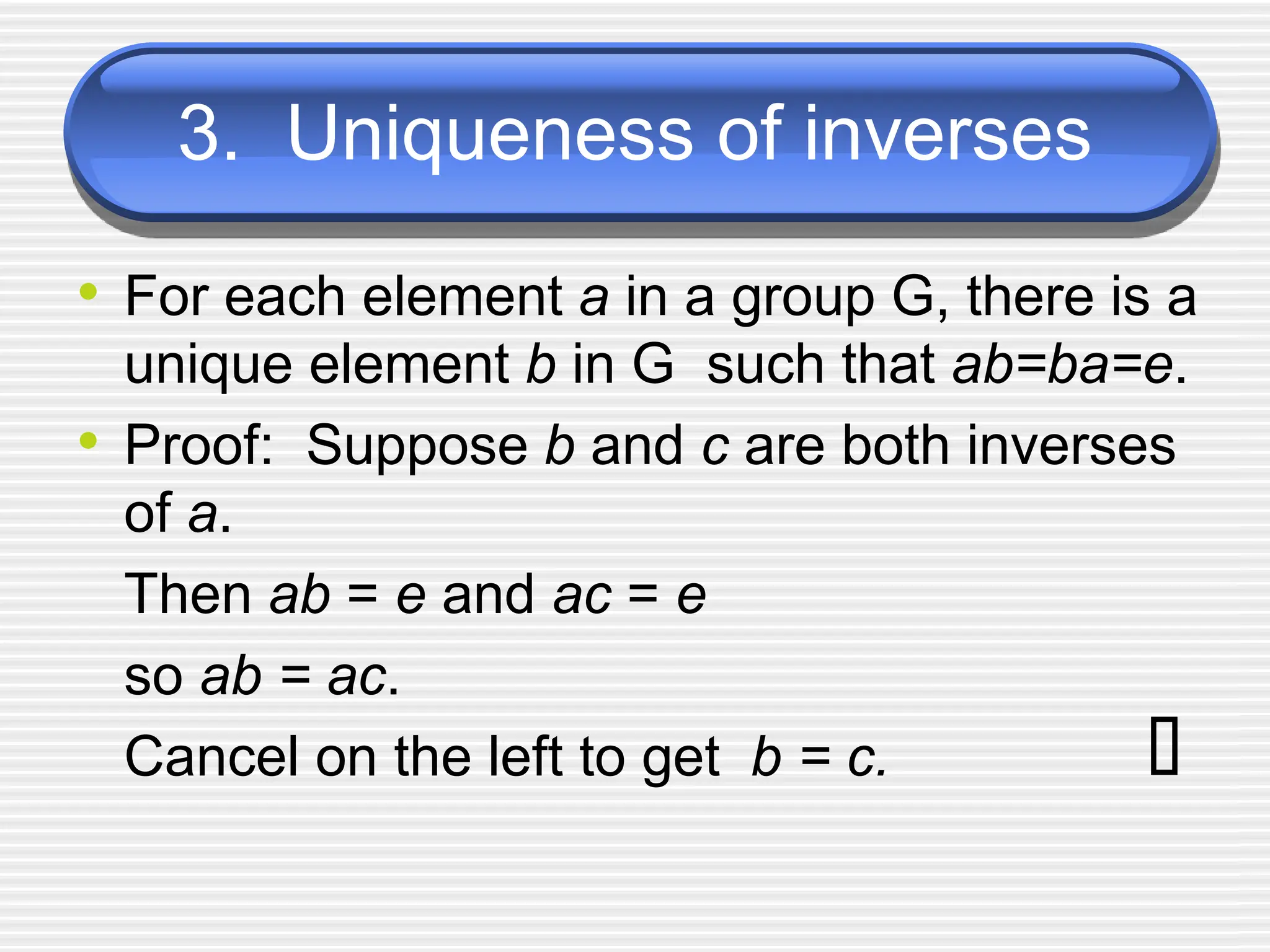
3. Uniqueness of inverses
• For each element a in a group G, there is a
unique element b in G such that ab=ba=e.
• Proof: Suppose b and c are both inverses
of a.
Then ab = e and ac = e
so ab = ac.
Cancel on the left to get b = c.
4. Shoes and Socks
• For group elements a and b,
(ab)-1 =b-1a-1
• Proof:
(ab)(b-1a-1) = (a(bb-1))a-1
=(ae)a-1
= aa-1
= e
Since inverses are unique, b-1a-1 must be (ab)-1

Elementary Properties of Groups .ppt

  • 1.
  • 2.
    4 Basic Properties 1.Uniqueness of the Identity 2. Cancellation 3. Uniqueness of Inverses 4. Shoes and Socks Property • What: Understand the property • Why: Prove the property • How: Use the property
  • 3.
    1. Uniqueness ofIdentity • In a group G, there is only one identity element. • Proof: Suppose both e and e' are identities of G. Then, 1. ae = a for all a in G, and 2. e'a = a for all a in G. Let a = e' in (1) and a = e in (2). Then (1) and (2) become (1) e'e = e', and (2) e'e = e. It follows that e = e'.
  • 4.
    To use uniquenessof identity • If ax = x for all x in some group G. • Then a most be the identity in G! Find e. e = 25! *mod 40 5 15 25 35 5 25 35 5 15 15 35 25 15 5 25 5 15 25 35 35 15 5 35 25
  • 5.
    2. Cancellation • Ina group G, the right and left cancellation laws hold. That is, ba = ca implies b = c (right cancellation) ab = ac implies b = c (left cancellation)
  • 6.
    Proof: Right cancellation •Let G be a group with identity element e. Suppose ba=ca. Let a' be an inverse of a. Then (ba)a' = (ca)a' => b(aa') = c(aa') by associativity => be = ce by the definition of inverses => b = c by the definition of the identity.
  • 7.
    Proof of leftcancellation • Similar. • Put it in your proof notebook.
  • 8.
    When not touse cancellation • In D4 R90D = D'R90 • You cannot cross cancel, since D ≠ D' • Order matters!
  • 9.
    3. Uniqueness ofinverses • For each element a in a group G, there is a unique element b in G such that ab=ba=e. • Proof: Suppose b and c are both inverses of a. Then ab = e and ac = e so ab = ac. Cancel on the left to get b = c.
  • 10.
    4. Shoes andSocks • For group elements a and b, (ab)-1 =b-1a-1 • Proof: (ab)(b-1a-1) = (a(bb-1))a-1 =(ae)a-1 = aa-1 = e Since inverses are unique, b-1a-1 must be (ab)-1