Raghavendra Institute of Pharmaceutical Education and Research - Autonomous
K.R.Palli Cross, Chiyyedu, Anantapuramu, A. P- 515721
General analytical methods for milk
A Seminar as a part of curricular requirement
for Master of Pharmacy, I Year - I semester
Presented by
KHALID OSMAN
(20L81S0710)
Pharmaceutical analysis
Under the guidance of
Dr. P. Vinod Kumar M.Pharm, Ph.D.
Professor & head of Pharmaceutical analysis
RIPER
AUTONOMOUS
NAAC &
NBA (UG)
SIRO- DSIR
Raghavendra Institute of Pharmaceutical Education and Research - Autonomous
K.R.Palli Cross, Chiyyedu, Anantapuramu, A. P- 515721 2
Contents :
 Introduction
 Milk Analysis Methods For :
 Density
 Fat Content
 Total dry extract (TDE)
 Non-fat dry extract (NFDE)
 Cryoscopy
 Acidity
 References
RIPER
AUTONOMOUS
NAAC &
NBA (UG)
SIRO- DSIR
Raghavendra Institute of Pharmaceutical Education and Research - Autonomous
K.R.Palli Cross, Chiyyedu, Anantapuramu, A. P- 515721
 INTRODUCTION :
 Milk provides essential nutrients and is an important source of dietary energy,
high-quality proteins and fats.
 Milk can make a significant contribution to the required nutrient intakes for
calcium, magnesium, selenium, riboflavin, vitamin B12 and pantothenic acid.
 Milk and milk products are nutrient-dense foods and their consumption can add
diversity to plant-based diets.
 Animal milk can play an important role in the diets of children in populations
with very low fat intakes and limited access to other animal source foods.
3
RIPER
AUTONOMOUS
NAAC &
NBA (UG)
SIRO- DSIR
Raghavendra Institute of Pharmaceutical Education and Research - Autonomous
K.R.Palli Cross, Chiyyedu, Anantapuramu, A. P- 515721
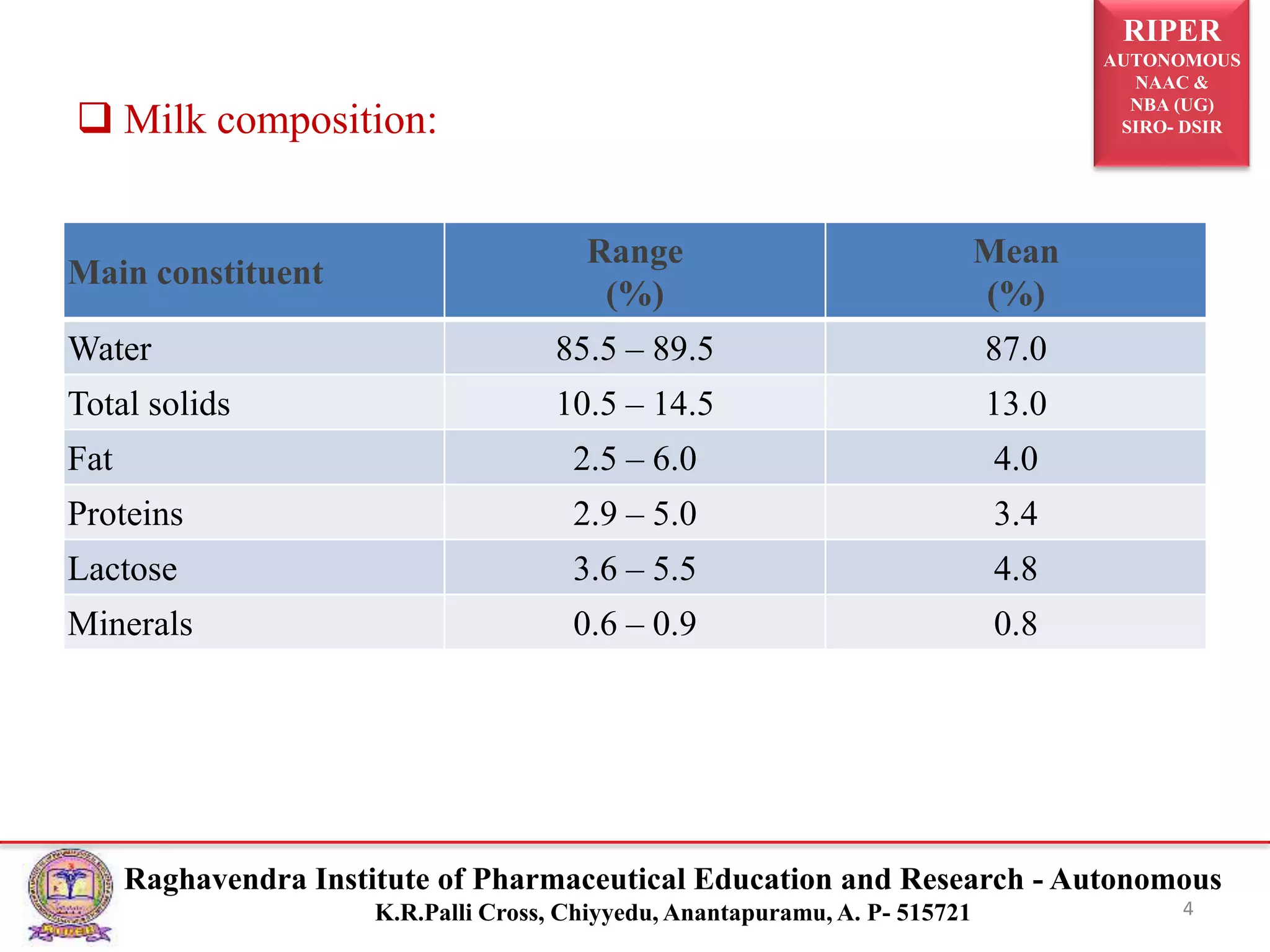
 Milk composition:
Main constituent
Range
(%)
Mean
(%)
Water 85.5 – 89.5 87.0
Total solids 10.5 – 14.5 13.0
Fat 2.5 – 6.0 4.0
Proteins 2.9 – 5.0 3.4
Lactose 3.6 – 5.5 4.8
Minerals 0.6 – 0.9 0.8
4
RIPER
AUTONOMOUS
NAAC &
NBA (UG)
SIRO- DSIR
Raghavendra Institute of Pharmaceutical Education and Research - Autonomous
K.R.Palli Cross, Chiyyedu, Anantapuramu, A. P- 515721
 variety of milk products:
 Cow milk : Fat constitutes approximately 3 to 4 percent of the solid
content of cow milk, protein about 3.5 percent and lactose 5 percent, but
the gross chemical composition of cow milk varies depending on the breed.
 Buffalo milk : has a very high fat content, which is on average twice as
high as that of cow milk. The fat-to-protein ratio in buffalo milk is about
2:1. Compared with cattle milk, buffalo milk also has a higher casein-to-
protein ratio. The high calcium content of casein facilitates cheese making.
5
RIPER
AUTONOMOUS
NAAC &
NBA (UG)
SIRO- DSIR
Raghavendra Institute of Pharmaceutical Education and Research - Autonomous
K.R.Palli Cross, Chiyyedu, Anantapuramu, A. P- 515721
 Camel milk : has a similar composition to cow milk but is slightly saltier.
Camel milk can be three times as rich in vitamin C as cow milk and
represents a vital source of this vitamin for people living in arid and semi-
arid areas, who often cannot obtain vitamin C from fruits and vegetables.
Camel milk is also rich in unsaturated fatty acids and B vitamins.
 Sheep milk : has higher fat and protein contents than goat and cow milk;
only buffalo and yak milk contain more fat. Sheep milk also generally has a
higher lactose content than milk from cows, buffaloes and goats.
6
RIPER
AUTONOMOUS
NAAC &
NBA (UG)
SIRO- DSIR
Raghavendra Institute of Pharmaceutical Education and Research - Autonomous
K.R.Palli Cross, Chiyyedu, Anantapuramu, A. P- 515721
 Goat milk : has a similar composition to cow milk. In Mediterranean
countries and in Latin America, goat milk is generally transformed into
cheese; in Africa and South Asia, it is usually consumed raw or acidified.
 Yak milk : tastes sweet and has a fragrant, sweetish smell. Yak milk has
between 15 and 18 percent solid content, 5.5 to 9 percent fat and 4 to
5.9 percent protein
 Equine milk: Horse and donkey milk have very similar compositions.
Equine milk, like human milk, is relatively low in proteins (particularly
caseins) and ashes and rich in lactose.
7
RIPER
AUTONOMOUS
NAAC &
NBA (UG)
SIRO- DSIR
Raghavendra Institute of Pharmaceutical Education and Research - Autonomous
K.R.Palli Cross, Chiyyedu, Anantapuramu, A. P- 515721
 Milk testing and quality control:
 quantity – measured in volume or weight;
 organoleptic characteristics – appearance, taste and smell;
 compositional characteristics – especially fat, solid and protein contents;
 physical and chemical characteristics;
 hygienic characteristics – hygienic conditions, cleanliness and quality;
 adulteration – with water, preservatives, added solids, etc;
 drug residues.
8
RIPER
AUTONOMOUS
NAAC &
NBA (UG)
SIRO- DSIR
Raghavendra Institute of Pharmaceutical Education and Research - Autonomous
K.R.Palli Cross, Chiyyedu, Anantapuramu, A. P- 515721 9
 Density :
 The density is a relationship between the body mass and the volume this body
occupies in the space.
 The density test is performed in order to be used in the detection of adulteration
in the milk, since the addition of water only would cause the decrease in density.
 whereas the skimming (fat removal) would cause an increased density in the
milk, besides supplying important information for the determination of the total
dry extract.
RIPER
AUTONOMOUS
NAAC &
NBA (UG)
SIRO- DSIR
Raghavendra Institute of Pharmaceutical Education and Research - Autonomous
K.R.Palli Cross, Chiyyedu, Anantapuramu, A. P- 515721 10
 Determination methods :
 The density determination is accomplished by the thermolactodensimeter
because the practicability of this method .
 Place the sample to be analyzed in the clean and dry test tube, by taking the
care of inclining the test tube and allowing the liquid to flow down the
walls of the glass for avoiding the incorporation of the air which would
reduce the density of the milk .
 Place the sample to be analyzed in the clean and dry test tube, by taking the
care of inclining the test tube and allowing the liquid to flow down the
walls of the glass for avoiding the incorporation of the air which would
reduce the density of the milk .
RIPER
AUTONOMOUS
NAAC &
NBA (UG)
SIRO- DSIR
Raghavendra Institute of Pharmaceutical Education and Research - Autonomous
K.R.Palli Cross, Chiyyedu, Anantapuramu, A. P- 515721
Immerse TDL into the test tube and make it rotate slowly on its own axis.
Perform the reading of both density and temperature of the milk, as soon as
TDL stabilizes.
Proceed to the correction of the influence from the temperature, by using an
adequate scale. The result will correspond to the corrected milk density.
RIPER
AUTONOMOUS
NAAC &
NBA (UG)
SIRO- DSIR
Raghavendra Institute of Pharmaceutical Education and Research - Autonomous
K.R.Palli Cross, Chiyyedu, Anantapuramu, A. P- 515721
 Fat Content :
 Fat is the most variable component (from 2.8 to 6.5%) of the milk, and has a
higher commercial value.
 Its determination became almost a routine in the dairies, because the easiness it
is removed from the milk
12
RIPER
AUTONOMOUS
NAAC &
NBA (UG)
SIRO- DSIR
Raghavendra Institute of Pharmaceutical Education and Research - Autonomous
K.R.Palli Cross, Chiyyedu, Anantapuramu, A. P- 515721 13
 Gerber's method :
 Carefully add 10 mL sulfuric acid in the butyrometer .
 Carefully add 11 mL milk to the butyrometer, by letting it to slowly flow
down the glass walls in order to it does not mix with the acid .
 Add 1 mL amyl alcohol .
 Clean the neck of the butyrometer and close with cork .
RIPER
AUTONOMOUS
NAAC &
NBA (UG)
SIRO- DSIR
Raghavendra Institute of Pharmaceutical Education and Research - Autonomous
K.R.Palli Cross, Chiyyedu, Anantapuramu, A. P- 515721
 Agitate as inverting the butyrometer so the three liquids are mixed
 Centrifuge for 4 to 5 minutes at 1200 rpm in the Gerber centrifuge
 Remove the butyrometer of the centrifuge and adjust the meniscus to
accomplish the reading.
 The reading value in the scale is the result of the percent fat in the milk (%
mass / volume)
14
RIPER
AUTONOMOUS
NAAC &
NBA (UG)
SIRO- DSIR
Raghavendra Institute of Pharmaceutical Education and Research - Autonomous
K.R.Palli Cross, Chiyyedu, Anantapuramu, A. P- 515721 15
 Total dry extract (TDE) :
 The dry extract may be defined as "all components of the milk, except water".
They determine the nutritional quality and industrial yield of the milk
products.
 The Ackermann’s disk is the indirect, low cost, and more practical method to
determine the total dry extract (TDE).
RIPER
AUTONOMOUS
NAAC &
NBA (UG)
SIRO- DSIR
Raghavendra Institute of Pharmaceutical Education and Research - Autonomous
K.R.Palli Cross, Chiyyedu, Anantapuramu, A. P- 515721 16
 Determination method :
 The fat content and density are determined by conventional methods .
 The demarcation of the internal disk regarding to fat content is taken to meet the
value concerning to the corrected milk density (shown in the intermediate circle) .
 The reading of the value is accomplished where the arrow in the external circle is.
Such as value refers to the percent total dry extract.
RIPER
AUTONOMOUS
NAAC &
NBA (UG)
SIRO- DSIR
Raghavendra Institute of Pharmaceutical Education and Research - Autonomous
K.R.Palli Cross, Chiyyedu, Anantapuramu, A. P- 515721 17
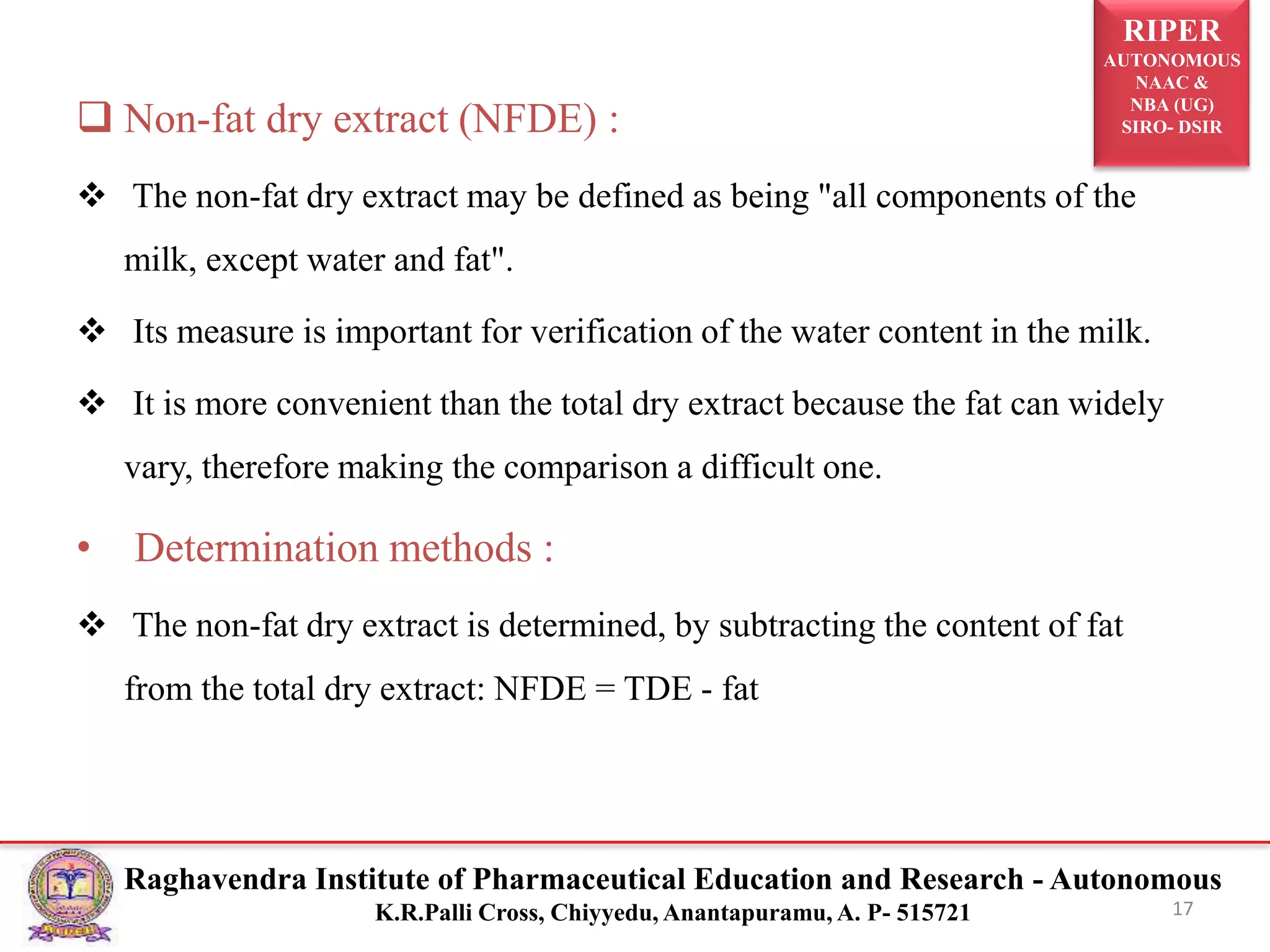
 Non-fat dry extract (NFDE) :
 The non-fat dry extract may be defined as being "all components of the
milk, except water and fat".
 Its measure is important for verification of the water content in the milk.
 It is more convenient than the total dry extract because the fat can widely
vary, therefore making the comparison a difficult one.
• Determination methods :
 The non-fat dry extract is determined, by subtracting the content of fat
from the total dry extract: NFDE = TDE - fat
RIPER
AUTONOMOUS
NAAC &
NBA (UG)
SIRO- DSIR
Raghavendra Institute of Pharmaceutical Education and Research - Autonomous
K.R.Palli Cross, Chiyyedu, Anantapuramu, A. P- 515721
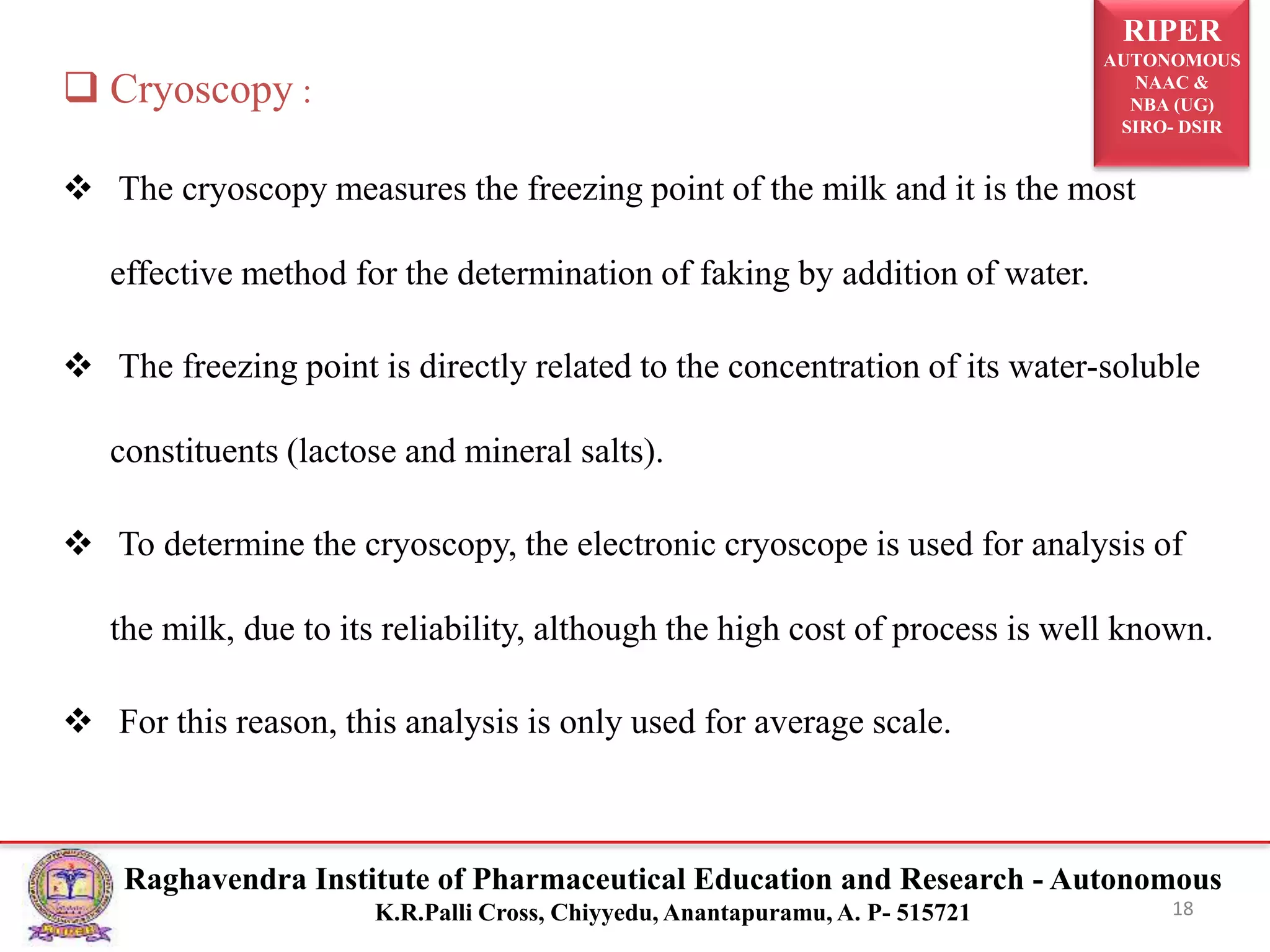
 Cryoscopy :
 The cryoscopy measures the freezing point of the milk and it is the most
effective method for the determination of faking by addition of water.
 The freezing point is directly related to the concentration of its water-soluble
constituents (lactose and mineral salts).
 To determine the cryoscopy, the electronic cryoscope is used for analysis of
the milk, due to its reliability, although the high cost of process is well known.
 For this reason, this analysis is only used for average scale.
18
RIPER
AUTONOMOUS
NAAC &
NBA (UG)
SIRO- DSIR
Raghavendra Institute of Pharmaceutical Education and Research - Autonomous
K.R.Palli Cross, Chiyyedu, Anantapuramu, A. P- 515721 19
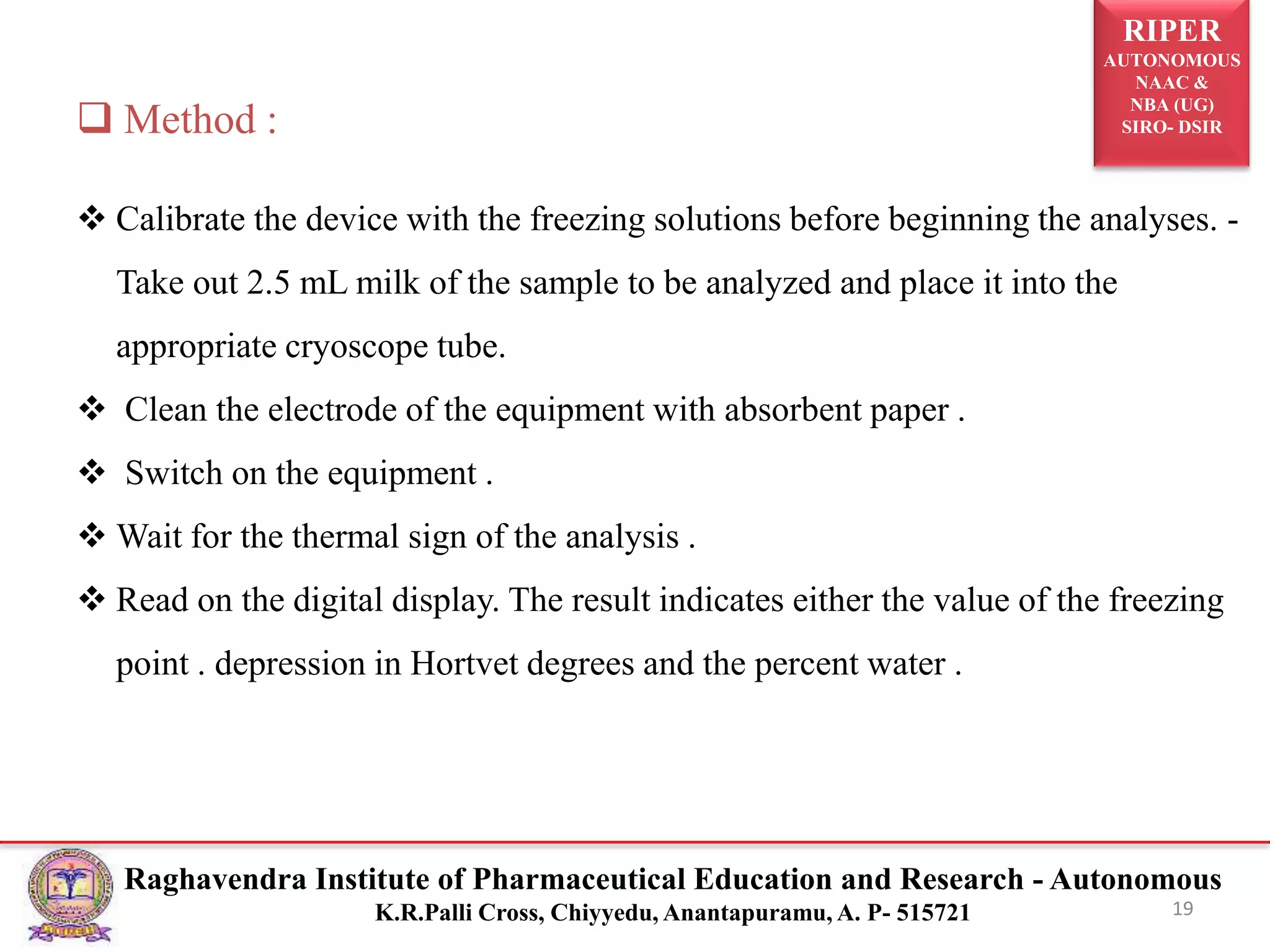
 Method :
 Calibrate the device with the freezing solutions before beginning the analyses. -
Take out 2.5 mL milk of the sample to be analyzed and place it into the
appropriate cryoscope tube.
 Clean the electrode of the equipment with absorbent paper .
 Switch on the equipment .
 Wait for the thermal sign of the analysis .
 Read on the digital display. The result indicates either the value of the freezing
point . depression in Hortvet degrees and the percent water .
RIPER
AUTONOMOUS
NAAC &
NBA (UG)
SIRO- DSIR
Raghavendra Institute of Pharmaceutical Education and Research - Autonomous
K.R.Palli Cross, Chiyyedu, Anantapuramu, A. P- 515721
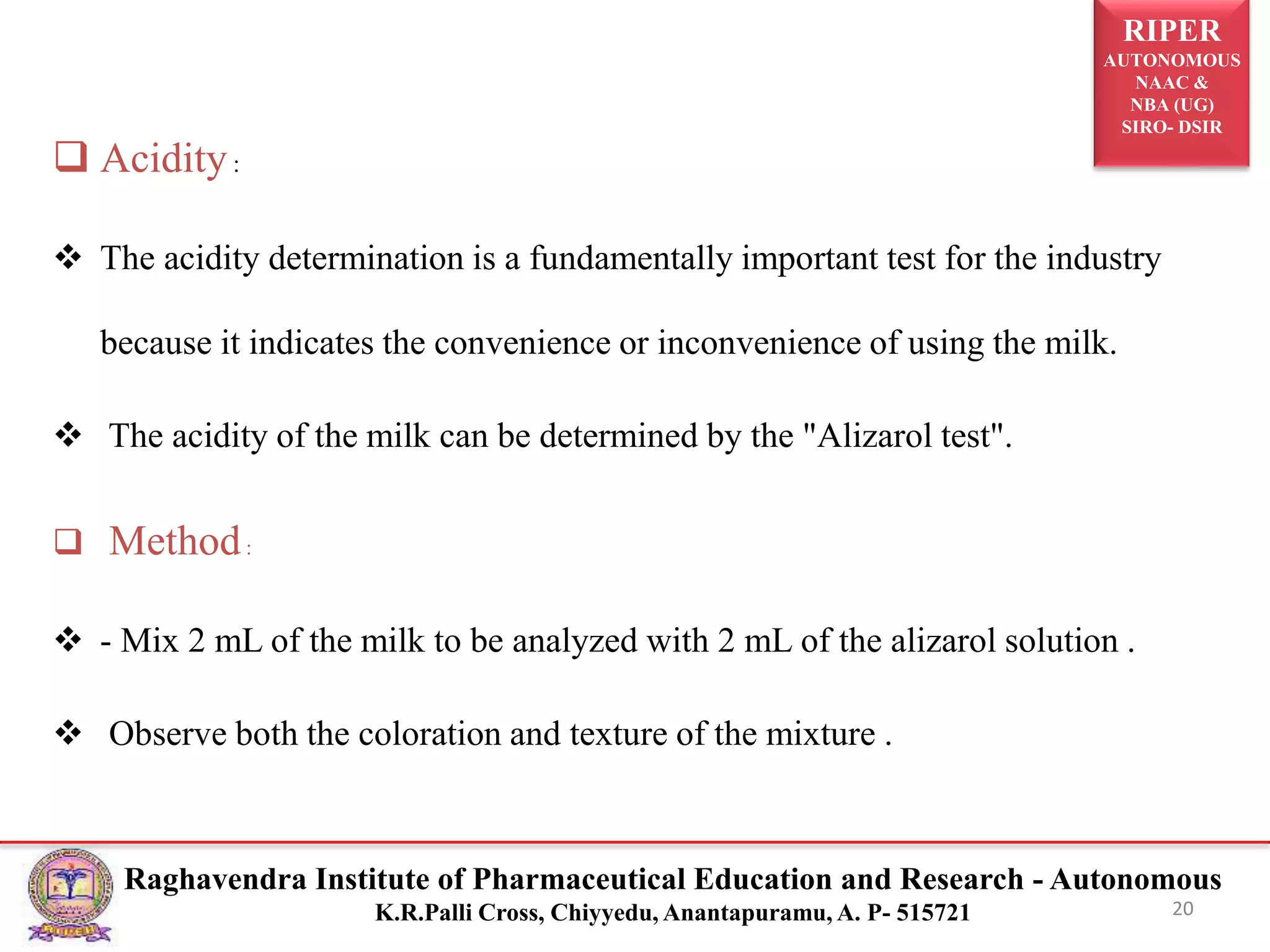
 Acidity:
 The acidity determination is a fundamentally important test for the industry
because it indicates the convenience or inconvenience of using the milk.
 The acidity of the milk can be determined by the "Alizarol test".
 Method:
 - Mix 2 mL of the milk to be analyzed with 2 mL of the alizarol solution .
 Observe both the coloration and texture of the mixture .
20
RIPER
AUTONOMOUS
NAAC &
NBA (UG)
SIRO- DSIR
Raghavendra Institute of Pharmaceutical Education and Research - Autonomous
K.R.Palli Cross, Chiyyedu, Anantapuramu, A. P- 515721 21
 The acid milk presents a mixture where the coloration of the alizarol is
rosy (little acid) or yellow (very acid), besides presenting clots .
 The normal milk presents a mixture with a brick-red coloration and
clotless .
 The alkalinized milk (usually by increment of water or neutralizing
substance) presents violet coloration.
RIPER
AUTONOMOUS
NAAC &
NBA (UG)
SIRO- DSIR
Raghavendra Institute of Pharmaceutical Education and Research - Autonomous
K.R.Palli Cross, Chiyyedu, Anantapuramu, A. P- 515721
 References :
 Food and Agriculture Organization of the United Nations.
Food and Agriculture Organization of the United Nation
22
RIPER
AUTONOMOUS
NAAC &
NBA (UG)
SIRO- DSIR
Raghavendra Institute of Pharmaceutical Education and Research - Autonomous
K.R.Palli Cross, Chiyyedu, Anantapuramu, A. P- 515721
Thank you
23

General Analytical Method for Milk

  • 1.
    Raghavendra Institute ofPharmaceutical Education and Research - Autonomous K.R.Palli Cross, Chiyyedu, Anantapuramu, A. P- 515721 General analytical methods for milk A Seminar as a part of curricular requirement for Master of Pharmacy, I Year - I semester Presented by KHALID OSMAN (20L81S0710) Pharmaceutical analysis Under the guidance of Dr. P. Vinod Kumar M.Pharm, Ph.D. Professor & head of Pharmaceutical analysis
  • 2.
    RIPER AUTONOMOUS NAAC & NBA (UG) SIRO-DSIR Raghavendra Institute of Pharmaceutical Education and Research - Autonomous K.R.Palli Cross, Chiyyedu, Anantapuramu, A. P- 515721 2 Contents :  Introduction  Milk Analysis Methods For :  Density  Fat Content  Total dry extract (TDE)  Non-fat dry extract (NFDE)  Cryoscopy  Acidity  References
  • 3.
    RIPER AUTONOMOUS NAAC & NBA (UG) SIRO-DSIR Raghavendra Institute of Pharmaceutical Education and Research - Autonomous K.R.Palli Cross, Chiyyedu, Anantapuramu, A. P- 515721  INTRODUCTION :  Milk provides essential nutrients and is an important source of dietary energy, high-quality proteins and fats.  Milk can make a significant contribution to the required nutrient intakes for calcium, magnesium, selenium, riboflavin, vitamin B12 and pantothenic acid.  Milk and milk products are nutrient-dense foods and their consumption can add diversity to plant-based diets.  Animal milk can play an important role in the diets of children in populations with very low fat intakes and limited access to other animal source foods. 3
  • 4.
    RIPER AUTONOMOUS NAAC & NBA (UG) SIRO-DSIR Raghavendra Institute of Pharmaceutical Education and Research - Autonomous K.R.Palli Cross, Chiyyedu, Anantapuramu, A. P- 515721  Milk composition: Main constituent Range (%) Mean (%) Water 85.5 – 89.5 87.0 Total solids 10.5 – 14.5 13.0 Fat 2.5 – 6.0 4.0 Proteins 2.9 – 5.0 3.4 Lactose 3.6 – 5.5 4.8 Minerals 0.6 – 0.9 0.8 4
  • 5.
    RIPER AUTONOMOUS NAAC & NBA (UG) SIRO-DSIR Raghavendra Institute of Pharmaceutical Education and Research - Autonomous K.R.Palli Cross, Chiyyedu, Anantapuramu, A. P- 515721  variety of milk products:  Cow milk : Fat constitutes approximately 3 to 4 percent of the solid content of cow milk, protein about 3.5 percent and lactose 5 percent, but the gross chemical composition of cow milk varies depending on the breed.  Buffalo milk : has a very high fat content, which is on average twice as high as that of cow milk. The fat-to-protein ratio in buffalo milk is about 2:1. Compared with cattle milk, buffalo milk also has a higher casein-to- protein ratio. The high calcium content of casein facilitates cheese making. 5
  • 6.
    RIPER AUTONOMOUS NAAC & NBA (UG) SIRO-DSIR Raghavendra Institute of Pharmaceutical Education and Research - Autonomous K.R.Palli Cross, Chiyyedu, Anantapuramu, A. P- 515721  Camel milk : has a similar composition to cow milk but is slightly saltier. Camel milk can be three times as rich in vitamin C as cow milk and represents a vital source of this vitamin for people living in arid and semi- arid areas, who often cannot obtain vitamin C from fruits and vegetables. Camel milk is also rich in unsaturated fatty acids and B vitamins.  Sheep milk : has higher fat and protein contents than goat and cow milk; only buffalo and yak milk contain more fat. Sheep milk also generally has a higher lactose content than milk from cows, buffaloes and goats. 6
  • 7.
    RIPER AUTONOMOUS NAAC & NBA (UG) SIRO-DSIR Raghavendra Institute of Pharmaceutical Education and Research - Autonomous K.R.Palli Cross, Chiyyedu, Anantapuramu, A. P- 515721  Goat milk : has a similar composition to cow milk. In Mediterranean countries and in Latin America, goat milk is generally transformed into cheese; in Africa and South Asia, it is usually consumed raw or acidified.  Yak milk : tastes sweet and has a fragrant, sweetish smell. Yak milk has between 15 and 18 percent solid content, 5.5 to 9 percent fat and 4 to 5.9 percent protein  Equine milk: Horse and donkey milk have very similar compositions. Equine milk, like human milk, is relatively low in proteins (particularly caseins) and ashes and rich in lactose. 7
  • 8.
    RIPER AUTONOMOUS NAAC & NBA (UG) SIRO-DSIR Raghavendra Institute of Pharmaceutical Education and Research - Autonomous K.R.Palli Cross, Chiyyedu, Anantapuramu, A. P- 515721  Milk testing and quality control:  quantity – measured in volume or weight;  organoleptic characteristics – appearance, taste and smell;  compositional characteristics – especially fat, solid and protein contents;  physical and chemical characteristics;  hygienic characteristics – hygienic conditions, cleanliness and quality;  adulteration – with water, preservatives, added solids, etc;  drug residues. 8
  • 9.
    RIPER AUTONOMOUS NAAC & NBA (UG) SIRO-DSIR Raghavendra Institute of Pharmaceutical Education and Research - Autonomous K.R.Palli Cross, Chiyyedu, Anantapuramu, A. P- 515721 9  Density :  The density is a relationship between the body mass and the volume this body occupies in the space.  The density test is performed in order to be used in the detection of adulteration in the milk, since the addition of water only would cause the decrease in density.  whereas the skimming (fat removal) would cause an increased density in the milk, besides supplying important information for the determination of the total dry extract.
  • 10.
    RIPER AUTONOMOUS NAAC & NBA (UG) SIRO-DSIR Raghavendra Institute of Pharmaceutical Education and Research - Autonomous K.R.Palli Cross, Chiyyedu, Anantapuramu, A. P- 515721 10  Determination methods :  The density determination is accomplished by the thermolactodensimeter because the practicability of this method .  Place the sample to be analyzed in the clean and dry test tube, by taking the care of inclining the test tube and allowing the liquid to flow down the walls of the glass for avoiding the incorporation of the air which would reduce the density of the milk .  Place the sample to be analyzed in the clean and dry test tube, by taking the care of inclining the test tube and allowing the liquid to flow down the walls of the glass for avoiding the incorporation of the air which would reduce the density of the milk .
  • 11.
    RIPER AUTONOMOUS NAAC & NBA (UG) SIRO-DSIR Raghavendra Institute of Pharmaceutical Education and Research - Autonomous K.R.Palli Cross, Chiyyedu, Anantapuramu, A. P- 515721 Immerse TDL into the test tube and make it rotate slowly on its own axis. Perform the reading of both density and temperature of the milk, as soon as TDL stabilizes. Proceed to the correction of the influence from the temperature, by using an adequate scale. The result will correspond to the corrected milk density.
  • 12.
    RIPER AUTONOMOUS NAAC & NBA (UG) SIRO-DSIR Raghavendra Institute of Pharmaceutical Education and Research - Autonomous K.R.Palli Cross, Chiyyedu, Anantapuramu, A. P- 515721  Fat Content :  Fat is the most variable component (from 2.8 to 6.5%) of the milk, and has a higher commercial value.  Its determination became almost a routine in the dairies, because the easiness it is removed from the milk 12
  • 13.
    RIPER AUTONOMOUS NAAC & NBA (UG) SIRO-DSIR Raghavendra Institute of Pharmaceutical Education and Research - Autonomous K.R.Palli Cross, Chiyyedu, Anantapuramu, A. P- 515721 13  Gerber's method :  Carefully add 10 mL sulfuric acid in the butyrometer .  Carefully add 11 mL milk to the butyrometer, by letting it to slowly flow down the glass walls in order to it does not mix with the acid .  Add 1 mL amyl alcohol .  Clean the neck of the butyrometer and close with cork .
  • 14.
    RIPER AUTONOMOUS NAAC & NBA (UG) SIRO-DSIR Raghavendra Institute of Pharmaceutical Education and Research - Autonomous K.R.Palli Cross, Chiyyedu, Anantapuramu, A. P- 515721  Agitate as inverting the butyrometer so the three liquids are mixed  Centrifuge for 4 to 5 minutes at 1200 rpm in the Gerber centrifuge  Remove the butyrometer of the centrifuge and adjust the meniscus to accomplish the reading.  The reading value in the scale is the result of the percent fat in the milk (% mass / volume) 14
  • 15.
    RIPER AUTONOMOUS NAAC & NBA (UG) SIRO-DSIR Raghavendra Institute of Pharmaceutical Education and Research - Autonomous K.R.Palli Cross, Chiyyedu, Anantapuramu, A. P- 515721 15  Total dry extract (TDE) :  The dry extract may be defined as "all components of the milk, except water". They determine the nutritional quality and industrial yield of the milk products.  The Ackermann’s disk is the indirect, low cost, and more practical method to determine the total dry extract (TDE).
  • 16.
    RIPER AUTONOMOUS NAAC & NBA (UG) SIRO-DSIR Raghavendra Institute of Pharmaceutical Education and Research - Autonomous K.R.Palli Cross, Chiyyedu, Anantapuramu, A. P- 515721 16  Determination method :  The fat content and density are determined by conventional methods .  The demarcation of the internal disk regarding to fat content is taken to meet the value concerning to the corrected milk density (shown in the intermediate circle) .  The reading of the value is accomplished where the arrow in the external circle is. Such as value refers to the percent total dry extract.
  • 17.
    RIPER AUTONOMOUS NAAC & NBA (UG) SIRO-DSIR Raghavendra Institute of Pharmaceutical Education and Research - Autonomous K.R.Palli Cross, Chiyyedu, Anantapuramu, A. P- 515721 17  Non-fat dry extract (NFDE) :  The non-fat dry extract may be defined as being "all components of the milk, except water and fat".  Its measure is important for verification of the water content in the milk.  It is more convenient than the total dry extract because the fat can widely vary, therefore making the comparison a difficult one. • Determination methods :  The non-fat dry extract is determined, by subtracting the content of fat from the total dry extract: NFDE = TDE - fat
  • 18.
    RIPER AUTONOMOUS NAAC & NBA (UG) SIRO-DSIR Raghavendra Institute of Pharmaceutical Education and Research - Autonomous K.R.Palli Cross, Chiyyedu, Anantapuramu, A. P- 515721  Cryoscopy :  The cryoscopy measures the freezing point of the milk and it is the most effective method for the determination of faking by addition of water.  The freezing point is directly related to the concentration of its water-soluble constituents (lactose and mineral salts).  To determine the cryoscopy, the electronic cryoscope is used for analysis of the milk, due to its reliability, although the high cost of process is well known.  For this reason, this analysis is only used for average scale. 18
  • 19.
    RIPER AUTONOMOUS NAAC & NBA (UG) SIRO-DSIR Raghavendra Institute of Pharmaceutical Education and Research - Autonomous K.R.Palli Cross, Chiyyedu, Anantapuramu, A. P- 515721 19  Method :  Calibrate the device with the freezing solutions before beginning the analyses. - Take out 2.5 mL milk of the sample to be analyzed and place it into the appropriate cryoscope tube.  Clean the electrode of the equipment with absorbent paper .  Switch on the equipment .  Wait for the thermal sign of the analysis .  Read on the digital display. The result indicates either the value of the freezing point . depression in Hortvet degrees and the percent water .
  • 20.
    RIPER AUTONOMOUS NAAC & NBA (UG) SIRO-DSIR Raghavendra Institute of Pharmaceutical Education and Research - Autonomous K.R.Palli Cross, Chiyyedu, Anantapuramu, A. P- 515721  Acidity:  The acidity determination is a fundamentally important test for the industry because it indicates the convenience or inconvenience of using the milk.  The acidity of the milk can be determined by the "Alizarol test".  Method:  - Mix 2 mL of the milk to be analyzed with 2 mL of the alizarol solution .  Observe both the coloration and texture of the mixture . 20
  • 21.
    RIPER AUTONOMOUS NAAC & NBA (UG) SIRO-DSIR Raghavendra Institute of Pharmaceutical Education and Research - Autonomous K.R.Palli Cross, Chiyyedu, Anantapuramu, A. P- 515721 21  The acid milk presents a mixture where the coloration of the alizarol is rosy (little acid) or yellow (very acid), besides presenting clots .  The normal milk presents a mixture with a brick-red coloration and clotless .  The alkalinized milk (usually by increment of water or neutralizing substance) presents violet coloration.
  • 22.
    RIPER AUTONOMOUS NAAC & NBA (UG) SIRO-DSIR Raghavendra Institute of Pharmaceutical Education and Research - Autonomous K.R.Palli Cross, Chiyyedu, Anantapuramu, A. P- 515721  References :  Food and Agriculture Organization of the United Nations. Food and Agriculture Organization of the United Nation 22
  • 23.
    RIPER AUTONOMOUS NAAC & NBA (UG) SIRO-DSIR Raghavendra Institute of Pharmaceutical Education and Research - Autonomous K.R.Palli Cross, Chiyyedu, Anantapuramu, A. P- 515721 Thank you 23