MAKING PRINTS
IN THE
PHILIPPINES
PRINTMAKING
• Printmaking is the process of
creating artworks by printing, normally on paper.
Printmaking normally covers only the process of
creating prints that have an element of originality,
rather than just being a photographic reproduction
of a painting. It is an acquired skill.
MATERIALS
PAPER
• Used by almost every form
of printing. Image is
transferred by applying
pressure either by manually
using hands or by printing
presses.
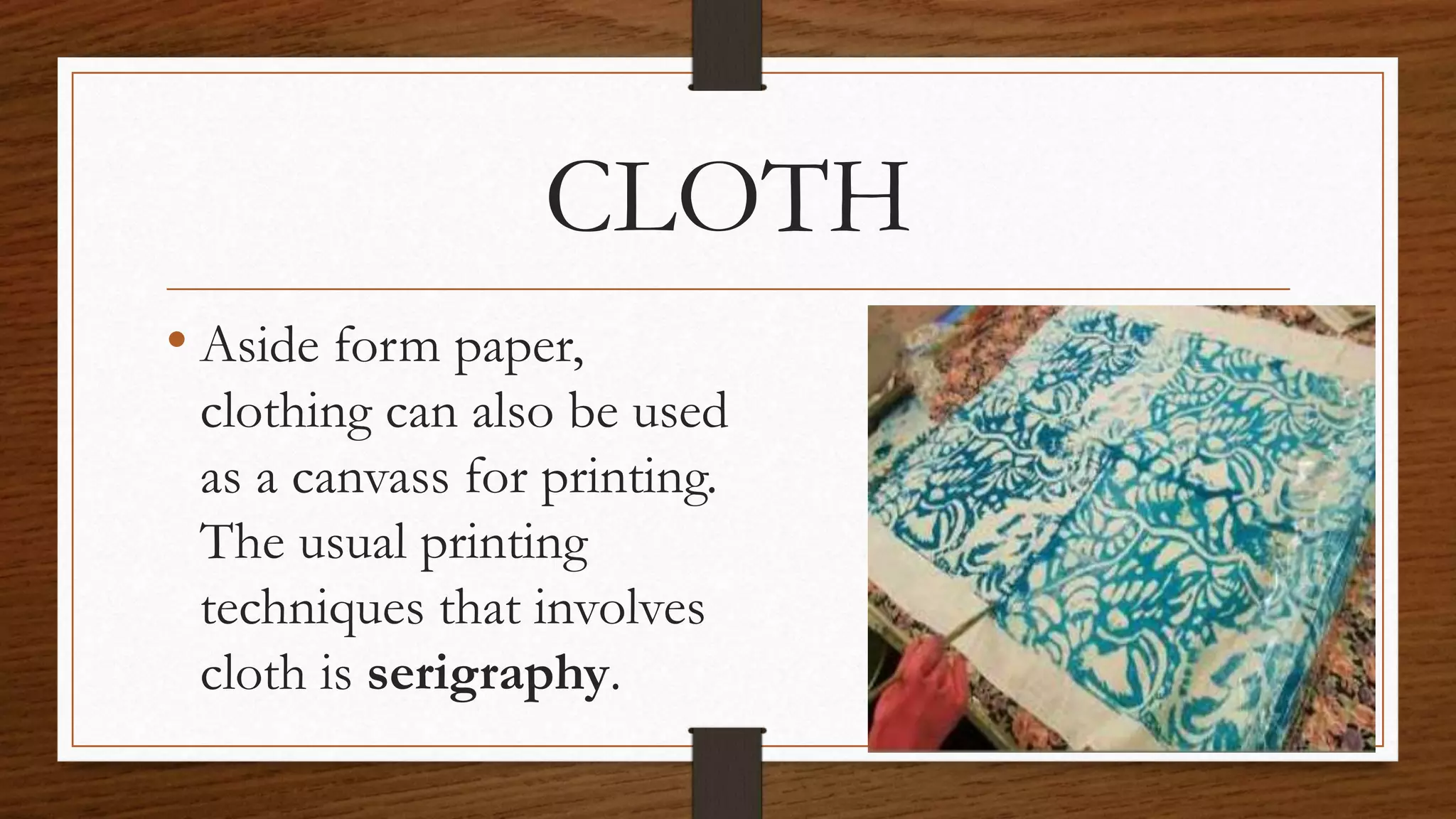
CLOTH
• Aside form paper,
clothing can also be used
as a canvass for printing.
The usual printing
techniques that involves
cloth is serigraphy.
MATRIX
• In printmaking,
matrices are the ones
that hold up the
image that makes up
the print. It ca be
made of wood, metal
and even limestone.
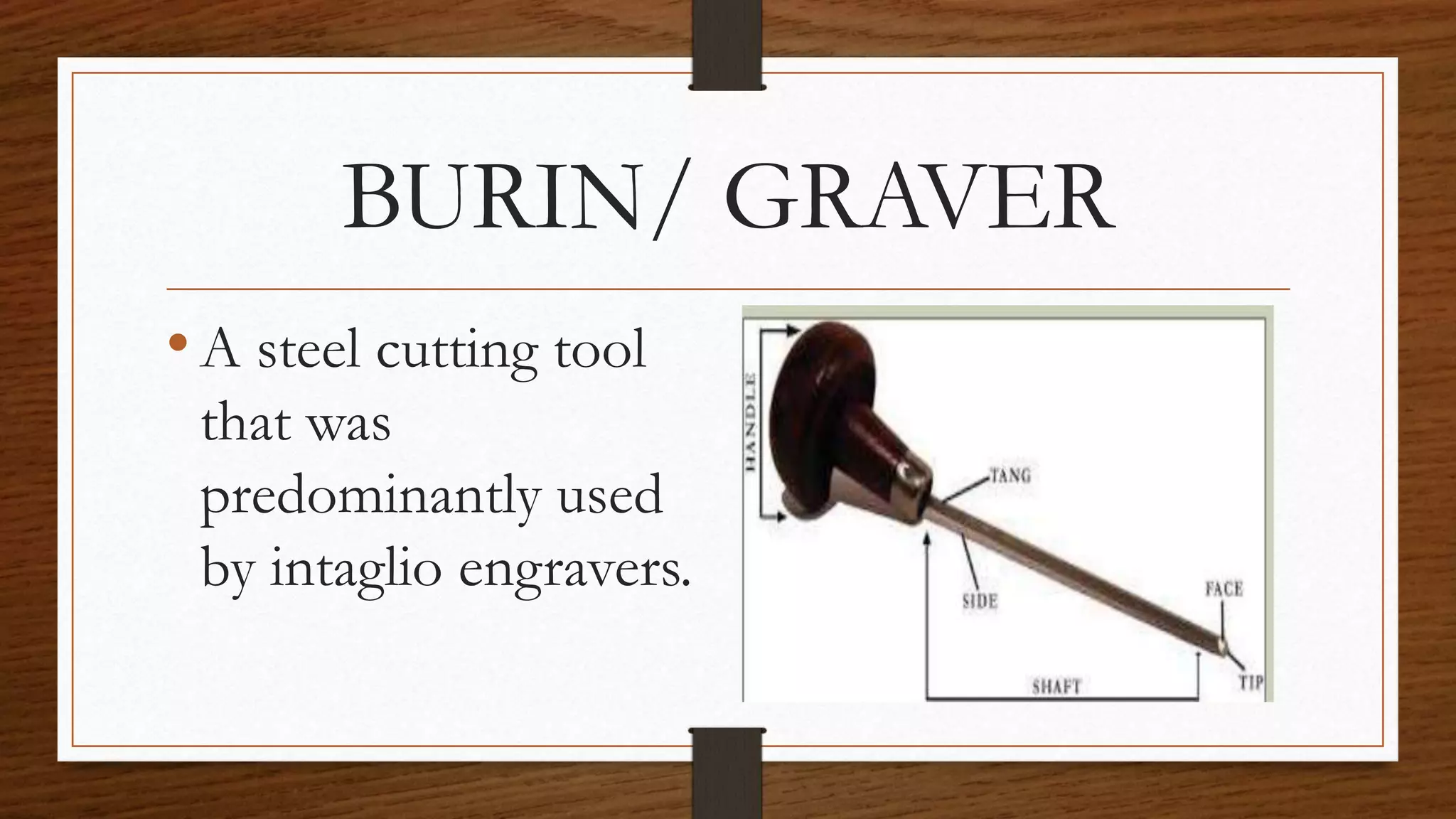
BURIN/ GRAVER
•A steel cutting tool
that was
predominantly used
by intaglio engravers.
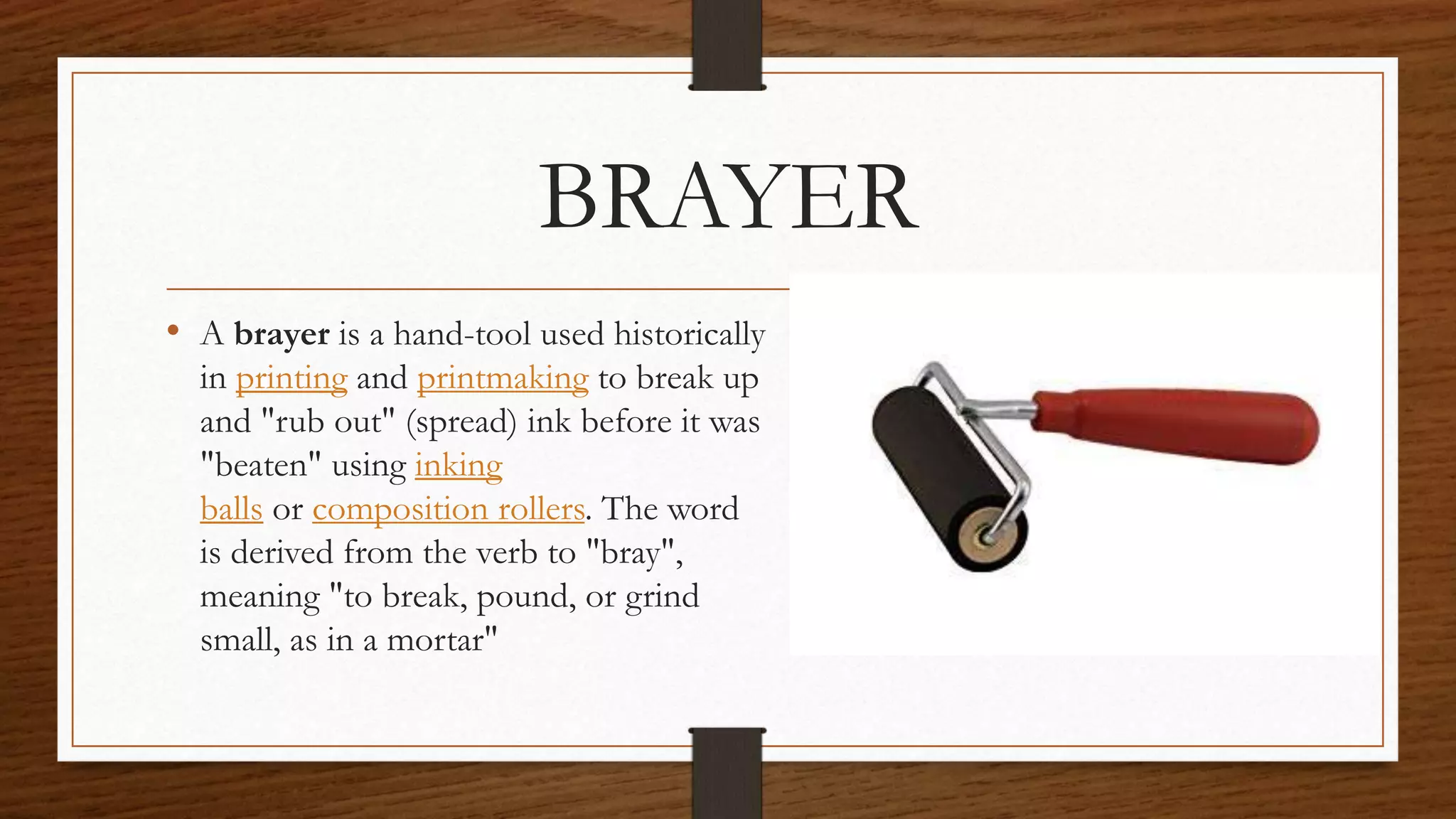
BRAYER
• A brayer is a hand-tool used historically
in printing and printmaking to break up
and "rub out" (spread) ink before it was
"beaten" using inking
balls or composition rollers. The word
is derived from the verb to "bray",
meaning "to break, pound, or grind
small, as in a mortar"
TECHNIQUES
• Printmaking techniques are generally divided into the following basic
categories:
• Relief
• Intaglio
• Planographic
• Stencil
RELIEF
•Where ink is applied to the original surface of
the matrix. Relief techniques
include woodcut or woodblock as the Asian
forms are usually known, wood
engraving, linocut and metalcut.
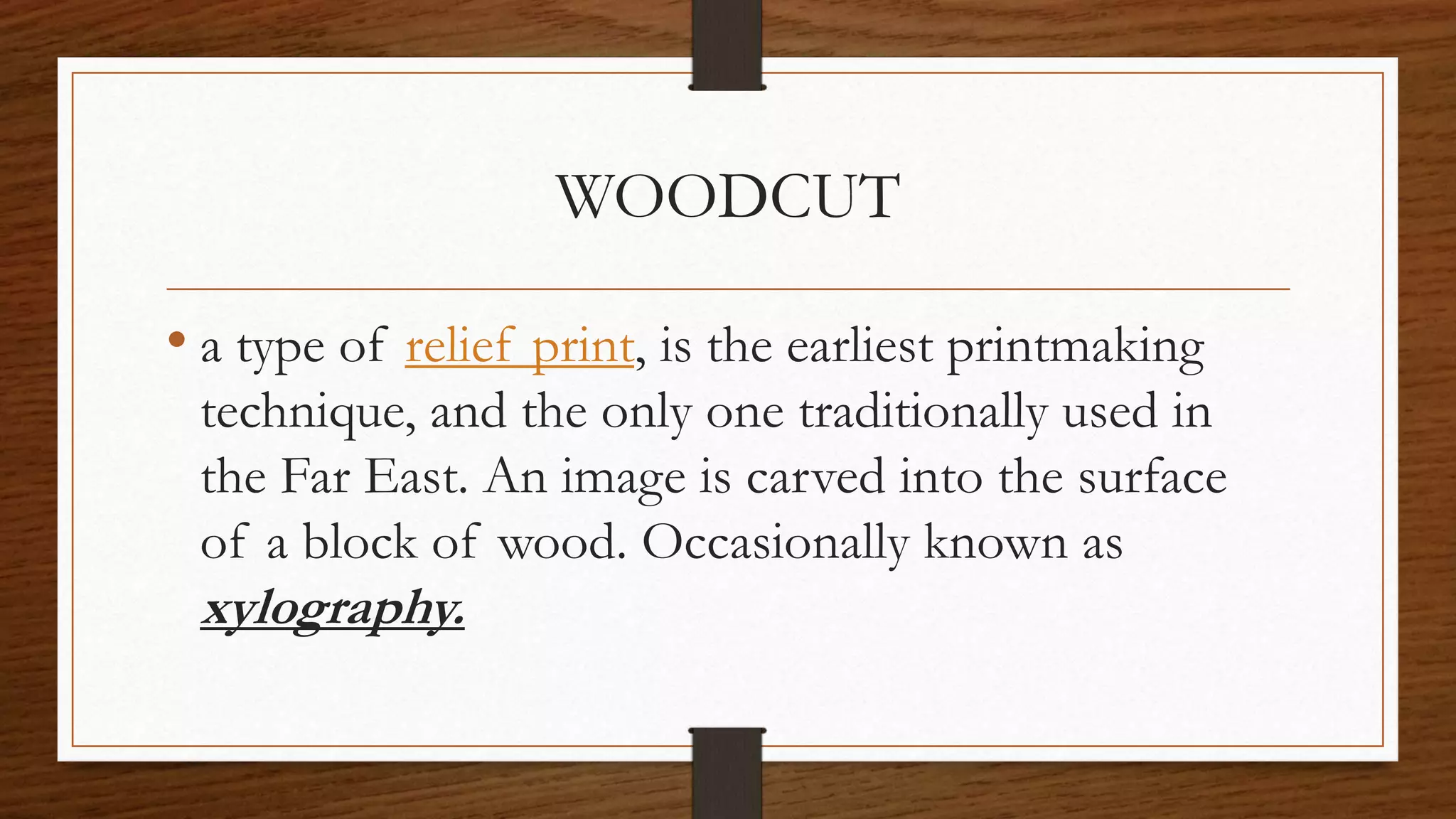
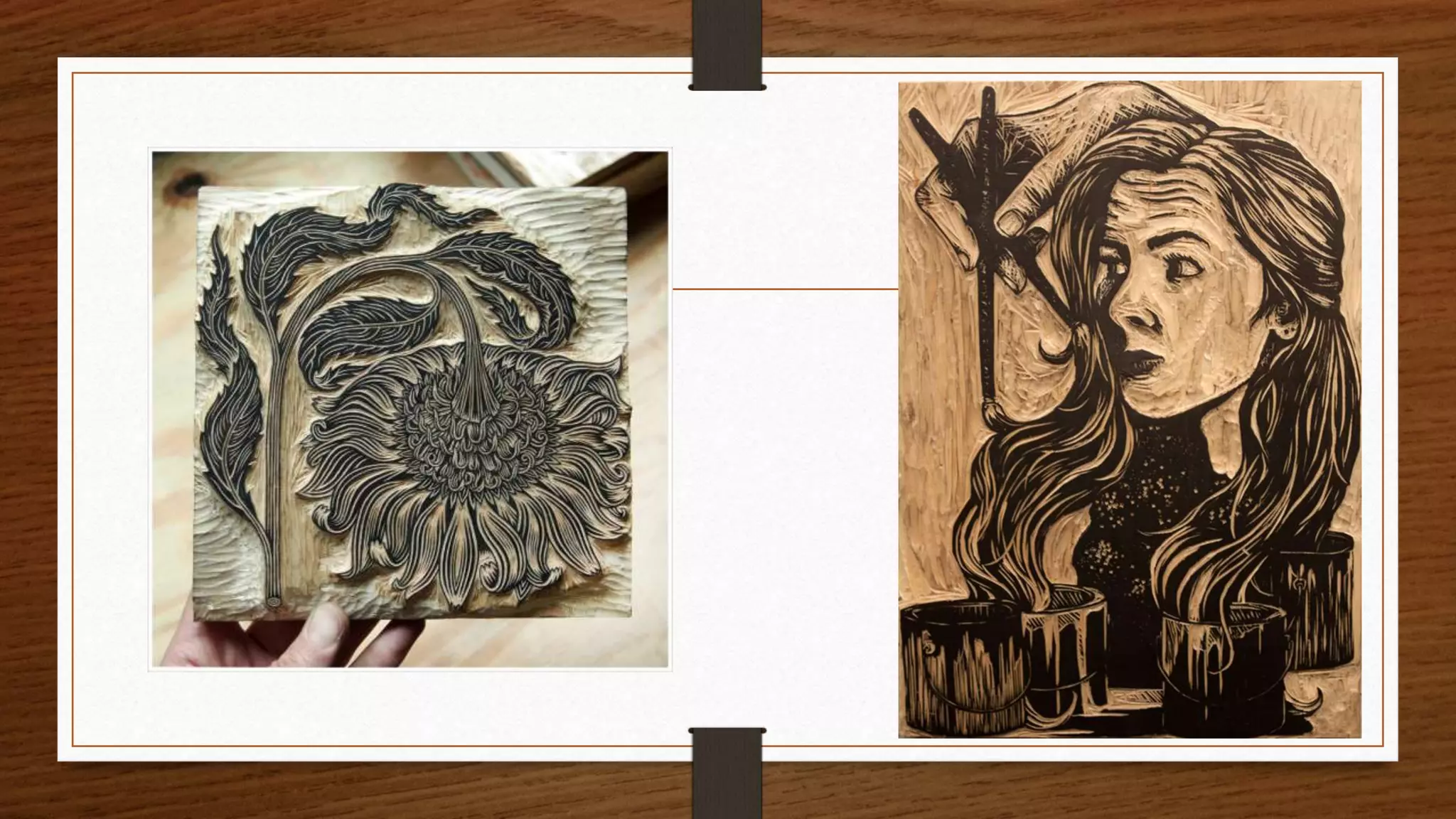
WOODCUT
• a type of relief print, is the earliest printmaking
technique, and the only one traditionally used in
the Far East. An image is carved into the surface
of a block of wood. Occasionally known as
xylography.
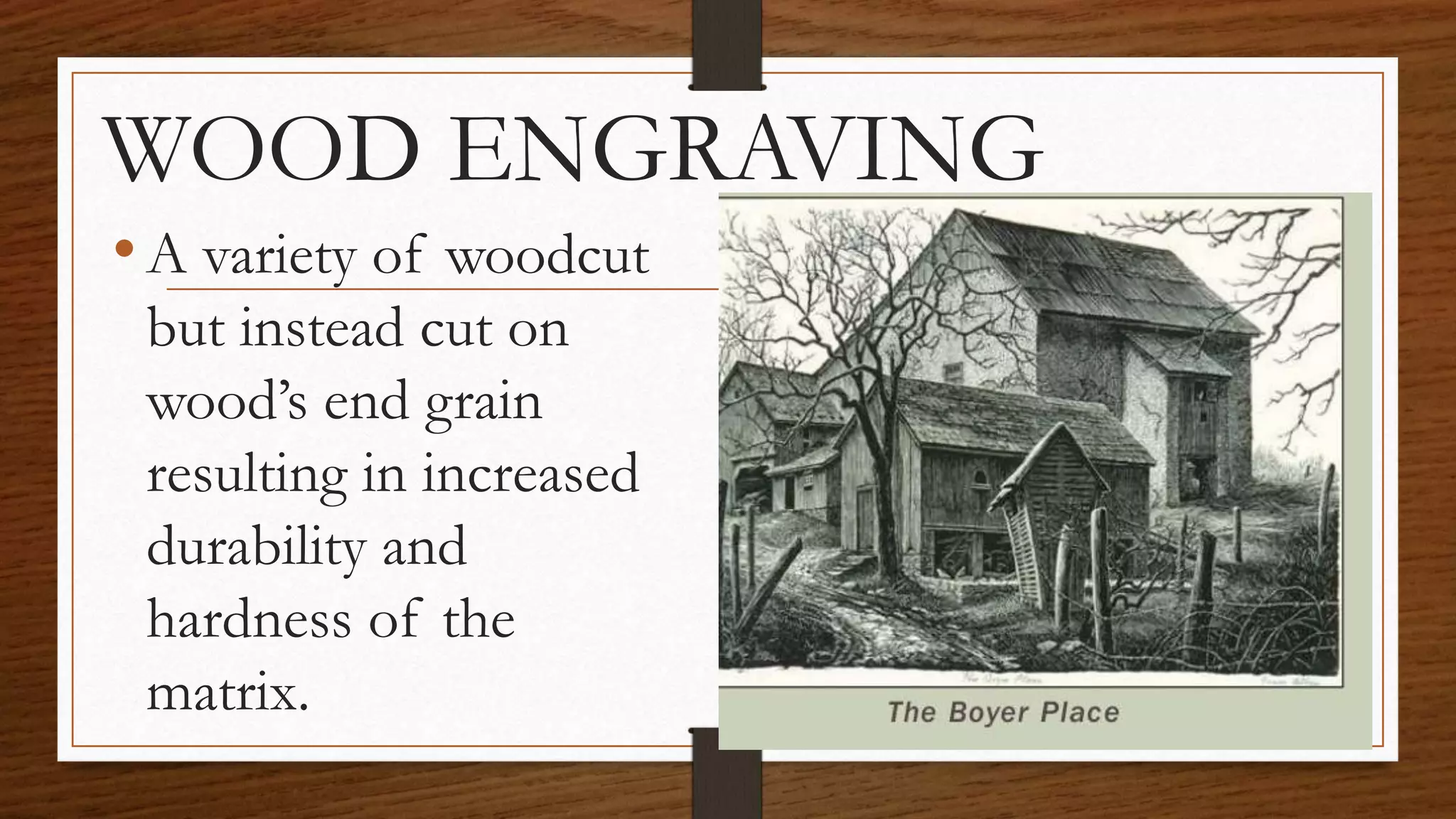
WOOD ENGRAVING
•A variety of woodcut
but instead cut on
wood’s end grain
resulting in increased
durability and
hardness of the
matrix.
LINOCUT
• Linocut is a printmaking technique, a variant of woodcut in
which a sheet of linoleum (sometimes mounted on a wooden
block) is used for a relief surface. A design is cut into the
linoleum surface with a sharp knife, V-shaped chisel or gouge,
with the raised (uncarved) areas representing a reversal (mirror
image) of the parts to show printed. The linoleum sheet is inked
with a roller (called a brayer), and then impressed onto paper or
fabric.
RUBBER CUT
•Uses a slab
of rubber
for the
matrix.
METAL-CUT
•Is essentially a wood-cut
but uses a thin metal
plate instead. It is almost
indistinguishable form
the woodcut.
COLLOGRAPHY
•The matrix of this
type of printmaking
is a three dimensional
collage made form
various materials such
as string, fabric, etc.
FILIPINO
PRINTMAKERS
• TOMAS PINPIN- was a
printer, writer and publisher from Abucay,
a municipality in the province
of Bataan, Philippines, who was the first
Filipino printer and is sometimes referred
as the "Prince of the Filipino Printers.“
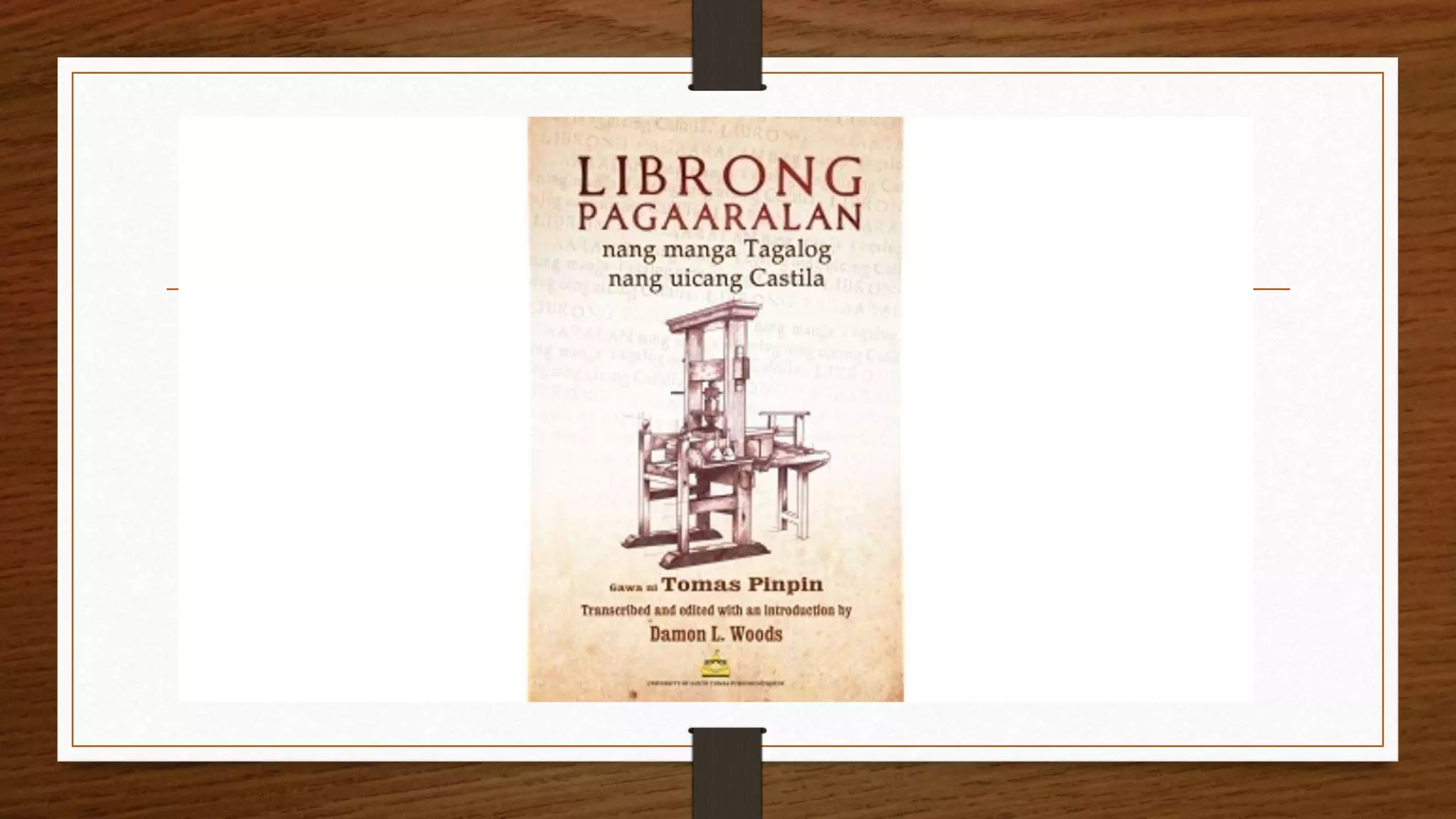
• Pinpin is remembered for being the first
native Filipino to publish and print a
book, "Librong Pagaaralan nang mga
Tagalog nang Uicang Castilla" in 1610,
entirely written by himself in the
old Tagalog orthography.[
• NICOLAS DE LA CRUZ
BAGAY
• woodblock artist, was born in Tambobong, now the
city of Malabon, in 1701. Trained and educated by
the Spaniards, Bagay was a renowned Filipino expert
in engraving and printing during the Spanish times.
• Bagay first drew attention in 1734 when he engraved
Pedro Murillo Velarde’s Mapa de Filipinas, the
first detailed map of the Philippines. His name
appeared in 1744 in a reduced size of the same map
in an engraved copper.
• Laureano Atlas
• Nicolas de la Cruz Bagay
• Phelipe Sevilla
• Francisco Suarez
- They were among the talented Filipino s who
engraved religious and secular themes on their
copperplate, books and posters.
While others used loose leaf editions called
estampas or estampitas.
MANUEL RODRIGUEZ SR.
• He was known as the “ Father of
Contemporary Printmaking”.
• He inspired and encouraged his
students and fellow artists to pursue
printmaking.
MAKING PRINTS IN THE PHILIPPINES

MAKING PRINTS IN THE PHILIPPINES

  • 1.
  • 2.
    PRINTMAKING • Printmaking isthe process of creating artworks by printing, normally on paper. Printmaking normally covers only the process of creating prints that have an element of originality, rather than just being a photographic reproduction of a painting. It is an acquired skill.
  • 3.
  • 4.
    PAPER • Used byalmost every form of printing. Image is transferred by applying pressure either by manually using hands or by printing presses.
  • 5.
    CLOTH • Aside formpaper, clothing can also be used as a canvass for printing. The usual printing techniques that involves cloth is serigraphy.
  • 6.
    MATRIX • In printmaking, matricesare the ones that hold up the image that makes up the print. It ca be made of wood, metal and even limestone.
  • 7.
    BURIN/ GRAVER •A steelcutting tool that was predominantly used by intaglio engravers.
  • 8.
    BRAYER • A brayeris a hand-tool used historically in printing and printmaking to break up and "rub out" (spread) ink before it was "beaten" using inking balls or composition rollers. The word is derived from the verb to "bray", meaning "to break, pound, or grind small, as in a mortar"
  • 9.
    TECHNIQUES • Printmaking techniquesare generally divided into the following basic categories: • Relief • Intaglio • Planographic • Stencil
  • 10.
    RELIEF •Where ink isapplied to the original surface of the matrix. Relief techniques include woodcut or woodblock as the Asian forms are usually known, wood engraving, linocut and metalcut.
  • 11.
    WOODCUT • a typeof relief print, is the earliest printmaking technique, and the only one traditionally used in the Far East. An image is carved into the surface of a block of wood. Occasionally known as xylography.
  • 13.
    WOOD ENGRAVING •A varietyof woodcut but instead cut on wood’s end grain resulting in increased durability and hardness of the matrix.
  • 14.
    LINOCUT • Linocut isa printmaking technique, a variant of woodcut in which a sheet of linoleum (sometimes mounted on a wooden block) is used for a relief surface. A design is cut into the linoleum surface with a sharp knife, V-shaped chisel or gouge, with the raised (uncarved) areas representing a reversal (mirror image) of the parts to show printed. The linoleum sheet is inked with a roller (called a brayer), and then impressed onto paper or fabric.
  • 16.
    RUBBER CUT •Uses aslab of rubber for the matrix.
  • 17.
    METAL-CUT •Is essentially awood-cut but uses a thin metal plate instead. It is almost indistinguishable form the woodcut.
  • 18.
    COLLOGRAPHY •The matrix ofthis type of printmaking is a three dimensional collage made form various materials such as string, fabric, etc.
  • 19.
  • 20.
    • TOMAS PINPIN-was a printer, writer and publisher from Abucay, a municipality in the province of Bataan, Philippines, who was the first Filipino printer and is sometimes referred as the "Prince of the Filipino Printers.“ • Pinpin is remembered for being the first native Filipino to publish and print a book, "Librong Pagaaralan nang mga Tagalog nang Uicang Castilla" in 1610, entirely written by himself in the old Tagalog orthography.[
  • 22.
    • NICOLAS DELA CRUZ BAGAY • woodblock artist, was born in Tambobong, now the city of Malabon, in 1701. Trained and educated by the Spaniards, Bagay was a renowned Filipino expert in engraving and printing during the Spanish times. • Bagay first drew attention in 1734 when he engraved Pedro Murillo Velarde’s Mapa de Filipinas, the first detailed map of the Philippines. His name appeared in 1744 in a reduced size of the same map in an engraved copper.
  • 23.
    • Laureano Atlas •Nicolas de la Cruz Bagay • Phelipe Sevilla • Francisco Suarez - They were among the talented Filipino s who engraved religious and secular themes on their copperplate, books and posters. While others used loose leaf editions called estampas or estampitas.
  • 24.
    MANUEL RODRIGUEZ SR. •He was known as the “ Father of Contemporary Printmaking”. • He inspired and encouraged his students and fellow artists to pursue printmaking.