SOUTH EAST ASIAN ARTS
ATTIRE, FABRICS
AND TAPESTRIES
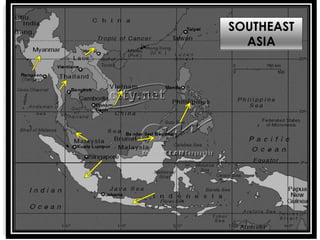
SOUTHEAST
ASIA
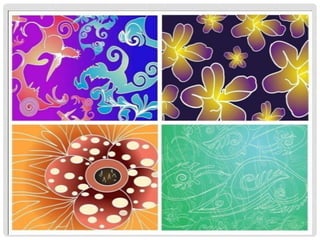
ACTIVITY 1: FIND ME
Match the picture with
its country of origin:
a. Philippine
s
b. Brunei
c. Malaysia
d. Indonesia
e. Singapor
e
f. Vietnam
a. Philippine
s
b. Brunei
c. Malaysia
d. Indonesia
e. Singapor
e
f. Vietnam
B FA
EDC
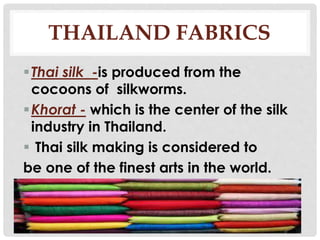
THAILAND FABRICS
Thai silk -is produced from the
cocoons of silkworms.
Khorat - which is the center of the silk
industry in Thailand.
 Thai silk making is considered to
be one of the finest arts in the world.
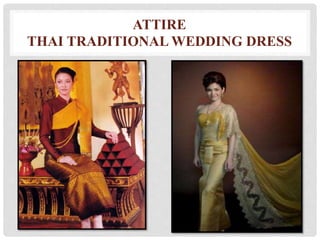
ATTIRE
THAI TRADITIONAL WEDDING DRESS
CAMBODIA
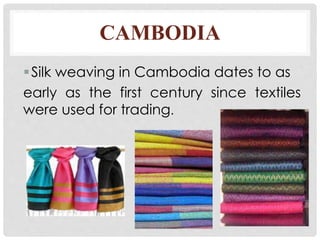
Silk weaving in Cambodia dates to as
early as the first century since textiles
were used for trading.
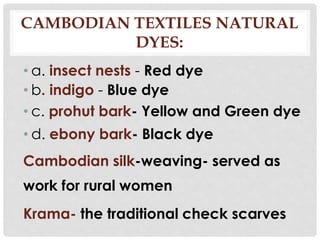
CAMBODIAN TEXTILES NATURAL
DYES:
• a. insect nests - Red dye
• b. indigo - Blue dye
• c. prohut bark- Yellow and Green dye
• d. ebony bark- Black dye
Cambodian silk-weaving- served as
work for rural women
Krama- the traditional check scarves
LAOS
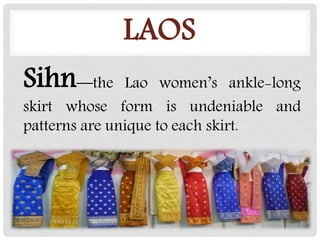
Sihn—the Lao women’s ankle-long
skirt whose form is undeniable and
patterns are unique to each skirt.
TWO MAIN TYPES OF CAMBODIAN
WEAVING
1. ikat technique (Khmer term: chongkiet) - To
create patterns, weavers tie and dye portions
of weft yarn before weaving begins.
2. uneven twill - single or two-color fabrics,
which are produced by weaving three
threads so that the "color of one thread
dominates on one side of the fabric, while the
two others determine the color on the reverse
side."
VIETNAM
 Golden Thread Silks –were born in Vietnam.
 Ha Dong- the center of weaving and
sericulture (silk worm production) for
centuries.
Some popular Vietnamese fabric ranges are:
1. Shantung taffeta
2. Bengaline weave
3. Ebony satin - an all natural lustrous silk
hand-woven in southern Vietnam and
naturally dyed using ebony fruit pods.
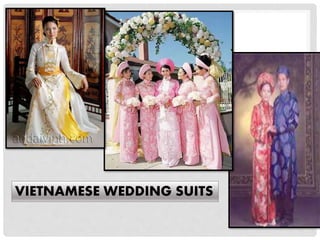
VIETNAMESE WEDDING SUITS
INDONESIA, MALAYSIA&
SINGAPORE
 The fabric most common to both countries
is the Batik.
 The term “batik” is an Indonesian Malay
word,
• Believed to be related to the Malay word
“titik”, whichmeans‘point’,‘dot’or‘drop’.
• There are two categories of batik designs:
• 1. geometric motifs
• 2. free form designs
MALAYSIA’S TWO MAIN TYPES OF
BATIK
1. Hand painted- the artist uses the
canting, a small copper container with
one or more different-sized pipes
2. Block printed- done by welding
together strips of metal to form a metal
block.
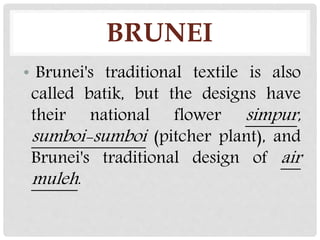
BRUNEI
• Brunei's traditional textile is also
called batik, but the designs have
their national flower simpur,
sumboi-sumboi (pitcher plant), and
Brunei's traditional design of air
muleh.
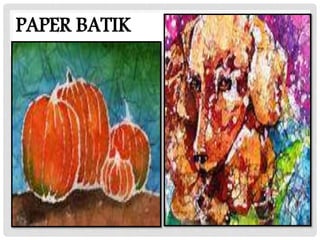
PAPER BATIK
Southeast asian arts

Southeast asian arts

  • 1.
    SOUTH EAST ASIANARTS ATTIRE, FABRICS AND TAPESTRIES
  • 2.
  • 3.
    ACTIVITY 1: FINDME Match the picture with its country of origin:
  • 4.
    a. Philippine s b. Brunei c.Malaysia d. Indonesia e. Singapor e f. Vietnam
  • 5.
    a. Philippine s b. Brunei c.Malaysia d. Indonesia e. Singapor e f. Vietnam B FA EDC
  • 6.
    THAILAND FABRICS Thai silk-is produced from the cocoons of silkworms. Khorat - which is the center of the silk industry in Thailand.  Thai silk making is considered to be one of the finest arts in the world.
  • 7.
  • 9.
    CAMBODIA Silk weaving inCambodia dates to as early as the first century since textiles were used for trading.
  • 10.
    CAMBODIAN TEXTILES NATURAL DYES: •a. insect nests - Red dye • b. indigo - Blue dye • c. prohut bark- Yellow and Green dye • d. ebony bark- Black dye Cambodian silk-weaving- served as work for rural women Krama- the traditional check scarves
  • 11.
    LAOS Sihn—the Lao women’sankle-long skirt whose form is undeniable and patterns are unique to each skirt.
  • 12.
    TWO MAIN TYPESOF CAMBODIAN WEAVING 1. ikat technique (Khmer term: chongkiet) - To create patterns, weavers tie and dye portions of weft yarn before weaving begins. 2. uneven twill - single or two-color fabrics, which are produced by weaving three threads so that the "color of one thread dominates on one side of the fabric, while the two others determine the color on the reverse side."
  • 13.
    VIETNAM  Golden ThreadSilks –were born in Vietnam.  Ha Dong- the center of weaving and sericulture (silk worm production) for centuries. Some popular Vietnamese fabric ranges are: 1. Shantung taffeta 2. Bengaline weave 3. Ebony satin - an all natural lustrous silk hand-woven in southern Vietnam and naturally dyed using ebony fruit pods.
  • 14.
  • 15.
    INDONESIA, MALAYSIA& SINGAPORE  Thefabric most common to both countries is the Batik.  The term “batik” is an Indonesian Malay word, • Believed to be related to the Malay word “titik”, whichmeans‘point’,‘dot’or‘drop’. • There are two categories of batik designs: • 1. geometric motifs • 2. free form designs
  • 16.
    MALAYSIA’S TWO MAINTYPES OF BATIK 1. Hand painted- the artist uses the canting, a small copper container with one or more different-sized pipes 2. Block printed- done by welding together strips of metal to form a metal block.
  • 18.
    BRUNEI • Brunei's traditionaltextile is also called batik, but the designs have their national flower simpur, sumboi-sumboi (pitcher plant), and Brunei's traditional design of air muleh.
  • 19.