Paradigm Shifts and Opportunities
in the Electronics Industry
Dr. Ajith Amerasekera
University of California, Berkeley, USA
Synergen Technology Lab, Colombo, Sri Lanka
and Dallas, USA
September 2016
Outline
• Introduction
• Market Growth
• Technology Drivers
• Expertise
• Summary
LOOKING BEYOND WIRELESS
Market Growth
3
Technology Trends
• Mega-Trends:
–Population growth
–Super-urbanization
–Transportation and Connectivity
–Limited natural resources
• Electronic technology is changing the way
the world operates
– Replacing mechanical components as we automate
tasks that have never been automated before
World Market for Internet Connected Devices - New Device Shipments
Connected Devices (M)
Source: IMS Research Aug-12
0
2,000
4,000
6,000
8,000
10,000
12,000
14,000
2011 2012 2013 2016 2019 2022 2025
Military &
Aerospace
Medical
Industrial
Consumer
Computers
Communications,
Mobile
Communications,
Fixed
Automotive
Market Growth Opportunities
Driven by Industrial
And Consumer Apps
LOOKING BEYOND WIRELESS
What is driving the
technology?
6
New Application Drivers: A Fundamental
Transformation in Engineering
Pre-1950’s: Engineering the
physical world (industrial
revolutions)
Post 2000: “Cyberphysical Systems” bridging the
two, engaging society at large
1950-2000’s: Engineering abstract
objects (the “cyber world”)
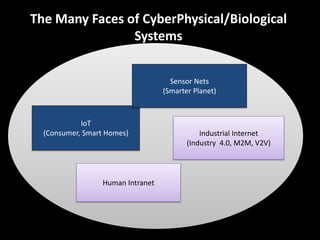
The Many Faces of CyberPhysical/Biological
Systems
IoT
(Consumer, Smart Homes)
Sensor Nets
(Smarter Planet)
Industrial Internet
(Industry 4.0, M2M, V2V)
Human Intranet
9
Connectivity – Platform for the Future
• Beyond 5G, networks will be required to provide
ubiquitous connectivity for large amounts of
information transfer – video, security, information.
• Semiconductor technologies transforming society –
from personal well-being to industrial automation and
transportation.
• Autonomous systems with closed loop control require
more data bandwidth driving higher communication
speeds, with lower latency, high robustness, and high
energy efficiency.
The IoT – More than just things
Cloud
Gateway
Bridge or
Router
Edge
Node
s
Edge
Nodes
• Connected Things
Enabling a More
Interactive
Environment
• Connected
Systems Enabling a
More Efficient
Environment
Smart SystemsSmart Things
The Next Frontier:
CoBots and the Industrial InternetThe Tactile Internet
The Manufacturing Revolution Ahead
Gerhard Fettweis Slide 13
http://jerryrushing.net/wp-
content/uploads/2012/04/robotic_assembly_line1.jpg http://www.witchdoctor.co.nz/wp-
content/uploads/2013/01/robot-fabrication-station.jpg
The Tactile Internet: Remote Controlled Humanoid Robots
Gerhard Fettweis
http://images.gizmag.com/hero/8456_51207105642.jpg
http://www.dvice.com/archives/2011/05/kinect_controll_1.php
An Internet
with co-joint
Senses
and Motor
Control
Human-Machine
Collaboration brings
new challenges and
opportunities
Driving the need for real-time communications
Internet of Things in Production
• The Smart Factory is an autonomous, self configurable, decentralized production facility
• The starting materials and the tools are intelligent, have their own identity and can be
located at any time; they know their history, status and how to reach their final state.
• The Smart Factory is able to handle complexity, achieving significantly higher flexibility and
adaptability by using highest productivity and quality levels with optimized use of resources
Internet of Things
Industrial
Internet of
Things
Industry 4.0
Consumer Building Industrial Manufacturing
Real-time
Functional Safety
After You
(⌒-⌒)
Go
Sag゙
Slow-down Propagation
Smooth flow at 50Km/h
Merger Assist
Passing Assist (w/BSW)
Sag Congestion
Highway Road
Local Group Cooperation
Go Assist for
Green Light
Green Wave Flow
Automotive – Future V2I and V2V Communication
Urban Road
Toyota, ISSCC 2013
Extend ourselves!
[Time Magazine, September 2014]
The Future
A Human Intranet
[J. Rabaey, Pervasive. Comp., 2014]
Image courtesy Y. Khan, UCB
An open scalable platform
enhancing human capabilities
Empowered Humans in an
Augmented World
IoT : System on a Chip
Energy
storage
Sensor
Wireless Sensor
Node
Energy Storage
Energy Harvesting
MEMS SensorMotivation and desig
The "smart grid" will require new, inexpensive senso
throughout the network. Applications include monito
condition monitoring of underground distribution cab
and diagnosis.
We have developed a new MEMS (micro-electro-me
sensor for these applications. It is passive, requiring
suitable for wireless sensor node deployment. The s
without needing to encircle the current carrier or bre
installation, resulting in an expanded set of possible
Cable
Piezoelectric
MEMS Cantilever
Microscale
Magnet
Output
Voltage
Magnetic
Field
Cable
Piezoelectric
MEMS Cantilever
Microscale
Magnet
Output
Voltage
Magnetic
Field
• AC cu
magne
• Cantil
the en
magne
• Piezo
output
• Oscill
are pr
curren
Radio
Energy
harvesting
Radio
Expertise
17
Electronic Control Systems
Interpret
ControlActuate
Sense
• Data Acquisition
• Signal
Processing
• Machine
Learning
• Control Theory
• Computing
Challenges
• At all possible levels:
–Physical layer and low latency networks
–Architecture and infrastructure; closed loop
and control systems
–Ultra low-energy cognitive processing
–Machine learning, system modeling ,
planning and anticipation, game theory,
collaboration, decision making
Combining many fields together for system-level solutions
The Global Industry
• High speed communication systems have changed the way we
operate with ease of access to people, machines, databases…..
• Global access to manufacturing, no longer restricts the industry to
a few countries with large investment capability in manufacturing
infrastructure.
• New systems will be small and deployed in vast numbers
distributing intelligence across the board and dramatically
changing the management of our cities, buildings, personal life,
health, transportation, safety and security.
• These systems require data acquisition and analysis, along with
machine learning and adoption.
• Expertise in digital signal processing, data analytics, neural
networks, and control systems theory, will be important in
developing the new applications.
• Countries producing strong computer science and engineering
skills, will be abe to engage in the economic growth enabled by
these technologies
Areas of Opportunity for Sri Lanka
• Digital Health/Telemedicine: This is an area that is wide open for technology. Todays
systems are still very primitive. $76B in 2015 – 22% CAGR
– Needs an infrastructure that enables simple, transparent, interaction between remote devices and the
central management systems – iTunes for Medical Systems
– Medical practitioners have to be able to quickly access and analyze the data and
provide direction.
• Wearables: $14B in 2014, $70B in 2022
– Synergies with strong Sri Lanka’s textile industry
– Ultra low power systems, signal processing and data analytics
– Flexible electronics, including batteries and energy harvesting.
• Factory and Industrial Automation: $150B in 2014, $200B in 2020
– Mechatronics - Intelligent systems for Cobots, Robots, and Automation.
– Need to work with systems manufacturers to understand their needs and driver technologies
• Smart Agriculture: $3B in 2015 to $5B in 2020
– Need to work with users to develop solutions to make electronics in agriculture a differentiator.
• Investments:
– Governments see technology investment as a forcing function
– Long development times require deep pockets to withstand market pressures
– Big investments across Asia as other countries see the economic value of technology.
21
22
Opportunities for Sri Lanka
• Synergen Tech Labs – An Example
• Self-funded by entrepeneurs with healthcare software experience. Began
in 2014 and has 9 recent undergraduates from University of Moratuwa.
• Focus on Intelligent Systems for the IoT. Quickly came up to speed on IoT
technologies using existing and new platforms. The platforms are not
differentiating.
• Differentiating skills are signal processing, communication
theory, and control systems.
• Areas where Universities in Sri Lanka have great advantages.
• Combined with mechanical engineering, to enable
mechatronics – a growing need in this field.
• STL identified niche areas in health care (e.g. telemedicine),
wellness and wearables as providing opportunities for
differentiation at global level.
23
SUMMARY
• Opportunities: mechanical systems are being
replaced by electronics with intelligence
enabling autonomous operation, adaptability,
energy efficiency.
• Challenges: need to work with the systems
manufacturers to understand the requirements
• Introduction times are long and so are
development times; need patience
• Skills: data acquisition and analytics, signal
processing, machine learning, and control
theory, are critical.

Electronics and Robotics - Ajith Amarasekara

  • 1.
    Paradigm Shifts andOpportunities in the Electronics Industry Dr. Ajith Amerasekera University of California, Berkeley, USA Synergen Technology Lab, Colombo, Sri Lanka and Dallas, USA September 2016
  • 2.
    Outline • Introduction • MarketGrowth • Technology Drivers • Expertise • Summary
  • 3.
  • 4.
    Technology Trends • Mega-Trends: –Populationgrowth –Super-urbanization –Transportation and Connectivity –Limited natural resources • Electronic technology is changing the way the world operates – Replacing mechanical components as we automate tasks that have never been automated before
  • 5.
    World Market forInternet Connected Devices - New Device Shipments Connected Devices (M) Source: IMS Research Aug-12 0 2,000 4,000 6,000 8,000 10,000 12,000 14,000 2011 2012 2013 2016 2019 2022 2025 Military & Aerospace Medical Industrial Consumer Computers Communications, Mobile Communications, Fixed Automotive Market Growth Opportunities Driven by Industrial And Consumer Apps
  • 6.
    LOOKING BEYOND WIRELESS Whatis driving the technology? 6
  • 7.
    New Application Drivers:A Fundamental Transformation in Engineering Pre-1950’s: Engineering the physical world (industrial revolutions) Post 2000: “Cyberphysical Systems” bridging the two, engaging society at large 1950-2000’s: Engineering abstract objects (the “cyber world”)
  • 8.
    The Many Facesof CyberPhysical/Biological Systems IoT (Consumer, Smart Homes) Sensor Nets (Smarter Planet) Industrial Internet (Industry 4.0, M2M, V2V) Human Intranet
  • 9.
    9 Connectivity – Platformfor the Future • Beyond 5G, networks will be required to provide ubiquitous connectivity for large amounts of information transfer – video, security, information. • Semiconductor technologies transforming society – from personal well-being to industrial automation and transportation. • Autonomous systems with closed loop control require more data bandwidth driving higher communication speeds, with lower latency, high robustness, and high energy efficiency.
  • 10.
    The IoT –More than just things Cloud Gateway Bridge or Router Edge Node s Edge Nodes • Connected Things Enabling a More Interactive Environment • Connected Systems Enabling a More Efficient Environment Smart SystemsSmart Things
  • 11.
    The Next Frontier: CoBotsand the Industrial InternetThe Tactile Internet The Manufacturing Revolution Ahead Gerhard Fettweis Slide 13 http://jerryrushing.net/wp- content/uploads/2012/04/robotic_assembly_line1.jpg http://www.witchdoctor.co.nz/wp- content/uploads/2013/01/robot-fabrication-station.jpg The Tactile Internet: Remote Controlled Humanoid Robots Gerhard Fettweis http://images.gizmag.com/hero/8456_51207105642.jpg http://www.dvice.com/archives/2011/05/kinect_controll_1.php An Internet with co-joint Senses and Motor Control Human-Machine Collaboration brings new challenges and opportunities Driving the need for real-time communications
  • 12.
    Internet of Thingsin Production • The Smart Factory is an autonomous, self configurable, decentralized production facility • The starting materials and the tools are intelligent, have their own identity and can be located at any time; they know their history, status and how to reach their final state. • The Smart Factory is able to handle complexity, achieving significantly higher flexibility and adaptability by using highest productivity and quality levels with optimized use of resources Internet of Things Industrial Internet of Things Industry 4.0 Consumer Building Industrial Manufacturing Real-time Functional Safety
  • 13.
    After You (⌒-⌒) Go Sag゙ Slow-down Propagation Smoothflow at 50Km/h Merger Assist Passing Assist (w/BSW) Sag Congestion Highway Road Local Group Cooperation Go Assist for Green Light Green Wave Flow Automotive – Future V2I and V2V Communication Urban Road Toyota, ISSCC 2013
  • 14.
    Extend ourselves! [Time Magazine,September 2014] The Future
  • 15.
    A Human Intranet [J.Rabaey, Pervasive. Comp., 2014] Image courtesy Y. Khan, UCB An open scalable platform enhancing human capabilities Empowered Humans in an Augmented World
  • 16.
    IoT : Systemon a Chip Energy storage Sensor Wireless Sensor Node Energy Storage Energy Harvesting MEMS SensorMotivation and desig The "smart grid" will require new, inexpensive senso throughout the network. Applications include monito condition monitoring of underground distribution cab and diagnosis. We have developed a new MEMS (micro-electro-me sensor for these applications. It is passive, requiring suitable for wireless sensor node deployment. The s without needing to encircle the current carrier or bre installation, resulting in an expanded set of possible Cable Piezoelectric MEMS Cantilever Microscale Magnet Output Voltage Magnetic Field Cable Piezoelectric MEMS Cantilever Microscale Magnet Output Voltage Magnetic Field • AC cu magne • Cantil the en magne • Piezo output • Oscill are pr curren Radio Energy harvesting Radio
  • 17.
  • 18.
    Electronic Control Systems Interpret ControlActuate Sense •Data Acquisition • Signal Processing • Machine Learning • Control Theory • Computing
  • 19.
    Challenges • At allpossible levels: –Physical layer and low latency networks –Architecture and infrastructure; closed loop and control systems –Ultra low-energy cognitive processing –Machine learning, system modeling , planning and anticipation, game theory, collaboration, decision making Combining many fields together for system-level solutions
  • 20.
    The Global Industry •High speed communication systems have changed the way we operate with ease of access to people, machines, databases….. • Global access to manufacturing, no longer restricts the industry to a few countries with large investment capability in manufacturing infrastructure. • New systems will be small and deployed in vast numbers distributing intelligence across the board and dramatically changing the management of our cities, buildings, personal life, health, transportation, safety and security. • These systems require data acquisition and analysis, along with machine learning and adoption. • Expertise in digital signal processing, data analytics, neural networks, and control systems theory, will be important in developing the new applications. • Countries producing strong computer science and engineering skills, will be abe to engage in the economic growth enabled by these technologies
  • 21.
    Areas of Opportunityfor Sri Lanka • Digital Health/Telemedicine: This is an area that is wide open for technology. Todays systems are still very primitive. $76B in 2015 – 22% CAGR – Needs an infrastructure that enables simple, transparent, interaction between remote devices and the central management systems – iTunes for Medical Systems – Medical practitioners have to be able to quickly access and analyze the data and provide direction. • Wearables: $14B in 2014, $70B in 2022 – Synergies with strong Sri Lanka’s textile industry – Ultra low power systems, signal processing and data analytics – Flexible electronics, including batteries and energy harvesting. • Factory and Industrial Automation: $150B in 2014, $200B in 2020 – Mechatronics - Intelligent systems for Cobots, Robots, and Automation. – Need to work with systems manufacturers to understand their needs and driver technologies • Smart Agriculture: $3B in 2015 to $5B in 2020 – Need to work with users to develop solutions to make electronics in agriculture a differentiator. • Investments: – Governments see technology investment as a forcing function – Long development times require deep pockets to withstand market pressures – Big investments across Asia as other countries see the economic value of technology. 21
  • 22.
    22 Opportunities for SriLanka • Synergen Tech Labs – An Example • Self-funded by entrepeneurs with healthcare software experience. Began in 2014 and has 9 recent undergraduates from University of Moratuwa. • Focus on Intelligent Systems for the IoT. Quickly came up to speed on IoT technologies using existing and new platforms. The platforms are not differentiating. • Differentiating skills are signal processing, communication theory, and control systems. • Areas where Universities in Sri Lanka have great advantages. • Combined with mechanical engineering, to enable mechatronics – a growing need in this field. • STL identified niche areas in health care (e.g. telemedicine), wellness and wearables as providing opportunities for differentiation at global level.
  • 23.
    23 SUMMARY • Opportunities: mechanicalsystems are being replaced by electronics with intelligence enabling autonomous operation, adaptability, energy efficiency. • Challenges: need to work with the systems manufacturers to understand the requirements • Introduction times are long and so are development times; need patience • Skills: data acquisition and analytics, signal processing, machine learning, and control theory, are critical.