REGULATORY & MARKET ENVIRONMENT 
Competition and regulation 
IN A CONVERGED 
BROADBA N D WORLD 
Broadband Series 
F E B R U A R Y 2 0 1 3 
T e l e c o m m u n i c a t i o n D e v e l o p m e n t S e c t o r
Competition and regulation in a 
converged broadband world 
February 2013
This report was prepared by Dr. Christian Koboldt of DotEcon Limited, under the direction of the 
Telecommunication Development Bureau (BDT) Regulatory and Market Environment Division (RME). 
This report is part of a new series of ITU reports on broadband that are available online and free of 
charge at the ITU Universe of Broadband portal: www.itu.int/broadband. 
 Please consider the environment before printing this report. 
 ITU 2013 
All rights reserved. No part of this publication may be reproduced, by any means whatsoever, without the 
prior written permission of ITU.
Competition and regulation in a converged broadband world 
i 
Table of contents 
Page 
Executive summary ............................................................................................................................... iii 
1 Introduction ................................................................................................................................ 1 
2 The changing broadband world .................................................................................................. 3 
2.1 Services as the drivers of bandwidth demand .................................................................. 3 
2.2 Bundling ............................................................................................................................ 5 
2.3 Different mixes of fixed and mobile broadband technologies ......................................... 8 
3 Market definition in a broadband world ................................................................................... 9 
3.1 Some general points about market definition .................................................................. 10 
3.2 Service-driven choice of networks and retail market definition ...................................... 12 
3.3 Wholesale market definition ............................................................................................ 19 
3.4 An illustration: are fixed and mobile broadband in the same market? ............................ 23 
4 Significant Market Power (SMP) designation ............................................................................ 28 
4.1 Some general points about SMP designation ................................................................... 28 
4.2 Convergence, demand growth and SMP .......................................................................... 31 
4.3 Vertical arrangements and bundling ................................................................................ 34 
5 Regulation in a converged broadband world ............................................................................ 37 
5.1 Traditional regulation of SMP operators .......................................................................... 38 
5.2 Implications of convergence for regulation ...................................................................... 41 
5.3 Conclusions ....................................................................................................................... 51 
References ............................................................................................................................................. 55 
Annex 1: A sample of broadband market definitions .......................................................................... 59 
Europe ......................................................................................................................................... 59 
Americas ...................................................................................................................................... 60 
Asia .......................................................................................................................................... 61 
Africa and Arab States ................................................................................................................. 61 
Annex 2: Examples of approaches towards margin squeeze ............................................................... 63
Competition and regulation in a converged broadband world 
iii 
Preface 
The past twenty years has been an extraordinary time for the development of information and 
communication technologies (ICTs) – and with the ‘mobile miracle’ we have brought the benefits of ICTs 
within reach of virtually all the world’s people. ITU has been in the forefront of this transformational 
ascent and is today committed to continue to drive positive change in the sector and beyond. It is now 
time to make the next step, and to ensure that everyone – wherever they live, and whatever their 
circumstances – has access to the benefits of broadband. This is not just about delivering connectivity for 
connectivity’s sake – or even about giving people access to the undoubted benefits of social 
communications. It is about leveraging the power of broadband technologies – and especially mobile 
technologies – to make the world a better place. 
In 2010, ITU, in conjunction with UNESCO, launched the Broadband Commission for Digital Development – 
to encourage governments to implement national broadband plans and to increase access to broadband 
applications and services. The Commission is co-chaired by President Paul Kagame of Rwanda and Carlos 
Slim, President of the Carlos Slim Foundation. We have over 50 Broadband Commissioners – all top-level 
leaders in their field – representing governments, industry, academia and international agencies. At the 
recent Broadband Leadership Summit held in October 2011 in Geneva, the Broadband Commission has 
recognized broadband as a critical modern infrastructure contributing to economic growth and has set 
four clear, new targets for making broadband policy universal and for boosting affordability and 
broadband uptake. Out-of-the-box models that promote competition, innovation and growth of markets 
are now needed to make the broadband opportunity reachable for all world citizens. 
At ITU, the United Nations specialized agency for telecommunications and information and 
communication technologies (ICTs), we are committed to playing a leading role in the development of the 
digital economy through extending the benefits of advances in broadband and embracing the 
opportunities it unleashes. The three ITU sectors – Radiocommunications, Standardization and 
Development – are working together to meet these challenges and our collective success will be a key 
factor in ensuring the provision of equitable broadband access throughout the world. The ITU Broadband 
Reports are one contribution towards this commitment. 
Dr. Hamadoun I. Touré 
Secretary-General, ITU
Competition and regulation in a converged broadband world 
v 
Foreword 
Broadband has become a key priority of the 21st Century, and I believe its transformative power as an 
enabler for economic and social growth makes it an essential tool for empowering people, creating an 
environment that nurtures the technological and service innovation, and triggering positive change in 
business processes as well as in society as a whole. Increased adoption and use of broadband in the next 
decade and beyond will be driven by the extent to which broadband-supported services and applications 
are not only made available to, but are also relevant and affordable for consumers. And while the benefits 
of broadband-enabled future are manifest, the broadband revolution has raised up new issues and 
challenges. 
In light of these developments, ITU launches a new series of ITU Broadband Reports. The first reports in 
the series launched in 2012 focus on cutting edge policy, regulatory and economic aspects of broadband. 
Other related areas and themes will be covered by subsequent reports including market analysis, 
broadband infrastructure and implementation, and broadband-enabled applications. In addition, a series 
of case studies will complement the resources already made available by ITU to all its many different 
types of readers, but especially to ICT regulators and policy-makers. 
This new series of reports is important for a number of reasons. First of all, the reports will focus on 
topical issues of special interest for developed and developing countries alike. Secondly, the various 
reports build on ITU’s recognized expertise in the area augmented by regular feedback from its 
Membership. Last but not least, this series is important because it provides a meaningful contribution to 
the work of the Broadband Commission for Digital Development. The findings of the ITU Broadband 
Reports will trace paths towards the timely achievement of the ambitious but achievable goals set 
recently by the Commission as well as provide concrete guidelines. As broadband is a field that’s growing 
very fast, we need to constantly build knowledge for our economies and societies to thrive and evolve 
into the future. 
For these reasons, I am proud to inaugurate this first series of the ITU Broadband Reports and look 
forward to furthering ITU’s work on the dynamic and exciting broadband ecosystem. 
Brahima Sanou 
Director, ITU Telecommunication Development Bureau
Competition and regulation in a converged broadband world 
Executive summary 
Across the world, broadband networks and the services to which they provide access are becoming an 
increasingly important part of our daily lives. Technology and usage patterns are changing fast, and the 
converging ICT sector looks very different from the traditional telecommunication environment of two 
decades ago. 
These changes pose challenges for regulatory policy. 
• How should regulators identify the markets that ought to be regulated when the underlying 
technology is evolving rapidly and broadband networks provide access to a wide and ever-changing 
vii 
range of services? 
• How should they go about identifying which operators enjoy market power? 
• What types of behaviour should concern policy makers, and how should regulators deal with 
commercial strategies that can be both efficient and beneficial for consumers, but also have 
anti-competitive effects? 
This report takes as its starting point a number of salient facts about the converged broadband world. 
Driven by the availability of novel and innovative services, demand for bandwidth is growing substantially. 
Services rather than the underlying technology drive the customers’ choice of broadband connection. The 
economies of scope brought about by convergence are reflected in bundling of services. A range of 
different access technologies co-exists with mobile broadband services gaining in importance not just in 
countries where fixed infrastructure is poor, but also in developed economies with almost universal fixed 
line coverage. 
The paper then discusses the implications of these developments for market definition. It gives a brief 
summary of the key principles used by regulatory and competition authorities for establishing the 
boundaries of the relevant market and then looks at the extent to which different broadband 
technologies can be said to compete with each other in light of these principles. 
Even though some retail customers may not have any choice of broadband connection – e.g. because 
their requirements are so specific that they can be met only by one technology, or because they live in 
areas where only one network is available – this does not necessarily matter for market definition. Market 
boundaries are set not by those customers who cannot switch to alternatives, but those who can. As a 
consequence, very different technologies may be linked through a chain of substitution. At the same time, 
even if different technologies could compete on the basis of their technical capabilities, markets may be 
separated because of exclusive agreements between network operators and service providers, or as a 
result of bundling of services. 
A brief discussion of the question whether discussion mobile and fixed broadband services are in the 
same market provides an illustration of how these considerations may be applied in practice. 
Unsurprisingly, the answer depends strongly on the extent to which the differences in the capabilities of 
mobile and fixed broadband networks matter for end users given the range of services available – and it 
may change over time as new services become available. 
More generally, the role of services in the delineation of markets means that market boundaries are not 
immutable: so even if mobile and fixed broadband services were fairly substitutable at present, they may 
become less so as more bandwidth-intensive services are being developed. What is important is that 
market boundaries are not determined by the technologies themselves, but by their capabilities, the 
capacity they provide and the services that they support. 
These changing market definitions matter when it comes to establishing market power. But convergence 
has further implications that go beyond the simple re-drawing of market boundaries. The strong growth in 
demand for bandwidth and the need for investment in network capacity – whether it be through 
improvements to existing networks or the construction of new ones – change the nature of competition. 
Such investment typically creates excess capacity that will only be filled over time, and competition during
Competition and regulation in a converged broadband world 
this period might be much stronger than a simple look at market structure might suggest. Wherever 
possible, promoting infrastructure-based competition can help to foster innovation, support service 
differentiation and drive penetration. 
The increasing importance of services and the effects of bundling strategies will need to be taken into 
account when assessing market power. It may well be the case that market power in the supply of 
broadband services flows from markets that have traditionally been the subject of regulatory control. This 
could suggest that the remit of regulators be broadened to include services, such as television 
programming, that have been shown to be important in driving take-up of broadband services (and this 
has already happened in some jurisdictions). 
However, simply extending the scope of regulatory controls may not be the best way of dealing with 
these new challenges. Bearing in mind the inherent limitations of regulatory intervention, in particular in 
relation to stimulating innovation, such intervention should be used sparingly and encourage the 
development of competition rather than mimic the outcome of competitive markets. Given the sizeable 
investments that are needed to meet the demand for more bandwidth – both in terms of serving a 
greater number of end-users and providing more bandwidth over individual connections – regulators 
need to be keenly aware of the impact of their decision on investment incentives. Well-established 
approaches, e.g. for setting cost-oriented access charges, have shortcomings in this respect that have not 
been fully acknowledged but that ought to be addressed going forward. 
At the same time, it will become more difficult to establish hard and fast rules for behaviour that should 
be caught in the regulatory net, and for the choice of remedies or restrictions that should be imposed. As 
commercial strategies in a converged world become more complex, case-by-case assessment will have to 
play a greater role. This may mean a greater reliance on general competition policy or a change in the 
nature of regulatory obligations, making them more competition-policy like. Of course the procedural 
details under which for example a general fair trading condition that is part of a licence might be enforced 
could be quite different from the provisions of general competition law, but the remedies may need to 
become more general and less prescriptive. Even where general competition law gains in importance, the 
sectoral expertise of regulatory authorities will continue to be extremely valuable. 
An immediate consequence of this is that coming up with general recommendations that would be 
suitable for regulatory policy across a range of different jurisdictions with very different broadband 
ecosystems and very different economic conditions is impossible. Depending on the specific conditions in 
particular markets, rather different measures may be needed in order to deal with the issues raised by 
convergence. All of these, however, ultimately derive from a common understanding of the main policy 
principles. 
viii
Competition and regulation in a converged broadband world 
1 Introduction 
Ex-ante regulation has been a prominent feature of the Information and Communications Technologies 
(ICT) sector for many years. In particular, when telecommunication networks that had been constructed 
and operated by state-controlled monopolies were privatized, or the provision of telecommunication 
services was liberalized, regulation assumed a key role in promoting competition and protecting end 
users. Regulatory controls were aimed at ensuring that control of network infrastructure that could not 
readily be replicated could not be exploited to the detriment of end users, either by foreclosing 
competition in other parts of the value chain or by charging excessive prices to final customers. 
This process rested crucially on the imposition of ex-ante regulatory obligations on firms with the power 
to frustrate the development of competition or to exploit customers. Such behaviour would of course also 
be caught under competition law, and there are examples of countries, such as New Zealand, which 
initially relied solely on competition law to support the process of liberalization.1 However, because 
competition law relies on identifying instances of abusive behaviour after the fact on a case-by-case basis, 
competition law remedies might be slow and the imposition of ex-ante obligations was generally seen to 
be more effective. 
Using wholesale access obligations2 to split the provision of services from the underlying network 
infrastructure and using interconnection obligations to facilitate the deployment of competing 
infrastructure has led to competition emerging in both services and network infrastructure. Even though 
some network elements, such as the local loop, may ultimately not be replicable (or at least not viably so), 
incumbents’ market shares have fallen dramatically almost everywhere as telecommunication markets 
have morphed into the much wider ICT sector. 
In the early stages of liberalization and market opening, establishing which operators should be regulated, 
and what regulatory obligations should be imposed on them, was relatively straightforward. 
• Services could be neatly distinguished with reference to the underlying network technology 
(fixed and mobile voice services, for example, or local, national and international calls, 
reflecting the parts of the network that were involved in their provision). This strong link 
between services and underlying technologies provided national regulatory authorities 
(NRAs) with a clear basis for the definition of ICT markets - where appropriate separated into 
retail and wholesale services. 
• Having delineated markets with reference to the underlying technologies, establishing which 
operators should be subject to regulatory obligations was relatively straightforward, too. 
Simple market share measures would often be sufficient for establishing significant market 
power (SMP) in the relevant markets (although the US Federal Communications 
Commission’s (FCC) declaration in 1993 that AT&T despite a market share in excess of 55 per 
cent was no longer dominant in the long-distance market, for example, shows that standard 
competition analysis has been playing a substantial role throughout).3 
1 The liberalization process in New Zealand started in the late 1980s, and Telecom New Zealand was privatized in 1990, 
but sector-specific regulation was not introduced until ten years later. For a brief overview see The Practice Notice on New 
Zealand in the ITU-infoDev ICT Regulation Toolkit (www.ictregulationtoolkit.org/en/PracticeNote.2597.html). 
2 ‘Access obligations’ is here used as a short hand for a wide range of obligations imposed on regulated firms, covering 
the requirement to offer access at cost-based priced and on terms that are transparent and non-discriminatory, supported 
by appropriate cost accounting and accounting separation obligations. 
3 For a detailed description of the FCC’s analysis, see Jamison et al. (2009). 
1
Competition and regulation in a converged broadband world 
2 
• Emerging competition was best promoted through imposing interconnection obligations to 
support new network operators, and wholesale access obligation to enable service 
competition where competition in the underlying network infrastructure was lacking. Of 
course, trade-offs had to be made: for example, lowering access charges would promote 
service competition, but would make life more difficult for those having invested in new 
infrastructure whilst higher charges would create incentives for investment in new 
infrastructure, but hurt end users in the short term. However, starting from a legacy 
monopoly network infrastructure, most of the choices were not too difficult to make. 
The success of regulation in opening up markets to competition has removed many of these certainties. 
The development of competition creates a need for assessing whether it has become sufficiently well-established 
to warrant the removal of ex-ante regulatory controls. As markets become competitive, the 
on-going protection of consumers from anti-competitive behaviour can be entrusted to national 
competition authorities (NCAs) where these exist, or to the application of competition law by NRAs with 
concurrent competition powers, and regulatory obligation can be removed. 
Moreover, fundamental technological changes over recent years have eroded the close link between 
services and technologies. The European Commission’s decision to replace the regulatory framework for 
telecommunications that pushed the process of liberalization (the so-called ‘Open Network Provision’ 
(ONP) framework of 1998) with one that covered all electronic communication networks and services in 
2003 is an example of how regulatory authorities respond to convergence, which allows the same service 
to be provided over a number of different networks. Although this implies on the one hand that 
competition between networks may become more effective, it also means that any individual network 
can provide access to a greater range of services than previously, leading to potentially much stronger 
economies of scale and scope than before. 
In line with this, demand for data services and broadband penetration have been growing, and continue 
to grow. In a number of countries, this has been accompanied by investment in upgrading existing 
infrastructures (e.g. xDSL services), rolling out new networks (fibre access networks) and/or improving the 
capabilities and extending the capacity of wireless networks. 
Convergence in the broadband world has a number of implications: 
• The traditional link between network technology and the service that is provided over the 
network is weakened or disappears completely, meaning that, going forward, different types 
of networks are more likely to be substitutable for each other. 
• Exploiting the improved capabilities of networks, there is an increased prevalence of bundled 
offerings (dual, triple and quad play). 
• There is a need for substantial investment in network infrastructure to satisfy growing 
demand. 
• Networks turn into platforms that bring together service providers and end users. 
This report argues that, as a result of these developments, both defining markets and establishing market 
power for the purpose of deciding where ex-ante regulation is necessary, and on which firms regulatory 
obligations should be imposed, are becoming more complex tasks: 
• Market boundaries are likely to change at the retail level as the specific network over which 
services are being delivered becomes less relevant, and the characteristics of the service 
bundle matter more. 
• At the wholesale level, whilst different networks may have become more substitutable 
market power may be exercised in relation to services that have traditionally not been the 
subject of ICT regulation (e.g. ‘must-have’ content such as premium television programming 
which is capable of driving the take-up of connections, or mobile payment platforms that 
may be available exclusively on some networks).
Competition and regulation in a converged broadband world 
• Greater emphasis may need to be placed on the platform nature (or multi-sidedness) of 
markets, i.e. the fact that operators of broadband networks essentially serve two masters – 
service providers who wish to reach end users, and end users who seek access to services. 
• Greater emphasis may also need to be given to promoting investment in new infrastructure 
3 
and services versus promoting access to existing infrastructure. 
• The speed with which markets may change needs to be considered in relation to the time 
required for regulatory remedies to be adopted and become established – it is important to 
avoid situations in which regulation that has been designed to deal with yesterday’s 
problems stifles innovation and holds back the development of the markets. 
All of this suggests that it will become increasingly difficult to define ex-ante where problems might arise, 
and put in place controls that would effectively address these. Therefore a greater reliance on the ex-post 
application of competition law might be appropriate, be it through greater involvement of NCAs or 
through the strengthening of concurrently applied competition powers by NRAs. Regulatory obligations 
may have to move from relatively simple access and cost-accounting obligations to more complex, 
effects-based restrictions on the behaviour of licensed SMP operators. 
This report begins by providing a brief overview of some salient facts about broadband: rapid take-up of 
broadband around the world driven by attractive services, an increased use of bundled offers and a mix of 
underlying technologies (Section 2). This is followed by a discussion of the implications of these 
developments for market definition (Section 3) and the identification of operators with SMP (Section 4). 
Section 5 then considers the consequences for regulation in a converged broadband world. 
2 The changing broadband world 
Historically, services provided over telecommunications networks were very specific and closely tied to 
the underlying network technology. By comparison with today’s telecommunications environment, the 
past may be characterised as a world with single-service networks. The significant and rapid technological 
developments and the move towards the use of IP-based protocols throughout the network over the past 
years have changed this substantially. Because understanding the link between networks, their technical 
capabilities, and the services to which they can provide access is crucial for market definition, this section 
provides a brief summary of these developments. 
2.1 Services as the drivers of bandwidth demand 
Broadband traffic is forecast to grow substantially over the next few years. Estimates prepared by Cisco 
(2011, 2012a) suggest that: 
• the monthly traffic of the world’s average Internet user will increase from 3.36 gigabytes in 
2012 to 24.8 gigabytes by 2015; 
• in Western Europe, monthly traffic per subscriber will reach 47.4 Gigabytes in 2015, up 270 
per cent from its 2010 level and total monthly traffic per month will grow from 7.2 exabytes 
per month in 2011 to 24.3 exabytes per month in 2016- a compound annual growth rate of 
27 per cent; 
• over the same period the Middle East and Africa will experience the strongest growth in IP 
traffic at a compound annual growth rate of 57 per cent; 
• the Asia-Pacific region will lead demand with IP Traffic at more than 40 exabytes per month 
by 2016; and 
• overall, global IP traffic is set to increase from 30.7 exabytes per month to 109.5 exabytes per 
month from 2011 to 2016. 
The forecast growth in traffic is phenomenal – and it is to a large extent service-driven. Unlike the single-service 
telecommunications networks of the past, broadband networks provide more than a means of
Competition and regulation in a converged broadband world 
allowing different end users to communicate with each other. Broadband networks support the delivery 
of a wide range of ‘over-the-top’ (OTT) services (such as on-demand video services, cloud computing or 
interactive gaming), and provide the conduit between the suppliers of such services and their customers. 
In economic terms, this is an interesting and important difference: it is not only end customers but also 
OTT players who benefit from the connectivity provided by broadband networks, but only the former pay 
for broadband services whilst the latter do often not make any direct contribution towards the cost of 
providing the connectivity that allows them to reach their customers. 
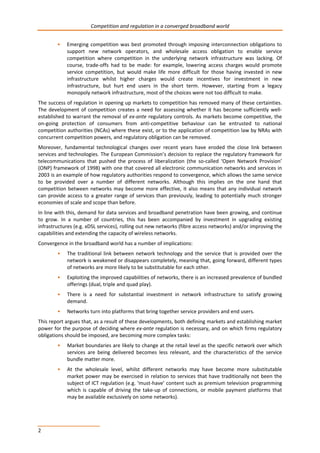
As shown in Figure 1, internet video is the major driver of the growth in consumer internet traffic, which 
is estimated to increase from 10.4 exabytes per month globally to over 44.2 exabytes between 2001 and 
2016 (which corresponds to a compound annual growth rate of 34 per cent). Broadband networks are 
increasingly used for the delivery of long-form video provided by services such as ‘LOVEFiLM Instant’ and 
‘NetFlix’4 rather than short-form Internet video traffic such as video clips on YouTube.5 For example: 
4 
• in Western Europe, where these services are available over both fixed and mobile networks, 
internet video traffic is expected to account for 60.3 per cent of all consumer Internet traffic 
in 2016, up from 44.8 per cent in 2011 (Cisco, 2012a); and 
• in China, it is predicted that by 2016, 79 per cent of all consumer internet traffic will be video 
content, up from 64 per cent in 2011 (Cisco, 2012b). 
4 According to Sandvine (2011), “Netflix accounts for 29.7% of peak period downstream traffic” across Americas fixed 
access networks. 
5 On Monday 9th Jan 2012, Amazon’s LOVEFiLM announced having reached two million subscribers, “driven by a record 
number of sign-ups in the fourth quarter of 2011. The Amazon-owned service added hundreds of thousands of new 
customers that now have access to LOVEFiLM Instant, which provides a unique offering of instantly streamed film and TV 
series, combined with the vast selection of DVD, Blu-ray and Video Game rentals. This is the fastest customer growth rate 
LOVEFiLM has experienced since 2009” when it was first introduced. See http://corporate.blog.lovefilm.com/a-press-releases/ 
amazon%E2%80%99s-lovefilm-hits-2-million-members.html#more-1403
Competition and regulation in a converged broadband world 
5 
Figure 1: Global Consumer Internet Traffic per Application (exabytes per month), forecast 2011-2016 
Source: Cisco (2012a) 
Users will increasingly require higher broadband speeds in order to make most of applications such as 
video-on-demand streaming, online gaming, cloud computing or other services. Consequently, the 
development of newer, faster broadband technologies will be a predominant feature of future broadband 
markets, both through FTTx services for fixed broadband, and 4G and WiMAX for mobile broadband 
services. Most countries have also set out ambitious national broadband plans, seeking to achieve 
widespread coverage of higher speed networks in the not-too-distant future (see OECD, 2011b). 
Regulators and competition authorities need to understand the importance of services and content as a 
driver of demand growth and network choice when looking at a converged broadband world. Because 
demand for connectivity depends on the availability of services that exploit the capabilities of the 
network, service availability is key. But at the same time, the incentives for the development of such 
services depend crucially on the expectation that there will be a sufficiently large addressable market. 
This can create a co-ordination problem that needs to be overcome if the potential for new services, 
supported by improved networks, is to be realized. 
2.2 Bundling 
Bundling of services that could – at least in principle – be provided separately has always been a feature 
of telecommunications markets. Access (line rental) and calling services were traditionally offered as a 
bundled service, and the fact that with liberalization it was possible to buy access from one provider but 
get calls from another probably surprised many users. Value added services such as call waiting or call 
divert were also often bundled with ‘basic’ telecommunications service. With the roll-out of cable 
networks, bundling of telecommunications services with television content (‘dual play’) has became 
prevalent. 
Bundled service offers are becoming increasingly common in the broadband world. Broadband access 
itself is often bundled with ‘traditional’ telecommunications services such as line rental and fixed voice
Competition and regulation in a converged broadband world 
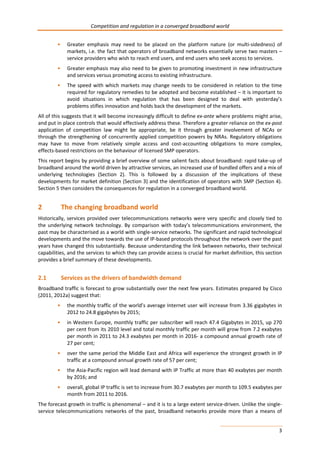
calls, but more typical bundles are ‘triple-play’ combinations of fixed-voice, data and video services, and 
sometimes quad-play packages further include mobile services (see Figure 2 below). 
Figure 2: Take-up of multi-service ‘bundles’ among fixed broadband customers, United Kingdom, 2012 
Source: Ofcom (2012) 
Historically service bundles may have involved multiple networks (e.g. a fixed line and a DTH broadcast 
satellite). The reason for bundling often was customers’ demand for one-stop-shop provision of services, 
with cost savings being limited to unified billing and customer support. Convergence means that service 
bundles can be delivered over a single network, creating economies of scale and scope and associated 
cost savings that go beyond those available before. With increasing bandwidth availability, bundling may 
become the common form of delivery (for example, internet, VOIP and IPTV all provided over a single 
broadband connection), and service bundles may grow to include further OTT services. 
These bundles are in most cases offered alongside standalone services (so-called ‘mixed bundling’).6 The 
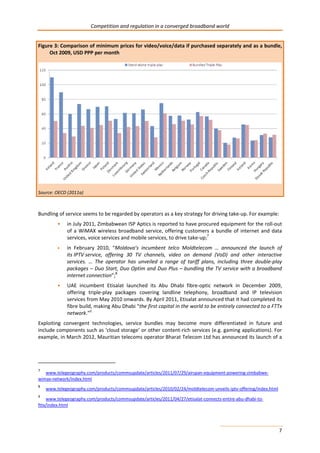
OECD (2011a, p3) finds that “[b]roadband bundles are typically sold with a significant price discount over 
stand-alone prices. The average bundled discount compared with buying the services separately is USD 15 
(PPP) per month or 26%. The average price of a triple-play bundle across all countries and operators is USD 
65 (PPP) per month, while the median price is USD 59 PPP. The average entry-level price for a triple-play 
bundle is USD 41 PPP per month.” 
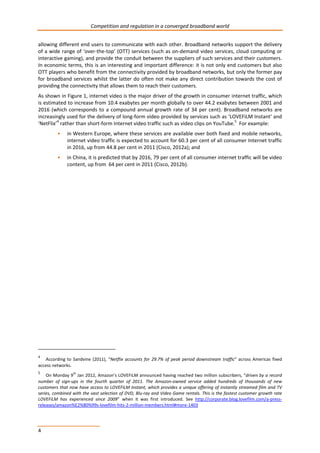
Figure 3 below gives an illustration of the savings across OECD countries, based on the most recent survey 
undertaken by the OECD. The average saving on triple-play bundles is approximately 27 per cent. 
6 This is different from ‘pure bundling’ or ‘tying’, where only packages are on offer. A 2011 report by the OECD analysing 
over 2 000 offers combining broadband, fixed-line telecommunications and television services from 90 firms in 30 countries 
found that more than three quarters of operators allowed customers to purchase broadband on a stand-alone basis. Tying 
with a fixed line was relatively common (17%), but tying to a television services was not (at 4%), and only 2% of offers 
required that all three services be taken in order to obtain broadband. For a general discussion of bundling and tying, and 
their impact on competition see Nalebuff (1999). 
6
Competition and regulation in a converged broadband world 
Figure 3: Comparison of minimum prices for video/voice/data if purchased separately and as a bundle, 
7 
Oct 2009, USD PPP per month 
Source: OECD (2011a) 
Bundling of service seems to be regarded by operators as a key strategy for driving take-up. For example: 
• in July 2011, Zimbabwean ISP Aptics is reported to have procured equipment for the roll-out 
of a WiMAX wireless broadband service, offering customers a bundle of internet and data 
services, voice services and mobile services, to drive take-up;7 
• in February 2010, “Moldova’s incumbent telco Moldtelecom … announced the launch of 
its IPTV service, offering 30 TV channels, video on demand (VoD) and other interactive 
services. … The operator has unveiled a range of tariff plans, including three double-play 
packages – Duo Start, Duo Optim and Duo Plus – bundling the TV service with a broadband 
internet connection”;8 
• UAE incumbent Etisalat launched its Abu Dhabi fibre-optic network in December 2009, 
offering triple-play packages covering landline telephony, broadband and IP television 
services from May 2010 onwards. By April 2011, Etisalat announced that it had completed its 
fibre build, making Abu Dhabi “the first capital in the world to be entirely connected to a FTTx 
network.”9 
Exploiting convergent technologies, service bundles may become more differentiated in future and 
include components such as ‘cloud storage’ or other content-rich services (e.g. gaming applications). For 
example, in March 2012, Mauritian telecoms operator Bharat Telecom Ltd has announced its launch of a 
7 www.telegeography.com/products/commsupdate/articles/2011/07/29/airspan-equipment-powering-zimbabwe-wimax- 
network/index.html 
8 www.telegeography.com/products/commsupdate/articles/2010/02/24/moldtelecom-unveils-iptv-offering/index.html 
9 www.telegeography.com/products/commsupdate/articles/2011/04/27/etisalat-connects-entire-abu-dhabi-to-fttx/ 
index.html
Competition and regulation in a converged broadband world 
FTTH network that will deliver broadband internet and IPTV, and offer a “carrier backbone for other 
service providers in the country operating in the gaming and WebTV business spheres.”10 
2.3 Different mixes of fixed and mobile broadband technologies 
There is notable variation in the role played by mobile and fixed broadband services, and across fixed 
broadband technologies used throughout the world. 
DSL is the main fixed broadband technology worldwide with over 60 per cent of connections in the top 
ten countries (by number of subscribers) using this type of technology (Point Topic 2011).11 Cable 
accounts for almost 20 per cent of broadband connections in these countries, with the US being the 
largest cable market. The remainder are largely FTTH connections, which are currently prevalent in 
countries such as the Republic of Korea and Japan (Point Topic 2011) and are expected to play a greater 
role in the future in other countries.12 Globally, fixed broadband connections stood at 591 million by the 
end of 2011, having doubled over the previous five years, and should have reached 612 million by the end 
of March 2012 (Point Topic, 2012b). 
This number is dwarfed by mobile broadband subscriptions, which stood at 1.09bn globally13 by the end 
of 2011. In many developing nations14 where the fixed network infrastructure is poor, mobile technology 
provides the main form of internet access. With 62 per cent of the world’s total number of Internet users 
coming from these nations at the end of 2011 (up from 44 per cent five years earlier – see ITU, 2012a), it 
should not be surprising that mobile broadband penetration in these countries is often substantially 
higher than fixed penetration, and is expected to grow further.15 
Growth in mobile broadband connections is however not purely the consequence of poor fixed network 
infrastructure. Changing usage patterns supported by mobile data cards and smartphones, and 
substantial improvements in mobile technology (most notably the shift towards 4G networks which offer 
substantially higher data rates) mean that mobile broadband is becoming a strong contender even in 
countries with a well-developed fixed network infrastructure (see Box 1). 
Overall, Ericsson (2012) forecasts global mobile traffic to increase from around 1 000 petabytes per 
month in 2012 to over 8 000 petabytes by 2017. 
10 www.telegeography.com/products/commsupdate/articles/2012/03/20/bharat-telecom-mauritius-launches-ftth-service/ 
8 
index.html 
11 The top 10 broadband fixed broadband markets are (China, USA, Japan, Germany, France, UK, the Republic of Korea, 
Russian Federation, Brazil, Italy and India. 
12 In particular, ambitious targets for available bandwidth (such as the European Commission’s Digital Agenda or the US 
National Broadband plan (Federal Communications Commission) may have a similar effect as the u-Japan policy set out by 
the Japanese the Ministry of Internal Affairs and Communications (MIC) in 2005 (see Business Software Alliance, 2012) or 
the Korean Broadband Convergence Network Initiative (BcN) of 2004 (see Ovum, 2009). 
13 www.itu.int/ITU-D/ict/statistics/at_glance/keytelecom.html 
14 The average fixed penetration is 4.8% in developing economies compared with 26% in developed countries; see ITU 
(2012a). www.itu.int/ITU-D/treg/publications/trends12.html 
15 Even in some Sub-Saharan African countries where capital cities are connected to ‘international fibre’ and fixed 
broadband connections in the major cities is developing it will remain costly to connect rural communities with costs 
escalating the further away from the core network the communities are (see Bernal, 2011, pp 26-28).
Competition and regulation in a converged broadband world 
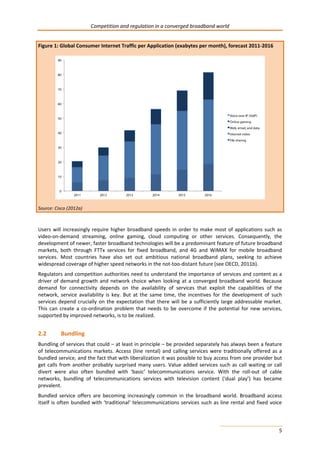
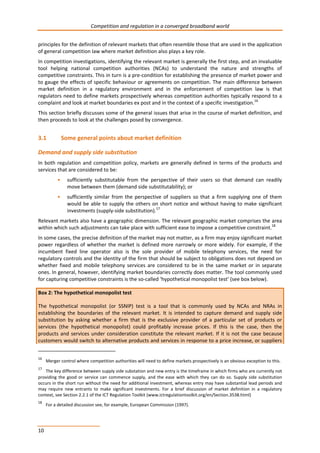
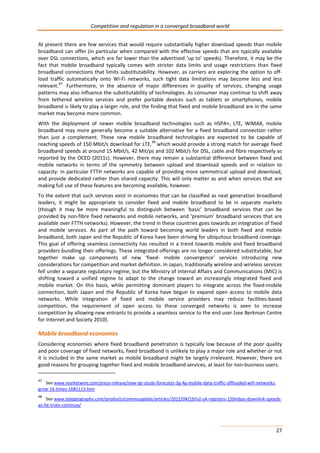
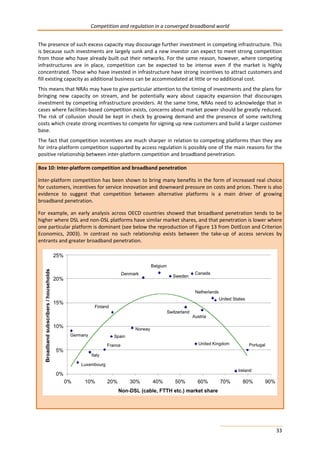
Box 1: Growth of mobile broadband penetration in countries with high fixed penetration, 2009-2011 
The table below shows the change in fixed and mobile broadband penetration for some of the countries 
with the highest level of fixed broadband penetration in 2009. This shows that even in countries where 
fixed broadband services are well established, and take-up is high, mobile broadband is growing 
dramatically, with average growth rates of around 26 per cent from 2010 to 2011, compared with a 3 per 
cent growth in the penetration of fixed broadband over the same period. On average across those 
countries, there are 56.7 mobile broadband connections per 100 inhabitants compared with 34 fixed 
broadband connections. 
9 
Source: ITU World Telecommunication/ICT indicators database, www.itu.int/icteye. 
3 Market definition in a broadband world 
As a general principle, the scope of regulatory intervention should be limited to markets where 
competition is ineffective or cannot develop without some assistance that protects smaller firms and new 
entrants from being pushed aside by strong incumbents, and regulatory obligations should only be 
imposed on firms that are capable of distorting competition, harming rivals or exploiting consumers. 
Regulation should be withdrawn when markets become competitive. This acknowledges the inherent 
limitations of regulatory intervention that results from regulators generally having less information about 
the costs of the regulated firms and the needs of customers and having fewer instruments at their 
disposal than they would need to achieve the outcomes that would occur in an effectively competitive 
market. 
This means that regulators need to establish which firms are likely to be in a position to exploit their 
customers, or behave in ways that make it more difficult for their competitors to gain a foothold. Such a 
position is generally described as one of significant market power (SMP), and it can only exist in relation 
to a particular market within which firms compete. Identifying these markets is therefore a key task. 
Defining the markets that are susceptible to ex-ante regulation generally involves a process of market 
analysis that is repeated at regular intervals. It may take a list of candidate markets as its starting point, 
and may be more or less formalised. As part of the market analysis process, regulators will typically apply
Competition and regulation in a converged broadband world 
principles for the definition of relevant markets that often resemble those that are used in the application 
of general competition law where market definition also plays a key role. 
In competition investigations, identifying the relevant market is generally the first step, and an invaluable 
tool helping national competition authorities (NCAs) to understand the nature and strengths of 
competitive constraints. This in turn is a pre-condition for establishing the presence of market power and 
to gauge the effects of specific behaviour or agreements on competition. The main difference between 
market definition in a regulatory environment and in the enforcement of competition law is that 
regulators need to define markets prospectively whereas competition authorities typically respond to a 
complaint and look at market boundaries ex post and in the context of a specific investigation.16 
This section briefly discusses some of the general issues that arise in the course of market definition, and 
then proceeds to look at the challenges posed by convergence. 
3.1 Some general points about market definition 
Demand and supply side substitution 
In both regulation and competition policy, markets are generally defined in terms of the products and 
services that are considered to be: 
10 
• sufficiently substitutable from the perspective of their users so that demand can readily 
move between them (demand side substitutability); or 
• sufficiently similar from the perspective of suppliers so that a firm supplying one of them 
would be able to supply the others on short notice and without having to make significant 
investments (supply-side substitution).17 
Relevant markets also have a geographic dimension. The relevant geographic market comprises the area 
within which such adjustments can take place with sufficient ease to impose a competitive constraint.18 
In some cases, the precise definition of the market may not matter, as a firm may enjoy significant market 
power regardless of whether the market is defined more narrowly or more widely. For example, if the 
incumbent fixed line operator also is the sole provider of mobile telephony services, the need for 
regulatory controls and the identity of the firm that should be subject to obligations does not depend on 
whether fixed and mobile telephony services are considered to be in the same market or in separate 
ones. In general, however, identifying market boundaries correctly does matter. The tool commonly used 
for capturing competitive constraints is the so-called ‘hypothetical monopolist test’ (see box below). 
Box 2: The hypothetical monopolist test 
The hypothetical monopolist (or SSNIP) test is a tool that is commonly used by NCAs and NRAs in 
establishing the boundaries of the relevant market. It is intended to capture demand and supply side 
substitution by asking whether a firm that is the exclusive provider of a particular set of products or 
services (the hypothetical monopolist) could profitably increase prices. If this is the case, then the 
products and services under consideration constitute the relevant market. If it is not the case because 
customers would switch to alternative products and services in response to a price increase, or suppliers 
16 Merger control where competition authorities will need to define markets prospectively is an obvious exception to this. 
17 The key difference between supply side substation and new entry is the timeframe in which firms who are currently not 
providing the good or service can commence supply, and the ease with which they can do so. Supply side substitution 
occurs in the short run without the need for additional investment, whereas entry may have substantial lead periods and 
may require new entrants to make significant investments. For a brief discussion of market definition in a regulatory 
context, see Section 2.2.1 of the ICT Regulation Toolkit (www.ictregulationtoolkit.org/en/Section.3538.html) 
18 For a detailed discussion see, for example, European Commission (1997).
Competition and regulation in a converged broadband world 
of such alternative products or services would commence supply of the products currently offered by the 
hypothetical monopolist, then the relevant market will have to include at least these alternatives. 
Starting from the smallest conceivable set of products (for example fixed broadband connections 
providing speeds in a specific range), one would ask whether a hypothetical monopolist offering these 
products could increase its profits by introducing a small but significant non-transitory increase in price 
(SSNIP). If the answer is ‘no’ the products to which customers would switch or whose suppliers would 
offer the reference product will be included, and the test is then repeated until a set of products is found 
over which a monopolistic supplier could profitably sustain such a price increase.19 In a similar way to 
product market definition, a geographic market definition would start from a narrow geographic area and 
apply the SSNIP test over wider geographic areas as appropriate. 
Davies and Garcés (2009) describe a number of techniques that can be used to assess the profitability or 
otherwise of a price increase. 
One potential methodological pitfall in applying the SSNIP test is the so-called ‘cellophane fallacy’ (named 
after a US antitrust case involving DuPont, the manufacturer of the cellophane plastic wrap in the US): 
the cellophane fallacy refers to the observation that a market that is served by an actual monopolist 
would wrongly be considered too narrow if the SSNIP test were conducted using the market price as its 
starting point.20 This is because a profit-maximising monopolist sets its price at the point where any 
further increase becomes unprofitable. The naïve application of the SSNIP test would thus find that a 
small price increase above the market price is not profitable and conclude that additional products need 
to be included in the relevant market. In order to avoid this problem, it is important to consider the 
profitability of a price increase over and above the competitive level, which will be different from the 
price if the market is affected by a competition problem. 
Requiring knowledge of the competitive price level in order to avoid the cellophane fallacy leads to an 
obvious conundrum, however: if the competitive price level could be established without reference to the 
market price, then the difference between the market price and the competitive price could be used to 
establish the presence of market power, and the entire market definition exercise would be unnecessary. 
Source: Author 
Retail and wholesale markets 
A key distinction can be drawn between retail markets where sales are being made to end users, and 
wholesale markets where customers are businesses who source inputs that will be used to sell to other 
businesses or, ultimately, to end users. 
Given the history of telecommunications liberalization with service competition being introduced on the 
basis of regulated access to key inputs, this distinction is particularly important for regulatory purposes. 
19 If the price increase is not profitable for the hypothetical monopolist because customers would switch away to 
alternatives, or firms offering products would readily switch some of their capacity to supply the product in question, then 
the scope is expanded to include those additional products or services. In other words, the products that consumers would 
credibly switch to in response to such a price increase, or the products whose suppliers could easily satisfy demand, would 
be included in the relevant product market. On the supply side, practitioners would look at the ability of alternative 
undertakings to be able to supply that particular product without incurring substantial sunk (non-recoverable) costs. For 
example, if the focal product under consideration were wholesale access to fixed infrastructure of an incumbent operator, 
it is unlikely that such technology may be replicated quickly, as significant investment in civil works and rolling out network 
infrastructure would be required, and most of the costs involved would be sunk. The analysis would be repeated, assuming 
a hypothetical monopolist of the larger set of products, until the point at which the hypothetical monopolist would be able 
to sustain profitably a price increase over the set. See OFT (2004). 
20 For a more detailed discussion of the cellophane fallacy see a presentation by Philip Nelson available from the US DOJ 
website (www.justice.gov/atr/public/hearings/single_firm/docs/222008.pdf). 
11
Competition and regulation in a converged broadband world 
Scale and scope economies in combination with sunk costs may limit the potential for competition mainly 
in relation to network infrastructure (or at least some parts of the network), with other parts of the value 
chain being in principle open to competition. 
By identifying wholesale markets and using ex-ante regulation to prevent abuses of market power at the 
wholesale level (for example, through defining appropriate access and interconnection obligations) 
regulators try to ensure that “as much of the value chain is open to normal competition processes as 
possible, thereby delivering the best outcomes for end-users”.21 
Exposing a greater proportion of the value chain to competition is beneficial because competition is 
usually more effective than regulation in promoting service differentiation and innovation. The principle 
that regulation should focus on wholesale rather than retail markets is particularly important in relation 
to broadband services because these services are far from mature and service innovation is an important 
dimension of the competitive process (see ITU 2012c). 
3.2 Service-driven choice of networks and retail market definition 
As discussed above, one of the main characteristics of broadband networks is that they are multi-service 
networks. Whilst traditional telecommunications networks provided one (and essentially only one) service 
– namely voice (later augmented by fax) communications between those connected to the network – a 
broadband connection is a conduit that enables consumers to access a plethora of services, and gives 
service providers the means to distribute their offerings. This is at the core of convergence, and means 
that broadband networks can be seen as platforms through which service providers and consumers 
interact.22 The platform nature of broadband networks implies that a broadband network will be more 
attractive to potential end users if it provides access to better services and a greater range of services, 
and be more attractive for service provider if it allows them to reach a greater number of users. 
To some extent, the strength of this specific type of network effect is masked by the fact that – at present, 
and at least in principle – services provided over the public internet are universally accessible regardless 
of the network connection used by the customer. However, the bandwidth that is available through 
particular types of connections imposes practical limitations, and it may well be possible to restrict access 
to particular services to customers of particular networks.23 
In any case, differences in the technological capabilities of networks matter largely because of the 
differences in the range of services to which a customer may gain access. For example, whether there is a 
single broadband market, or whether it would be more appropriate to distinguish markets for basic and 
ultra-fast broadband depends on whether some services are accessible through one, but not the other. 
Similarly, depending on whether there are services that require near-symmetrical upload and download 
speeds, broadband networks that support such symmetrical speeds may be in a different market from 
those that offer high download, but limited upload speeds. 
This means that the definition of relevant markets in relation to broadband connections is strongly 
affected by the nature of services to which broadband customers might gain access, and that market 
boundaries may change over time. For example, broadband services that at present are considered to be 
substitutable may not be so in the future if services that require high-bandwidth low-latency connections 
emerge and become mainstream. 
21 See European Commission (2007a), Clause 15. 
22 For a detailed discussion of the economic issues that arise in multi-sided markets or platforms, see for example Evans 
and Schmalensee (2008) or Evans et al. (2011). 
23 The ‘walled garden’ approach originally adopted by AOL is a good example for limiting access to services to the 
subscribers of the firm that provides the connectivity. Content-rich portals have also been used by many mobile operators 
aiming to provide their subscribers not just with connectivity, but also exclusive access to services. 
12
Competition and regulation in a converged broadband world 
NRAs may need to define a number of sub-markets characterized by the ability of the network to provide 
consumers with the experiences they require. For example, if broadband networks provide the main way 
of accessing video content in the future, then the question whether a particular type of network provides 
the bandwidth and the latency to support multiple high-definition video streams may matter for market 
definition, even if it does not at present. This may well require more complex assessments of 
substitutability than have been undertaken in the past. 
The role of ‘marginal’ customers 
Consider the extreme case of an ultra-fast fibre-to-the-home (FTTH) network supporting near-symmetrical 
speeds of 100 Mbit/s on the one hand, and a basic ADSL network with an effective download 
speed of 2 Mbit/s, and upload speeds of 256 kbit/s on the other hand. Those networks appear to be too 
different to be substitutable from the perspective of customers who wish to access bandwidth-hungry 
services that only the FTTH network can deliver. Such customers do not have an effective choice. 
However, this does not necessarily matter for market definition. If there is a sufficiently large group of 
customers for whom access to bandwidth-intensive services is not crucially important, and who might 
therefore be prepared to switch to the slower network if a hypothetical monopolist of FTTH services were 
to increase the price above the competitive level, such a price increase would be unprofitable. It is such 
‘marginal’ customers who determine the strength of competitive constraints that one type of broadband 
network exercises in relation to the other. Market definition needs to focus on these customers rather 
than focusing on those who would not consider switching (so-called ‘captive’ customers). 
The SSNIP test, by focusing on the profitability of a small price increase, should help in this regard. 
However, it may also sometimes ignore the ability of suppliers to charge different prices to captive and 
non-captive customers (i.e. to engage in so-called ‘price discrimination’). If a supplier can exploit the fact 
that some customers may not be willing to switch to alternative products by charging them a higher price, 
then it may be appropriate to identify separate markets, or define markets more narrowly.24 Such price 
discrimination may happen in a number of ways, and does not require that the operator is able to identify 
captive and non-captive customers. For example, offering a menu of tariffs and allowing customers to pick 
the one that best suits their needs can be used as a way of segmenting customers into different groups.25 
Depending on how effective these strategies are, it may then be appropriate to define separate markets 
for different types of tariff packages, for example. 
Note that the relative proportion of captive and non-captive, marginal consumers may change as the 
underlying services mature: where in the early stages of development of a bandwidth-hungry services 
only the small group of early adopters may be considered captive, the proportion of captive customers 
may grow over time as the service acquires mass market appeal. These changes should be picked up in 
the course of the periodic market analyses undertaken by regulatory authorities. 
Chains of substitution 
The role of marginal consumers is important when looking at chains of substitution. Even if the two 
networks described above may not be directly substitutable from the perspective of any particular user, 
they may be part of the same market if they are linked by a chain of substitution. For example, there may 
be a VDSL network that provides upload and download speeds that lie between those offered by the FTTH 
network and those available via ADSL. Even though nobody would consider the ADSL connection to be a 
24 The role of price discrimination in relation to market definition is considered, for example, in the merger guidelines in 
Australia, Canada, the EC, Finland, New Zealand, the UK and the US (see Leddy et al., 2005). Price discrimination may mean 
that an otherwise unprofitable price increase pays off, and thus would lead to the identification of smaller markets (see, for 
example, Strand, 2008). 
25 This is so-called ‘third degree price discrimination’. For a simple and accessible discussion of the different forms of price 
discrimination, see the tutorial provided at http://tutor2u.net/economics/revision-notes/a2-micro-price-discrimination. 
13 
html.
Competition and regulation in a converged broadband world 
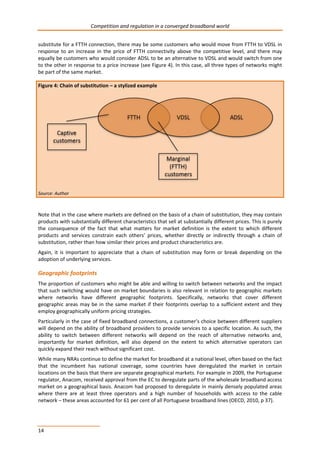
substitute for a FTTH connection, there may be some customers who would move from FTTH to VDSL in 
response to an increase in the price of FTTH connectivity above the competitive level, and there may 
equally be customers who would consider ADSL to be an alternative to VDSL and would switch from one 
to the other in response to a price increase (see Figure 4). In this case, all three types of networks might 
be part of the same market. 
Figure 4: Chain of substitution – a stylized example 
Source: Author 
Note that in the case where markets are defined on the basis of a chain of substitution, they may contain 
products with substantially different characteristics that sell at substantially different prices. This is purely 
the consequence of the fact that what matters for market definition is the extent to which different 
products and services constrain each others’ prices, whether directly or indirectly through a chain of 
substitution, rather than how similar their prices and product characteristics are. 
Again, it is important to appreciate that a chain of substitution may form or break depending on the 
adoption of underlying services. 
Geographic footprints 
The proportion of customers who might be able and willing to switch between networks and the impact 
that such switching would have on market boundaries is also relevant in relation to geographic markets 
where networks have different geographic footprints. Specifically, networks that cover different 
geographic areas may be in the same market if their footprints overlap to a sufficient extent and they 
employ geographically uniform pricing strategies. 
Particularly in the case of fixed broadband connections, a customer’s choice between different suppliers 
will depend on the ability of broadband providers to provide services to a specific location. As such, the 
ability to switch between different networks will depend on the reach of alternative networks and, 
importantly for market definition, will also depend on the extent to which alternative operators can 
quickly expand their reach without significant cost. 
While many NRAs continue to define the market for broadband at a national level, often based on the fact 
that the incumbent has national coverage, some countries have deregulated the market in certain 
locations on the basis that there are separate geographical markets. For example in 2009, the Portuguese 
regulator, Anacom, received approval from the EC to deregulate parts of the wholesale broadband access 
market on a geographical basis. Anacom had proposed to deregulate in mainly densely populated areas 
where there are at least three operators and a high number of households with access to the cable 
network – these areas accounted for 61 per cent of all Portuguese broadband lines (OECD, 2010, p 37). 
14
Competition and regulation in a converged broadband world 
In other cases, regulators may instead decide to impose differentiated remedies in a single, national 
market. For example, in 2008, as part of the market review process, the Austrian regulator proposed to 
define a single national market for wholesale broadband in which the incumbent, Telekom Austria (TA) 
would be designated as having SMP. However, while TA was considered to have SMP at the national level, 
it was recognized that there were particular regions where there was less competition from other 
infrastructure operators. For example, in less populated, rural areas, TA was the only operator. The 
regulatory authority proposed to address these different competitive pressures in different regions by 
applying differentiated remedies.26 
The need to define broadband access markets geographically may become increasingly important during 
the transition to new ultra-fast networks. For example, given the heterogeneity of different geographic 
areas, ultra-fast networks are likely to be rolled out first in the most ‘profitable’ areas (e.g. densely 
populated urban areas) where economies of scale and scope can easily be realized before extending to 
other areas. Differences in demand and supply characteristics in different areas may require markets to 
be defined differently by region, at least in the short to medium term, if rollout of new competitive 
networks is slow. 
As noted above, even in some sub-Sahara African countries where capital cities are connected to 
‘international fibre’ and fixed broadband connections in the major cities are gaining in importance, it will 
remain costly to connect rural communities with costs escalating the further away from the core network 
the communities are (Bernal, 2011). Thus, in these countries, it may be necessary to consider different 
markets depending on the geography, as customers in rural areas will not have the same choice of 
services and networks as in the densely populated urban centres. The increasing coverage of 3G, and the 
future roll-out of 4G mobile networks may fill gaps in the chain of substitution, as discussed above, but 
the strength of the constraints this creates need to be assessed on a case-by-case basis. 
One-way substitution 
It may well be the case that customers would be prepared to switch from the less capable network to the 
more capable one (e.g. trade up from ADSL to VDSL in response to an increase in the price of ADSL 
services), but not in the other direction. This means that VDSL prices impose a strong constraint on the 
pricing of ADSL services, but that the constraining effect in the other direction is perhaps less strong. 
While at present no comprehensive analysis in relation to broadband service may have been undertaken, 
one-way substitutability has been discussed extensively in relation to the competitive interaction 
between fixed and mobile voice services. For example, as BEREC (2011) reports, the Finnish regulator 
FICORA found “that retail fixed access for voice services was fully substitutable with mobile access 
services, but not the other way around. That is, there was no two-way substitution between these services. 
If there was a SSNIP of retail fixed access services, fixed subscribers would switch to mobile telephony 
subscriptions. But, if there was a SSNIP of retail mobile access services, mobile subscribers would not 
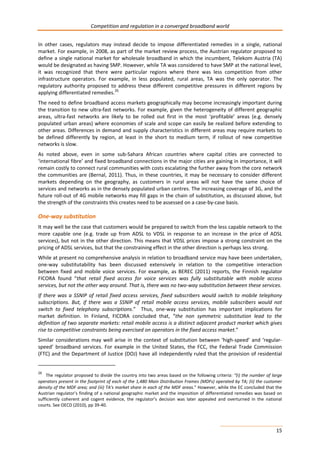
switch to fixed telephony subscriptions.” Thus, one-way substitution has important implications for 
market definition. In Finland, FICORA concluded that, “the non symmetric substitution lead to the 
definition of two separate markets: retail mobile access is a distinct adjacent product market which gives 
rise to competitive constraints being exercised on operators in the fixed access market.” 
Similar considerations may well arise in the context of substitution between ‘high-speed’ and ‘regular-speed’ 
broadband services. For example in the United States, the FCC, the Federal Trade Commission 
(FTC) and the Department of Justice (DOJ) have all independently ruled that the provision of residential 
26 The regulator proposed to divide the country into two areas based on the following criteria: “(i) the number of large 
operators present in the footprint of each of the 1,480 Main Distribution Frames (MDFs) operated by TA; (ii) the customer 
density of the MDF area; and (iii) TA's market share in each of the MDF areas.” However, while the EC concluded that the 
Austrian regulator’s finding of a national geographic market and the imposition of differentiated remedies was based on 
sufficiently coherent and cogent evidence, the regulator’s decision was later appealed and overturned in the national 
courts. See OECD (2010), pp 39-40. 
15
Competition and regulation in a converged broadband world 
high speed broadband internet access service is a distinct market in its own right compared to narrow 
band services due to the benefits of ‘trading up’ from narrowband to broadband.27 
Depending on how ‘one-way’ substitutability is captured in the definition of the relevant market, it may 
need to be addressed in the context of establishing whether an operator enjoys market power: although 
narrowband services may be considered to be in a market of their own, for example, operators with a 
strong position in this market may not enjoy market power because of the competitive threat they are 
facing from broadband providers (even though they do not impose a strong constraint in the other 
direction). 
Vertical relationships 
The range of services to which a broadband customer may get access is not necessarily affected only by 
the technical parameters of the network. It may also depend on vertical relationships between network 
operators and service providers. At present, most services are accessible over the public internet, and 
thus through any network connection that supports the required bandwidth and latency. However, this 
does not have to be the case. For example, until recently, in the UK BSkyB’s video on demand service, ‘Sky 
Anytime+’ was available only over a Sky broadband connection. 
Some proprietary services also exist in relation to mobile broadband offerings.28 For example, the mobile 
M-PESA payment service used in Kenya, and others in Afghanistan and Tanzania is only available on a 
single operator’s network in a given country.29 For example, in Kenya, where it is estimated that up to 25 
per cent of the population uses the M-PESA payment system,30 the service is only available over the 
‘Safaricom’ network.31 Other operators may offer their own proprietary mobile payment services, and 
access to the service may be expected to have a strong impact on mobile network choice. 
With the choice of network being service-driven, consumers may be unable to switch between broadband 
offers if the content in which they are interested is unavailable over alternative platforms. Here again the 
maturity of the service under consideration (e.g. whether it attracts mostly early adopters or has mass 
market appeal) is important, and market boundaries may change as services move from niche to general 
interest. Where the majority of customers is interested in using a particular service such as mobile 
payments, for example, that is available only over some networks, these networks may need to be 
considered as being in a separate market. Again, what matters here is the proportion of ‘marginal’ 
consumers, i.e. users who are prepared to forego access to such services in response to an increase in the 
price above the competitive level. 
27 See Federal Communications Commission (2001), Federal Trade Commission (2000), Department of Justice (2000). 
28 Where a service provider agrees to make services available exclusively over a particular network, it obviously matters 
how many customers are connected to this network. From the perspective of the service provider, the broadband network 
will be more attractive the more customers can be reached. This gives rise to the complications of market definition in two-sided 
16 
markets, where the appropriate basis of the SSNIP test would have to take account of the fact that a reduction in 
demand on one side will also reduce demand on the other side, which would magnify the impact of a price increase (see, 
for example, Evans and Schmalensee, 2007, p 173f.). 
29 “M-PESA is an innovative mobile transfer solution that enables customers to transfer money. It is aimed at mobile 
customers who do not have a bank account, either by choice, because they do not have access to a bank or because they do 
not have sufficient income to justify a bank account.” See www.safaricom.co.ke/personal/m-pesa/how-to-register/faqs 
30 See Vodafone’s website at http://enterprise.vodafone.com/products_solutions/finance_solutions/m-pesa.jsp 
31 “M-PESA is only available on Safaricom SIMs, so only a Safaricom subscriber can deposit or send money.” See Safaricom 
website at www.safaricom.co.ke/personal/m-pesa/how-to-register/faqs
Competition and regulation in a converged broadband world 
Bundling 
Even in the absence of exclusive arrangements, bundling may affect the substitutability of broadband 
services offered through different networks or by different providers. In the presence of bundled offers, 
should the relevant market comprise bundles or individual products, or potentially both? 
While bundling network connectivity and services may be the most efficient way to overcome the co-ordination 
problem that can arise from the service-driven demand for bandwidth, it may also have the 
effect of limiting customer switching to alternative offers and may thus affect market definition. 
Customers may sometimes find it difficult to compare bundled offers where packages are different, for 
example, in terms of channels being offered, broadband speeds and the inclusion of deals on certain calls 
(e.g. flat rates on national calls). This increases search costs and may be customers less likely to respond 
to price increases by looking for alternative suppliers and switching their demand to these. 
Perhaps more importantly, customers may find themselves locked-in to bundles where an individual 
component might not be available through any other means or where the contractual terms limit their 
ability to break the bundle. 32 Certainly in relation to ‘traditional’ telecommunications service bundles 
(access, voice calls and potentially value-added services) the ability of operators to compete in the 
provision of individual components has been limited. This has been one of the lessons from the first phase 
of liberalization in South Africa, where the fact that Telkom could offer a bundled package of voice, data 
and value added services was seen by competitors who could only offer value-added services as a major 
hindrance (see Sibanda, 2006). 
Customers may also be averse to unpicking bundles in response to price changes of individual 
components offered by rivals, given increases in transaction costs. Here again, the key issue is how large 
the proportion of customers unable or unwilling to consider sourcing individual components (captive 
customers) is compared with the proportion of customers who would be willing to unpick the bundle and 
switch to buying individual components. 
One approach to addressing the question whether bundled services should be considered to be a 
separate market that has been advocated for example by the European Commission is to look at whether 
customers would be prepared to unpick the bundle in response to a price increase and switch to 
purchasing individual components.33 This is linked to (though slightly different from) the question 
whether suppliers of individual bundle elements would be able to attract customers away from buying 
bundles and source individual components instead. 
One needs to be careful, however, in terms of adopting the correct starting point for assessing the effects 
of an increase in the bundle price. This is because a hypothetical monopolist of the service bundle would 
be expected to set prices in such a way that any increase in the bundle price would be unprofitable, taking 
into account the propensity of consumers to switch to individual services, both those supplied by the 
hypothetical monopolistic bundle provider and potential competitors offering services on a stand-alone 
basis. This means that, starting from optimally set bundle discounts, any increase in the prevailing price of 
a bundle will by definition be unprofitable, regardless of whether the supplier of the bundle is facing 
competition from firms supplying individual components or is setting its bundle price in the face of limited 
32 For example, “[a]n OECD data collection of over 2 000 offers of stand-alone and bundled services from 90 firms across 
30 OECD countries reveals that broadband services in the OECD are overwhelmingly sold as mixed bundles, allowing users to 
choose among stand-alone offers or bundled services. Of the 90 operators surveyed, 77% allow users to buy stand-alone 
broadband service. 17% tie broadband service to a fixed-line voice service and 4% require a television package to obtain 
broadband access. Only 2% of the offers surveyed required subscribers to take a triple-play service to have broadband.” See 
OECD (2011a), p 3. 
33 For example, in its explanatory note to the EC Recommendation on ICT markets, the EC notes that “[i]f, in the presence 
of a small but significant non-transitory increase in price there is evidence that a sufficient number of customers would 
“unpick” the bundle and obtain the service elements of the bundle separately, then it can be concluded that the service 
elements constitute the relevant markets in their own right and not the bundle” (European Commission, 2007b, p15). 
17
Competition and regulation in a converged broadband world 
competition, e.g. because not all of the bundle components would be available from other suppliers.34 
This means that, in line with the general principles of market definition, one should use the competitive 
bundle price as a starting point when examining whether customers would be willing to unpick bundles in 
response to a price increase, noting that this might be different from the prevailing bundle price.35 
Establishing the competitive bundle price is of course far from straightforward and might, for example, 
involve considering the cost savings that can be justified by economies of scale and scope. In addition, 
information about actual switching between bundles and individual products, or the general take-up of 
bundles and individual products might be considered by NRAs. 
Box 3: Looking at service bundles – an example 
A study of bundling in Hungary assessed the impact of an increase in a hypothetically competitive price of 
certain bundles (using a critical loss test36). 
The study used results from a survey of 1 000 members of the Hungarian population. A special, situation-adaptive 
18 
questionnaire design was applied in order to obtain stated preference reactions to a 10 per cent 
price increase against a hypothetical competitive price for any given bundle of services (this starting price 
was calculated by applying a discount to tariffs available in the market at the time i.e. acting as a proxy a 
hypothetical competitive offer). 
The study then used a critical loss test to consider whether there is a separate market for triple play 
bundles. This test establishes “whether the loss of sales is above a critical level when the variable cost 
savings and the larger price cannot balance the effect of diminishing quantity.” 
The study found that only between 5 per cent and 10 per cent of customers would respond to an increase 
in the bundle ‘price’ by 10 per cent by breaking up the bundle (or ceasing to buy altogether). In terms of 
the stability of bundles, the research found the combination of internet and television to be most stable, 
followed by the triple-play bundle including internet, television, and telephony. The telephony-TV 
package was the least stable. This shows that bundles may well be considered to be in separate markets 
in Hungary. 
Source: Papai et al (2011) 
There are few general conclusions that hold regardless of the specific circumstances, and depending on 
the nature of the services and service bundles under consideration, one might find: 
• a separate market for the bundled product in addition to markets for the individual 
components (e.g. a market for broadband access, a market for television services, and a 
market for dual-play broadband and television services); 
• separate markets for the bundle components, but no separate market for the bundle; 
• a single market for the bundle and its constituent parts. 37 
34 This is analogous to the well-known ‘cellophane fallacy’ encountered in the process of market definition discussed 
above. 
35 Of course, in this case one would not have to undertake the market definition exercise (see previous footnote). 
36 For a description of the critical loss test see for example Davies and Garcés (2009), 
37 See BEREC (2010b). The case where there is a market for the bundle but no markets for individual components is 
unlikely if individual elements are bought and sold separately by at least some customers. It has been recognized, however, 
that in the case of complementary services (which is commonly the case with service bundles) the process of market 
definition may produce unreasonable results if it starts from an individual component and proceeds by including further 
services that are offered as parts of a bundle (see, for example, Gual, 2003).
Competition and regulation in a converged broadband world 
3.3 Wholesale market definition 
In order to pursue the goal of minimizing regulatory intervention at the retail level through imposing 
access obligations at the wholesale level, it is important to identify wholesale services that would enable 
competitors to provide services to retail customers. 
If there is strong competition at the network level, such wholesale services may be offered on commercial 
terms as network operators can take advantage of strong brand or other specific skills of downstream 
competitors to expand the retail market. However, in the absence of network competition, such 
wholesale services will only exist as a result of regulatory intervention. This provides considerable latitude 
to regulatory authorities in terms of the range of access products they would like regulated firms to 
provide. Policy objectives therefore play a major role in the identification of wholesale markets. 
Identification of wholesale services 
Ideally, wholesale access obligations should promote the emergence of competition across the value 
chain by limiting the ability of incumbent operators to leverage control over infrastructure that cannot be 
easily replicated (at least not in the short term). Because regulatory obligations should ultimately be 
limited to these parts of the value chain, it is however also important that such access obligations provide 
the right incentives for investment in alternative infrastructure wherever economically feasible. Access 
obligations should provide the right ‘build-or-buy’ incentives. 
In pursuit of these objectives, NRAs may identify a wide range of wholesale services at different layers of 
the value chain. This will clearly present third parties who have not invested in their own infrastructure 
with a wide range of opportunities for reaching retail customers, and will thus facilitate retail competition. 
This is clearly beneficial to end users, and the best option in cases where the roll-out of alternative 
networks is prohibitively costly. 
At first sight NRAs may be tempted to expect that offering a wide choice of wholesale products promotes 
infrastructure investment by enabling third parties to enter the market at the retail level, attract 
customers, and then invest in infrastructure in order to replace the purchase of access over time. The 
underlying idea is that access seekers would climb a ‘ladder of investment’: having established a presence 
in the market using initially what might be no more than fully managed connectivity offered on wholesale 
terms, third parties would invest in their own infrastructure and seek to purchase access services further 
up the value chain.38 Offering this opportunity to third parties is intended to reduce the amount of 
investment required to enter the market in the first place and make it easier to start building a customer 
base. 
The ‘ladder of investment’ view has particularly shaped the regulation of broadband access and the 
identification of broadband markets in Europe, where wholesale markets have been identified for both 
bitstream access and unbundled local loops. However, a layered approach to the identification of 
wholesale access is also used elsewhere. Box 4 provides some examples. 
19 
38 See Cave and Vogelsang (2003) or Cave (2006).
Competition and regulation in a converged broadband world 
Box 4: Layered approaches to the regulation of wholesale services 
Europe – As recommended by the European Commission in December 2007, the relevant broadband 
market includes ‘Market 5’ or ‘Wholesale broadband access’ that “comprises non-physical or virtual 
network access including ‘bit-stream’ access at a fixed location. This market is situated downstream from 
the physical access…in that wholesale broadband access can be constructed using this input combined 
with other elements”. ‘Market 4’ related to ‘Wholesale (physical) network infrastructure access (including 
shared or fully unbundled access) at a fixed location’ is relevant for access to the physical infrastructure 
that would allow a new entrant to develop and roll-out new services of their own design without the need 
to install their own physical network. 
Japan - In Japan, regulation of fixed broadband access (independent of technology) distinguishes between 
different ‘layers’ including physical access, service, platform and content. This framework means that, 
“competition, speed, availability, and discrimination are examined within each layer” however, “[t]he 
government generally views competition in a layered model, and tends to work more aggressively to 
preserve competition at the physical layer.” With the emergence of more IP based services, the need for 
telecom service providers to enhance their business to include the upper layers such as content and 
applications was recognized, but together with the shift towards a vertically integrated structure for the 
regulator, ensuring ‘openness’ among each layer will be increasingly important. 
Malaysia - In Malaysia, the regulatory approach also comprises network layers. The Communications and 
Multimedia Act (CMA) relates to four categories: ‘network facility provider’ (owners of facilities, including 
telecom lines and exchanges, radiocommunications transmission equipment, etc.); ‘network service 
provider’ (provides the basic connectivity and bandwidth to support a variety of applications. Network 
services enable connectivity or transport between different networks); ‘application service provider’ 
(provides particular functions, such as voice services, data services, content-based services, electronic 
commerce and other transmission services. These are the functions or capabilities that are delivered to 
end-users); and ‘content service provider’ (a special subset of application service providers. Includes 
traditional broadcast services and newer services such as online publishing and information services). 
Under Section 149 (Standard access obligations for facilities and services) of the Communications and 
Multimedia Act 1998 (Part VI, Chapter 3, Section 149) “[…] a network facilities provider and a network 
service provider shall provide access to their network facilities or network services listed in the access list 
to any other— (a) network facilities provider; (b) network service provider; (c) applications service 
provider; or (d) content applications service provider, who makes a written request for access to such 
network facilities provider or network service provider on reasonable terms and conditions.” 
Sources: European Commission (2007a); Berkman Center for Internet & Society (2010); Taniwaki (2004); Malaysian 
Communications and Multimedia Commission. 
However, while offering third parties a wide choice of potential wholesale services is an effective tool of 
promoting retail competition, there is no strong evidence to support the view that such a layered 
approach facilitates investment in competing infrastructure, as suggested by the ‘ladder of investment’ 
concept. 
An international study by Bouckaert et al. (2010) looking at the evolution of broadband penetration in 
twenty OECD countries over the five-year period from 2003 to 2008 and a detailed case study of the 
evolution of broadband services found that whilst “[t]he ‘ladder of investment’ theory argues that it is 
good to promote intra-platform competition as a stepping stone for new entrants to induce them to invest 
… there may not be an empirical support for this theory, and that to the contrary intra-platform 
competition may even give adverse investment incentives. To improve broadband penetration, the 
promotion of inter-platform competition is likely to be a more effective policy.” 
20
Competition and regulation in a converged broadband world 
Another study of 15 European broadband markets by Bacache et al. (2011) finds that the ladder of 
investment appears to work for the step from bitstream access to unbundled loops, but not for the 
further step towards next generation access infrastructure, where alternative models may need to be 
pursued. A point in case is the example of Australia, where the government is promoting the roll-out of a 
national broadband network through a specific company (NBN Co Limited) based on a mix of optical fibre, 
satellite and fixed wireless technologies with an obligation to provide open access in exchange for public 
sector support.39 
The definition of separate wholesale markets for bitstream access and unbundled loops would seem to be 
difficult to reconcile with the standard principles of market definition if these services are substitutable 
for each other. If different wholesale services are in the same economic market, however, this has 
profound implications for the setting of regulated access charges, as these charges determine which of 
the regulated wholesale services will be most attractive to access seekers. For example, a low access 
charge for bitstream access will undermine demand for unbundled loops, and vice versa. This is 
particularly problematic in relation to providing the correct build-or-buy incentives as setting any 
particular access charge too low would discourage access seekers from investing in their own 
infrastructure. Put differently, a proliferation of access products increases the chance of getting the build-and- 
buy incentives wrong because setting any of the access charges too low will not only make this 
particular access product more attractive than any other access product, but also make buying access 
more attractive than investing in own infrastructure. 
Perhaps it is in recognition of these problems that the layered approach to identifying wholesale markets 
is not used universally. The US, for example, used to follow an open access approach but in 2002 shifted 
its focus on inter-platform competition between the two main network infrastructures in the United 
States, copper and cable networks, even though the fact that there were no open access provisions in the 
National Broadband Plan attracted some criticism. 
21 
39 Further details on Australia’s NBN are at: www.nbn.gov.au/.
Competition and regulation in a converged broadband world 
Box 5: Inter-platform competition as an alternative intra-modal competition 
In the United States, the implementation of the Telecommunication Act of 1996 introduced the concepts 
of unbundling, interconnection, co-location and wholesale access as elements of open access. While 
initially implemented for the purposes of competition in the fixed telephony market, as DSL became 
increasingly important for the provision of internet services the applicability of a similar open-access 
approach was considered. Moreover, in the late 1990s and early 2000s the emergence of a significant 
cable network raised questions of the applicability of open access regulation to cable networks. Following 
a series of appeals from network operators, in 2002, FCC changed its approach to regulation of the 
internet access market and embraced the theory of ‘inter-modal’ competition between incumbent 
telephone companies and incumbent cable companies. The FCC believed that competition between the 
two networks would be sufficient to discipline the operators within the broadband market. In essence, 
the FCC was defining broadband as a single market independent of the technology used for its provision. 
While the Supreme Court questioned the approach, it was eventually approved and inter-modal 
competition was favoured over the originally proposed open-access regime. 
Similarly, in Chile while the regulatory framework is based on free access, “the unbundling of the 
telecommunications network is not considered to be part of the current policy agenda” and the broadband 
market in Chile is now focused on high levels of inter-platform competition. The importance of platform-based 
22 
competition has been claimed as one of the key features that have led to the development of the 
broadband sector in Chile and a reduction in broadband prices. In terms of broadband, Chile is now one of 
the most advanced broadband countries in Latin America. 
Sources: Berkman Center for Internet & Society (2010), Katz and Avila (2010) 
Delineating wholesale markets 
Ultimately wholesale demand is derived from retail demand, and therefore, substitutability at the retail 
level needs to be taken into account when considering the appropriate delineation of markets for the 
purpose of regulatory policy. 
A good example for this interaction between wholesale and retail markets is the Austrian NRA’s decision 
to remove regulatory obligations to provide bitstream access for service providers seeking to supply 
residential customers with fixed broadband services based on its finding that “there is a residential 
broadband market at the retail level including DSL, CATV and mobile broadband” whereas there is a DSL-only 
business retail market. This meant that “there is effective, sustainable competition at the residential 
retail market and there is no more need for a bitstream regulation.” Consequently, the relevant wholesale 
market was defined “as a market including only internally and externally provided DSL-lines which are 
used to provide access to non-residential customers at the retail level.“ (BEREC, 2010a) 
In the US, the FCC considers there to be a single broadband market comprising traditional fixed lines and 
cable, and acknowledging the effects of mobile services, and using the strength of the competitive 
interaction at the retail level as an argument to roll back regulatory obligations. As Baake (2006) states: 
“After a period of rather restrictive regulatory interventions on access and wholesale markets, the national 
regulator, FCC, now emphasizes the potentially adverse effects of regulation. Focusing on infrastructure 
based competition, considering fixed line networks and cable networks as close substitutes and taking 
mobile networks into account, the FCC has almost completely repealed regulation of broadband access 
and wholesale markets. Additionally, the obligations with respect to access to narrowband network 
elements have been significantly reduced.” 
Such an approach may of course not be suitable in countries where alternative infrastructures do not exist, 
or their construction would be prohibitively expensive. This may be the case in many developing countries, 
although here the greater reliance on mobile networks should provide greater scope for infrastructure-based 
competition, at least in those parts of a country where build-out is driven by the need to provide 
capacity rather than purely to offer coverage.
Competition and regulation in a converged broadband world 
Wholesale markets with bundling 
Where retail market definition is determined by bundling or the exclusive availability of services on 
particular networks, a further question is how this is reflected in the definition of wholesale markets. 
Unfortunately, there is no hard and fast answer, and the specifics of the case matter, as the stylized 
example in Box 6 demonstrates. 
Box 6: Retail and wholesale markets with service-driven network choice 
Consider the case of multiple networks that have similar technological capabilities, but one of which (say 
network A) provides exclusive access to content that is considered as ‘must have’ (say high-definition 3D 
video services) by a distinct group of customers, either because of an exclusive supply agreement 
between the network operator and the service provider, or as a result of a bundling strategy pursued by 
the network operator. Assume further that it is possible to charge a different price to customers who 
require such content and to customers who do not. This would suggest that there are two distinct retail 
markets, namely one for providing connectivity to customers who are strongly interested in the service 
that is available only through one network, and another market for providing connectivity to all customers 
that includes all networks. 
However, whether this retail market separation is reflected in corresponding wholesale markets depends 
on the specific needs of the access seeker. 
For an access seeker who wishes merely to compete in the provision of connectivity, all networks might 
be substitutes, as all networks are substitutable from the perspective of end users. This would of course 
not allow the access seeker to compete for customers who also wish to get access to the premium 
service; in order to do so, the third party would also need to get wholesale access to the video service 
(which might be outside any regulatory remit), or be able to obtain a wholesale version of the retail 
service provided by network A for resale. 
For a third party that is seeking access with the aim of offering its own service bundle involving some 
other type of content (say an immersive interactive gaming service that has similar bandwidth 
requirements), all networks would be able to provide such a wholesale service, assuming the overlap in 
end user preferences for the two services is small. This means that the wholesale market may be wider 
than the retail market as the separation on the basis of exclusive access to a service does not matter for 
wholesale supply. 
If, by contrast, demand for the new service is likely to come largely from those customers who are also 
interested in high definition 3D video content, then the access seeker is dependent on obtaining 
wholesale access from network A. 
The Telecommunications Regulatory Authority of the UAE, for example, appears to be following the 
approach of considering wholesale markets for both individual services and service bundles. It matches 
wholesale markets to retail markets, defining the former as a market including self-supply and supply to 
third parties on a wholesale basis of the services and service bundles offered to end customers (see 
Telecommunications Regulatory Authority, 2011, p 13 f.). 
3.4 An illustration: Are fixed and mobile broadband in the same market? 
Given the growing role of mobile access to the internet, both in developing and developed economies, a 
key question is whether fixed and mobile broadband are part of the same market. Given the greater level 
of infrastructure-based competition in the mobile sector where generally multiple mobile network 
operators compete for customers, the inclusion of mobile and fixed broadband in the same market would 
suggest that regulatory obligations on fixed broadband providers could be removed (as in the case of 
Austria, as discussed below). 
23
Competition and regulation in a converged broadband world 
To some extent, the debate about whether fixed and mobile broadband should be considered as part of 
the same market echoes the earlier discussion about whether mobile and fixed voice services are 
substitutes, which began in developed economies at the start of the last decade but is still on-going.40 
The extent to which fixed and mobile broadband services are substitutable will depend strongly on 
product characteristics and the intended use by the consumer. This may involve consideration of service 
speed, service quality and possible restrictions such as data allowances. The European Commission (2009, 
p 8) for example, has noted that “in order to correctly assess the substitutability of two different products 
and with particular regard to fixed-to-mobile substitutability, utmost account should be taken of the 
different product functionalities used by the end customers, as well as other key factors such as, inter alia, 
download throughput, upload throughput, latency, network oversubscription, packet loss, service 
continuity, etc.” 
As noted above, the extent to which fixed and mobile broadband technologies differ in terms of the 
services to which they give access is key. Even though fixed broadband connections may be capable of 
providing higher bandwidth and lower latency – at least at present, with 3G networks not even deployed 
in some countries, and 4G technology only at the start of its deployment – this may not matter if the 
bandwidth and latency provided by mobile networks is sufficient to support most services that consumers 
would typically access (taking into account also the mode through which these services are being 
accessed, e.g. via a smartphone, a mobile data card in combination with a laptop or PC, or through 
internet-enabled television sets etc.). 
What matters also is the willingness of customers to trade off bandwidth limitations against the ability to 
use broadband services if not ‘on the move’, then at least in an untethered way. Last but not least, one 
should consider the extent to which public Wi-Fi services might be capable of plugging any gap that exists 
in the chain of substitution between high-bandwidth, low-latency fixed broadband services, and mobile 
services that offer lower bandwidth and potentially higher latency, but the benefits of being usable away 
from a wired connection. Even though such services at present might be said to occupy a niche, they 
could well become more important with the award of spectrum that is suitable for the provision of 
WiMAX services and the corresponding development of equipment that can make use of frequencies that 
are potentially less attractive for ‘normal’ mobile services. 
In practice, the extent to which mobile broadband technologies are complementary or substitutable for 
other broadband access technologies will differ across different markets. In broad terms, one might 
distinguish the following categories: 
24 
• Next generation broadband leaders: A group of the most advanced broadband economies 
with fixed broadband predominantly supplied by FTTx, for example Japan and the Republic of 
Korea. Mobile broadband is also almost ubiquitous in these countries as well.41 
• Developed DSL or cable broadband economies: Countries with widespread coverage of fixed 
broadband networks and competitively supplied broadband services, largely as a result of 
wholesale access to copper networks (such as Germany or the UK, where broadband is 
generally supplied by copper DSL, even though there is some access to cable networks), or 
because of intense competition between copper and cable (such as in the US, where high 
penetration levels and widespread broadband coverage are supported by a fairly competitive 
‘duopoly’ of copper and cable). Fibre broadband rollout in these economies at present is 
limited to small-scale deployments, often in co-operation with local authorities or public 
utilities, though it may gather momentum not least because of ambitious public policy 
targets. Mobile penetration is high. 
40 For a discussion of the early literature and some early empirical evidence see Maldoom and Horvath (2002). For a more 
recent review see Briglauer et al. (2011). 
41 See ITU (2012b). Note that Korea and Japan have 91.0 and 87.8 active mobile broadband subscriptions per 
100 inhabitants respectively.
Competition and regulation in a converged broadband world 
• Mobile broadband economies: Nations with low fixed broadband penetration (often because 
of poor coverage and poor quality of fixed networks), where mobile networks provide most 
of the communications infrastructure both for traditional voice services and internet access. 
For example, in Africa mobile broadband penetration, while still low at 3.3 mobile broadband 
subscriptions per 100 inhabitants in 2011 is higher by an order of magnitude than fixed 
broadband penetration (0.2 fixed broadband subscriptions per 100 inhabitants, see ITU, 
2011, Figure 1.2). 
Box 7: Examples of different broadband economies 
Japan: A next generation broadband leader - As a leader in fibre deployment, Japan is an example of 
where large, long-term public capital investments through expenditures, tax breaks and long term loans 
have helped deployment with strategic planning of broadband going back to 2001. With fixed broadband 
penetration at 26.4 subscriptions per 100 population in Japan (2011), 58.1 per cent of which was supplied 
by next generation FTTx services in 2010, Japan is ranked at number 1 worldwide for its broadband 
speeds by several measures and has already exceeded the level of advancement in a broadband enabled 
technology which are mere targets for Europe and the USA. Japan has emphasized ubiquitous, seamless 
connectivity, with its 2005 u-Japan policy, and alongside commitments such as achieving ultra high speeds 
in 90 per cent of Japan by 2010, there is a focus on seamless connectivity between devices, people and 
networked objects. The anyone-anywhere-anytime concept while focusing on seamless experience is an 
ambitious target, which seems to represent a future proof policy definition rather than that of focus on 
current technological reach. 
The Republic of Korea: a next generation broadband leader - Korea has lead the way in “ICT master 
plans” implementing five year plans first adopted in 1995 to facilitate the transition into an advanced 
information society. Plans have been wide ranging including the promotion of both demand promotion 
policies and supply side infrastructure development, unlike most other developed countries where 
demand has been left to develop on its own. In 2011 the Republic of Korea has the highest household 
penetration rate in the world (36.9 fixed broadband subscriptions per 100 population) and with 105 active 
mobile broadband subscriptions per 100 inhabitants is the top mobile broadband economy according to 
ITU figures. 
United Kingdom: A developed DSL broadband economy - Unlike the broadband leaders, with the view 
that public investment risks crowding out market investment and under guidelines from the EC, the UK 
and other European economies have invested almost nothing publically in developing broadband 
infrastructure, instead relying on private investments fostered by a competitive environment. Guidelines 
do allow for two types of state investments, the first to achieve universal access in first generation 
broadband technologies in the form of stimulus funding, and second to speed the deployment of next 
generation broadband technologies in order to harvest the anticipated social and economic benefits of 
roll out. The idea is that investments should provide passive neutral infrastructure, however without 
commitments in regulation of next generation broadband services, development of ultra fast broadband 
networks is slow. As of 2012, the UK for example had a penetration level of 33.9 fixed broadband 
subscriptions per 100 inhabitants, with less than a 1 per cent penetration rate for fibre broadband 
services. Mobile broadband penetration stood at 62.3 active connections per 100 inhabitants and 
spectrum for next generation mobile broadband is still unallocated at the time of writing. 
USA: A developed cable broadband economy - While penetration levels are high with widespread 
broadband coverage (in 2011 28.8 and 65.5 connections per 100 population for fixed line and active 
mobile broadband connections respectively), in contrast to Europe and others broadband access is 
predominantly from cable services rather than copper DSL. While the US telecommunications act of 1996 
introduced unbundling, and wholesale access as elements of open access, the main focus has lifted from 
regulated competition within each wire of copper and cable lines, to competition between the two 
services. Inter-modal competition (competition between firms using different technology to provide the 
service) therefore forms the backbone of US broadband regulation. 
25
Competition and regulation in a converged broadband world 
Ghana: A developing mobile broadband economy - Although among one of the first African countries to 
introduce ADSL broadband, fixed line broadband penetration in Ghana is low, with fixed broadband 
subscriptions only at a rate of 1 in every 400 of the population, attributable to the poor condition of the 
fixed line network infrastructure. In contrast however active mobile broadband connections in Ghana 
were at 23 per 100 inhabitants in 2011 and growing rapidly. Data indicates that over the period 2010 to 
2011 the number of active mobile broadband connections per 100 more than tripled. With more than 140 
licensed ISPs, the broadband market in Ghana is fairly competitive, even though the market is highly 
concentrated. 
Sources: ITU World Telecommunication/ICT Indicators database, www.itu.int/icteye; 
www.lightreading.com/document.asp?doc_id=217571; www.budde.com.au/Research/Ghana-Internet-and- 
Broadband-Market-Overview-and-Statistics.html; Berkman Center for Internet and Society (2010). 
Developed DSL or cable broadband economies and broadband leaders 
At present, mobile broadband is considered to be a complement rather than a substitute for fixed services 
in those countries with widespread fixed broadband coverage (ITU, 2012a). This appears to reflect the 
view that mobile allows simple web usage on the go, but that it offers only limited speed and data 
volumes when compared to fixed.42 In Ireland – a country with a substantial proportion of the population 
living in sparsely populated rural areas43 – a recent market review did not consider mobile broadband to 
be a suitable substitute for fixed broadband services. According to BEREC (2010a) few customers were 
found to have cancelled fixed broadband connections44 in favour of mobile connections and “…in relation 
to consumer download profiles on fixed and mobile broadband networks, where download volumes are of 
orders of magnitude higher for fixed networks. Such variance in the level of utilisation is suggestive of 
different underlying consumer preferences in using fixed broadband networks for more bandwidth 
intensive applications, in particular, due to their differing technical capabilities.” 
By contrast, the decision of the Austrian NRA to deregulate bitstream access for residential customers was 
based on the fact that in Austria mobile data cards account for a substantial proportion of total 
broadband subscriptions,45 and that the mobile data packages that are on offer are not dissimilar to what 
is available from fixed providers in terms of both price and bandwidth. RTR – the Austrian regulator - 
undertook a comparison of product characteristics between fixed (DSL/CATV) and mobile broadband. The 
standard product for fixed broadband was capable of achieving download speeds of up to 8 Mbit/s 
whereas mobile broadband could achieve download speeds of up to 7.2 Mbit/s, which is largely 
comparable.46 
42 In the EC’s opinion, “[t]he speed and quality of mobile broadband access is normally less predictable and reliable and 
largely dependent on variable elements such as the distance to the nearest network base station or atmospheric conditions. 
Customers can consequently be more often exposed to disconnections due to weak signals from a base station, jamming, 
network overloading, etc.” (see European Commission 2009, p. 8). 
43 62% of the Irish population live in urban areas that take up just 2.4 per cent of the country’s land mass (Ireland Central 
Statistics Office, April 2012, “Census 2011, Press Release Profile 1 Town and Country). 
44 Note that focusing on actual cancellations of fixed broadband connections seems to be overly restrictive. The key 
question for market definition is to what extent customers would switch to alternative services or providers if prices were 
increased. In particular where the number of connections is growing fast, the key consideration would not necessarily be 
the rate at which customers cancel existing connections, but how the share of new connections would respond to 
differences in prices. 
45 Residential mobile broadband users accounted for 27% of all residential broadband connections (and their share was 
increasing), with only a quarter of these users also having a fixed broadband connection (see BEREC 2010a, p 11). 
46 Comparing product characteristics between fixed (DSL/CATV) and mobile broadband, the Austrian regulator found that 
the standard product for fixed broadband was capable of achieving download speeds of up to 8 Mbit/s whereas mobile 
broadband could achieve download speeds of up to 7.2 Mbit/s (see BEREC 2010a, p 11). 
26
Competition and regulation in a converged broadband world 
At present there are few services that would require substantially higher download speeds than mobile 
broadband can offer (in particular when compared with the effective speeds that are typically available 
over DSL connections, which are far lower than the advertised ‘up to’ speeds). Therefore, it may be the 
fact that mobile broadband typically comes with stricter data limits and usage restrictions than fixed 
broadband connections that limits substitutability. However, as carriers are exploring the option to off-load 
traffic automatically onto Wi-Fi networks, such tight data limitations may become less and less 
relevant.47 Furthermore, in the absence of major differences in quality of services, changing usage 
patterns may also influence the substitutability of technologies. As consumer may continue to shift away 
from tethered wireline services and prefer portable devices such as tablets or smartphones, mobile 
broadband is likely to play a larger role, and the finding that fixed and mobile broadband are in the same 
market may become more common. 
With the deployment of newer mobile broadband technologies such as HSPA+, LTE, WiMAX, mobile 
broadband may more generally become a suitable alternative for a fixed broadband connection rather 
than just a complement. These new mobile broadband technologies are expected to be capable of 
reaching speeds of 150 Mbit/s download for LTE,48 which would provide a strong match for average fixed 
broadband speeds at around 15 Mbit/s, 42 Mit/ps and 102 Mbit/s for DSL, cable and fibre respectively as 
reported by the OCED (2011c). However, there may remain a substantial difference between fixed and 
mobile networks in terms of the symmetry between upload and download speeds and in relation to 
capacity: in particular FTTH networks are capable of providing more symmetrical upload and download, 
and provide dedicated rather than shared capacity. This will only matter as and when services that are 
making full use of these features are becoming available, however. 
To the extent that such services exist in economies that can be classified as next generation broadband 
leaders, it might be appropriate to consider fixed and mobile broadband to be in separate markets 
(though it may be more meaningful to distinguish between ‘basic’ broadband services that can be 
provided by non-fibre fixed networks and mobile networks, and ‘premium’ broadband services that are 
available over FTTH networks). However, the trend in these countries goes towards an integration of fixed 
and mobile services. As part of the path toward becoming world leaders in both fixed and mobile 
broadband, both Japan and the Republic of Korea have been striving for ubiquitous broadband coverage. 
This goal of offering seamless connectivity has resulted in a trend towards mobile and fixed broadband 
providers bundling their offerings. These integrated offerings are no longer considered substitutable, but 
together make up components of new ‘fixed- mobile convergence’ services introducing new 
considerations for competition and market definition. In Japan, traditionally wireline and wireless services 
fell under a separate regulatory regime, but the Ministry of Internal Affairs and Communications (MIC) is 
shifting toward a unified regime to adapt to the change toward an increasingly integrated fixed and 
mobile market. On this basis, while permitting dominant players to integrate across the fixed-mobile 
connection, both Japan and the Republic of Korea have begun to expand open access to mobile data 
networks. While integration of fixed and mobile service providers may reduce facilities-based 
competition, the requirement of open access to these converged networks is seen to increase 
competition by allowing new entrants to provide a seamless service to the end user (see Berkman Centre 
for Internet and Society 2010). 
Mobile broadband economies 
Considering economies where fixed broadband penetration is typically low because of the poor quality 
and poor coverage of fixed networks, fixed broadband is unlikely to play a major role and whether or not 
it is included in the same market as mobile broadband might be largely irrelevant. However, there are 
good reasons for grouping together fixed and mobile broadband services, at least for non-business users. 
27 
47 See www.marketwire.com/press-release/new-igr-study-forecasts-3g-4g-mobile-data-traffic-offloaded-wifi-networks-grow- 
16-times-1681113.htm 
48 See www.telegeography.com/products/commsupdate/articles/2012/04/19/o2-uk-registers-150mbps-downlink-speeds-as- 
lte-trials-continue/
Competition and regulation in a converged broadband world 
With mobile broadband being the predominant technology, most of the services available to end users 
will be tailored to the capabilities of mobile technologies (e.g. in terms of required bandwidth, the design 
of user interfaces suitable for small screens etc.). Given this, even if fixed networks offered superior 
technological capabilities, a hypothetical monopolist of fixed broadband network infrastructure might find 
it difficult to increase prices above the competitive level in light of the fact that mobile broadband 
connectivity is widely available and that most services are designed to make best use of mobile access 
technology. On the other hand, a hypothetical monopolist with ownership of the complete mobile 
network infrastructure (e.g. spectrum usage rights and base stations etc.) might find it profitable to 
increase prices above the competitive level at both the retail and the wholesale levels. The fixed network 
would not impose any effective constraint, as fixed broadband connections would not be widely available, 
at least not in all countries in the short term. 
4 Significant Market Power (SMP) designation 
Having defined the relevant market, the next step in establishing regulatory obligations is to consider 
whether any particular operator or service provider holds a position of SMP in the relevant market. 
4.1 Some general points about SMP designation 
In principle, SMP should reflect the ability of a firm to behave in ways that are detrimental to the interests 
of end users (e.g. by setting excessive prices, delivering services of poor quality, failing to innovate), or 
that foreclose the market to more effective competition. This means that the concept of SMP should be 
closely aligned with the notion of dominance as it would be used in the context of competition 
proceedings. 
This is not universally the case. For example, a number of countries in Africa, the Arab-States, Asia-Pacific 
and Latin America rely exclusively on market share figures to determine SMP, albeit with widely varying 
thresholds. For example, according to the ITU World Telecommunication/ICT Regulatory Survey, in Mali 
any operator holding 25 per cent or more of the market is considered to have SMP, whereas in Bolivia a 
market share above 40 per cent is required, and in Algeria the threshold stands at a 50 per cent share of 
the market. 
Similarly, under the old European ONP (Open Network Provision) framework that governed the process of 
liberalisation, a rebuttable presumption of SMP was linked to a market share in excess of 25 per cent49, 
which is substantially below any market share threshold that would give rise to concerns about 
dominance. In the years immediately following liberalisation, this did not matter much – whether the cut-off 
28 
point was set at 25 per cent, 40 per cent or higher was largely irrelevant when faced with former state-owned 
monopolies which in many cases controlled the entire market. However, as competition develops, 
a greater alignment of the SMP concept with the competition law notion of dominance is to be 
welcomed, in particular where this involves a wider assessment of competitive constraints. Of course a 
main difference between SMP and dominance will remain: SMP needs to be established ex-ante, looking 
prospectively at whether a firm can be expected to be in a position where it might behave anti-competitively, 
whereas dominance is normally assessed only after a complaint has been made about 
alleged abusive behaviour of a firm, i.e. ex-post. However, the same analytical steps that underpin the 
assessment of dominance can be applied in the process of identifying SMP. 
Dominance (though being defined in different ways around the world) is in general terms regarded as “…a 
position of economic strength enjoyed by an undertaking which enables it to prevent effective competition 
being maintained on the relevant market by affording it the power to behave to an appreciable extent 
49 This obviously meant that companies that would not be considered dominant in the context of a competition 
assessment could have been designated as having SMP for regulatory purposes, but because markets were defined in the 
ONP Directives rather than case-by-case on the basis set out above, the reverse was also possible. For a discussion, see 
Freund (2011).
Competition and regulation in a converged broadband world 
independently of its competitors, its customers and ultimately of the consumers.”50 In economic terms, 
this means that an SMP operator is able to exploit customers without the fear of losing business to 
competitors, or to restrict competition without a credible threat of entry (ITU, 2011). 
Although neither dominance nor SMP are strongly linked to market share,51 market share information can 
be a useful indicator. Operators serving a small proportion of the market are generally not able to exploit 
customers or restrict competition, and thus a small market share can be used to eliminate the prospect 
that a firm might be dominant (always provided, of course, that the market has been defined properly). A 
firm with a large market share may or may not enjoy market power, and further investigation is generally 
required. 
In addition to market share of an individual firm alone, measures such as simple concentration ratios or 
the Hirschman-Herfindahl Index (HHI) have been, and continue to be used to establish the position of 
operators within a market.52 
While market share data or other structural data (such as concentration ratios or indices) are relatively 
easy to obtain and can be extremely informative, they do not always capture the specific nature of 
competition in a particular market, or the ability of a player to exercise market power. Where barriers to 
entry are low, market share obviously does not equal market power. 
Other considerations may be relevant, too. For example, there may be countervailing buyer power 
amongst customers that keeps a check on even the largest suppliers. There may be excess capacity in the 
market that allows rivals to expand their output quickly and at little additional cost (low barriers to 
expansion), meaning that competition in a heavily concentrated market can be fierce. 
Competition from one-way substitutes where the limited substitutability has not been considered in the 
context of market definition needs to be taken into account as well. For example, if the pricing of high-bandwidth 
low-latency services is not constrained by the presence of more basic services, but constrains 
the pricing of the latter, then this should be taken into account when looking at market power in the 
separate market for basic broadband services. 
In the light of such considerations, some countries have sought to move away from pre-determined 
thresholds of market shares and instead have focused on case-by-case assessments in an attempt to 
identify instances of SMP. According to the ITU World Telecommunication Regulatory Survey, many 
countries including the Republic of Korea, the UK or the US rely on a combination of several different 
measures when determining dominance or SMP, including, but not limited to, factors such as the control 
of essential facilities, the strength of the countervailing power of consumers, barriers to entry and 
potential competition. Box 8 below provides an overview of the criteria used in determining SMP in 
different regions around the world and also indicates how frequently SMP status is reviewed. 
50 See Hoffmann-La Roche & Co. AG v Commission of the European Communities. Case 85/76, February 1979. 
51 A close link between market, the behavior of firms and market outcomes that is at the heart of the so-called Structure- 
Conduct-Performance paradigm that was popular around the middle of the last century (see Scherer and Ross, 1990). 
However the automatism that links a large market share to market power has subsequently been questioned. The theory of 
contestable markets shows that under certain, albeit strict conditions, even monopolistic markets produce the same 
outcome that one would expect to see with perfect competition (see Baumol et al. 1982). 
52 Concentration ratios are typically the sum of the market shares of the largest X firms. For example CR4=share of total 
market held by the largest four firms. The HHI is a measure of concentration of an industry measured by the sum of the 
squares of market share of all firms in the market. Typically, a HHI above 2000 suggests a highly concentrated market. 
Unlike a simple concentration ratio, the HHI takes the sum of the squares of the market shares of each of the players in the 
market. By taking the sum of the squares, this measure takes into account the level of asymmetry of market shares. In this 
case, the HHI highlights the potential differences in the way a market with four symmetric players will compete with each 
other compared with a market in which one player holds 70% of the market share with the other three players sharing the 
remaining share. 
29
Competition and regulation in a converged broadband world 
Box 8: Criteria used in determining ‘dominance’ or SMP, 2011 
Africa – While few countries such as Congo and Mali use only market shares to determine dominance, a 
significant number of African countries consider market share and the control of essential facilities in 
determining dominance, for example Niger, Burundi, Equatorial Guinea and Zimbabwe. Ghana considers 
barriers to entry and potential competition in addition to the market share and control of an essential 
facility (and the market share at which dominance is considered ranges from between 25 per cent and 65 
per cent). The majority of NRAs from Africa responded that they undertake a review of dominant status 
on an annual basis while others undertake periodic reviews every two to three years. 
Arab-States – Algeria considers only market share and acknowledges a market player as dominant if it 
holds a share above 50 per cent. However, in addition to market share, countries such as Bahrain and the 
United Arab Emirates consider a wider set of criteria for assessing dominance including: geography, 
control of essential facilities, easy access to financial resources, economies of scale and scope, barriers to 
entry, potential competition, technological advantages or superiority. Periodic review of dominant status 
ranges from every year in Kuwait and Sudan, to as long as every five years in Saudi Arabia. 
Asia-Pacific – India, Indonesia, Pakistan and Viet Nam acknowledge market shares only, each setting the 
threshold for dominance between 25 and 30 per cent. In addition to market shares, Japan considers only 
the control of an essential facility and Fiji considers only potential competition. In contrast, Singapore and 
Samoa consider a wider range of determinants while the Republic of Korea includes non-price 
competition such as the level of innovation, investment and consumer satisfaction. 
CIS – CIS countries generally consider more than just market share, but not as comprehensively as regions 
such as Europe. In Azerbaijan the only stated criterion was the operator’s or service provider’s capability 
to influence market conditions. 
Europe – In Europe, countries are governed by the Telecommunications Framework laid out by the 
European Union, and while each country’s NRA may have some discretion in the factors they will consider 
when assessing SMP, survey results show that all countries consider a wide range of factors in addition to 
market share. Taking account of factors such as potential for competition, barriers to entry, control of an 
essential facility allow NRAs to establish the ability of an operator to exert its market power. Reviews 
typically take place every two to three years. 
Americas – While the US did not provide an answer to this question, Canada acknowledged its 
consideration of geography, market share, control of essential facilities, economies of scale and scope, 
and barriers to entry when assessing market power and dominance. In Latin America, several countries 
such as Bolivia, Costa Rica, Dominica and Paraguay consider only market share with defined thresholds 
standing at between 25 and 40 per cent. While Trinidad and Tobago put the onus on the dominant player 
to apply for its dominant status to be reviewed if they felt that updated analysis would result in their 
dominant status being revoked. The majority of NRAs undertake regular reviews every two years. 
Source: ITU World Telecommunication/ICT Regulatory database 2011, www.itu.int/icteye. 
30
Competition and regulation in a converged broadband world 
Finally, it is also possible to assess dominance in relation to a combination of players in the market. The 
concept of collective (or joint) dominance is part of the competition rules in some jurisdictions and allows 
for two or more firms to be found jointly dominant if no effective competition exists between the players, 
and each player enjoys the same position in respect of their customers and competitors.53 Collective 
dominance is however of limited relevance for the finding of SMP in a regulatory context and is 
considered mainly under competition law. 
4.2 Convergence, demand growth and SMP 
With different types of networks being able to provide the same range of services, convergence should be 
expected to facilitate competition amongst a greater range of technologies. To a large extent, this is 
reflected in changing market definitions with markets potentially becoming wider. The discussion about 
the potential combination of mobile and fixed broadband into a single broadband market is a case in 
point. 
This in itself would tend to reduce the scope for any particular firm to enjoy SMP. Even though barriers to 
entry for new mobile operators are high if not insurmountable unless suitable spectrum becomes 
available (either as a result of existing licences expiring, or new spectrum being made available), network 
competition in the mobile sector is generally much more intense, and covers all network layers including 
the final access layer. Widening the market to include both fixed and mobile broadband services would 
suggest that no single provider enjoys market power in the retail market. This will both remove the need 
for promoting retail competition by imposing access obligations, and increase the likelihood that 
wholesale services will be supplied on commercial terms even without such obligations in place. This is 
indeed what drove the de-regulation of bitstream access in the supply of residential customers in Austria 
(see Box 9). 
53 See ITU (2002). The European Court, for example, has stated that, “[t]here is nothing, in principle, to prevent two or 
more independent economic entities from being, on a specific market, united by such economic links that, by virtue of that 
fact, together they hold a dominant position vis à vis the other operators on the same market” (see Judgment of the Court 
of First Instance (First Chamber) Società Italiano Vetro SpA v Commission, March 1992). Under Japan’s Competition 
Promotion Program 2010, the concept of join or collective dominance is recognised in relation to the collective business 
operations of the East and West operations of the incumbent (Nippon Telegraph and Telephone - NTT) and its subsidiaries 
and affiliates (see Ministry of Internal Affairs and Communications, 2006). 
31
Competition and regulation in a converged broadband world 
Box 9: The de-regulation of bitstream access for residential customers in Austria 
In 2009, there were around 22 fixed broadband connections per 100 inhabitants in Austria, with mobile 
broadband penetration standing at around 15.4 per 100 inhabitants. One year later, mobile broadband 
connections had almost doubled (29.3 per 100 inhabitants), whilst fixed broadband penetration had 
grown by only around 12 per cent.54 
Having concluded, through consideration of price and product characteristics, consumer surveys and 
historic price reactions and price quantity developments, that there is a residential broadband market at 
the retail level that includes DSL, cable and mobile broadband and that competition in this market was 
effective and sustainable, the Austrian telecommunication regulator, RTR, considered that there was no 
longer a need for bitstream regulation. 
As part of the market investigation, RTR identified two separate retail markets for broadband access, one 
for residential customers and the other for business customers. This was due to “profound variations in 
prices and differences in product characteristics and service levels” available to residential and business 
customers, in particular, business customers were more concerned about wide area coverage, 
maintenance and quick response times. Thus, RTR concluded that the business market was separate from 
the residential broadband market and included only DSL connection whereas the residential market also 
included cable and mobile broadband connections. Due to the level of competition at the retail level, RTR 
considered that it was not necessary to continue to consider that wholesale broadband access used to 
provide services to residential customers should be subject to ex-ante regulation. 
Thus the wholesale market was redefined as the “wholesale broadband access market for the provision of 
access to non-residential customers” and includes only internally and externally provided DSL-lines used 
to provide access to non-residential (business) customers at the retail level. 
Initially, the EC had raised ‘serious doubts’ about the inclusion of mobile broadband into the retail 
broadband market for residential consumers and the subsequent redefinition of the wholesale markets. 
However, after further investigation and some minor amendments to the draft measure, the EC withdrew 
its doubts. The EC acknowledged the reasoning given by RTR for its inclusion of mobile broadband into the 
residential retail market given its findings of substitutability with fixed line connections. However, the EC 
also noted the importance of continuing to monitor the situation given evolution of services provided 
over broadband connection, the development of NGNs and potential constraints on mobile connections 
as the number of subscriptions and data usage increase. 
Sources: BEREC (2010a), European Commission (2010) 
Beyond the adjustment of market boundaries, however, there may be changes in the nature of 
competition that need to be considered in assessing market power. 
In many markets substantial investments have been, or will need to be undertaken to serve the growing 
demand for bandwidth. Such investments tend to be lumpy and create substantial excess capacity that 
will only be slowly filled up. This is particularly relevant where new fibre infrastructure is being rolled 
out.55 
54 Data from the ITU World Telecommunication/ICT indicators database (www.itu.int/icteye); similar gains in absolute 
terms were experienced in the following year, with mobile broadband penetration reaching 43.3 connections per 
100 inhabitants, compared with 26.5 for fixed broadband. 
55 Where there is need for investment in entirely new technologies, this may create scope for new entry (although new 
entrants may need to be put on an equal footing with incumbent operators in terms of access to physical infrastructure, 
e.g. existing poles and ducts). 
32
Competition and regulation in a converged broadband world 
The presence of such excess capacity may discourage further investment in competing infrastructure. This 
is because such investments are largely sunk and a new investor can expect to meet strong competition 
from those who have already built out their networks. For the same reason, however, where competing 
infrastructures are in place, competition can be expected to be intense even if the market is highly 
concentrated. Those who have invested in infrastructure have strong incentives to attract customers and 
fill existing capacity as additional business can be accommodated at little or no additional cost. 
This means that NRAs may have to give particular attention to the timing of investments and the plans for 
bringing new capacity on stream, and be potentially wary about capacity expansion that discourages 
investment by competing infrastructure providers. At the same time, NRAs need to acknowledge that in 
cases where facilities-based competition exists, concerns about market power should be greatly reduced. 
The risk of collusion should be kept in check by growing demand and the presence of some switching 
costs which create strong incentives to compete for signing up new customers and build a larger customer 
base. 
The fact that competition incentives are much sharper in relation to competing platforms than they are 
for intra-platform competition supported by access regulation is possibly one of the main reasons for the 
positive relationship between inter-platform competition and broadband penetration. 
Box 10: Inter-platform competition and broadband penetration 
Inter-platform competition has been shown to bring many benefits in the form of increased real choice 
for customers, incentives for service innovation and downward pressure on costs and prices. There is also 
evidence to suggest that competition between alternative platforms is a main driver of growing 
broadband penetration. 
For example, an early analysis across OECD countries showed that broadband penetration tends to be 
higher where DSL and non-DSL platforms have similar market shares, and that penetration is lower where 
one particular platform is dominant (see below the reproduction of Figure 13 from DotEcon and Criterion 
Economics, 2003). In contrast no such relationship exists between the take-up of access services by 
entrants and greater broadband penetration. 
33
Competition and regulation in a converged broadband world 
A recent study by Bouckaert et al (2010) provides further evidence for inter-platform competition being 
the main driver for broadband take-up. The study considers the effect of different forms of regulated 
competition on the evolution of broadband penetration in a number of OECD countries. Three regimes 
are considered: inter-platform competition (competition between multiple networks); facilities based 
intra-platform competition (on the basis of mandatory access to unbundled local loops); and service-based 
34 
intra-platform competition (built on regulated bitstream access). 
Taking total broadband penetration as the dependent variable, a linear regression model is estimated 
using a panel data set for 20 OECD countries covering December 2003 to March 2008 which shows 
broadband connections per quarter broken down by type of platform, incumbent wholesale connections 
(both incumbent retail and bitstream/resale) and unbundled connections. Explanatory variables grouped 
into three categories (competition variables, broadband service variables and market demographics) 
provide a robust set of results. 
The analysis found that inter-platform competition is the main contributor to a higher broadband 
penetration: a more equal share of the market for a cable and DSL operator leads to higher broadband 
penetration. While facilities-based intra-platform competition was found to have an insignificant impact, 
service-based intra-platform competition was shown to have a negative impact on broadband 
penetration. 
These results cannot be generalised to developing economies – most certainly not with regard to the 
replication of fixed network infrastructure. However, without ignoring the substantial benefits that flow 
from increased levels of competition supported by facilitating access to existing infrastructure, they show 
that competition over a greater portion of the value chain can have beneficial effects that are not easily 
replicated through regulatory intervention. Of course, replication of networks may often not be an option 
– and in these cases, the open access model is the only option for improving the availability of 
communications services for a greater proportion of the population 
Sources: DotEcon and Criterion Economics (2003); Bouckaert et al. (2010) 
4.3 Vertical arrangements and bundling 
The increasing importance of OTT services can augment or reduce SMP of some broadband suppliers and 
means that attention will need to shift to some extent to include also those who are able to supply such 
content. 
The importance of service availability for network choice implies that vertical relations between network 
operators and service providers will have an important bearing on the assessment of market power. In 
particular, arrangements under which content with ‘must-have’ status is being provided exclusively over a 
particular network would need to be assessed very carefully. 
In any case, if market power of a broadband provider is linked to exclusive access to an OTT service, the 
source of such market power is not control over network infrastructure, but rather control over the 
service. Any advantage that a network operator may gain from being able to provide exclusive access to a 
particular type of content may have been competed away in the process of signing an exclusive 
agreement with the content provider. For example, a broadband provider that is in a position to offer 
exclusive video-on-demand access to premium movies might face reduced competition from other 
broadband providers and may be able to sustain higher prices, but much of the profit that results will 
ultimately flow to the content provider.56 
56 As Armstrong and Wright (2005, p 22) explain, “[w]hen agents on one side of the market multihome, platforms might 
offer exclusive contracts to them to prevent them multihoming, thereby profiting from the increased demand from agents 
on the other side. Such exclusive contracts can be “cheap” to offer, since by tying up one side of the market (say sellers), the
Competition and regulation in a converged broadband world 
Any regulatory access obligation aimed at addressing this problem would have to be linked to access to 
the content, possibly in addition to access to the network infrastructure. For example, an obligation to 
provide bitstream access imposed on a broadband operator who enjoys market power because it 
provides exclusive access to on-demand premium video services would do little to rectify the problem, as 
an effective competitor would require access to such (or similar) content. 
In the presence of bundling strategies the assessment of SMP needs to consider whether and how other 
providers can replicate specific bundles with sufficient ease. Where bundles are difficult to replicate, 
competition concerns may arise. Replicability will need to be assessed on a case-by-case basis, and 
conclusions cannot easily be generalized. Replicability depends, for example, on “the network architecture 
of the SMP operators, on the wholesale obligations imposed and its implementation, on the network 
infrastructure owned by alternative operators and, especially in the case of TV services, also on access to 
contents.”57 
In developed economies, television services have been identified as the component of the bundle that 
may be expected to raise the strongest concerns with regard to replicability, and one where the ability of 
NRAs to intervene is currently very limited.58 In other words, particular concerns may arise where service 
bundles constitute separate markets, and the bundle includes television content, access to which is not 
generally under the remit of ICT NRAs. 
For example, Figure 5 shows that while the ICT regulator in a number of countries also regulates 
broadcasting transmission, in fewer cases it is also responsible for the regulation of broadcasting content. 
This may create problems where access to broadcasting content may be needed in addition to network 
access for third parties to be able to compete at the retail level. 
platform attracts the other side (buyers), which reinforces the decision of sellers to sign up exclusively.” A full assessment of 
the complexities that arise in the context of two-sided markets, or better: multi-sided platforms, is beyond the scope of this 
report, but see, for example, Evans and Schmalensee (2007). 
57 See ERG (2009a), p 6. 
58 The ERG study goes on to note that “TV services and access to content for these services have been considered by NRAs 
[in European Member States] as the ones with the highest probability of raising doubts regarding the replicability of 
bundles. In connection with this, the majority of the few interventions reported by NRAs are centred on TV services and some 
NRAs exposed the possibilities of imposing multicast on the Relevant Market 5 “Wholesale broadband access”. Although 
access to content is considered as an issue likely to raise doubts on replicability, most of the NRAs state that they cannot act 
as they have no competences on content” (see ERG 2009a, p 30). 
35
Competition and regulation in a converged broadband world 
Figure 5: Authority responsible for regulation of broadcasting transmission and content, 2011 
Percentages of 
responses in 2011 
Based on 33/44 
Responses 
Based on 14/21 
Responses 
Broadcasting (ra 
Based on 25/38 
Responses 
adio and TV transmission) 
Based on 37/43 
Responses 
Based on 6/12 
Responses 
Percentages of 
responses in 2011 
Based on 32/44 
Responses 
Based on 14/21 
Responses 
Broad 
Based on 25/38 
Responses 
Based on 37/43 
Responses 
dcasting content 
Based on 6/12 
Responses 
Source: ITU World Telecommunication/ICT Regulatory Database, www.itu.int/icteye.. 
Based on 31/35 
Responses 
Based on 146/193 
Responses 
Based on 29/35 
Responses 
Based on 143/193 
Responses 
Similar concerns may of course arise in relation to other services. In developing markets, mobile payment 
applications and other business-enabling services may have the status of ‘must have’ content, and may 
therefore be an issue that NRAs should keep under review. 
Also, as noted above, the complexity of bundled offers can make it difficult for customers to compare 
service prices and characteristics. This can create barriers to switching that allow operators to exercise 
market power even in the case where, on the face of it, bundles should be replicable. 
From a regulatory perspective, the greatest challenge in dealing with bundling and exclusive vertical 
arrangements is that these practices can both create substantial efficiency benefits and harm 
competition. Bundling, for example, may allow the supplier to share some of the cost savings from 
economies of scale with its customers. It may reduce transaction costs and respond to customer 
preferences for a single bill. It may avoid double marginalization, and allow firms to engage in output-increasing 
36 
price discrimination, broadening access to services (see Box 11). At the same time, it can limit 
the competitive pressure exercised by other firms and soften, distort or restrict competition.
Competition and regulation in a converged broadband world 
Box 11: Bundling as price discrimination – a stylized example 
Consider an example with three groups of customers (A, B and C) of equal size who differ with regard to 
their willingness to pay for broadband and television services. The following table shows the maximum 
willingness to pay of each customer type for broadband and television. The willingness to pay for the 
package is simply the sum of the individual valuations. 
Assuming marginal costs of zero, the profit-maximising price for broadband services would be 4, and only 
groups A and B would be served. The profit-maximising price for television services would be 8, at which 
only customers of type B and C would obtain access. The profit-maximising bundle price would also be 8, 
and all customer groups would gain access to both broadband and television services. Both profits and 
consumer surplus increase as a result. 
The reason for this is that bundling is an effective form of price discrimination. Customers of type A obtain 
television services for an additional price of 4, which matches their willingness to pay. Customers of type 
B and C will effectively get broadband ‘for free’ compared with the stand-alone price they would pay for 
television in any case. The bundle price effectively allows the operator to cut prices for television services 
to customers of type A without having to reduce the price charged to other customers, and to cut the 
price of broadband to customers of type C. As a result, a larger number of customers obtain access to 
services, and consumer surplus increases. 
Source: Author 
Whether the net effect of a particular bundling strategy, for example, is positive or negative can only be 
established in the specific context. There are no hard and fast rules that would allow one to separate 
‘good’ from ‘bad’ practices. This makes it difficult to come up with clear rules that could be imposed in the 
form of regulatory obligation in the same way that, for example, an access obligation can be imposed on 
an SMP operator. 
The question what remedies have traditionally been imposed on SMP operators, and how this might 
change in a converged broadband world, is the subject of the next section. 
5 Regulation in a converged broadband world 
As the above discussion has shown, convergence implies shifting market boundaries and potentially more 
complex considerations in the assessment market power. These complexities together with the need to 
provide appropriate incentives for investment in upgrading existing network infrastructure or 
constructing new networks pose substantial challenges for regulators. 
As market power may be exercised in relation to services that have traditionally not been the subject of 
ICT regulation, and as the behaviour that might potentially be of concern is more difficult to pinpoint with 
accuracy, it will become increasingly difficult to define ex-ante where problems might arise. Rather than 
extending the scope of regulation to cover all forms of behaviour that could conceivably frustrate 
competition or harm consumers, there may be scope for a greater reliance on ex-post application of 
competition law. 
This section discusses the new roles to be played by NRAs and NCAs with regard to regulation of SMP 
operators with the aim of providing some guidance for practitioners. 
37
Competition and regulation in a converged broadband world 
5.1 Traditional regulation of SMP operators 
The mandates of NRAs 
The mandates of ICT regulators have generally been tightly circumscribed to ensure that only those 
products and services that are not provided competitively are caught in the net of regulatory policy. 
Amongst others, NRAs have to: 
38 
• regulate charge controls for retail tariffs where competition is weak or emergent; 
• mandated access to SMP providers’ infrastructure; 
• regulate wholesale charges, and where necessary the terms and conditions upon which 
access must be granted (e.g. in the form of Reference Interconnect Offers (RIO) that include 
specific obligations in relation to order fulfilment times, fault handling etc), and where 
required impose obligations on SMP providers that assist in this task (e.g. accounting 
separation and cost accounting obligations); and 
• enforce provisions to ensure interoperability where this is required by new entrants or 
competitors.59 
Box 12 below summarizes the current mandate of the ICT regulators and describes the most common 
obligations adopted around the world. 
59 In general terms, the remit of regulatory authorities also includes the assignment of spectrum, the enforcement of 
provisions to guarantee that appropriately defined universal services are available to all customers on terms that are set 
with reference to the underlying policy objective, and the protection of vulnerable consumers (and consumers in general).
Competition and regulation in a converged broadband world 
39 
Box 12: Mandate of ICT regulators, 2011 
Survey results suggest that where regulators have acknowledged SMP or dominance, a wide range of ex-ante 
obligations are imposed including: transparency, non-discrimination, interconnection and access 
obligations, regulatory accounting, accounting separation and price controls. In general, the majority of 
regulators impose several if not all of these obligations on operators considered dominant or with SMP. 
While no obvious pattern emerges across different regions with regard to which obligations are imposed 
exclusively, or which combinations are favoured, there are some countries that chose only to impose one 
or two obligations or have specified ‘other’ ex-ante obligations. Some of these unusual cases are 
highlighted below. 
Africa & Arab States – The most common obligations applied include transparency, non-discrimination, 
interconnection and access obligations, and accounting separation. 
Asia-Pacific – While most countries reported the imposition of multiple obligations, Fiji reported only 
transparency as the most common ex-ante regulation, Mongolia acknowledged only non-discrimination 
obligations, while Malaysia highlighted transparency and interconnection and access obligations as the 
most common. 
CIS & Europe – The majority impose a wide range of measures, however, France responded only with an 
acknowledgement of imposition of transparency obligations. Latvia noted that in addition to obligations 
of transparency, non-discrimination, interconnection and access obligations as well as regulatory 
accounting and accounting separation, it may oblige the SMP operator to provide a minimum number of 
leased lines. 
Americas – El Salvador imposes only transparency obligations, and Jamaica only provided 
acknowledgement of non-discrimination and interconnection and access obligations. Paraguay 
acknowledged some other kinds of measures, such as specific interconnection regulations including on 
collocation and local transit as well as specifying maximum and minimum tariffs. 
Source: ITU World Telecommunication Regulatory Database , www.itu.int/icteye. 
NRAs are normally expected periodically to review the scope of their controls, withdrawing them from 
those products or services where competition has become sufficiently established and where competition 
law can be expected to protect customers and access seekers. In practice, this has meant a strong focus 
on traditional telecommunication services (voice and data services), where NRAs have traditionally
Competition and regulation in a converged broadband world 
imposed a number of ex-ante regulatory obligations on SMP operators.60 Often, these have focused on 
wholesale markets: “(r)egulatory controls on retail services should only be imposed where national 
regulatory authorities consider that relevant wholesale measures or measures regarding carrier selection 
or pre-selection would fail to achieve the objective of ensuring effective competition and the fulfilment of 
public interest objectives” (European Commission 2007a). 
Wholesale regulation exposes a greater range of services to competition, and generates more benefits in 
terms of product differentiation and innovation, responding to changing customer preferences and needs. 
These are natural outcomes of competitive supply that cannot be easily replicated through regulatory 
intervention, which by its very nature tends to be very specific and prescriptive. Regulated access creates 
scope for competition at the retail level through a wide variety of routes, for example through innovation 
in customer services or via alternative and novel pricing models, benefitting end-users more than any rigid 
retail control could ever do. This is particularly important in relation to broadband markets where there is 
much more room for service differentiation than in the case of ‘plain vanilla’ voice telephony, for example 
(see ITU, 2012c). 
Similarly, interconnection obligations in combination with regulated interconnection charges create 
opportunities for the deployment of alternative infrastructure where scale and scope economies are 
potentially weaker, for example because existing capacity is insufficient to accommodate growing 
demand (as has been, for example, the case in long distance transmission). 
The interaction of regulation and competition policy 
Much of the behaviour that is addressed by ex-ante regulation (e.g. discriminatory pricing, refusal to 
supply, excessive pricing) would also be caught under competition law – mostly under the provisions 
aimed at preventing the abuse of a dominant position.61 
There are indeed many cases where competition law provisions have been used to tackle issues in 
relation to access charges. For example, in November 2011, the Chinese authority responsible for 
assessing price-related anti-competitive behaviour (the National Development and Reform Commission of 
China (NDRC)), confirmed that it was investigating China Telecom and China Unicom (which together 
account for over two thirds of China’s broadband access market) under the Anti-Monopoly Law (AML) 
about alleged abuse of dominance in that market. As part of the investigation, the NDRC found that “[t]he 
two companies had charged rival broadband access operators higher fees for broadband access while 
prices for non-competing companies were lower. The NDRC official determined such behaviour to 
constitute abusive price discrimination. … The companies had deliberately allocated an insufficient amount 
of bandwidth … for the interconnection services offered to rivals, resulting in lower interconnection speed 
which in turn, resulted in significantly slower internet speed for end users in many parts of China.”62 
Such issues are of course at the heart of regulatory policy, and are addressed through obligations to 
provide access at regulated prices and in a non-discriminatory fashion. However, discriminatory practices 
can sometimes be very subtle and focus on secondary services rather than headline prices. Order lead 
60 For example, the European Commission has identified a number of markets susceptible to ex-ante regulation on the 
basis of three criteria, all of which must be met: “(a) the presence of high and non-transitory barriers to entry. These may be 
of a structural, legal or regulatory nature; (b) a market structure which does not tend towards effective competition within 
the relevant time horizon. The application of this criterion involves examining the state of competition behind the barriers to 
entry; (c) the insufficiency of competition law alone to adequately address the market failure(s) concerned.” (See European 
Commission 2007a).) This test has since been adopted in many other countries outside of Europe including Moldova, 
Oman, Saudi Arabia and the United Arab Emirates (see ITU 2012c). 
61 Unlike sector-specific regulation, however, competition law enforcement takes place after a particular case has been 
investigated, either following from a complaint, or driven by an investigation carried out by the NCA on its own initiative. 
Although the threat of fines imposed by NCAs will have a deterrent effect, any behavioral remedies that an NCA might 
introduce would be ex-post rather than ex-ante. 
62 http://competition.practicallaw.com/6-517-0485?q=broadband+price+discrimination 
40
Competition and regulation in a converged broadband world 
times, for example, or the time taken to deal with reported faults can in principle differ substantially 
between an integrated operator’s own downstream operation and third party access seekers. It may not 
be possible to come up with an exhaustive list of conditions that a regulated firm needs to comply with, 
and ex-post investigations of allegedly abusive discriminatory behaviour may be needed. 
Similarly, even where ex-ante regulatory controls are in place and firms are subject to obligations to 
provide access on terms and conditions set by the regulator, they may engage in a ‘margin squeeze’ 
resulting in limited, restricted or no competition in the downstream markets. Margin squeeze occurs 
where a firm supplying wholesale products to third parties with whom it competes at the retail level sets 
its retail price at a level that, at the given wholesale price, leaves an insufficient margin to the competitors 
that require the wholesale product in order to compete downstream. 63 A margin squeeze does not 
involve discrimination as the same wholesale price can notionally be charged to the vertically integrated 
firm’s own downstream operation, which might lead to notional losses downstream. The access charge is 
a direct cost for the third party competitor but only a notional transfer charge for the vertically integrated 
incumbent, and therefore the access seeker would be suffering actual rather than notional losses. This 
may point towards regulated charges being set inappropriately, but may also be the result of predatory 
behaviour in the retail market. The specific circumstances of the market, the relevant cost standards 
adopted, and the level of product aggregation to reflect entry decisions and business models clearly 
matter.64 
41 
5.2 Implications of convergence for regulation 
Regulatory policy is affected by convergence in a number of ways: 
• The dynamic nature of the sector, and the need to serve a fast growing demand for 
bandwidth means that setting the right investment incentives is crucial. 
• Because services are a key driver of demand and substitutability in a converged broadband 
world, concerns may arise not just in relation to access to traditional communications 
networks, but also with regard to services traditionally outside the scope of ICT regulation. 
• The platform nature of broadband networks implies that a much richer set of commercial 
strategies might need to be examined, and that case-by-case assessment becomes more 
important. 
Each of these points is discussed in more detail below. 
Regulation needs to be alert to the importance of promoting investment 
Meeting the growing demand for bandwidth is likely to require substantial investments in network 
infrastructure. Extending the supply of broadband services to those who currently have limited or no 
access to connectivity, and supporting the development of new services is important not least because 
there seems to be agreement that improved broadband access has substantial positive spill-over effects. 
63 See OECD (2009, p1): “A margin squeeze occurs when there is such a narrow margin between an integrated provider’s 
price for selling essential inputs to a rival and its downstream price that the rival cannot survive or effectively compete.” 
Margin squeeze and established tests were considered in detail in the last broadband series ITU paper (see ITU 2012c, 
Box 10). 
64 The approach taken toward margin squeeze differs across countries and regions. In some countries, a finding of margin 
squeeze behaviour is necessarily considered as abuse of dominance, whereas in other cases such behaviour may only be 
considered abusive if certain other criteria are met. For example, in Europe and New Zealand, price squeezing is typically 
regarded as being either directly or indirectly related to an abuse of dominance. By contrast, in the United States, price 
squeezing is regarded as a normal market activity unless the firm engaging in price squeezing practices is obliged to provide 
wholesale services to alternative operators, or where the price squeezing is considered to be predatory pricing. More 
examples are available at Annex 2 of the ICT Regulation Toolkit, “Comparative Approaches to Price Squeezes and Abuse of 
Dominance” (available at www.ictregulationtoolkit.org/en/PracticeNotes.html#3096).
Competition and regulation in a converged broadband world 
A number of empirical studies have sought to establish a link between broadband penetration and GDP as 
well as broadband penetration and employment, with the research focus shifting towards the impact of 
higher speed services.65 These studies demonstrate the benefits of increased broadband speed and the 
roll-out of ultra-fast networks. For example, a recent study conducted by Ericsson, Arthur D. Little and the 
Chalmers University of Technology found that doubling a country’s broadband speed could lead to a 0.3 
per cent increase in GDP growth.66 Katz et al. (2009) estimate that meeting the German National 
Broadband Strategy targets would create over half a million new jobs as a result of construction alone, 
with almost the same number added as a result of additional growth and service innovation after 
completion. Overall, the effect of significant investment in ultra-fast broadband networks on GDP would 
likely be equivalent to 0.6 per cent of annual growth over the ten-year period from 2010 to 2020. 
ITU (2012) reports similar effects for other parts of the world. In Latin America, a one percentage point 
increase in broadband penetration is estimated to generate an additional 0.016 per cent in GDP growth, 
indicating a contribution of between USD 6.7 billion and 14.3 billion between 2007 and 2009. Similarly 
across the Arab States a ten per cent increase in the broadband penetration rate is estimated to e 
increase GDP per capita by between 0.18 and 0.21 per cent on average. This would amount to an average 
annual contribution of broadband to per capita GDP growth in the six years to 2010 of 0.7 per cent in the 
UAE and 0.92 per cent in Jordan, for example. In India, a one percentage point increase in broadband 
penetration is estimated to increase the employment rate by 0.028 percentage points, and a ten per cent 
increase in the penetration rate is estimated to increase Indian regional GDP by 0.313 percentage points. 
Of course, regulators and policy makers have always been concerned about setting the right incentives for 
investment in infrastructure. However, with substantive investment being needed in upgrading existing 
networks or constructing new ones, getting the investment incentives right becomes much more 
important. Providing the right investment incentives to operators is far from straightforward particularly 
where new access networks could be subject to cost-based regulation. 
NRAs generally rely on cost models when setting regulated charges, using a mix of approaches as shown 
in Figure 6. 
65 For example, Czernich et al. (2011), who investigate the effect of broadband infrastructure on economic growth. 
Koutroumpis (2009) considered that for the EU-15, between 2002-2007 the impact of broadband on GDP was 0.63%, 
contributing 16.9% of total growth over the period (). For an overview of research into the economic impact of broadband 
see ITU (2012d). 
66 The findings rest on an econometric analysis of a panel of 33 OECD countries over the period 2008-2012 using publicly 
available data. The positive effects of increases in broadband speed for the economy are broken down into three main 
categories with direct and indirect effects providing a short-to-medium term stimulus, and ‘induced’ effects having a long-term 
42 
impact. The direct effects include job creation through civil works, construction and equipment required for building 
the new infrastructure. The indirect effect includes the spill-over arising from efficiency improvements resulting 
from the availability of high-speed broadband. Induced effects capture new styles of business caused 
by the increased speeds including the creation of more online services. See “Need For Speed – a new study 
confirms the positive effects of an increased broadband speed on GDP” September 2011 found at 
www.ericsson.com/networkedsociety/media/hosting/Need_for_speed.pdf
Competition and regulation in a converged broadband world 
43 
Figure 6: The use of cost models when establishing regulated charges, 2011 
Source: ITU World Telecommunication/ICT Tariff Policies Database, www.itu.int/icteye. 
Unfortunately, the standard cost measures established through these cost models often fail to take 
proper account of all the risks associated with infrastructure investments. Standard regulatory 
approaches for establishing cost-based access charges might therefore fall short of providing sufficient 
returns for investors. Such investments tend to be largely sunk, and future demand is uncertain, which 
creates particular challenges and generates potentially large option values associated with delaying the 
investment. These option values are normally not reflected in cost-based charges. Neither is the option 
value that is provided to access seekers who can rely on pay-as-you-go access services without having to 
commit resource. The box below shows that forward-looking long-run incremental cost modelling – the 
standard cost concept used by many regulators – on the basis of an operator’s weighted average cost of 
capital (WACC) may often fail to provide the correct investment incentives.
Competition and regulation in a converged broadband world 
Box 13: The standards method for establishing cost-based charges is insufficient to encourage 
44 
investment 
Although common practice, using the operator-specific Weighted Average Cost of Capital (WACC) in the 
calculation of cost-based access charges provides insufficient incentives for making investments that are 
sunk and where returns are uncertain. 
Imagine, for example, a network operator considering whether to commit substantial resources to a 
network upgrade enabling the provision of higher bandwidth in a regulatory environment where a 
regulator sets access charges to limit the return of that firm from the provision of regulated access to the 
operator’s WACC. Whilst this means that the firm does not earn economic profits on a successful 
investment, it ignores that at the point at which an investment is made, future returns are uncertain, and 
may include cases in which the investment has to be written off completely, as well as cases in which the 
return absent the regulatory constraint might be well above WACC. 
The investment will only be undertaken if the net present value (NPV) of future returns, calculated at the 
operator’s WACC is positive (and possibly above a certain project-specific hurdle rate that may be applied 
for good reason), but not otherwise. However, the effect of the regulatory constraint is asymmetric in 
that it will ‘bite’ only in the case where the firm would otherwise earn a return in excess of WACC, but not 
in cases where for example the willingness of customers to pay for high bandwidth or the take-up of the 
service is lagging far behind expectations. 
Limiting the return on successful investments without accounting for the risk of failure will mean that the 
expected return at the point at which the investment decision has to be made is less than WACC, resulting 
in a negative NPV and discouraging investment. 
This means that successful investments may need to earn a return that is above WACC, resulting in what 
after the event might look like economic profits supported by excessive prices, but what is simply the 
reward for the investor having taken the risk of committing resources that might have to be written off in 
part or completely. The excess over WACC – and thus the apparent excess profit – has to be larger the 
greater the risk, potentially leading to a situation where an initial commitment by the regulator to allow 
higher returns may become unsustainable in the face of public pressure to curb what looks like 
profiteering by an incumbent operator. For this approach to be effective, there would have to be a clear 
indication of the magnitude of the reward successful investors would be allowed and a commitment from 
the regulator to protect returns on successful investment from being eroded in the future. If regulators 
cannot credibly commit to maintaining the promised higher rate of return to operators (e.g. where the 
permitted rate of return could easily be reduced as part of a regular review process) there will be limited 
impact on investment incentives (see Levine & Rickman (2002) for a discussion of the commitment 
problem). 
Similar asymmetries exist between access providers and third party access seekers. Whilst the former 
have committed substantial resources, the latter enjoy the flexibility of a ‘pay-as-you-go’ service: they can 
purchase access services at regulated prices if demand is sufficiently high to allow them to earn a return, 
but are not committed to making any payments or investment otherwise. Put differently, the provision of 
regulated access includes a potentially very valuable option to take access services (but not the obligation 
to do so), often for free. This again has the effect of discouraging investment unless access providers are 
allowed to charge a premium for pay-as-you-go access, or require long-term commitments from access 
seekers. 
Source: Author
Competition and regulation in a converged broadband world 
There are a number of ways in which regulatory policy could correct for distorted investment incentives 
from the application of standard cost-based regulation. Regulatory holidays (i.e. a commitment not to 
impose access obligations and set regulated charges) for a period of time are one option of rewarding 
investors. Enabling NRAs to include additional risk premiums when setting regulated charges is another 
possibility (though, as noted in the box above, this may create commitment issues if the premiums that 
would be required are so large that successful investors will earn returns that look excessive to the 
public). Allowing regulated operators to make use of more differentiate pricing, charging more for short-term 
access without any commitments on the part of the access seeker and discounting access charges 
where access seekers make commitments and share some of the risk associated with the investment can 
also have a positive impact (though such differentiated pricing schemes may open the door for anti-competitive 
45 
discrimination that regulators could find difficult to control). 
A fairly general point in this regard is that a proliferation of access products disproportionately increases 
the risk of discouraging investments. This is because there is an asymmetry in the sense that under-pricing 
any one access product will reduce the returns on investment, whilst over-pricing some will only affect 
the mix of access services that third parties will use. For example, with LLU and bitstream access, a high 
price for unbundled loops will be ineffective if bitstream access is priced too low as third parties will tend 
to use the latter instead of unbundled loops, and vice versa. The access product with the lowest regulated 
charge effectively caps the return the access provider can expect to earn. 
In this regard it is noteworthy that not every country seeks to regulate the price of wholesale access. 
Figure 7 below shows that while the majority of regulators in Europe and the Arab States set regulated 
charges for wholesale access to the dominant player’s network, this is not the case in the United States or 
in some of Latin American countries (e.g. Argentina, Brazil and Paraguay). Similarly, countries in the CIS 
region tend not to set an explicit wholesale charge control. 
Figure 7: Price regulation of wholesale broadband access/bitstream access, 2011 
Percentages of 
responses in 2011 
Based on 24/44 
Responses 
Based on 11/21 
Responses 
Wholesale boradb 
Based on 16/38 
Responses 
band access/bistream access 
Based on 24/43 
Responses 
Based on 25/35 
Responses 
Based on 6/12 
Responses 
Source: ITU World Telecommunication/ICT Tariff Policies Database, www.itu.int/icteye. 
Based on 106/193 
Responses 
Looking beyond access obligations and regulated charges, policies that promote risk-sharing for example 
through providing the right incentives for co-investment may help to stimulate infrastructure investment. 
This may be tied, for example, to suspending regulatory controls where co-investors can be expected to 
compete effectively in downstream markets. Such competition could emerge where co-investors in fibre 
access networks obtain control over individual fibre strands, which effectively means that competing 
access networks are in place. 
Given the platform nature of broadband (as discussed above), co-investment strategies may however 
involve not only potential competitors, but also providers of complementary services. For example, 
policies to encourage co-investment between network operators and content producers may encourage 
roll-out of the ‘ultra-fast’ networks because it addresses the co-ordination problem of needing services to 
drive infrastructure take-up, and needing infrastructure to encourage service development. Network 
investments by OTT players can more generally help to provide customers with a service-rich broadband 
environment that will encourage take-up and assist with roll-out.
Competition and regulation in a converged broadband world 
However, such agreements may require some preferential treatment of some services or types of traffic 
in return for contributing to investment costs, which would raise concerns in relation to the principle of 
net neutrality. This might not be an insurmountable problem if consumers are well informed in advance of 
the traffic management policies that will be used by their network provider, and be given the option to 
opt out of such restrictions in exchange for paying more towards the cost of providing the connection. In 
any case, regulators will need to think very carefully about the appropriate definition and scope of net 
neutrality requirements in light of the importance that services play for the adoption of broadband in a 
converged environment67. 
All of these options are at the leading edge of the current debate about the appropriate regulatory policy 
towards next generation access networks in Europe, and the subject of intense discussion and research.68 
This debate is fluid, and far from producing general accepted recommendations or principles. At least for 
the foreseeable future, case-by-case analysis taking account of the specific conditions in particular 
markets, will in all likelihood be required. 
Services not traditionally covered by sector specific regulation may matter 
The greater role played by services to which a broadband user can get access and the dynamism of the 
broadband sector will make it more difficult to establish ex-ante relevant markets and identify operators 
with market power. Market power and the potential for abusing it may not arise from control over assets 
and services that have traditionally been the subject of sector-specific regulation (i.e. telecommunication 
networks and services derived from these), but be linked to control of ‘must-have’ content. 
Television (or perhaps more generally video) services have been identified as potentially giving rise to 
concerns, certainly in developed economies. Mobile payment services or other add-on services that 
provide support to businesses such as tools that improve information about prices in various locations 
etc. may play a similar role in developing economies. As a result, market definition and SMP designation 
may require consideration of services currently beyond the scope of ICT regulators. 
It is interesting to note that, in some countries, technological convergence has already sparked a review of 
the mandates of ICT regulators. So far, three different responses have been observed: 
46 
• first, adding to the more traditional functions, certain NRAs are now being given the mandate 
of managing both broadcasting transmissions and content (see Box 14 below) and/or internet 
content - areas previously left unregulated or as the preserve of ministries or central 
government departments;69 
• second, some countries have sought to form multi-sectoral agencies, regulating a wider 
range of services than just telecommunications. Some have incorporated many sectors, for 
example, the Danish Business Authority - brought into existence in January 2012 - has not 
only taken on the specific functions of the IT and Telecommunications Agency (NITA) but has 
also taken on commerce functions related to all businesses in Denmark;70 and 
• third, some countries have sought to transfer functions back to relevant sectoral ministries, 
for example in Ethiopia and Kazakhstan, where independent industry regulators were 
abolished in 2010 (ITU, 2012a). 
67 For an in-depth discussion on the issue, see the GSR12 Discussion Paper on “Net neutrality: A regulatory perspective”, 
available at: www.itu.int/ITU-D/treg/Events/Seminars/GSR/GSR12/documents.html 
68 See, for example, WIK Consult (2011), Plum Consulting (2011), Charles River Associates (2012). 
69 “Over the past five years, a growing number of telecom/ICT regulators have seen their mandate expand to include 
information technology and broadcasting. More recently, electronic content, cybersecurity, data protection, privacy and 
environmental issues have entered into the purview of regulators”; See ITU (2012), p 12. 
70 See www.dcca.dk/sw63084.asp.
Competition and regulation in a converged broadband world 
Box 14: Broadcasting (radio and TV transmission) and broadcasting content under the remit of a single 
47 
converged regulator. 
Given the growing importance of bundled offers including both traditional telecommunications services 
and broadcasting services such as television, several countries now have a converged regulator 
responsible for both the traditional ICT sector as well as broadcasting transmission and content. 
For example, in Hong Kong, China, the Office of the Telecommunications Authority (OFTA) was on 1 April 
2012 replaced by the Office of Communications Agency (OFCA), merging the tasks of OFTA with those of 
the Broadcasting Division of the Television and Entertainment Licensing Authority (TELA). 
In Thailand, the NRA Organisation Act of 2010 established the National Broadcasting and 
Telecommunications Commission (NBTC) as a single converged regulator for telecoms and broadcasting 
sectors. The new Act requires NBTC to issue a broadcast master plan as a five-year guideline for 
broadcasting business and spectrum policy, and as a successor of the former telecoms regulatory body 
(National Telecommunications Commission), the NBTC is also responsible for regulation in the telecoms 
sector. The converged regulator has joint authority and responsibility for adopting policy and regulation 
to promote free and fair competition across both sectors giving due regard to the public interest. 
Similarly, in addition to its role as the internet and telecommunications regulator, the Australian 
Communications and Media Authority (ACMA) is responsible for both broadcasting transmission through 
planning the radio spectrum to be used by radio and television services and the issuing of licences and 
broadcasting content regulation covering both radio and television. 
There are a number of other countries with converged regulators responsible for both broadcasting 
transmission and content together with traditional ICT regulation including: Austria, Bahamas, Canada, 
Chile, Georgia, Guinea, Korea (Republic of), Mongolia, Panama, Slovenia and Switzerland to name just a 
few. 
Sources: www.ofca.gov.hk/index.html; http://www.nbtc.go.th/wps/portal/NTC/eng; Thaveechaiyagarn; 
www.acma.gov.au/WEB/LANDING/pc=BROADCASTING_MAIN; ITU World Telecommunication/ICT Regulatory 
database, www.itu.int/icteye. 
Box 15 provides an overview of the changing regulatory mandates, based on ITU survey data. This shows 
that an increasing number of countries are expanding the mandate of the NRA to Internet content in 
addition to traditional functions such as licensing, interconnection rates and price regulation.
Competition and regulation in a converged broadband world 
Box 15: Expanding mandate of regulators, 2011 
Whilst regulators are generally in charge on functions such as interconnection rates and price regulation, 
some countries also see their regulators responsible for monitoring Internet content. The following 
diagram provides a summary overview, and more detailed descriptions follow below. 
Africa – Of the countries that responded, regulators were responsible for monitoring Internet content in 
four countries including Congo Dem. Rep., Mauritius, Nigeria and Zambia. In eight countries (29 per cent 
of respondents) internet content was not regulated (the remaining respondents noted that internet 
content was monitored solely by the sector ministry or other ministry/government body). 
Arab States – Of the 14 countries that responded, regulators were responsible for monitoring Internet 
content in four countries including Comoros, Iraq, Mauritania (together with the sector ministry) and 
Oman (together with another ministry/ government body). In one country, Jordan, Internet content was 
not regulated whilst the remaining respondents noted that internet content was monitored solely by the 
sector ministry, other ministry or government body or the operator(s)*. 
Asia Pacific – Of the countries that responded, the regulator was responsible for monitoring Internet 
content in countries including Australia, Korea (Rep. of), Malaysia, Mongolia, Sri-Lanka and Vanuatu. 
Internet content was not regulated in Micronesia and the Solomon Islands, whilst the remaining 
respondents noted that content was monitored solely by the sector ministry or another 
ministry/government body. 
CIS – Of the four countries that responded, the regulator was not responsible for monitoring Internet 
content in any country although there are seven functional separate regulatory authorities for 
telecommunications/ICTs in the region. In two countries (Azerbaijan and Moldova) Internet content was 
not regulated whilst the remaining respondents noted that it was monitored solely by the sector ministry 
or another ministry/government body. 
Europe - Of the 35 countries that responded, the regulator was responsible for monitoring Internet 
content in five countries (14 per cent of respondents) including Finland, Hungary, Romania (together with 
the sector ministry), Serbia and Turkey. In 18 countries (51 per cent of respondents) Internet content was 
not regulated whilst the remaining respondents noted that it was monitored solely by the sector ministry 
or other ministry/government body. 
Americas – Of the 27 countries that responded, the regulator was responsible for monitoring Internet 
content in only one country (Panama). 78 per cent of respondents noted that Internet content was not 
regulated whilst the remaining respondents noted that it was monitored solely by the sector ministry, 
another ministry/government body or the operator(s). 
Source: ITU World Telecommunication/ICT Regulatory database, www.itu.int/icteye. 
*in this case, interconnection agreements are determined entirely by commercial negotiations between operators 
without regulatory intervention. 
48
Competition and regulation in a converged broadband world 
Simply expanding the scope of regulation by broadening the jurisdiction of NRAs and regulating services 
that at present are not subject to such controls is however not necessarily the best way forward. Because 
many of the strategies that operators in a converged world might pursue can have both efficiency 
benefits and anti-competitive effects (and sometimes both) depending on the specifics of the case, they 
do not easily sit within a framework of relatively rigid ex-ante controls. Regulatory policy is most effective 
in an environment where it is easy to come up with rules that produce broadly the right outcome in 
almost all cases – but this is unfortunately not the case where multiple services and complex commercial 
strategies are concerned, as discussed next. 
More complex behaviour with ambiguous effects may need to be addressed 
Exclusive agreements between network operators and service providers limiting the availability of must-have 
content to particular networks can result in very narrow markets and the creation of market power, 
and might therefore seem an obvious target for regulatory intervention. However, such arrangements 
may be the most effective way of addressing the co—ordination problems that might otherwise hold back 
the deployment of improved networks and the development of better services. They can therefore have 
substantial efficiency benefits. This means that “one needs to consider whether the efficiencies from 
exclusive contracts—for example, in helping to create a platform that might not otherwise exist for the 
benefit of consumers—offset possible costs from reducing competition.”71 Whether a particular practice is 
overall harmful or desirable is likely to be very case-specific, and an outright ban on using exclusive 
arrangements to limit access to services could well be counter-productive. 
Similar issues arise in relation to bundling practices. Whilst bundling can have anti-competitive effects, it 
is also a source of potentially considerable efficiencies, and simply banning bundling of services because it 
might lead to competition concerns would be inappropriate. It is difficult, if not impossible, to establish 
hard-and-fast rules for determining what particular bundling practices should not be permitted. 72 
Some examples of how NRAs and competition authorities have dealt with bundling in the context of ICT 
services are provided in Box 16. They show that restrictions have been imposed as part of a general case-by- 
case assessment. The Danish example is interesting because it involves the imposition of an access 
obligation that should enable third parties to replicate the bundles offered by the incumbent, which 
would of course require that they will also be able to get access to the television content that the 
incumbent offers as part of the bundle. Such access may not always be easily available. 
49 
71 See Evans and Schmalensee (2007), p 179. 
72 See, for example, Arlandis (2008).
Competition and regulation in a converged broadband world 
Box 16: Restrictions on bundling 
In Luxembourg, the standard triple-play offer includes fixed telephony, data and mobile voice but not 
television services. Television is not included in the incumbent’s bundle due to a ruling by the Competition 
Council (Conseil de la Concurrence) in 2008 that stated the integration of IPTV into a bundled offer by the 
incumbent constituted an abusive practice of bundling. The incumbent is not allowed to incorporate IPTV 
into the integral bundled offer or in any other bundled offer until alternative operators are in a position to 
replicate it (EC, 2009). 
In Mexico, concerns about the market power of Telmex, the fixed-line incumbent, led in 2011 to the 
refusal to award a licence to Telmex to offer video services over its broadband network. This has delayed 
the introduction of triple play services from the incumbent but the combined services are available via 
cable in areas with network coverage. Mexico has not adopted local-loop unbundling to foster 
competition in the broadband market and Telmex maintains one of the highest market shares in the 
entire OECD, likely leading to the fear that Telmex could use its market power, combined with bundling, 
to limit competition. 
Similar concerns about bundling re-enforcing market power in Poland led to a 2010 European court ruling 
finding that countries are allowed, in some circumstances, to prohibit making the conclusion of a contract 
for the provision of services contingent on the conclusion, by the end user, of a contract for the provision 
of other services. Essentially the ability to limit certain types of bundling was upheld under European law, 
but the ruling also clarified that countries would not be able to simply ban the selling of bundled goods in 
most circumstances. 
In Slovenia, in its 2005 analysis of the retail fixed access market, the Slovenia regulator APEK proposed to 
prohibit the tying of the broadband access connection to ISDN telephony services, i.e. to prevent the 
incumbent to make the purchase of the broadband connection conditional on the purchase of the SMP 
product 'retail narrowband access'. The Commission invited APEK to impose a general obligation on the 
local incumbent not to require consumers of fixed access products to subscribe to any particular type of 
access product unless it is technically necessary for the provision of a given service. 
In the context of the market for wholesale broadband access, the Danish NRA proposed in 2010 to impose 
on the SMP operator an extended access obligation giving access to additional functionalities such as 
multicasting, which allows IPTV. This obligation was intended to enable alternative operators to replicate 
the bundled retail services of the incumbent. The Commission stated that it is possible that the market for 
wholesale broadband access develops in such a way that a TV offering becomes indispensable to 
effectively compete at the retail level, in which case such a remedy may be justified. 
Sources: OECD (2011), “Broadband Bundling Trends and policy implications”, p 40; BEREC (2010), “BEREC report on 
impact of bundled offers in retail and wholesale market definition” 
Discounts for bundles that include regulated products (e.g. broadband access and television services) may 
also give rise to margin squeeze concerns, even if the stand-alone price of the regulated product 
(broadband access) passes a margin squeeze test. If the bundle is offered at a (potentially substantial) 
discount from the sum of the standalone retail price for broadband and the standalone price of television 
services (which may be competitively determined), a sufficient margin between the regulated wholesale 
price and the stand-alone broadband price to allow an equally efficient competitor profitably to offer 
stand-alone broadband services may be of limited practical relevance. The margin squeeze test may be 
passed on the basis of an inflated retail price for the regulated product on a stand-alone basis, which may 
be notional if most customers buy the bundle, and the access seeker has to compete with the bundled 
offer. 
50
Competition and regulation in a converged broadband world 
Appropriate adjustments to the margin squeeze test may need to be made. Such adjustments are 
potentially difficult because they essentially involve an assessment of the reasonableness of bundle 
discounts, and in some cases the regulatory response has been to prohibit ‘undue’ bundling by SMP 
operators.73 
5.3 Conclusions 
Regulatory policy in a converging broadband world is facing a number of challenges. First, it becomes 
more difficult to define relevant markets and identify firms that enjoy market power. Second, there are 
likely to be many forms of behaviour that are of potential concern, but not easily addressable through 
regulatory obligations that can be clearly defined and relatively easily monitored and enforced. 
A greater role for competition-law like regulatory provisions 
Apart from the old problems related to strong incumbent control over essential network infrastructure, a 
host of additional issues might need to be addressed to allow competition to develop so that customers 
reap the full benefits of technological developments. Exclusive vertical relationships and more service 
bundling are examples of the richer set of commercial strategies pursued by broadband service providers 
that could potentially restrict or distort competition. However, much of this behaviour can have a strong 
efficiency rationale and create substantial benefits as well as competitive harm. It is therefore impossible 
clearly and unambiguously to identify behaviour that is detrimental to the interests of consumers and 
competition. And even in relation to the regulation of network access, the goal of encouraging investment 
in upgrades of existing infrastructures, and the deployment of new networks means that regulators may 
need to tread more carefully. 
Therefore, the tools that NRAs should deploy may have to change at the same time as the scope of 
regulatory control might need to extend to a wider range of activities and services. Instead of fully 
specified obligations that can easily be enforced, a greater reliance on regulatory provisions that are more 
akin to the obligations created by general competition law, e.g. fairly general ‘fair trading’ obligations 
imposed on licensed operators, may be needed. 
For the avoidance of doubt, this is different from simply relying on general competition law. Such 
obligations may be enforceable by NRAs, and the procedural rules may be very different from those that 
govern competition law enforcement. Small differences in relation to timetables and the burden of proof 
could have significant effects on the effectiveness of such provisions. For example, where under general 
competition law, a competition authority might have to demonstrate that a particular form of behaviour 
has an anti-competitive effect, under a general fair trading condition the licensed operator may be 
required in the first instance to demonstrate that the practice under question does not frustrate 
competition, or has a strong countervailing efficiency benefit. The ability to penalize rapidly any failures to 
comply with licence conditions or the ability to impose temporary or interim measures, the ability to 
impose immediate desist orders may also imply that special regulatory provisions might be more effective 
than general competition law, even though they seek to address the same behaviour that would also be 
caught under general competition law provisions. In this regard, it is important that operators are not 
exposed to double jeopardy, and that suitable safeguards are in place to prevent the strategic abuse of 
such fair-trading provisions for example through vexatious complaints. 
Even if countries decide to wind back the scope of regulatory control and rely to a greater extent on the 
application of standard competition law, NRAs may be involved, e.g. by giving them concurrent powers to 
apply competition law in their respective sectors. NRAs have the advantage of greater sectoral expertise 
in relation to the traditional components that make up broadband service bundles. They may be in a 
better position to take into account the effects of existing ex-ante obligations, for example in relation to 
73 See ERG (2009b) for a discussion of the methodological issues and the potential regulatory responses in relation to 
margin squeeze tests for bundled offers where some of the bundle components may be unregulated. 
51
Competition and regulation in a converged broadband world 
wholesale access to particular components that are crucial for effective competition. They may more 
easily identify how these obligations might need to be adjusted in light of the actual issues that arise, and 
may therefore be better placed than a general-purpose NCA to deal with such matters. 
Figure 8 below summarizes how competition matters in the telecommunications/ICT sector are dealt with 
in different regions of the world, and the legal instrument under which competition issues in respect of 
the ICT sector are considered. Overall, approximately 33 per cent of cases involve the NRA handling 
competition cases alone, approximately 18 per cent involve the NCA handling an ICT case, approximately 
11 per cent involve both parties (with the NRA advising the NCA on a case) and the remainder of the cases 
involve other approaches including, for example, where concurrent regimes or memoranda of 
understanding (MoUs) are relied upon. 
Figure 8: Jurisdiction over competition issues in the ICT sector and legal instruments 
Who has jurisdiction over competition issues related to telecommunications/ICT sectors? 
of 
Percentages In what legal instruments is the provision of competition defined? 
Source: ITU World Telecommunication/ICT Regulatory Database, www.itu.int/icteye. 
74 All data comes from the ITU World Telecommunications Regulatory Database, www.itu.int/icteye. 
75 For more on how MoUs can be made to work see the Practice Notice “Facilitating Cooperation between 
Regulatory Agencies – Memorandums of Understanding and Cooperation Protocols” provided as part of the ICT Regulation 
Toolkit (www.ictregulationtoolkit.org/en/PracticeNote.3274.html). Different countries have adopted different approaches to tackling jurisdictional overlaps in ICT cases, 
which can serve as a model for how the evolution of regulation towards sector-specific competition policy 
might best be dealt with:74 
52 
• In some countries, NRAs simply provide advice to the NCA, perhaps through an expert panel 
called for an individual case. For example, amongst other countries, NRAs provide advice to 
the relevant NCA in Cote D’Ivoire, Croatia, France, Mongolia, Namibia, Tunisia and Viet Nam. 
• Other countries have established a formalized Memorandum of Understanding (MoU) to deal 
with competition cases as and when these arise. This is the case, for example, in Bulgaria, 
Finland and Mauritius.75 
responses in 2011 
Based on 23/44 
Responses 
Based on 10/21 
Responses 
Based on 14/38 
Responses 
Based on 33/43 
Responses 
Based on 18/35 
Responses 
Based on 4/12 
Responses 
Based on 102/193 
Responses 
Percentages of 
responses in 2011 
Based on 7/44 
Responses 
Based on 5/21 
Responses 
Based on 9/38 
Responses 
Based on 13/43 
Responses 
Based on 7/35 
Responses 
Based on 2/12 
Responses 
Based on 43/193 
Responses
Competition and regulation in a converged broadband world 
• In other countries still, NRAs are charged with dealing with all competition issues in ICT 
sectors, in part given their detailed knowledge of the sectors that they regulate. This 
approach is being used, for example, in Greece, Korea (Republic of), Kyrgyzstan, Morocco, 
Saudi Arabia and Singapore. 
• Finally, some countries operate alterative systems such as, for example, MoUs or a system of 
‘concurrency’, whereby sectoral regulators have been designated with the power to apply 
competition provisions on behalf of the relevant NCA. The latter approach is used in the UK, 
where all sectoral NRAs have been designated with the power to apply competition law 
provisions on behalf of the UK competition authority, the Office of Fair Trading (OFT). The 
concurrent regulator of communications in the UK, Ofcom, is therefore charged with 
handling competition cases that arise in the ICT sector that could otherwise have been 
assessed under both the auspices of the UK Competition Act 1998 and the UK 
Communications Act 2003 (Ofcom has also noted that it will give primacy to the application 
of the Competition Act 1998 when assessing cases).76 A similar approach is followed in the 
US, where the NRA and the appropriate competition authority have both independent and 
concurrent jurisdiction. 
Regardless of the specific ways in which this is being achieved, NRAs and NCAs should find the most 
effective way of working together and sharing their responsibilities without creating the spectre of double 
jeopardy. 
One size does not fit all 
Another lesson is that specific market conditions matter. There are substantial differences between 
economies in terms of their broadband infrastructure, and therefore finding a set of regulatory policy 
prescriptions that fit all economies is likely to be impossible. 
Where mobile broadband is in the lead because of poor fixed infrastructure, or where geography is better 
suited to mobile networks it will be increasingly important to ensure that the mobile market remains 
competitive. In particular, attempts by MNOs to monopolize particular services should be regarded with 
caution, as this might reduce the benefit from the generally stronger infrastructure competition that 
exists between mobile networks (and which should provide strong incentives to upgrade networks to 
keep pace with technical developments). 
For countries with a well-developed DSL or cable broadband economy, the challenge may be the most 
effective migration to ultra-fast broadband based on a greater deployment of fibre. The incentives for 
operators to upgrade their networks and build new ones will need to be considered very carefully, while 
guarding against the risk that the migration to ultra-fast networks leads to a re-monopolization of 
network infrastructure. The extent to which mobile broadband services could provide a competitive 
constraint should be considered and kept under review – what could be a constraining influence at 
present might not remain so as fixed network capabilities increase and a whole new service ecosystem 
develops. 
Developing economies that rely mainly on mobile networks need to ensure that the benefits from 
increases in available bandwidth through new mobile technologies will be realised and that key services 
will be available to all. This will require them to strike a delicate balance between providing the right 
incentives for operators to innovate and invest and ensuring that services are used to drive demand, but 
not to restrict competition. 
53 
76 See UK Department of Trade and Industry and HM Treasury (2006).
Competition and regulation in a converged broadband world 
Economies that are at the leading edge of ultra-fast broadband deployment (such as Japan, the Republic 
of Korea or Singapore) may perhaps be closest to being able to re-focus their attention on securing 
effective competition on the basis of ensuring third party access to infrastructure, limited of course to 
instances where infrastructure competition is not effective. 
Overall, technological convergence will create its very distinct challenges in different economies. These 
need to be met with different responses, though all of these should flow from a common understanding 
of the main policy principles. 
54
Competition and regulation in a converged broadband world 
References 
Arlandis, A (2008), “Bundling and Economies of Scope”, Communications & Strategies Special Issue, 
November 2008. 
Armstrong, M and J Wright (2005), “Two-sided Markets, Competitive Bottlenecks and Exclusive 
Contracts”, mimeo. 
Baake, P and B Preissl (2006), “Local Loop Unbundling and Bitstream Access: Regulatory Practice in Europe 
and the U.S.”, DIW Berlin: Politikberatung kompakt 20. 
Bacache, M, M Bourreau and G Gaudin (2011), "Dynamic Entry and Investment in New Infrastructures: 
Empirical Evidence from the Telecoms Industry", Telecom ParisTech Working Paper ESS-11-01. 
Baumol, W J, J C Panzar and R D Willig (1982), “Contestable Markets and the Theory of Industry 
Structure”, New York, Harcourt Brace Jovanovich. 
BEREC (2010a), “The impact of technological and market evolution on market definitions in electronic 
communications: the case of spectrum”; BEREC-RSPG, BoR(10). 
BEREC (2010b), “BEREC report on impact of bundled offers in retail and wholesale market definition”. 
BEREC (2011), “BEREC report on impact of fixed-mobile substitution in market definition. 
Berkman Center for Internet & Society (2010), “Next Generation Connectivity: A review of broadband 
Internet transitions and policy from around the world”, Harvard University. 
Bernal, D (2011), “Development of broadband in Africa”, presentation at the ITU Regional Seminar on 
Costs and Tariffs for Member Countries of the Regional Group for Africa (SG3RG-AFR). 
Bouckaert, J, T van Dijk and F Verboven (2010), “Access regulation, competition, and broadband 
penetration: An international study”, Telecommunications Policy, Vol. 34. 
Briglauer, W, A Schwarz and C Zulehner (2011), "Is fixed-mobile substitution strong enough to de-regulate 
fixed voice telephony? Evidence from the Austrian markets?”, Journal of Regulatory Economics, Vol 39. 
Business Software Alliance (2012), “Country Report: Japan”, available at 
http://portal.bsa.org/cloudscorecard2012/assets/pdfs/country_reports/Country_Report_Japan.pdf. 
Canadian Radio-television and Telecommunications Commission (2008), “Telecom Decision CRTC 2008-17, 
Revised regulatory framework for wholesale services and definition of essential service”. 
Cave, M (2006), "Encouraging infrastructure competition via the ladder of investment", 
Telecommunications Policy, Vol 30. 
Cave, M and I Vogelsang (2003), “How access pricing and entry interact”, Telecommunications Policy, 
Vol. 27. 
Charles River Associates (2012), “Costing methodologies and the incentives to invest in fibre”, report 
prepared for DG Information Society and Media. 
Cisco (2011), “Cisco Visual Networking Index (VNI) Global IP Traffic Forecast 2010 – 2015, Western Europe 
Highlights”. 
Cisco (2012a), “Cisco Visual Networking Index: Forecast and Methodology, 2011-2016”. 
Cisco (2012b), “Cisco Visual Networking Index: China- 2016 forecast highlights”. 
Czernich, O Falck, T Kretschmer and L Woessmann, “Broadband Infrastructure and Economic Growth”, 
The Economic Journal, Vol 121. 
Davies, P and E Garcés (2009), “Quantitative techniques for competition and antitrust analysis”, Princeton 
University Press. 
Department of Justice (2000), “Competitive Impact Statement at 9, United States v. AT&T Corp.Civil 
No. 00-CV-1176”, (D.D.C. filed May 25, 2000). 
55
Competition and regulation in a converged broadband world 
DotEcon and Criterion Economics (2003), “Competition in broadband provision and its implications for 
regulatory policy – A report for the Brussels Round Table”. 
ERG (2009a), “Replicability of bundles from the perspective of the availability of wholesale inputs and 
access to content”, Convergence PT. 
ERG (2009b), “Report on the Discussion on the application of margin squeeze tests to bundles”, March. 
Ericsson (2012), “Traffic and Market Report”, June. 
European Commission (1997) “Notice on the definition of the relevant market for the purposes of 
Community competition law”. 
European Commission (2003), “Commission Recommendation relevant product and service markets 
within the electronic communications sector susceptible to ex ante regulation in accordance with 
Directive 2002/21/EC of the European Parliament and of the Council on a common regulatory framework 
for electronic communication networks and services (2003/311/EC)”. 
European Commission (2007a) “Commission Recommendation on relevant product and service markets 
within the electronic communications sector susceptible to ex ante regulation in accordance with 
Directive 2002/21/EC of the European Parliament and of the Council on a common regulatory framework 
for electronic communications networks and services (2007/879/EC)”. 
European Commission (2007b), “Commission staff working document Explanatory Note: Accompanying 
document to the Commission Recommendation on Relevant Product and Service Markets within the 
electronic communications sector susceptible to ex ante regulation in accordance with Directive 
2002/21/EC of the European Parliament and of the Council on a common regulatory framework for 
electronic communications networks and services (Second edition)”. 
European Commission (2009), “Withdrawal of serious doubts and comments pursuant to Article 7(3) of 
Directive 2002/21/EC”; Letter to RTR Austria, of 7 December 2009. 
European Commission (2010), “Progress Report on the Single European Electronic Communications 
Market 2009 (15th Report)" SEC (2010) 630/1. 
European Commission (2012), “European Union 2011 Telecommunication Market and Regulatory 
Developments”, Commission Services working document, issued as part of the Scoreboard 2012 
(http://ec.europa.eu/information_society/digital-agenda/scoreboard/). 
Evans, D S and R Schmalensee (2007) “The Industrial Organization of Markets with Two-sided Platforms”, 
Competition Policy International, Vol 3. 
Evans, D S and R Schmalensee (2008), “Markets with Two-Sided Platforms”, Chapter 28 in “Issues in 
Competition Law and Policy (ABA Section of Antitrust Law)”, Vol. 1. 
Evans, D S, R Schmalensee, M D Noel and H Chang (2011), “Platform Economics: Essays on Multi-Sided 
Businesses” , Competition Policy International. 
Federal Communications Commission (2001), “Memorandum Opinion & Order, Applications for Consent 
to the Tansfer of Control of Licenses and Section 214 Authorizations by Time Warner Inc. and America 
Online, Inc., Transferors, to AOL Time Warner Inc., Transferee, 16 F.C.C. Rcd. 6547, 56. 
Federal Communications Commission, “Connecting America: The National Broadband Plan” 
(www.broadband.gov/plan). 
Federal Trade Commission (2000), “Complaint, America Online, Inc. v. Time Warner, Inc., Dkt. No. C-3989 
(FTC filed Dec. 14, 2000) 21. 
Freund, N (2001), “The proposed SMP-concept of the European Commission and its implications on 
regulation in the Member States”, paper presented at the regional ITS conference 2001 in Dublin, 
September 2001. 
Gual, J (2003), Market Definition in the Telecoms Industry, IESE Working Paper No. D/517. 
56
Competition and regulation in a converged broadband world 
ictQATAR (2011), “A Review of Definition of Relevant Markets and Designation of Dominant Service 
Provide in Qatar (MDDD 2010) Response Document”. 
IRG Expert Group (2009), “Opening of Phase II investigation Pursuant to Article 7(4) of Directive 2002/21 
EC: Case AT/2009/0970 – Wholesale Broadband Access”, IRG(09)37. 
ITU (2002), “Competition Policy in Telecommunications: Background Paper”. 
ITU (2011), “Trends in Telecommunication Reform 2010-11, Enabling Tomorrow’s Digital World”. 
ITU (2012a) “Trends in Telecommunications Reform 2012: Smart regulation for a broadband world”. 
ITU (2012b), “The World in facts and figures”. 
ITU (2012c), “Regulating Broadband Prices”. 
ITU (2012d), “The Impact of Broadband on the Economy: Research to Date and Policy Issues”. 
Jamison, M, S Berg and L Jiang (2009), “Analyzing Telecommunications Market Competition: A comparison 
of cases”, mimeo, Public Utility Research Center, University of Florida. 
Katz, R and J G Avila (2010), “The Importance of Broadband Policy on the Economy”, Proceedings of the 
4th ACORN-REDECOM Conference Brasilia May 14-15, 2010. 
Katz, R, S Vaterlaus, P Zenhäusern, S Suter and P. Mahler (2009), “The Impact of Broadband on Jobs and 
the German Economy”, mimeo, available at www.elinoam.com/raulkatz/German_BB_2009.pdf. 
Koutroumpis, O (2009), “The Economic Impact of Broadband on Growth: A Simultaneous Approach”, 
Telecommunications Policy, Vol 33. 
Lavine, P and N Rickman, “Price Regulation, Investment and the Commitment Problem”, CEPR Discussion 
Paper No 3200, February 2002. 
Leddy, M, S Hallouët, M Kehoe, M Grinberg, P Benelli Walker,J R Calzado and A Ojala (2005) "Market 
definition", prepared for the Training Workshop on Telecommunications Policy and 
Regulation for Competition organised by the ITU and the NTC Thailand, Bangkok 
(www.itu.int/ITU-D/treg/Events/Seminars/2005/Thailand/). 
Malaysian Communications and Multimedia Commission, “Categories of Licensable Activities” available at 
www.skmm.gov.my/index.php?c=public&v=art_view&art_id=81. 
Maldoom, D and R Horvath (2002), “Fixed mobile substitution: a simultaneous equation model with 
qualitative and limited dependent variables”, paper presented at the 2002 regional ITS conference in 
Madrid. 
Ministry of Internal Affairs and Communications (MIC) Japan (2006), “New Competition Promotion 
Program 2010”. 
Nalebuff, B (1999), “Bundling”, Yale ICF Working Paper No. 99-14. 
OECD (2009), “Policy Roundtables, Margin Squeeze”. 
OECD (2010) “Geographically Segmented Regulation For Telecommunications”; OECD, June. 
OECD (2011a) “Broadband Bundling Trends and policy implications”, OECD Digital Economy Papers 
No. 175. 
OECD (2011b), "Working Party on Communication Infrastructures and Services Policy, National Broadband 
Plans”. 
OECD (2011c), “OECD broadband statistics”. 
Ofcom (2011), “International Communications Market Report 2011”, December 2011. 
OFT (2004), “Market definition, understanding competition law”. 
57
Competition and regulation in a converged broadband world 
Ovum Consulting (2009), “Broadband Policy Development in the Republic of Korea”, Report for the Global 
Information and Communications Technologies Department of the World Bank”. 
Pápai, Z, L Lőriencz, B Édes (2011), “Triple play as a separate market? Empirical findings and consequences 
to broadband market definition” (in cooperation with International Telecommunications Society), 22nd 
European Regional conference of the International Telecommunications Society (ITS2011), Budapest 
18-21 September 2011. 
Plum Consulting (2011), “Copper pricing and the fibre transition – escaping a cul-de-sac”, report prepared 
for ETNO. 
Point Topic (2011), “World Broadband Statistics, Q1 2011”, June. 
Point Topic (2012a), "World Broadband Statistics - Short Report Q4 2011”, April. 
Point Topic (2012b) “News release - broadband passes 600 million subscriber milestone”, June. 
Sandvine (2011), Global Internet Phenomena Report, Spring 2011. 
Scherer, F M and D Ross (1990), “Industrial Market Structure and Economic Performance”, 3rd edition. 
Sibanda, B F (2006), "The State of Competition in the Telecommunications Sector in South Africa", in 
Report of the ICN Working Group. 
Report of the ICN Working Group on Telecommunications Services on Telecommunications Services, 
presented at the Fifth Annual Conference Cape Town, South Africa, Appendix III. 
Strand, N (2006) “A simple critical loss test for the geographic market “,Journal of Competition Law & 
Economics Vol 2. 
Tanwaki, Y (2004), “Broadband Deployment Strategy in Japan – Challenge for developing ubiquitous and 
secure networks”, December 2004. 
Telecommunications Regulatory Authority UAE (2011), “Relevant Markets for Telecommunication 
Services and Related Products in the UAE”, Annexure to Determination No. (1) of 2011. 
Thaveechaiyagarn, S, “Current Development in That Telecommunications Law 
(www.aseanlawassociation.org/Thai_telecomm_law.pdf). 
UK Department of Trade and Industry and HM Treasury (2006) “Concurrent competition powers in 
sectoral regulation”. 
WIK-Consult (2011), “Wholesale pricing, NGA take-up and competition”, report prepared for ECTA. 
58
Competition and regulation in a converged broadband world 
59 
Annex 1: A sample of broadband market definitions 
Europe 
Since 2003, the EC has provided recommendations to NRAs in Member States on the relevant products 
and services within the electronic communications sector that it considers may be susceptible to ex-ante 
regulation. Whilst the recommendation does not necessarily mean that Member States must impose 
obligations in those markets, the EC does require each NRA to carry out regular analyses of the relevant 
markets, confirming the precise delineation of the market (which could if need be differ from the EC’s 
recommendation, subject to the EC reviewing and agreeing to the analysis). The European Commission 
(2007a) also notes that “…regulation cannot be imposed or must be withdrawn if there is effective 
competition on these markets in the absence of regulation, that is to say, if no operator has significant 
market power.” In cases where the market is found not to be competitive, the NRA must identify SMP 
players and impose on them ex-ante obligations as may be needed.77 
In December 2007, an EC recommendation was released outlining seven markets (one at the retail level 
and six at the wholesale level) that may be subject to ex-ante regulation (European Commission, 2007a), 
This represented a significant reduction from the 18 markets (seven at the retail level and 11 at the 
wholesale level) that it had recommended in 2003. The reduction in the number of markets over the years 
reflects the EC’s view that competition has become increasingly more established – notably so in retail 
markets - and that the need for ex-ante regulation is largely reduced, with ex-post competition rules 
sufficient to protect consumers within the deregulated markets. 
The most directly relevant market in respect of broadband services, as recommended by the European 
Commission in December 2007, was ‘Market 5’ or ‘Wholesale broadband access’. The recommendation 
noted that, “This market comprises non-physical or virtual network access including ‘bit-stream’ access at 
a fixed location. This market is situated downstream from the physical access…in that wholesale 
broadband access can be constructed using this input combined with other elements.” In addition, ‘Market 
4’ related to ‘Wholesale (physical) network infrastructure access (including shared or fully unbundled 
access) at a fixed location’, is also relevant insofar as access to the physical infrastructure may allow a new 
entrant to develop and roll-out new services without the need to install their own physical network 
elements such as ducts and poles, for example, thus encouraging innovation and competition. 
In the context of broadband, most Member States have sought to include traditional copper (ADSL) 
networks but to exclude mobile, wireless and satellite from their definition of broadband services. 
Convergence has, however, led to questions about the extent to which mobile and other services might in 
fact be included in current market delineations. Indeed, a recent noteworthy case arose in Austria where 
mobile broadband was considered by the regulator, RTR, and included within the retail market for 
broadband (see Box 9). 
In 2011, a number of NRAs also completed further rounds of market analysis of wholesale broadband 
access. Some of these countries, such as Belgium, Germany, France and Bulgaria, included fibre in the 
relevant market definitions (European Commission, 2012). While a significant number of European NRAs 
have now proposed to include fibre in their market definitions, some have adopted a different approach, 
imposing less onerous regulatory obligations on fibre providers, for example, in France where physical 
unbundling and bitstream access have not been imposed on fibre (European Commission, 2012). 
77 See http://europa.eu/legislation_summaries/information_society/legislative_framework/l24216a_en.htm
Competition and regulation in a converged broadband world 
Americas 
In the United States78, the implementation of the Telecommunication Act of 1996 introduced the 
concepts of unbundling, interconnection, collocation and wholesale access as elements of open access. 
While initially implemented for the purposes of competition in the fixed telephony market, as DSL became 
increasingly important for the provision of internet services the applicability of a similar open-access 
approach was considered. Moreover, in the late 1990s and early 2000s the emergence of a significant 
cable network raised questions of the applicability of open access regulation to cable networks. 
Following a series of appeals from network operators, in 2002, the FCC changed its approach to regulation 
of the internet access market and embraced the theory of ‘inter-modal’ competition between incumbent 
telephone companies and incumbent cable companies. The FCC believed that competition between the 
two networks would be sufficient to discipline the operators within the broadband market. In essence, 
the FCC was defining broadband as a single market independent of the technology used for its provision. 
While the Supreme Court questioned the approach, it was eventually approved and inter-modal 
competition was favoured over the originally proposed open-access regime. 
In Canada, the concept of access to an ‘essential facility’ plays a large role in the regulatory framework for 
wholesale services in the telecommunication market. Canada’s Telecommunications Act (1993) designates 
the role of the regulation of wholesale internet access to the Canadian Radio-television and Telecoms 
Commission (CRTC) while retail internet access is exempt from regulation.79 In 2008, the CRTC revised its 
regulatory framework for wholesale services and the definition of essential services. The review of 
wholesale network services resulted in a plan to remove up to a third of existing services from the list of 
‘essential facilities’ subject to regulation (Canadian Radio-television and Telecommunications 
Commission, 2008). 
Having consulted on its definition of an essential service, the CRTC classified existing wholesale services 
into six categories: essential, conditional essential, conditional mandated non-essential, public good, 
interconnection, and non-essential subject to phase-out. Applying the definition of an essential service to 
the relevant wholesale markets, the CRTC considered “whether a carrier can use market power over a 
facility's supply in the upstream market to substantially lessen or prevent downstream competition.” The 
CRTC acknowledged that “if a facility can be duplicated practically and feasibly by competitors, it is 
unlikely that the carrier could use upstream market power to substantially lessen or prevent downstream 
competition.” 
A complete list of wholesale services by category is provided as an appendix to the decision. However, 
broadband specific services are categorised as follows: 
60 
• DSL access services (conditional essential); 
• Aggregated ADSL access services (conditional mandated non-essential); and 
• Ethernet access (Non-essential subject to phase out). 
The CRTC recognise that “the definition of an essential service… is the keystone of its revised regulatory 
framework, [and] is based on economic principles associated with competition policy, adapted to the 
telecommunications regulatory environment. As a result… the revised framework for wholesale services 
sends the correct regulatory signals to all TSPs, thereby increasing incentives for investment in, and 
construction of, competitive telecommunications network facilities.” 
78 This summary is based on Berkman Center for Internet & Society (2010). 
79 See TeleGeography, “GlobalComms Database, Canada Country Overview” (2011).
Competition and regulation in a converged broadband world 
Asia 
In some countries,80 NRAs have gone further than simple wholesale and retail market splits, focussing 
instead on a ‘layer’ approach. By way of example, in Japan, where regulation of fixed broadband access 
(independent of technology) falls under Japan’s Telecommunications Business Law, the regulatory 
approach distinguishes between different ‘layers’ including physical access, service, platform and content. 
This framework means that, “competition, speed, availability, and discrimination are examined within 
each layer, but integration between services in different layers is not prohibited.” Moreover, “(t)he 
government generally views competition in a layered model, and tends to work more aggressively to 
preserve competition at the physical layer.” 
By taking this approach, the NRA seeks to act as an enabler of competition, reviewing continually the 
dependencies between various network elements or layers. This approach to regulating the broadband 
market also ensures the consideration of net neutrality concerns as “…this approach becomes part of the 
definition of net neutrality, which is understood as a mandate to ensure openness of the platform layer 
functions and openness of interfaces between layers, so that every user (end user and intermediate) 
should have equal access to every layer, based on well-defined technical standards that offer ready access 
to content and application layers.” 
Africa and Arab States 
In Nigeria, broadband is driven by wireless access technologies (including UMTS, HSPA and LTE networks) 
and wireline services are rarely present.81 Fixed network infrastructure is typically very limited outside 
the capital. Fixed (wired)-broadband penetration is extremely low in Nigeria with just 0.13 per 100 
inhabitants having subscriptions to fixed broadband in 2011, compared with 2.83 per 100 inhabitants for 
active mobile-broadband subscriptions which is of course still low by developing country standards.82 
According to Bernal (2011), “[t]he Nigerian Communications Commission (NCC) has generally used 
effective, proportionate regulation.” Ex-ante regulation in the form of local loop unbundling has been 
imposed on the incumbent Nitel, however, due to the poor state of the infrastructure it is not used in 
practice. As such the NCC has focused on access to spectrum as a means to facilitating market provision of 
broadband. 
With regards to market definition in telecommunication markets, the Nigerian Communication 
Commission (NCC) defined two markets for the purpose of SMP designation. The two markets were 
considered to be the market for mobile telephony services (focussing mainly on retail services) and the 
market for International Internet connectivity (i.e. wholesale access the international internet backbone 
and related leased line data connectivity). 
The Nigerian Communications Commission (2009) has identified an International Internet Connectivity 
(IIC) market that consists of “the connection of leased high-speed data circuits, including, predominantly, 
circuits connected to the Internet backbone.” The market for mobile telephone services includes the 
“retail supply of wireless mobile telephony and related features” and includes voice, sms/text and data 
connections. However, there may be scope or further delineation of this market into separate markets 
such as mobile voice, mobile SMS and its related services and the mobile data and mobile broadband 
market. 
In Qatar83, markets are defined and designation of dominant power identified under the country’s Market 
Definition and Dominance Designation (MDDD) review process. The MDDD follows a pre-defined process 
61 
80 This summary is based on Berkman Center for Internet & Society (2010). 
81 See Bernal (2011). 
82 See ITU World Telecommunication/ICT Indicators database, www.itu.int/icteye. 
83 See ictQATAR (2011)
Competition and regulation in a converged broadband world 
in which baseline markets are identified and relevant markets defined: “Baseline Markets are typically 
Relevant Markets from previous MDDDs or follow international best practices and specific circumstances 
in the country.” 
Following the market definition stage, ictQATAR - the ICT policy and regulatory body in Qatar - determines 
whether any of the service providers in the relevant marker hold a dominant position, acknowledged as, 
“…the ability to behave independently (of competitors and/or customers) in the market.” Finally, 
obligations are imposed on the Dominant Service Provider (DSP), which are “largely predefined in the 
Applicable Regulatory Framework in Qatar or are levied additionally on a case by case basis by ictQATAR.” 
As part of the 2010 review process, ictQATAR identified 14 relevant markets in the telecommunication 
sector comprising seven retail markets (of which five related to fixed and two to mobile) and seven 
wholesale markets (of which five related to fixed and two to mobile). Those markets referring directly to 
broadband include: 
62 
• M4 – Broadband services at a fixed location (includes fibre); 
• M7 – Broadband services via a mobile device; and 
• M11 – Wholesale access to broadband services at fixed locations. 
Further, the regulator recognises that some of these markets are fast moving and has designated them as 
‘dynamic’ requiring pro-active quarterly analysis to assess dominance designation in these markets. 
In the UAE the Telecommunications Regulatory Authority (TRA) has defined several markets in the 
telecommunication sector. The approach taken follows the principles of the SSNIP test (see Box 2) and 
examines demand and supply-side substitution between products using qualitative assessment in addition 
to quantitative tests. 
When defining the market for broadband services, the TRA considered that while services provided over 
fibre, copper, cable and WiFi could all be considered to be part of the same market, dial-up and mobile 
data services could not. In the case of mobile, the TRA considered that it could not be considered as a 
suitable substitute for fixed broadband services due to the limited data allowances and download speeds 
available over mobile networks. Further, the TRA considered that broadband services for residential and 
business consumers must be considered to in separate markets due to the higher quality of service 
required by business customers.84 
Following its market analysis, the TRA defined the following retail broadband markets: 
• Post-pay retail mobile voice and data services; 
• Pre-pay retail mobile voice and data services; 
• Fixed residential broadband access services; 
• Fixed business broadband access services; and 
• Business connectivity services. 
Wholesale markets were defined in line with the retail markets, and defined as follows: 
• Mobile access and call origination including wholesale data access; 
• Residential wholesale fixed broadband access; 
• Business wholesale fixed broadband access; and 
• Wholesale trunk and terminating segments of fixed connectivity services. 
In addition, the TRA noted that fixed broadband access included bundled services including for example, 
voice and internet and IPTV.85 
84 See Telecommunications Regulatory Authority (2011) p 50 f. 
85 See Telecommunications Regulatory Authority (2011) p 10 f.
Competition and regulation in a converged broadband world 
Annex 2: Examples of approaches towards margin squeeze 
In Europe, cases have included landmark rulings in the cases of Deutsche Telekom and Telefonica. Both 
these cases resulted in large fines on the providers. The Court of First Instance’s judgment in the Deutsche 
Telekom case confirmed that margin squeeze was a distinct pricing practice that constituted an anti-competitive 
abuse under Article 82 (now Article 102). The case defined a margin squeeze as an instance 
where “the difference between the retail prices charged by a dominant undertaking and the wholesale 
prices it charges its competitors for comparable services is negative, or insufficient to cover the product-specific 
costs to the dominant operator of providing its own retail services on the downstream market” 
(see Commission Decision of 21 May 2003, COMP/C-1/37.451, 37.578, 37.579 — Deutsche Telekom AG, 
2003 O.J. L 263). The Court also established that the ex-post methodology should apply ex-ante in a 
regulated context. 
In the Republic of Korea certain acts of dominant firms are prohibited by the ‘Monopoly Regulation and 
Fair Trade Act’, however there is no direct provision for the control of margin squeeze. In contrast to 
some other countries, cases involving margin squeeze in the telecommunication sector are not considered 
under competition law, but fall under direct jurisdiction of the Korean Communications Committee (see 
OECD, 2009). 
In Mexico, margin squeeze is not identified as a standalone concept by the Federal Law of Economic 
Competition (FLEC), nor in sectoral regulations. However the FLEC does provide economic and legal 
criteria to deal with such cases. Article 10 of the FLEC typifies four monopolistic practices that could 
encompass characteristics of a margin squeeze: discriminatory pricing at the wholesale level; raising 
rival’s costs at the wholesale level; predatory pricing at retail level; or cross subsidisations between 
wholesale and retail pricing (OECD, 2009). 
In 2009, the New Zealand Commerce Commission alleged that the incumbent operator (Telecom 
Corporation of New Zealand Limited/Telecom New Zealand Limited) had abused its dominant position by 
charging a wholesale price to other telecom service providers (TSPs) for access to ‘data tails’ at a high 
level relative to the retail price thus causing a price squeeze. The Commission argued that Telecom’s 
action violated the Commerce Act (the NZ Act) and “…used its dominant position in the relevant wholesale 
market for data tails (and, from 26 May 2001, the substantial degree of power it had in that market) to set 
wholesale prices and other terms on which it supplied data tails to TSPs at a level which would prevent or 
deter existing or potential TSPs from competing in the relevant retail market and deter those TSPs from 
competing in the wholesale market for ‘backbone’ transmission services” (see New Zealand Commerce 
Commission v. Telecom Corporation of New Zealand Limited and Telecom New Zealand Limited, 9 
October 2009, CIV 2004-404-1333). As part of the investigation by the High Court of New Zealand a 
counterfactual test was used to consider whether the prices charged were in fact higher that the prices a 
non-dominant player in a hypothetical competitive market would have set. The Court found that prices 
charged were above those determined by an “Efficient Component Pricing Rule” (ECPR) (pricing that 
permits efficient entry by competitors) and that this would not have been the case for a non-dominant 
firm, and that Telecom had therefore abused its dominant position.86 
86 ICT Regulation Toolkit, “Comparative Approaches to Price Squeezes and Abuse of Dominance”. Available at 
www.ictregulationtoolkit.org/en/PracticeNotes.html#3096 
63
Competition and regulation in a converged broadband world 
In the United States, margin squeeze complaints are typically filed under the American anti-trust 
legislation, the Sherman Antitrust Act. In 2009, the United States Supreme Court (USSC) concluded on a 
case brought forward by a group of independent internet service providers against Pacific Bell Telephone 
(AT&T) on the basis that AT&T had squeezed profit margins by charging them a high price for wholesale 
DSL services while providing its own customers with retail services at low cost.87, The USSC considered 
that, in general, businesses have the freedom to choose who they deal with and on what prices, terms 
and conditions they do so. Only if the price squeezing behaviour is counterpart to predatory price 
behaviour, or where the operator engaging in margin squeeze is under obligation to provide the service at 
a wholesale level to competitors, may such behaviour be considered anti-competitive. “Since AT&T was 
not required to provide wholesale service to the competitive Internet service providers and since the 
Internet service providers had failed to raise the issue of predatory pricing in its pleadings, the USSC 
determined that AT&T’s pricing did not violate §2 of the Sherman Act.”88 
87 ICT Regulation Toolkit, “Comparative Approaches to Price Squeezes and Abuse of Dominance”. Available at 
www.ictregulationtoolkit.org/en/PracticeNotes.html#3096. The ISPs argued that the price squeeze behaviour of AT&T 
violated §2 of the Sherman Act which states that “[e]very person who shall monopolize, or attempt to monopolize, or 
combine or conspire with any other person or persons, to monopolize any part of the trade or commerce among the several 
States, or with foreign nations, shall be deemed guilty of a felony, and, on conviction thereof, shall be punished by fine not 
exceeding $10,000,000 if a corporation, or, if any other person, $350,00, or by imprisonment not exceeding three years, or 
by both said punishments, in the discretion of the court.” 
88 ICT Regulation Toolkit, “Comparative Approaches to Price Squeezes and Abuse of Dominance”. Available at 
www.ictregulationtoolkit.org/en/PracticeNotes.html#3096 
64
Office of the Director 
Telecommunication Development Bureau (BDT) 
Place des Nations 
CH-1211 Geneva 20 
Email: mailto:bdtdirector@itu.int 
Tel.: +41 22 730 5035/5435 
Fax.: +41 22 730 5484 
Deputy to the Director 
and Administration and 
Operations Coordination 
Department (DDR) 
Email: bdtdeputydir@itu.int 
Tel.: +41 22 730 5784 
Fax: +41 22 730 5484 
Infrastructure Enabling 
Environmnent and 
E-Applications Department (IEE) 
Email: bdtiee@itu.int 
Tel.: +41 22 730 5421 
Fax: +41 22 730 5484 
Innovation and Partnership 
Department (IP) 
Email: bdtip@itu.int 
Tel.: +41 22 730 5900 
Fax: +41 22 730 5484 
Project Support and Knowledge 
Management Department (PKM) 
Email: bdtpkm@itu.int 
Tel.: +41 22 730 5447 
Fax: +41 22 730 5484 
Africa 
Ethiopia 
International Telecommunication 
Union (ITU) 
Regional Office 
P.O. Box 60 005 
Gambia Rd. Leghar ETC Bldg 3rd Floor 
Addis Ababa – Ethiopia 
E-mail: itu-addis@itu.int 
Tel.: +251 11 551 49 77 
Tel.: +251 11 551 48 55 
Tel.: +251 11 551 83 28 
Fax.: +251 11 551 72 99 
Americas 
Brazil 
International Telecommunication 
Union (ITU) 
Cameroon 
Union internationale des 
télécommunications (UIT) 
Bureau de zone 
Immeuble CAMPOST, 3ème étage 
Boulevard du 20 mai 
Boîte postale 11017 
Yaoundé – Cameroun 
E-mail: itu-yaounde@itu.int 
Tel.: + 237 22 22 92 92 
Tel.: + 237 22 22 92 91 
Fax.: + 237 22 22 92 97 
Barbados 
International Telecommunication 
Union (ITU) 
Senegal 
Union internationale des 
télécommunications (UIT) 
Bureau de zone 
Immeuble Fayçal, 4ème Etage 
19, Rue Parchappe x Amadou Assane 
Ndoye 
Boîte postale 50202 Dakar RP 
Dakar – Sénégal 
E-mail: itu-dakar@itu.int 
Tel.: +221 33 849 77 20 
Fax.: +221 33 822 80 13 
Chile 
Unión Internacional de 
Telecomunicaciones (UIT) 
Zimbabwe 
International Telecommunication 
Union (ITU) 
Area Office 
TelOne Centre for Learning 
Corner Samora Machel 
and Hampton Road 
P.O. Box BE 792 
Belvedere Harare, Zimbabwe 
E-mail: itu-harare@itu.int 
Tel.: +263 4 77 59 41 
Tel.: +263 4 77 59 39 
Fax. +263 4 77 12 57 
Honduras 
Unión Internacional de 
Telecomunicaciones (UIT) 
Regional Office Area Office Oficina de Representación de Área Oficina de Representación de Área 
SAUS Quadra 06 Bloco “E” 
United Nations House 
11 andar – Ala Sul 
Marine Gardens 
Ed. Luis Eduardo Magalhães (AnaTel.) – 
Hastings – Christ Church 
CEP 70070-940 – Brasilia – DF – Brasil 
P.O. Box 1047 
E-mail: itubrasilia@itu.int 
Bridgetown – Barbados 
Tel.: +55 61 2312 2730 
E-mail: itubridgetown@itu.int 
Tel.: +55 61 2312 2733 
Tel.: +1 246 431 0343/4 
Tel.: +55 61 2312 2735 
Fax.: +1 246 437 7403 
Tel.: +55 61 2312 2736 
Fax.: +55 61 2312 2738 
Arab States 
Egypt 
International Telecommunication 
Union (ITU) 
Regional Office 
c/o National Telecommunications 
Institute Bldg (B 147) 
Smart Village – Km 28 
Cairo – Alexandria Desert Road 
6th October Governorate – Egypt 
E-mail: itucairo@itu.int 
Tel.: +20 2 35 37 17 77 
Fax.: +20 2 35 37 18 88 
Asia and the Pacific 
Thailand 
International Telecommunication 
Union (ITU) 
Regional Office 
3rd Floor Building 6, 
TOT Public Co., Ltd 
89/2 Chaengwattana Road, Laksi 
Bangkok 10210 – Thailand 
Mailing address: 
P.O. Box 178, Laksi Post Office 
Bangkok 10210, Thailand 
E-mail: itubangkok@itu.int 
Tel.: +66 2 574 8565/9 
Tel.: +66 2 574 9326/7 
Fax.: +66 2 574 9328 
Merced 753, Piso 4 
Casilla 50484 – Plaza de Armas 
Santiago de Chile – Chile 
E-mail: itusantiago@itu.int 
Tel.: +56 2 632 6134/6147 
Fax.: +56 2 632 6154 
Indonesia 
International Telecommunication 
Union (ITU) 
Area Office 
Sapta Pesona Building, 13th floor 
JI. Merdeka Barat No. 17 
Jakarta 10110 – Indonesia 
Mailing address: 
c/o UNDP – P.O. Box 2338 
Jakarta – Indonesia 
E-mail: itujakarta@itu.int 
Tel.: +62 21 381 35 72 
Tel.: +62 21 380 23 22 
Tel.: +62 21 380 23 24 
Fax.: +62 21 389 05 521 
Colonia Palmira, Avenida Brasil 
Edificio COMTELCA/UIT 4 Piso 
P.O. Box 976 
Tegucigalpa – Honduras 
E-mail: itutegucigalpa@itu.int 
Tel.: +504 2 201 074 
Fax. +504 2 201 075 
CIS countries 
Russian Federation 
International Telecommunication 
Union (ITU) 
Area Office 
4, building 1 
Sergiy Radonezhsky Str. 
Moscow 105120 
Russian Federation 
Mailing address: 
P.O. Box 25 – Moscow 105120 
Russian Federation 
E-mail: itumoskow@itu.int 
Tel.: +7 495 926 60 70 
Fax. +7 495 926 60 73 
Europe 
Switzerland 
International Telecommunication 
Union ( ITU) Europe Unit EUR 
Telecommunication Development 
Bureau BDT 
Place des Nations 
CH-1211 Geneva 20 – Switzerland 
E-mail: eurregion@itu.int 
Tel.: +41 22 730 5111
02/2013 
Printed in Switzerland Geneva, 2013 
International Telecommunication Union 
Telecommunication Development Bureau 
Place des Nations 
CH-1211 Geneva 20 
Switzerland 
www.itu.int

Competitionregulation

  • 1.
    REGULATORY & MARKETENVIRONMENT Competition and regulation IN A CONVERGED BROADBA N D WORLD Broadband Series F E B R U A R Y 2 0 1 3 T e l e c o m m u n i c a t i o n D e v e l o p m e n t S e c t o r
  • 3.
    Competition and regulationin a converged broadband world February 2013
  • 4.
    This report wasprepared by Dr. Christian Koboldt of DotEcon Limited, under the direction of the Telecommunication Development Bureau (BDT) Regulatory and Market Environment Division (RME). This report is part of a new series of ITU reports on broadband that are available online and free of charge at the ITU Universe of Broadband portal: www.itu.int/broadband.  Please consider the environment before printing this report.  ITU 2013 All rights reserved. No part of this publication may be reproduced, by any means whatsoever, without the prior written permission of ITU.
  • 5.
    Competition and regulationin a converged broadband world i Table of contents Page Executive summary ............................................................................................................................... iii 1 Introduction ................................................................................................................................ 1 2 The changing broadband world .................................................................................................. 3 2.1 Services as the drivers of bandwidth demand .................................................................. 3 2.2 Bundling ............................................................................................................................ 5 2.3 Different mixes of fixed and mobile broadband technologies ......................................... 8 3 Market definition in a broadband world ................................................................................... 9 3.1 Some general points about market definition .................................................................. 10 3.2 Service-driven choice of networks and retail market definition ...................................... 12 3.3 Wholesale market definition ............................................................................................ 19 3.4 An illustration: are fixed and mobile broadband in the same market? ............................ 23 4 Significant Market Power (SMP) designation ............................................................................ 28 4.1 Some general points about SMP designation ................................................................... 28 4.2 Convergence, demand growth and SMP .......................................................................... 31 4.3 Vertical arrangements and bundling ................................................................................ 34 5 Regulation in a converged broadband world ............................................................................ 37 5.1 Traditional regulation of SMP operators .......................................................................... 38 5.2 Implications of convergence for regulation ...................................................................... 41 5.3 Conclusions ....................................................................................................................... 51 References ............................................................................................................................................. 55 Annex 1: A sample of broadband market definitions .......................................................................... 59 Europe ......................................................................................................................................... 59 Americas ...................................................................................................................................... 60 Asia .......................................................................................................................................... 61 Africa and Arab States ................................................................................................................. 61 Annex 2: Examples of approaches towards margin squeeze ............................................................... 63
  • 7.
    Competition and regulationin a converged broadband world iii Preface The past twenty years has been an extraordinary time for the development of information and communication technologies (ICTs) – and with the ‘mobile miracle’ we have brought the benefits of ICTs within reach of virtually all the world’s people. ITU has been in the forefront of this transformational ascent and is today committed to continue to drive positive change in the sector and beyond. It is now time to make the next step, and to ensure that everyone – wherever they live, and whatever their circumstances – has access to the benefits of broadband. This is not just about delivering connectivity for connectivity’s sake – or even about giving people access to the undoubted benefits of social communications. It is about leveraging the power of broadband technologies – and especially mobile technologies – to make the world a better place. In 2010, ITU, in conjunction with UNESCO, launched the Broadband Commission for Digital Development – to encourage governments to implement national broadband plans and to increase access to broadband applications and services. The Commission is co-chaired by President Paul Kagame of Rwanda and Carlos Slim, President of the Carlos Slim Foundation. We have over 50 Broadband Commissioners – all top-level leaders in their field – representing governments, industry, academia and international agencies. At the recent Broadband Leadership Summit held in October 2011 in Geneva, the Broadband Commission has recognized broadband as a critical modern infrastructure contributing to economic growth and has set four clear, new targets for making broadband policy universal and for boosting affordability and broadband uptake. Out-of-the-box models that promote competition, innovation and growth of markets are now needed to make the broadband opportunity reachable for all world citizens. At ITU, the United Nations specialized agency for telecommunications and information and communication technologies (ICTs), we are committed to playing a leading role in the development of the digital economy through extending the benefits of advances in broadband and embracing the opportunities it unleashes. The three ITU sectors – Radiocommunications, Standardization and Development – are working together to meet these challenges and our collective success will be a key factor in ensuring the provision of equitable broadband access throughout the world. The ITU Broadband Reports are one contribution towards this commitment. Dr. Hamadoun I. Touré Secretary-General, ITU
  • 9.
    Competition and regulationin a converged broadband world v Foreword Broadband has become a key priority of the 21st Century, and I believe its transformative power as an enabler for economic and social growth makes it an essential tool for empowering people, creating an environment that nurtures the technological and service innovation, and triggering positive change in business processes as well as in society as a whole. Increased adoption and use of broadband in the next decade and beyond will be driven by the extent to which broadband-supported services and applications are not only made available to, but are also relevant and affordable for consumers. And while the benefits of broadband-enabled future are manifest, the broadband revolution has raised up new issues and challenges. In light of these developments, ITU launches a new series of ITU Broadband Reports. The first reports in the series launched in 2012 focus on cutting edge policy, regulatory and economic aspects of broadband. Other related areas and themes will be covered by subsequent reports including market analysis, broadband infrastructure and implementation, and broadband-enabled applications. In addition, a series of case studies will complement the resources already made available by ITU to all its many different types of readers, but especially to ICT regulators and policy-makers. This new series of reports is important for a number of reasons. First of all, the reports will focus on topical issues of special interest for developed and developing countries alike. Secondly, the various reports build on ITU’s recognized expertise in the area augmented by regular feedback from its Membership. Last but not least, this series is important because it provides a meaningful contribution to the work of the Broadband Commission for Digital Development. The findings of the ITU Broadband Reports will trace paths towards the timely achievement of the ambitious but achievable goals set recently by the Commission as well as provide concrete guidelines. As broadband is a field that’s growing very fast, we need to constantly build knowledge for our economies and societies to thrive and evolve into the future. For these reasons, I am proud to inaugurate this first series of the ITU Broadband Reports and look forward to furthering ITU’s work on the dynamic and exciting broadband ecosystem. Brahima Sanou Director, ITU Telecommunication Development Bureau
  • 11.
    Competition and regulationin a converged broadband world Executive summary Across the world, broadband networks and the services to which they provide access are becoming an increasingly important part of our daily lives. Technology and usage patterns are changing fast, and the converging ICT sector looks very different from the traditional telecommunication environment of two decades ago. These changes pose challenges for regulatory policy. • How should regulators identify the markets that ought to be regulated when the underlying technology is evolving rapidly and broadband networks provide access to a wide and ever-changing vii range of services? • How should they go about identifying which operators enjoy market power? • What types of behaviour should concern policy makers, and how should regulators deal with commercial strategies that can be both efficient and beneficial for consumers, but also have anti-competitive effects? This report takes as its starting point a number of salient facts about the converged broadband world. Driven by the availability of novel and innovative services, demand for bandwidth is growing substantially. Services rather than the underlying technology drive the customers’ choice of broadband connection. The economies of scope brought about by convergence are reflected in bundling of services. A range of different access technologies co-exists with mobile broadband services gaining in importance not just in countries where fixed infrastructure is poor, but also in developed economies with almost universal fixed line coverage. The paper then discusses the implications of these developments for market definition. It gives a brief summary of the key principles used by regulatory and competition authorities for establishing the boundaries of the relevant market and then looks at the extent to which different broadband technologies can be said to compete with each other in light of these principles. Even though some retail customers may not have any choice of broadband connection – e.g. because their requirements are so specific that they can be met only by one technology, or because they live in areas where only one network is available – this does not necessarily matter for market definition. Market boundaries are set not by those customers who cannot switch to alternatives, but those who can. As a consequence, very different technologies may be linked through a chain of substitution. At the same time, even if different technologies could compete on the basis of their technical capabilities, markets may be separated because of exclusive agreements between network operators and service providers, or as a result of bundling of services. A brief discussion of the question whether discussion mobile and fixed broadband services are in the same market provides an illustration of how these considerations may be applied in practice. Unsurprisingly, the answer depends strongly on the extent to which the differences in the capabilities of mobile and fixed broadband networks matter for end users given the range of services available – and it may change over time as new services become available. More generally, the role of services in the delineation of markets means that market boundaries are not immutable: so even if mobile and fixed broadband services were fairly substitutable at present, they may become less so as more bandwidth-intensive services are being developed. What is important is that market boundaries are not determined by the technologies themselves, but by their capabilities, the capacity they provide and the services that they support. These changing market definitions matter when it comes to establishing market power. But convergence has further implications that go beyond the simple re-drawing of market boundaries. The strong growth in demand for bandwidth and the need for investment in network capacity – whether it be through improvements to existing networks or the construction of new ones – change the nature of competition. Such investment typically creates excess capacity that will only be filled over time, and competition during
  • 12.
    Competition and regulationin a converged broadband world this period might be much stronger than a simple look at market structure might suggest. Wherever possible, promoting infrastructure-based competition can help to foster innovation, support service differentiation and drive penetration. The increasing importance of services and the effects of bundling strategies will need to be taken into account when assessing market power. It may well be the case that market power in the supply of broadband services flows from markets that have traditionally been the subject of regulatory control. This could suggest that the remit of regulators be broadened to include services, such as television programming, that have been shown to be important in driving take-up of broadband services (and this has already happened in some jurisdictions). However, simply extending the scope of regulatory controls may not be the best way of dealing with these new challenges. Bearing in mind the inherent limitations of regulatory intervention, in particular in relation to stimulating innovation, such intervention should be used sparingly and encourage the development of competition rather than mimic the outcome of competitive markets. Given the sizeable investments that are needed to meet the demand for more bandwidth – both in terms of serving a greater number of end-users and providing more bandwidth over individual connections – regulators need to be keenly aware of the impact of their decision on investment incentives. Well-established approaches, e.g. for setting cost-oriented access charges, have shortcomings in this respect that have not been fully acknowledged but that ought to be addressed going forward. At the same time, it will become more difficult to establish hard and fast rules for behaviour that should be caught in the regulatory net, and for the choice of remedies or restrictions that should be imposed. As commercial strategies in a converged world become more complex, case-by-case assessment will have to play a greater role. This may mean a greater reliance on general competition policy or a change in the nature of regulatory obligations, making them more competition-policy like. Of course the procedural details under which for example a general fair trading condition that is part of a licence might be enforced could be quite different from the provisions of general competition law, but the remedies may need to become more general and less prescriptive. Even where general competition law gains in importance, the sectoral expertise of regulatory authorities will continue to be extremely valuable. An immediate consequence of this is that coming up with general recommendations that would be suitable for regulatory policy across a range of different jurisdictions with very different broadband ecosystems and very different economic conditions is impossible. Depending on the specific conditions in particular markets, rather different measures may be needed in order to deal with the issues raised by convergence. All of these, however, ultimately derive from a common understanding of the main policy principles. viii
  • 13.
    Competition and regulationin a converged broadband world 1 Introduction Ex-ante regulation has been a prominent feature of the Information and Communications Technologies (ICT) sector for many years. In particular, when telecommunication networks that had been constructed and operated by state-controlled monopolies were privatized, or the provision of telecommunication services was liberalized, regulation assumed a key role in promoting competition and protecting end users. Regulatory controls were aimed at ensuring that control of network infrastructure that could not readily be replicated could not be exploited to the detriment of end users, either by foreclosing competition in other parts of the value chain or by charging excessive prices to final customers. This process rested crucially on the imposition of ex-ante regulatory obligations on firms with the power to frustrate the development of competition or to exploit customers. Such behaviour would of course also be caught under competition law, and there are examples of countries, such as New Zealand, which initially relied solely on competition law to support the process of liberalization.1 However, because competition law relies on identifying instances of abusive behaviour after the fact on a case-by-case basis, competition law remedies might be slow and the imposition of ex-ante obligations was generally seen to be more effective. Using wholesale access obligations2 to split the provision of services from the underlying network infrastructure and using interconnection obligations to facilitate the deployment of competing infrastructure has led to competition emerging in both services and network infrastructure. Even though some network elements, such as the local loop, may ultimately not be replicable (or at least not viably so), incumbents’ market shares have fallen dramatically almost everywhere as telecommunication markets have morphed into the much wider ICT sector. In the early stages of liberalization and market opening, establishing which operators should be regulated, and what regulatory obligations should be imposed on them, was relatively straightforward. • Services could be neatly distinguished with reference to the underlying network technology (fixed and mobile voice services, for example, or local, national and international calls, reflecting the parts of the network that were involved in their provision). This strong link between services and underlying technologies provided national regulatory authorities (NRAs) with a clear basis for the definition of ICT markets - where appropriate separated into retail and wholesale services. • Having delineated markets with reference to the underlying technologies, establishing which operators should be subject to regulatory obligations was relatively straightforward, too. Simple market share measures would often be sufficient for establishing significant market power (SMP) in the relevant markets (although the US Federal Communications Commission’s (FCC) declaration in 1993 that AT&T despite a market share in excess of 55 per cent was no longer dominant in the long-distance market, for example, shows that standard competition analysis has been playing a substantial role throughout).3 1 The liberalization process in New Zealand started in the late 1980s, and Telecom New Zealand was privatized in 1990, but sector-specific regulation was not introduced until ten years later. For a brief overview see The Practice Notice on New Zealand in the ITU-infoDev ICT Regulation Toolkit (www.ictregulationtoolkit.org/en/PracticeNote.2597.html). 2 ‘Access obligations’ is here used as a short hand for a wide range of obligations imposed on regulated firms, covering the requirement to offer access at cost-based priced and on terms that are transparent and non-discriminatory, supported by appropriate cost accounting and accounting separation obligations. 3 For a detailed description of the FCC’s analysis, see Jamison et al. (2009). 1
  • 14.
    Competition and regulationin a converged broadband world 2 • Emerging competition was best promoted through imposing interconnection obligations to support new network operators, and wholesale access obligation to enable service competition where competition in the underlying network infrastructure was lacking. Of course, trade-offs had to be made: for example, lowering access charges would promote service competition, but would make life more difficult for those having invested in new infrastructure whilst higher charges would create incentives for investment in new infrastructure, but hurt end users in the short term. However, starting from a legacy monopoly network infrastructure, most of the choices were not too difficult to make. The success of regulation in opening up markets to competition has removed many of these certainties. The development of competition creates a need for assessing whether it has become sufficiently well-established to warrant the removal of ex-ante regulatory controls. As markets become competitive, the on-going protection of consumers from anti-competitive behaviour can be entrusted to national competition authorities (NCAs) where these exist, or to the application of competition law by NRAs with concurrent competition powers, and regulatory obligation can be removed. Moreover, fundamental technological changes over recent years have eroded the close link between services and technologies. The European Commission’s decision to replace the regulatory framework for telecommunications that pushed the process of liberalization (the so-called ‘Open Network Provision’ (ONP) framework of 1998) with one that covered all electronic communication networks and services in 2003 is an example of how regulatory authorities respond to convergence, which allows the same service to be provided over a number of different networks. Although this implies on the one hand that competition between networks may become more effective, it also means that any individual network can provide access to a greater range of services than previously, leading to potentially much stronger economies of scale and scope than before. In line with this, demand for data services and broadband penetration have been growing, and continue to grow. In a number of countries, this has been accompanied by investment in upgrading existing infrastructures (e.g. xDSL services), rolling out new networks (fibre access networks) and/or improving the capabilities and extending the capacity of wireless networks. Convergence in the broadband world has a number of implications: • The traditional link between network technology and the service that is provided over the network is weakened or disappears completely, meaning that, going forward, different types of networks are more likely to be substitutable for each other. • Exploiting the improved capabilities of networks, there is an increased prevalence of bundled offerings (dual, triple and quad play). • There is a need for substantial investment in network infrastructure to satisfy growing demand. • Networks turn into platforms that bring together service providers and end users. This report argues that, as a result of these developments, both defining markets and establishing market power for the purpose of deciding where ex-ante regulation is necessary, and on which firms regulatory obligations should be imposed, are becoming more complex tasks: • Market boundaries are likely to change at the retail level as the specific network over which services are being delivered becomes less relevant, and the characteristics of the service bundle matter more. • At the wholesale level, whilst different networks may have become more substitutable market power may be exercised in relation to services that have traditionally not been the subject of ICT regulation (e.g. ‘must-have’ content such as premium television programming which is capable of driving the take-up of connections, or mobile payment platforms that may be available exclusively on some networks).
  • 15.
    Competition and regulationin a converged broadband world • Greater emphasis may need to be placed on the platform nature (or multi-sidedness) of markets, i.e. the fact that operators of broadband networks essentially serve two masters – service providers who wish to reach end users, and end users who seek access to services. • Greater emphasis may also need to be given to promoting investment in new infrastructure 3 and services versus promoting access to existing infrastructure. • The speed with which markets may change needs to be considered in relation to the time required for regulatory remedies to be adopted and become established – it is important to avoid situations in which regulation that has been designed to deal with yesterday’s problems stifles innovation and holds back the development of the markets. All of this suggests that it will become increasingly difficult to define ex-ante where problems might arise, and put in place controls that would effectively address these. Therefore a greater reliance on the ex-post application of competition law might be appropriate, be it through greater involvement of NCAs or through the strengthening of concurrently applied competition powers by NRAs. Regulatory obligations may have to move from relatively simple access and cost-accounting obligations to more complex, effects-based restrictions on the behaviour of licensed SMP operators. This report begins by providing a brief overview of some salient facts about broadband: rapid take-up of broadband around the world driven by attractive services, an increased use of bundled offers and a mix of underlying technologies (Section 2). This is followed by a discussion of the implications of these developments for market definition (Section 3) and the identification of operators with SMP (Section 4). Section 5 then considers the consequences for regulation in a converged broadband world. 2 The changing broadband world Historically, services provided over telecommunications networks were very specific and closely tied to the underlying network technology. By comparison with today’s telecommunications environment, the past may be characterised as a world with single-service networks. The significant and rapid technological developments and the move towards the use of IP-based protocols throughout the network over the past years have changed this substantially. Because understanding the link between networks, their technical capabilities, and the services to which they can provide access is crucial for market definition, this section provides a brief summary of these developments. 2.1 Services as the drivers of bandwidth demand Broadband traffic is forecast to grow substantially over the next few years. Estimates prepared by Cisco (2011, 2012a) suggest that: • the monthly traffic of the world’s average Internet user will increase from 3.36 gigabytes in 2012 to 24.8 gigabytes by 2015; • in Western Europe, monthly traffic per subscriber will reach 47.4 Gigabytes in 2015, up 270 per cent from its 2010 level and total monthly traffic per month will grow from 7.2 exabytes per month in 2011 to 24.3 exabytes per month in 2016- a compound annual growth rate of 27 per cent; • over the same period the Middle East and Africa will experience the strongest growth in IP traffic at a compound annual growth rate of 57 per cent; • the Asia-Pacific region will lead demand with IP Traffic at more than 40 exabytes per month by 2016; and • overall, global IP traffic is set to increase from 30.7 exabytes per month to 109.5 exabytes per month from 2011 to 2016. The forecast growth in traffic is phenomenal – and it is to a large extent service-driven. Unlike the single-service telecommunications networks of the past, broadband networks provide more than a means of
  • 16.
    Competition and regulationin a converged broadband world allowing different end users to communicate with each other. Broadband networks support the delivery of a wide range of ‘over-the-top’ (OTT) services (such as on-demand video services, cloud computing or interactive gaming), and provide the conduit between the suppliers of such services and their customers. In economic terms, this is an interesting and important difference: it is not only end customers but also OTT players who benefit from the connectivity provided by broadband networks, but only the former pay for broadband services whilst the latter do often not make any direct contribution towards the cost of providing the connectivity that allows them to reach their customers. As shown in Figure 1, internet video is the major driver of the growth in consumer internet traffic, which is estimated to increase from 10.4 exabytes per month globally to over 44.2 exabytes between 2001 and 2016 (which corresponds to a compound annual growth rate of 34 per cent). Broadband networks are increasingly used for the delivery of long-form video provided by services such as ‘LOVEFiLM Instant’ and ‘NetFlix’4 rather than short-form Internet video traffic such as video clips on YouTube.5 For example: 4 • in Western Europe, where these services are available over both fixed and mobile networks, internet video traffic is expected to account for 60.3 per cent of all consumer Internet traffic in 2016, up from 44.8 per cent in 2011 (Cisco, 2012a); and • in China, it is predicted that by 2016, 79 per cent of all consumer internet traffic will be video content, up from 64 per cent in 2011 (Cisco, 2012b). 4 According to Sandvine (2011), “Netflix accounts for 29.7% of peak period downstream traffic” across Americas fixed access networks. 5 On Monday 9th Jan 2012, Amazon’s LOVEFiLM announced having reached two million subscribers, “driven by a record number of sign-ups in the fourth quarter of 2011. The Amazon-owned service added hundreds of thousands of new customers that now have access to LOVEFiLM Instant, which provides a unique offering of instantly streamed film and TV series, combined with the vast selection of DVD, Blu-ray and Video Game rentals. This is the fastest customer growth rate LOVEFiLM has experienced since 2009” when it was first introduced. See http://corporate.blog.lovefilm.com/a-press-releases/ amazon%E2%80%99s-lovefilm-hits-2-million-members.html#more-1403
  • 17.
    Competition and regulationin a converged broadband world 5 Figure 1: Global Consumer Internet Traffic per Application (exabytes per month), forecast 2011-2016 Source: Cisco (2012a) Users will increasingly require higher broadband speeds in order to make most of applications such as video-on-demand streaming, online gaming, cloud computing or other services. Consequently, the development of newer, faster broadband technologies will be a predominant feature of future broadband markets, both through FTTx services for fixed broadband, and 4G and WiMAX for mobile broadband services. Most countries have also set out ambitious national broadband plans, seeking to achieve widespread coverage of higher speed networks in the not-too-distant future (see OECD, 2011b). Regulators and competition authorities need to understand the importance of services and content as a driver of demand growth and network choice when looking at a converged broadband world. Because demand for connectivity depends on the availability of services that exploit the capabilities of the network, service availability is key. But at the same time, the incentives for the development of such services depend crucially on the expectation that there will be a sufficiently large addressable market. This can create a co-ordination problem that needs to be overcome if the potential for new services, supported by improved networks, is to be realized. 2.2 Bundling Bundling of services that could – at least in principle – be provided separately has always been a feature of telecommunications markets. Access (line rental) and calling services were traditionally offered as a bundled service, and the fact that with liberalization it was possible to buy access from one provider but get calls from another probably surprised many users. Value added services such as call waiting or call divert were also often bundled with ‘basic’ telecommunications service. With the roll-out of cable networks, bundling of telecommunications services with television content (‘dual play’) has became prevalent. Bundled service offers are becoming increasingly common in the broadband world. Broadband access itself is often bundled with ‘traditional’ telecommunications services such as line rental and fixed voice
  • 18.
    Competition and regulationin a converged broadband world calls, but more typical bundles are ‘triple-play’ combinations of fixed-voice, data and video services, and sometimes quad-play packages further include mobile services (see Figure 2 below). Figure 2: Take-up of multi-service ‘bundles’ among fixed broadband customers, United Kingdom, 2012 Source: Ofcom (2012) Historically service bundles may have involved multiple networks (e.g. a fixed line and a DTH broadcast satellite). The reason for bundling often was customers’ demand for one-stop-shop provision of services, with cost savings being limited to unified billing and customer support. Convergence means that service bundles can be delivered over a single network, creating economies of scale and scope and associated cost savings that go beyond those available before. With increasing bandwidth availability, bundling may become the common form of delivery (for example, internet, VOIP and IPTV all provided over a single broadband connection), and service bundles may grow to include further OTT services. These bundles are in most cases offered alongside standalone services (so-called ‘mixed bundling’).6 The OECD (2011a, p3) finds that “[b]roadband bundles are typically sold with a significant price discount over stand-alone prices. The average bundled discount compared with buying the services separately is USD 15 (PPP) per month or 26%. The average price of a triple-play bundle across all countries and operators is USD 65 (PPP) per month, while the median price is USD 59 PPP. The average entry-level price for a triple-play bundle is USD 41 PPP per month.” Figure 3 below gives an illustration of the savings across OECD countries, based on the most recent survey undertaken by the OECD. The average saving on triple-play bundles is approximately 27 per cent. 6 This is different from ‘pure bundling’ or ‘tying’, where only packages are on offer. A 2011 report by the OECD analysing over 2 000 offers combining broadband, fixed-line telecommunications and television services from 90 firms in 30 countries found that more than three quarters of operators allowed customers to purchase broadband on a stand-alone basis. Tying with a fixed line was relatively common (17%), but tying to a television services was not (at 4%), and only 2% of offers required that all three services be taken in order to obtain broadband. For a general discussion of bundling and tying, and their impact on competition see Nalebuff (1999). 6
  • 19.
    Competition and regulationin a converged broadband world Figure 3: Comparison of minimum prices for video/voice/data if purchased separately and as a bundle, 7 Oct 2009, USD PPP per month Source: OECD (2011a) Bundling of service seems to be regarded by operators as a key strategy for driving take-up. For example: • in July 2011, Zimbabwean ISP Aptics is reported to have procured equipment for the roll-out of a WiMAX wireless broadband service, offering customers a bundle of internet and data services, voice services and mobile services, to drive take-up;7 • in February 2010, “Moldova’s incumbent telco Moldtelecom … announced the launch of its IPTV service, offering 30 TV channels, video on demand (VoD) and other interactive services. … The operator has unveiled a range of tariff plans, including three double-play packages – Duo Start, Duo Optim and Duo Plus – bundling the TV service with a broadband internet connection”;8 • UAE incumbent Etisalat launched its Abu Dhabi fibre-optic network in December 2009, offering triple-play packages covering landline telephony, broadband and IP television services from May 2010 onwards. By April 2011, Etisalat announced that it had completed its fibre build, making Abu Dhabi “the first capital in the world to be entirely connected to a FTTx network.”9 Exploiting convergent technologies, service bundles may become more differentiated in future and include components such as ‘cloud storage’ or other content-rich services (e.g. gaming applications). For example, in March 2012, Mauritian telecoms operator Bharat Telecom Ltd has announced its launch of a 7 www.telegeography.com/products/commsupdate/articles/2011/07/29/airspan-equipment-powering-zimbabwe-wimax- network/index.html 8 www.telegeography.com/products/commsupdate/articles/2010/02/24/moldtelecom-unveils-iptv-offering/index.html 9 www.telegeography.com/products/commsupdate/articles/2011/04/27/etisalat-connects-entire-abu-dhabi-to-fttx/ index.html
  • 20.
    Competition and regulationin a converged broadband world FTTH network that will deliver broadband internet and IPTV, and offer a “carrier backbone for other service providers in the country operating in the gaming and WebTV business spheres.”10 2.3 Different mixes of fixed and mobile broadband technologies There is notable variation in the role played by mobile and fixed broadband services, and across fixed broadband technologies used throughout the world. DSL is the main fixed broadband technology worldwide with over 60 per cent of connections in the top ten countries (by number of subscribers) using this type of technology (Point Topic 2011).11 Cable accounts for almost 20 per cent of broadband connections in these countries, with the US being the largest cable market. The remainder are largely FTTH connections, which are currently prevalent in countries such as the Republic of Korea and Japan (Point Topic 2011) and are expected to play a greater role in the future in other countries.12 Globally, fixed broadband connections stood at 591 million by the end of 2011, having doubled over the previous five years, and should have reached 612 million by the end of March 2012 (Point Topic, 2012b). This number is dwarfed by mobile broadband subscriptions, which stood at 1.09bn globally13 by the end of 2011. In many developing nations14 where the fixed network infrastructure is poor, mobile technology provides the main form of internet access. With 62 per cent of the world’s total number of Internet users coming from these nations at the end of 2011 (up from 44 per cent five years earlier – see ITU, 2012a), it should not be surprising that mobile broadband penetration in these countries is often substantially higher than fixed penetration, and is expected to grow further.15 Growth in mobile broadband connections is however not purely the consequence of poor fixed network infrastructure. Changing usage patterns supported by mobile data cards and smartphones, and substantial improvements in mobile technology (most notably the shift towards 4G networks which offer substantially higher data rates) mean that mobile broadband is becoming a strong contender even in countries with a well-developed fixed network infrastructure (see Box 1). Overall, Ericsson (2012) forecasts global mobile traffic to increase from around 1 000 petabytes per month in 2012 to over 8 000 petabytes by 2017. 10 www.telegeography.com/products/commsupdate/articles/2012/03/20/bharat-telecom-mauritius-launches-ftth-service/ 8 index.html 11 The top 10 broadband fixed broadband markets are (China, USA, Japan, Germany, France, UK, the Republic of Korea, Russian Federation, Brazil, Italy and India. 12 In particular, ambitious targets for available bandwidth (such as the European Commission’s Digital Agenda or the US National Broadband plan (Federal Communications Commission) may have a similar effect as the u-Japan policy set out by the Japanese the Ministry of Internal Affairs and Communications (MIC) in 2005 (see Business Software Alliance, 2012) or the Korean Broadband Convergence Network Initiative (BcN) of 2004 (see Ovum, 2009). 13 www.itu.int/ITU-D/ict/statistics/at_glance/keytelecom.html 14 The average fixed penetration is 4.8% in developing economies compared with 26% in developed countries; see ITU (2012a). www.itu.int/ITU-D/treg/publications/trends12.html 15 Even in some Sub-Saharan African countries where capital cities are connected to ‘international fibre’ and fixed broadband connections in the major cities is developing it will remain costly to connect rural communities with costs escalating the further away from the core network the communities are (see Bernal, 2011, pp 26-28).
  • 21.
    Competition and regulationin a converged broadband world Box 1: Growth of mobile broadband penetration in countries with high fixed penetration, 2009-2011 The table below shows the change in fixed and mobile broadband penetration for some of the countries with the highest level of fixed broadband penetration in 2009. This shows that even in countries where fixed broadband services are well established, and take-up is high, mobile broadband is growing dramatically, with average growth rates of around 26 per cent from 2010 to 2011, compared with a 3 per cent growth in the penetration of fixed broadband over the same period. On average across those countries, there are 56.7 mobile broadband connections per 100 inhabitants compared with 34 fixed broadband connections. 9 Source: ITU World Telecommunication/ICT indicators database, www.itu.int/icteye. 3 Market definition in a broadband world As a general principle, the scope of regulatory intervention should be limited to markets where competition is ineffective or cannot develop without some assistance that protects smaller firms and new entrants from being pushed aside by strong incumbents, and regulatory obligations should only be imposed on firms that are capable of distorting competition, harming rivals or exploiting consumers. Regulation should be withdrawn when markets become competitive. This acknowledges the inherent limitations of regulatory intervention that results from regulators generally having less information about the costs of the regulated firms and the needs of customers and having fewer instruments at their disposal than they would need to achieve the outcomes that would occur in an effectively competitive market. This means that regulators need to establish which firms are likely to be in a position to exploit their customers, or behave in ways that make it more difficult for their competitors to gain a foothold. Such a position is generally described as one of significant market power (SMP), and it can only exist in relation to a particular market within which firms compete. Identifying these markets is therefore a key task. Defining the markets that are susceptible to ex-ante regulation generally involves a process of market analysis that is repeated at regular intervals. It may take a list of candidate markets as its starting point, and may be more or less formalised. As part of the market analysis process, regulators will typically apply
  • 22.
    Competition and regulationin a converged broadband world principles for the definition of relevant markets that often resemble those that are used in the application of general competition law where market definition also plays a key role. In competition investigations, identifying the relevant market is generally the first step, and an invaluable tool helping national competition authorities (NCAs) to understand the nature and strengths of competitive constraints. This in turn is a pre-condition for establishing the presence of market power and to gauge the effects of specific behaviour or agreements on competition. The main difference between market definition in a regulatory environment and in the enforcement of competition law is that regulators need to define markets prospectively whereas competition authorities typically respond to a complaint and look at market boundaries ex post and in the context of a specific investigation.16 This section briefly discusses some of the general issues that arise in the course of market definition, and then proceeds to look at the challenges posed by convergence. 3.1 Some general points about market definition Demand and supply side substitution In both regulation and competition policy, markets are generally defined in terms of the products and services that are considered to be: 10 • sufficiently substitutable from the perspective of their users so that demand can readily move between them (demand side substitutability); or • sufficiently similar from the perspective of suppliers so that a firm supplying one of them would be able to supply the others on short notice and without having to make significant investments (supply-side substitution).17 Relevant markets also have a geographic dimension. The relevant geographic market comprises the area within which such adjustments can take place with sufficient ease to impose a competitive constraint.18 In some cases, the precise definition of the market may not matter, as a firm may enjoy significant market power regardless of whether the market is defined more narrowly or more widely. For example, if the incumbent fixed line operator also is the sole provider of mobile telephony services, the need for regulatory controls and the identity of the firm that should be subject to obligations does not depend on whether fixed and mobile telephony services are considered to be in the same market or in separate ones. In general, however, identifying market boundaries correctly does matter. The tool commonly used for capturing competitive constraints is the so-called ‘hypothetical monopolist test’ (see box below). Box 2: The hypothetical monopolist test The hypothetical monopolist (or SSNIP) test is a tool that is commonly used by NCAs and NRAs in establishing the boundaries of the relevant market. It is intended to capture demand and supply side substitution by asking whether a firm that is the exclusive provider of a particular set of products or services (the hypothetical monopolist) could profitably increase prices. If this is the case, then the products and services under consideration constitute the relevant market. If it is not the case because customers would switch to alternative products and services in response to a price increase, or suppliers 16 Merger control where competition authorities will need to define markets prospectively is an obvious exception to this. 17 The key difference between supply side substation and new entry is the timeframe in which firms who are currently not providing the good or service can commence supply, and the ease with which they can do so. Supply side substitution occurs in the short run without the need for additional investment, whereas entry may have substantial lead periods and may require new entrants to make significant investments. For a brief discussion of market definition in a regulatory context, see Section 2.2.1 of the ICT Regulation Toolkit (www.ictregulationtoolkit.org/en/Section.3538.html) 18 For a detailed discussion see, for example, European Commission (1997).
  • 23.
    Competition and regulationin a converged broadband world of such alternative products or services would commence supply of the products currently offered by the hypothetical monopolist, then the relevant market will have to include at least these alternatives. Starting from the smallest conceivable set of products (for example fixed broadband connections providing speeds in a specific range), one would ask whether a hypothetical monopolist offering these products could increase its profits by introducing a small but significant non-transitory increase in price (SSNIP). If the answer is ‘no’ the products to which customers would switch or whose suppliers would offer the reference product will be included, and the test is then repeated until a set of products is found over which a monopolistic supplier could profitably sustain such a price increase.19 In a similar way to product market definition, a geographic market definition would start from a narrow geographic area and apply the SSNIP test over wider geographic areas as appropriate. Davies and Garcés (2009) describe a number of techniques that can be used to assess the profitability or otherwise of a price increase. One potential methodological pitfall in applying the SSNIP test is the so-called ‘cellophane fallacy’ (named after a US antitrust case involving DuPont, the manufacturer of the cellophane plastic wrap in the US): the cellophane fallacy refers to the observation that a market that is served by an actual monopolist would wrongly be considered too narrow if the SSNIP test were conducted using the market price as its starting point.20 This is because a profit-maximising monopolist sets its price at the point where any further increase becomes unprofitable. The naïve application of the SSNIP test would thus find that a small price increase above the market price is not profitable and conclude that additional products need to be included in the relevant market. In order to avoid this problem, it is important to consider the profitability of a price increase over and above the competitive level, which will be different from the price if the market is affected by a competition problem. Requiring knowledge of the competitive price level in order to avoid the cellophane fallacy leads to an obvious conundrum, however: if the competitive price level could be established without reference to the market price, then the difference between the market price and the competitive price could be used to establish the presence of market power, and the entire market definition exercise would be unnecessary. Source: Author Retail and wholesale markets A key distinction can be drawn between retail markets where sales are being made to end users, and wholesale markets where customers are businesses who source inputs that will be used to sell to other businesses or, ultimately, to end users. Given the history of telecommunications liberalization with service competition being introduced on the basis of regulated access to key inputs, this distinction is particularly important for regulatory purposes. 19 If the price increase is not profitable for the hypothetical monopolist because customers would switch away to alternatives, or firms offering products would readily switch some of their capacity to supply the product in question, then the scope is expanded to include those additional products or services. In other words, the products that consumers would credibly switch to in response to such a price increase, or the products whose suppliers could easily satisfy demand, would be included in the relevant product market. On the supply side, practitioners would look at the ability of alternative undertakings to be able to supply that particular product without incurring substantial sunk (non-recoverable) costs. For example, if the focal product under consideration were wholesale access to fixed infrastructure of an incumbent operator, it is unlikely that such technology may be replicated quickly, as significant investment in civil works and rolling out network infrastructure would be required, and most of the costs involved would be sunk. The analysis would be repeated, assuming a hypothetical monopolist of the larger set of products, until the point at which the hypothetical monopolist would be able to sustain profitably a price increase over the set. See OFT (2004). 20 For a more detailed discussion of the cellophane fallacy see a presentation by Philip Nelson available from the US DOJ website (www.justice.gov/atr/public/hearings/single_firm/docs/222008.pdf). 11
  • 24.
    Competition and regulationin a converged broadband world Scale and scope economies in combination with sunk costs may limit the potential for competition mainly in relation to network infrastructure (or at least some parts of the network), with other parts of the value chain being in principle open to competition. By identifying wholesale markets and using ex-ante regulation to prevent abuses of market power at the wholesale level (for example, through defining appropriate access and interconnection obligations) regulators try to ensure that “as much of the value chain is open to normal competition processes as possible, thereby delivering the best outcomes for end-users”.21 Exposing a greater proportion of the value chain to competition is beneficial because competition is usually more effective than regulation in promoting service differentiation and innovation. The principle that regulation should focus on wholesale rather than retail markets is particularly important in relation to broadband services because these services are far from mature and service innovation is an important dimension of the competitive process (see ITU 2012c). 3.2 Service-driven choice of networks and retail market definition As discussed above, one of the main characteristics of broadband networks is that they are multi-service networks. Whilst traditional telecommunications networks provided one (and essentially only one) service – namely voice (later augmented by fax) communications between those connected to the network – a broadband connection is a conduit that enables consumers to access a plethora of services, and gives service providers the means to distribute their offerings. This is at the core of convergence, and means that broadband networks can be seen as platforms through which service providers and consumers interact.22 The platform nature of broadband networks implies that a broadband network will be more attractive to potential end users if it provides access to better services and a greater range of services, and be more attractive for service provider if it allows them to reach a greater number of users. To some extent, the strength of this specific type of network effect is masked by the fact that – at present, and at least in principle – services provided over the public internet are universally accessible regardless of the network connection used by the customer. However, the bandwidth that is available through particular types of connections imposes practical limitations, and it may well be possible to restrict access to particular services to customers of particular networks.23 In any case, differences in the technological capabilities of networks matter largely because of the differences in the range of services to which a customer may gain access. For example, whether there is a single broadband market, or whether it would be more appropriate to distinguish markets for basic and ultra-fast broadband depends on whether some services are accessible through one, but not the other. Similarly, depending on whether there are services that require near-symmetrical upload and download speeds, broadband networks that support such symmetrical speeds may be in a different market from those that offer high download, but limited upload speeds. This means that the definition of relevant markets in relation to broadband connections is strongly affected by the nature of services to which broadband customers might gain access, and that market boundaries may change over time. For example, broadband services that at present are considered to be substitutable may not be so in the future if services that require high-bandwidth low-latency connections emerge and become mainstream. 21 See European Commission (2007a), Clause 15. 22 For a detailed discussion of the economic issues that arise in multi-sided markets or platforms, see for example Evans and Schmalensee (2008) or Evans et al. (2011). 23 The ‘walled garden’ approach originally adopted by AOL is a good example for limiting access to services to the subscribers of the firm that provides the connectivity. Content-rich portals have also been used by many mobile operators aiming to provide their subscribers not just with connectivity, but also exclusive access to services. 12
  • 25.
    Competition and regulationin a converged broadband world NRAs may need to define a number of sub-markets characterized by the ability of the network to provide consumers with the experiences they require. For example, if broadband networks provide the main way of accessing video content in the future, then the question whether a particular type of network provides the bandwidth and the latency to support multiple high-definition video streams may matter for market definition, even if it does not at present. This may well require more complex assessments of substitutability than have been undertaken in the past. The role of ‘marginal’ customers Consider the extreme case of an ultra-fast fibre-to-the-home (FTTH) network supporting near-symmetrical speeds of 100 Mbit/s on the one hand, and a basic ADSL network with an effective download speed of 2 Mbit/s, and upload speeds of 256 kbit/s on the other hand. Those networks appear to be too different to be substitutable from the perspective of customers who wish to access bandwidth-hungry services that only the FTTH network can deliver. Such customers do not have an effective choice. However, this does not necessarily matter for market definition. If there is a sufficiently large group of customers for whom access to bandwidth-intensive services is not crucially important, and who might therefore be prepared to switch to the slower network if a hypothetical monopolist of FTTH services were to increase the price above the competitive level, such a price increase would be unprofitable. It is such ‘marginal’ customers who determine the strength of competitive constraints that one type of broadband network exercises in relation to the other. Market definition needs to focus on these customers rather than focusing on those who would not consider switching (so-called ‘captive’ customers). The SSNIP test, by focusing on the profitability of a small price increase, should help in this regard. However, it may also sometimes ignore the ability of suppliers to charge different prices to captive and non-captive customers (i.e. to engage in so-called ‘price discrimination’). If a supplier can exploit the fact that some customers may not be willing to switch to alternative products by charging them a higher price, then it may be appropriate to identify separate markets, or define markets more narrowly.24 Such price discrimination may happen in a number of ways, and does not require that the operator is able to identify captive and non-captive customers. For example, offering a menu of tariffs and allowing customers to pick the one that best suits their needs can be used as a way of segmenting customers into different groups.25 Depending on how effective these strategies are, it may then be appropriate to define separate markets for different types of tariff packages, for example. Note that the relative proportion of captive and non-captive, marginal consumers may change as the underlying services mature: where in the early stages of development of a bandwidth-hungry services only the small group of early adopters may be considered captive, the proportion of captive customers may grow over time as the service acquires mass market appeal. These changes should be picked up in the course of the periodic market analyses undertaken by regulatory authorities. Chains of substitution The role of marginal consumers is important when looking at chains of substitution. Even if the two networks described above may not be directly substitutable from the perspective of any particular user, they may be part of the same market if they are linked by a chain of substitution. For example, there may be a VDSL network that provides upload and download speeds that lie between those offered by the FTTH network and those available via ADSL. Even though nobody would consider the ADSL connection to be a 24 The role of price discrimination in relation to market definition is considered, for example, in the merger guidelines in Australia, Canada, the EC, Finland, New Zealand, the UK and the US (see Leddy et al., 2005). Price discrimination may mean that an otherwise unprofitable price increase pays off, and thus would lead to the identification of smaller markets (see, for example, Strand, 2008). 25 This is so-called ‘third degree price discrimination’. For a simple and accessible discussion of the different forms of price discrimination, see the tutorial provided at http://tutor2u.net/economics/revision-notes/a2-micro-price-discrimination. 13 html.
  • 26.
    Competition and regulationin a converged broadband world substitute for a FTTH connection, there may be some customers who would move from FTTH to VDSL in response to an increase in the price of FTTH connectivity above the competitive level, and there may equally be customers who would consider ADSL to be an alternative to VDSL and would switch from one to the other in response to a price increase (see Figure 4). In this case, all three types of networks might be part of the same market. Figure 4: Chain of substitution – a stylized example Source: Author Note that in the case where markets are defined on the basis of a chain of substitution, they may contain products with substantially different characteristics that sell at substantially different prices. This is purely the consequence of the fact that what matters for market definition is the extent to which different products and services constrain each others’ prices, whether directly or indirectly through a chain of substitution, rather than how similar their prices and product characteristics are. Again, it is important to appreciate that a chain of substitution may form or break depending on the adoption of underlying services. Geographic footprints The proportion of customers who might be able and willing to switch between networks and the impact that such switching would have on market boundaries is also relevant in relation to geographic markets where networks have different geographic footprints. Specifically, networks that cover different geographic areas may be in the same market if their footprints overlap to a sufficient extent and they employ geographically uniform pricing strategies. Particularly in the case of fixed broadband connections, a customer’s choice between different suppliers will depend on the ability of broadband providers to provide services to a specific location. As such, the ability to switch between different networks will depend on the reach of alternative networks and, importantly for market definition, will also depend on the extent to which alternative operators can quickly expand their reach without significant cost. While many NRAs continue to define the market for broadband at a national level, often based on the fact that the incumbent has national coverage, some countries have deregulated the market in certain locations on the basis that there are separate geographical markets. For example in 2009, the Portuguese regulator, Anacom, received approval from the EC to deregulate parts of the wholesale broadband access market on a geographical basis. Anacom had proposed to deregulate in mainly densely populated areas where there are at least three operators and a high number of households with access to the cable network – these areas accounted for 61 per cent of all Portuguese broadband lines (OECD, 2010, p 37). 14
  • 27.
    Competition and regulationin a converged broadband world In other cases, regulators may instead decide to impose differentiated remedies in a single, national market. For example, in 2008, as part of the market review process, the Austrian regulator proposed to define a single national market for wholesale broadband in which the incumbent, Telekom Austria (TA) would be designated as having SMP. However, while TA was considered to have SMP at the national level, it was recognized that there were particular regions where there was less competition from other infrastructure operators. For example, in less populated, rural areas, TA was the only operator. The regulatory authority proposed to address these different competitive pressures in different regions by applying differentiated remedies.26 The need to define broadband access markets geographically may become increasingly important during the transition to new ultra-fast networks. For example, given the heterogeneity of different geographic areas, ultra-fast networks are likely to be rolled out first in the most ‘profitable’ areas (e.g. densely populated urban areas) where economies of scale and scope can easily be realized before extending to other areas. Differences in demand and supply characteristics in different areas may require markets to be defined differently by region, at least in the short to medium term, if rollout of new competitive networks is slow. As noted above, even in some sub-Sahara African countries where capital cities are connected to ‘international fibre’ and fixed broadband connections in the major cities are gaining in importance, it will remain costly to connect rural communities with costs escalating the further away from the core network the communities are (Bernal, 2011). Thus, in these countries, it may be necessary to consider different markets depending on the geography, as customers in rural areas will not have the same choice of services and networks as in the densely populated urban centres. The increasing coverage of 3G, and the future roll-out of 4G mobile networks may fill gaps in the chain of substitution, as discussed above, but the strength of the constraints this creates need to be assessed on a case-by-case basis. One-way substitution It may well be the case that customers would be prepared to switch from the less capable network to the more capable one (e.g. trade up from ADSL to VDSL in response to an increase in the price of ADSL services), but not in the other direction. This means that VDSL prices impose a strong constraint on the pricing of ADSL services, but that the constraining effect in the other direction is perhaps less strong. While at present no comprehensive analysis in relation to broadband service may have been undertaken, one-way substitutability has been discussed extensively in relation to the competitive interaction between fixed and mobile voice services. For example, as BEREC (2011) reports, the Finnish regulator FICORA found “that retail fixed access for voice services was fully substitutable with mobile access services, but not the other way around. That is, there was no two-way substitution between these services. If there was a SSNIP of retail fixed access services, fixed subscribers would switch to mobile telephony subscriptions. But, if there was a SSNIP of retail mobile access services, mobile subscribers would not switch to fixed telephony subscriptions.” Thus, one-way substitution has important implications for market definition. In Finland, FICORA concluded that, “the non symmetric substitution lead to the definition of two separate markets: retail mobile access is a distinct adjacent product market which gives rise to competitive constraints being exercised on operators in the fixed access market.” Similar considerations may well arise in the context of substitution between ‘high-speed’ and ‘regular-speed’ broadband services. For example in the United States, the FCC, the Federal Trade Commission (FTC) and the Department of Justice (DOJ) have all independently ruled that the provision of residential 26 The regulator proposed to divide the country into two areas based on the following criteria: “(i) the number of large operators present in the footprint of each of the 1,480 Main Distribution Frames (MDFs) operated by TA; (ii) the customer density of the MDF area; and (iii) TA's market share in each of the MDF areas.” However, while the EC concluded that the Austrian regulator’s finding of a national geographic market and the imposition of differentiated remedies was based on sufficiently coherent and cogent evidence, the regulator’s decision was later appealed and overturned in the national courts. See OECD (2010), pp 39-40. 15
  • 28.
    Competition and regulationin a converged broadband world high speed broadband internet access service is a distinct market in its own right compared to narrow band services due to the benefits of ‘trading up’ from narrowband to broadband.27 Depending on how ‘one-way’ substitutability is captured in the definition of the relevant market, it may need to be addressed in the context of establishing whether an operator enjoys market power: although narrowband services may be considered to be in a market of their own, for example, operators with a strong position in this market may not enjoy market power because of the competitive threat they are facing from broadband providers (even though they do not impose a strong constraint in the other direction). Vertical relationships The range of services to which a broadband customer may get access is not necessarily affected only by the technical parameters of the network. It may also depend on vertical relationships between network operators and service providers. At present, most services are accessible over the public internet, and thus through any network connection that supports the required bandwidth and latency. However, this does not have to be the case. For example, until recently, in the UK BSkyB’s video on demand service, ‘Sky Anytime+’ was available only over a Sky broadband connection. Some proprietary services also exist in relation to mobile broadband offerings.28 For example, the mobile M-PESA payment service used in Kenya, and others in Afghanistan and Tanzania is only available on a single operator’s network in a given country.29 For example, in Kenya, where it is estimated that up to 25 per cent of the population uses the M-PESA payment system,30 the service is only available over the ‘Safaricom’ network.31 Other operators may offer their own proprietary mobile payment services, and access to the service may be expected to have a strong impact on mobile network choice. With the choice of network being service-driven, consumers may be unable to switch between broadband offers if the content in which they are interested is unavailable over alternative platforms. Here again the maturity of the service under consideration (e.g. whether it attracts mostly early adopters or has mass market appeal) is important, and market boundaries may change as services move from niche to general interest. Where the majority of customers is interested in using a particular service such as mobile payments, for example, that is available only over some networks, these networks may need to be considered as being in a separate market. Again, what matters here is the proportion of ‘marginal’ consumers, i.e. users who are prepared to forego access to such services in response to an increase in the price above the competitive level. 27 See Federal Communications Commission (2001), Federal Trade Commission (2000), Department of Justice (2000). 28 Where a service provider agrees to make services available exclusively over a particular network, it obviously matters how many customers are connected to this network. From the perspective of the service provider, the broadband network will be more attractive the more customers can be reached. This gives rise to the complications of market definition in two-sided 16 markets, where the appropriate basis of the SSNIP test would have to take account of the fact that a reduction in demand on one side will also reduce demand on the other side, which would magnify the impact of a price increase (see, for example, Evans and Schmalensee, 2007, p 173f.). 29 “M-PESA is an innovative mobile transfer solution that enables customers to transfer money. It is aimed at mobile customers who do not have a bank account, either by choice, because they do not have access to a bank or because they do not have sufficient income to justify a bank account.” See www.safaricom.co.ke/personal/m-pesa/how-to-register/faqs 30 See Vodafone’s website at http://enterprise.vodafone.com/products_solutions/finance_solutions/m-pesa.jsp 31 “M-PESA is only available on Safaricom SIMs, so only a Safaricom subscriber can deposit or send money.” See Safaricom website at www.safaricom.co.ke/personal/m-pesa/how-to-register/faqs
  • 29.
    Competition and regulationin a converged broadband world Bundling Even in the absence of exclusive arrangements, bundling may affect the substitutability of broadband services offered through different networks or by different providers. In the presence of bundled offers, should the relevant market comprise bundles or individual products, or potentially both? While bundling network connectivity and services may be the most efficient way to overcome the co-ordination problem that can arise from the service-driven demand for bandwidth, it may also have the effect of limiting customer switching to alternative offers and may thus affect market definition. Customers may sometimes find it difficult to compare bundled offers where packages are different, for example, in terms of channels being offered, broadband speeds and the inclusion of deals on certain calls (e.g. flat rates on national calls). This increases search costs and may be customers less likely to respond to price increases by looking for alternative suppliers and switching their demand to these. Perhaps more importantly, customers may find themselves locked-in to bundles where an individual component might not be available through any other means or where the contractual terms limit their ability to break the bundle. 32 Certainly in relation to ‘traditional’ telecommunications service bundles (access, voice calls and potentially value-added services) the ability of operators to compete in the provision of individual components has been limited. This has been one of the lessons from the first phase of liberalization in South Africa, where the fact that Telkom could offer a bundled package of voice, data and value added services was seen by competitors who could only offer value-added services as a major hindrance (see Sibanda, 2006). Customers may also be averse to unpicking bundles in response to price changes of individual components offered by rivals, given increases in transaction costs. Here again, the key issue is how large the proportion of customers unable or unwilling to consider sourcing individual components (captive customers) is compared with the proportion of customers who would be willing to unpick the bundle and switch to buying individual components. One approach to addressing the question whether bundled services should be considered to be a separate market that has been advocated for example by the European Commission is to look at whether customers would be prepared to unpick the bundle in response to a price increase and switch to purchasing individual components.33 This is linked to (though slightly different from) the question whether suppliers of individual bundle elements would be able to attract customers away from buying bundles and source individual components instead. One needs to be careful, however, in terms of adopting the correct starting point for assessing the effects of an increase in the bundle price. This is because a hypothetical monopolist of the service bundle would be expected to set prices in such a way that any increase in the bundle price would be unprofitable, taking into account the propensity of consumers to switch to individual services, both those supplied by the hypothetical monopolistic bundle provider and potential competitors offering services on a stand-alone basis. This means that, starting from optimally set bundle discounts, any increase in the prevailing price of a bundle will by definition be unprofitable, regardless of whether the supplier of the bundle is facing competition from firms supplying individual components or is setting its bundle price in the face of limited 32 For example, “[a]n OECD data collection of over 2 000 offers of stand-alone and bundled services from 90 firms across 30 OECD countries reveals that broadband services in the OECD are overwhelmingly sold as mixed bundles, allowing users to choose among stand-alone offers or bundled services. Of the 90 operators surveyed, 77% allow users to buy stand-alone broadband service. 17% tie broadband service to a fixed-line voice service and 4% require a television package to obtain broadband access. Only 2% of the offers surveyed required subscribers to take a triple-play service to have broadband.” See OECD (2011a), p 3. 33 For example, in its explanatory note to the EC Recommendation on ICT markets, the EC notes that “[i]f, in the presence of a small but significant non-transitory increase in price there is evidence that a sufficient number of customers would “unpick” the bundle and obtain the service elements of the bundle separately, then it can be concluded that the service elements constitute the relevant markets in their own right and not the bundle” (European Commission, 2007b, p15). 17
  • 30.
    Competition and regulationin a converged broadband world competition, e.g. because not all of the bundle components would be available from other suppliers.34 This means that, in line with the general principles of market definition, one should use the competitive bundle price as a starting point when examining whether customers would be willing to unpick bundles in response to a price increase, noting that this might be different from the prevailing bundle price.35 Establishing the competitive bundle price is of course far from straightforward and might, for example, involve considering the cost savings that can be justified by economies of scale and scope. In addition, information about actual switching between bundles and individual products, or the general take-up of bundles and individual products might be considered by NRAs. Box 3: Looking at service bundles – an example A study of bundling in Hungary assessed the impact of an increase in a hypothetically competitive price of certain bundles (using a critical loss test36). The study used results from a survey of 1 000 members of the Hungarian population. A special, situation-adaptive 18 questionnaire design was applied in order to obtain stated preference reactions to a 10 per cent price increase against a hypothetical competitive price for any given bundle of services (this starting price was calculated by applying a discount to tariffs available in the market at the time i.e. acting as a proxy a hypothetical competitive offer). The study then used a critical loss test to consider whether there is a separate market for triple play bundles. This test establishes “whether the loss of sales is above a critical level when the variable cost savings and the larger price cannot balance the effect of diminishing quantity.” The study found that only between 5 per cent and 10 per cent of customers would respond to an increase in the bundle ‘price’ by 10 per cent by breaking up the bundle (or ceasing to buy altogether). In terms of the stability of bundles, the research found the combination of internet and television to be most stable, followed by the triple-play bundle including internet, television, and telephony. The telephony-TV package was the least stable. This shows that bundles may well be considered to be in separate markets in Hungary. Source: Papai et al (2011) There are few general conclusions that hold regardless of the specific circumstances, and depending on the nature of the services and service bundles under consideration, one might find: • a separate market for the bundled product in addition to markets for the individual components (e.g. a market for broadband access, a market for television services, and a market for dual-play broadband and television services); • separate markets for the bundle components, but no separate market for the bundle; • a single market for the bundle and its constituent parts. 37 34 This is analogous to the well-known ‘cellophane fallacy’ encountered in the process of market definition discussed above. 35 Of course, in this case one would not have to undertake the market definition exercise (see previous footnote). 36 For a description of the critical loss test see for example Davies and Garcés (2009), 37 See BEREC (2010b). The case where there is a market for the bundle but no markets for individual components is unlikely if individual elements are bought and sold separately by at least some customers. It has been recognized, however, that in the case of complementary services (which is commonly the case with service bundles) the process of market definition may produce unreasonable results if it starts from an individual component and proceeds by including further services that are offered as parts of a bundle (see, for example, Gual, 2003).
  • 31.
    Competition and regulationin a converged broadband world 3.3 Wholesale market definition In order to pursue the goal of minimizing regulatory intervention at the retail level through imposing access obligations at the wholesale level, it is important to identify wholesale services that would enable competitors to provide services to retail customers. If there is strong competition at the network level, such wholesale services may be offered on commercial terms as network operators can take advantage of strong brand or other specific skills of downstream competitors to expand the retail market. However, in the absence of network competition, such wholesale services will only exist as a result of regulatory intervention. This provides considerable latitude to regulatory authorities in terms of the range of access products they would like regulated firms to provide. Policy objectives therefore play a major role in the identification of wholesale markets. Identification of wholesale services Ideally, wholesale access obligations should promote the emergence of competition across the value chain by limiting the ability of incumbent operators to leverage control over infrastructure that cannot be easily replicated (at least not in the short term). Because regulatory obligations should ultimately be limited to these parts of the value chain, it is however also important that such access obligations provide the right incentives for investment in alternative infrastructure wherever economically feasible. Access obligations should provide the right ‘build-or-buy’ incentives. In pursuit of these objectives, NRAs may identify a wide range of wholesale services at different layers of the value chain. This will clearly present third parties who have not invested in their own infrastructure with a wide range of opportunities for reaching retail customers, and will thus facilitate retail competition. This is clearly beneficial to end users, and the best option in cases where the roll-out of alternative networks is prohibitively costly. At first sight NRAs may be tempted to expect that offering a wide choice of wholesale products promotes infrastructure investment by enabling third parties to enter the market at the retail level, attract customers, and then invest in infrastructure in order to replace the purchase of access over time. The underlying idea is that access seekers would climb a ‘ladder of investment’: having established a presence in the market using initially what might be no more than fully managed connectivity offered on wholesale terms, third parties would invest in their own infrastructure and seek to purchase access services further up the value chain.38 Offering this opportunity to third parties is intended to reduce the amount of investment required to enter the market in the first place and make it easier to start building a customer base. The ‘ladder of investment’ view has particularly shaped the regulation of broadband access and the identification of broadband markets in Europe, where wholesale markets have been identified for both bitstream access and unbundled local loops. However, a layered approach to the identification of wholesale access is also used elsewhere. Box 4 provides some examples. 19 38 See Cave and Vogelsang (2003) or Cave (2006).
  • 32.
    Competition and regulationin a converged broadband world Box 4: Layered approaches to the regulation of wholesale services Europe – As recommended by the European Commission in December 2007, the relevant broadband market includes ‘Market 5’ or ‘Wholesale broadband access’ that “comprises non-physical or virtual network access including ‘bit-stream’ access at a fixed location. This market is situated downstream from the physical access…in that wholesale broadband access can be constructed using this input combined with other elements”. ‘Market 4’ related to ‘Wholesale (physical) network infrastructure access (including shared or fully unbundled access) at a fixed location’ is relevant for access to the physical infrastructure that would allow a new entrant to develop and roll-out new services of their own design without the need to install their own physical network. Japan - In Japan, regulation of fixed broadband access (independent of technology) distinguishes between different ‘layers’ including physical access, service, platform and content. This framework means that, “competition, speed, availability, and discrimination are examined within each layer” however, “[t]he government generally views competition in a layered model, and tends to work more aggressively to preserve competition at the physical layer.” With the emergence of more IP based services, the need for telecom service providers to enhance their business to include the upper layers such as content and applications was recognized, but together with the shift towards a vertically integrated structure for the regulator, ensuring ‘openness’ among each layer will be increasingly important. Malaysia - In Malaysia, the regulatory approach also comprises network layers. The Communications and Multimedia Act (CMA) relates to four categories: ‘network facility provider’ (owners of facilities, including telecom lines and exchanges, radiocommunications transmission equipment, etc.); ‘network service provider’ (provides the basic connectivity and bandwidth to support a variety of applications. Network services enable connectivity or transport between different networks); ‘application service provider’ (provides particular functions, such as voice services, data services, content-based services, electronic commerce and other transmission services. These are the functions or capabilities that are delivered to end-users); and ‘content service provider’ (a special subset of application service providers. Includes traditional broadcast services and newer services such as online publishing and information services). Under Section 149 (Standard access obligations for facilities and services) of the Communications and Multimedia Act 1998 (Part VI, Chapter 3, Section 149) “[…] a network facilities provider and a network service provider shall provide access to their network facilities or network services listed in the access list to any other— (a) network facilities provider; (b) network service provider; (c) applications service provider; or (d) content applications service provider, who makes a written request for access to such network facilities provider or network service provider on reasonable terms and conditions.” Sources: European Commission (2007a); Berkman Center for Internet & Society (2010); Taniwaki (2004); Malaysian Communications and Multimedia Commission. However, while offering third parties a wide choice of potential wholesale services is an effective tool of promoting retail competition, there is no strong evidence to support the view that such a layered approach facilitates investment in competing infrastructure, as suggested by the ‘ladder of investment’ concept. An international study by Bouckaert et al. (2010) looking at the evolution of broadband penetration in twenty OECD countries over the five-year period from 2003 to 2008 and a detailed case study of the evolution of broadband services found that whilst “[t]he ‘ladder of investment’ theory argues that it is good to promote intra-platform competition as a stepping stone for new entrants to induce them to invest … there may not be an empirical support for this theory, and that to the contrary intra-platform competition may even give adverse investment incentives. To improve broadband penetration, the promotion of inter-platform competition is likely to be a more effective policy.” 20
  • 33.
    Competition and regulationin a converged broadband world Another study of 15 European broadband markets by Bacache et al. (2011) finds that the ladder of investment appears to work for the step from bitstream access to unbundled loops, but not for the further step towards next generation access infrastructure, where alternative models may need to be pursued. A point in case is the example of Australia, where the government is promoting the roll-out of a national broadband network through a specific company (NBN Co Limited) based on a mix of optical fibre, satellite and fixed wireless technologies with an obligation to provide open access in exchange for public sector support.39 The definition of separate wholesale markets for bitstream access and unbundled loops would seem to be difficult to reconcile with the standard principles of market definition if these services are substitutable for each other. If different wholesale services are in the same economic market, however, this has profound implications for the setting of regulated access charges, as these charges determine which of the regulated wholesale services will be most attractive to access seekers. For example, a low access charge for bitstream access will undermine demand for unbundled loops, and vice versa. This is particularly problematic in relation to providing the correct build-or-buy incentives as setting any particular access charge too low would discourage access seekers from investing in their own infrastructure. Put differently, a proliferation of access products increases the chance of getting the build-and- buy incentives wrong because setting any of the access charges too low will not only make this particular access product more attractive than any other access product, but also make buying access more attractive than investing in own infrastructure. Perhaps it is in recognition of these problems that the layered approach to identifying wholesale markets is not used universally. The US, for example, used to follow an open access approach but in 2002 shifted its focus on inter-platform competition between the two main network infrastructures in the United States, copper and cable networks, even though the fact that there were no open access provisions in the National Broadband Plan attracted some criticism. 21 39 Further details on Australia’s NBN are at: www.nbn.gov.au/.
  • 34.
    Competition and regulationin a converged broadband world Box 5: Inter-platform competition as an alternative intra-modal competition In the United States, the implementation of the Telecommunication Act of 1996 introduced the concepts of unbundling, interconnection, co-location and wholesale access as elements of open access. While initially implemented for the purposes of competition in the fixed telephony market, as DSL became increasingly important for the provision of internet services the applicability of a similar open-access approach was considered. Moreover, in the late 1990s and early 2000s the emergence of a significant cable network raised questions of the applicability of open access regulation to cable networks. Following a series of appeals from network operators, in 2002, FCC changed its approach to regulation of the internet access market and embraced the theory of ‘inter-modal’ competition between incumbent telephone companies and incumbent cable companies. The FCC believed that competition between the two networks would be sufficient to discipline the operators within the broadband market. In essence, the FCC was defining broadband as a single market independent of the technology used for its provision. While the Supreme Court questioned the approach, it was eventually approved and inter-modal competition was favoured over the originally proposed open-access regime. Similarly, in Chile while the regulatory framework is based on free access, “the unbundling of the telecommunications network is not considered to be part of the current policy agenda” and the broadband market in Chile is now focused on high levels of inter-platform competition. The importance of platform-based 22 competition has been claimed as one of the key features that have led to the development of the broadband sector in Chile and a reduction in broadband prices. In terms of broadband, Chile is now one of the most advanced broadband countries in Latin America. Sources: Berkman Center for Internet & Society (2010), Katz and Avila (2010) Delineating wholesale markets Ultimately wholesale demand is derived from retail demand, and therefore, substitutability at the retail level needs to be taken into account when considering the appropriate delineation of markets for the purpose of regulatory policy. A good example for this interaction between wholesale and retail markets is the Austrian NRA’s decision to remove regulatory obligations to provide bitstream access for service providers seeking to supply residential customers with fixed broadband services based on its finding that “there is a residential broadband market at the retail level including DSL, CATV and mobile broadband” whereas there is a DSL-only business retail market. This meant that “there is effective, sustainable competition at the residential retail market and there is no more need for a bitstream regulation.” Consequently, the relevant wholesale market was defined “as a market including only internally and externally provided DSL-lines which are used to provide access to non-residential customers at the retail level.“ (BEREC, 2010a) In the US, the FCC considers there to be a single broadband market comprising traditional fixed lines and cable, and acknowledging the effects of mobile services, and using the strength of the competitive interaction at the retail level as an argument to roll back regulatory obligations. As Baake (2006) states: “After a period of rather restrictive regulatory interventions on access and wholesale markets, the national regulator, FCC, now emphasizes the potentially adverse effects of regulation. Focusing on infrastructure based competition, considering fixed line networks and cable networks as close substitutes and taking mobile networks into account, the FCC has almost completely repealed regulation of broadband access and wholesale markets. Additionally, the obligations with respect to access to narrowband network elements have been significantly reduced.” Such an approach may of course not be suitable in countries where alternative infrastructures do not exist, or their construction would be prohibitively expensive. This may be the case in many developing countries, although here the greater reliance on mobile networks should provide greater scope for infrastructure-based competition, at least in those parts of a country where build-out is driven by the need to provide capacity rather than purely to offer coverage.
  • 35.
    Competition and regulationin a converged broadband world Wholesale markets with bundling Where retail market definition is determined by bundling or the exclusive availability of services on particular networks, a further question is how this is reflected in the definition of wholesale markets. Unfortunately, there is no hard and fast answer, and the specifics of the case matter, as the stylized example in Box 6 demonstrates. Box 6: Retail and wholesale markets with service-driven network choice Consider the case of multiple networks that have similar technological capabilities, but one of which (say network A) provides exclusive access to content that is considered as ‘must have’ (say high-definition 3D video services) by a distinct group of customers, either because of an exclusive supply agreement between the network operator and the service provider, or as a result of a bundling strategy pursued by the network operator. Assume further that it is possible to charge a different price to customers who require such content and to customers who do not. This would suggest that there are two distinct retail markets, namely one for providing connectivity to customers who are strongly interested in the service that is available only through one network, and another market for providing connectivity to all customers that includes all networks. However, whether this retail market separation is reflected in corresponding wholesale markets depends on the specific needs of the access seeker. For an access seeker who wishes merely to compete in the provision of connectivity, all networks might be substitutes, as all networks are substitutable from the perspective of end users. This would of course not allow the access seeker to compete for customers who also wish to get access to the premium service; in order to do so, the third party would also need to get wholesale access to the video service (which might be outside any regulatory remit), or be able to obtain a wholesale version of the retail service provided by network A for resale. For a third party that is seeking access with the aim of offering its own service bundle involving some other type of content (say an immersive interactive gaming service that has similar bandwidth requirements), all networks would be able to provide such a wholesale service, assuming the overlap in end user preferences for the two services is small. This means that the wholesale market may be wider than the retail market as the separation on the basis of exclusive access to a service does not matter for wholesale supply. If, by contrast, demand for the new service is likely to come largely from those customers who are also interested in high definition 3D video content, then the access seeker is dependent on obtaining wholesale access from network A. The Telecommunications Regulatory Authority of the UAE, for example, appears to be following the approach of considering wholesale markets for both individual services and service bundles. It matches wholesale markets to retail markets, defining the former as a market including self-supply and supply to third parties on a wholesale basis of the services and service bundles offered to end customers (see Telecommunications Regulatory Authority, 2011, p 13 f.). 3.4 An illustration: Are fixed and mobile broadband in the same market? Given the growing role of mobile access to the internet, both in developing and developed economies, a key question is whether fixed and mobile broadband are part of the same market. Given the greater level of infrastructure-based competition in the mobile sector where generally multiple mobile network operators compete for customers, the inclusion of mobile and fixed broadband in the same market would suggest that regulatory obligations on fixed broadband providers could be removed (as in the case of Austria, as discussed below). 23
  • 36.
    Competition and regulationin a converged broadband world To some extent, the debate about whether fixed and mobile broadband should be considered as part of the same market echoes the earlier discussion about whether mobile and fixed voice services are substitutes, which began in developed economies at the start of the last decade but is still on-going.40 The extent to which fixed and mobile broadband services are substitutable will depend strongly on product characteristics and the intended use by the consumer. This may involve consideration of service speed, service quality and possible restrictions such as data allowances. The European Commission (2009, p 8) for example, has noted that “in order to correctly assess the substitutability of two different products and with particular regard to fixed-to-mobile substitutability, utmost account should be taken of the different product functionalities used by the end customers, as well as other key factors such as, inter alia, download throughput, upload throughput, latency, network oversubscription, packet loss, service continuity, etc.” As noted above, the extent to which fixed and mobile broadband technologies differ in terms of the services to which they give access is key. Even though fixed broadband connections may be capable of providing higher bandwidth and lower latency – at least at present, with 3G networks not even deployed in some countries, and 4G technology only at the start of its deployment – this may not matter if the bandwidth and latency provided by mobile networks is sufficient to support most services that consumers would typically access (taking into account also the mode through which these services are being accessed, e.g. via a smartphone, a mobile data card in combination with a laptop or PC, or through internet-enabled television sets etc.). What matters also is the willingness of customers to trade off bandwidth limitations against the ability to use broadband services if not ‘on the move’, then at least in an untethered way. Last but not least, one should consider the extent to which public Wi-Fi services might be capable of plugging any gap that exists in the chain of substitution between high-bandwidth, low-latency fixed broadband services, and mobile services that offer lower bandwidth and potentially higher latency, but the benefits of being usable away from a wired connection. Even though such services at present might be said to occupy a niche, they could well become more important with the award of spectrum that is suitable for the provision of WiMAX services and the corresponding development of equipment that can make use of frequencies that are potentially less attractive for ‘normal’ mobile services. In practice, the extent to which mobile broadband technologies are complementary or substitutable for other broadband access technologies will differ across different markets. In broad terms, one might distinguish the following categories: 24 • Next generation broadband leaders: A group of the most advanced broadband economies with fixed broadband predominantly supplied by FTTx, for example Japan and the Republic of Korea. Mobile broadband is also almost ubiquitous in these countries as well.41 • Developed DSL or cable broadband economies: Countries with widespread coverage of fixed broadband networks and competitively supplied broadband services, largely as a result of wholesale access to copper networks (such as Germany or the UK, where broadband is generally supplied by copper DSL, even though there is some access to cable networks), or because of intense competition between copper and cable (such as in the US, where high penetration levels and widespread broadband coverage are supported by a fairly competitive ‘duopoly’ of copper and cable). Fibre broadband rollout in these economies at present is limited to small-scale deployments, often in co-operation with local authorities or public utilities, though it may gather momentum not least because of ambitious public policy targets. Mobile penetration is high. 40 For a discussion of the early literature and some early empirical evidence see Maldoom and Horvath (2002). For a more recent review see Briglauer et al. (2011). 41 See ITU (2012b). Note that Korea and Japan have 91.0 and 87.8 active mobile broadband subscriptions per 100 inhabitants respectively.
  • 37.
    Competition and regulationin a converged broadband world • Mobile broadband economies: Nations with low fixed broadband penetration (often because of poor coverage and poor quality of fixed networks), where mobile networks provide most of the communications infrastructure both for traditional voice services and internet access. For example, in Africa mobile broadband penetration, while still low at 3.3 mobile broadband subscriptions per 100 inhabitants in 2011 is higher by an order of magnitude than fixed broadband penetration (0.2 fixed broadband subscriptions per 100 inhabitants, see ITU, 2011, Figure 1.2). Box 7: Examples of different broadband economies Japan: A next generation broadband leader - As a leader in fibre deployment, Japan is an example of where large, long-term public capital investments through expenditures, tax breaks and long term loans have helped deployment with strategic planning of broadband going back to 2001. With fixed broadband penetration at 26.4 subscriptions per 100 population in Japan (2011), 58.1 per cent of which was supplied by next generation FTTx services in 2010, Japan is ranked at number 1 worldwide for its broadband speeds by several measures and has already exceeded the level of advancement in a broadband enabled technology which are mere targets for Europe and the USA. Japan has emphasized ubiquitous, seamless connectivity, with its 2005 u-Japan policy, and alongside commitments such as achieving ultra high speeds in 90 per cent of Japan by 2010, there is a focus on seamless connectivity between devices, people and networked objects. The anyone-anywhere-anytime concept while focusing on seamless experience is an ambitious target, which seems to represent a future proof policy definition rather than that of focus on current technological reach. The Republic of Korea: a next generation broadband leader - Korea has lead the way in “ICT master plans” implementing five year plans first adopted in 1995 to facilitate the transition into an advanced information society. Plans have been wide ranging including the promotion of both demand promotion policies and supply side infrastructure development, unlike most other developed countries where demand has been left to develop on its own. In 2011 the Republic of Korea has the highest household penetration rate in the world (36.9 fixed broadband subscriptions per 100 population) and with 105 active mobile broadband subscriptions per 100 inhabitants is the top mobile broadband economy according to ITU figures. United Kingdom: A developed DSL broadband economy - Unlike the broadband leaders, with the view that public investment risks crowding out market investment and under guidelines from the EC, the UK and other European economies have invested almost nothing publically in developing broadband infrastructure, instead relying on private investments fostered by a competitive environment. Guidelines do allow for two types of state investments, the first to achieve universal access in first generation broadband technologies in the form of stimulus funding, and second to speed the deployment of next generation broadband technologies in order to harvest the anticipated social and economic benefits of roll out. The idea is that investments should provide passive neutral infrastructure, however without commitments in regulation of next generation broadband services, development of ultra fast broadband networks is slow. As of 2012, the UK for example had a penetration level of 33.9 fixed broadband subscriptions per 100 inhabitants, with less than a 1 per cent penetration rate for fibre broadband services. Mobile broadband penetration stood at 62.3 active connections per 100 inhabitants and spectrum for next generation mobile broadband is still unallocated at the time of writing. USA: A developed cable broadband economy - While penetration levels are high with widespread broadband coverage (in 2011 28.8 and 65.5 connections per 100 population for fixed line and active mobile broadband connections respectively), in contrast to Europe and others broadband access is predominantly from cable services rather than copper DSL. While the US telecommunications act of 1996 introduced unbundling, and wholesale access as elements of open access, the main focus has lifted from regulated competition within each wire of copper and cable lines, to competition between the two services. Inter-modal competition (competition between firms using different technology to provide the service) therefore forms the backbone of US broadband regulation. 25
  • 38.
    Competition and regulationin a converged broadband world Ghana: A developing mobile broadband economy - Although among one of the first African countries to introduce ADSL broadband, fixed line broadband penetration in Ghana is low, with fixed broadband subscriptions only at a rate of 1 in every 400 of the population, attributable to the poor condition of the fixed line network infrastructure. In contrast however active mobile broadband connections in Ghana were at 23 per 100 inhabitants in 2011 and growing rapidly. Data indicates that over the period 2010 to 2011 the number of active mobile broadband connections per 100 more than tripled. With more than 140 licensed ISPs, the broadband market in Ghana is fairly competitive, even though the market is highly concentrated. Sources: ITU World Telecommunication/ICT Indicators database, www.itu.int/icteye; www.lightreading.com/document.asp?doc_id=217571; www.budde.com.au/Research/Ghana-Internet-and- Broadband-Market-Overview-and-Statistics.html; Berkman Center for Internet and Society (2010). Developed DSL or cable broadband economies and broadband leaders At present, mobile broadband is considered to be a complement rather than a substitute for fixed services in those countries with widespread fixed broadband coverage (ITU, 2012a). This appears to reflect the view that mobile allows simple web usage on the go, but that it offers only limited speed and data volumes when compared to fixed.42 In Ireland – a country with a substantial proportion of the population living in sparsely populated rural areas43 – a recent market review did not consider mobile broadband to be a suitable substitute for fixed broadband services. According to BEREC (2010a) few customers were found to have cancelled fixed broadband connections44 in favour of mobile connections and “…in relation to consumer download profiles on fixed and mobile broadband networks, where download volumes are of orders of magnitude higher for fixed networks. Such variance in the level of utilisation is suggestive of different underlying consumer preferences in using fixed broadband networks for more bandwidth intensive applications, in particular, due to their differing technical capabilities.” By contrast, the decision of the Austrian NRA to deregulate bitstream access for residential customers was based on the fact that in Austria mobile data cards account for a substantial proportion of total broadband subscriptions,45 and that the mobile data packages that are on offer are not dissimilar to what is available from fixed providers in terms of both price and bandwidth. RTR – the Austrian regulator - undertook a comparison of product characteristics between fixed (DSL/CATV) and mobile broadband. The standard product for fixed broadband was capable of achieving download speeds of up to 8 Mbit/s whereas mobile broadband could achieve download speeds of up to 7.2 Mbit/s, which is largely comparable.46 42 In the EC’s opinion, “[t]he speed and quality of mobile broadband access is normally less predictable and reliable and largely dependent on variable elements such as the distance to the nearest network base station or atmospheric conditions. Customers can consequently be more often exposed to disconnections due to weak signals from a base station, jamming, network overloading, etc.” (see European Commission 2009, p. 8). 43 62% of the Irish population live in urban areas that take up just 2.4 per cent of the country’s land mass (Ireland Central Statistics Office, April 2012, “Census 2011, Press Release Profile 1 Town and Country). 44 Note that focusing on actual cancellations of fixed broadband connections seems to be overly restrictive. The key question for market definition is to what extent customers would switch to alternative services or providers if prices were increased. In particular where the number of connections is growing fast, the key consideration would not necessarily be the rate at which customers cancel existing connections, but how the share of new connections would respond to differences in prices. 45 Residential mobile broadband users accounted for 27% of all residential broadband connections (and their share was increasing), with only a quarter of these users also having a fixed broadband connection (see BEREC 2010a, p 11). 46 Comparing product characteristics between fixed (DSL/CATV) and mobile broadband, the Austrian regulator found that the standard product for fixed broadband was capable of achieving download speeds of up to 8 Mbit/s whereas mobile broadband could achieve download speeds of up to 7.2 Mbit/s (see BEREC 2010a, p 11). 26
  • 39.
    Competition and regulationin a converged broadband world At present there are few services that would require substantially higher download speeds than mobile broadband can offer (in particular when compared with the effective speeds that are typically available over DSL connections, which are far lower than the advertised ‘up to’ speeds). Therefore, it may be the fact that mobile broadband typically comes with stricter data limits and usage restrictions than fixed broadband connections that limits substitutability. However, as carriers are exploring the option to off-load traffic automatically onto Wi-Fi networks, such tight data limitations may become less and less relevant.47 Furthermore, in the absence of major differences in quality of services, changing usage patterns may also influence the substitutability of technologies. As consumer may continue to shift away from tethered wireline services and prefer portable devices such as tablets or smartphones, mobile broadband is likely to play a larger role, and the finding that fixed and mobile broadband are in the same market may become more common. With the deployment of newer mobile broadband technologies such as HSPA+, LTE, WiMAX, mobile broadband may more generally become a suitable alternative for a fixed broadband connection rather than just a complement. These new mobile broadband technologies are expected to be capable of reaching speeds of 150 Mbit/s download for LTE,48 which would provide a strong match for average fixed broadband speeds at around 15 Mbit/s, 42 Mit/ps and 102 Mbit/s for DSL, cable and fibre respectively as reported by the OCED (2011c). However, there may remain a substantial difference between fixed and mobile networks in terms of the symmetry between upload and download speeds and in relation to capacity: in particular FTTH networks are capable of providing more symmetrical upload and download, and provide dedicated rather than shared capacity. This will only matter as and when services that are making full use of these features are becoming available, however. To the extent that such services exist in economies that can be classified as next generation broadband leaders, it might be appropriate to consider fixed and mobile broadband to be in separate markets (though it may be more meaningful to distinguish between ‘basic’ broadband services that can be provided by non-fibre fixed networks and mobile networks, and ‘premium’ broadband services that are available over FTTH networks). However, the trend in these countries goes towards an integration of fixed and mobile services. As part of the path toward becoming world leaders in both fixed and mobile broadband, both Japan and the Republic of Korea have been striving for ubiquitous broadband coverage. This goal of offering seamless connectivity has resulted in a trend towards mobile and fixed broadband providers bundling their offerings. These integrated offerings are no longer considered substitutable, but together make up components of new ‘fixed- mobile convergence’ services introducing new considerations for competition and market definition. In Japan, traditionally wireline and wireless services fell under a separate regulatory regime, but the Ministry of Internal Affairs and Communications (MIC) is shifting toward a unified regime to adapt to the change toward an increasingly integrated fixed and mobile market. On this basis, while permitting dominant players to integrate across the fixed-mobile connection, both Japan and the Republic of Korea have begun to expand open access to mobile data networks. While integration of fixed and mobile service providers may reduce facilities-based competition, the requirement of open access to these converged networks is seen to increase competition by allowing new entrants to provide a seamless service to the end user (see Berkman Centre for Internet and Society 2010). Mobile broadband economies Considering economies where fixed broadband penetration is typically low because of the poor quality and poor coverage of fixed networks, fixed broadband is unlikely to play a major role and whether or not it is included in the same market as mobile broadband might be largely irrelevant. However, there are good reasons for grouping together fixed and mobile broadband services, at least for non-business users. 27 47 See www.marketwire.com/press-release/new-igr-study-forecasts-3g-4g-mobile-data-traffic-offloaded-wifi-networks-grow- 16-times-1681113.htm 48 See www.telegeography.com/products/commsupdate/articles/2012/04/19/o2-uk-registers-150mbps-downlink-speeds-as- lte-trials-continue/
  • 40.
    Competition and regulationin a converged broadband world With mobile broadband being the predominant technology, most of the services available to end users will be tailored to the capabilities of mobile technologies (e.g. in terms of required bandwidth, the design of user interfaces suitable for small screens etc.). Given this, even if fixed networks offered superior technological capabilities, a hypothetical monopolist of fixed broadband network infrastructure might find it difficult to increase prices above the competitive level in light of the fact that mobile broadband connectivity is widely available and that most services are designed to make best use of mobile access technology. On the other hand, a hypothetical monopolist with ownership of the complete mobile network infrastructure (e.g. spectrum usage rights and base stations etc.) might find it profitable to increase prices above the competitive level at both the retail and the wholesale levels. The fixed network would not impose any effective constraint, as fixed broadband connections would not be widely available, at least not in all countries in the short term. 4 Significant Market Power (SMP) designation Having defined the relevant market, the next step in establishing regulatory obligations is to consider whether any particular operator or service provider holds a position of SMP in the relevant market. 4.1 Some general points about SMP designation In principle, SMP should reflect the ability of a firm to behave in ways that are detrimental to the interests of end users (e.g. by setting excessive prices, delivering services of poor quality, failing to innovate), or that foreclose the market to more effective competition. This means that the concept of SMP should be closely aligned with the notion of dominance as it would be used in the context of competition proceedings. This is not universally the case. For example, a number of countries in Africa, the Arab-States, Asia-Pacific and Latin America rely exclusively on market share figures to determine SMP, albeit with widely varying thresholds. For example, according to the ITU World Telecommunication/ICT Regulatory Survey, in Mali any operator holding 25 per cent or more of the market is considered to have SMP, whereas in Bolivia a market share above 40 per cent is required, and in Algeria the threshold stands at a 50 per cent share of the market. Similarly, under the old European ONP (Open Network Provision) framework that governed the process of liberalisation, a rebuttable presumption of SMP was linked to a market share in excess of 25 per cent49, which is substantially below any market share threshold that would give rise to concerns about dominance. In the years immediately following liberalisation, this did not matter much – whether the cut-off 28 point was set at 25 per cent, 40 per cent or higher was largely irrelevant when faced with former state-owned monopolies which in many cases controlled the entire market. However, as competition develops, a greater alignment of the SMP concept with the competition law notion of dominance is to be welcomed, in particular where this involves a wider assessment of competitive constraints. Of course a main difference between SMP and dominance will remain: SMP needs to be established ex-ante, looking prospectively at whether a firm can be expected to be in a position where it might behave anti-competitively, whereas dominance is normally assessed only after a complaint has been made about alleged abusive behaviour of a firm, i.e. ex-post. However, the same analytical steps that underpin the assessment of dominance can be applied in the process of identifying SMP. Dominance (though being defined in different ways around the world) is in general terms regarded as “…a position of economic strength enjoyed by an undertaking which enables it to prevent effective competition being maintained on the relevant market by affording it the power to behave to an appreciable extent 49 This obviously meant that companies that would not be considered dominant in the context of a competition assessment could have been designated as having SMP for regulatory purposes, but because markets were defined in the ONP Directives rather than case-by-case on the basis set out above, the reverse was also possible. For a discussion, see Freund (2011).
  • 41.
    Competition and regulationin a converged broadband world independently of its competitors, its customers and ultimately of the consumers.”50 In economic terms, this means that an SMP operator is able to exploit customers without the fear of losing business to competitors, or to restrict competition without a credible threat of entry (ITU, 2011). Although neither dominance nor SMP are strongly linked to market share,51 market share information can be a useful indicator. Operators serving a small proportion of the market are generally not able to exploit customers or restrict competition, and thus a small market share can be used to eliminate the prospect that a firm might be dominant (always provided, of course, that the market has been defined properly). A firm with a large market share may or may not enjoy market power, and further investigation is generally required. In addition to market share of an individual firm alone, measures such as simple concentration ratios or the Hirschman-Herfindahl Index (HHI) have been, and continue to be used to establish the position of operators within a market.52 While market share data or other structural data (such as concentration ratios or indices) are relatively easy to obtain and can be extremely informative, they do not always capture the specific nature of competition in a particular market, or the ability of a player to exercise market power. Where barriers to entry are low, market share obviously does not equal market power. Other considerations may be relevant, too. For example, there may be countervailing buyer power amongst customers that keeps a check on even the largest suppliers. There may be excess capacity in the market that allows rivals to expand their output quickly and at little additional cost (low barriers to expansion), meaning that competition in a heavily concentrated market can be fierce. Competition from one-way substitutes where the limited substitutability has not been considered in the context of market definition needs to be taken into account as well. For example, if the pricing of high-bandwidth low-latency services is not constrained by the presence of more basic services, but constrains the pricing of the latter, then this should be taken into account when looking at market power in the separate market for basic broadband services. In the light of such considerations, some countries have sought to move away from pre-determined thresholds of market shares and instead have focused on case-by-case assessments in an attempt to identify instances of SMP. According to the ITU World Telecommunication Regulatory Survey, many countries including the Republic of Korea, the UK or the US rely on a combination of several different measures when determining dominance or SMP, including, but not limited to, factors such as the control of essential facilities, the strength of the countervailing power of consumers, barriers to entry and potential competition. Box 8 below provides an overview of the criteria used in determining SMP in different regions around the world and also indicates how frequently SMP status is reviewed. 50 See Hoffmann-La Roche & Co. AG v Commission of the European Communities. Case 85/76, February 1979. 51 A close link between market, the behavior of firms and market outcomes that is at the heart of the so-called Structure- Conduct-Performance paradigm that was popular around the middle of the last century (see Scherer and Ross, 1990). However the automatism that links a large market share to market power has subsequently been questioned. The theory of contestable markets shows that under certain, albeit strict conditions, even monopolistic markets produce the same outcome that one would expect to see with perfect competition (see Baumol et al. 1982). 52 Concentration ratios are typically the sum of the market shares of the largest X firms. For example CR4=share of total market held by the largest four firms. The HHI is a measure of concentration of an industry measured by the sum of the squares of market share of all firms in the market. Typically, a HHI above 2000 suggests a highly concentrated market. Unlike a simple concentration ratio, the HHI takes the sum of the squares of the market shares of each of the players in the market. By taking the sum of the squares, this measure takes into account the level of asymmetry of market shares. In this case, the HHI highlights the potential differences in the way a market with four symmetric players will compete with each other compared with a market in which one player holds 70% of the market share with the other three players sharing the remaining share. 29
  • 42.
    Competition and regulationin a converged broadband world Box 8: Criteria used in determining ‘dominance’ or SMP, 2011 Africa – While few countries such as Congo and Mali use only market shares to determine dominance, a significant number of African countries consider market share and the control of essential facilities in determining dominance, for example Niger, Burundi, Equatorial Guinea and Zimbabwe. Ghana considers barriers to entry and potential competition in addition to the market share and control of an essential facility (and the market share at which dominance is considered ranges from between 25 per cent and 65 per cent). The majority of NRAs from Africa responded that they undertake a review of dominant status on an annual basis while others undertake periodic reviews every two to three years. Arab-States – Algeria considers only market share and acknowledges a market player as dominant if it holds a share above 50 per cent. However, in addition to market share, countries such as Bahrain and the United Arab Emirates consider a wider set of criteria for assessing dominance including: geography, control of essential facilities, easy access to financial resources, economies of scale and scope, barriers to entry, potential competition, technological advantages or superiority. Periodic review of dominant status ranges from every year in Kuwait and Sudan, to as long as every five years in Saudi Arabia. Asia-Pacific – India, Indonesia, Pakistan and Viet Nam acknowledge market shares only, each setting the threshold for dominance between 25 and 30 per cent. In addition to market shares, Japan considers only the control of an essential facility and Fiji considers only potential competition. In contrast, Singapore and Samoa consider a wider range of determinants while the Republic of Korea includes non-price competition such as the level of innovation, investment and consumer satisfaction. CIS – CIS countries generally consider more than just market share, but not as comprehensively as regions such as Europe. In Azerbaijan the only stated criterion was the operator’s or service provider’s capability to influence market conditions. Europe – In Europe, countries are governed by the Telecommunications Framework laid out by the European Union, and while each country’s NRA may have some discretion in the factors they will consider when assessing SMP, survey results show that all countries consider a wide range of factors in addition to market share. Taking account of factors such as potential for competition, barriers to entry, control of an essential facility allow NRAs to establish the ability of an operator to exert its market power. Reviews typically take place every two to three years. Americas – While the US did not provide an answer to this question, Canada acknowledged its consideration of geography, market share, control of essential facilities, economies of scale and scope, and barriers to entry when assessing market power and dominance. In Latin America, several countries such as Bolivia, Costa Rica, Dominica and Paraguay consider only market share with defined thresholds standing at between 25 and 40 per cent. While Trinidad and Tobago put the onus on the dominant player to apply for its dominant status to be reviewed if they felt that updated analysis would result in their dominant status being revoked. The majority of NRAs undertake regular reviews every two years. Source: ITU World Telecommunication/ICT Regulatory database 2011, www.itu.int/icteye. 30
  • 43.
    Competition and regulationin a converged broadband world Finally, it is also possible to assess dominance in relation to a combination of players in the market. The concept of collective (or joint) dominance is part of the competition rules in some jurisdictions and allows for two or more firms to be found jointly dominant if no effective competition exists between the players, and each player enjoys the same position in respect of their customers and competitors.53 Collective dominance is however of limited relevance for the finding of SMP in a regulatory context and is considered mainly under competition law. 4.2 Convergence, demand growth and SMP With different types of networks being able to provide the same range of services, convergence should be expected to facilitate competition amongst a greater range of technologies. To a large extent, this is reflected in changing market definitions with markets potentially becoming wider. The discussion about the potential combination of mobile and fixed broadband into a single broadband market is a case in point. This in itself would tend to reduce the scope for any particular firm to enjoy SMP. Even though barriers to entry for new mobile operators are high if not insurmountable unless suitable spectrum becomes available (either as a result of existing licences expiring, or new spectrum being made available), network competition in the mobile sector is generally much more intense, and covers all network layers including the final access layer. Widening the market to include both fixed and mobile broadband services would suggest that no single provider enjoys market power in the retail market. This will both remove the need for promoting retail competition by imposing access obligations, and increase the likelihood that wholesale services will be supplied on commercial terms even without such obligations in place. This is indeed what drove the de-regulation of bitstream access in the supply of residential customers in Austria (see Box 9). 53 See ITU (2002). The European Court, for example, has stated that, “[t]here is nothing, in principle, to prevent two or more independent economic entities from being, on a specific market, united by such economic links that, by virtue of that fact, together they hold a dominant position vis à vis the other operators on the same market” (see Judgment of the Court of First Instance (First Chamber) Società Italiano Vetro SpA v Commission, March 1992). Under Japan’s Competition Promotion Program 2010, the concept of join or collective dominance is recognised in relation to the collective business operations of the East and West operations of the incumbent (Nippon Telegraph and Telephone - NTT) and its subsidiaries and affiliates (see Ministry of Internal Affairs and Communications, 2006). 31
  • 44.
    Competition and regulationin a converged broadband world Box 9: The de-regulation of bitstream access for residential customers in Austria In 2009, there were around 22 fixed broadband connections per 100 inhabitants in Austria, with mobile broadband penetration standing at around 15.4 per 100 inhabitants. One year later, mobile broadband connections had almost doubled (29.3 per 100 inhabitants), whilst fixed broadband penetration had grown by only around 12 per cent.54 Having concluded, through consideration of price and product characteristics, consumer surveys and historic price reactions and price quantity developments, that there is a residential broadband market at the retail level that includes DSL, cable and mobile broadband and that competition in this market was effective and sustainable, the Austrian telecommunication regulator, RTR, considered that there was no longer a need for bitstream regulation. As part of the market investigation, RTR identified two separate retail markets for broadband access, one for residential customers and the other for business customers. This was due to “profound variations in prices and differences in product characteristics and service levels” available to residential and business customers, in particular, business customers were more concerned about wide area coverage, maintenance and quick response times. Thus, RTR concluded that the business market was separate from the residential broadband market and included only DSL connection whereas the residential market also included cable and mobile broadband connections. Due to the level of competition at the retail level, RTR considered that it was not necessary to continue to consider that wholesale broadband access used to provide services to residential customers should be subject to ex-ante regulation. Thus the wholesale market was redefined as the “wholesale broadband access market for the provision of access to non-residential customers” and includes only internally and externally provided DSL-lines used to provide access to non-residential (business) customers at the retail level. Initially, the EC had raised ‘serious doubts’ about the inclusion of mobile broadband into the retail broadband market for residential consumers and the subsequent redefinition of the wholesale markets. However, after further investigation and some minor amendments to the draft measure, the EC withdrew its doubts. The EC acknowledged the reasoning given by RTR for its inclusion of mobile broadband into the residential retail market given its findings of substitutability with fixed line connections. However, the EC also noted the importance of continuing to monitor the situation given evolution of services provided over broadband connection, the development of NGNs and potential constraints on mobile connections as the number of subscriptions and data usage increase. Sources: BEREC (2010a), European Commission (2010) Beyond the adjustment of market boundaries, however, there may be changes in the nature of competition that need to be considered in assessing market power. In many markets substantial investments have been, or will need to be undertaken to serve the growing demand for bandwidth. Such investments tend to be lumpy and create substantial excess capacity that will only be slowly filled up. This is particularly relevant where new fibre infrastructure is being rolled out.55 54 Data from the ITU World Telecommunication/ICT indicators database (www.itu.int/icteye); similar gains in absolute terms were experienced in the following year, with mobile broadband penetration reaching 43.3 connections per 100 inhabitants, compared with 26.5 for fixed broadband. 55 Where there is need for investment in entirely new technologies, this may create scope for new entry (although new entrants may need to be put on an equal footing with incumbent operators in terms of access to physical infrastructure, e.g. existing poles and ducts). 32
  • 45.
    Competition and regulationin a converged broadband world The presence of such excess capacity may discourage further investment in competing infrastructure. This is because such investments are largely sunk and a new investor can expect to meet strong competition from those who have already built out their networks. For the same reason, however, where competing infrastructures are in place, competition can be expected to be intense even if the market is highly concentrated. Those who have invested in infrastructure have strong incentives to attract customers and fill existing capacity as additional business can be accommodated at little or no additional cost. This means that NRAs may have to give particular attention to the timing of investments and the plans for bringing new capacity on stream, and be potentially wary about capacity expansion that discourages investment by competing infrastructure providers. At the same time, NRAs need to acknowledge that in cases where facilities-based competition exists, concerns about market power should be greatly reduced. The risk of collusion should be kept in check by growing demand and the presence of some switching costs which create strong incentives to compete for signing up new customers and build a larger customer base. The fact that competition incentives are much sharper in relation to competing platforms than they are for intra-platform competition supported by access regulation is possibly one of the main reasons for the positive relationship between inter-platform competition and broadband penetration. Box 10: Inter-platform competition and broadband penetration Inter-platform competition has been shown to bring many benefits in the form of increased real choice for customers, incentives for service innovation and downward pressure on costs and prices. There is also evidence to suggest that competition between alternative platforms is a main driver of growing broadband penetration. For example, an early analysis across OECD countries showed that broadband penetration tends to be higher where DSL and non-DSL platforms have similar market shares, and that penetration is lower where one particular platform is dominant (see below the reproduction of Figure 13 from DotEcon and Criterion Economics, 2003). In contrast no such relationship exists between the take-up of access services by entrants and greater broadband penetration. 33
  • 46.
    Competition and regulationin a converged broadband world A recent study by Bouckaert et al (2010) provides further evidence for inter-platform competition being the main driver for broadband take-up. The study considers the effect of different forms of regulated competition on the evolution of broadband penetration in a number of OECD countries. Three regimes are considered: inter-platform competition (competition between multiple networks); facilities based intra-platform competition (on the basis of mandatory access to unbundled local loops); and service-based 34 intra-platform competition (built on regulated bitstream access). Taking total broadband penetration as the dependent variable, a linear regression model is estimated using a panel data set for 20 OECD countries covering December 2003 to March 2008 which shows broadband connections per quarter broken down by type of platform, incumbent wholesale connections (both incumbent retail and bitstream/resale) and unbundled connections. Explanatory variables grouped into three categories (competition variables, broadband service variables and market demographics) provide a robust set of results. The analysis found that inter-platform competition is the main contributor to a higher broadband penetration: a more equal share of the market for a cable and DSL operator leads to higher broadband penetration. While facilities-based intra-platform competition was found to have an insignificant impact, service-based intra-platform competition was shown to have a negative impact on broadband penetration. These results cannot be generalised to developing economies – most certainly not with regard to the replication of fixed network infrastructure. However, without ignoring the substantial benefits that flow from increased levels of competition supported by facilitating access to existing infrastructure, they show that competition over a greater portion of the value chain can have beneficial effects that are not easily replicated through regulatory intervention. Of course, replication of networks may often not be an option – and in these cases, the open access model is the only option for improving the availability of communications services for a greater proportion of the population Sources: DotEcon and Criterion Economics (2003); Bouckaert et al. (2010) 4.3 Vertical arrangements and bundling The increasing importance of OTT services can augment or reduce SMP of some broadband suppliers and means that attention will need to shift to some extent to include also those who are able to supply such content. The importance of service availability for network choice implies that vertical relations between network operators and service providers will have an important bearing on the assessment of market power. In particular, arrangements under which content with ‘must-have’ status is being provided exclusively over a particular network would need to be assessed very carefully. In any case, if market power of a broadband provider is linked to exclusive access to an OTT service, the source of such market power is not control over network infrastructure, but rather control over the service. Any advantage that a network operator may gain from being able to provide exclusive access to a particular type of content may have been competed away in the process of signing an exclusive agreement with the content provider. For example, a broadband provider that is in a position to offer exclusive video-on-demand access to premium movies might face reduced competition from other broadband providers and may be able to sustain higher prices, but much of the profit that results will ultimately flow to the content provider.56 56 As Armstrong and Wright (2005, p 22) explain, “[w]hen agents on one side of the market multihome, platforms might offer exclusive contracts to them to prevent them multihoming, thereby profiting from the increased demand from agents on the other side. Such exclusive contracts can be “cheap” to offer, since by tying up one side of the market (say sellers), the
  • 47.
    Competition and regulationin a converged broadband world Any regulatory access obligation aimed at addressing this problem would have to be linked to access to the content, possibly in addition to access to the network infrastructure. For example, an obligation to provide bitstream access imposed on a broadband operator who enjoys market power because it provides exclusive access to on-demand premium video services would do little to rectify the problem, as an effective competitor would require access to such (or similar) content. In the presence of bundling strategies the assessment of SMP needs to consider whether and how other providers can replicate specific bundles with sufficient ease. Where bundles are difficult to replicate, competition concerns may arise. Replicability will need to be assessed on a case-by-case basis, and conclusions cannot easily be generalized. Replicability depends, for example, on “the network architecture of the SMP operators, on the wholesale obligations imposed and its implementation, on the network infrastructure owned by alternative operators and, especially in the case of TV services, also on access to contents.”57 In developed economies, television services have been identified as the component of the bundle that may be expected to raise the strongest concerns with regard to replicability, and one where the ability of NRAs to intervene is currently very limited.58 In other words, particular concerns may arise where service bundles constitute separate markets, and the bundle includes television content, access to which is not generally under the remit of ICT NRAs. For example, Figure 5 shows that while the ICT regulator in a number of countries also regulates broadcasting transmission, in fewer cases it is also responsible for the regulation of broadcasting content. This may create problems where access to broadcasting content may be needed in addition to network access for third parties to be able to compete at the retail level. platform attracts the other side (buyers), which reinforces the decision of sellers to sign up exclusively.” A full assessment of the complexities that arise in the context of two-sided markets, or better: multi-sided platforms, is beyond the scope of this report, but see, for example, Evans and Schmalensee (2007). 57 See ERG (2009a), p 6. 58 The ERG study goes on to note that “TV services and access to content for these services have been considered by NRAs [in European Member States] as the ones with the highest probability of raising doubts regarding the replicability of bundles. In connection with this, the majority of the few interventions reported by NRAs are centred on TV services and some NRAs exposed the possibilities of imposing multicast on the Relevant Market 5 “Wholesale broadband access”. Although access to content is considered as an issue likely to raise doubts on replicability, most of the NRAs state that they cannot act as they have no competences on content” (see ERG 2009a, p 30). 35
  • 48.
    Competition and regulationin a converged broadband world Figure 5: Authority responsible for regulation of broadcasting transmission and content, 2011 Percentages of responses in 2011 Based on 33/44 Responses Based on 14/21 Responses Broadcasting (ra Based on 25/38 Responses adio and TV transmission) Based on 37/43 Responses Based on 6/12 Responses Percentages of responses in 2011 Based on 32/44 Responses Based on 14/21 Responses Broad Based on 25/38 Responses Based on 37/43 Responses dcasting content Based on 6/12 Responses Source: ITU World Telecommunication/ICT Regulatory Database, www.itu.int/icteye.. Based on 31/35 Responses Based on 146/193 Responses Based on 29/35 Responses Based on 143/193 Responses Similar concerns may of course arise in relation to other services. In developing markets, mobile payment applications and other business-enabling services may have the status of ‘must have’ content, and may therefore be an issue that NRAs should keep under review. Also, as noted above, the complexity of bundled offers can make it difficult for customers to compare service prices and characteristics. This can create barriers to switching that allow operators to exercise market power even in the case where, on the face of it, bundles should be replicable. From a regulatory perspective, the greatest challenge in dealing with bundling and exclusive vertical arrangements is that these practices can both create substantial efficiency benefits and harm competition. Bundling, for example, may allow the supplier to share some of the cost savings from economies of scale with its customers. It may reduce transaction costs and respond to customer preferences for a single bill. It may avoid double marginalization, and allow firms to engage in output-increasing 36 price discrimination, broadening access to services (see Box 11). At the same time, it can limit the competitive pressure exercised by other firms and soften, distort or restrict competition.
  • 49.
    Competition and regulationin a converged broadband world Box 11: Bundling as price discrimination – a stylized example Consider an example with three groups of customers (A, B and C) of equal size who differ with regard to their willingness to pay for broadband and television services. The following table shows the maximum willingness to pay of each customer type for broadband and television. The willingness to pay for the package is simply the sum of the individual valuations. Assuming marginal costs of zero, the profit-maximising price for broadband services would be 4, and only groups A and B would be served. The profit-maximising price for television services would be 8, at which only customers of type B and C would obtain access. The profit-maximising bundle price would also be 8, and all customer groups would gain access to both broadband and television services. Both profits and consumer surplus increase as a result. The reason for this is that bundling is an effective form of price discrimination. Customers of type A obtain television services for an additional price of 4, which matches their willingness to pay. Customers of type B and C will effectively get broadband ‘for free’ compared with the stand-alone price they would pay for television in any case. The bundle price effectively allows the operator to cut prices for television services to customers of type A without having to reduce the price charged to other customers, and to cut the price of broadband to customers of type C. As a result, a larger number of customers obtain access to services, and consumer surplus increases. Source: Author Whether the net effect of a particular bundling strategy, for example, is positive or negative can only be established in the specific context. There are no hard and fast rules that would allow one to separate ‘good’ from ‘bad’ practices. This makes it difficult to come up with clear rules that could be imposed in the form of regulatory obligation in the same way that, for example, an access obligation can be imposed on an SMP operator. The question what remedies have traditionally been imposed on SMP operators, and how this might change in a converged broadband world, is the subject of the next section. 5 Regulation in a converged broadband world As the above discussion has shown, convergence implies shifting market boundaries and potentially more complex considerations in the assessment market power. These complexities together with the need to provide appropriate incentives for investment in upgrading existing network infrastructure or constructing new networks pose substantial challenges for regulators. As market power may be exercised in relation to services that have traditionally not been the subject of ICT regulation, and as the behaviour that might potentially be of concern is more difficult to pinpoint with accuracy, it will become increasingly difficult to define ex-ante where problems might arise. Rather than extending the scope of regulation to cover all forms of behaviour that could conceivably frustrate competition or harm consumers, there may be scope for a greater reliance on ex-post application of competition law. This section discusses the new roles to be played by NRAs and NCAs with regard to regulation of SMP operators with the aim of providing some guidance for practitioners. 37
  • 50.
    Competition and regulationin a converged broadband world 5.1 Traditional regulation of SMP operators The mandates of NRAs The mandates of ICT regulators have generally been tightly circumscribed to ensure that only those products and services that are not provided competitively are caught in the net of regulatory policy. Amongst others, NRAs have to: 38 • regulate charge controls for retail tariffs where competition is weak or emergent; • mandated access to SMP providers’ infrastructure; • regulate wholesale charges, and where necessary the terms and conditions upon which access must be granted (e.g. in the form of Reference Interconnect Offers (RIO) that include specific obligations in relation to order fulfilment times, fault handling etc), and where required impose obligations on SMP providers that assist in this task (e.g. accounting separation and cost accounting obligations); and • enforce provisions to ensure interoperability where this is required by new entrants or competitors.59 Box 12 below summarizes the current mandate of the ICT regulators and describes the most common obligations adopted around the world. 59 In general terms, the remit of regulatory authorities also includes the assignment of spectrum, the enforcement of provisions to guarantee that appropriately defined universal services are available to all customers on terms that are set with reference to the underlying policy objective, and the protection of vulnerable consumers (and consumers in general).
  • 51.
    Competition and regulationin a converged broadband world 39 Box 12: Mandate of ICT regulators, 2011 Survey results suggest that where regulators have acknowledged SMP or dominance, a wide range of ex-ante obligations are imposed including: transparency, non-discrimination, interconnection and access obligations, regulatory accounting, accounting separation and price controls. In general, the majority of regulators impose several if not all of these obligations on operators considered dominant or with SMP. While no obvious pattern emerges across different regions with regard to which obligations are imposed exclusively, or which combinations are favoured, there are some countries that chose only to impose one or two obligations or have specified ‘other’ ex-ante obligations. Some of these unusual cases are highlighted below. Africa & Arab States – The most common obligations applied include transparency, non-discrimination, interconnection and access obligations, and accounting separation. Asia-Pacific – While most countries reported the imposition of multiple obligations, Fiji reported only transparency as the most common ex-ante regulation, Mongolia acknowledged only non-discrimination obligations, while Malaysia highlighted transparency and interconnection and access obligations as the most common. CIS & Europe – The majority impose a wide range of measures, however, France responded only with an acknowledgement of imposition of transparency obligations. Latvia noted that in addition to obligations of transparency, non-discrimination, interconnection and access obligations as well as regulatory accounting and accounting separation, it may oblige the SMP operator to provide a minimum number of leased lines. Americas – El Salvador imposes only transparency obligations, and Jamaica only provided acknowledgement of non-discrimination and interconnection and access obligations. Paraguay acknowledged some other kinds of measures, such as specific interconnection regulations including on collocation and local transit as well as specifying maximum and minimum tariffs. Source: ITU World Telecommunication Regulatory Database , www.itu.int/icteye. NRAs are normally expected periodically to review the scope of their controls, withdrawing them from those products or services where competition has become sufficiently established and where competition law can be expected to protect customers and access seekers. In practice, this has meant a strong focus on traditional telecommunication services (voice and data services), where NRAs have traditionally
  • 52.
    Competition and regulationin a converged broadband world imposed a number of ex-ante regulatory obligations on SMP operators.60 Often, these have focused on wholesale markets: “(r)egulatory controls on retail services should only be imposed where national regulatory authorities consider that relevant wholesale measures or measures regarding carrier selection or pre-selection would fail to achieve the objective of ensuring effective competition and the fulfilment of public interest objectives” (European Commission 2007a). Wholesale regulation exposes a greater range of services to competition, and generates more benefits in terms of product differentiation and innovation, responding to changing customer preferences and needs. These are natural outcomes of competitive supply that cannot be easily replicated through regulatory intervention, which by its very nature tends to be very specific and prescriptive. Regulated access creates scope for competition at the retail level through a wide variety of routes, for example through innovation in customer services or via alternative and novel pricing models, benefitting end-users more than any rigid retail control could ever do. This is particularly important in relation to broadband markets where there is much more room for service differentiation than in the case of ‘plain vanilla’ voice telephony, for example (see ITU, 2012c). Similarly, interconnection obligations in combination with regulated interconnection charges create opportunities for the deployment of alternative infrastructure where scale and scope economies are potentially weaker, for example because existing capacity is insufficient to accommodate growing demand (as has been, for example, the case in long distance transmission). The interaction of regulation and competition policy Much of the behaviour that is addressed by ex-ante regulation (e.g. discriminatory pricing, refusal to supply, excessive pricing) would also be caught under competition law – mostly under the provisions aimed at preventing the abuse of a dominant position.61 There are indeed many cases where competition law provisions have been used to tackle issues in relation to access charges. For example, in November 2011, the Chinese authority responsible for assessing price-related anti-competitive behaviour (the National Development and Reform Commission of China (NDRC)), confirmed that it was investigating China Telecom and China Unicom (which together account for over two thirds of China’s broadband access market) under the Anti-Monopoly Law (AML) about alleged abuse of dominance in that market. As part of the investigation, the NDRC found that “[t]he two companies had charged rival broadband access operators higher fees for broadband access while prices for non-competing companies were lower. The NDRC official determined such behaviour to constitute abusive price discrimination. … The companies had deliberately allocated an insufficient amount of bandwidth … for the interconnection services offered to rivals, resulting in lower interconnection speed which in turn, resulted in significantly slower internet speed for end users in many parts of China.”62 Such issues are of course at the heart of regulatory policy, and are addressed through obligations to provide access at regulated prices and in a non-discriminatory fashion. However, discriminatory practices can sometimes be very subtle and focus on secondary services rather than headline prices. Order lead 60 For example, the European Commission has identified a number of markets susceptible to ex-ante regulation on the basis of three criteria, all of which must be met: “(a) the presence of high and non-transitory barriers to entry. These may be of a structural, legal or regulatory nature; (b) a market structure which does not tend towards effective competition within the relevant time horizon. The application of this criterion involves examining the state of competition behind the barriers to entry; (c) the insufficiency of competition law alone to adequately address the market failure(s) concerned.” (See European Commission 2007a).) This test has since been adopted in many other countries outside of Europe including Moldova, Oman, Saudi Arabia and the United Arab Emirates (see ITU 2012c). 61 Unlike sector-specific regulation, however, competition law enforcement takes place after a particular case has been investigated, either following from a complaint, or driven by an investigation carried out by the NCA on its own initiative. Although the threat of fines imposed by NCAs will have a deterrent effect, any behavioral remedies that an NCA might introduce would be ex-post rather than ex-ante. 62 http://competition.practicallaw.com/6-517-0485?q=broadband+price+discrimination 40
  • 53.
    Competition and regulationin a converged broadband world times, for example, or the time taken to deal with reported faults can in principle differ substantially between an integrated operator’s own downstream operation and third party access seekers. It may not be possible to come up with an exhaustive list of conditions that a regulated firm needs to comply with, and ex-post investigations of allegedly abusive discriminatory behaviour may be needed. Similarly, even where ex-ante regulatory controls are in place and firms are subject to obligations to provide access on terms and conditions set by the regulator, they may engage in a ‘margin squeeze’ resulting in limited, restricted or no competition in the downstream markets. Margin squeeze occurs where a firm supplying wholesale products to third parties with whom it competes at the retail level sets its retail price at a level that, at the given wholesale price, leaves an insufficient margin to the competitors that require the wholesale product in order to compete downstream. 63 A margin squeeze does not involve discrimination as the same wholesale price can notionally be charged to the vertically integrated firm’s own downstream operation, which might lead to notional losses downstream. The access charge is a direct cost for the third party competitor but only a notional transfer charge for the vertically integrated incumbent, and therefore the access seeker would be suffering actual rather than notional losses. This may point towards regulated charges being set inappropriately, but may also be the result of predatory behaviour in the retail market. The specific circumstances of the market, the relevant cost standards adopted, and the level of product aggregation to reflect entry decisions and business models clearly matter.64 41 5.2 Implications of convergence for regulation Regulatory policy is affected by convergence in a number of ways: • The dynamic nature of the sector, and the need to serve a fast growing demand for bandwidth means that setting the right investment incentives is crucial. • Because services are a key driver of demand and substitutability in a converged broadband world, concerns may arise not just in relation to access to traditional communications networks, but also with regard to services traditionally outside the scope of ICT regulation. • The platform nature of broadband networks implies that a much richer set of commercial strategies might need to be examined, and that case-by-case assessment becomes more important. Each of these points is discussed in more detail below. Regulation needs to be alert to the importance of promoting investment Meeting the growing demand for bandwidth is likely to require substantial investments in network infrastructure. Extending the supply of broadband services to those who currently have limited or no access to connectivity, and supporting the development of new services is important not least because there seems to be agreement that improved broadband access has substantial positive spill-over effects. 63 See OECD (2009, p1): “A margin squeeze occurs when there is such a narrow margin between an integrated provider’s price for selling essential inputs to a rival and its downstream price that the rival cannot survive or effectively compete.” Margin squeeze and established tests were considered in detail in the last broadband series ITU paper (see ITU 2012c, Box 10). 64 The approach taken toward margin squeeze differs across countries and regions. In some countries, a finding of margin squeeze behaviour is necessarily considered as abuse of dominance, whereas in other cases such behaviour may only be considered abusive if certain other criteria are met. For example, in Europe and New Zealand, price squeezing is typically regarded as being either directly or indirectly related to an abuse of dominance. By contrast, in the United States, price squeezing is regarded as a normal market activity unless the firm engaging in price squeezing practices is obliged to provide wholesale services to alternative operators, or where the price squeezing is considered to be predatory pricing. More examples are available at Annex 2 of the ICT Regulation Toolkit, “Comparative Approaches to Price Squeezes and Abuse of Dominance” (available at www.ictregulationtoolkit.org/en/PracticeNotes.html#3096).
  • 54.
    Competition and regulationin a converged broadband world A number of empirical studies have sought to establish a link between broadband penetration and GDP as well as broadband penetration and employment, with the research focus shifting towards the impact of higher speed services.65 These studies demonstrate the benefits of increased broadband speed and the roll-out of ultra-fast networks. For example, a recent study conducted by Ericsson, Arthur D. Little and the Chalmers University of Technology found that doubling a country’s broadband speed could lead to a 0.3 per cent increase in GDP growth.66 Katz et al. (2009) estimate that meeting the German National Broadband Strategy targets would create over half a million new jobs as a result of construction alone, with almost the same number added as a result of additional growth and service innovation after completion. Overall, the effect of significant investment in ultra-fast broadband networks on GDP would likely be equivalent to 0.6 per cent of annual growth over the ten-year period from 2010 to 2020. ITU (2012) reports similar effects for other parts of the world. In Latin America, a one percentage point increase in broadband penetration is estimated to generate an additional 0.016 per cent in GDP growth, indicating a contribution of between USD 6.7 billion and 14.3 billion between 2007 and 2009. Similarly across the Arab States a ten per cent increase in the broadband penetration rate is estimated to e increase GDP per capita by between 0.18 and 0.21 per cent on average. This would amount to an average annual contribution of broadband to per capita GDP growth in the six years to 2010 of 0.7 per cent in the UAE and 0.92 per cent in Jordan, for example. In India, a one percentage point increase in broadband penetration is estimated to increase the employment rate by 0.028 percentage points, and a ten per cent increase in the penetration rate is estimated to increase Indian regional GDP by 0.313 percentage points. Of course, regulators and policy makers have always been concerned about setting the right incentives for investment in infrastructure. However, with substantive investment being needed in upgrading existing networks or constructing new ones, getting the investment incentives right becomes much more important. Providing the right investment incentives to operators is far from straightforward particularly where new access networks could be subject to cost-based regulation. NRAs generally rely on cost models when setting regulated charges, using a mix of approaches as shown in Figure 6. 65 For example, Czernich et al. (2011), who investigate the effect of broadband infrastructure on economic growth. Koutroumpis (2009) considered that for the EU-15, between 2002-2007 the impact of broadband on GDP was 0.63%, contributing 16.9% of total growth over the period (). For an overview of research into the economic impact of broadband see ITU (2012d). 66 The findings rest on an econometric analysis of a panel of 33 OECD countries over the period 2008-2012 using publicly available data. The positive effects of increases in broadband speed for the economy are broken down into three main categories with direct and indirect effects providing a short-to-medium term stimulus, and ‘induced’ effects having a long-term 42 impact. The direct effects include job creation through civil works, construction and equipment required for building the new infrastructure. The indirect effect includes the spill-over arising from efficiency improvements resulting from the availability of high-speed broadband. Induced effects capture new styles of business caused by the increased speeds including the creation of more online services. See “Need For Speed – a new study confirms the positive effects of an increased broadband speed on GDP” September 2011 found at www.ericsson.com/networkedsociety/media/hosting/Need_for_speed.pdf
  • 55.
    Competition and regulationin a converged broadband world 43 Figure 6: The use of cost models when establishing regulated charges, 2011 Source: ITU World Telecommunication/ICT Tariff Policies Database, www.itu.int/icteye. Unfortunately, the standard cost measures established through these cost models often fail to take proper account of all the risks associated with infrastructure investments. Standard regulatory approaches for establishing cost-based access charges might therefore fall short of providing sufficient returns for investors. Such investments tend to be largely sunk, and future demand is uncertain, which creates particular challenges and generates potentially large option values associated with delaying the investment. These option values are normally not reflected in cost-based charges. Neither is the option value that is provided to access seekers who can rely on pay-as-you-go access services without having to commit resource. The box below shows that forward-looking long-run incremental cost modelling – the standard cost concept used by many regulators – on the basis of an operator’s weighted average cost of capital (WACC) may often fail to provide the correct investment incentives.
  • 56.
    Competition and regulationin a converged broadband world Box 13: The standards method for establishing cost-based charges is insufficient to encourage 44 investment Although common practice, using the operator-specific Weighted Average Cost of Capital (WACC) in the calculation of cost-based access charges provides insufficient incentives for making investments that are sunk and where returns are uncertain. Imagine, for example, a network operator considering whether to commit substantial resources to a network upgrade enabling the provision of higher bandwidth in a regulatory environment where a regulator sets access charges to limit the return of that firm from the provision of regulated access to the operator’s WACC. Whilst this means that the firm does not earn economic profits on a successful investment, it ignores that at the point at which an investment is made, future returns are uncertain, and may include cases in which the investment has to be written off completely, as well as cases in which the return absent the regulatory constraint might be well above WACC. The investment will only be undertaken if the net present value (NPV) of future returns, calculated at the operator’s WACC is positive (and possibly above a certain project-specific hurdle rate that may be applied for good reason), but not otherwise. However, the effect of the regulatory constraint is asymmetric in that it will ‘bite’ only in the case where the firm would otherwise earn a return in excess of WACC, but not in cases where for example the willingness of customers to pay for high bandwidth or the take-up of the service is lagging far behind expectations. Limiting the return on successful investments without accounting for the risk of failure will mean that the expected return at the point at which the investment decision has to be made is less than WACC, resulting in a negative NPV and discouraging investment. This means that successful investments may need to earn a return that is above WACC, resulting in what after the event might look like economic profits supported by excessive prices, but what is simply the reward for the investor having taken the risk of committing resources that might have to be written off in part or completely. The excess over WACC – and thus the apparent excess profit – has to be larger the greater the risk, potentially leading to a situation where an initial commitment by the regulator to allow higher returns may become unsustainable in the face of public pressure to curb what looks like profiteering by an incumbent operator. For this approach to be effective, there would have to be a clear indication of the magnitude of the reward successful investors would be allowed and a commitment from the regulator to protect returns on successful investment from being eroded in the future. If regulators cannot credibly commit to maintaining the promised higher rate of return to operators (e.g. where the permitted rate of return could easily be reduced as part of a regular review process) there will be limited impact on investment incentives (see Levine & Rickman (2002) for a discussion of the commitment problem). Similar asymmetries exist between access providers and third party access seekers. Whilst the former have committed substantial resources, the latter enjoy the flexibility of a ‘pay-as-you-go’ service: they can purchase access services at regulated prices if demand is sufficiently high to allow them to earn a return, but are not committed to making any payments or investment otherwise. Put differently, the provision of regulated access includes a potentially very valuable option to take access services (but not the obligation to do so), often for free. This again has the effect of discouraging investment unless access providers are allowed to charge a premium for pay-as-you-go access, or require long-term commitments from access seekers. Source: Author
  • 57.
    Competition and regulationin a converged broadband world There are a number of ways in which regulatory policy could correct for distorted investment incentives from the application of standard cost-based regulation. Regulatory holidays (i.e. a commitment not to impose access obligations and set regulated charges) for a period of time are one option of rewarding investors. Enabling NRAs to include additional risk premiums when setting regulated charges is another possibility (though, as noted in the box above, this may create commitment issues if the premiums that would be required are so large that successful investors will earn returns that look excessive to the public). Allowing regulated operators to make use of more differentiate pricing, charging more for short-term access without any commitments on the part of the access seeker and discounting access charges where access seekers make commitments and share some of the risk associated with the investment can also have a positive impact (though such differentiated pricing schemes may open the door for anti-competitive 45 discrimination that regulators could find difficult to control). A fairly general point in this regard is that a proliferation of access products disproportionately increases the risk of discouraging investments. This is because there is an asymmetry in the sense that under-pricing any one access product will reduce the returns on investment, whilst over-pricing some will only affect the mix of access services that third parties will use. For example, with LLU and bitstream access, a high price for unbundled loops will be ineffective if bitstream access is priced too low as third parties will tend to use the latter instead of unbundled loops, and vice versa. The access product with the lowest regulated charge effectively caps the return the access provider can expect to earn. In this regard it is noteworthy that not every country seeks to regulate the price of wholesale access. Figure 7 below shows that while the majority of regulators in Europe and the Arab States set regulated charges for wholesale access to the dominant player’s network, this is not the case in the United States or in some of Latin American countries (e.g. Argentina, Brazil and Paraguay). Similarly, countries in the CIS region tend not to set an explicit wholesale charge control. Figure 7: Price regulation of wholesale broadband access/bitstream access, 2011 Percentages of responses in 2011 Based on 24/44 Responses Based on 11/21 Responses Wholesale boradb Based on 16/38 Responses band access/bistream access Based on 24/43 Responses Based on 25/35 Responses Based on 6/12 Responses Source: ITU World Telecommunication/ICT Tariff Policies Database, www.itu.int/icteye. Based on 106/193 Responses Looking beyond access obligations and regulated charges, policies that promote risk-sharing for example through providing the right incentives for co-investment may help to stimulate infrastructure investment. This may be tied, for example, to suspending regulatory controls where co-investors can be expected to compete effectively in downstream markets. Such competition could emerge where co-investors in fibre access networks obtain control over individual fibre strands, which effectively means that competing access networks are in place. Given the platform nature of broadband (as discussed above), co-investment strategies may however involve not only potential competitors, but also providers of complementary services. For example, policies to encourage co-investment between network operators and content producers may encourage roll-out of the ‘ultra-fast’ networks because it addresses the co-ordination problem of needing services to drive infrastructure take-up, and needing infrastructure to encourage service development. Network investments by OTT players can more generally help to provide customers with a service-rich broadband environment that will encourage take-up and assist with roll-out.
  • 58.
    Competition and regulationin a converged broadband world However, such agreements may require some preferential treatment of some services or types of traffic in return for contributing to investment costs, which would raise concerns in relation to the principle of net neutrality. This might not be an insurmountable problem if consumers are well informed in advance of the traffic management policies that will be used by their network provider, and be given the option to opt out of such restrictions in exchange for paying more towards the cost of providing the connection. In any case, regulators will need to think very carefully about the appropriate definition and scope of net neutrality requirements in light of the importance that services play for the adoption of broadband in a converged environment67. All of these options are at the leading edge of the current debate about the appropriate regulatory policy towards next generation access networks in Europe, and the subject of intense discussion and research.68 This debate is fluid, and far from producing general accepted recommendations or principles. At least for the foreseeable future, case-by-case analysis taking account of the specific conditions in particular markets, will in all likelihood be required. Services not traditionally covered by sector specific regulation may matter The greater role played by services to which a broadband user can get access and the dynamism of the broadband sector will make it more difficult to establish ex-ante relevant markets and identify operators with market power. Market power and the potential for abusing it may not arise from control over assets and services that have traditionally been the subject of sector-specific regulation (i.e. telecommunication networks and services derived from these), but be linked to control of ‘must-have’ content. Television (or perhaps more generally video) services have been identified as potentially giving rise to concerns, certainly in developed economies. Mobile payment services or other add-on services that provide support to businesses such as tools that improve information about prices in various locations etc. may play a similar role in developing economies. As a result, market definition and SMP designation may require consideration of services currently beyond the scope of ICT regulators. It is interesting to note that, in some countries, technological convergence has already sparked a review of the mandates of ICT regulators. So far, three different responses have been observed: 46 • first, adding to the more traditional functions, certain NRAs are now being given the mandate of managing both broadcasting transmissions and content (see Box 14 below) and/or internet content - areas previously left unregulated or as the preserve of ministries or central government departments;69 • second, some countries have sought to form multi-sectoral agencies, regulating a wider range of services than just telecommunications. Some have incorporated many sectors, for example, the Danish Business Authority - brought into existence in January 2012 - has not only taken on the specific functions of the IT and Telecommunications Agency (NITA) but has also taken on commerce functions related to all businesses in Denmark;70 and • third, some countries have sought to transfer functions back to relevant sectoral ministries, for example in Ethiopia and Kazakhstan, where independent industry regulators were abolished in 2010 (ITU, 2012a). 67 For an in-depth discussion on the issue, see the GSR12 Discussion Paper on “Net neutrality: A regulatory perspective”, available at: www.itu.int/ITU-D/treg/Events/Seminars/GSR/GSR12/documents.html 68 See, for example, WIK Consult (2011), Plum Consulting (2011), Charles River Associates (2012). 69 “Over the past five years, a growing number of telecom/ICT regulators have seen their mandate expand to include information technology and broadcasting. More recently, electronic content, cybersecurity, data protection, privacy and environmental issues have entered into the purview of regulators”; See ITU (2012), p 12. 70 See www.dcca.dk/sw63084.asp.
  • 59.
    Competition and regulationin a converged broadband world Box 14: Broadcasting (radio and TV transmission) and broadcasting content under the remit of a single 47 converged regulator. Given the growing importance of bundled offers including both traditional telecommunications services and broadcasting services such as television, several countries now have a converged regulator responsible for both the traditional ICT sector as well as broadcasting transmission and content. For example, in Hong Kong, China, the Office of the Telecommunications Authority (OFTA) was on 1 April 2012 replaced by the Office of Communications Agency (OFCA), merging the tasks of OFTA with those of the Broadcasting Division of the Television and Entertainment Licensing Authority (TELA). In Thailand, the NRA Organisation Act of 2010 established the National Broadcasting and Telecommunications Commission (NBTC) as a single converged regulator for telecoms and broadcasting sectors. The new Act requires NBTC to issue a broadcast master plan as a five-year guideline for broadcasting business and spectrum policy, and as a successor of the former telecoms regulatory body (National Telecommunications Commission), the NBTC is also responsible for regulation in the telecoms sector. The converged regulator has joint authority and responsibility for adopting policy and regulation to promote free and fair competition across both sectors giving due regard to the public interest. Similarly, in addition to its role as the internet and telecommunications regulator, the Australian Communications and Media Authority (ACMA) is responsible for both broadcasting transmission through planning the radio spectrum to be used by radio and television services and the issuing of licences and broadcasting content regulation covering both radio and television. There are a number of other countries with converged regulators responsible for both broadcasting transmission and content together with traditional ICT regulation including: Austria, Bahamas, Canada, Chile, Georgia, Guinea, Korea (Republic of), Mongolia, Panama, Slovenia and Switzerland to name just a few. Sources: www.ofca.gov.hk/index.html; http://www.nbtc.go.th/wps/portal/NTC/eng; Thaveechaiyagarn; www.acma.gov.au/WEB/LANDING/pc=BROADCASTING_MAIN; ITU World Telecommunication/ICT Regulatory database, www.itu.int/icteye. Box 15 provides an overview of the changing regulatory mandates, based on ITU survey data. This shows that an increasing number of countries are expanding the mandate of the NRA to Internet content in addition to traditional functions such as licensing, interconnection rates and price regulation.
  • 60.
    Competition and regulationin a converged broadband world Box 15: Expanding mandate of regulators, 2011 Whilst regulators are generally in charge on functions such as interconnection rates and price regulation, some countries also see their regulators responsible for monitoring Internet content. The following diagram provides a summary overview, and more detailed descriptions follow below. Africa – Of the countries that responded, regulators were responsible for monitoring Internet content in four countries including Congo Dem. Rep., Mauritius, Nigeria and Zambia. In eight countries (29 per cent of respondents) internet content was not regulated (the remaining respondents noted that internet content was monitored solely by the sector ministry or other ministry/government body). Arab States – Of the 14 countries that responded, regulators were responsible for monitoring Internet content in four countries including Comoros, Iraq, Mauritania (together with the sector ministry) and Oman (together with another ministry/ government body). In one country, Jordan, Internet content was not regulated whilst the remaining respondents noted that internet content was monitored solely by the sector ministry, other ministry or government body or the operator(s)*. Asia Pacific – Of the countries that responded, the regulator was responsible for monitoring Internet content in countries including Australia, Korea (Rep. of), Malaysia, Mongolia, Sri-Lanka and Vanuatu. Internet content was not regulated in Micronesia and the Solomon Islands, whilst the remaining respondents noted that content was monitored solely by the sector ministry or another ministry/government body. CIS – Of the four countries that responded, the regulator was not responsible for monitoring Internet content in any country although there are seven functional separate regulatory authorities for telecommunications/ICTs in the region. In two countries (Azerbaijan and Moldova) Internet content was not regulated whilst the remaining respondents noted that it was monitored solely by the sector ministry or another ministry/government body. Europe - Of the 35 countries that responded, the regulator was responsible for monitoring Internet content in five countries (14 per cent of respondents) including Finland, Hungary, Romania (together with the sector ministry), Serbia and Turkey. In 18 countries (51 per cent of respondents) Internet content was not regulated whilst the remaining respondents noted that it was monitored solely by the sector ministry or other ministry/government body. Americas – Of the 27 countries that responded, the regulator was responsible for monitoring Internet content in only one country (Panama). 78 per cent of respondents noted that Internet content was not regulated whilst the remaining respondents noted that it was monitored solely by the sector ministry, another ministry/government body or the operator(s). Source: ITU World Telecommunication/ICT Regulatory database, www.itu.int/icteye. *in this case, interconnection agreements are determined entirely by commercial negotiations between operators without regulatory intervention. 48
  • 61.
    Competition and regulationin a converged broadband world Simply expanding the scope of regulation by broadening the jurisdiction of NRAs and regulating services that at present are not subject to such controls is however not necessarily the best way forward. Because many of the strategies that operators in a converged world might pursue can have both efficiency benefits and anti-competitive effects (and sometimes both) depending on the specifics of the case, they do not easily sit within a framework of relatively rigid ex-ante controls. Regulatory policy is most effective in an environment where it is easy to come up with rules that produce broadly the right outcome in almost all cases – but this is unfortunately not the case where multiple services and complex commercial strategies are concerned, as discussed next. More complex behaviour with ambiguous effects may need to be addressed Exclusive agreements between network operators and service providers limiting the availability of must-have content to particular networks can result in very narrow markets and the creation of market power, and might therefore seem an obvious target for regulatory intervention. However, such arrangements may be the most effective way of addressing the co—ordination problems that might otherwise hold back the deployment of improved networks and the development of better services. They can therefore have substantial efficiency benefits. This means that “one needs to consider whether the efficiencies from exclusive contracts—for example, in helping to create a platform that might not otherwise exist for the benefit of consumers—offset possible costs from reducing competition.”71 Whether a particular practice is overall harmful or desirable is likely to be very case-specific, and an outright ban on using exclusive arrangements to limit access to services could well be counter-productive. Similar issues arise in relation to bundling practices. Whilst bundling can have anti-competitive effects, it is also a source of potentially considerable efficiencies, and simply banning bundling of services because it might lead to competition concerns would be inappropriate. It is difficult, if not impossible, to establish hard-and-fast rules for determining what particular bundling practices should not be permitted. 72 Some examples of how NRAs and competition authorities have dealt with bundling in the context of ICT services are provided in Box 16. They show that restrictions have been imposed as part of a general case-by- case assessment. The Danish example is interesting because it involves the imposition of an access obligation that should enable third parties to replicate the bundles offered by the incumbent, which would of course require that they will also be able to get access to the television content that the incumbent offers as part of the bundle. Such access may not always be easily available. 49 71 See Evans and Schmalensee (2007), p 179. 72 See, for example, Arlandis (2008).
  • 62.
    Competition and regulationin a converged broadband world Box 16: Restrictions on bundling In Luxembourg, the standard triple-play offer includes fixed telephony, data and mobile voice but not television services. Television is not included in the incumbent’s bundle due to a ruling by the Competition Council (Conseil de la Concurrence) in 2008 that stated the integration of IPTV into a bundled offer by the incumbent constituted an abusive practice of bundling. The incumbent is not allowed to incorporate IPTV into the integral bundled offer or in any other bundled offer until alternative operators are in a position to replicate it (EC, 2009). In Mexico, concerns about the market power of Telmex, the fixed-line incumbent, led in 2011 to the refusal to award a licence to Telmex to offer video services over its broadband network. This has delayed the introduction of triple play services from the incumbent but the combined services are available via cable in areas with network coverage. Mexico has not adopted local-loop unbundling to foster competition in the broadband market and Telmex maintains one of the highest market shares in the entire OECD, likely leading to the fear that Telmex could use its market power, combined with bundling, to limit competition. Similar concerns about bundling re-enforcing market power in Poland led to a 2010 European court ruling finding that countries are allowed, in some circumstances, to prohibit making the conclusion of a contract for the provision of services contingent on the conclusion, by the end user, of a contract for the provision of other services. Essentially the ability to limit certain types of bundling was upheld under European law, but the ruling also clarified that countries would not be able to simply ban the selling of bundled goods in most circumstances. In Slovenia, in its 2005 analysis of the retail fixed access market, the Slovenia regulator APEK proposed to prohibit the tying of the broadband access connection to ISDN telephony services, i.e. to prevent the incumbent to make the purchase of the broadband connection conditional on the purchase of the SMP product 'retail narrowband access'. The Commission invited APEK to impose a general obligation on the local incumbent not to require consumers of fixed access products to subscribe to any particular type of access product unless it is technically necessary for the provision of a given service. In the context of the market for wholesale broadband access, the Danish NRA proposed in 2010 to impose on the SMP operator an extended access obligation giving access to additional functionalities such as multicasting, which allows IPTV. This obligation was intended to enable alternative operators to replicate the bundled retail services of the incumbent. The Commission stated that it is possible that the market for wholesale broadband access develops in such a way that a TV offering becomes indispensable to effectively compete at the retail level, in which case such a remedy may be justified. Sources: OECD (2011), “Broadband Bundling Trends and policy implications”, p 40; BEREC (2010), “BEREC report on impact of bundled offers in retail and wholesale market definition” Discounts for bundles that include regulated products (e.g. broadband access and television services) may also give rise to margin squeeze concerns, even if the stand-alone price of the regulated product (broadband access) passes a margin squeeze test. If the bundle is offered at a (potentially substantial) discount from the sum of the standalone retail price for broadband and the standalone price of television services (which may be competitively determined), a sufficient margin between the regulated wholesale price and the stand-alone broadband price to allow an equally efficient competitor profitably to offer stand-alone broadband services may be of limited practical relevance. The margin squeeze test may be passed on the basis of an inflated retail price for the regulated product on a stand-alone basis, which may be notional if most customers buy the bundle, and the access seeker has to compete with the bundled offer. 50
  • 63.
    Competition and regulationin a converged broadband world Appropriate adjustments to the margin squeeze test may need to be made. Such adjustments are potentially difficult because they essentially involve an assessment of the reasonableness of bundle discounts, and in some cases the regulatory response has been to prohibit ‘undue’ bundling by SMP operators.73 5.3 Conclusions Regulatory policy in a converging broadband world is facing a number of challenges. First, it becomes more difficult to define relevant markets and identify firms that enjoy market power. Second, there are likely to be many forms of behaviour that are of potential concern, but not easily addressable through regulatory obligations that can be clearly defined and relatively easily monitored and enforced. A greater role for competition-law like regulatory provisions Apart from the old problems related to strong incumbent control over essential network infrastructure, a host of additional issues might need to be addressed to allow competition to develop so that customers reap the full benefits of technological developments. Exclusive vertical relationships and more service bundling are examples of the richer set of commercial strategies pursued by broadband service providers that could potentially restrict or distort competition. However, much of this behaviour can have a strong efficiency rationale and create substantial benefits as well as competitive harm. It is therefore impossible clearly and unambiguously to identify behaviour that is detrimental to the interests of consumers and competition. And even in relation to the regulation of network access, the goal of encouraging investment in upgrades of existing infrastructures, and the deployment of new networks means that regulators may need to tread more carefully. Therefore, the tools that NRAs should deploy may have to change at the same time as the scope of regulatory control might need to extend to a wider range of activities and services. Instead of fully specified obligations that can easily be enforced, a greater reliance on regulatory provisions that are more akin to the obligations created by general competition law, e.g. fairly general ‘fair trading’ obligations imposed on licensed operators, may be needed. For the avoidance of doubt, this is different from simply relying on general competition law. Such obligations may be enforceable by NRAs, and the procedural rules may be very different from those that govern competition law enforcement. Small differences in relation to timetables and the burden of proof could have significant effects on the effectiveness of such provisions. For example, where under general competition law, a competition authority might have to demonstrate that a particular form of behaviour has an anti-competitive effect, under a general fair trading condition the licensed operator may be required in the first instance to demonstrate that the practice under question does not frustrate competition, or has a strong countervailing efficiency benefit. The ability to penalize rapidly any failures to comply with licence conditions or the ability to impose temporary or interim measures, the ability to impose immediate desist orders may also imply that special regulatory provisions might be more effective than general competition law, even though they seek to address the same behaviour that would also be caught under general competition law provisions. In this regard, it is important that operators are not exposed to double jeopardy, and that suitable safeguards are in place to prevent the strategic abuse of such fair-trading provisions for example through vexatious complaints. Even if countries decide to wind back the scope of regulatory control and rely to a greater extent on the application of standard competition law, NRAs may be involved, e.g. by giving them concurrent powers to apply competition law in their respective sectors. NRAs have the advantage of greater sectoral expertise in relation to the traditional components that make up broadband service bundles. They may be in a better position to take into account the effects of existing ex-ante obligations, for example in relation to 73 See ERG (2009b) for a discussion of the methodological issues and the potential regulatory responses in relation to margin squeeze tests for bundled offers where some of the bundle components may be unregulated. 51
  • 64.
    Competition and regulationin a converged broadband world wholesale access to particular components that are crucial for effective competition. They may more easily identify how these obligations might need to be adjusted in light of the actual issues that arise, and may therefore be better placed than a general-purpose NCA to deal with such matters. Figure 8 below summarizes how competition matters in the telecommunications/ICT sector are dealt with in different regions of the world, and the legal instrument under which competition issues in respect of the ICT sector are considered. Overall, approximately 33 per cent of cases involve the NRA handling competition cases alone, approximately 18 per cent involve the NCA handling an ICT case, approximately 11 per cent involve both parties (with the NRA advising the NCA on a case) and the remainder of the cases involve other approaches including, for example, where concurrent regimes or memoranda of understanding (MoUs) are relied upon. Figure 8: Jurisdiction over competition issues in the ICT sector and legal instruments Who has jurisdiction over competition issues related to telecommunications/ICT sectors? of Percentages In what legal instruments is the provision of competition defined? Source: ITU World Telecommunication/ICT Regulatory Database, www.itu.int/icteye. 74 All data comes from the ITU World Telecommunications Regulatory Database, www.itu.int/icteye. 75 For more on how MoUs can be made to work see the Practice Notice “Facilitating Cooperation between Regulatory Agencies – Memorandums of Understanding and Cooperation Protocols” provided as part of the ICT Regulation Toolkit (www.ictregulationtoolkit.org/en/PracticeNote.3274.html). Different countries have adopted different approaches to tackling jurisdictional overlaps in ICT cases, which can serve as a model for how the evolution of regulation towards sector-specific competition policy might best be dealt with:74 52 • In some countries, NRAs simply provide advice to the NCA, perhaps through an expert panel called for an individual case. For example, amongst other countries, NRAs provide advice to the relevant NCA in Cote D’Ivoire, Croatia, France, Mongolia, Namibia, Tunisia and Viet Nam. • Other countries have established a formalized Memorandum of Understanding (MoU) to deal with competition cases as and when these arise. This is the case, for example, in Bulgaria, Finland and Mauritius.75 responses in 2011 Based on 23/44 Responses Based on 10/21 Responses Based on 14/38 Responses Based on 33/43 Responses Based on 18/35 Responses Based on 4/12 Responses Based on 102/193 Responses Percentages of responses in 2011 Based on 7/44 Responses Based on 5/21 Responses Based on 9/38 Responses Based on 13/43 Responses Based on 7/35 Responses Based on 2/12 Responses Based on 43/193 Responses
  • 65.
    Competition and regulationin a converged broadband world • In other countries still, NRAs are charged with dealing with all competition issues in ICT sectors, in part given their detailed knowledge of the sectors that they regulate. This approach is being used, for example, in Greece, Korea (Republic of), Kyrgyzstan, Morocco, Saudi Arabia and Singapore. • Finally, some countries operate alterative systems such as, for example, MoUs or a system of ‘concurrency’, whereby sectoral regulators have been designated with the power to apply competition provisions on behalf of the relevant NCA. The latter approach is used in the UK, where all sectoral NRAs have been designated with the power to apply competition law provisions on behalf of the UK competition authority, the Office of Fair Trading (OFT). The concurrent regulator of communications in the UK, Ofcom, is therefore charged with handling competition cases that arise in the ICT sector that could otherwise have been assessed under both the auspices of the UK Competition Act 1998 and the UK Communications Act 2003 (Ofcom has also noted that it will give primacy to the application of the Competition Act 1998 when assessing cases).76 A similar approach is followed in the US, where the NRA and the appropriate competition authority have both independent and concurrent jurisdiction. Regardless of the specific ways in which this is being achieved, NRAs and NCAs should find the most effective way of working together and sharing their responsibilities without creating the spectre of double jeopardy. One size does not fit all Another lesson is that specific market conditions matter. There are substantial differences between economies in terms of their broadband infrastructure, and therefore finding a set of regulatory policy prescriptions that fit all economies is likely to be impossible. Where mobile broadband is in the lead because of poor fixed infrastructure, or where geography is better suited to mobile networks it will be increasingly important to ensure that the mobile market remains competitive. In particular, attempts by MNOs to monopolize particular services should be regarded with caution, as this might reduce the benefit from the generally stronger infrastructure competition that exists between mobile networks (and which should provide strong incentives to upgrade networks to keep pace with technical developments). For countries with a well-developed DSL or cable broadband economy, the challenge may be the most effective migration to ultra-fast broadband based on a greater deployment of fibre. The incentives for operators to upgrade their networks and build new ones will need to be considered very carefully, while guarding against the risk that the migration to ultra-fast networks leads to a re-monopolization of network infrastructure. The extent to which mobile broadband services could provide a competitive constraint should be considered and kept under review – what could be a constraining influence at present might not remain so as fixed network capabilities increase and a whole new service ecosystem develops. Developing economies that rely mainly on mobile networks need to ensure that the benefits from increases in available bandwidth through new mobile technologies will be realised and that key services will be available to all. This will require them to strike a delicate balance between providing the right incentives for operators to innovate and invest and ensuring that services are used to drive demand, but not to restrict competition. 53 76 See UK Department of Trade and Industry and HM Treasury (2006).
  • 66.
    Competition and regulationin a converged broadband world Economies that are at the leading edge of ultra-fast broadband deployment (such as Japan, the Republic of Korea or Singapore) may perhaps be closest to being able to re-focus their attention on securing effective competition on the basis of ensuring third party access to infrastructure, limited of course to instances where infrastructure competition is not effective. Overall, technological convergence will create its very distinct challenges in different economies. These need to be met with different responses, though all of these should flow from a common understanding of the main policy principles. 54
  • 67.
    Competition and regulationin a converged broadband world References Arlandis, A (2008), “Bundling and Economies of Scope”, Communications & Strategies Special Issue, November 2008. Armstrong, M and J Wright (2005), “Two-sided Markets, Competitive Bottlenecks and Exclusive Contracts”, mimeo. Baake, P and B Preissl (2006), “Local Loop Unbundling and Bitstream Access: Regulatory Practice in Europe and the U.S.”, DIW Berlin: Politikberatung kompakt 20. Bacache, M, M Bourreau and G Gaudin (2011), "Dynamic Entry and Investment in New Infrastructures: Empirical Evidence from the Telecoms Industry", Telecom ParisTech Working Paper ESS-11-01. Baumol, W J, J C Panzar and R D Willig (1982), “Contestable Markets and the Theory of Industry Structure”, New York, Harcourt Brace Jovanovich. BEREC (2010a), “The impact of technological and market evolution on market definitions in electronic communications: the case of spectrum”; BEREC-RSPG, BoR(10). BEREC (2010b), “BEREC report on impact of bundled offers in retail and wholesale market definition”. BEREC (2011), “BEREC report on impact of fixed-mobile substitution in market definition. Berkman Center for Internet & Society (2010), “Next Generation Connectivity: A review of broadband Internet transitions and policy from around the world”, Harvard University. Bernal, D (2011), “Development of broadband in Africa”, presentation at the ITU Regional Seminar on Costs and Tariffs for Member Countries of the Regional Group for Africa (SG3RG-AFR). Bouckaert, J, T van Dijk and F Verboven (2010), “Access regulation, competition, and broadband penetration: An international study”, Telecommunications Policy, Vol. 34. Briglauer, W, A Schwarz and C Zulehner (2011), "Is fixed-mobile substitution strong enough to de-regulate fixed voice telephony? Evidence from the Austrian markets?”, Journal of Regulatory Economics, Vol 39. Business Software Alliance (2012), “Country Report: Japan”, available at http://portal.bsa.org/cloudscorecard2012/assets/pdfs/country_reports/Country_Report_Japan.pdf. Canadian Radio-television and Telecommunications Commission (2008), “Telecom Decision CRTC 2008-17, Revised regulatory framework for wholesale services and definition of essential service”. Cave, M (2006), "Encouraging infrastructure competition via the ladder of investment", Telecommunications Policy, Vol 30. Cave, M and I Vogelsang (2003), “How access pricing and entry interact”, Telecommunications Policy, Vol. 27. Charles River Associates (2012), “Costing methodologies and the incentives to invest in fibre”, report prepared for DG Information Society and Media. Cisco (2011), “Cisco Visual Networking Index (VNI) Global IP Traffic Forecast 2010 – 2015, Western Europe Highlights”. Cisco (2012a), “Cisco Visual Networking Index: Forecast and Methodology, 2011-2016”. Cisco (2012b), “Cisco Visual Networking Index: China- 2016 forecast highlights”. Czernich, O Falck, T Kretschmer and L Woessmann, “Broadband Infrastructure and Economic Growth”, The Economic Journal, Vol 121. Davies, P and E Garcés (2009), “Quantitative techniques for competition and antitrust analysis”, Princeton University Press. Department of Justice (2000), “Competitive Impact Statement at 9, United States v. AT&T Corp.Civil No. 00-CV-1176”, (D.D.C. filed May 25, 2000). 55
  • 68.
    Competition and regulationin a converged broadband world DotEcon and Criterion Economics (2003), “Competition in broadband provision and its implications for regulatory policy – A report for the Brussels Round Table”. ERG (2009a), “Replicability of bundles from the perspective of the availability of wholesale inputs and access to content”, Convergence PT. ERG (2009b), “Report on the Discussion on the application of margin squeeze tests to bundles”, March. Ericsson (2012), “Traffic and Market Report”, June. European Commission (1997) “Notice on the definition of the relevant market for the purposes of Community competition law”. European Commission (2003), “Commission Recommendation relevant product and service markets within the electronic communications sector susceptible to ex ante regulation in accordance with Directive 2002/21/EC of the European Parliament and of the Council on a common regulatory framework for electronic communication networks and services (2003/311/EC)”. European Commission (2007a) “Commission Recommendation on relevant product and service markets within the electronic communications sector susceptible to ex ante regulation in accordance with Directive 2002/21/EC of the European Parliament and of the Council on a common regulatory framework for electronic communications networks and services (2007/879/EC)”. European Commission (2007b), “Commission staff working document Explanatory Note: Accompanying document to the Commission Recommendation on Relevant Product and Service Markets within the electronic communications sector susceptible to ex ante regulation in accordance with Directive 2002/21/EC of the European Parliament and of the Council on a common regulatory framework for electronic communications networks and services (Second edition)”. European Commission (2009), “Withdrawal of serious doubts and comments pursuant to Article 7(3) of Directive 2002/21/EC”; Letter to RTR Austria, of 7 December 2009. European Commission (2010), “Progress Report on the Single European Electronic Communications Market 2009 (15th Report)" SEC (2010) 630/1. European Commission (2012), “European Union 2011 Telecommunication Market and Regulatory Developments”, Commission Services working document, issued as part of the Scoreboard 2012 (http://ec.europa.eu/information_society/digital-agenda/scoreboard/). Evans, D S and R Schmalensee (2007) “The Industrial Organization of Markets with Two-sided Platforms”, Competition Policy International, Vol 3. Evans, D S and R Schmalensee (2008), “Markets with Two-Sided Platforms”, Chapter 28 in “Issues in Competition Law and Policy (ABA Section of Antitrust Law)”, Vol. 1. Evans, D S, R Schmalensee, M D Noel and H Chang (2011), “Platform Economics: Essays on Multi-Sided Businesses” , Competition Policy International. Federal Communications Commission (2001), “Memorandum Opinion & Order, Applications for Consent to the Tansfer of Control of Licenses and Section 214 Authorizations by Time Warner Inc. and America Online, Inc., Transferors, to AOL Time Warner Inc., Transferee, 16 F.C.C. Rcd. 6547, 56. Federal Communications Commission, “Connecting America: The National Broadband Plan” (www.broadband.gov/plan). Federal Trade Commission (2000), “Complaint, America Online, Inc. v. Time Warner, Inc., Dkt. No. C-3989 (FTC filed Dec. 14, 2000) 21. Freund, N (2001), “The proposed SMP-concept of the European Commission and its implications on regulation in the Member States”, paper presented at the regional ITS conference 2001 in Dublin, September 2001. Gual, J (2003), Market Definition in the Telecoms Industry, IESE Working Paper No. D/517. 56
  • 69.
    Competition and regulationin a converged broadband world ictQATAR (2011), “A Review of Definition of Relevant Markets and Designation of Dominant Service Provide in Qatar (MDDD 2010) Response Document”. IRG Expert Group (2009), “Opening of Phase II investigation Pursuant to Article 7(4) of Directive 2002/21 EC: Case AT/2009/0970 – Wholesale Broadband Access”, IRG(09)37. ITU (2002), “Competition Policy in Telecommunications: Background Paper”. ITU (2011), “Trends in Telecommunication Reform 2010-11, Enabling Tomorrow’s Digital World”. ITU (2012a) “Trends in Telecommunications Reform 2012: Smart regulation for a broadband world”. ITU (2012b), “The World in facts and figures”. ITU (2012c), “Regulating Broadband Prices”. ITU (2012d), “The Impact of Broadband on the Economy: Research to Date and Policy Issues”. Jamison, M, S Berg and L Jiang (2009), “Analyzing Telecommunications Market Competition: A comparison of cases”, mimeo, Public Utility Research Center, University of Florida. Katz, R and J G Avila (2010), “The Importance of Broadband Policy on the Economy”, Proceedings of the 4th ACORN-REDECOM Conference Brasilia May 14-15, 2010. Katz, R, S Vaterlaus, P Zenhäusern, S Suter and P. Mahler (2009), “The Impact of Broadband on Jobs and the German Economy”, mimeo, available at www.elinoam.com/raulkatz/German_BB_2009.pdf. Koutroumpis, O (2009), “The Economic Impact of Broadband on Growth: A Simultaneous Approach”, Telecommunications Policy, Vol 33. Lavine, P and N Rickman, “Price Regulation, Investment and the Commitment Problem”, CEPR Discussion Paper No 3200, February 2002. Leddy, M, S Hallouët, M Kehoe, M Grinberg, P Benelli Walker,J R Calzado and A Ojala (2005) "Market definition", prepared for the Training Workshop on Telecommunications Policy and Regulation for Competition organised by the ITU and the NTC Thailand, Bangkok (www.itu.int/ITU-D/treg/Events/Seminars/2005/Thailand/). Malaysian Communications and Multimedia Commission, “Categories of Licensable Activities” available at www.skmm.gov.my/index.php?c=public&v=art_view&art_id=81. Maldoom, D and R Horvath (2002), “Fixed mobile substitution: a simultaneous equation model with qualitative and limited dependent variables”, paper presented at the 2002 regional ITS conference in Madrid. Ministry of Internal Affairs and Communications (MIC) Japan (2006), “New Competition Promotion Program 2010”. Nalebuff, B (1999), “Bundling”, Yale ICF Working Paper No. 99-14. OECD (2009), “Policy Roundtables, Margin Squeeze”. OECD (2010) “Geographically Segmented Regulation For Telecommunications”; OECD, June. OECD (2011a) “Broadband Bundling Trends and policy implications”, OECD Digital Economy Papers No. 175. OECD (2011b), "Working Party on Communication Infrastructures and Services Policy, National Broadband Plans”. OECD (2011c), “OECD broadband statistics”. Ofcom (2011), “International Communications Market Report 2011”, December 2011. OFT (2004), “Market definition, understanding competition law”. 57
  • 70.
    Competition and regulationin a converged broadband world Ovum Consulting (2009), “Broadband Policy Development in the Republic of Korea”, Report for the Global Information and Communications Technologies Department of the World Bank”. Pápai, Z, L Lőriencz, B Édes (2011), “Triple play as a separate market? Empirical findings and consequences to broadband market definition” (in cooperation with International Telecommunications Society), 22nd European Regional conference of the International Telecommunications Society (ITS2011), Budapest 18-21 September 2011. Plum Consulting (2011), “Copper pricing and the fibre transition – escaping a cul-de-sac”, report prepared for ETNO. Point Topic (2011), “World Broadband Statistics, Q1 2011”, June. Point Topic (2012a), "World Broadband Statistics - Short Report Q4 2011”, April. Point Topic (2012b) “News release - broadband passes 600 million subscriber milestone”, June. Sandvine (2011), Global Internet Phenomena Report, Spring 2011. Scherer, F M and D Ross (1990), “Industrial Market Structure and Economic Performance”, 3rd edition. Sibanda, B F (2006), "The State of Competition in the Telecommunications Sector in South Africa", in Report of the ICN Working Group. Report of the ICN Working Group on Telecommunications Services on Telecommunications Services, presented at the Fifth Annual Conference Cape Town, South Africa, Appendix III. Strand, N (2006) “A simple critical loss test for the geographic market “,Journal of Competition Law & Economics Vol 2. Tanwaki, Y (2004), “Broadband Deployment Strategy in Japan – Challenge for developing ubiquitous and secure networks”, December 2004. Telecommunications Regulatory Authority UAE (2011), “Relevant Markets for Telecommunication Services and Related Products in the UAE”, Annexure to Determination No. (1) of 2011. Thaveechaiyagarn, S, “Current Development in That Telecommunications Law (www.aseanlawassociation.org/Thai_telecomm_law.pdf). UK Department of Trade and Industry and HM Treasury (2006) “Concurrent competition powers in sectoral regulation”. WIK-Consult (2011), “Wholesale pricing, NGA take-up and competition”, report prepared for ECTA. 58
  • 71.
    Competition and regulationin a converged broadband world 59 Annex 1: A sample of broadband market definitions Europe Since 2003, the EC has provided recommendations to NRAs in Member States on the relevant products and services within the electronic communications sector that it considers may be susceptible to ex-ante regulation. Whilst the recommendation does not necessarily mean that Member States must impose obligations in those markets, the EC does require each NRA to carry out regular analyses of the relevant markets, confirming the precise delineation of the market (which could if need be differ from the EC’s recommendation, subject to the EC reviewing and agreeing to the analysis). The European Commission (2007a) also notes that “…regulation cannot be imposed or must be withdrawn if there is effective competition on these markets in the absence of regulation, that is to say, if no operator has significant market power.” In cases where the market is found not to be competitive, the NRA must identify SMP players and impose on them ex-ante obligations as may be needed.77 In December 2007, an EC recommendation was released outlining seven markets (one at the retail level and six at the wholesale level) that may be subject to ex-ante regulation (European Commission, 2007a), This represented a significant reduction from the 18 markets (seven at the retail level and 11 at the wholesale level) that it had recommended in 2003. The reduction in the number of markets over the years reflects the EC’s view that competition has become increasingly more established – notably so in retail markets - and that the need for ex-ante regulation is largely reduced, with ex-post competition rules sufficient to protect consumers within the deregulated markets. The most directly relevant market in respect of broadband services, as recommended by the European Commission in December 2007, was ‘Market 5’ or ‘Wholesale broadband access’. The recommendation noted that, “This market comprises non-physical or virtual network access including ‘bit-stream’ access at a fixed location. This market is situated downstream from the physical access…in that wholesale broadband access can be constructed using this input combined with other elements.” In addition, ‘Market 4’ related to ‘Wholesale (physical) network infrastructure access (including shared or fully unbundled access) at a fixed location’, is also relevant insofar as access to the physical infrastructure may allow a new entrant to develop and roll-out new services without the need to install their own physical network elements such as ducts and poles, for example, thus encouraging innovation and competition. In the context of broadband, most Member States have sought to include traditional copper (ADSL) networks but to exclude mobile, wireless and satellite from their definition of broadband services. Convergence has, however, led to questions about the extent to which mobile and other services might in fact be included in current market delineations. Indeed, a recent noteworthy case arose in Austria where mobile broadband was considered by the regulator, RTR, and included within the retail market for broadband (see Box 9). In 2011, a number of NRAs also completed further rounds of market analysis of wholesale broadband access. Some of these countries, such as Belgium, Germany, France and Bulgaria, included fibre in the relevant market definitions (European Commission, 2012). While a significant number of European NRAs have now proposed to include fibre in their market definitions, some have adopted a different approach, imposing less onerous regulatory obligations on fibre providers, for example, in France where physical unbundling and bitstream access have not been imposed on fibre (European Commission, 2012). 77 See http://europa.eu/legislation_summaries/information_society/legislative_framework/l24216a_en.htm
  • 72.
    Competition and regulationin a converged broadband world Americas In the United States78, the implementation of the Telecommunication Act of 1996 introduced the concepts of unbundling, interconnection, collocation and wholesale access as elements of open access. While initially implemented for the purposes of competition in the fixed telephony market, as DSL became increasingly important for the provision of internet services the applicability of a similar open-access approach was considered. Moreover, in the late 1990s and early 2000s the emergence of a significant cable network raised questions of the applicability of open access regulation to cable networks. Following a series of appeals from network operators, in 2002, the FCC changed its approach to regulation of the internet access market and embraced the theory of ‘inter-modal’ competition between incumbent telephone companies and incumbent cable companies. The FCC believed that competition between the two networks would be sufficient to discipline the operators within the broadband market. In essence, the FCC was defining broadband as a single market independent of the technology used for its provision. While the Supreme Court questioned the approach, it was eventually approved and inter-modal competition was favoured over the originally proposed open-access regime. In Canada, the concept of access to an ‘essential facility’ plays a large role in the regulatory framework for wholesale services in the telecommunication market. Canada’s Telecommunications Act (1993) designates the role of the regulation of wholesale internet access to the Canadian Radio-television and Telecoms Commission (CRTC) while retail internet access is exempt from regulation.79 In 2008, the CRTC revised its regulatory framework for wholesale services and the definition of essential services. The review of wholesale network services resulted in a plan to remove up to a third of existing services from the list of ‘essential facilities’ subject to regulation (Canadian Radio-television and Telecommunications Commission, 2008). Having consulted on its definition of an essential service, the CRTC classified existing wholesale services into six categories: essential, conditional essential, conditional mandated non-essential, public good, interconnection, and non-essential subject to phase-out. Applying the definition of an essential service to the relevant wholesale markets, the CRTC considered “whether a carrier can use market power over a facility's supply in the upstream market to substantially lessen or prevent downstream competition.” The CRTC acknowledged that “if a facility can be duplicated practically and feasibly by competitors, it is unlikely that the carrier could use upstream market power to substantially lessen or prevent downstream competition.” A complete list of wholesale services by category is provided as an appendix to the decision. However, broadband specific services are categorised as follows: 60 • DSL access services (conditional essential); • Aggregated ADSL access services (conditional mandated non-essential); and • Ethernet access (Non-essential subject to phase out). The CRTC recognise that “the definition of an essential service… is the keystone of its revised regulatory framework, [and] is based on economic principles associated with competition policy, adapted to the telecommunications regulatory environment. As a result… the revised framework for wholesale services sends the correct regulatory signals to all TSPs, thereby increasing incentives for investment in, and construction of, competitive telecommunications network facilities.” 78 This summary is based on Berkman Center for Internet & Society (2010). 79 See TeleGeography, “GlobalComms Database, Canada Country Overview” (2011).
  • 73.
    Competition and regulationin a converged broadband world Asia In some countries,80 NRAs have gone further than simple wholesale and retail market splits, focussing instead on a ‘layer’ approach. By way of example, in Japan, where regulation of fixed broadband access (independent of technology) falls under Japan’s Telecommunications Business Law, the regulatory approach distinguishes between different ‘layers’ including physical access, service, platform and content. This framework means that, “competition, speed, availability, and discrimination are examined within each layer, but integration between services in different layers is not prohibited.” Moreover, “(t)he government generally views competition in a layered model, and tends to work more aggressively to preserve competition at the physical layer.” By taking this approach, the NRA seeks to act as an enabler of competition, reviewing continually the dependencies between various network elements or layers. This approach to regulating the broadband market also ensures the consideration of net neutrality concerns as “…this approach becomes part of the definition of net neutrality, which is understood as a mandate to ensure openness of the platform layer functions and openness of interfaces between layers, so that every user (end user and intermediate) should have equal access to every layer, based on well-defined technical standards that offer ready access to content and application layers.” Africa and Arab States In Nigeria, broadband is driven by wireless access technologies (including UMTS, HSPA and LTE networks) and wireline services are rarely present.81 Fixed network infrastructure is typically very limited outside the capital. Fixed (wired)-broadband penetration is extremely low in Nigeria with just 0.13 per 100 inhabitants having subscriptions to fixed broadband in 2011, compared with 2.83 per 100 inhabitants for active mobile-broadband subscriptions which is of course still low by developing country standards.82 According to Bernal (2011), “[t]he Nigerian Communications Commission (NCC) has generally used effective, proportionate regulation.” Ex-ante regulation in the form of local loop unbundling has been imposed on the incumbent Nitel, however, due to the poor state of the infrastructure it is not used in practice. As such the NCC has focused on access to spectrum as a means to facilitating market provision of broadband. With regards to market definition in telecommunication markets, the Nigerian Communication Commission (NCC) defined two markets for the purpose of SMP designation. The two markets were considered to be the market for mobile telephony services (focussing mainly on retail services) and the market for International Internet connectivity (i.e. wholesale access the international internet backbone and related leased line data connectivity). The Nigerian Communications Commission (2009) has identified an International Internet Connectivity (IIC) market that consists of “the connection of leased high-speed data circuits, including, predominantly, circuits connected to the Internet backbone.” The market for mobile telephone services includes the “retail supply of wireless mobile telephony and related features” and includes voice, sms/text and data connections. However, there may be scope or further delineation of this market into separate markets such as mobile voice, mobile SMS and its related services and the mobile data and mobile broadband market. In Qatar83, markets are defined and designation of dominant power identified under the country’s Market Definition and Dominance Designation (MDDD) review process. The MDDD follows a pre-defined process 61 80 This summary is based on Berkman Center for Internet & Society (2010). 81 See Bernal (2011). 82 See ITU World Telecommunication/ICT Indicators database, www.itu.int/icteye. 83 See ictQATAR (2011)
  • 74.
    Competition and regulationin a converged broadband world in which baseline markets are identified and relevant markets defined: “Baseline Markets are typically Relevant Markets from previous MDDDs or follow international best practices and specific circumstances in the country.” Following the market definition stage, ictQATAR - the ICT policy and regulatory body in Qatar - determines whether any of the service providers in the relevant marker hold a dominant position, acknowledged as, “…the ability to behave independently (of competitors and/or customers) in the market.” Finally, obligations are imposed on the Dominant Service Provider (DSP), which are “largely predefined in the Applicable Regulatory Framework in Qatar or are levied additionally on a case by case basis by ictQATAR.” As part of the 2010 review process, ictQATAR identified 14 relevant markets in the telecommunication sector comprising seven retail markets (of which five related to fixed and two to mobile) and seven wholesale markets (of which five related to fixed and two to mobile). Those markets referring directly to broadband include: 62 • M4 – Broadband services at a fixed location (includes fibre); • M7 – Broadband services via a mobile device; and • M11 – Wholesale access to broadband services at fixed locations. Further, the regulator recognises that some of these markets are fast moving and has designated them as ‘dynamic’ requiring pro-active quarterly analysis to assess dominance designation in these markets. In the UAE the Telecommunications Regulatory Authority (TRA) has defined several markets in the telecommunication sector. The approach taken follows the principles of the SSNIP test (see Box 2) and examines demand and supply-side substitution between products using qualitative assessment in addition to quantitative tests. When defining the market for broadband services, the TRA considered that while services provided over fibre, copper, cable and WiFi could all be considered to be part of the same market, dial-up and mobile data services could not. In the case of mobile, the TRA considered that it could not be considered as a suitable substitute for fixed broadband services due to the limited data allowances and download speeds available over mobile networks. Further, the TRA considered that broadband services for residential and business consumers must be considered to in separate markets due to the higher quality of service required by business customers.84 Following its market analysis, the TRA defined the following retail broadband markets: • Post-pay retail mobile voice and data services; • Pre-pay retail mobile voice and data services; • Fixed residential broadband access services; • Fixed business broadband access services; and • Business connectivity services. Wholesale markets were defined in line with the retail markets, and defined as follows: • Mobile access and call origination including wholesale data access; • Residential wholesale fixed broadband access; • Business wholesale fixed broadband access; and • Wholesale trunk and terminating segments of fixed connectivity services. In addition, the TRA noted that fixed broadband access included bundled services including for example, voice and internet and IPTV.85 84 See Telecommunications Regulatory Authority (2011) p 50 f. 85 See Telecommunications Regulatory Authority (2011) p 10 f.
  • 75.
    Competition and regulationin a converged broadband world Annex 2: Examples of approaches towards margin squeeze In Europe, cases have included landmark rulings in the cases of Deutsche Telekom and Telefonica. Both these cases resulted in large fines on the providers. The Court of First Instance’s judgment in the Deutsche Telekom case confirmed that margin squeeze was a distinct pricing practice that constituted an anti-competitive abuse under Article 82 (now Article 102). The case defined a margin squeeze as an instance where “the difference between the retail prices charged by a dominant undertaking and the wholesale prices it charges its competitors for comparable services is negative, or insufficient to cover the product-specific costs to the dominant operator of providing its own retail services on the downstream market” (see Commission Decision of 21 May 2003, COMP/C-1/37.451, 37.578, 37.579 — Deutsche Telekom AG, 2003 O.J. L 263). The Court also established that the ex-post methodology should apply ex-ante in a regulated context. In the Republic of Korea certain acts of dominant firms are prohibited by the ‘Monopoly Regulation and Fair Trade Act’, however there is no direct provision for the control of margin squeeze. In contrast to some other countries, cases involving margin squeeze in the telecommunication sector are not considered under competition law, but fall under direct jurisdiction of the Korean Communications Committee (see OECD, 2009). In Mexico, margin squeeze is not identified as a standalone concept by the Federal Law of Economic Competition (FLEC), nor in sectoral regulations. However the FLEC does provide economic and legal criteria to deal with such cases. Article 10 of the FLEC typifies four monopolistic practices that could encompass characteristics of a margin squeeze: discriminatory pricing at the wholesale level; raising rival’s costs at the wholesale level; predatory pricing at retail level; or cross subsidisations between wholesale and retail pricing (OECD, 2009). In 2009, the New Zealand Commerce Commission alleged that the incumbent operator (Telecom Corporation of New Zealand Limited/Telecom New Zealand Limited) had abused its dominant position by charging a wholesale price to other telecom service providers (TSPs) for access to ‘data tails’ at a high level relative to the retail price thus causing a price squeeze. The Commission argued that Telecom’s action violated the Commerce Act (the NZ Act) and “…used its dominant position in the relevant wholesale market for data tails (and, from 26 May 2001, the substantial degree of power it had in that market) to set wholesale prices and other terms on which it supplied data tails to TSPs at a level which would prevent or deter existing or potential TSPs from competing in the relevant retail market and deter those TSPs from competing in the wholesale market for ‘backbone’ transmission services” (see New Zealand Commerce Commission v. Telecom Corporation of New Zealand Limited and Telecom New Zealand Limited, 9 October 2009, CIV 2004-404-1333). As part of the investigation by the High Court of New Zealand a counterfactual test was used to consider whether the prices charged were in fact higher that the prices a non-dominant player in a hypothetical competitive market would have set. The Court found that prices charged were above those determined by an “Efficient Component Pricing Rule” (ECPR) (pricing that permits efficient entry by competitors) and that this would not have been the case for a non-dominant firm, and that Telecom had therefore abused its dominant position.86 86 ICT Regulation Toolkit, “Comparative Approaches to Price Squeezes and Abuse of Dominance”. Available at www.ictregulationtoolkit.org/en/PracticeNotes.html#3096 63
  • 76.
    Competition and regulationin a converged broadband world In the United States, margin squeeze complaints are typically filed under the American anti-trust legislation, the Sherman Antitrust Act. In 2009, the United States Supreme Court (USSC) concluded on a case brought forward by a group of independent internet service providers against Pacific Bell Telephone (AT&T) on the basis that AT&T had squeezed profit margins by charging them a high price for wholesale DSL services while providing its own customers with retail services at low cost.87, The USSC considered that, in general, businesses have the freedom to choose who they deal with and on what prices, terms and conditions they do so. Only if the price squeezing behaviour is counterpart to predatory price behaviour, or where the operator engaging in margin squeeze is under obligation to provide the service at a wholesale level to competitors, may such behaviour be considered anti-competitive. “Since AT&T was not required to provide wholesale service to the competitive Internet service providers and since the Internet service providers had failed to raise the issue of predatory pricing in its pleadings, the USSC determined that AT&T’s pricing did not violate §2 of the Sherman Act.”88 87 ICT Regulation Toolkit, “Comparative Approaches to Price Squeezes and Abuse of Dominance”. Available at www.ictregulationtoolkit.org/en/PracticeNotes.html#3096. The ISPs argued that the price squeeze behaviour of AT&T violated §2 of the Sherman Act which states that “[e]very person who shall monopolize, or attempt to monopolize, or combine or conspire with any other person or persons, to monopolize any part of the trade or commerce among the several States, or with foreign nations, shall be deemed guilty of a felony, and, on conviction thereof, shall be punished by fine not exceeding $10,000,000 if a corporation, or, if any other person, $350,00, or by imprisonment not exceeding three years, or by both said punishments, in the discretion of the court.” 88 ICT Regulation Toolkit, “Comparative Approaches to Price Squeezes and Abuse of Dominance”. Available at www.ictregulationtoolkit.org/en/PracticeNotes.html#3096 64
  • 77.
    Office of theDirector Telecommunication Development Bureau (BDT) Place des Nations CH-1211 Geneva 20 Email: mailto:bdtdirector@itu.int Tel.: +41 22 730 5035/5435 Fax.: +41 22 730 5484 Deputy to the Director and Administration and Operations Coordination Department (DDR) Email: bdtdeputydir@itu.int Tel.: +41 22 730 5784 Fax: +41 22 730 5484 Infrastructure Enabling Environmnent and E-Applications Department (IEE) Email: bdtiee@itu.int Tel.: +41 22 730 5421 Fax: +41 22 730 5484 Innovation and Partnership Department (IP) Email: bdtip@itu.int Tel.: +41 22 730 5900 Fax: +41 22 730 5484 Project Support and Knowledge Management Department (PKM) Email: bdtpkm@itu.int Tel.: +41 22 730 5447 Fax: +41 22 730 5484 Africa Ethiopia International Telecommunication Union (ITU) Regional Office P.O. Box 60 005 Gambia Rd. Leghar ETC Bldg 3rd Floor Addis Ababa – Ethiopia E-mail: itu-addis@itu.int Tel.: +251 11 551 49 77 Tel.: +251 11 551 48 55 Tel.: +251 11 551 83 28 Fax.: +251 11 551 72 99 Americas Brazil International Telecommunication Union (ITU) Cameroon Union internationale des télécommunications (UIT) Bureau de zone Immeuble CAMPOST, 3ème étage Boulevard du 20 mai Boîte postale 11017 Yaoundé – Cameroun E-mail: itu-yaounde@itu.int Tel.: + 237 22 22 92 92 Tel.: + 237 22 22 92 91 Fax.: + 237 22 22 92 97 Barbados International Telecommunication Union (ITU) Senegal Union internationale des télécommunications (UIT) Bureau de zone Immeuble Fayçal, 4ème Etage 19, Rue Parchappe x Amadou Assane Ndoye Boîte postale 50202 Dakar RP Dakar – Sénégal E-mail: itu-dakar@itu.int Tel.: +221 33 849 77 20 Fax.: +221 33 822 80 13 Chile Unión Internacional de Telecomunicaciones (UIT) Zimbabwe International Telecommunication Union (ITU) Area Office TelOne Centre for Learning Corner Samora Machel and Hampton Road P.O. Box BE 792 Belvedere Harare, Zimbabwe E-mail: itu-harare@itu.int Tel.: +263 4 77 59 41 Tel.: +263 4 77 59 39 Fax. +263 4 77 12 57 Honduras Unión Internacional de Telecomunicaciones (UIT) Regional Office Area Office Oficina de Representación de Área Oficina de Representación de Área SAUS Quadra 06 Bloco “E” United Nations House 11 andar – Ala Sul Marine Gardens Ed. Luis Eduardo Magalhães (AnaTel.) – Hastings – Christ Church CEP 70070-940 – Brasilia – DF – Brasil P.O. Box 1047 E-mail: itubrasilia@itu.int Bridgetown – Barbados Tel.: +55 61 2312 2730 E-mail: itubridgetown@itu.int Tel.: +55 61 2312 2733 Tel.: +1 246 431 0343/4 Tel.: +55 61 2312 2735 Fax.: +1 246 437 7403 Tel.: +55 61 2312 2736 Fax.: +55 61 2312 2738 Arab States Egypt International Telecommunication Union (ITU) Regional Office c/o National Telecommunications Institute Bldg (B 147) Smart Village – Km 28 Cairo – Alexandria Desert Road 6th October Governorate – Egypt E-mail: itucairo@itu.int Tel.: +20 2 35 37 17 77 Fax.: +20 2 35 37 18 88 Asia and the Pacific Thailand International Telecommunication Union (ITU) Regional Office 3rd Floor Building 6, TOT Public Co., Ltd 89/2 Chaengwattana Road, Laksi Bangkok 10210 – Thailand Mailing address: P.O. Box 178, Laksi Post Office Bangkok 10210, Thailand E-mail: itubangkok@itu.int Tel.: +66 2 574 8565/9 Tel.: +66 2 574 9326/7 Fax.: +66 2 574 9328 Merced 753, Piso 4 Casilla 50484 – Plaza de Armas Santiago de Chile – Chile E-mail: itusantiago@itu.int Tel.: +56 2 632 6134/6147 Fax.: +56 2 632 6154 Indonesia International Telecommunication Union (ITU) Area Office Sapta Pesona Building, 13th floor JI. Merdeka Barat No. 17 Jakarta 10110 – Indonesia Mailing address: c/o UNDP – P.O. Box 2338 Jakarta – Indonesia E-mail: itujakarta@itu.int Tel.: +62 21 381 35 72 Tel.: +62 21 380 23 22 Tel.: +62 21 380 23 24 Fax.: +62 21 389 05 521 Colonia Palmira, Avenida Brasil Edificio COMTELCA/UIT 4 Piso P.O. Box 976 Tegucigalpa – Honduras E-mail: itutegucigalpa@itu.int Tel.: +504 2 201 074 Fax. +504 2 201 075 CIS countries Russian Federation International Telecommunication Union (ITU) Area Office 4, building 1 Sergiy Radonezhsky Str. Moscow 105120 Russian Federation Mailing address: P.O. Box 25 – Moscow 105120 Russian Federation E-mail: itumoskow@itu.int Tel.: +7 495 926 60 70 Fax. +7 495 926 60 73 Europe Switzerland International Telecommunication Union ( ITU) Europe Unit EUR Telecommunication Development Bureau BDT Place des Nations CH-1211 Geneva 20 – Switzerland E-mail: eurregion@itu.int Tel.: +41 22 730 5111
  • 78.
    02/2013 Printed inSwitzerland Geneva, 2013 International Telecommunication Union Telecommunication Development Bureau Place des Nations CH-1211 Geneva 20 Switzerland www.itu.int